
 Published on and written by Cyril Jarnias
For a French investor, international real estate often brings to mind Lisbon, Montreal, or the Costa del Sol. Yet, thousands of miles away, a much less publicized market now offers high returns, still affordable prices, and a remarkably stable currency: Guatemala. In 2026, this Central American country stands out as one of the region’s most attractive real estate markets—provided you understand its logic, key zones, and rules of the game.
This guide is aimed at French nationals looking to invest in rental real estate, a second home, or diversify their long-term assets.
A Growing Market, Still Under the Radar
Residential real estate in Guatemala has seen steady growth for several years. Between 2020 and 2025, prices rose by approximately 59.8% in nominal terms, one of the fastest increases in Latin America. In 2024 and 2025 alone, gains were around 5% per year, with an expected trajectory of 3–7% annually at least through 2028.
Statista projections point to an average annual growth of around 6.12% for the residential market between 2025 and 2029. Cumulatively, that would represent a 28–34% price increase over five years. Local analysts anticipate similar rates (5–6% annual appreciation through the end of the decade), enough to mobilize more than $1.3 billion in the residential sector alone.
More than 20% of real estate transactions are made by foreign investors, fueling genuine demand without relying on a credit boom.
The market is therefore in a phase of sustained growth, but with fundamentals considered healthy: no massive over-indebtedness, no widespread overconstruction, and structural demand driven by strong household formation, a regional housing deficit estimated at more than 45 million units in Latin America, and the continued rise of the middle class.
A Rather Reassuring Macroeconomic Context
For a French person interested in an emerging country, the issue of macroeconomic stability is central. On this front, Guatemala presents an atypically solid profile for the region.
The central bank forecasts real GDP growth between 2.9% and 4.9% in 2026, with a midpoint near 4%, in a context of economic normalization after strong expansion in 2025. Risks include high energy prices, evolving migration flows and remittances, and a severe El Niño, but fundamentals remain robust.
Expatriate remittances are a vital pillar of local housing demand. Despite a “front-running” effect in 2025, these flows showed real resilience in early 2026. Above all, they are less volatile than foreign capital flows and directly support the purchasing power of lower-income households.
The Bank of Guatemala cut its benchmark interest rate by 100 basis points in 2025 and early 2026 to 3.5%.
Strong signal for a French investor accustomed to sovereign ratings: the EMBI indicator, which measures country risk on emerging-market debt, stands around 2.30–2.60. Guatemala thus ranks among the five least risky countries in the “emerging” category, sometimes even better rated than some states with official investment-grade status from Moody’s or S&P.
A Surprisingly Stable Currency: A Rare Asset in Latin America
In many countries in the region, real estate gains can be wiped out by a depreciation of the local currency. Not so here. The quetzal (GTQ) is one of the most stable currencies in Latin America.
Between end-2023 and end-2024, the exchange rate against the dollar went from 7.7369 to 7.6988 GTQ per 1 USD, a slight appreciation. At the end of February 2026, it stood at around 7.67 GTQ per 1 USD, with a monthly variation close to +0.04% and annual variation around +0.49%. The quetzal moves very little, rarely more than a 1% monthly change, even during periods of global market uncertainty.
The country uses a band-exchange system where the central bank only intervenes to prevent overly sharp movements. This makes the currency reliable for investors and forex operators, significantly reducing exchange-rate risk for a French investor calculating returns in euros.
The legislation also offers complete freedom to move and convert capital: no significant restrictions on transfers, the ability to hold foreign-currency accounts since 2001, and no general controls on remittances and capital flows. For a foreign investor, this environment is a radical change from some more interventionist neighbors.
Prices Still Low Compared to Neighbors… and France
Despite the rise of recent years, prices remain significantly lower than in competing markets such as Costa Rica or Panama.
In 2025, the average price per square meter for a downtown apartment in Guatemala City was around 11,099 quetzals, or about $1,425. By comparison, a square meter in downtown San José (Costa Rica) trades around 20,542 quetzals, or nearly $2,638. In other words, the Guatemalan capital is still 50% to 85% cheaper than the Costa Rican capital, often with significantly higher rental yields.
Median home price nationally in 2026, while the average price reaches 2.15 million quetzals, reflecting a 35% gap due to the high-end segment.
In practice, about 80% of residential properties fall in a range of 900,000 to 3.6 million quetzals (roughly $117,000 to $470,000). The entry point for an investor is often lower: with a budget of 550,000 to 850,000 quetzals ($72,000 to $111,000; €65,000 to €101,000), it is possible to buy a 1–2 bedroom older apartment of 55–70 m² in secondary areas of the capital (Zone 11, Zone 12).
At the other end, the luxury segment commands prices comparable to those in nice European cities: between 6 and 20 million quetzals ($783,000 to $2.61 million) for penthouses of 250–350 m² in the most sought-after neighborhoods of Guatemala City (notably Zone 14 and Zone 15), with premium services, enhanced security, and spectacular views.
Some Concrete Price Benchmarks
| Property Type | Main Location | Indicative Range (USD) |
|---|---|---|
| Small house ~70 m² | Antigua | ~$125,000 |
| Single-family home | Quetzaltenango | ~$156,000 |
| Standard apartment | Zona 10 (Guatemala City) | $119,000 – $225,000 |
| High-end villa | Downtown Antigua | > $750,000 |
| Luxury penthouse | Zone 14 (Guatemala City) | up to $1.3 million (and more) |
These levels remain very competitive compared to many French or European cities, especially given the rental yields observed.
Rental Yields Among the Highest in Latin America
One of the major arguments in favor of Guatemalan real estate is the gross profitability. In 2026, the average gross residential yield hovers around 7.5% per year, with a realistic range from 6% for ultra-prime buildings to 10% or more for well-positioned properties.
After deducting expenses (management, maintenance, taxes, condo fees), the net average yield is around 5% per year, which remains very competitive compared to French, European, or North American markets where a net 3% is already considered respectable. On the best-optimized products, net yields of 5.5% to 6.5% are not uncommon.
Guatemala City: The Core of Stable Yields
The capital offers the most predictable yield base. In the best urban areas, rents are solid, vacancy is limited (about one month per year in prime neighborhoods), and demand is driven by upper-middle classes, expats, and business travelers.
Gross yields in zones 10, 14, and 15 reach 8.6% to 9.4%, roughly double those seen in Mexico City or Bogotá.
Some areas stand out clearly in terms of gross yield:
| Zone / Neighborhood (Guatemala City) | Typical Gross Rental Yield |
|---|---|
| Zona 10 (Reforma, Oakland) | 7% – 8.5% |
| Zona 4 (Cuatro Grados Norte) | 7% – 9% |
| Zona 13 (La Aurora) | 6.5% – 8% |
| Pockets of Zona 15 (Vista Hermosa II) | 6% – 7.5% |
In these sectors, the most effective strategy is to target apartments or townhouses with a holding period of at least five years to amortize transaction costs and capture appreciation.
Antigua and Lake Atitlán: Tourist Yield and Capital Appreciation
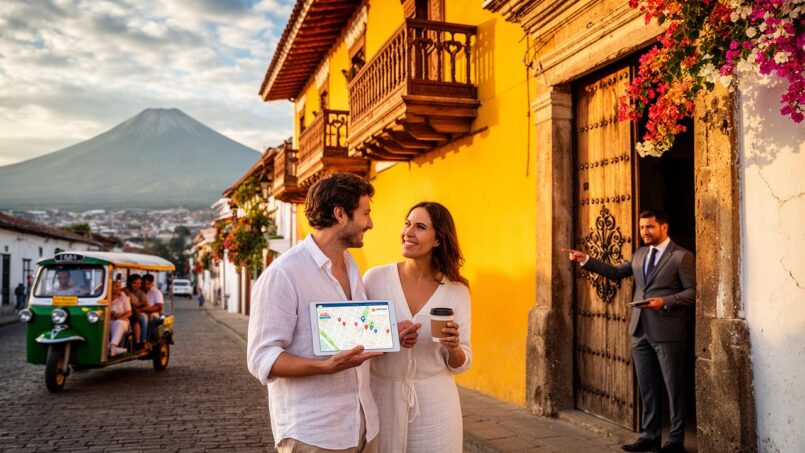
For French people who dream more of colonial charm, cobblestone streets, and cafés than glass towers, Antigua is the absolute gem. The market there is considered the most solid in the country, with historical price appreciation of about 5% to 8% per year in recent years, and no real slowdown in sight. The scarcity of colonial buildings, strict architectural preservation rules, and the rise of international tourism are pushing prices up.
Rental yields in Antigua are attractive for a world-famous heritage site. In short-term rental, a well-managed property generates about $78 per night with a 54% occupancy rate, giving annual revenue close to $15,000 before expenses. The best properties near the central park command significantly higher daily rates, with occupancy reaching up to 98% in high season (Holy Week, Christmas).
On Lake Atitlán, the most active markets are Panajachel and San Marcos la Laguna, with other premium pockets like Santa Catarina Palopó and Santa Cruz la Laguna for waterfront properties. Gross yields around the lake are among the highest in the country, often between 7% and 10%, with measured peaks at 8.4% in some segments. All this in a context of booming eco-tourism and loyal international clientele.
Why Are Yields So High?
Several factors explain these levels of profitability rarely seen in Europe:
– Acquisition prices are still modest compared to neighboring markets;
– Light property tax (low IUSI property tax, mainly local source taxation);
– Accelerated development of short-term rentals (Airbnb, etc.), but without general saturation – there were about 5,900 active short-term rental listings nationwide, with annual growth of around 8%;
– Growing demand from remote workers and digital nomads, especially in Antigua and on Lake Atitlán;
– Tourist flows increasing by 7% to 9% per year.
Where to Invest: Overview of Key Areas
Guatemala is not a homogeneous market: location is crucial. For a French investor, it is useful to distinguish three broad market families.
Guatemala City: Economic Hub and Long-Term Yield
In the capital, the country’s economic and administrative heart, the most sought-after areas for rental investments are Zones 10, 14, 15, and 16. They offer mainly modern condos, high-end apartments, and gated residences. Prices roughly range from $1,500 to over $3,000 per square meter, with entry-level condos around $120,000 to $300,000.
The dominant strategy here relies on long-term rental, which is more stable and less management-intensive than short-term rental. Typical gross yields range between 8% and 10% in the best cases, with controlled vacancy.
Two areas deserve special attention:
A look at two promising areas for rental investment, combining yield and appreciation potential.
Gentrifying neighborhood popular with young professionals, creatives, and co-working spaces. Gross yields of 7–9%, with appreciation driven by urban transformation.
On the edge of the upscale Ciudad Cayalá district, these micro-areas are seeing new real estate projects. Appreciation potential as infrastructure consolidates.
Antigua: The High-End Classic
Antigua attracts for three reasons: its colonial heritage, its tourism power, and a solid expat community, including a growing share of remote workers. The city combines high rental yields, especially in short-term rental, with long-term appreciation potential, particularly on colonial buildings.
Prices are logically higher than in Guatemala City for equivalent properties, with a premium of about 20–30% on comparable houses. A small 70 m² house trades around $125,000, but upscale villas in the historic heart easily exceed $750,000. The typical range of available properties spans from $196,000 to over $650,000.
Antigua’s market is structured around three types of opportunities:
Discover three categories of properties suited to different investor profiles: prestigious colonial houses, high-performance rental residences, and pre-construction projects.
Located in the historic center, these ‘trophy’ properties combine prestige and short-term rental profitability.
In areas like Jocotenango or Santa Lucía, they offer a better risk/return ratio for rental performance.
On growth corridors (El Hato, Highway 14), they offer low entry prices and staggered payments over 12–18 months.
Lake Atitlán, Quetzaltenango, Pacific Coast: The ‘Follower’ Markets
Beyond the capital and Antigua, several areas are considered emerging:
– Panajachel and San Marcos la Laguna (Lake Atitlán): Very active in terms of transactions, these localities combine high rental yields and strong lifestyle potential. Panajachel is a tourist hub, San Marcos is more wellness- and retreat-oriented.
– Quetzaltenango (Xela): The country’s second city, dynamic in student and middle-class segments. Price per square meter is lower (about $700 to $1,800/m²), with slower but steady appreciation.
– Pacific coast (Monterrico, Puerto San José): Developing vacation markets, benefiting from weekend tourism from the capital and growing interest in beach projects. Prices remain relatively contained ($900 to $2,500/m² depending on location), with appreciation prospects linked to infrastructure improvements and rising eco-tourism.
– Río Dulce: River area with access to the Caribbean Sea, worth watching for marina and nautical potential.
These markets offer entry prices often 25–40% lower than heritage hubs, with a potential catch-up trajectory as infrastructure and international visibility improve.
A Legal Framework Open to Foreigners
Legally, Guatemala takes a very welcoming approach to international investors. Foreigners, whether individuals or legal entities, can acquire most types of real estate (houses, apartments, urban lots, commercial buildings) with rights equivalent to those of citizens.
There is no foreign ownership quota, no minimum investment threshold, and no residency requirement to buy. A simple passport and a local tax ID number (NIT), relatively easy to obtain, are sufficient to appear on the land registry.
The Guatemalan Constitution prohibits direct foreign ownership in reserve areas (borders, coasts, strategic lake shores). To get around this, a structure via a local company is possible. However, in Guatemala City, Antigua, or most of Lake Atitlán, these restrictions generally do not apply to French investors.
No “golden visa” type scheme is tied to real estate purchase: buying a property does not automatically grant residency. Residency paths go through other channels (retirees, rentiers, investors…), but they coexist without interfering with property rights.
Taxation: A Generally Favorable Environment
For a French person, taxation is always a sensitive point. The Guatemalan tax architecture is based on a key principle: strict territoriality. Only Guatemalan-source income is taxable. Income earned abroad (salaries, dividends, rents outside the country, foreign pensions) is not taxed in Guatemala, even for a local tax resident.
For a local rental investment, several elements come into play:
Rental income tax applies a rate of about 10% on 70% of gross rent (i.e., ~7% of gross). Capital gains on real estate are taxed at a flat 10%. Property tax (IUSI) is low: 0.3% to 0.6% of cadastral value. Transfer taxes amount to 5–9% of the purchase price (excluding 12% VAT on new builds).
Overall, the combination of high rental yields, modest property taxes, and contained source taxation gives a yield/tax ratio that is hard to match in developed countries.
Financing: Possible, but Often Secondary for a French Investor
In theory, several Guatemalan banks lend to foreigners for real estate purchases. In practice, for a non-resident with no local banking history, access to credit remains complicated and requirements are high.
The loan-to-value ratio for foreigners is generally limited to 60–70%, requiring a minimum down payment of 30–40%.
For a French investor with borrowing capacity in France, it is often more relevant to use credit from their home country or alternative financing (e.g., a mortgage on a French property, a bullet loan, or a Lombard loan) at often more competitive rates, then buy in Guatemala with cash. Many international investors choose this approach: financing in the home country, buying “cash” abroad, and possibly refinancing locally later.
Other financing options include:
– Developer financing: common on new builds and pre-sales, with installment payment plans (20–40% down, balance spread over 3–5 years) and rates around 8–12%.
– Seller financing: fairly common, especially in the high-end segment, with negotiable terms (30–50% down, 1–5 year term).
For a French non-resident, these solutions can be interesting for speeding up a purchase, but the core strategy remains to view Guatemala as a high-yield investment market, rather than a cheap financing market.
Holding Cost Structure: What You Really Need to Plan For
Listings often highlight attractive gross yields. To assess the economic reality of an investment, you need to factor in all expenses. For a foreign owner, a realistic ballpark is that about 25% of gross rent will be consumed by:
List of main costs associated with managing a rental property
8–12% of rent for a professional manager; higher for short-term rental
Often $50–$300 per month, i.e., $600–$3,600 per year
Routine costs to keep the property in good condition
Generally 0.3–0.7% of property value per year for a multi-risk policy; more in seismic or volcanic zones
Property taxes and tax obligations on rental income
Factoring these in, a gross yield of 8–9% easily translates into a net yield of around 5% for a well-managed property, which remains very solid compared to French or European standards.
Winning Strategies for a French Investor in 2026
For a French investor, the question is not just whether Guatemala is attractive, but how to go about it pragmatically. Based on 2026 data, several major strategies emerge.
1. Urban Condos for Defensive Yield
Target apartments in Zones 10, 14, 15, or 16 of Guatemala City, oriented toward long-term rental, is the most ‘institutional’ option: solid yields, low vacancy, structural demand from middle classes, expats, businesses, and business travelers.
To succeed, be selective: choose well-managed buildings with security, good connections to business hubs, and units (studio, one or two bedrooms) suited to dominant rental demand.
2. Antigua: Between Tourist Yield and Heritage Capital Gains
For those seeking both attractive rental yield and an asset with strong heritage value, Antigua remains the number one target. A well-placed house or apartment can be operated as a short-term rental, generating annual gross income of around $13,000–$15,000, or even more in the high-end segment.
About 25–30% of foreign buyer inquiries are now attributed to remote workers.
3. Lake Atitlán and Emerging Markets: Betting on Catch-Up
For a more opportunistic profile, anticipating a price catch-up, the markets of Lake Atitlán (Panajachel, San Marcos, certain premium shorelines), Quetzaltenango, or the Pacific coast offer a good compromise between low entry prices and growth potential.
Gross yields are often above 7–8%, but demand is more seasonal and management can be more complex, especially for short-term rental. These areas are suited to investors who can build a strong local team (management, maintenance, tax) and are willing to accept more volatility in exchange for greater appreciation potential.
Should You Fear a Market Reversal?
Forecasts for 2026 show a rather favorable scenario, but without excessive optimism. Prices should generally move between stability and +5% nominal over one year, with a non-negligible probability of another mini-surge (up to +5–10% in some prime urban corridors if rates fall and infrastructure projects advance).
A significant price decline seems unlikely in the short term, in the absence of a credit crisis, speculative bubble, or demand collapse. The market is generally balanced, or even slightly favorable to buyers across most segments, except for very high-end properties in Zones 10 and 14 where supply scarcity maintains a seller’s market.
For a French investor thinking in five- or ten-year terms, the equation is clear: this is an emerging market, with more potential volatility than in France, but a high probability of significant cumulative capital gains, in addition to high rental yields. All in a country where the currency is stable and real estate taxation is moderate.
In Summary: Why Guatemala Deserves a Place in a French Portfolio
Bringing together the key elements, Guatemala checks many boxes that international real estate investors are looking for in 2026:
Guatemala offers a unique combination of advantages for real estate investors: competitive prices, solid yields, economic stability, and an exceptional lifestyle.
Prices still far below those of Costa Rica or Panama, for comparable or even superior quality of life, heritage, and landscapes.
Gross rental yields averaging 7.5%, with peaks of 8–10% in the best neighborhoods of Guatemala City or around Lake Atitlán.
Remarkably stable currency limiting exchange-rate risk for euro-based investors, in a growing economy driven by the diaspora, middle class, and tourism.
Legal framework open to foreigners without quotas or residency requirements, and reasonable property taxation on rents, capital gains, and holding.
Modern urban real estate with high yields, colonial heritage in Antigua, tourist markets on Lake Atitlán or the Pacific coast, and secondary cities like Quetzaltenango.
It is neither a risk-free El Dorado nor a fully transparent mature market. Information remains segmented, practices can vary greatly from one region to another, and investment success depends heavily on the ability to identify the right locations, negotiate properly (final sale prices average 7% below asking price), and surround yourself with competent professionals (lawyer, notary, manager).
For a French investor willing to accept administrative complexity and target the medium to long term, real estate in Guatemala offers yield, geographic diversification, and appreciation potential, with performance often exceeding the 3% net seen in European or North American metropolitan areas.
A wealth project or a question? Contact us now to speak with a wealth management expert.
Disclaimer: The information provided on this website is for informational purposes only and does not constitute financial, legal, or professional advice. We encourage you to consult qualified experts before making any investment, real estate, or expatriation decisions. Although we strive to maintain up-to-date and accurate information, we do not guarantee the completeness, accuracy, or timeliness of the proposed content. As investment and expatriation involve risks, we disclaim any liability for potential losses or damages arising from the use of this site. Your use of this site confirms your acceptance of these terms and your understanding of the associated risks.

Cyril Jarnias is an independent expert in international wealth management with over 20 years of experience. As an expatriate himself, he is dedicated to helping individuals and business leaders build, protect, and pass on their wealth with complete peace of mind.
On his website, cyriljarnias.com, he shares his expertise on international real estate, offshore company formation, and expatriation.
Thanks to his expertise, he offers sound advice to optimize his clients' wealth management. Cyril Jarnias is also recognized for his appearances in many prestigious media outlets such as BFM Business, les Français de l’étranger, Le Figaro, Les Echos, and Mieux vivre votre argent, where he shares his knowledge and know-how in wealth management.





