
 Published on and written by Cyril Jarnias
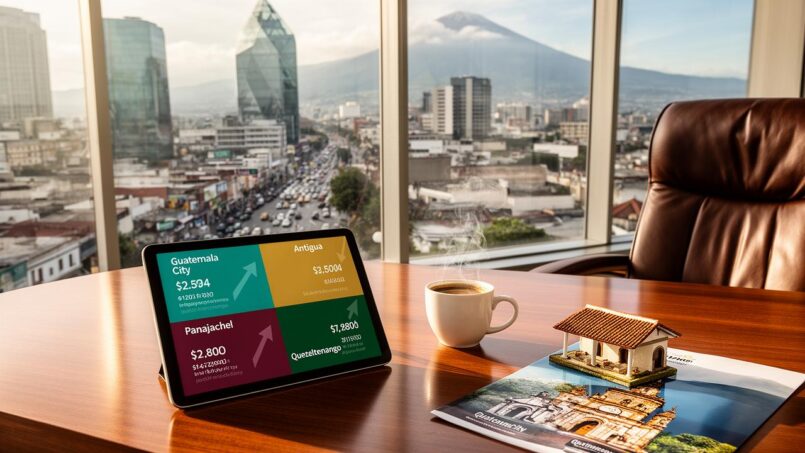
The Guatemalan real estate market is experiencing a phase of sustained growth, but one that is very uneven across different cities. Between Guatemala City, the ultra-urban economic capital; Antigua, the colonial showcase popular with expats; Panajachel on the shores of Lake Atitlán; and Quetzaltenango, a more affordable highland city, price and yield gaps are substantial. For a foreign buyer or investor, understanding these differences has become essential.
In 2026, prices are rising steadily in Guatemala thanks to the economy, remittances, and tourism. However, the country remains significantly cheaper than Costa Rica or Panama, still offering excellent value for money.
A rising national market, still competitive
At the national level, the trend is clear: residential values are gradually but steadily increasing. Available statistics for 2024 and 2025 show an average increase of around 5% in 2024, followed by momentum of about 3 to 7% per year in major cities and tourist destinations. Independent forecasts – notably from Statista – even predict annual growth of around 6% between 2025 and 2029, representing a cumulative increase of nearly 30% over five years.
The median home price in Guatemala is approximately 1.6 million quetzales, or about $209,000 or €190,000, while the average price reaches 2.15 million quetzales, or $281,000, a 35% gap due to high-end properties.
In terms of floor area, the median price per square meter nationwide is close to Q14,000, or around $1,830 or €1,665 per m². The average rises to Q16,500, about $2,155, pulled upward by luxury apartments and exceptional villas.
In 2026, about 80% of properties sell between Q900,000 and Q3.6 million ($117,000 to $470,000). Entry-level options fall between Q550,000 and Q850,000 ($72,000 to $111,000), allowing the purchase of a small older apartment of 55 to 70 m² in areas like zones 11 or 12 in Guatemala City.
At the other end of the scale, the luxury segment is broad: between Q6 and Q20 million, roughly $783,000 to $2.6 million, for 250-350 m² penthouses in zones 14 or 15 of the capital, or architect-designed homes in the best neighborhoods of Antigua or on the shores of Lake Atitlán.
Negotiation is still possible: on average, sales close around 7% below the asking price, with flexibility varying by segment and time on the market.
Guatemala City: the driving market and most expensive in the country
As the political capital and economic heart of the country, Guatemala City concentrates both the highest prices and the greatest market depth. In 2026, for a “typical” home of 90 to 110 m², the average price is around Q1.25 million, or about $163,000. The average price per square meter stands at Q10,700, approximately $1,400 or €1,280, but this figure masks significant disparities between areas.
The most recent data also give a median price per m² in the capital around Q14,500 (about $1,890 or €1,605) and an average near Q16,500 ($2,150). In practice, the most sought-after central neighborhoods far exceed these levels, while peripheral areas remain well below.
Very wide price ranges
To cover approximately 80% of purchases made in Guatemala City in 2026, a budget between Q600,000 and Q2.5 million, or about $78,000 to $325,000, is required. Two- to three-bedroom family homes typically trade between Q1.15 million and Q2.7 million ($150,000 to $350,000), while large four-bedroom residences easily range from Q2.3 to Q5.4 million ($300,000 to $700,000), or even more in the city’s wealthiest enclaves.
The maximum price for the most exclusive six-bedroom-plus properties in Guatemala City.
For new homes, the premium is real: expect on average 15% more per m² than for a comparable older property. In gated suburbs, a new house typically costs between Q1.54 and Q3.5 million ($200,000 to $450,000). Premium developments in zone 16 – Cayalá or San Isidro – instead range from Q3.5 to Q6.9 million ($450,000 to $900,000).
Premium zones: 10, 14, 15, 16
The geography of prices in Guatemala City is very marked. Zones 10, 14, 15, and 16, located in the southern corridor of the capital, concentrate most of the high-end market.
In these neighborhoods, the price per square meter commonly ranges between Q14,000 and Q22,000, or roughly $1,800 to $2,800. Some luxury projects in zone 14 even exceed Q25,000 per m². In dollar terms, one is often looking at between $1,800 and $2,500 per square meter, with entry prices around $120,000 to $300,000 for mid-sized condos.
The premium zones break down as follows:
| Zone of Guatemala City | Dominant property type | Typical price per m² (USD) | Typical total budget (USD) |
|---|---|---|---|
| Zone 10 / 14 | Luxury condos, modern towers, penthouses | 1,800 – 2,500+ | 250,000 – 500,000+ |
| Zone 15 / 16 | Mid/high-end apartments, houses | 1,200 – 1,800 | 150,000 – 250,000 |
| Zones 9 / 13 | Entry/mid-range buildings | 900 – 1,200 | 100,000 – 150,000 |
Zones 10 (Zona Viva, Oakland), 14 (Las Américas, La Villa), and 16 (Ciudad Cayalá) are also where analysts anticipate the strongest growth in coming years, with forecasts of 5 to 7% per year, or even higher if major infrastructure projects (metro, modernization of La Aurora Airport) materialize smoothly.
Affordable zones and suburbs
At the other end of the spectrum, budget-conscious households turn to areas like zones 17 and 18, Mixco (San Cristóbal, Bosques de San Nicolás) or Villa Nueva. Purchase prices there are significantly lower than in the southern corridor, for both apartments and land.
In the metropolitan fringe, a building lot costs a few hundred dollars per m², compared to thousands in zone 14. Large houses with gardens there are worth between Q1.9 and Q4.6 million ($250,000 to $600,000), i.e., 2 to 3 times less than in Cayalá or La Villa.
Rental yield and price dynamics
Guatemala City is also the main rental market in the country, which interests investors. In the center and nearby residential areas, the rental price per m² is typically between Q65 and Q75 per month ($8.5 to $10), with extremes from Q55 to Q85 depending on the neighborhood. Furnished apartments command a premium of about 35%, particularly appreciated by expats and executives.
The average monthly rent for a two-bedroom apartment ranges from $850 to $980 depending on size and location.
This rental demand supports prices. Between early 2025 and early 2026, residential values in Guatemala City rose by about 5% nominally, or 1 to 2% in real terms after inflation. The consensus among analysts for 2026 points to another increase of 4 to 7% over the year, with a central estimate around 5.5%. The most cautious scenarios foresee short-term stagnation; the most optimistic see growth potentially reaching 8% in premium neighborhoods.
For now, data do not show a generalized bubble: over ten years, the cumulative nominal increase is around 55%, but once inflation is deducted, the real increase does not exceed 7%. In other words, fundamentals – urbanization, remittances from abroad, the rise of the middle class – have driven the market more than pure speculation.
Located about forty kilometers from the capital, Antigua has become the country’s most iconic market for foreign buyers. A UNESCO World Heritage Site, surrounded by three volcanoes and crisscrossed by cobblestone streets, the city combines a picture-postcard setting, a rich cultural life, and a strong presence of expats, retirees, and remote workers.
This appeal comes at a price. Prices per square meter in Antigua are on average higher than in Guatemala City, especially for restored colonial houses in the historic center. 2026 data indicate an average price per m² between $2,000 and $4,500, with peaks well beyond for the most high-end properties.
A highly polarized market
Antigua’s market structure can be summarized in three main price levels:
| Sector of Antigua | Dominant property type | Price per m² (USD) | Typical budget (USD) |
|---|---|---|---|
| Historic center (Casco Urbano) | Restored colonial houses | 2,000 – 3,000+ | 400,000 – 1,000,000+ |
| Near suburbs | Modern houses/apartments, condos, small villas | 1,500 – 2,000 | 250,000 – 500,000 |
| Surrounding villages / gated communities | Condominium houses, villas in subdivisions | 1,000 – 1,500 | 200,000 – 350,000 |
In quetzals, available studies for early 2026 indicate a median house price in Antigua around Q3.2 million (about $420,000) and an average price close to Q5 million ($650,000). Again, the gap between median and average is explained by the weight of the luxury segment: large renovated colonial homes or villas in the most prestigious condominios easily exceed Q7.7 million ($1 million) and can climb to Q11.5 million ($1.5 million) or more.
Price levels by house size
In 2026, the ranges observed for Antigua houses are structured as follows:
Price range in quetzales (Q) and dollars ($) according to number of bedrooms, up to 6+ bedrooms in the luxury segment.
From Q1.7 to Q2.9 million ($220,000 to $380,000)
From Q2.1 to Q4 million ($280,000 to $520,000)
From Q3.5 to Q8.1 million ($450,000 to $1.05 million)
From Q5 to Q11.5 million ($650,000 to $1.5 million)
From Q5.8 to Q13.8 million and up ($750,000 to $1.8 million and up) — luxury segment
For a minimum budget of about Q920,000 to Q1.4 million ($120,000 to $180,000), it is possible to find a “livable” house in Antigua, but these will almost always be properties away from the historic core, in the crown of villages like Ciudad Vieja, San Pedro Las Huertas, Jocotenango, or Alotenango. In this crown, family homes are mostly positioned between Q1.4 and Q3.4 million ($180,000 to $450,000).
Purchase, rental, and yield
Antigua is both a residential destination and a thriving short-term rental market. Demand for short-term rentals – especially through platforms like Airbnb – is increasing, driven by international travelers and by Guatemalans from the capital on weekend getaways.
Available estimates suggest gross rental yields can reach 6 to 10% per year for well-located properties, especially in the Casco Urbano and in areas highly sought after by expats. Renovated colonial properties with an interior courtyard, parking, and finishes suitable for high-end rentals frequently exceed $600,000 and justify these prices through their occupancy rates and ability to capture the most expensive nights of the year (Holy Week, year-end holidays, peak tourist season).
On the long-term rental side, a furnished one-bedroom apartment in central Antigua typically rents for $500 to $800 per month. In the near suburbs (Jocotenango, San Pedro Las Huertas), furnished units can be found between $300 and $500. A restored, furnished three-bedroom colonial house easily goes for $1,000 to $1,800 monthly, and large prestige homes reach $2,000 to $4,000 in rent.
Investment value
Appreciation figures confirm Antigua’s status as the “champion” of real estate investment in Guatemala. Available studies report an annual value increase of around 5 to 8% in recent years, with forecasts of 6 to 8% per year over the next five years. The combination of limited stock (strict heritage protections), affluent local demand (second homes, retirement), and a growing flow of foreigners creates an environment of scarcity that strongly supports prices.
Strong long-term capital appreciation and high rents, for furnished long-term or tourist rentals.
Panajachel and Lake Atitlán: spectacular views, still varied prices
Another major hub of the Guatemalan real estate market, the Lake Atitlán region, with Panajachel as its main gateway, attracts a unique mix of long-term travelers, international retirees, digital nomads, and investors seeking rental income. The lake is now the second most visited destination in the country.
Real estate market around the lake
The Lake Atitlán market is highly fragmented, with strong price differences between villages and depending on direct proximity to the water. Overall, the following can be noted:
Villas and houses with lake views or waterfront are priced between about $1,200 and $3,500 per m² in Guatemala.
Around Panajachel, recent listings include, for example, a small property with several wooden houses in the Jucanyá area for $700,000, lakefront lots in Santa Cruz La Laguna for around $615,000, or spectacular plots facing the volcanoes exceeding $1 million.
Panajachel: the most structured base
Panajachel stands out from other lake villages due to its accessibility (good road, bus station, hospital in Sololá), the presence of banks, supermarkets, pharmacies, and a wide range of accommodations. Logically, it also offers the most varied price range for both purchase and rental.
For long-term rentals, a studio or one-bedroom apartment in Panajachel typically rents for $350 to $550 per month. A two-bedroom goes for $450 to $880, while an entire house ranges more from $600 to $1,500 depending on size, view, and proximity to the lake.
Panajachel’s micro-neighborhoods have different dynamics:
| Sector of Panajachel | Dominant atmosphere | Furnished 1BR rent (USD/month) | Access to lake |
|---|---|---|---|
| Calle Santander | Tourist heart, shops, nightlife | 400 – 800 | 5 min walk |
| Calle del Lago | Lakeside, partial/full views | 500 – 1,100 | nearly direct |
| Jucanyá | Residential, quiet, more affordable | 250 – 500 | 10 min walk |
| Patanatic | Hillside, panoramic views | 350 – 700 (houses) | 15–25 min walk |
| El Tzanjuyú | Quiet residential area | 300 – 600 | approx. 10 min |
The very high-end segment – waterfront villas with private dock, large terraces, garden, and services – can easily reach $1,500 to $2,500 per month in rent, targeting both affluent residents and short-term vacation rentals.
Yields and outlook
In terms of rental investment, Panajachel has a mid-sized but dynamic short-term rental market: nearly 400 active listings, supply growth of over 50% in one year, an average nightly rate around $100, and an average annual income of about $11,000 per property, with an occupancy rate of around 32%.
In the best locations around the lake, gross rental yields can reach 8% or more, the high end of the national range.
In terms of appreciation, projections point to price increases of 3 to 7% per year for the region, with higher potential (7 to 9% per year) over ten years in the most sought-after micro-locations, given the scarcity of lakeside land, environmental restrictions, and tourism growth.
Quetzaltenango: an affordable highland city
Compared to the premium markets of Guatemala City, Antigua, and the lake region, Quetzaltenango – often called Xela – stands out as a much more affordable urban alternative. As the country’s second-largest city, a regional university and commercial center, it mainly attracts a local market, which has tempered price increases.
Purchase price levels
2026 data shows a market significantly cheaper than the capital. The average price per square meter for analyzed listings is around $1,280, with a median near $1,323. In the city center, some reports even mention an average price around $725 per m², making it one of the most accessible urban markets in the country.
For different property types, the usual ranges are as follows:
| Property type in Quetzaltenango | Indicative size | Total price (USD) | Price per m² (USD) |
|---|---|---|---|
| Small apartment | 50 – 70 m² | $35,000 – $70,000 | $600 – $1,000 |
| Standard house | ~120 m² | $60,000 – $120,000 | $500 – $1,000 |
| Modern condo | 80 – 120 m² | $70,000 – $150,000 | $875 – $1,250 |
| Large house with garden | >150 m² | $100,000 – $200,000 | $700 – $1,200 |
| Building lot (suburban) | — | — | $80 – $250 / m² |
Land in Quetzaltenango remains particularly cheap compared to Guatemala City: where a building lot in a peripheral zone of the capital often exceeds $850 per m², equivalent land around Xela can be found for $80 to $150 per m². Construction costs there are also estimated about 10% lower than in the capital, making self-building or custom development particularly attractive.
Rental market and cost of living
On the rental market, rents in Quetzaltenango remain moderate. A one-bedroom apartment in the center rents for around $215 per month, with basic options starting at $120–$130. In the periphery, a one-bedroom can climb higher in some reports, but overall it remains far below rents observed in Guatemala City or Antigua.
A single person spends on average $1,100 per month, including housing, reflecting the moderate cost of living.
This combination of low purchase prices, reduced construction costs, and a reasonable standard of living places Quetzaltenango in the category of “secondary cities” where analysts forecast moderate but steady price increases, around 4 to 6% per year over the next five years.
Overall comparison: who pays what, and for which profile?
For a foreign buyer or wealthy Guatemalan, the choice between Guatemala City, Antigua, Panajachel, and Quetzaltenango is primarily a trade-off between lifestyle, budget, and investment strategy.
To summarize the average price per square meter levels in 2026:
| City / Region | Price range per m² (USD) | Market profile |
|---|---|---|
| Guatemala City (overall) | ~$1,400 (average), $1,830 – $2,150 (national median/average) | Capital, strong local & expat demand |
| Guatemala City Z10–16 | $1,800 – $3,000+ | Premium corridor, modern condos, high security |
| Antigua | $2,000 – $4,500+ | Colonial city, strong tourist & expat demand |
| Panajachel / Lake | $1,200 – $3,500 | Lakeside villas, resort market |
| Quetzaltenango | $700 – $1,800 | Highland city, largely local market |
The closer one gets to historic centers and iconic views (Antigua’s colonial core, Atitlán’s lakefront, luxurious towers in zone 14 of Guatemala City), the more the price per m² soars, sometimes well above $3,000 or $4,000. Conversely, non-tourist urban neighborhoods of Guatemala City, Antigua’s outskirts, and Quetzaltenango’s residential areas retain prices that are still accessible by regional standards.
In terms of overall budget:
Price ranges for purchasing real estate in Guatemala, from entry-level to luxury
Small apartment or modest house in Quetzaltenango, entry-level condo in affordable zones of Guatemala City, or villages around Antigua.
Comfortable house on the outskirts of Antigua, villa with lake view (non-waterfront) or well-located apartment in zones 9, 13, 15 of Guatemala City.
Large colonial house near Parque Central in Antigua, penthouse or corner apartment in zone 14 towers, lakeside villa with private dock.
Prestige properties in Antigua, lakeside estates, large residences in Cayalá or golf clubs around the capital.
Yields and outlook over five to ten years
The central question for an investor remains the same: where is the relationship between entry price, potential rents, and capital appreciation potential most attractive?
Projections for the next five years indicate:
– Antigua: annual appreciation of 6 to 8%;
– premium zones of Guatemala City: 5 to 7% per year;
– Lake Atitlán region: 7 to 9% per year, with higher volatility depending on the village;
– secondary cities like Quetzaltenango: 4 to 6% per year.
On the rental side, the best gross yields are found in two segments: short-term rentals in tourist destinations (Antigua, Panajachel, and some Atitlán villages) and well-located apartments in Guatemala City’s premium corridors, rented to expat or business clientele. In Panajachel, for example, the best properties can generate an annual yield of around 8% or more, while in Antigua, some colonial houses optimized for tourist rental also achieve high ratios.
Conversely, cities like Quetzaltenango offer moderate but stable profitability, with lower rents but also very contained acquisition prices, which can suit a long-term, cautious holding approach.
Conclusion: a diversified market, still under regional radar
Taken as a whole, the 2026 Guatemalan real estate market presents a rare combination in Central America: prices still lower than better-known destinations like Costa Rica or Panama, steady value growth without obvious speculative overheating, and a diversity of sub-markets capable of meeting very different profiles.
Guatemala City acts as the engine, particularly through its southern corridor (zones 10, 14, 15, 16) where demand for secure, business-proximate housing is densifying construction. Antigua, the colonial jewel, sees its prices driven by architectural scarcity and international demand. Lake Atitlán (Panajachel) offers accessible landscape luxury, but the best positions are increasingly rare. Quetzaltenango represents an affordable urban alternative, with discreet growth potential supported by local dynamics.
For a savvy buyer or investor, the key is to choose your side: aim for high appreciation and yields in premium markets, at the cost of a significant entry ticket, or favor secondary cities like Quetzaltenango where the upfront capital is lower and competitive pressure is weaker. In any case, the 2026 figures show a country still in a catch-up phase, where the medium-term appreciation potential remains significant for those who can select the right location and negotiate based on market data, rather than surface impressions.
A wealth project or a question? Contact us now to speak with a wealth management expert.
Disclaimer: The information provided on this website is for informational purposes only and does not constitute financial, legal, or professional advice. We encourage you to consult qualified experts before making any investment, real estate, or expatriation decisions. Although we strive to maintain up-to-date and accurate information, we do not guarantee the completeness, accuracy, or timeliness of the proposed content. As investment and expatriation involve risks, we disclaim any liability for potential losses or damages arising from the use of this site. Your use of this site confirms your acceptance of these terms and your understanding of the associated risks.

Cyril Jarnias is an independent expert in international wealth management with over 20 years of experience. As an expatriate himself, he is dedicated to helping individuals and business leaders build, protect, and pass on their wealth with complete peace of mind.
On his website, cyriljarnias.com, he shares his expertise on international real estate, offshore company formation, and expatriation.
Thanks to his expertise, he offers sound advice to optimize his clients' wealth management. Cyril Jarnias is also recognized for his appearances in many prestigious media outlets such as BFM Business, les Français de l’étranger, Le Figaro, Les Echos, and Mieux vivre votre argent, where he shares his knowledge and know-how in wealth management.





