
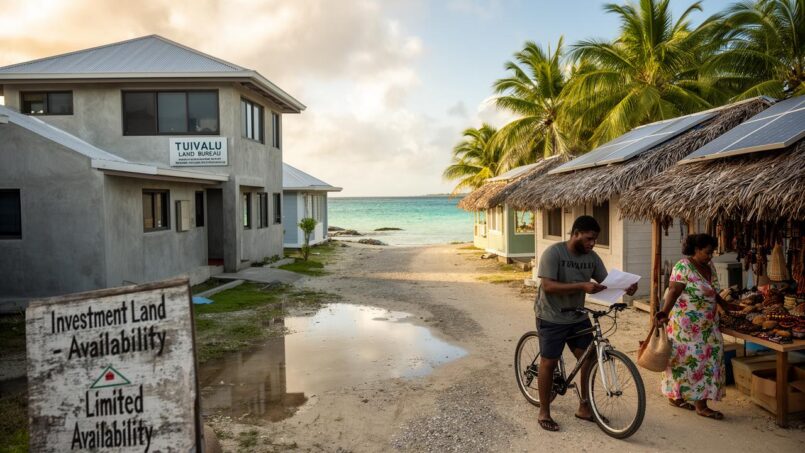
 Published on and written by Cyril Jarnias
Tuvalu, a micro‑state lost in the middle of the Pacific with barely 11,000 inhabitants and only 26 km² of above‑water land, is nothing like a “traditional real estate market.” Here, every real estate project runs up against three inseparable realities: demographic pressure on ultra‑scarce land, a customary system that almost completely locks out foreign property ownership, and an existential climate threat that forces a rethinking of housing and even… the country’s geography.
In 2026, the real estate market in Tuvalu is less about rising prices than about survival in a fragile ecosystem. Land is central, and any investment strategy rests on climate resilience, precise legal structuring, and community anchoring.
A tiny market under climate pressure
The starting point is unforgiving: Tuvalu rests on nine very low‑lying coral atolls, with an average elevation of less than 2 meters. The country’s highest point, on the island of Niulakita, reaches about 4.6 meters. In this setting, sea‑level rise is no abstraction.
Sea level at Funafuti, Tuvalu, is rising by 3.9 mm per year, nearly double the global average.
The consequences are already visible in the daily lives of Tuvaluans. Spring tides combined with storms regularly flood the lowest‑lying areas, including Funafuti’s airport. Seawater seeps up through the porous coral substrate, forming pools at every high tide. The coastline is retreating, low‑lying islets have already been swallowed, and culturally significant sites – ancestral graves, places of worship, gathering spaces – have been eroded away.
Climate models predict an increase in extreme heat days, intense rainfall, and flooding, with more than 100 flood days per year by the end of the century, worsening freshwater lens salinization, coastal fish decline, and water‑borne diseases.
For a real estate investor, this means the first question isn’t “how much is this land worth?” but “will this land still be livable, or even visible, in 20, 30, or 50 years?”
A modest economy, but boosted by public investment
On the macroeconomic level, Tuvalu is a very modest‑income state. GDP is around 50 to 65 million US dollars, or a GDP per capita of about $6,300. After the Covid shock between 2020 and 2022, growth resumed, driven by large externally funded projects and public spending.
Recent figures give an idea of the trajectory:
| Macroeconomic indicator | Recent / forecast value |
|---|---|
| Real growth 2023 | ≈ 4% |
| Real growth 2024 | ≈ 3.1% |
| Forecast 2025 | 2.5–3.0% depending on source |
| Forecast 2026 | 2.6–2.7% |
| Inflation 2025 (forecast) | ≈ 2–2.5% |
| Estimated GDP 2025 | ≈ $53.7 million |
Beneath this growth, the economic structure remains extremely vulnerable. Fishing license revenues – the main budget driver – are volatile and depend on both tuna stocks (themselves affected by El Niño and climate) and negotiations with major fishing powers. Official development aid, income from the Tuvalu Trust Fund, and revenues from the .tv domain name complete a picture where the domestic private sector remains embryonic.
Approximately $11.2 million is allocated to infrastructure in 2025‑2026, including housing, roads, and climate projects.
This context directly shapes the real estate market: the bulk of major construction projects is public or quasi‑public, often related to coastal adaptation, social housing, water, or energy. The private sector, especially foreign, only intervenes at the margins, on small‑scale operations.
A customary land system locked to foreigners
Legally, Tuvalu stands out with a mix of British common law and local legislation, against a backdrop of very powerful customary law. The 1986 Constitution recognizes the right to property, but specifies that land is governed by specific rules and that the state retains broad regulatory power.
In practice, the vast majority of land falls under custom. It is held collectively by extended families or communities, and its transfer follows traditional rules codified in the Lands Code and the Land and Title Act. The logic is communal: land is not simply a marketable asset, but an element of identity and spirituality passed down through generations.
For a foreign investor, freehold ownership of land is, in practice, inaccessible.
Typology of land rights
The land landscape breaks down into several categories:
– customary land, the heart of the system, held by families and governed by usage;
– “alienated” or statutory land, much rarer, falling under a more modern legal framework;
– land held by the state for public infrastructure, but which the state itself actually leases from customary owners;
– the public coastal domain, governed by the Foreshore and Land Reclamation Act, which attributes ownership of the upper beach and seabed to the Crown.
On the islands of Nanumea, Nukufetau, or Funafuti, the sale of certain lands or agricultural pits is prohibited; only exchange or lease is permitted unless the Lands Court agrees. Land gained from the sea (accretion) reverts to the owner of the original land, while new formations without adjacent private land belong to the government.
This complex system is already a headache for Tuvaluans themselves. Successive deaths, inter‑island marriages, and hereditary fragmentation have multiplied micro‑plots with multiple co‑owners. Often, the head of the family – usually the oldest man – is registered as the “owner,” but all members retain use rights. Formal land registers are incomplete, and the Lands Court regularly has to settle disputes to clarify who can do what on a given plot.
For a foreigner, attempting to buy land in this context is simply not possible under the current legal framework.
Land lease: the only entry point for foreign investors
Without access to freehold ownership, non‑citizen investors must turn to a single avenue: long‑term leasing. Tuvaluan law does allow leases granted to foreigners, but within a very regulated framework.
The key principles are clear:
In Tuvalu, land remains the exclusive property of citizens or the state. Foreigners can obtain a right of enjoyment through a lease, generally intended for specific uses such as commerce, agriculture, tourism, staff housing, or private infrastructure. The duration of these leases ranges from 30 to 99 years, offering stability without conferring a perpetual right.
In practice, negotiation takes place directly with customary owners, sometimes with support from the Falekaupule (traditional council). When a plot has many right‑holders, everyone must be convinced and signed up, or a decision from the Lands Court obtained to validate the agreement. This mediation work is both legal and cultural.
Once an agreement is reached, the lease must be:
To be valid, a land title must be approved by the Ministry of Justice or the Ministry of Lands and Natural Resources, officially registered with the Lands and Survey Department, and comply with the Land and Title Act and foreign investment regulations.
The processing time can vary from a few weeks to several months, depending on the complexity of the file, the location, and the sensitivity of the project.
In practice, these leases mainly concern Funafuti, the capital, which concentrates about 6,000 inhabitants, the airport, the port, ministries, and the national bank. It is the only atoll where an investor can hope for a minimum of flow and visibility. The other islands – less populated, poorly connected, with rudimentary infrastructure – remain essentially subsistence spaces, where private commercial projects are extremely rare.
A legal framework in flux: building codes and coastal adaptation
As the climate threat becomes more precise, the regulatory arsenal is strengthening. A very concrete example for the real estate sector is the update of the Tuvalu National Building Code in 2024. This text, backed by the Building Act 2019, was revised to incorporate new flood‑hazard maps derived from LiDAR surveys and analyses carried out under the Tuvalu Coastal Adaptation Project (TCAP) and the Pacific Community (SPC).
A key section, dedicated to minimum floor levels, was modified to account for:
Potential water heights during a storm with a return period of about 200 years, combined with expected sea‑level rise in coming decades, determine long‑term coastal flood risks.
The goal is simple: prevent new buildings, whether homes, schools, or public buildings, from being flooded a few decades after completion. Concretely, this means raising houses, designing foundations according to wave dynamics, and strengthening the resistance of structures to cyclones and salt corrosion.
For an investor, this has several implications:
From the design stage, any serious real estate project must comply with strict standards for height, structural strength, and materials. Construction costs are 30 to 50% higher than regional prices due to the importation of suitable materials. Authorities, through the Building Code Assessment Unit, review plans with increased resilience requirements.
International donors are supporting this regulatory upgrade. In 2023, the World Bank granted Tuvalu $11.5 million as part of a climate resilience and disaster management program, part of which is dedicated to improving building standards and risk assessment.
TCAP and L‑TAP: when adaptation becomes a national real estate project
Beyond the codes, Tuvalu has launched two major initiatives that directly impact real estate thinking: the Tuvalu Coastal Adaptation Project (TCAP) and the Long‑Term Adaptation Plan, known as “Te Lafiga o Tuvalu”.
The TCAP project is funded to the tune of nearly $39 million, including $36 million from the Green Climate Fund.
A few orders of magnitude illustrate the scale of this undertaking:
| Key component of TCAP | Estimate / target |
|---|---|
| Total project cost | ≈ $38.9 million |
| Length of coastline protected | 2,780 m (about 10% of vulnerable coasts) |
| Raised land created | ≈ 7.3 hectares |
| Directly benefiting population | ≈ 3,100 people |
| Indirectly benefiting population | ≈ 3,500 people |
| Share of population covered | ≈ 60–62% |
At the same time, the long‑term plan L‑TAP pushes the logic further: it envisions creating about 3.6 km² of raised land, a significant area for a country that has only 26 km². The idea is to gradually, until beyond 2100, concentrate the population of the different atolls in secure zones of the capital, with:
– raised residential neighborhoods,
– water and sanitation networks designed for the future climate,
– 100% renewable energy infrastructure,
– public facilities (hospitals, schools, administrative buildings),
– commercial and service spaces.
To protect Tuvalu’s land, the only sustainable solution is to “build more land and build it higher.”
Minister of Finance
For investors, these public projects redraw the map of “investable” areas. In the short term, they limit private land opportunities – most of the raised surfaces are earmarked for national needs. But in the medium term, they could open the door to targeted public‑private partnerships in housing, local services, or supporting infrastructure (renewable energy, desalination, water storage, logistics, etc.).
A narrow residential market, significant rents, few transactions
Measuring the size of the Tuvaluan real estate market is almost a statistical fine‑tuning exercise, as data is scarce. A few recently compiled indicators nevertheless give an idea of price and rent levels, though they should be handled with caution given the small sample sizes.
Based on about a dozen observations, the following orders of magnitude are suggested:
| Real estate indicator (order of magnitude) | Indicative value |
|---|---|
| Monthly rent 1‑bedroom city center (Funafuti) | ≈ €275–300 |
| Monthly rent 1‑bedroom outside center | ≈ €193–200 |
| Monthly rent 3‑bedroom outside center | ≈ €300–380 |
| Purchase price per m² in central zone | ≈ €1,000–1,400 |
| Purchase price per m² in peripheral zone | ≈ €200–950 |
| Gross rental yield outside center | ≈ 20% (very indicative value) |
| Mortgage interest rate (20 years, local) | ≈ 5–11% depending on source |
It must be stressed: these figures do not reflect a “deep” market like in large cities. There are virtually no formal real estate agencies, no large‑scale classified ad platforms, and the rare transactions are done privately, within the community, often among relatives or through informal networks.
Nearly all rental values concern Funafuti. On the other islands, the monetized rental market is virtually absent: housing is family‑based, the economy is subsistence‑oriented, and the monetization of housing remains marginal.
Under these conditions, the very notion of “land appreciation” must be relativized. In the medium term, most of the value for an investor lies in the operational income stream (rents, revenue from a tourism or service activity) rather than in the hope of reselling at a higher price. Liquidity risk is maximal: the number of potential buyers for a commercial lease in Tuvalu is extremely small.
Legal limits and specific risks for investors
Beyond the constraints on property access, an investor must factor in several layers of risk.
On the legal front, the customary tenure system leads to:
– sometimes poorly documented titles, or even ones non‑existent in modern registers;
– multiple claims on the same plot;
– an almost systematic need to involve the Lands Court to secure agreements when disputes arise;
– a strong reliance on customary mediation processes, which can be lengthy and sensitive.
Few specialized lawyers, slow administration, and limited capacity to enforce court decisions; the Foreign Direct Investment Act and the facilitation body mainly target economic sectors (fisheries, SMEs, renewable energy), not real estate.
On the financial side, the lack of a developed mortgage market, the near‑absence of bank cards, the lack of ATMs, and the weakness of financial services complicate conventional project financing. Most operations must be funded through equity or partnerships with development institutions. Construction costs are high and strained by logistics: monthly cargo supply, limited storage capacity, dependence on a few suppliers.
The low‑lying Pacific islands, including Tuvalu, could become difficult to inhabit between 2060 and 2070 under high‑emission scenarios.
Any savvy investor will therefore need to include climate‑specific force majeure clauses in their contracts, design “sacrificable” or easily repairable structures, and accept the possibility of a shortened time horizon.
What reasonable opportunities by 2026?
In this very constrained context, it would be misleading to present Tuvalu as a new real estate Eldorado. However, for investor profiles capable of combining long‑term vision, high risk tolerance, impact logic, and close partnership with communities, certain niches exist.
Accommodation and resilient micro‑tourism
With only about 3,100 annual visitors, tourism remains marginal. Nevertheless, Funafuti attracts some travelers seeking extreme destinations or on professional missions (NGOs, donors, technical experts). Small accommodation structures – guesthouses, small climate‑compatible lodges – can find a place, provided they:
– are based on a long lease on stable land, ideally in or near areas that will benefit from TCAP raises or future projects;
– design raised, naturally ventilated buildings with an efficient thermal envelope and materials resistant to salt corrosion;
– aim for energy self‑sufficiency (solar + storage) and water self‑sufficiency (rainwater collection and storage) to limit vulnerability to public networks.
The estimated potential annual return for well‑managed micro‑structures ranges from 5% to 10%, with a payback period of 7 to 10 years and a high level of risk.
“Autonomous” infrastructure linked to water and energy
Tuvalu has set ambitious targets for energy: 100% renewable electricity by 2030, an 80% reduction in energy sector emissions compared to 2014 by 2035. Projects already funded by the World Bank and the Asian Development Bank include the installation of an additional 2 MW of photovoltaic capacity and storage, covering about 90% of Funafuti’s renewable energy needs.
On the outer islands, several mini‑solar grids are already operational, but some are out of service due to a lack of maintenance and suitable batteries. The question of the sustainability of island energy systems therefore remains open.
For an investor, avenues exist in partnership with the government or communities:
– supply, operation, or maintenance of mini‑solar grids for specific neighborhoods or facilities;
– solar systems coupled with storage and smart management units for mixed‑use buildings (housing + offices + services);
– solutions combining energy, water (desalination or filtration), and connectivity (satellite, fiber) in a service package for public or semi‑public operators.
Available estimates suggest that well‑calibrated solar projects can generate returns in the 8–15% range with a return on investment in 5 to 7 years, provided that subsidies or concessional financing are obtained to reduce the initial cost.
Targeted rental housing and partnerships with the development bank
The government has allocated about $1 million to the Development Bank of Tuvalu to tackle the rental housing deficit and improve access to financing for women and youth. This opens a window for co‑financing or guarantee schemes for small rental housing programs in Funafuti, for example:
Overview of the different housing categories offered
Housing for active civil servants.
Accommodation for engineers, technicians, and NGO staff.
Housing solution for families relocated during adaptation works.
In this case, the logic is less speculative than service‑oriented: the investor brings capital, design and management expertise; the state or public bank secures demand (long leases, partial rent subsidies, potential grants).
Support services for adaptation: engineering, materials, prefabricated
The scale of TCAP, L‑TAP, and related programs (water projects, evacuation centers, reinforcement of public buildings) implies a massive need for technical expertise and operational solutions:
– design of flood‑resistant structures, incorporating new minimum floor levels;
– prefabricated modules manufactured in Fiji or Australia, adapted for sea transport and local assembly;
– coatings and modular systems for dykes and coastal defenses (for example, using prefabricated Seabee blocks for protection walls).
For an investor oriented toward “solutions,” positioning oneself as a supplier or technical partner for these programs can be a way to enter the real estate ecosystem without directly bearing the land risk.
Investing in Tuvalu in 2026: success factors and blind spots
Any real estate investment reflection for Tuvalu in 2026 must incorporate a series of prerequisites and safeguards.
It is essential to:
To invest in Tuvalu, you must commit for the long term (horizon of at least 10 years) by giving up quick liquidity, accept a return based on cash flow without speculating on land capital, work with a local lawyer specialized in Tuvaluan land law, establish real partnerships with the community through joint ventures or profit‑sharing, and integrate climate justice by ensuring the investment strengthens residents’ resilience without opportunistic land grabbing.
It is equally crucial to calibrate substantial financial reserves:
Plan for a cash reserve covering 12 to 18 months of operating expenses to cope with cyclones, logistical disruptions, or pandemics. Set aside an annual maintenance reserve of 10 to 15% of the infrastructure value due to the aggressive environment (salt, humidity, heat). Finally, stock a buffer of key supplies for 3 to 6 months to reduce dependence on supply ships.
Finally, project governance must be thought through in advance: specific clauses in case of major natural disaster, parametric insurance mechanisms if available, alignment with national plans (Te Kete, Te Vaka Fenua, NAP, NDC 3.0) to maximize chances of accessing climate co‑financing.
In 2026, talking about a “real estate market” in Tuvalu means accepting to step away from usual patterns. There is no speculative boom, no great liquidity, no metropolitan dynamic. Instead, there is an entire country engaged in a radical experiment: inventing an urbanism of survival on threatened atolls, while refusing – at least as far as possible – the option of mass exile.
In this open‑air laboratory, real estate is no longer just another sector: it becomes the concrete arena where adaptation plays out, house by house, dyke by dyke, islet by islet. For an investor, the only tenable course of action is to position oneself not as a hunter of quick returns, but as a resilience partner, accepting all legal, ecological, and cultural constraints.
Climate adaptation investor
The outlook for 2026 is therefore not that of an Eldorado, but of an ultra‑niche, demanding, and high‑risk market, where every project must convince the land‑owning families, the authorities, international donors… and the sea itself. In such a context, the best investment strategy is not to circumvent legal limits, but to understand them deeply in order to co‑build, with Tuvaluans, safe havens worth far more than the sum of their square meters.
A portfolio project or a question? Contact us now to speak with a wealth management expert.
Disclaimer: The information provided on this website is for informational purposes only and does not constitute financial, legal, or professional advice. We encourage you to consult qualified experts before making any investment, real estate, or expatriation decisions. Although we strive to maintain up-to-date and accurate information, we do not guarantee the completeness, accuracy, or timeliness of the proposed content. As investment and expatriation involve risks, we disclaim any liability for potential losses or damages arising from the use of this site. Your use of this site confirms your acceptance of these terms and your understanding of the associated risks.

Cyril Jarnias is an independent expert in international wealth management with over 20 years of experience. As an expatriate himself, he is dedicated to helping individuals and business leaders build, protect, and pass on their wealth with complete peace of mind.
On his website, cyriljarnias.com, he shares his expertise on international real estate, offshore company formation, and expatriation.
Thanks to his expertise, he offers sound advice to optimize his clients' wealth management. Cyril Jarnias is also recognized for his appearances in many prestigious media outlets such as BFM Business, les Français de l’étranger, Le Figaro, Les Echos, and Mieux vivre votre argent, where he shares his knowledge and know-how in wealth management.





