
 Published on and written by Cyril Jarnias
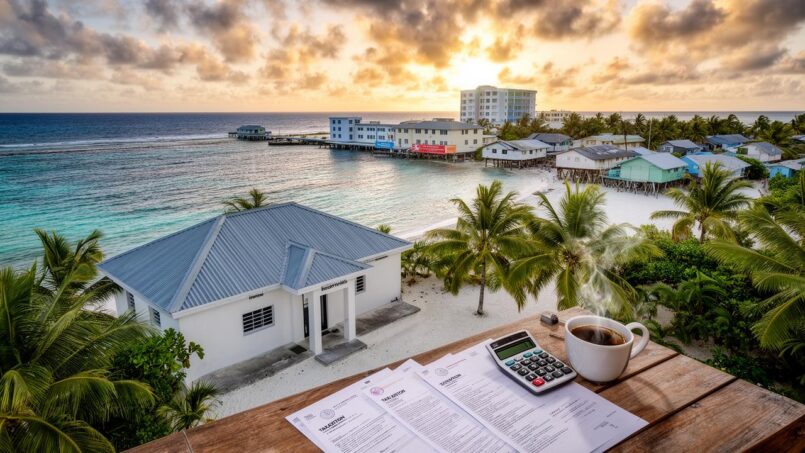
Tuvalu intrigues on two fronts for anyone interested in property taxation. On one hand, this Pacific micro-state has no classic property tax: no annual levy is due simply for owning a house or land. On the other hand, nearly all of its land is both extremely scarce, culturally sacred, and physically threatened by rising sea levels.
Investing in real estate in Tuvalu involves a unique customary land tenure system, a very limited tax framework, and a risk of regular flooding by the end of the century due to climate change, setting it apart from tax optimization projects in Europe or classic tourist resorts.
A Tiny Country, Land Measured by the Centimeter
Tuvalu is one of the smallest countries in the world: about 26 km² of land spread over nine atolls. The average elevation barely exceeds 2 meters, with a highest point around 4.6 meters. In other words, every square meter of soil is both precious and vulnerable.
The majority of homes and infrastructure sit on narrow strips of coastal land. Funafuti, the capital, is home to more than half of the country’s 11,000 inhabitants, exacerbating overpopulation, land scarcity, real estate pressure, and direct exposure to storms and storm surges.
This setup makes “property ownership” something very different from what we know in industrialized countries: land is limited, inherited, shared among clans, and simultaneously threatened by coastal erosion and soil salinization. This directly impacts how the state chooses—or not—to tax it.
A State Without Property Tax: What This Means in Practice
Consistent sources indicate that Tuvalu does not have a generalized property tax system. No annual “property tax” is owed by owners on the value of their land or buildings constructed on it.
Several features stand out:
In practice, there is no recurring tax on the value of land or buildings. This absence is linked to the predominance of customary land tenure, which covers the majority of land. Although some general texts theoretically mention the possibility of taxes on real estate or local “rates,” owners do not receive an annual tax bill for their house or land.
For a foreign investor accustomed to property tax rate tables by state in the United States (where an effective rate of 1% or 2% of the property’s value is common), Tuvalu sits at the opposite extreme: the recurring cost of simply holding real estate is zero. Taxation is focused elsewhere.
When the Absence of Property Tax Becomes an Attractiveness Argument
The lack of a property tax is often presented as an asset for real estate investment: holding commercial or residential buildings does not trigger a specific annual tax burden, which is all the more striking when compared to jurisdictions like:
| Jurisdiction (International Examples) | Approximate Effective Property Tax Rate on Property Value |
|---|---|
| New Jersey (USA) | 2.23% |
| Texas (USA) | 1.58% |
| California (USA) | 0.71% |
| Hawaii (USA) | 0.27% (lowest in the USA) |
| Tuvalu | 0% (no generalized property tax) |
In U.S. states where median-priced homes incur several thousand dollars in annual tax, the implicit savings in Tuvalu are obvious. But this purely numerical comparison would be misleading if we forget two crucial elements: the nature of property rights and the physical vulnerability of the land.
The Key to the System: Customary Ownership and the Role of Families
It is impossible to understand property taxation in Tuvalu without first looking at its land tenure system.
Most land is held under a customary ownership regime. Land belongs to extended families (kaitasi) or clans, and usage rights are defined by kinship relationships, decisions of elders, and traditional customs. Modern legislation—the Constitution, Native Lands Act, Tuvalu Lands Code, and Land and Title Act—recognizes this reality and regulates it.
Some key points:
Land is generally held collectively, not individually. The outright sale of customary land to a foreigner is prohibited. Even the state does not own land as private property; it leases it from traditional owners for public infrastructure. Foreigners can only acquire leasehold rights for 30 to 99 years, without full land ownership.
In this context, introducing a classic property tax, based on a detailed and individualized cadastre, would amount to taxing usage rights that are often intertwined, shared among many beneficiaries, and defined by complex customary rules. The administrative and political cost of such a tax would be colossal for a state with limited capacity.
A Patchwork of Norms: Modern Laws and Ancestral Lands
Property law in Tuvalu combines several sources:
The Constitution governs property rights and expropriation for public interest, with fair compensation. The Native Lands Act and the Tuvalu Lands Code codify customary practices such as inheritance sharing and land gifts for services. The Land and Title Act organizes land registration and rights protection. Finally, the Falekaupule Act authorizes local authorities to levy property charges for community development.
The coexistence of customary rules and written codes is evident even in the details: on some islands, the sale of land or taro pits for money is outright prohibited, with exchanges or leases preferred. Decisions by the Lands Court—a specialized jurisdiction—complement these texts by settling many boundary, inheritance, or customary adoption disputes.
For an investor, this means that access to land first requires social negotiation before becoming a legal matter and, eventually, a tax matter.
Local Property Tax: A Possibility More Than a Reality
The Falekaupule Act authorizes the Kaupule, with the approval of traditional assemblies, to institute local contributions to fund community services and projects. The text provides for several forms of “rates“:
– a community development tax per head (poll tax type);
– a possible tax on the value of real estate (land and buildings);
– a tax on the value of movable possessions.
Structured property tax revenue is non-existent at the island level, with income coming primarily from national taxes and fees.
In other words, the legal toolbox allows for taxing property at the local level, but nothing indicates that a complete cadastre and a uniform property tax are actually in place today.
Real Estate Taxation in Practice: Where the Levies Are
The absence of a “property tax” does not mean that real estate escapes all taxation in Tuvalu. The main tax channels pass through income, transactions, and certain administrative fees.
Tax on Rental Income and Real Estate Gains
Tuvalu applies an income tax governed by the Income Tax Act (CAP 26.16). The following rules are crucial for a landlord:
– rents are expressly considered taxable income and, for non-residents, as a category of income subject to withholding tax;
– the personal income tax schedule is progressive, with a marginal rate potentially reaching 30% for residents;
– companies, including those holding real estate, are generally taxed at 30% of net profit (reduced from 40%);
– non-residents and foreign companies are taxed at a flat rate of 40% on their Tuvalu-source income.
Real estate capital gains are not subject to a specific autonomous tax. Two streams of information exist in the documents:
According to the texts, Tuvalu does not have an autonomous capital gains tax system: capital gains could be integrated into total income if the transaction falls under an activity akin to a “business.” Another source indicates that profits from real estate sales could be taxed as capital gains under specific conditions.
What is certain is that the Income Tax Act defines the concept of “business” broadly: any purchase of assets with a view to resale for profit can fall into the scope of business income. For a real estate developer carrying out multiple transactions, resale margins are highly likely to be taxed as business profits at the corporate rate of 30%.
Fees and Costs Related to Leases and Transfers
While there is no recurring property tax, there are transaction and registration fees:
– fees for registering titles and leases in the Land Title Register;
– fees associated with the assignment of leasehold rights;
– various administrative fees from the Lands Court, the relevant ministry (Lands and Natural Resources, Justice), or the Tuvalu Investment Authority.
These fees are not documented in a detailed public schedule in available sources, but guides for foreign investors estimate that
Official sources
| Type of Cost Related to a Real Estate Project | Indicative Range (USD) |
|---|---|
| Legal fees & documentation | 5,000 – 15,000 |
| Company/business registration | 1,000 – 5,000 |
| Construction / renovation | 50,000 – 500,000+ |
These amounts are not strictly taxes but unavoidable entry costs for structuring a project. They add to income taxes and, where applicable, VAT.
VAT and Consumption Taxes: The Other Pillar of Taxation
To fund its expenditures, Tuvalu relies on a combination of indirect taxes:
– a value-added tax or consumption tax (often referred to as VAT or Tuvalu Consumption Tax – TCT), at a standard rate of approximately 15% on most goods and services;
– a reduced rate of 5% for certain basic goods (food, medicine), while education and healthcare are exempt;
– high excise duties on goods like alcohol and tobacco;
– customs duties on most imports, essential in a country where nearly everything used for construction (cement, steel, equipment) arrives by ship.
For a real estate investor, this means that the tax burden is concentrated upstream on materials, construction services, and operations, rather than on land ownership. The total cost of a project is therefore heavily influenced by these indirect taxes.
Land, Culture, and Rights: The Issue of Succession and Disputes
Property taxation cannot be separated from the mechanisms of inheritance and conflict resolution, especially in a country where land is the foundation of symbolic and economic wealth.
Inheritance, Gender, and Parcel Fragmentation
The Tuvalu Lands Code details inheritance rules that, on several islands, favor: the transmission of family lands to members of the maternal lineage.
– the eldest son, who receives a larger share;
– in the absence of a son, the eldest daughter;
– divisions that account for multiple unions (multiple wives) and kinship ties.
This logic can lead to progressive fragmentation of parcels, as land is subdivided among many heirs. In a tiny territory, this multiplication of micro-parcels owned by a multitude of co-owners severely complicates management.
– securing titles;
– negotiating commercial leases;
– implementing a possible property tax based on a clearly identified per-parcel value.
Provisions also exist to protect the right to subsistence: the Lands Court can ease the power of an owner who prevents their descendants from earning a minimum income from family land.
Disputes and the Role of the Courts
The presence of many bodies shows how frequent land disputes are:
– Island Courts and Lands Courts handle disputes over boundaries, succession, customary adoption, and fishing rights associated with land;
– a Lands Courts Appeal Panel hears appeals;
– these decisions can then be contested before the Magistrates Court, and finally, as a last resort, before the High Court of Tuvalu.
Informal mechanisms, however, remain very present: elders, clan chiefs, and customary mediators are often consulted before a case moves into the modern judicial system. For a real estate project, tax stability also depends on the legal security of the underlying land rights.
Real Estate Facing Climate Change: An Asset Under Pressure
If Tuvalu stands out for the absence of property tax, it is also at the forefront of countries threatened by rising sea levels.
Alarming Projections for Inhabited Land
Several studies, cited in the documents, converge:
– sea level rise at Funafuti is approximately 3.9 mm per year, double the global average, and even higher over a longer period;
– estimates suggest that around mid-century, half of the capital could be regularly flooded during the highest tides;
– by 2100, some projections point to more than 90% of the national territory being regularly submerged or severely impacted by waves and storms.
In this context, each house, each buildable plot is potentially exposed to:
– temporary submersion by waves and storm surges;
– accelerated coastal erosion;
– progressive salinization of soils and freshwater lenses, making land less productive and threatening traditional crops (pulaka, taro, coconut palms).
Atoll Resilience and Uncertainties
A 2018 study by the University of Auckland highlighted a more complex dynamic: between 1971 and 2014, Tuvalu’s total land area actually increased by about 73.5 hectares, or nearly 3%, thanks to the input of sediments and coral debris redistributed by storms.
Eight atolls out of nine and about three-quarters of the islets gained area, while one atoll and about 27% of islets decreased. This morphological resilience suggests that some atolls can, at least temporarily, keep pace with sea level rise.
But the risks remain major:
– there is no guarantee that reef growth rates (estimated at around 2 mm/year in some areas) will continue to offset accelerated sea level rise;
– massive coral bleaching observed at Funafuti (up to 80% of corals affected during some El Niño events) compromises the reefs’ ability to regenerate;
– the most violent storms can instead strip the thin soil layer from islets, rendering land temporarily uninhabitable.
For a landowner, these factors translate into systemic physical risk: the future value of land is not just a matter of market or taxation, but of habitability.
Adaptation: When Public Investment Also Protects Land Value
Aware of these threats, the Tuvaluan government has engaged in coastal protection projects, the most emblematic being the Tuvalu Coastal Adaptation Project (TCAP), launched with support from the United Nations Development Programme and funded to the tune of US$36 million by the Green Climate Fund, plus a national contribution.
This project includes:
– construction of “hard” coastal defenses (dikes, rock revetments) and “soft” ones (replenished beaches, vegetation) on three inhabited islands, including Funafuti;
– in Funafuti, a land reclamation project to create new protected land, extending an already reclaimed area near Queen Elizabeth Park.
These investments have no direct fiscal purpose, but they constitute, de facto, an in-kind subsidy to the value of existing and future properties: houses protected by a public dike or land reclaimed from the sea have a market and use value that taxpayers do not pay for through a property tax.
One can read an implicit policy choice: fund coastal protection through external resources (climate funds, fishing license fees, etc.) rather than through a direct tax on landowners.
Public Finances Driven by the Sea… But Not by Land
Tuvalu’s budget reveals how much the state relies on resources other than property taxation:
Out of a total budget of about AUD 100 million, revenues are split between tax and non-tax contributions.
Modest share, mainly including income tax, consumption taxes, and import duties, with no significant property tax.
Constitutes the bulk: sale of fishing licenses, .tv domain leasing, dividends from state-owned enterprises, maritime fees, and external budget support.
A table drawn from budget data illustrates the composition of revenues in an aggregated scenario:
| Main Revenue Source (Example) | Approximate Amount (AUD) | Relative Weight |
|---|---|---|
| Fishing licenses | ≈ $39 M | very high |
| Taxation (all taxes combined) | ≈ $12.7 M | moderate |
| Commercial contracts | ≈ $10.9 M | significant |
| Interest / dividends / rents | ≈ $4.1 M | secondary |
| Other government income | ≈ $1.8 M | marginal |
| Budget support from partners | ≈ $24.5 M | major |
In this model, implementing a generalized property tax would be a heavy reform for a likely limited budgetary gain, given:
– the small size of the built stock;
– the difficulties of valuation and collection;
– the country’s heavy reliance on exogenous revenues (marine resources, international agreements).
Investing in Real Estate in Tuvalu: Tax Opportunities, Structural Risks
For an investor or potential owner, the question is not just “will I pay a property tax?” but rather: “What is the overall regime—land, tax, environmental—that I am subject to?”
Attractive Points
From a strictly fiscal standpoint, several elements may seem favorable:
In the Seychelles, there is no recurring property tax or autonomous capital gains tax. Nominal income tax rates are 30% for residents and companies. Exemptions or reliefs are possible on a case-by-case basis, especially for tourism or strategic projects, and development agencies can benefit from full exemptions on interest, dividends, or loan repayments.
Less Obvious but Major Risks
In return, several specific risks weigh on any real estate project:
Acquiring full ownership is impossible for a foreigner; only long-term leases with the consent of rightful owners and the state are possible. Land disputes are frequent, the limited public budget reliant on external aid risks fiscal instability, and the extreme climate risk (sea level rise, flooding, infrastructure degradation) can sharply reduce property values.
On this last point, Tuvalu’s property taxation can almost be read as a sign: a country that knows large parts of its territory are threatened has little interest in building a heavy property tax system based on long-term valuations.
Tuvalu’s Choice: Tax the Land or Defend the Land?
For now, the Tuvalu government has made a clear choice: focus its efforts on resilience and defending the territory, rather than on introducing a sophisticated property tax.
The stated priorities are:
– strengthening infrastructure against flooding and erosion;
– securing the country’s international status, even if its lands were to disappear, notably by amending the Constitution to affirm the continuity of the state despite possible submersion;
– negotiating agreements with countries like Australia to provide residency solutions for Tuvaluans displaced by climate change, while preserving an identity and a “virtual nation.”
The main issue is not knowing at what rate to tax the value of the land, but knowing how long the land will remain habitable.
Unknown author
Nevertheless, the tax question could resurface:
– if budgetary pressure increased due to more frequent climate disasters;
– if massive land reclamation projects created new, high-value buildable surfaces;
– if the densification of Funafuti required finer regulation of land use and financing urban services (water, sanitation, waste management) through a dedicated land levy.
Tuvalu is a nearly unique case of a country without property tax, where land is at the heart of culture, politics, and the fight against climate change.
—
In summary, property taxation in Tuvalu is less about what is taxed—there is no generalized property tax—than about what is protected and what is made possible through a set of customary rules and budgetary choices. For Tuvaluans, land remains primarily an ancestral good, both a foundation of identity and the front line of a climate battle whose outcome will determine, far more than any tax rate, the future of all forms of real estate in the country.
A wealth planning project or a question? Contact us now to speak with a wealth management expert.
Disclaimer: The information provided on this website is for informational purposes only and does not constitute financial, legal, or professional advice. We encourage you to consult qualified experts before making any investment, real estate, or expatriation decisions. Although we strive to maintain up-to-date and accurate information, we do not guarantee the completeness, accuracy, or timeliness of the proposed content. As investment and expatriation involve risks, we disclaim any liability for potential losses or damages arising from the use of this site. Your use of this site confirms your acceptance of these terms and your understanding of the associated risks.

Cyril Jarnias is an independent expert in international wealth management with over 20 years of experience. As an expatriate himself, he is dedicated to helping individuals and business leaders build, protect, and pass on their wealth with complete peace of mind.
On his website, cyriljarnias.com, he shares his expertise on international real estate, offshore company formation, and expatriation.
Thanks to his expertise, he offers sound advice to optimize his clients' wealth management. Cyril Jarnias is also recognized for his appearances in many prestigious media outlets such as BFM Business, les Français de l’étranger, Le Figaro, Les Echos, and Mieux vivre votre argent, where he shares his knowledge and know-how in wealth management.





