
 Published on and written by Cyril Jarnias
At first glance, the real estate market in Tuvalu resembles a permanent paradox. On barely 26 km² of land, squeezed between a rising ocean and a culture deeply attached to every patch of soil, the classic rules of real estate crumble. Here, the value of a plot is measured as much in square meters as in symbolic depth, customary rights, climate vulnerability, and the ability… to stay above water in the decades to come.
This article explores a tiny but strategic market, influenced by customary land law, sea-level rise, land reclamation projects, and new regional mobility that risks emptying the islands of their inhabitants.
A real estate market shaped by geography and climate threat
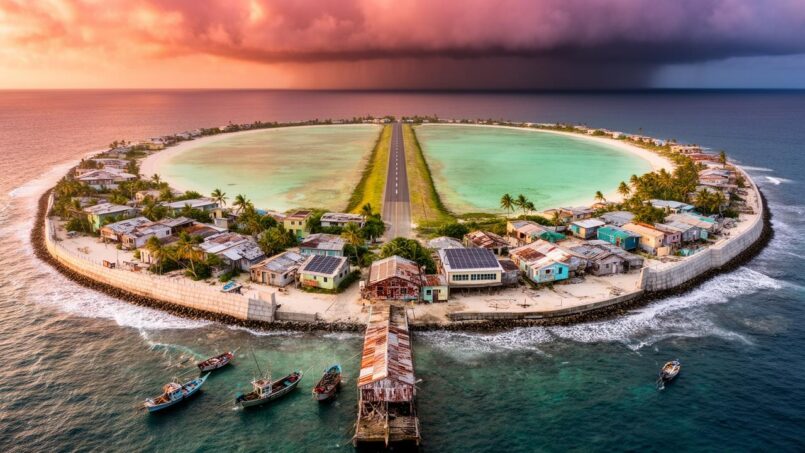
Tuvalu is an archipelago of six atolls and three reef islands, totaling about 26 km² of land, spread over nearly 710 km² of reef platforms. The capital, Funafuti, is an atoll whose main island, Fogafale, barely exceeds 400 meters wide at its widest point. Across the country, the majority of the population lives less than one meter above sea level.
An extreme topography that redefines the notion of land
The average elevation of Tuvalu is around 1.8 meters, with a highest point on Niulakita ranging between 4.6 and 6.5 meters. In Funafuti, the average elevation of the built-up area relative to spring tides is about 0.5 meters. On Fongafale, 46% of the central built-up area is already below the level reached by the highest tides.
The entire population lives less than one kilometer from the coast.
The sea-level rise measured at Funafuti is approximately 3.9 mm per year, roughly double the global average. Over 30 years, that already represents about fifteen centimeters, with median projections around 20 to 40 cm of rise over the century, potentially rendering the archipelago practically uninhabitable. Added to this are more intense cyclones, storm surges, accelerated coastal erosion, flooding from “king tides,” and saltwater intrusion into aquifers.
For an investor, owner, or household, the question is no longer just “where to buy” but “will this land still be habitable in 30 or 50 years?”.
A tiny… and shifting land supply
Paradoxically, some studies have shown that the islets of Tuvalu have, overall, slightly gained in area (about +73.5 hectares, or +2.9% over four decades), due to sediment shifts on the reefs. About 74% of islets have thus increased in size, while 27% have lost area. But this “gain” does not mean creation of habitable land: it involves additions of sand or reef materials, highly exposed to waves and submersion.
The country “is not expanding” and has not gained truly habitable land. The shoreline shifts, but the truly livable area is retreating under the combined pressure of erosion, saltwater intrusion into aquifers, and increased frequency of flooding.
Former Prime Minister Enele Sopoaga
In Funafuti, projections based on IPCC sea-level rise scenarios are stark: about 50% of Fongafale would be regularly flooded by tides by 2050, and up to 95% of the area could be submerged at high tide by the end of the century in the absence of massive action. The consequence for real estate is clear: land scarcity is not just about surface area, but about “still viable surface area.”
A customary land system that locks down conventional ownership
Beyond geography, the real estate market in Tuvalu is primarily determined by a deeply customary land tenure system. As in many Pacific island states, the vast majority of land is called “customary” and belongs to family lineages.
The traditional land logic is often described by the term kaitasi, literally “eating the same land.” Anyone who lives on a plot, cultivates it, or draws sustenance from its resources acquires rights equivalent to those of other family group members.
Concretely, this means that:
– several co-owners share the same piece of land,
– no major decision (leasing, change of use, construction project) can be made without everyone’s agreement,
– the land is not sold: it is passed down, lent, leased, or exchanged, but does not leave the group’s patrimony.
The customary land system worked better with a smaller population. Today, with over 11,000 inhabitants, especially concentrated in Funafuti and half without direct genealogical ties, inter-island marriages and internal migration have multiplied competing rights, fragmented plots, and complicated decision-making structures.
Result: many micro-plots have a large number of owners, which increases legal uncertainty and slows or blocks certain projects. In consultations conducted across the nine islands, land conflicts have indeed been identified as a major concern.
A state that regulates without owning
Legally, Tuvalu blends customary law, law derived from British common law, and a series of specific laws:
The Fijian Constitution recognizes private property but subjects land use to state control. The *Land and Title Act* governs registration, transfers, and protection of land rights. The *Native Lands Act* and its regulations govern the management of customary lands and leases. Finally, the *Trust Land Act* administers lands held in trust for public or community purposes.
Notably: the government itself is, in practice, a tenant on many lands it uses for public infrastructure (airport, administrative buildings…) and signs leases with customary owners, notably at an indicative rate of about 3,000 AUD per acre per year for the 2015‑2019 period.
Strategic decisions (long‑term leases, infrastructure projects, foreign investments) typically go through several levels: island land courts, Ministry of Justice, Ministry of Lands and Natural Resources, and the Minister of Finance when tax incentives are involved. But in the background, land sovereignty remains in the hands of families and clans.
A near-lock on foreign ownership
In this context, the room for maneuver for foreign investors is very narrow. From a strictly legal standpoint, the answer to the question “can a foreigner buy property in Tuvalu?” is almost no.
Prohibition of direct ownership, central role of the lease
The key principles are as follows:
– non-citizens cannot hold freehold title to customary land,
– companies not 100% owned by Tuvaluans cannot directly own land,
– since nearly all land is customary, the range of “free” plots is extremely limited.
However, it is possible for a foreigner, or a foreign company, to obtain usage rights through leases. Several regimes coexist:
There are three main types of leases in Tuvalu: so-called ‘native’ leases limited to 21 years and 5 acres for residential or agricultural use (generally between Tuvaluans); common law leases that can go up to 99 years for certain residential or commercial projects; and specific leases for foreign-capital enterprises, often capped at 25 years, notably for tourism or service projects.
Any creation of a lease involves a formalized process: plan preparation, validation by the island land court, review by the minister to ensure that conditions do not disadvantage any party nor contravene regulations. Rents are in principle subject to review every five years, with possible arbitration by a specialized panel in case of disagreement.
Highly regulated investment offerings
For the rare potential investors, the most realistic path goes through:
Three legal structures adapted to local contexts, combining customary partnership, parcel securing, and state involvement for projects of national interest.
Partnerships with local partners holding customary rights, ensuring a legitimate and shared foundation.
Medium- or long-term leases on clearly identified plots, with substantial preliminary work to secure family agreements.
Arrangements with the state or parastatal entities for infrastructure or projects of national interest (sustainable tourist accommodation, essential services).
But in practice, the market remains very underdeveloped: there is no structured network of real estate agencies, most transactions are informal or managed directly at the community level, and banking or mortgage credit services are very limited. No credit cards, no ATMs, a single small national bank: all of this hinders the emergence of a “modern” real estate market.
Small-scale and highly dependent economic fundamentals
Tuvalu’s economy is tiny: its annual GDP is around 60 million US dollars. Growth in recent years has been driven less by internal market dynamics than by massive public investments in infrastructure and climate adaptation, financed by international aid.
Misleading macroeconomic figures for real estate
Real GDP growth forecasts indicate:
| Year (est./proj.) | Real GDP Growth |
|---|---|
| 2022 | ≈ 3.5% |
| 2024 | ≈ 3.4% (estimate) |
| 2025 | ≈ 2.8% (forecast) |
| 2026 | ≈ 2.7% (forecast) |
This growth is mainly driven by:
– major coastal adaptation projects (raising and polderization, seawalls, protections),
– the gradual normalization of trade and travel after the pandemic,
– budgetary aid and co-financed projects by donors such as the Green Climate Fund, ADB, UN, or partner countries (Australia, New Zealand, United States).
Meanwhile, revenue from fishing licenses, highly volatile and sensitive to phenomena like El Niño, conditions part of the state’s spending capacity. Public spending historically accounts for most domestic demand.
For real estate, this means that: demand for affordable housing continues to grow and prices may adjust accordingly.
– construction cycles are largely dictated by externally funded projects,
– household incomes remain highly dependent on public jobs, temporary construction work, and diaspora remittances,
– significant private investments are rare and often backed by a public lease or aid project.
Unusual price and yield indicators
Compiled data on rents and real estate costs provide a surprising snapshot for such a vulnerable country:
| Indicator | Approximate Value |
|---|---|
| Monthly rent 1-bedroom, central Funafuti | €300 |
| Monthly rent 1-bedroom, outside center | €200 |
| Monthly rent 3-bedroom, outside center | €300 |
| Purchase price per m² apartment, center | €1,000 |
| Purchase price per m² apartment, outside center | €200 |
| Gross rental yield outside center | ≈ 20% |
| Price-to-income ratio | ≈ 0.53 |
| Annual mortgage rate (fixed 20 years) | ≈ 5% |
These figures should be read with caution (small sample size, conversion to indicative European currency), but they reflect some realities:
Prices per m² are low due to a small market and climate risk. Gross rental yields outside the center appear high due to sustained rents and reduced construction costs. The low price-to-income ratio is explained by external diaspora income and data biases.
For a foreign investor, these figures would be theoretically attractive in terms of cash flow… if the land context and physical risks were not so high, and if the legal barriers to ownership did not make the operation nearly impossible.
Adaptation as a driver for creating “new” land
The most decisive element for the future of Tuvalu’s real estate market is probably neither current supply nor demand, but the major adaptation projects that are literally reshaping the country’s map.
TCAP and polderization: manufacturing “safe” land
The Tuvalu Coastal Adaptation Project (TCAP), launched in 2017 with initial funding of 36 million US dollars from the Green Climate Fund and 2.9 million from the Tuvalu government, is at the heart of this strategy. Its objectives:
– protect the most vulnerable coastlines,
– create elevated land surfaces,
– prepare the ground for gradual relocation of threatened populations.
Key results and quantified targets are telling:
| TCAP Component | Key Figures |
|---|---|
| Initial project duration | 7 years (from 2017) |
| GCF funding | $36 million USD |
| Tuvalu co-financing | $2.9 million USD |
| New elevated land | 7.3 ha (Funafuti, Nanumaga, Nanumea) |
| Phase 1A (Fogafale) | Additional 8 ha, above 2100 levels |
| Protected coastline | from 570 m to 2,780 m of high-value shoreline |
| Direct beneficiaries | ≈ 3,100 people |
| Indirect beneficiaries | ≈ 3,499 people |
On Fongafale, a large 7‑8 hectare embankment has been built on the lagoon side, forming a platform of 780 m by 100 m, designed to stay above water beyond 2100, even during storms. This new “safe” land is intended to host:
– housing,
– public facilities,
– recreational spaces,
– critical infrastructure (port improvements, airport upgrades, large-scale rainwater harvesting).
The design life of the ‘geobag’ systems used for geotextile seawalls at Nanumaga and Nanumea is estimated between 25 and 40 years.
The unit cost of this type of structure is high: geotextile bag walls fall within a range of 4,000 to 8,000 USD per linear meter, to which are added enormous logistical costs due to extreme isolation, lack of local rock, and the need to import aggregates or prefabricated structures. But for Tuvalu, for now, it is the only way to “manufacture” real estate that has a chance of surviving sea-level rise.
L‑TAP: survival urban planning on a national scale
Beyond TCAP, the government has presented, with UNDP support, a Long-Term Adaptation Plan (L‑TAP), sometimes called Te Lafiga o Tuvalu (“the refuge of Tuvalu”). This is the first national adaptation strategy based on scientific data and explicitly designed to keep the population safe “beyond 2100”.
The main outlines of L‑TAP:
National relocation plan in response to sea-level rise: create over 3.6 km² of elevated land in the lagoon to concentrate the majority of the population, infrastructure, and services, then restore existing land.
Approximately 3.6 km² of elevated land, more than double the current habitable Funafuti, by filling and raising part of the lagoon.
Relocate nearly the entire national population, from all nine islands, in stages.
Concentrate housing, institutions, hospital, schools, transportation, water systems, and renewable energy.
Then raise part of the existing land and restore its vegetation.
The estimated cost is staggering for the country’s scale: on the order of 1.3 billion US dollars according to an IMF estimate, or even more (“billion low mark” according to Finance Minister Seve Paeniu). Recall that Tuvalu’s annual GDP is around 60 million dollars: so we are talking about works representing more than 20 years of GDP, entirely dependent on external funding.
If this plan materializes, it will create an elevated urban core that will, in fact, become the heart of the future real estate market: any plot located on these new platforms will gain considerable value, not through conventional speculation, but because it will offer the rare combination of:
– relative physical safety from the sea,
– access to public services,
– clarified occupancy title compared to the current customary patchwork.
For now, these lands remain under state control and integrated into community development plans. But inevitably, they will become the subject of new forms of usage rights, leases, and even hybrid titles.
Migration, demographics, and real estate demand: toward declining pressure?
The other major variable that will weigh on the future of Tuvalu’s real estate market is demographic. The archipelago is not emptying today, far from it: most Tuvaluans wish to stay, out of cultural attachment to the land, way of life, and island identity. The government, through its foreign policy Te Sikulagi, has clearly established the principle that migration should only occur as a last resort, once all “in situ” adaptation solutions have been exhausted.
An arsenal of migration pathways… potentially depopulating
But at the same time, several agreements and mechanisms now open up unprecedented climate migration channels:
The Falepili Union treaty between Tuvalu and Australia, ratified in 2024, provides a quota of 280 permanent residences per year for Tuvaluans, without requiring a work contract, with access to social protections and residency rights, explicitly linked to climate change.
In total, if all these pathways were used fully, about 465 Tuvaluans per year could theoretically settle permanently in Australia or New Zealand, more than 4% of the population each year. Some analyses suggest the population actually willing and able to migrate is around 2,200 people, but the order of magnitude is sufficient to envisage a significant impact on internal demographics.
The risk identified by several observers is twofold:
– demographic decline if departures accelerate (even a net balance of –200 people per year could trigger a population decrease by 2030),
– weakening of the local tax base and labor market, with fewer workers to run services and maintain infrastructure.
A strong exodus reduces demand and stabilizes prices, but threatens the economic viability of crucial real estate projects due to lack of solvent tenants, labor, and public services.
A constitution that locks sovereignty, even without land
Aware of this zero-sum game, the government amended the Constitution in 2023 to assert that Tuvalu will remain a state, even if its physical territory were to disappear. The goal is to lock in international law the continuity of sovereignty, particularly over the exclusive economic zone and marine resources.
This effort goes hand in hand with:
– the promotion of a “Digital Tuvalu” – 3D reproduction of the islands in the metaverse, progressive transfer of certain public services to a virtual environment – to preserve identity, culture and administration,
– active advocacy for maritime boundaries to be considered permanent, regardless of shoreline changes.
These elements do not create real estate value in the conventional sense, but they send a signal: even in the extreme scenario where inhabited land is severely reduced, the notion of Tuvaluan “property” would retain legal and symbolic meaning. For expatriate Tuvaluans, this opens the door to forms of circular return or retention of rights on plots, even if the primary residence is in Australia or New Zealand.
Where and how will we still be able to build?
The concrete question that interests households, authorities, and potential investors is ultimately quite prosaic: where, how, and with what techniques to build — or rebuild — in Tuvalu in the coming decades?
A forced shift toward resilient architecture
Current infrastructure, largely in imported concrete, is already showing its limits: accelerated corrosion from saltwater, foundations weakened by porous soils, roofs ill-suited to extreme events. Several studies and conceptual projects argue for a partial return to vernacular architectural principles adapted to the climate, combined with modern innovations:
To adapt to climate risks, buildings can be elevated (stilts, platforms), use anti-corrosion materials (treated bamboo, recycled composites, plastic-aggregate concrete), incorporate passive solutions (ventilation, shading, rainwater harvesting roofs), and favor modular or prefabricated structures for rapid assembly, easy repair, and potential relocation.
In a more radical approach, projects for amphibious or floating structures are being sketched in the Pacific region and elsewhere: neighborhoods on pontoons, houses on floating concrete caissons, amphibious micro-homes that can rise and fall with water levels. While these concepts have been developed, for example, in the Maldives or the Netherlands, the idea of testing prototypes in Funafuti is beginning to appear in some research scenarios, in connection with technical partners such as the Pacific Community (SPC) or specialized firms.
A maintenance market rather than speculation
In this context, the “real estate market” in Tuvalu will probably never resemble that of a beach resort or a regional capital. Existing studies converge:
The profitable horizons are 5 to 10 years and beyond. Resale appreciation is nearly zero due to land restrictions. Value rests on the operating income stream. Exit from investment is very uncertain, with very few buyers.
An operational recommendation often cited is to provide: continuous employee training to ensure they remain up-to-date with necessary skills.
– an annual maintenance fund equivalent to 10–15% of the infrastructure value, dedicated to climate-related repairs (erosion, corrosion, wind and saltwater exposure),
– a safety reserve covering 12 to 18 months of operating expenses,
– a buffer stock of 3 to 6 months of critical materials, due to supply lead times and irregular shipping connections.
This steers the market toward a cautious operation logic: small eco-hotels, family guesthouses, fishing- or administration-related services, a few modest co-living or co-working projects in Funafuti, aimed at humanitarian workers, consultants, or a very limited number of “digital nomads” insofar as connectivity (10 Mbps on average, subscriptions around $50 USD) allows.
Funafuti: the narrow heart of the future real estate market
With about 6,000 inhabitants, Funafuti concentrates most of the economic activity, institutions, and therefore real estate demand. Its status will strengthen if L‑TAP materializes, since the plan aims to regroup the national population there.
A capital under pressure… but a target for major projects
Already today, Funafuti suffers from:
– relative overcrowding on a very narrow strip of land,
– pronounced erosion on exposed coasts,
– sanitation issues (lack of controlled landfill, complex waste management),
– increased pressure on freshwater and arable land, forcing raised garden beds, as shown by experiments supported by Taiwan.
The influx of internal migrants from other islands, seeking public jobs, services, or health safety during the pandemic, has increased pressure. Meanwhile, almost all major adaptation projects (elevated platforms, bank protections, waterfront redevelopment, lagoonward extension) are centered on the atoll.
In the coming decades, Tuvalu’s “prime” real estate will likely therefore be located on:
– newly filled and elevated areas,
– segments of coast permanently protected by heavy structures,
– neighborhoods where access to water, renewable electricity, and transportation routes is guaranteed.
Lower-lying lands, even if they remain in surface area, could gradually shift to an intermediate status: residual agricultural use, buffer spaces facing the sea, or simply periodically flooded zones.
Niche tourism projects rather than a “boom”
Unlike some Pacific neighbors, Tuvalu has not developed a mass tourism industry. There is no resort, no international chain, no significant cruise traffic. The country receives few visitors and lacks the economies of scale to host conventional tourism.
Nevertheless, niche tourism investment opportunities exist, targeting:
– travelers seeking an isolated and authentic stay,
– researchers, journalists, NGOs, diplomats, drawn by Tuvalu’s emblematic role in climate negotiations,
– a small number of curious visitors or diving and coral reef enthusiasts.
Envisageable projects are small-scale: a few-room guesthouses, eco-bungalows, accommodation for long-term missions. They rely on valuing the environmental and cultural dimension rather than luxury or volume.
In all cases, integration into development plans (TCAP, L‑TAP) and respect for customary realities are essential: a hotel project built on a disputed plot, exposed to erosion, without seawall or elevation, would be both economically risky and politically explosive.
Toward which “future” for the real estate market in Tuvalu?
Talking about the future of the real estate market in a country where some projections announce possible physical uninhabitability by 2060–2070 may seem contradictory. Yet, several trends are emerging.
1. An increasingly dual market
We can expect growing polarization:
– on one side, secure and elevated zones, concentrating infrastructure, formalized housing, services, and investments (essentially public and para-public),
– on the other, inherited residential zones, lower-lying, subject to recurrent flooding, where value will be less financial than cultural and symbolic (ancestral villages, cemeteries, customary sites).
This duality will be reflected in usage rights, leases, and the hierarchy of public priorities.
2. Increased importance of usage rights over conventional ownership
Freehold ownership will remain the exception; what will prevail is the security of usage rights:
– clear leases, registered, with a limited number of co‑decision-makers,
– explicit guarantees of compensation or relocation in case of land loss due to a project or hazard,
– integration of families and island councils (Kaupules) into operational urban planning.
For Tuvaluans themselves, the continuity of *kaitasi* – “eating the same land” – will have to be rethought on the scale of artificial, elevated, and limited common lands, while preserving equity between clans and islands.
The Tuvaluans
3. A central role for donors and climate diplomacy
Tuvalu’s future real estate value will largely depend on decisions made far from Fogafale: in Geneva, Nouméa, Canberra, New York, in the assemblies of the IMF, the Green Climate Fund, or bilateral partners.
Three major issues:
– securing financing commensurate with the $1.3 to $2 billion needed for L‑TAP,
– international legal recognition of sovereignty and maritime boundaries independently of coastline dynamics,
– establishment of permanent mechanisms for reparation and “loss and damage” that include not only infrastructure but also non-economic losses (sacred sites, traditions, ties to the territory).
Only at that cost will the built plots of tomorrow on the filled platforms have sufficient value to justify the billions invested.
4. A necessary reinvention of dwelling
Finally, the future of real estate in Tuvalu is not just a question of cubic meters of concrete or geotextile bags. It is a question of dwelling in an overheating world:
Preserving the centrality of land in Tuvaluan identity despite its reconstruction from dredged sand; reconciling increasing mobility, the desire to stay, and the necessity to leave; and transforming coastal engineering projects into societal projects integrating architecture, lifestyles, adapted agriculture, and community management.
In this process, the real estate market is only a partial reflection. Prices, leases, and returns will never fully tell what is at stake behind each plot: a struggle to stay, to pass on, not to be reduced to the status of “climate refugee.”
The future of real estate in Tuvalu will therefore be played out as much in the air-conditioned meeting rooms of donors as in the falekaupules, those meeting houses of the island councils, where the acceptance — or not — of these new pieces of land won from the lagoon will be decided. Between the concrete of the seawalls and the flexibility of kaitasi, that is where the map of tomorrow’s Tuvalu will be concretely drawn.
A heritage project or a question? Contact us now to speak with a wealth management expert.
Disclaimer: The information provided on this website is for informational purposes only and does not constitute financial, legal, or professional advice. We encourage you to consult qualified experts before making any investment, real estate, or expatriation decisions. Although we strive to maintain up-to-date and accurate information, we do not guarantee the completeness, accuracy, or timeliness of the proposed content. As investment and expatriation involve risks, we disclaim any liability for potential losses or damages arising from the use of this site. Your use of this site confirms your acceptance of these terms and your understanding of the associated risks.

Cyril Jarnias is an independent expert in international wealth management with over 20 years of experience. As an expatriate himself, he is dedicated to helping individuals and business leaders build, protect, and pass on their wealth with complete peace of mind.
On his website, cyriljarnias.com, he shares his expertise on international real estate, offshore company formation, and expatriation.
Thanks to his expertise, he offers sound advice to optimize his clients' wealth management. Cyril Jarnias is also recognized for his appearances in many prestigious media outlets such as BFM Business, les Français de l’étranger, Le Figaro, Les Echos, and Mieux vivre votre argent, where he shares his knowledge and know-how in wealth management.





