
 Published on and written by Cyril Jarnias
Slovenia is roughly the size of Massachusetts, with just two million inhabitants, yet it stands out as one of Europe’s greatest sporting playgrounds. Between the Julian Alps, forests covering nearly 60% of the territory, turquoise rivers, and a short Adriatic coast, the country packs a diversity of landscapes into 7,827 square miles that encourages almost universal sports participation: about 70% of the population engages in recreational sports year-round, and nearly 60% of adults are active for more than 2.5 hours per week.
Number of Olympic medalists produced by the country, with an annual progression of about 8% in major competitions over the last 25 years.
In this context, what are the most popular sports to practice in Slovenia, as a traveler or resident? An overview, discipline by discipline, of the “green heart of Europe.”
Hiking and Mountaineering: The Sporting Backbone of the Country
It’s difficult to understand Slovenia without talking about mountain walking. Here, hiking is almost a rite of passage. Climbing Mount Triglav, the country’s highest peak at 2,864 meters (9,396 ft), is considered an almost civic achievement: a former president, Milan Kučan, even said that every Slovenian should do it at least once in their life.
The country boasts over 10,000 kilometers of marked trails, indicated by the famous red circles with a white center, the Knafelc marks. These routes cover three major alpine chains – Julian Alps, Karavanke, and Kamnik-Savinja Alps – as well as the forested Pohorje hills, wine valleys, or karst plateaus. The network ranges from accessible walks to multi-week treks, like the Slovene Mountain Trail (nearly 600 km / 373 miles, about 28 days of hiking, 49 mountain huts traversed, 23 summits).
From Family Walks to the Mythical Summit
Around Bled and Bohinj, hiking takes on a gentler but equally spectacular face. The circuit of Lake Bled (6 km / 3.7 miles) is an accessible classic, complemented by the viewpoints of Ojstrica, Mala, and Velika Osojnica, which offer postcard views of the island and the castle. Nearby, the Vintgar Gorge, a 1.6 km (1 mile) walk along boardwalks above the Radovna River, leads to the Šum waterfall (13 m / 43 ft) and is an ideal introduction to gorge hiking.
In Triglav National Park, the Valley of the Seven Lakes offers alpine hiking with high-altitude lakes like Dvojno Jezero and Jezero v Ledvicah, the largest. Lake Krn, the largest alpine lake in Slovenia (300×150 m / 984×492 ft at an altitude of 1,391 m / 4,564 ft), is accessible via historic trails along old World War I front lines.
For those wanting a quick taste of the “true” mountain air, intermediate peaks like Viševnik (2,050 m / 6,726 ft), Debela Peč (2,014 m / 6,608 ft), or Slemenova Špica (1,909 m / 6,263 ft) offer grand panoramas of Triglav and surrounding ridges while remaining technically accessible in the summer season.
Mountain Huts and Mountain Culture
Slovenian mountains are structured by a dense network of mountain huts (koča, dom): in Triglav National Park alone, there are 35, offering dormitories, private rooms, and meals. Places like Dom Planika on the slopes of Triglav, Koča pri Triglavskih jezerih by the lakes, or Dom v Kamniški Bistrici and Kamniška koča na Kamniškem sedlu in the Kamnik-Savinja Alps play a central role in practicing two-day or longer hikes.
The optimal period for mountaineering above 2,000 m (6,562 ft) extends from early July to mid-September. For hikes at lower altitudes, the season is longer, generally running from May/June to October. September is particularly recommended in the mountains for its more stable weather, less crowded trails, and the appearance of the first autumn colors.
For more challenging routes, especially on Triglav, the use of a helmet, sometimes via ferrata kits, and hiring a guide are highly recommended. Local agencies like Exploring Slovenia or Slotrips organize guided or self-guided traverses of the Julian Alps, relying on the hut infrastructure.
Key Hiking Statistics in Slovenia
| Indicator | Approximate Value |
|---|---|
| Total length of marked trails | > 10,000 km (> 6,214 miles) |
| Length of Slovene Mountain Trail | ~ 600 km (~ 373 miles) (617 km / 383 mi according to some sources) |
| Typical duration of Slovene Mountain Trail | ~ 28 days |
| Number of huts traversed by this trail | 49 |
| Number of summits on this trail | 23 |
| Altitude of Mount Triglav | 2,864 m (9,396 ft) |
| Best season for high mountains | early July – mid‑September |
| Forest coverage of the territory | ~ 60% |
Cycling: From Green Leisure to the Feats of Roglič and Pogačar
If you arrive in Slovenia with a bike (or the desire to rent one), you’re in the right place. The country is described by many operators as a true paradise for cyclists: uncrowded roads, great variety of landscapes, deeply rooted eco-friendly culture, and a structured network of paths and routes.
Historically, the discipline was established early: as early as 1885, Germans founded the first cycling club in Ljubljana, followed by Slovenski Klub in 1887. After World War I, cycling spread to Gorica, Maribor, and other cities, then truly exploded after 1945 with the creation of clubs like Rog in Ljubljana, Sava in Kranj, or Krka in Novo Mesto. Today, the number of cycling enthusiasts in the country is estimated at around 100,000.
From Tourism to World Elite
This fertile ground has ended up producing some of the best riders on the planet. In 2019, Primož Roglič became the first Slovenian to win a Grand Tour (La Vuelta), followed in 2020 by Tadej Pogačar, the first Slovenian to win the Tour de France. In 2018, Slovenia even had the highest number of World Tour victories per capita in the world.
The Giro d’Italia has crossed Slovenia several times, highlighting its iconic mountain passes like the Vršič Pass (1,611 m / 5,285 ft, 50 hairpin turns) and the Mangart Saddle road, the country’s highest drivable road, exceeding 2,000 m (6,562 ft) in altitude.
But Slovenian cycling isn’t limited to high performance. A series of long-distance routes labeled “Slovenia Green” focus on sustainable tourism: gourmet, thermal, heritage, or forest routes, all ideally navigable by gravel bike.
Major Bike and MTB Routes
Around Triglav Park, the Juliana Bike loop (approximately 290 km / 180 miles) allows for a multi-day tour of the Julian Alps, while the Trans Karawanks Mountain Bike Trail (132 km / 82 miles) follows the Karavanke ridge along the Austrian border. Along the Drava River, the Adriatic coast, or in the Pannonian plain, other smoother routes are better suited for families.
Slovenia is a prime destination for mountain biking, with renowned bike parks like Jamnica and the Flow Trail Peca in Koroška. The latter, 12 km (7.5 miles) long, is one of the longest in Europe and has hosted an Enduro World Series stage. Around cities, especially in Ljubljana, you can also find modern pumptracks in the districts of Spodnja Šiška, Bežigrad, and Fužine.
Examples of Iconic Routes
| Route / Sector | Type of Riding | Length / Characteristics |
|---|---|---|
| Juliana Bike | Road/Gravel touring | ~ 290 km (~ 180 mi) around Triglav Park |
| Trans Karawanks MTB Trail | Mountain bike touring | 132 km (82 mi) in the Karavanke |
| Slovenia Green Gourmet Route | Thematic Road/Gravel | 16 stages, ~ 535 miles (≈ 860 km) |
| Slovenia Green Capitals Route | Road | 174 km (108 mi) connecting several towns and capitals |
| Flow Trail Peca (Koroška) | MTB downhill/flow | 12 km (7.5 mi), one of the longest in Europe |
| Jamnica Single Trail Bike Park | MTB (enduro / all‑mountain) | Network of technical trails in Koroška |
Slovenian trains (Slovenske Železnice) accept bikes for a supplement, making it easy to plan multi‑region, car‑free trips. Many local agencies – Life Bike, Helia, SLOTRIPS, GoodPlace – organize guided or self-guided tours, with luggage transport and GPS tracks.
Alpine Skiing, Cross-Country Skiing, and Winter Sports: The White Season
In winter, Slovenia transforms into a ski resort on a national scale. The main season runs from December to March, with resorts often cheaper and less crowded than in the French or Swiss Alps, but benefiting from equally alpine landscapes.
Skiing has been anchored in Slovenian culture for a long time: writings from 1689 already mention the use of skis on the Bloke plateau near Ljubljana. Today, the number of alpine skiing enthusiasts in the country is estimated at around 500,000.
Kranjska Gora, Vogel, Krvavec: The Headliners
Kranjska Gora is the most internationally known resort. Backed by Mount Vitranc, it has about 20 km (12.4 miles) of slopes – including World Cup giant slalom runs (Vitranc Cup) – and significant night skiing offerings. A few kilometers away, the Planica Nordic Center hosts World Cup ski jumping finals on some of the world’s largest jumps.
A panoramic ski resort located above Lake Bohinj, in Triglav National Park.
Accessible by cable car, the resort is located in Triglav National Park, offering a preserved natural setting.
Approximately 22 km (13.7 mi) of panoramic slopes, no black runs, ideal for intermediate and beginner skiers.
Features a quality snowpark, known for its modules and maintenance, dedicated to freestyle enthusiasts.
Thanks to its altitude and exposure, the resort often benefits from stable snow cover until spring.
Krvavec, about twenty kilometers from Ljubljana and only 8 km (5 mi) from the international airport, is very popular for quick getaways from the capital. With about 30 km (18.6 mi) of slopes between 1,480 and 1,971 m (4,856–6,466 ft), a freeride track, and views over the Ljubljana basin, it’s a valued compromise between accessibility and sporty skiing.
Further away, the Kanin resort, connected to the Italian Sella Nevea area, is the highest in the country (up to 2,300 m / 7,546 ft) and targets skiers seeking off-piste terrain. Mariborsko Pohorje, above Maribor, is the largest Slovenian resort in terms of slope kilometers, famous for the women’s World Cup race “Golden Fox.”
Resorts at a Glance
| Resort | Slopes (approx.) | Min–Max Altitude | Main Features |
|---|---|---|---|
| Kranjska Gora | ~ 20 km (~12.4 mi) | ~ 810–1,295 m (~2,657–4,249 ft) | World Cup, night skiing, proximity to Planica |
| Vogel | ~ 22 km (~13.7 mi) | ~ 560–1,800 m (~1,837–5,906 ft) | In Triglav Park, views of Bohinj and Triglav |
| Krvavec | ~ 30 km (~18.6 mi) | ~ 1,480–1,971 m (~4,856–6,466 ft) | Very close to Ljubljana, freeride, short trips |
| Kanin–Sella Nevea | ~ 30 km (~18.6 mi) | ~ 1,140–2,300 m (~3,740–7,546 ft) | Highest resort, cross-border skiing with Italy |
| Mariborsko Pohorje | ~ 41.5 km (~25.8 mi) | ~ 325–1,327 m (~1,066–4,354 ft) | Largest ski area, long night slope |
| Cerkno | ~ 18 km (~11.2 mi) | ~ 935–1,287 m (~3,068–4,222 ft) | Family resort, integrated spa |
| Rogla | ~ 13–20 km (~8–12.4 mi) | ~ 1,050–1,517 m (~3,445–4,977 ft) | Olympic training center, Nordic skiing |
Beyond alpine skiing, Slovenia is also a country of cross-country skiing and biathlon. The Pokljuka plateau offers over 30 km (18.6 mi) of Nordic trails and regularly hosts Biathlon World Cup events. Rogla and Mariborsko Pohorje, like Rateče near Kranjska Gora, also have maintained loops.
Alternative Winter Activities
For non‑skiers or those who want to mix things up, the winter palette is wide: snowshoeing, night sledding at Krvavec, ski touring in the Julian Alps, ice climbing in Mlačca gorges, hikes to frozen waterfalls like Peričnik or Savica, skating on temporary rinks, or even recreational biathlon on the Pokljuka plateau (rifle shooting coupled with cross-country skiing).
Thermal spas and wellness centers – Thermana Laško, Zreče near Rogla, centers around Maribor or the coast – complement the sporting experience with a dimension of recovery and relaxation.
Cross-Country Skiing, Biathlon, and Nordic Sports: The Other White Tradition
While less publicized than alpine skiing, cross-country skiing has a long tradition in Slovenia: the first official competition dates back to 1914 in Bohinjska Bistrica. Athlete Petra Majdič left her mark on the sport with 24 World Cup wins and an Olympic medal, becoming a national figure.
Biathlon, virtually non-existent before 1991, experienced a rapid rise in Slovenia. Pokljuka has hosted World Cup events since 1992. The country achieved its first women’s victory in 1996 with Andreja Koblar, then a men’s victory in 2003 with Janez Marič. Today, Jakov Fak – born in Croatia but naturalized Slovenian – is considered the country’s most decorated biathlete.
Jakov Fak, naturalized Slovenian biathlete
For recreational practice, these disciplines lend themselves well to occasional trials: some resorts offer public biathlon introductions, while the Nordic loops around Rogla, Rateče, or Pokljuka are easily accessible with equipment rental on-site.
Ski Jumping: Planica, Cathedral of the Air
In the category of purely Slovenian sports, ski jumping holds a special place. The first national championship dates back to 1921 in Bohinj, with a record jump of… nine meters, far from current distances but already foundational. In 1961, Jože Šlibar set a world record, setting the tone for a discipline in which Slovenia would regularly shine.
The year the FIS World Cup was created, of which Planica has been a key stop ever since.
For visitors, attending a World Cup event in Planica or visiting the Nordic center allows one to gauge how much this aerial sport resonates in the country.
Rock Climbing, Via Ferrata, and Modern Mountaineering
Slovenia shines not only on snow but also on rock. Since the mid-2000s, it has produced some of the world’s best climbers: Mina Markovič, Jernej Kruder, Domen Škofic, and especially Janja Garnbret, double Olympic climbing champion (Tokyo 2020 and Paris 2024) and multiple overall World Cup winner in lead and combined.
Natural rock faces abound, from the limestone cliffs of the Vipava Valley to gorges near Kranjska Gora, via the sectors of Bohinj, Bled, or Koroška. The country also boasts large modern artificial climbing structures, used for both training and international competitions.
The Spectacular Rise of Via Ferrata
The practice of via ferrata – these “secured climbing routes” equipped with cables and metal rungs – is experiencing strong development. Today, about 70 routes or hiking trails include equipped sections, covering the full spectrum of difficulty in the Austrian rating system (A to F).
Slovenia offers via ferrata suitable for all experience levels. For a gentle introduction, there are family-friendly routes like those at Grančišče (including Aljaževa pot, rated B) or Hvadnik in the Gozd Martuljek gorges (B/C, with suspension bridges). For experienced climbers, very sporty lines like Gonžarjeva peč (D/E) near Velenje or Spodnji plot (sections D and E) near Zelenica are available. Finally, iconic routes of intermediate difficulty exist, such as Hanzova pot on Mala Mojstrovka (B/C), built as early as 1928, or the ferratas of the Vipava Valley (Furlanova, B; Otmarjeva, up to D/E).
Mount Triglav itself is climbed via partially equipped routes (Prag, Tominškova, Bamberg), with a final ridge section of via ferrata lasting about 1.5 hours. Using a full kit (harness, shock-absorbing lanyard, helmet) is strongly recommended, as the mountain can remain snow-covered even in mid-summer.
IFMGA guides and specialized companies, like Altitude Activities in Bled, offer a complete range for ski touring. This includes equipment rental, guided outings led by professionals, and video introductions to learn how to properly use the gear.
Notable Via Ferrata Routes
| Route | Region | Approx. Rating | Secured Elevation Gain | Features |
|---|---|---|---|---|
| Grančišče – Aljaževa pot | Mojstrana | B | ~ 180 m (~590 ft) | Family-friendly, views of Julian Alps |
| Hvadnik | Gozd Martuljek | B/C | ~ 170 m (~558 ft) | Bridges, narrow gorge, humid atmosphere |
| Gonžarjeva peč | Vinska Gora | D/E | ~ 70 m (~230 ft) | Country’s first “hard” sport route |
| Spodnji plot (left/right) | Zelenica / Ljubelj | D and E | ~ 90 m (~295 ft) | Considered the most difficult |
| Hanzova pot – Mala Mojstrovka | Vršič Pass | B/C | ~ 500 m (~1,640 ft) secured | Historic, exposed sections |
| Mangart – Italian route | Julian Alps | A/B or C | Variable | Panorama over Soča and Adriatic |
In all cases, safety rules remain the same: don’t overestimate your abilities, monitor the weather, avoid solo outings on serious terrain, and respect seasonal closures (some ferratas close in winter or in case of rockfall risk).
Water Sports and Canyoning: The Kingdom of the Soča
With over 27,000 km (16,777 mi) of waterways, glacial lakes, and 87 thermal or mineral springs, Slovenia is also a destination for whitewater and calm water. The Soča River, with its iconic turquoise waters, is often described as one of the best rafting grounds in the world on its upper course.
Around Bovec, Kobarid, or Tolmin, the Soča Valley concentrates a dense offering: rafting, whitewater kayaking, canyoning, hydrospeed, stand-up paddleboarding, even descents in “river bug” or bellyak (small, hand-paddled craft for lying down). Companies like Soča Rafting, Sport Mix, or Altitude Activities run these activities, providing all equipment: wetsuits, booties, helmets, life jackets, harnesses, ropes.
Canyoning: Plunging into Alpine Gorges
Canyoning combines walking, swimming, jumping, natural slides, and rope rappelling into water-sculpted gorges. In Slovenia, it’s practiced notably in the canyons of Sušec and Fratarica in the Soča Valley, or in the Grmečica and Jereka canyons between Bled and Bohinj. A route like Grmečica, for example, involves two hours of active descent after a half-hour approach walk, with jumps from 3 to 10 meters (10–33 ft) for those who wish.
The starting price in euros for a canyoning or rafting outing in the Alps, making it a competitive and accessible activity.
Kayak, Rafting, and Other Water Sports
On the Soča, Sava, Savinja, Krka, or Kolpa rivers, the range of activities is wide:
Discover a range of aquatic experiences for all levels, from whitewater to peaceful bodies of water.
Tackle Class II to IV river sections as a team for a collective, invigorating adventure.
Reserved for experienced paddlers, to tackle the most technical currents.
Enjoy calmer river stretches for a peaceful, contemplative paddle.
Practice on Lakes Bled or Bohinj, or on calm sections of rivers.
Experience thrills close to the water with these swimming-based descent activities.
The Sava is even considered Europe’s greatest salmon reserve in terms of natural diversity, which also explains the popularity of fly fishing on certain stretches, notably for marble trout, brown trout, grayling, or huchen.
For independent activities (especially unguided kayaking or SUP), some access points require a specific permit, purchasable online, and it is essential to stay informed about current navigation rules and water flow levels.
Running, Trail Running, and Public Events
Running figures, along with hiking and cycling, among the most practiced recreational sports in Slovenia. In major cities, parks and riverbanks become open-air stadiums. In Ljubljana, the outdoor infrastructure managed by the municipal sports institution includes three fitness trails, eight fitness “islets,” 22 outdoor gym stations, and street workout equipment at two sites, complemented by exercise equipment in eight parks. The municipality even organizes free 45‑minute guided exercise sessions outdoors every day.
The Ljubljana Marathon and numerous mountain runs, trail races, and half‑marathons take place in various natural settings. Multiple recreational events from spring to autumn are aimed at walkers, cyclists, and runners, illustrating the porosity between health‑oriented sports and performance sports in the country.
Team Sports: Soccer, Basketball, Handball, and Other Indoor Passions
On the team sports front, Slovenia displays an impressive density relative to its population. Soccer, basketball, handball, volleyball, and ice hockey dominate.
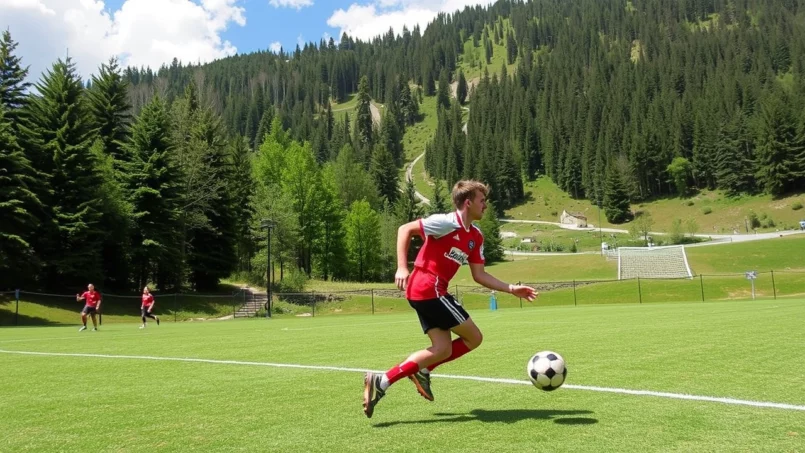
Soccer, structured around the PrvaLiga (10 clubs), is considered the national sport in terms of popularity, with about 30,000 players. The national team has played in two World Cups (2002, 2010) and qualified for the Euros in 2000 and 2024. Goalkeepers like Samir Handanović or Jan Oblak, and players like Zlatko Zahovič or Benjamin Šeško, have contributed to its visibility.
This is the estimated number of basketball players in Slovenia, a country that has established itself as a regular European power with notably a victory at EuroBasket 2017.
Handball distinguished itself with a second place at Euro 2004, hosted in Slovenia, and a bronze medal at the 2017 World Championship, while the club RK Celje won the Champions League in 2004. Ice hockey, although practiced by fewer than 1,000 registered players, benefits from the fame of Anže Kopitar, the first Slovenian NHL champion (Stanley Cup 2012).
The Stožice complex in Ljubljana is the epicenter of indoor sports, hosting high‑level matches and international competitions. Other cities like Maribor, Celje, and Koper also have significant infrastructure, forming a comprehensive national network.
Estimated Number of Participants per Major Team Sport
| Team Sport | Approximate Number of Participants |
|---|---|
| Basketball | ~ 40,000 |
| Soccer | ~ 30,000 |
| Handball | ~ 15,000 |
| Volleyball | ~ 12,000 |
| Rugby Union | ~ 2,000 |
| Ice Hockey | ~ 1,000 |
These figures, placed within a population of two million inhabitants, give an idea of the weight of sports in Slovenian society.
Other Flagship Disciplines: From Athletics to Judo, Including Rowing
The range of sports where Slovenia displays a remarkable level is surprisingly wide for such a small country. Athletics, structured as early as the beginning of the 20th century by clubs like SK Ilirija, then after the war by specialized structures (ŽAK in Ljubljana, Kladivar in Celje), has produced champions like hammer thrower Primož Kozmus, Olympic champion, or middle‑distance runner Jolanda Čeplak.
In swimming, the Olympic final and silver medal of Sara Isakovič, or the titles of Peter Mankoč, are the extension of an educational policy where swimming lessons are compulsory in primary school, increasing the proportion of swimmers from 72% to 92% in 18 years.
This is the number of Olympic Games participations by Slovenian shooter Rajmond Debevec, who also holds the world record in the 50 m rifle three positions event.
On water, rowing is one of the most fruitful areas since independence: Iztok Čop and Luka Špik, Olympic champions in 2000, are part of a long list of multi‑medaled rowers, while Lake Bled is internationally recognized as an ideal training water body. In slalom canoe‑kayak, Peter Kauzer and Benjamin Savšek have amassed world and Olympic titles, based notably on the Tacen whitewater stadium near Ljubljana.
This is the length in kilometers (28.6 miles) of Slovenia’s Adriatic coast, which favors sailing.
Finally, motor sports and extreme outdoor sports also feed the image of a country of controlled “extremes”: ultramarathon swimmer Martin Strel (Danube, Mississippi, Yangtze, Amazon), extreme skier and mountaineer Davo Karničar (first to descend Everest on skis from top to bottom), rally raid or motorcycle riders engaged in long‑range expeditions.
Infrastructure Geared Towards All Audiences
If Slovenia produces Olympic medalists in series, it’s also because the foundation is solid. More than 8,000 sports and recreational clubs structure participation, and there are over 3,000 sports facilities in the country. Compulsory physical education at all levels, from kindergarten to university, ensures early familiarity with movement.
The city of Ljubljana aims to provide 3 square meters of outdoor sports space per inhabitant.
Among the major recent or ongoing investments in Ljubljana are the Stožice Sports Center, the Bežigrad Sport Park, the athletics hall, the Ilirija swimming and gymnastics center, the renovated municipal pool at Kolezija, a golf course in Stanežiče, and even a project for an indoor ski center in Podutik.
An Outsized Olympic Track Record
All these practices, from leisure to high performance, are reflected in the numbers. Since its debut as an independent nation at the Games in 1992, Slovenia has participated in fifteen editions (summer and winter combined) and won, according to sources, about 31 medals at the Summer Games (including 8 to 10 gold) and 24 at the Winter Games (4 gold), for a total of around fifty podiums for two million inhabitants.
In 2010, Slovenia obtained one Olympic medal per 681,000 inhabitants, the third‑best performance in the world.
Olympic Summary (Order of Magnitude)
| Competition | Total Medals | Gold | Silver | Bronze |
|---|---|---|---|---|
| Summer Games (9) | ~ 28–31 | 8–10 | 9–10 | 11 |
| Winter Games (9) | 24 | 4 | 8 | 12 |
In addition to these results are those from the Mediterranean Games (136 medals total, 40 gold) and numerous world and European medals in disciplines as varied as basketball, handball, volleyball, climbing, canoe‑kayak, or biathlon.
A Safe and Accessible Playground for the Sporting Traveler
Beyond championships, Slovenia’s great strength for an active person is the combination of several factors: high overall safety (the country ranks among the safest in the world according to the Global Peace Index), short distances between sea, mountains, and countryside, a very inclusive sporting culture, quality infrastructure, and often more moderate prices than in major Alpine destinations.
In one week, it is possible to combine several outdoor activities in Slovenia: hiking in Triglav Park, mountain biking in Koroška, kayaking on the Soča River, climbing a via ferrata, then finishing with stand‑up paddleboarding at sunset on Lake Bled or a bike ride to the vineyards of Vipava or Goriška Brda. This example illustrates the diversity and density of natural and sporting experiences offered by the country.
To organize a trip, several institutional actors can serve as an entry point: the official portal slovenia.info, the Slovenian Olympic Committee, the Faculty of Sport at the University of Ljubljana, the Sports Directorate at the relevant ministry, or the Association of Slovenian Sports Centers. For training camps and events, agencies like Condor Travel Sport, Kompas DMC, or Pro Sports Services coordinate logistics, facilities, and competitions.
In this country often described as “the adventurer in compact version” or “Little Europe,” sport is never far away. It is a common language that everyone practices at their own level, in a life‑size setting.
Slovenia, a Country of Adventure
Disclaimer: The information provided on this website is for informational purposes only and does not constitute financial, legal, or professional advice. We encourage you to consult qualified experts before making any investment, real estate, or expatriation decisions. Although we strive to maintain up-to-date and accurate information, we do not guarantee the completeness, accuracy, or timeliness of the proposed content. As investment and expatriation involve risks, we disclaim any liability for potential losses or damages arising from the use of this site. Your use of this site confirms your acceptance of these terms and your understanding of the associated risks.

Cyril Jarnias is an independent expert in international wealth management with over 20 years of experience. As an expatriate himself, he is dedicated to helping individuals and business leaders build, protect, and pass on their wealth with complete peace of mind.
On his website, cyriljarnias.com, he shares his expertise on international real estate, offshore company formation, and expatriation.
Thanks to his expertise, he offers sound advice to optimize his clients' wealth management. Cyril Jarnias is also recognized for his appearances in many prestigious media outlets such as BFM Business, les Français de l’étranger, Le Figaro, Les Echos, and Mieux vivre votre argent, where he shares his knowledge and know-how in wealth management.





