
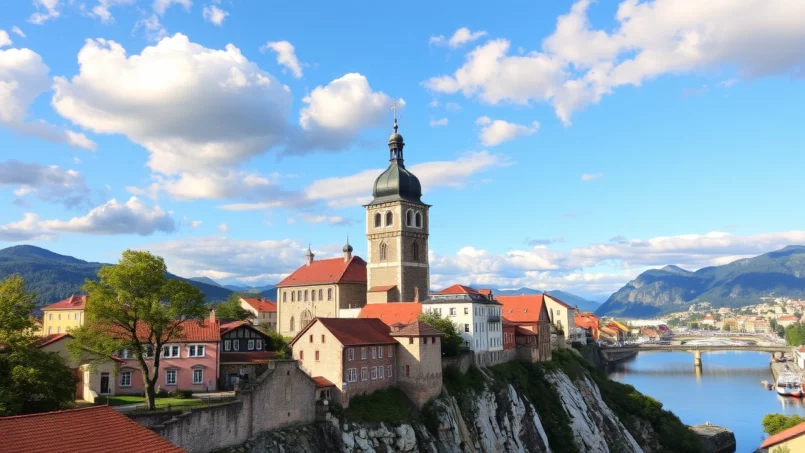
 Published on and written by Cyril Jarnias
Moving to Slovenia without speaking the language is possible. But building a real life there, making local friends, understanding the humor, administrative nuances, or office jokes is much easier with at least some Slovenian. The country is small, very English-speaking—especially among the young and in tourism—but the language remains the key to social, professional, and cultural integration.
This article provides a comprehensive guide for expats in Slovenia, covering how the language works, public support schemes, school choices, app usage, practice opportunities, and exams to target, proposing a logical progression.
Understanding Slovenian: A Demanding Yet Logical Language
Before choosing a method, it’s useful to understand what you’re getting into. Slovenian is a South Slavic language, spoken by about 2 to 2.5 million people, mainly in Slovenia but also in parts of Italy, Austria, Hungary, and Croatia. It has a long written tradition, a rich literature (France Prešeren, Fran Milčinski…) and a very strong cultural anchoring.
Features That Surprise Expats
On paper, Slovenian is intimidating: a highly inflectional grammar, six cases, three genders, and especially a “dual” system, a specific form for “two” (two people, two objects), which affects nouns, adjectives, pronouns, and verbs. A single noun can have up to around twenty forms depending on case, gender, and number. For a French speaker, it feels like a super-version of German… with more Slavic traits.
The Russian language uses six main cases (nominative, genitive, dative, accusative, locative, instrumental) that modify word endings. At the same time, verbs are distinguished by their aspect (perfective or imperfective) and conjugate according to tense, person, number, and sometimes gender. Mastering these systems requires significant learning time to become automatic.
Another typical difficulty: dialects. There are several dozen regional varieties, to the point where some Slovenians have difficulty understanding each other. Everyday language can also differ from the “standard” Slovenian learned in courses. Finally, pronunciation includes rolled consonants, tight consonant clusters, and specific letters (č, š, ž), with a mobile stress accent.
What Makes Life Easier for Learners
Faced with this picture, there are fortunately some reassuring elements. Slovenian uses the Latin alphabet, with only three additional letters (č, š, ž). Spelling is largely phonetic: once the sounds are mastered, you read what you see. The basic verb tenses are few (mainly one present, one past, one future), which simplifies conjugation compared to French.
The Slovenian language has integrated many international loanwords, particularly in technology, commerce, and popular culture, which can facilitate learning. Furthermore, its similarities with other Slavic languages, like Croatian, Serbian, or Russian, are an asset for speakers of those languages. In practice, as many Slovenians have a good command of English, it’s possible to start communicating in that language while gradually introducing Slovenian phrases for practice, for example: “Učim se slovenščino. Prosim, govorite slovensko.” (“I’m learning Slovenian, please speak Slovenian to me.”).
A realistic estimate, for a native English speaker, speaks of about 1100 hours to achieve true mastery. For a motivated expat, 6 to 12 months is generally enough to hold an everyday conversation, provided you are consistent and combine several approaches.
Major Learning Pathways for Expats in Slovenia
In Slovenia, expats have a range of often complementary levers: free (or subsidized) public programs, universities, private schools, online courses, applications, language exchanges, guided self-study.
Public Language Integration Programs
The core of the system relies on programs co-financed by the Slovenian government and European Union funds, particularly the “Asylum, Migration and Integration Fund” (AMIF).
Two flagship schemes structure the offer for third-country nationals (non-EU):
– the “Initial Integration of Migrants” (ZIP) program;
– the informal “Learning Slovenian for Survival” program.
Both are focused on Slovenian as a second language and knowledge of Slovenian society. They are free for participants, but funded by the state and European funds.
ZIP and Survival Courses: How Many Hours, For Whom, Why?
The ZIP program is an accredited public curriculum, centered on Slovenian and life in Slovenia. The standard format includes 180 hours of classes. If you don’t pass the final exam, you can get an additional 60 hours, for up to 240 hours total. A recent reform has officially increased the maximum number of hours accessible to adult immigrants.
The “Learning Slovenian for Survival” program also offers 180 hours, with the same possibility of 60 additional hours if results are insufficient. It primarily aims at basic communication for surviving daily life: stores, transport, health, simple administration.
These two offerings primarily target a specific audience, although the content does not explicitly detail which one. It is essential to refer to the full source document to precisely identify the beneficiaries or the targeted objectives of these proposals.
– third-country nationals with a temporary or permanent residence permit valid for at least one year;
– family members of Slovenian or EU citizens residing in Slovenia;
– persons with international or temporary protection.
EU citizens themselves are not eligible for these specific free programs. They will have to go through other channels (language schools, universities, private courses).
Registration Formalities: The €22.60 Certificate
To access these courses or certain exams for free, a key document is required: a certificate issued by the “administrative unit” (Upravna enota) of your place of residence. It costs €22.60, paid once. It certifies your eligibility and gives you the right to a certain number of hours (60, 120, 180, or 240 depending on your status and the duration of your permit).
The providers delivering these courses are selected through tenders every two years: people’s universities (Ljudska univerza) in various cities, the Centre for Slovenian as a Second and Foreign Language at the University of Ljubljana, associations like Slovenska filantropija, or private institutes like Didaktum, very active for “survival level” training in about forty localities.
Language and the Job Market: Legal Requirements to Know
Learning Slovenian is not just a matter of politeness towards your neighbors. Slovenian law has gradually integrated language requirements related to work, permanent residence, or family reunification.
This is the number of hours for the free A1-level Slovenian language training offered by the Employment Service for third-country national job seekers.
A recent amendment to the Aliens Act further strengthens these requirements:
– for family reunification, a “survival” level of Slovenian is required;
– for a permanent residence permit, an A2 level (CEFR) is required, with exceptions (degree obtained in Slovenian, exam already passed at a higher level, etc.).
Concretely, this means that the language issue will arise sooner or later for any expat wishing to stay beyond a few years.
Official Exams: What Are They For and How to Access Them?
The Slovenian exam system is structured around the “Slovene as a Second and Foreign Language” program, divided into four main levels, all aligned with the Common European Framework of Reference (A1 to C1/C2). Since 2017, the exams designed by the Examination Centre of the Centre for Slovenian at the University of Ljubljana have been awarded the ALTE Q-mark quality certification, enhancing their international recognition.
Several types of exams are distinguished:
– official multinational exams (B1, B2, C1) recognized by the Global Seal of Biliteracy, used for academic or professional dossiers;
– public “Slovene as a second and foreign language” exams (breakthrough, basic, intermediate, advanced levels) accessible for free once for eligible third-country nationals under ZIP;
– “survival” level test, more oral, intended to verify the ability to handle daily needs (shopping, doctor, transport, etc.).
For citizenship applicants or certain statuses, the basic level exam is particularly strategic. It consists of four equally weighted parts: listening comprehension, reading comprehension, written production, and oral interview (general conversation, guided description with pictures, role-play). To pass, you must obtain at least 60% of the points in each component. Grading is descriptive (from “excellent” to “insufficient”).
Candidates who have completed a 180 or 120-hour ZIP course with at least 80% attendance are entitled to a first free attempt, funded by the Government Office for the Support and Integration of Migrants and the AMIF. However, they must cover their own travel and material costs.
The “survival” tests are entrusted to the Didaktum institute, with registration via an online form. Again, the first attempt is covered by the state, after obtaining a specific certificate costing €22.60.
Universities and Language Centers: A Dense Offer for Students and Researchers
If you are a student, PhD candidate, researcher, or student’s spouse, Slovenian universities are a natural entry point into Slovenian.
The Centre for Slovenian as a Second and Foreign Language (University of Ljubljana)
The Centre for Slovenian as a Second and Foreign Language, part of the Faculty of Arts at the University of Ljubljana, plays a central role. It designs exams, publishes textbooks, conducts didactic research, and offers an impressive range of courses, in-person and online, for adults and youth.
Among the flagship formats:
The Slovenian Language Winter School offers a two-week intensive program in Ljubljana, consisting of 4 mandatory morning lessons (9 AM-12:30 PM) and optional afternoon modules (2 PM-3:30 PM). The cultural program and homework bring the total to 60-80 hours of work, validating 3-4 ECTS credits. The cost is €600 for the morning module and cultural program, plus €230 for the afternoon option. Scholarships are available for members of Slovene minorities abroad and descendants of expatriates.
– Summer School for Youth (13–17 years old), organized since 2006, mixing language classes in the morning with fun or cultural activities in the afternoon and evening.
– Intensive Weeks of Slovenian for students of Slovenian or bilingual secondary schools abroad, initially launched for students from Carinthia in Austria and later extended to Hungary.
– Courses for Future Students in Slovenia: for example, an 80-lesson module in Slovenian for secondary school students wishing to study locally, two evenings a week, or beginner/intermediate courses for children and teenagers over two weeks (20 lessons for about €295).
Courses can be in-person or online (via Zoom), also with individual formats (about €45 per 45-minute lesson).
The Center offers the online course ‘Slovene Learning Online (SLO)’, completely free and user-friendly. Available in several interface languages, it includes dialogues, animations, interactive exercises, and work on the Slovenian alphabet (25 specific letters) and numbers. All exercises are corrected, and audio recordings are made by native speakers. It’s an excellent resource to start or consolidate knowledge between courses.
University of Nova Gorica and University of Primorska: Two Very Active Hubs
The Language Centre of the University of Nova Gorica (UNG LC) offers a very flexible structure for all levels (A1 to B2):
– each standard course lasts 60 hours of 45 minutes (reduced to 45 in small groups);
– the format can be classical in-person, hybrid (one-third in class, two-thirds online), or fully online;
– courses are usually worth 4 ECTS (6 ECTS for a basic Slovenian course);
– for UNG students and staff, one course per year is free; subsequent ones cost €320. For others, prices are around €379 (A1/A2) to €399 (B1/B2).
The universities of Primorska (Koper and surrounding area) also focus on a welcoming language policy:
The university offers several course formats to facilitate language learning and cultural integration for foreign students.
Free “Slovenian Language and Culture” courses before the semester starts for international students.
“Slovene as a Foreign Language” course, 60 hours, worth 6 ECTS credits, available for three levels.
Specific slots for Erasmus students, with assigned teachers (e.g., A1 on Wednesday afternoons).
A2 and B1 level groups specially organized for certain faculties, like health sciences.
Slovenian language requirements depend on the field of study. Generally, for programs taught in Slovenian, foreign students must prove A2 upon entering the second year. Some bachelor’s or master’s programs require B1 or C1 by the end of the program. For PhDs (excluding Slovenian studies), there is often no formal requirement, except for the “Slovenian studies” program which requires B1 upon entry, B2 upon exit.
Leto PLUS: The Preparatory Year for Future Students
Another useful tool for young expats: the Leto PLUS / Year PLUS program at the University of Nova Gorica, intended for international students with insufficient Slovenian to follow regular classes. It is a preparatory year mixing language courses and university integration. This type of scheme allows reaching the required level without skipping steps.
Private Schools, Intensive Courses, and Specialized Training
When you don’t qualify for public programs—or want to go faster, further—private Slovenian language schools are a flexible, but paid, alternative.
Summer Intensive Courses, Evening Classes, and Online Training
Several organizations offer intensive courses, often very popular with expats:
– Zavod ŠOLT for example organizes 30-hour summer intensive courses, completed in two and a half weeks, with four sessions per week. Prices start around €199 for students and €259 for non-students. If the number of participants is less than four, the course duration may be reduced or the group canceled.
Some private or associative schools offer group courses limited to 10 people, covering all CEFR levels (from A1 to C2), with evening slots available in-person or online. For example: A1 online on Tuesday from 5 PM to 7:15 PM, A1 in-person on Monday at the same times, A2 on Thursday from 5:45 PM to 8 PM, B1 on Monday from 4:30 PM to 6:45 PM, B2 on Tuesday from 5 PM to 7:15 PM, and a C1-level conversation course on Friday from 4:30 PM to 6:45 PM.
Typical pricing packages for this type of group course look like this:
| Package Duration | Indicative Hours | Approximate Price |
|---|---|---|
| 1 month | 12 h | ~€99.90 |
| 3 months | 36 h (1 level) | ~€269.70 |
| 6 months | 72 h (2 levels) | ~€509.49 |
These offers are well-suited for expats who work and want a regular but moderate pace, with a small group.
Via Linguae and Structured Online Courses
Some companies specialize in structured online training. This is the case with Via Linguae, Jezikovni tečaji d.o.o., based in Ljubljana. It offers modules of 50, 100, or 120 hours, often on Zoom, with an online learning environment (like the ERUDIO virtual classroom) containing materials, exercises, and recordings.
Some price benchmarks:
| Via Linguae Course Type | Volume | Indicative Price |
|---|---|---|
| General Course | 50 h | ~€250 |
| General Course | 100 h | ~€460 |
| Complete Course | 120 h | €470 (or 2 × €250 for two 60-hour blocks) |
| Medical Slovenian | 230 h | €1600 |
The Medical Slovenian course aims at the C1 level required to work in Slovenian healthcare institutions or enter certain medical faculties. The cost/hour ratio is high, but the objective is very specific (terminology, in-depth preparation for a high-level exam).
The general terms and conditions are governed by Slovenian legislation, particularly regarding consumer protection, personal data, and electronic communications. Payments are usually made by invoice. Note that courses already started are not refundable.
Expats, Employment, and the Public Employment Service
For people registered as job seekers, the public service offers free A1 courses (120–180 hours) and an exam, plus:
– reimbursement of travel expenses (€0.23/km) to attend classes and on exam day;
– participation allowance (€1.50/hour) to compensate for the time invested.
The exam must be taken within one year of registration (extendable up to 12 months in case of force majeure). Those who pass an exam at a higher level (A2 or above) or who have formal studies in Slovenian are exempt from this obligation.
Self-Study: Choosing Your Online and App Resources Wisely
The other pillar for an expat is independent work, especially if you have a full-time job or a busy family life. The advantage, for Slovenian, is that the ecosystem of resources has significantly enriched in recent years, even if the offer remains less abundant than for Spanish or German.
Structured Free Online Courses
Two free platforms deserve particular attention.
First, Slovene Learning Online (slonline.si), already mentioned, developed by the Centre for Slovenian in cooperation with the company DigiEd. The interface is clear, playful, and covers the alphabet, numbers, common phrases, practical situations. Short animations present the country, language, and daily life.
This platform offers about 125 free 5-minute lessons, focused on vocabulary acquisition and pronunciation. Its method is based on daily, progressive learning in small units, ideal for learners, especially expats on a budget, looking to enrich their lexicon without intensive sessions.
You can add 50LANGUAGES, with its “Slovene for beginners” course based on 100 practical phrase lessons. Audio files are downloadable in MP3, and the mobile app offers games, tests, and offline review. Again, no prerequisites are needed, the approach is clearly oriented towards basic communication.
Mobile Apps: Don’t Wait for Duolingo
Unlike other languages, Slovenian is not (or not fully) integrated into mainstream platforms like Duolingo. So you have to look elsewhere. Several apps stand out for Slovenian:
– Ling App: designed by Simya Solutions, it covers over 60 languages including Slovenian. Courses aim to be comprehensive (reading, writing, comprehension, and speaking) with mini-games, AI chatbot, pronunciation exercises, letter tracing on screen, etc. Content is created with native speakers, voices are not synthetic. A freemium model gives access to beginner lessons; paid subscriptions (monthly, semi-annual, annual, lifetime) allow going further.
The Memrise app is very useful for learning vocabulary and working on pronunciation thanks to videos of native speakers. Its spaced repetition system and use of mnemonics make it an excellent complement for solidly anchoring useful words and phrases.
– Clozemaster: more for intermediate and advanced levels. The app offers fill-in-the-blank sentences in various contexts to consolidate vocabulary and grammatical structures in real situations.
– Mondly: offers interactive lessons, a chatbot, speech recognition, and even augmented reality experiences for some languages. For Slovenian, it’s an interesting option if you want a balanced path between comprehension and expression.
– Drops, LinGo Play, DuoCards, 50 Languages: each has its angle (ultra-short sessions, flashcards, visual immersion, etc.), useful for supplementing without necessarily replacing a real course.
– Forvo: a pronunciation dictionary where you can hear thousands of Slovenian words pronounced by natives, sometimes with dialectal variations. Ideal for correcting an accent or checking the right intonation before an appointment.
For an expat learning Slovenian, relying solely on an app is a classic mistake. Optimal use involves combining an app (e.g., Ling or Memrise for vocabulary) with a structured course and real-world practice (tandems, outings, colleagues).
Multimedia Platforms and Creator Content
The range extends well beyond apps:
– YouTube concentrates several creators of content in Slovenian for foreigners: educational videos, series like “How to be a Slovene”, channels by expats sharing their integration. Some videos offer English subtitles, facilitating the switch between languages.
– Bloggers and expats also share resource lists: grammar memos, lists of false friends, feedback on different schools or textbooks (“Colloquial Slovene”, “Slovene: A Comprehensive Grammar”, etc.).
– Tools like Forvo, Besana (for checking declensions), Termania or the lexical portal Fran offer a deep dive into the written language, useful for those who like to understand in depth how the language works.
Again, the challenge for the expat is to turn these resources into a manageable routine: listen to a Slovenian podcast on the bus, follow one or two local channels, set your phone interface to Slovenian, etc.
Practicing with Slovenians: Tandems, Meetups, Social Media
No method, however brilliant, replaces conversations with real people. For expats, practice is doubly crucial: it unlocks the language and opens social doors.
Tandem Apps and Online Communities
Several platforms facilitate connecting with Slovenian speakers:
– Tandem and HelloTalk: very popular “language exchange” apps where you can find dozens of profiles in Slovenia, especially in Ljubljana and Maribor. Slovenians there often learn English, German, Italian, or Korean, and are happy to exchange for French or another language.
This site, one of the oldest, allows language exchanges via written chat, audio, or video. It is distinguished by a guided methodology (worksheets, session plans) created by a teacher. Its new voice and video chat tool includes speech recognition and contextual translation.
– HelloTalk, beyond messaging, offers “Voice Rooms” (audio lounges) and lives, which can be a good way to get used to Slovenian accents without pressure.
These platforms require a minimum of caution (avoid sharing sensitive data, spot unserious profiles) but they offer, at little or no cost, a conversational immersion hard to achieve otherwise.
Local Life: Cafes, Libraries, and Universities
In Slovenia itself, language exchanges also organize in real life: conversation cafes in major cities, municipal libraries (like in Maribor), student associations on campuses, organizations like Slovenska filantropija which sometimes offer volunteer Slovenian workshops (without a certificate, but very useful for speaking).
For an expat based in Ljubljana or Maribor, the university is a good social and cultural anchor point, even without being a student, thanks to its open events, lectures, and language clubs. Furthermore, student neighborhoods and riverbanks, like the Lent district in Maribor or the banks of the Ljubljanica and parks in Ljubljana, are conducive meeting places for practicing the language, especially during the spring and summer seasons.
Concrete Strategies for Effectively Combining These Resources
Faced with the abundance of programs, schools, and tools, many expats wonder where to start. Here are some organizational pointers, depending on profiles.
Profile 1: Third-Country Expat, New Arrival
If you are a non-EU national, newly settled in Slovenia, several reflexes are strategic:
1. Check your eligibility for the ZIP program and/or the survival course, as well as for the employment service courses if you are registered as a job seeker.
2. Quickly obtain the certificate from your Upravna enota (€22.60), then register for a ZIP or survival course on one of the sites listing providers (infotujci.si, people’s university sites, etc.).
3. Take advantage of the free exam at the end of the course, aiming for at least A1 or A2 level depending on your plans (job, family reunification, permanent permit). Remember to use self-directed learning centers to prepare for the exam.
To strengthen your learning, use platforms like Slovene Learning Online, LingoHut, or 50LANGUAGES to acquire the basics. Automate vocabulary acquisition with an app like Ling or Memrise. Finally, perfect your pronunciation by using Forvo.
5. Very quickly, add practice: language tandem (Tandem, HelloTalk), meeting neighbors, participation in association events. Don’t wait until you “speak well” before speaking.
Profile 2: EU Expat in a Job, Little Time
For a European who came to work in Slovenia, often exempt from free schemes but very busy:
– enroll in an evening course at a private school (like group course A1 then A2, once or twice a week);
– follow Slovene Learning Online in parallel to solidify basic grammar;
– use an app like Memrise or Drops daily to enrich vocabulary (5 to 10 minutes per day);
– schedule one or two tandem sessions per week, online or in-person, to practice what was learned;
– set a deadline (e.g., take an A1 or A2 exam within the year) to stay motivated.
Profile 3: Foreign Student
For a student, the logic is often to go through the university:
To learn Slovenian as a foreign student, several effective options are available to you. Take the Slovenian courses for foreigners offered by your university (like UP, UNG, or the University of Ljubljana): they are often free or very affordable, integrated into the curriculum with ECTS credits, and adapted to the academic calendar. Take advantage of preparatory language and culture days when offered for an intensive start. If necessary, consider a preparatory program like Leto PLUS before starting a program entirely taught in Slovenian. Complement this formal learning with campus immersion: get involved in student associations, opt for mixed shared housing (with Slovenians and foreigners), and participate in cultural events.
Profile 4: Expat Spouse, Stay-at-Home Parent
This profile sometimes has more time but less direct contact with the language:
– take a summer intensive course (Zavod ŠOLT, universities, private schools), useful to “break the initial barrier”;
– combine with online courses (Via Linguae or others) if mobility is limited (children, travel);
– use resources adapted for children (language workshops, games in Slovenian) to learn as a family;
– integrate into the neighborhood: markets, parent-teacher associations, libraries, where a few phrases like “Živijo”, “Hvala”, “Lep dan!” are much appreciated and encourage Slovenians to help.
Why the Language Investment Pays Off in Slovenia
All studies on integration remind us: language is one of the major levers for access to employment, social participation, and reducing discrimination. In Slovenia, where immigrants represent a growing share of the population (over 12% third-country nationals and about 3% EU citizens), the recent national integration strategy emphasizes the importance of offering Slovenian language courses.
A significant proportion of immigrants report having experienced ethnic discrimination in the past year.
For many expats, a pivotal moment is when you successfully handle your first complex interaction in Slovenian: resolving an administrative problem, explaining a health issue to a doctor, leading a work meeting, joking with Slovenian friends. These “small victories” consolidated by practice give the feeling of truly inhabiting the country, not just residing there.
Setting Up a Personal Roadmap
The last piece of advice, perhaps the most important, is not to leave it to chance. Slovenian is not a language you absorb passively by having a coffee on the main square in Ljubljana. It requires regularity, but not necessarily full days of study.
A simple plan for an expat might look like this:
To learn Slovenian effectively, it is recommended to follow a precise plan: set a clear goal for the year (like reaching A2 level or handling daily procedures), choose a structured course (ZIP, university) as a base, pair it with a serious online tool (Slovene Learning Online, LingoHut) for independent work, select a dedicated vocabulary app (Memrise, Ling), regularly participate in language exchanges (tandem, cafes), and keep a progress log to note improvements and points to review.
The good news is that in Slovenia, the institutional ecosystem (public programs, universities, language centers, European funding) and the citizen ecosystem (volunteering, tandems) form a rather favorable environment. Many Slovenians deeply appreciate a foreigner making the effort to learn their language, especially in a country where English could suffice on the surface.
For an expat willing to invest a little time each day, Slovenian then ceases to be an “impossible language” to become a concrete, living tool, that opens the doors to this small green country nestled between Austria, Hungary, Croatia, and Italy—and to the daily life that goes with it.
Disclaimer: The information provided on this website is for informational purposes only and does not constitute financial, legal, or professional advice. We encourage you to consult qualified experts before making any investment, real estate, or expatriation decisions. Although we strive to maintain up-to-date and accurate information, we do not guarantee the completeness, accuracy, or timeliness of the proposed content. As investment and expatriation involve risks, we disclaim any liability for potential losses or damages arising from the use of this site. Your use of this site confirms your acceptance of these terms and your understanding of the associated risks.

Cyril Jarnias is an independent expert in international wealth management with over 20 years of experience. As an expatriate himself, he is dedicated to helping individuals and business leaders build, protect, and pass on their wealth with complete peace of mind.
On his website, cyriljarnias.com, he shares his expertise on international real estate, offshore company formation, and expatriation.
Thanks to his expertise, he offers sound advice to optimize his clients' wealth management. Cyril Jarnias is also recognized for his appearances in many prestigious media outlets such as BFM Business, les Français de l’étranger, Le Figaro, Les Echos, and Mieux vivre votre argent, where he shares his knowledge and know-how in wealth management.





