
 Published on and written by Cyril Jarnias
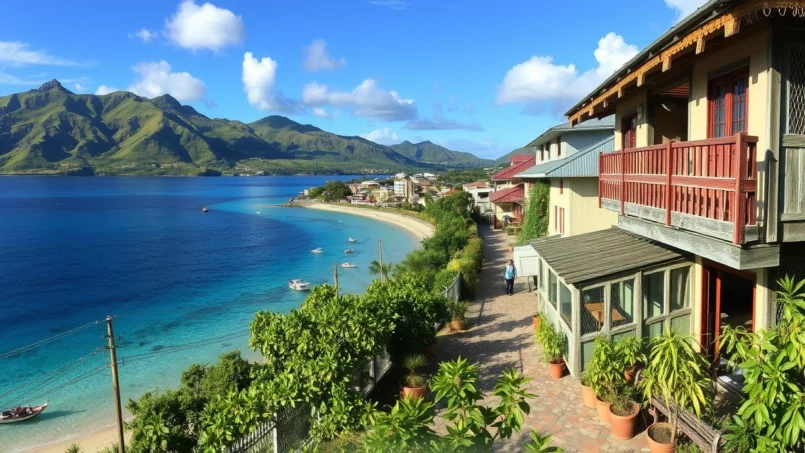
Moving to Wallis and Futuna means accepting to live at the end of the world, in a tiny archipelago lost in the middle of the Pacific, yet benefiting from a French administrative framework, a practically non-existent tax system, and an exceptional level of safety. In this setting of turquoise lagoons and vegetation-covered volcanoes, expatriates tend to concentrate in a few well-identified areas, primarily on the island of Wallis and around the capital, Mata-Utu.
For newcomers (civil servants, entrepreneurs, remote workers), finding housing is not enough. It is crucial to select an environment suited to one’s lifestyle, considering proximity to services, access to the beach, distance from the airport, the tranquility of the villages, and the desired level of cultural immersion. This choice is all the more important as the local real estate market is very limited and travel is primarily by car.
Understanding the landscape: a tiny but highly contrasted territory
Before zooming in on the most sought-after neighborhoods, it’s helpful to place Wallis and Futuna in context. This French overseas territory, associated with the European Union as an overseas country and territory, covers only 142.42 km² of land. It is composed of two main groups: the Wallis Islands (Uvea) to the north and the Hoorn Islands (Futuna and Alofi) to the south, separated by about 260 kilometers of ocean.
The total population of Wallis and Futuna, which has been in sharp decline since the 2000s due to emigration to New Caledonia and mainland France.
The climate is equatorial and particularly humid: it rains between 2,500 and 3,000 mm per year, with over 260 rainy days. Temperatures hover around 26.5 °C (80 °F) year-round, with a hot and very humid season from November to April, and a slightly cooler and drier period from May to October. For an expatriate, this is not a minor detail: depending on the neighborhood, natural ventilation, shade, proximity to the coast, or easy access to stores will matter more than elsewhere.
A French territory with a customary organization
Wallis and Futuna combines two systems: a French republican organization (President of the Republic, High Administrator, Territorial Assembly, senator, deputy) and three customary kingdoms – Uvea on Wallis, Sigave and Alo on Futuna. This dual structure also influences how one inhabits the territory: land largely falls under customary chieftaincies, classic private property exists but remains rare, and renting a property often operates within the logic of family networks or trust.
For an expatriate, it is important to understand that the real estate supply is structurally weak. Consequently, the search and negotiation for housing frequently happen through word of mouth, administrative services, or local contacts.
Wallis, the heart of expat life: Mata-Utu and its surroundings
In residential terms, Wallis dominates Futuna significantly. The formal economy is more present there, the international airport is located there, the majority of businesses are there, and it’s where health services, education, and the main stores are concentrated. For an expatriate, the question is therefore first posed in these terms: where to live on Wallis, and should one be in or near Mata-Utu or, on the contrary, move away from it to gain tranquility and access to beaches?
Mata-Utu and Hahake: the choice of maximum practicality
Mata-Utu, the capital of the territory, is by far the most popular area for expatriates. The town itself is not a metropolis: just over a thousand inhabitants, no street names, relatively calm traffic. But it concentrates almost everything that makes daily life easier.
It is home to the prefecture, the Territorial Assembly, the courthouse, the main post office, the radio station, the Fenuarama shopping center, the headquarters of the Wallis and Futuna Bank, Aircalin agencies, several supermarkets, as well as the main healthcare facility: Sia Hospital, equipped with an operating room, surgery, medicine, obstetrics-gynecology services, and a scanner, radiology, and laboratory.
The area around the Matâ’Utu cathedral and the royal palace constitutes the nerve center of the island, where civil servants, shopkeepers, students, and families mingle. Its appeal lies in its practicality: expatriates appreciate being able to do everything on foot or within a few minutes by car, a rare advantage in the archipelago. This centrality is reinforced by the concentration of tourist accommodations (like Hôtel Ulukula, Lomipeau, Océania gîte, Tanoa inn, Matala’a Studio, or Liufau guest rooms), making it a preferred area for short stays or the first weeks of settling in.
In the district of Hahake, which encompasses Mata-Utu and several neighboring villages like Aka’aka or Lavegahau, the environment offers an interesting compromise between centrality and island living: just minutes from the administrative heart, one already has access to beaches, traditional villages, more residential areas.
The advantages of Mata-Utu and Hahake can be summarized as follows:
| Main Advantage | Concretely for an Expatriate |
|---|---|
| Proximity to services | Administration, bank, hospital, post office, stores, and schools concentrated within a short radius |
| Housing supply | Largest number of properties for rent, including furnished housing and government-provided housing |
| Social life | Presence of the majority of expatriates, more visible community life |
| Accessibility | Main road (RT1), direct connection to the airport, port, shopping center |
For a couple with children, living in Mata-Utu or a village in Hahake, a few minutes by car from the middle schools and high school, limits daily fatigue and partially compensates for the overall isolation of the territory.
Hihifo: the air gateway and more dispersed housing
The district of Hihifo extends over the western part of Wallis. Its main anchor point for expatriates is Hihifo International Airport, located about 5.5 km northwest of Mata-Utu. Nearby, a few establishments like the Hôtel-Restaurant l’Albatros accommodate travelers in transit.
The area mainly attracts frequent travelers and families seeking a more open, less dense environment while remaining close to the capital. Road accessibility is better on Wallis than on Futuna, and Hihifo benefits from the main road that circles the island.
Villages like Vaitupu – which is also the district’s main village – or Lavegahau offer a more village-like atmosphere, with a strong immersion into customary life. For an expatriate, this means more authenticity, but also a need to adapt to the local pace, to “Polynesian time,” where interpersonal relations often take precedence over European-style efficiency.
In Hihifo, the presence of clinics, as relays to the Mata-Utu hospital, ensures a minimum of local medical care, a non-negligible element for families.
Mu’a: Southern Wallis, residential beaches, and Polynesian immersion
In the south of the island, the district of Mu’a particularly attracts expatriates seeking calm, views of the lagoon, and direct beach access. One finds villages like Mala’efo’ou (main village), Halalo, Gahi, or Nuku, as well as major historical sites like the Tongan fortifications of Talietumu or Tonga Toto.
For a foreign resident, Mu’a is often perceived as the most ‘postcard-worthy’ part of Wallis. The beaches, the coastline, the proximity to accessible lagoon islets, but also the very vibrant customary culture make it an area where daily life unfolds to the rhythm of ceremonies, masses, and village festivals.
Foreign resident
Expatriates who settle there generally accept a slightly longer commute to Mata-Utu (but distances remain modest: Wallis is about 20 km long), in exchange for a more residential environment and better proximity to water activities. This district is also home to Gahi Bay, the only authorized anchorage on the island for boats.
One can compare these three districts of Wallis, which structure most of the residential choices, as follows:
| District (Wallis) | General Profile | Proximity to Services (admin, hospital, schools) | Access to Beaches/Lagoon | Atmosphere for Expatriates |
|---|---|---|---|---|
| Hahake / Mata-Utu | Central urban | Maximum | Average to good | Very frequented, denser social network |
| Hihifo | Semi-rural, airport | Good (via road) | Variable | More for mobile civil servants, families |
| Mu’a | Coastal residential | Adequate but farther | Excellent | ‘Quality of life’ profile, immersion |
In practice, many expatriates choose a compromise: living a few kilometers south or north of Mata-Utu, in a village in Hahake or on the border of Hihifo/Mu’a, which allows both for a quick commute to work in town and to enjoy a more open environment, even direct access to the sea.
Futuna: inhabited areas, a much more limited offering
While Wallis concentrates the majority of expatriates, Futuna attracts very specific profiles: missionaries, aid workers, healthcare or teaching staff on temporary assignment, or a few niche entrepreneurs. The island is more rugged, even more rural, and much less equipped in road infrastructure – about twenty kilometers of roads, none of them paved.
Residential areas are concentrated in three spaces: around Leava, in Sigave, and in the kingdom of Alo.
Leava and Sigave: the port, administration, and some services
Leava, on the southwestern coast of Futuna, serves as the island’s main village. This is where the delegation of the high administration, customs, public works, agriculture, fishing, social services, and scholarship offices are located. It is also the site of Futuna’s main port, in Sigave Bay, which is undergoing modernization.
For an expatriate in Futuna, residing near the main village offers essential practical advantages for daily life.
Being as close as possible to the island’s limited administrative and logistical activities, concentrated in Leava.
Presence of an ATM for the Wallis and Futuna Bank, attached to the Faletoa post office, facilitating financial management.
Leava and its neighboring villages like Faletoa or Fiua therefore constitute the main residential area for government workers, technical personnel, and local entrepreneurs. Tourist accommodation is scarce here, but Futuna has a few small hotels and guesthouses, as well as homestay possibilities.
Alo and Taoa: more dispersed housing, a more traditional lifestyle
In the kingdom of Alo, in the east of Futuna, localities like Taoa or Mala’e present a much more rural setting. One finds Kaleveleve Hospital there, the territory’s second medical facility, with limited capacity and no surgery or maternity services, as well as primary schools.
For an expatriate, settling in this area means accepting an even more isolated life: few businesses, no intensive port operations, basic roads, limited services. On the other hand, it offers complete immersion in Futunian culture, extremely devout (the population is 100% Catholic) and still strongly structured by local chieftaincies.
The total population of Futuna is around 3,000 inhabitants; the room for maneuver in terms of neighborhood choice is therefore limited, and the choice depends more on the nature of the professional mission or life project than on a neighborhood strategy comparable to that on Wallis.
Rental market and budget: what’s the reality behind the “sought-after neighborhoods”?
In an archipelago where the entire population does not exceed 11,000 inhabitants, talking about “neighborhoods” comes down, in fact, to distinguishing a few zones where the density of services, jobs, and housing is slightly higher. The market itself remains extremely restricted, which directly impacts residential trade-offs.
A narrow market, moderate but not negligible rents
Available data indicates that rents for a standard home generally range between 80,000 and 120,000 XPF per month, approximately 800 to 1,200 USD. A furnished three-bedroom house typically costs around 100,000 XPF (approximately 1,000 USD). The security deposit most often corresponds to one month’s rent.
Electricity, produced locally by a thermal power plant, adds an average of 10,000 to 20,000 XPF per month to the bill, so a combined housing + energy budget around 100,000 to 150,000 XPF (1,000 to 1,500 USD) per month is common for an expatriate household.
This is the import duty rate applied to commercial goods overseas, contributing to a higher cost of living.
These financial parameters can be summarized in the following table:
| Expense Item | Average Monthly Amount (XPF) | Comment |
|---|---|---|
| Rent for standard housing | 80,000 – 120,000 | Medium-sized house or apartment |
| Rent for furnished 3-bedroom house | ≈ 100,000 | Typical segment for expat family |
| Security deposit | 1 month’s rent | Common practice |
| Electricity | 10,000 – 20,000 | Depends on air conditioning and appliances |
| Total housing + energy budget | 100,000 – 150,000 | Common range for an expat household |
For a single person, a total monthly budget (rent, food, utilities) is often estimated around 140,000 to 170,000 XPF, while a family of four can exceed 250,000 XPF including food – which is very expensive as it is almost entirely imported.
Supply concentrated around Mata-Utu… and government housing
The bulk of the private rental supply is on Wallis, and particularly in and around Mata-Utu. This is logical: nearly three-quarters of the territory’s businesses are located on this island, and almost all administrative and educational infrastructure is there.
To this are added housing managed by the State or local authorities to accommodate civil servants assigned to the archipelago (teachers, healthcare staff, administrative managers, etc.). Many of them thus live in residential complexes or individual houses assigned automatically, often located near Mata-Utu, the middle schools, or the hospital.
For a non-civil servant expatriate, the search for housing in Mata-Utu is competitive. It mainly happens through local networks, small ads from consular chambers, or territorial websites. Insularity makes good preparation crucial, as it’s not easy to consider a ‘plan B’ by quickly changing regions.
Buying to settle: possible, but not necessarily rational
The possibility of buying property exists, but local consensus highlights the difficulties of resale in a narrow market with very few potential buyers. The declining demographics and massive emigration to New Caledonia or mainland France do not encourage heavy investment in real estate, except for very long-term family or professional projects.
Especially since the land system, intertwining custom and individual property, requires an excellent understanding of the local fabric and strong legal support. Many expatriates therefore prefer renting, often largely covered by their allowances, over home ownership.
Services, schools, health: a determining factor for neighborhood choice
In such a small territory, one might think all villages are equal. In reality, location relative to essential services makes a big difference, especially for families.
Schools: almost everything on Wallis, around Mata-Utu
The school system follows the French model and covers the entire curriculum up to the baccalaureate for free. There are several primary schools spread between Wallis and Futuna, six middle schools (four on Wallis, two on Futuna) and two high schools, both located on Wallis – one general, technological, and vocational with a boarding school, the other agricultural.
For families with teenagers, it is advisable to reside near Mata-Utu, or in the Hahake or Hihifo districts on Wallis, to minimize travel time to middle schools and high school. In Futuna, middle schoolers study locally, but access to high school generally requires moving to Wallis. Higher education is pursued mainly in New Caledonia or mainland France.
In the absence of an international school, teaching is exclusively in French, which can pose challenges for non-French speaking families. Nevertheless, the deep roots of local languages (Wallisian and Futunian) in daily life mean that expatriate children are exposed to a truly multilingual environment.
Health: the strength of a modern hospital in Mata-Utu
Another major criterion for residential choice: access to healthcare. The system is entirely public, free, and managed by the Health Agency, with no private practice. Sia Hospital, in Mata-Utu, was completely modernized in the mid-2020s, with a full range of technical facilities for a territory of this size. Most specialists intervene on occasional missions, and serious cases are evacuated to Nouméa, Australia, or mainland France.
For a family, it is advisable to live in Mata-Utu or within 10 km on the circular road of Wallis to limit travel time in case of a medical emergency. In Futuna, Kaleveleve Hospital does not have surgery services, making an air transfer to Wallis necessary for any major intervention.
This is one of the reasons why, with equivalent health needs, an expatriate will willingly choose a neighborhood in Hahake or Hihifo, or even the north of Mu’a, rather than a very peripheral or isolated village.
Lifestyle and atmosphere: what each area truly offers
Beyond technical aspects, the choice of a neighborhood in Wallis and Futuna also reflects a choice of lifestyle. In a territory where time sometimes seems suspended, the question is not only “where to live?” but “how do you want to live day-to-day?“
Mata-Utu and its immediate “suburbs”: conviviality and micro-urbanity
In and around Mata-Utu, daily life is paced by the activity of the shopping center, religious services at the cathedral, the comings and goings of civil servants, the markets (like those of Fuga’Uvea, even if located in other villages), meetings at the Chamber of Commerce headquarters or the radio station.
In the central neighborhoods, the lives of expatriates, whether teachers, doctors, managers, or entrepreneurs, are characterized by great proximity. Social encounters happen less in Western-style cafes or bars than in snack bars, sports associations, or clubs like rugby or football. Choosing this area implies accepting a denser and sometimes less calm environment but offers the advantage of building a network more easily.
For digital nomads and online workers, the combination of fiber optics (via the Tui Samoa cable), complete absence of income tax, and proximity to services makes this heart of Wallis particularly attractive: you live by the lagoon, but have access to a high-performance connection and the territory’s few “urban amenities.”
The coastal villages of the south and west: lagoon horizon and omnipresent custom
Living in the coastal villages of Mu’a or certain parts of Hihifo means living closest to the lagoon, beaches, and water activities. Bases like Vakala offer sailing, kayaking, paddleboarding, providing an ideal outlet for evenings or weekends.
In these areas, life is structured around customary ceremonies (katoaga), masses, family gatherings, and agricultural or fishing work. The expatriate is considered a full member of the community, which implies respecting traditional hierarchies, participating in collective events, and accepting a certain social visibility.
For many, this immersion is precisely the main richness of the experience. For others, especially those seeking a more anonymous lifestyle, the relative proximity of Mata-Utu remains preferable.
Futuna: for profiles ready for extreme immersion
On Futuna, life is harsher but also more intensely Polynesian. The absence of paved roads, the distance from the international airport, the scarcity of stores, reinforce dependence on village solidarity and customary networks. Expatriates who settle there are generally clearly assigned, for defined durations, and accept a living environment where modern distractions are extremely rare.
In this context, the preferred “neighborhoods” are above all the localities where vital services are found: Leava and its immediate surroundings for administrative and maritime functions, Taoa and Kaleveleve for health, as well as villages with schools.
What “sought-after neighborhood” means in a territory of 11,000 inhabitants
On the scale of a large metropolis, one would call “sought-after” neighborhoods offering a mix of centrality, quality of life, image, and amenities. In Wallis and Futuna, the reading grid is different but the logic remains similar.
Expatriates concentrate around a few poles:
Guide to the main sectors to consider for settling, according to your lifestyle priorities and service needs.
For maximum proximity to services, social life, and centrality on Wallis Island.
For frequent travelers or those seeking a less dense environment, with easy access to transportation.
For the living environment, beach access, and a strong anchorage in customary life and traditions.
On Futuna Island, ideal for proximity to administrative missions and logistical infrastructure.
For families, prioritize sectors close to health and education establishments.
One could liken these choices to a set of sliders: each expatriate positions their balance differently between accessibility, cultural immersion, modern comfort, and proximity to nature.
To summarize the overall attractiveness of the main areas for an expatriate, a comparative table can be drawn up:
| Main Area | Access to Services | Access to Education | Access to Health | Access to Beaches / Lagoon | Customary Immersion | Typical Expatriate Profile |
|---|---|---|---|---|---|---|
| Mata-Utu (Central Hahake) | Excellent | Excellent | Excellent | Average | Average | Civil servants, self-employed, remote workers, families |
| Outskirts of Mata-Utu (Hahake) | Very good | Very good | Very good | Good | High | Families seeking a town/village compromise |
| Hihifo (near airport) | Good | Good | Good | Variable | High | Frequent travelers, families who prefer calm |
| Mu’a (South Wallis) | Adequate | Adequate | Adequate | Excellent | Very high | Lagoon enthusiasts, ‘quality of life’ oriented profiles |
| Leava (Futuna) | Average | Average | Average | Good | Very high | Aid workers, administration and infrastructure personnel |
| Remote villages of Futuna | Low | Low | Low | Good to excellent | Extreme | Highly targeted missions, profiles ready for total immersion |
A territory for what type of expatriate?
The very characteristics of Wallis and Futuna make it a very special place to live. The cost of living, significantly higher than in mainland France, the near-absence of tourism (only about a hundred visitors per year), the low number of businesses (just over 1,200), and the importance of the public sector (65% of formal employment) paint an environment far from classic beach destinations.
On the other hand, the combination of factors like:
Several territories offer particularly advantageous living conditions, notably the complete absence of income tax, VAT, corporate tax, and social security contributions (CSG/CRDS). They also benefit from completely free healthcare and education, high safety with almost non-existent crime, pleasant climate, and good digital connectivity through fiber optics and, increasingly, Starlink kits.
offers an attractive framework for very specific profiles: civil servants on assignment, niche entrepreneurs in services or digital, self-employed individuals who can work online, a few families seeking a radically different life project.
The choice of neighborhood in Wallis and Futuna determines the level of immersion and isolation. Mata-Utu offers a French administrative setting. The coastal villages of Mu’a or Hihifo bring you closer to traditional Polynesian life. Settling on Futuna, in Leava or the villages of Alo, implies an additional step back from the world.
In an archipelago of this size, the “most sought-after neighborhoods” are not those with the most outrageous rents or the most luxurious buildings, but those that manage to reconcile, for each expatriate, the delicate equation between services, culture, nature, and privacy. Mata-Utu and its immediate surroundings, the coastal villages of Wallis, and the small hub of Leava on Futuna thus outline the preferred destinations of a numerically small expatriate community, which nevertheless contributes significantly to the economic and social life of this unique territory.
Disclaimer: The information provided on this website is for informational purposes only and does not constitute financial, legal, or professional advice. We encourage you to consult qualified experts before making any investment, real estate, or expatriation decisions. Although we strive to maintain up-to-date and accurate information, we do not guarantee the completeness, accuracy, or timeliness of the proposed content. As investment and expatriation involve risks, we disclaim any liability for potential losses or damages arising from the use of this site. Your use of this site confirms your acceptance of these terms and your understanding of the associated risks.

Cyril Jarnias is an independent expert in international wealth management with over 20 years of experience. As an expatriate himself, he is dedicated to helping individuals and business leaders build, protect, and pass on their wealth with complete peace of mind.
On his website, cyriljarnias.com, he shares his expertise on international real estate, offshore company formation, and expatriation.
Thanks to his expertise, he offers sound advice to optimize his clients' wealth management. Cyril Jarnias is also recognized for his appearances in many prestigious media outlets such as BFM Business, les Français de l’étranger, Le Figaro, Les Echos, and Mieux vivre votre argent, where he shares his knowledge and know-how in wealth management.





