
 Published on and written by Cyril Jarnias
Long marked by political tensions and poverty, Burundi has nonetheless built a vibrant and inventive sports culture. In cities and on the hills, sport has become a common language, a meeting place, and often a tool for reconciliation. Whether it’s soccer in the alleyways of Bujumbura, banana-laden cycling on mountain roads, judo in sometimes rudimentary dojos, or races on the shores of Lake Tanganyika, the country is full of practices accessible to all skill levels.
This article provides an overview of the most popular sports to play in Burundi, blending modern sports, traditional disciplines, and new trends. The goal is not just to list activities but to show how they fit into the country’s daily life, local economy, and cultural identity.
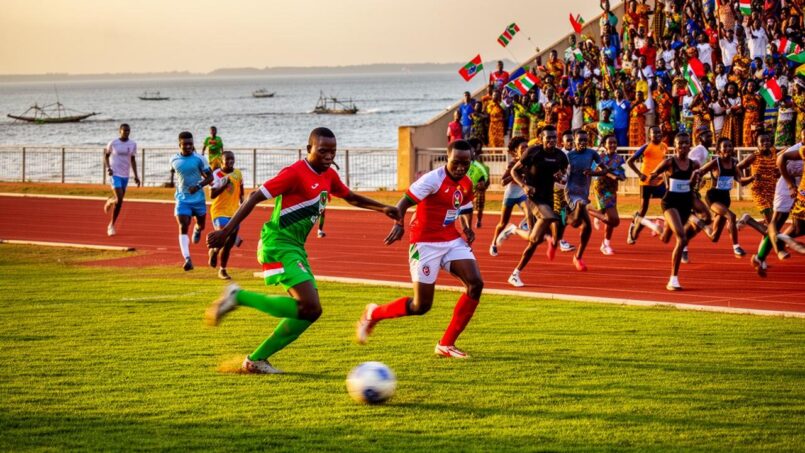
It is impossible to talk about sports in Burundi without starting with soccer. It is by far the most played and followed discipline, to the point that some call it the “presidential sport.” In urban neighborhoods as in remote villages, all it takes is a vaguely flat field, a few stones to mark the goals, and a ball – sometimes made of rags or plant materials – for a match to begin.
Burundi has a structured championship, the Burundi Premier League, and an annual national Cup organized in Bujumbura. Iconic clubs such as Vital’O FC, Inter Star, Aigle Noir, and Club Prince Louis participate, attracting large crowds to the Intwari or Prince Louis Rwagasore stadiums, despite sometimes modest infrastructure.
The round ball is also a matter of national pride. The national team, nicknamed The Swallows (Intamba m’Urugamba), had its historic moment by qualifying for the Africa Cup of Nations for the first time in 2019, after a decisive match against Gabon. Even though the journey stopped at the group stage without scoring a goal, the qualification was lived as a collective victory and a promise for the new generation of players.
Soccer in Burundi is a sport widely played by the population. City dwellers often play before or after work, benefiting from a half-day per week dedicated to sports for civil servants. In rural areas, youth organize friendly tournaments with limited means but great creativity. The development of women’s soccer is also visible thanks to a dedicated league, supported by the authorities and international programs like FIFA’s Football for Schools, recently implemented in the country.
To get an idea of the particular weight of soccer in the Burundian sports landscape, one can compare its place with other modern disciplines often played:
| Modern Sport | Relative Popularity in Burundi | Structured National Competition | Organized Women’s Practice |
|---|---|---|---|
| Soccer | 1st, most popular sport | Yes (championship + Cup) | Yes (women’s league) |
| Basketball | 2nd | Yes | Yes |
| Athletics | 3rd | Yes | Yes |
| Rugby | 4th, growing | Yes | Very limited |
| Volleyball | 5th | Yes | Yes |
| Handball | 6th | Yes | Yes |
| Wrestling (modern sport) | 7th | Yes | Low but existing |
Beyond statistics, soccer has played a cohesive role. Since the 1990s, stadiums have often served as gathering places for peace initiatives. Former physical education teachers turned political leaders – such as former President Pierre Nkurunziza, a soccer enthusiast – have actively used sport to encourage national unity.
Basketball, a sport on the rise
If soccer dominates, basketball is gradually establishing itself as the other major urban sporting passion. More and more young people identify with this fast, spectacular sport that carries international role models. In Burundi, basketball is played in schoolyards, on improvised concrete courts, as well as in structured clubs united under the Burundi Basketball Federation (FEBABU).
The flagship competition is the National Championship, known as the Viva Basketball League, a semi-professional league supported by a malt beverage sponsor. Twelve teams participate, several based in Bujumbura like Urunani, Dynamo, New Star, Gymkhana, Kern, Les Hippos, Lion Team, Muzinga, Remesha, or Tigers, but also clubs from the interior of the country, like Aigle Noir (Makamba) or Young Eagles (Gitega).
Burundi won gold in men’s and women’s basketball at the African Games that year.
On the player level, several Burundian basketball players stand out in local leagues and in East Africa. Profiles like Joe Guibert Nijimbere, who has played for New Star, Urunani, Dynamo and then Rwandan clubs, illustrate the mobility and rising level of Burundian training. Foreigners, like the South African Nkosinathi Sibanyoni or the Zimbabwean Dyvonne Kuda Pfachi, also come to play in the Viva Basketball League, raising the competition level.
Playing basketball in Burundi is relatively accessible for an amateur, especially in large cities where neighborhood courts can be found. In Bujumbura, the amateur ACBAB league allows participation in competitions without necessarily joining a major club. This sport mainly attracts urban youth, for whom it represents a leisure activity, a chance to socialize, and for the most talented, a possible gateway to a regional career.
The dynamics of Burundian basketball can be summarized in the following table:
| Element | Situation in Burundi |
|---|---|
| Viva League Level | Semi‑professional |
| Number of Teams (recently) | 12 teams |
| Major Clubs | Urunani, Dynamo, New Star, Aigle Noir, Gymkhana, Les Hippos… |
| Continental Successes | Participation in the BAL and the Africa Clubs Cup |
| Men’s National Team | FIBA member, still seeking qualification for AfroBasket |
| Women’s National Team | Ranked in FIBA rankings, participation in AfroBasket qualifiers |
Even if the FIBA rankings remain modest, basketball is asserting itself as a sport of the future, supported by the enthusiasm of youth and an increasingly structured club system.
Athletics and Jogging Culture: Running for Performance… and Freedom
Athletics holds a special place in the Burundian sports imagination, thanks to a few figures who have become mythical. Vénuste Niyongabo made history by giving the country its first Olympic medal, gold in the 5000 meters at the Atlanta Games. Francine Niyonsaba, a specialist in the 800 meters, then paved the way for women by becoming the first Burundian woman to stand on an Olympic podium, with a silver medal. These champions, alongside other runners like Diane Nukuri-Johnson or Aloÿs Nizigama, have made long-distance running a symbol of national excellence.
The Burundi Athletics Federation builds on the tradition of running, natural in this country of many high-altitude terrains, to develop the discipline through coach training, club support, and backing for participation in international competitions.
But running, and even more so jogging, have taken on a unique social and political dimension in Burundi. In Bujumbura, the tradition of group jogging developed during the years of ethnic conflict. Residents would gather early in the morning to run, sing, exorcise fear, and rebuild bonds. Jogging clubs formed, meeting on weekends to run through the city, then share a friendly moment.
This practice eventually bothered the authorities, to the point that in 2014, the government banned “mass” walks and jogging in the streets, only allowing individual runs or registered clubs in specific sites like certain playgrounds or the Kiriri hill. Behind the official public safety justification, critics saw a way to control a space where the opposition sometimes used running as a cover for political mobilizations.
Angolan Government
This paradox – a country where jogging is both a sporting routine for thousands of people and a marker of protest – shows how deeply athletics is intertwined with social life. Today, the practice remains extremely widespread. On the winding roads of Bujumbura at sunrise, one still encounters solitary runners or small groups, a symbol of sporting and civic resilience.
For those who wish to start, running is one of the simplest sports to practice in Burundi: no need for sophisticated infrastructure, just good shoes, a bit of caution in traffic, and ideally, joining a local club to benefit from coaching and the collective dynamic.
Cycling: Between Daily Sport and Emerging Competitions
In Burundi, the bicycle is much more than a leisure activity: it is the silent backbone of the daily economy. In a landlocked, densely populated country where motorized vehicles remain expensive, the bicycle stands out as the main means of transport.
On the roads connecting north to south, armies of cyclists – often called “coureurs” (runners) – carry impressive loads: bunches of bananas, sacks of charcoal, bricks, furniture, or even passengers. Some load up to 200 to 250 kilos onto single-speed bicycles with rudimentary brakes. In the south, where the terrain is a bit less rugged, these “bike-taxis” sometimes cover up to a hundred kilometers in a day.
A unique sport born from the realities of transport in the region, combining extreme endurance and skill on perilous roads.
The transporters demonstrate exceptional physical resilience to cover long distances with heavy loads.
Mastery of downhill riding on narrow and pothole-ridden roads, requiring great skill and precision.
Ability to maneuver and control bulky loads in dangerous traffic conditions.
The fastest transporters capable of handling the largest loads enjoy genuine local celebrity.
This practice is not without risks. The roads are often narrow, potholed, trucks drive fast, and some cyclists hitch onto vehicles to climb hills, a forbidden but frequent maneuver that causes serious accidents. The poor mechanical condition of many bicycles worsens the situation. In Bujumbura, a decree even banned cyclists from the city center to improve traffic flow, which greatly affected workers in the sector.
To organize these thousands of bicycle workers, an association, “Solidarité des Taxis Vélos du Burundi,” federates more than 15,000 members. This union also functions as a mutual aid structure, a legacy of the war years when bicycles served as a discreet means to flee fighting.
In Burundi, sport cycling is developing with regular training sessions of 25 to 30 km on the roads of Lake Tanganyika and the hills of Bujumbura. Structuring events like the Tour du Burundi and, especially, the Tour International Féminin du Burundi, have strengthened its competitive dimension. This women’s race, a pioneer in Africa, covers nearly 360 km across several provinces and attracts athletes from various countries on the continent. Burundian cyclist Annick Kaneza sees it as proof of the rise of African women’s cycling, driven by Burundi’s leading role.
The tourist potential of this Burundian cycling is also beginning to be recognized. An emerging market of “cycle-tourism” is taking shape, taking advantage of the lake landscapes, hills, and mountain roads. For a visiting amateur cyclist, riding on the road along Lake Tanganyika or on the routes connecting Gitega and neighboring regions offers both a sporting challenge and an immersion into the country’s daily life.
Here is a comparative overview of the different dimensions of cycling in Burundi:
| Form of Cycling | Main Characteristics | Target Audience |
|---|---|---|
| Utility / Bike-taxi | Transport of goods and passengers, loads 200–250 kg, long distances | Workers, farmers, traders |
| Urban Sport Cycling | Regular training (25–30 km), often in the evening or early morning | Urban youth, amateurs |
| National Competitions | Tour du Burundi, regional races | Licensed racers |
| International Women’s Tour | 5 stages, several African countries represented | High-level women cyclists |
| Emerging Cycle‑tourism | Lakeside and mountain routes, growth potential | Sports tourists, expatriates |
The bicycle, in Burundi, thus embodies both economic resourcefulness, resistance to underdevelopment, and a promising sporting horizon.
Volleyball and Beach Volleyball: From Schoolyards to the International Circuit
Volleyball arrived relatively early in Burundi, introduced in the 1950s by Catholic missionaries in schools. The first structured club dates back to the late 1960s, and the Burundi Volleyball Federation (FBVB) was created in the early 1990s, quickly affiliated with the International Federation (FIVB).
Volleyball is today one of the most popular sports in Burundi. It is structured around a national championship and active clubs such as Muzinga, Rukinzo, Gacosmos, and the Gender Light Club (GLC). Although competitions mainly concentrate in Bujumbura, participation from teams from the interior of the country is growing.
The most spectacular dimension, however, is that of beach volleyball. Thanks to the shores of Lake Tanganyika, the country has been able to develop sand facilities and host stages of the World Beach Pro Tour, a series of international competitions under the FIVB. Teams from Europe, Asia, America, and Africa come to face Burundian duos in tournaments repeated year after year in Bujumbura.
Even if local teams do not yet compete with the top nations, organizing competitions has beneficial effects: improved infrastructure, coach training, media exposure, and inspiration for young people, girls and boys, who now see volleyball as both a fun activity and one offering professional prospects.
For those who wish to play, courts exist in some schools, private clubs and, for beach volleyball, on the developed beaches of the capital or lakeside towns. From simple friendly matches to federal competitions, volleyball offers a friendly format, accessible to diverse audiences.
Martial Arts and Combat Sports: Judo Leading the Way
Martial arts hold a surprising place in the Burundian sports landscape. Judo, karate, and more recently, sambo have taken root in the country, with particular success for judo.
Introduced as early as the 1950s, judo gradually became structured to become a regional specialty. The Burundi Judo Federation now has more than 30 clubs and about 1,200 judokas. The country has dominated the East African rankings in the discipline for over seven years and regularly shines in zonal competitions.
The year Kanyamuneza Signoline became the first Burundian woman to win an African gold medal in judo.
However, the practice still faces material obstacles: lack of mats, gis, equipped dojos. The federation carries out projects for the inclusion of women and people with disabilities, as well as programs for participation in future African competitions.
In the clubs, judo is both a combat sport and a school of discipline. Clubs like Turikumwe or judo sections of the Entente Sportive complex in Bujumbura offer regular classes, accessible to children and adults alike. The growing interest in self‑defense and fitness also helps broaden the practitioner base.
The Zanshin club, led by local experts, has brought Burundi to the regional forefront by winning East African Community competitions. National championships, gathering hundreds of karatekas, are sometimes organized outside the capital, like in Gitega. Despite a lack of equipment that sometimes hinders progress, the passion of practitioners often compensates for limited means.
More recently, sambo – a wrestling discipline of Russian origin – has appeared, with a first national championship organized in Bujumbura and more than 60 participants from several clubs. Burundi even placed fourth in an African championship, proof of rapid development potential.
For a budding practitioner, these martial arts offer several advantages: structured training, educational value (respect, self-control, perseverance), potential for sports progression, and access to regional competitions. They appeal to youth seeking structure as much as to adults looking to get back in shape.
Traditional Sports: Living Heritage and Local Identities
Beyond modernized and federated disciplines, Burundi retains a rich heritage of traditional games and sports, still alive especially in the countryside. These often mix physical exercise, rituals, and artistic or symbolic dimension.
Among these practices, traditional wrestling, called “gukina”, holds a central place. It is staged during major community festivals and can sometimes serve to resolve tensions between villages, within a codified framework. Wrestlers compete after precise rituals, before an assembly that judges strength, skill, and courage.
Alongside wrestling, other ancestral disciplines test various physical qualities: archery for precision and strength, spear throwing for agility and coordination, and running as well as swimming as endurance tests. On the lakes, canoe races, called “ubwato,” are organized during ceremonies or festivals, thus turning navigation into a true sporting spectacle.
Some activities directly blend sport and cultural expression. The warrior dance “Intore” is the most emblematic example: young men perform acrobatic figures, jumps, and demanding choreography, sometimes handling symbolic weapons, all to the beat of drums and songs. Mastering the Intore requires training comparable to a sports discipline, and Burundian troupes have won several international folklore competitions.
In Rwanda, traditional games like “Horo” (a ball game for girls), variants of hide-and-seek like “kwitura,” and strategy games like mancala such as “igisoro” or “kibuguzo” punctuate children’s lives, especially in rural areas. These activities, involving physical activity and reflection, resist the advance of digital leisure, although their practice is decreasing in urban areas.
These traditional sports and games fulfill several functions: transmission of values (courage, loyalty, endurance), maintaining bonds between generations, staging a shared cultural identity. Initiatives exist to preserve and revalorize them, sometimes integrating them into festivals or educational programs.
Water Sports and Outdoor Activities around Lake Tanganyika
Lake Tanganyika, one of the largest and deepest lakes on the continent, offers Burundi a unique terrain for water sports and aquatic leisure. On its shores, in Bujumbura or localities like Rumonge, several beaches – Saga Beach, Karera Beach, or more rustic beaches – allow for swimming, kayaking, or simple boat rides.
The Burundi Swimming Federation organizes competitions and courses for young people, often in pools like the one at the Entente Sportive in Bujumbura. Access is via a daily entry fee or an annual subscription, with adapted schedules, especially during school holidays. It is a sport very popular with urban families during the hot season.
Kayaking and boat excursions, sometimes to the small islands of the lake, remain mainly leisure activities, but their popularity is increasing with the timid growth of tourism. The lake also offers opportunities for snorkeling in reputedly clear waters, although the activity remains marginal due to a lack of equipment and specialized supervision.
Beyond the lake, other natural spaces are suitable for hiking or trail running: the Karera waterfalls in the east, national parks like Kibira or Rusizi, hills surrounding Gitega or Bujumbura. These activities are currently mostly practiced by groups of enthusiasts, NGOs, or tourists, but they clearly constitute a breeding ground for the future development of structured outdoor sports.
Infrastructure, Clubs, and Access to Practice
To assess the concrete possibilities of practicing a sport in Burundi, one must consider a dual reality: that of cities, where facilities are concentrated, and that of the countryside, where material resources are scarce but natural terrain is immense.
In Bujumbura, the Entente Sportive, a legacy of the colonial period, is a major multi‑sport complex. It offers a swimming pool, tennis courts, soccer fields, and halls for judo and aikido. Each discipline there is managed with relative autonomy, financed by annual fees and user access rights. This offering is complemented by other infrastructures like stadiums, private clubs, gyms, dojos, and school grounds, enabling the practice of a wide range of activities: soccer, basketball, volleyball, judo, karate, tennis, weightlifting, and athletics.
On the other hand, in the hills, the offering is more rudimentary. Soccer is played on improvised fields, people run on natural tracks, cycling is done out of necessity. Access to facilities like gyms remains limited. This contrast does not prevent strong sports participation: creativity often compensates for the lack of equipment.
The state and international partners recognize the key role of sport for social cohesion and development. The Ministry of Youth and Sports devotes a significant part of its budget to it, with the objectives of improving infrastructure, supporting clubs and federations, broadening the base of practitioners, and promoting elite sport.
Institutions like the National Olympic Committee, sports federations (soccer, basketball, volleyball, judo, swimming, etc.), but also organizations like Peace and Sport or UNESCO, deploy programs aimed at using sport as a tool for education, violence prevention, promotion of gender equality, and health. Projects like FIFA’s Football for Schools, or “sport for peace” activities supported by Vénuste Niyongabo, specifically target schools and youth, with educational content integrated into sports practice.
A Country Where Sport is Also a Language of Peace
In the end, talking about popular sports to play in Burundi is telling much more than a list of disciplines. It is describing a country where:
In Burundi, soccer is omnipresent, enlivening stadiums as well as parking lots, streets, and schoolyards. Basketball and volleyball are gradually building regional elites and offering new models to urban youth. Cycling, vital for the economy, is evolving into a full-fledged sport, supported by racers and international women’s tours. Judo and martial arts prove that a small country can shine on continental stages through rigor. Running, from the elite level to jogging, remains a collective outlet and a symbol of freedom. Traditional sports perpetuate ancestral values, while the beaches of Lake Tanganyika and the hills inspire new outdoor practices.
For Burundians, sport is not a luxury reserved for a privileged few. It is a practice rooted in daily life, a way to earn a living, a pretext for gathering, a space to overcome past wounds. For the visitor or outside observer, it is also a privileged gateway to understanding this small East African country, its strengths, its fragilities, and its ability to transform physical effort into a vehicle for dignity and hope.
Disclaimer: The information provided on this website is for informational purposes only and does not constitute financial, legal, or professional advice. We encourage you to consult qualified experts before making any investment, real estate, or expatriation decisions. Although we strive to maintain up-to-date and accurate information, we do not guarantee the completeness, accuracy, or timeliness of the proposed content. As investment and expatriation involve risks, we disclaim any liability for potential losses or damages arising from the use of this site. Your use of this site confirms your acceptance of these terms and your understanding of the associated risks.

Cyril Jarnias is an independent expert in international wealth management with over 20 years of experience. As an expatriate himself, he is dedicated to helping individuals and business leaders build, protect, and pass on their wealth with complete peace of mind.
On his website, cyriljarnias.com, he shares his expertise on international real estate, offshore company formation, and expatriation.
Thanks to his expertise, he offers sound advice to optimize his clients' wealth management. Cyril Jarnias is also recognized for his appearances in many prestigious media outlets such as BFM Business, les Français de l’étranger, Le Figaro, Les Echos, and Mieux vivre votre argent, where he shares his knowledge and know-how in wealth management.





