
 Published on and written by Cyril Jarnias
Long regarded as the “land of cedars” or the former “Paris of the Middle East,” Lebanon packs an incredible density of natural, archaeological, and cultural sites within a tiny territory. Between the Mediterranean and the Mount Lebanon range, you can move in a few hours from fine sandy beaches to karst caves, from monumental Roman temples to forgotten monastic valleys, from old souks scented with spices to cedar forests that are several millennia old.
To discover Lebanon, the ideal itinerary covers several aspects: the coast and its ancient cities, UNESCO World Heritage sites, iconic natural landscapes, as well as villages, museums, and authentic experiences for a complete immersion in the country’s culture.
A Mediterranean Coast Dense with History
The country stretches along a Mediterranean coastline of about 220 to 225 kilometers. This is where most of the major cities are concentrated, a legacy of a Phoenician maritime power past. Ancient ports, Crusader ramparts, lively souks, public beaches, and private clubs follow one another, offering a mosaic of landscapes and atmospheres.
Tyre (Sour): Phoenician City and Mythical Beach
A UNESCO World Heritage site, Tyre is both a major ancient port, an exceptional archaeological site, and one of the country’s most renowned seaside resorts. Founded according to tradition around 2750 BCE, the city ruled maritime routes, founding colonies as prosperous as Cadiz or Carthage. It is here that the famous purple dye extracted from shellfish, the veritable textile gold of antiquity, is said to have originated.
Archaeologically speaking, Tyre is visited in two main sectors. The first, inland, contains a necropolis rich in sarcophagi, the largest known Roman hippodrome, a triumphal arch, and the remains of an aqueduct. The second, closer to the souk and the old port, features columns, remains of baths, residential districts, and Roman ruins overlooking the Mediterranean. The whole reflects more than four millennia of occupation, from the Phoenician period to the Ottoman era, via Rome and the Crusaders.
But Tyre is not just about its stones. The public beach is considered one of the most beautiful in Lebanon, with an endless stretch of golden sand and clear, calm water, ideal for family swimming or water sports. Nearby, restaurants serve freshly caught fish and seafood, naturally extending the visit of the ruins with a lunch facing the sea. To the south, more secluded coves such as Bakbouk Natural Reserve Beach or Warshaldeh Beach offer a wilder atmosphere, sometimes within protected areas where vegetation descends to the cliffs.
Saida (Sidon): Crusader Fortress and Phoenician Heritage
A bit further north, Saida is among the oldest continuously inhabited cities, with origins dating back at least to the 4th millennium BCE. It was a major Phoenician center well before the Roman age, frequently mentioned in the Bible, and the region’s inhabitants were called Sidonians.
The most spectacular monument in Sidon is the Sea Castle, a fortress built in the early 13th century by the Knights of Saint John on an islet. It is connected to the coast by a causeway nearly 80 meters long. The edifice rests on the foundations of an ancient sanctuary dedicated to the Phoenician deity Melqart, later assimilated to Heracles by the Greeks. After the Frankish period, the Mamluks made their own modifications to the site, giving it its current appearance.
Nearby, the Phoenician temple of Eshmun, the healing god, is considered the best preserved in the country from that era. Bas-reliefs, ritual basins, and structures testifying to ancient cults can still be seen. The old city also houses lively vaulted souks, historic mosques, a 17th-century Ottoman khan, and a museum dedicated to traditional soap-making. The whole makes for a calmer visit than Beirut, but rich in historical resonance.
Beirut: Capital, Corniche, and Memory
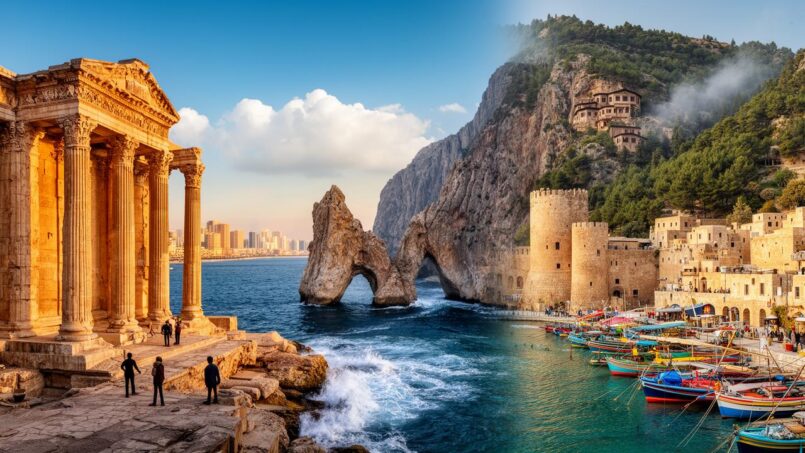
Beirut, the capital and largest city of the country, faces the sea. The corniche that runs along the coast offers a panoramic view of the shoreline and leads to the Raouché Rocks, also known as the Pigeon Rocks. These natural formations rise like two monumental arches emerging from the waves, particularly spectacular at sunset.
The rebuilt city center, or Beirut Central District, combines modern architecture with ancient remains. It houses iconic monuments like the Mohammad Al-Amin Mosque, but also open-air Roman ruins (cardo maximus, baths). These vestiges, sometimes wedged between contemporary buildings, testify to the past of Berytus, a major center of Roman law and culture in the East.
The National Museum of Beirut completes this historical panorama by gathering more than 100,000 objects, of which about 1,300 are permanently displayed, covering a chronology from prehistory to the Mamluk period. Sarcophagi, mosaics, statues, jewelry, and stelae form a unique synthesis of the diversity of civilizations that have succeeded one another on Lebanese soil.
Byblos (Jbeil): Birthplace of the Alphabet and Seaside Resort
About thirty kilometers north of the capital, Byblos – Jbeil in Arabic – accumulates superlatives and records. A UNESCO World Heritage site, it is often cited as one of the oldest continuously inhabited cities in the world, with traces of habitation dating back to the Neolithic. It is also one of the main Phoenician ports, a major player in the spread of the alphabet, whose earliest known inscriptions were found on the sarcophagus of King Ahiram.
The archaeological site spreads around a powerful Crusader castle from the 12th century, built reusing ancient blocks, and surrounded by moats. Visitors explore a layering of remains: Phoenician temples, royal tombs, Persian fortifications, a Roman theater and road, Byzantine churches, medieval and Ottoman walls and constructions. The old port, still usable, today lines up small fishing boats and yachts, while the souk alleys house shops, cafés, fish restaurants, and fossil vendors.
The coast of Byblos also hosts popular beach resorts. Some, like Edde Sands, have long been must-visit spots for Lebanese families, combining sandy beach, pools, and dining. Other trendy places offer music, cocktails, and stunning sunset views. The city, especially in summer, thus becomes a lively mix of open-air museum and festive seaside resort.
Batroun, Anfeh, Chekka: Coastal Villages and Secret Coves
Further north still, Batroun has established itself as one of the capitals of Lebanese coastal “coolness”. A historic city mentioned as early as the Bronze Age, it retains a Phoenician defensive wall that runs along the sea and Roman remains, including a small theater nestled in a guesthouse garden. Its old souk, ancient churches, craft beer bars, and port make it a singular blend of heritage, nightlife, and water sports.
Discover the diversity of beaches, from discreet coves to lively spots, for all tastes and desires.
Rocky areas developed by renowned beach bars, lively places for life and relaxation.
More intimate and preserved inlets and coves for a quiet escape.
Characteristic cove of white pebbles, offering a unique landscape and crystal-clear water.
Free beaches oriented towards surfing or kitesurfing.
Establishments like Colonel Reef or Pierre & Friends, true institutions for music, local beer, and idleness with feet in the water.
Not far away, Anfeh has earned the nickname “Little Greece” with its whitewashed houses adorned with blue shutters, rocks plunging into crystal-clear water, and ancient salt pans carved into the rock. The coast here is mostly rocky, ideal for sunbathing or discovering the seabed with a mask and snorkel. Nearby, natural promontories such as Ras al-Qalaat, Ras Al Natour, or Ras el-Mlelih have been included on the official tourist map due to their environmental, heritage, and cultural importance.
Chekka, further north still, features impressive cliffs, fairly uncrowded beaches, and waters renowned for their clarity, popular with divers and snorkeling enthusiasts. Here again, some public beaches like Nanaya Beach welcome families looking for clean sand, shade, and calm sea.
To better grasp the diversity of major coastal cities, we can summarize some characteristics in a summary table.
| Coastal City | Status / Designation | Main Assets | Beach Features |
|---|---|---|---|
| Tyre (Sour) | UNESCO (ancient city) | Roman hippodrome, necropolis, ancient port, Phoenician heritage | Long sandy beach, calm waters, coastal reserve, wild coves |
| Saida (Sidon) | Historic center on UNESCO tentative list (old town) | Sea Castle, Temple of Eshmun, souks, khan, soap museum | Quiet beaches near the city |
| Beirut | Capital, urban corniche | Pigeon Rocks, rebuilt city center, Roman remains, major museums | Ramlet al‑Baida as main public beach |
| Byblos (Jbeil) | UNESCO (archaeological site) | Multi-millennial city, Crusader castle, port, souks | Beach resorts, private beaches, rocky coves |
| Batroun | Historic center on UNESCO tentative list | Phoenician wall, small Roman theater, souk, craft beer scene | Beach clubs, surf/kite spots, pebble and rock beaches |
| Anfeh | Promontories and coastline on UNESCO tentative list | Salt pans, Mediterranean atmosphere, blue and white houses | Rocks for sunbathing, developed swimming areas |
| Chekka | Coasts and monasteries on cultural map | Cliffs, monasteries, clear waters | Less crowded beaches, ideal for diving |
Naqoura: The Turquoise Secret of the Far South
At the southern tip of the coastline lies Naqoura, often described as a hidden paradise. Here, no large hotel complexes or flashy clubs: only protected turquoise coves, steep cliffs, and an almost untouched environment. Visitation remains low, making it a privileged refuge for those seeking absolute calm, swimming in crystal-clear water, or some snorkeling sessions far from urban hustle. The lack of infrastructure, however, requires self-sufficiency: you must bring everything, from water to food.
The Great Ancient Capitals and UNESCO Sites
Beyond the coastal cities, Lebanon concentrates several sites inscribed on the UNESCO World Heritage list, almost all linked to key periods of Mediterranean history. Giant Roman temples, Phoenician cities, a planned Umayyad city, monastic valleys, and cedar forests tell the story of the evolution of beliefs, arts, and urban planning techniques.
Baalbek: The “City of the Sun” and Its Colossal Temples
In the heart of the Beqaa Valley, Baalbek impresses by the simply disproportionate scale of its monuments. The monumental complex, known in antiquity as Heliopolis, “City of the Sun,” is a UNESCO site for the exceptional quality of its Roman temples and the technical mastery evident in handling stone blocks sometimes exceeding a thousand tons.
The complex notably includes the Temple of Jupiter, considered the largest Roman temple ever built. Built on a raised terrace and accessible by a vast ceremonial staircase, it retains only six of its original columns, but each reaches about 22 meters in height, resting on monumental blocks. The Temple of Bacchus, built nearby, is one of the best preserved in the world: its still-standing peristyle lines up 42 slender columns about 20 meters high, and you can enter the cella to admire the sculpted ceiling reliefs, niches, and altar.
A more modest temple dedicated to Venus, an odeon, porticoed courtyards, stairs, and underground passages complete the picture. Beneath these Roman structures lie older cults, linked to the Canaanite deities Hadad and Atargatis, whose traits the Romans incorporated into their own pantheons.
Archaeology of Cults at Baalbek
A few hundred meters away, the quarry known as Hajar el-Hibla reveals the behind-the-scenes of this titanic construction site: several unfinished stone blocks, including one nearly 20 meters long weighing an estimated 1,000 tons and another approaching 1,650 tons, testify to quarrying and transport techniques that continue to amaze modern engineers.
Anjar: The Umayyad City Frozen in Time
Also in the Beqaa, Anjar offers a radically different face. Here, no multiple layers, but a city designed at once in the early 8th century under the Umayyad caliph al-Walid I. Built at the crossroads of trade routes linking Beirut to Damascus and the Beqaa to Galilee, it was conceived as a commercial and administrative center, with a regular plan inspired by Roman urbanism: two main axes crossing at right angles, cardo and decumanus, flanked by colonnades and rows of shops.
Today, visitors walk through the ruins of some 600 shops, the remains of palaces, a mosque, Roman-inspired baths, and an enclosure punctuated by 42 towers. The city was never completed and was abandoned after the fall of the Umayyads, which explains this impression of an interrupted construction site, left intact.
After the rediscovery of the ruins in the late 1940s, a large Armenian community settled near the site, giving the current village a culture and face unique within the Lebanese landscape.
Tyre, Byblos, Saida: The Network of Great Phoenician Cities
The three major coastal cities already mentioned – Tyre, Byblos, and Saida – are at the heart of Phoenician history. Tyre and Byblos are officially inscribed as UNESCO sites; Saida is on the tentative list with its historic center and citadels.
Byblos stands out for its exceptional continuity of occupation, bringing together Neolithic remains, Egyptian temples, Phoenician royal necropolis, Persian structures, Roman theater and road, Crusader castle, medieval walls, and Ottoman quarter. Tyre illustrates Phoenician maritime power, the prosperity of the Roman period, and the layering of eras up to the Crusaders. Saida completes this triptych, with Phoenician and Roman layers overlaid by Crusader, Mamluk, and Ottoman monuments.
Archaeology and ancient sources converge to describe these cities as pivots of Mediterranean civilization: spread of the alphabet, production of purple dye, trade in papyrus, export of cedar wood for great fleets.
Qadisha and the Cedars: Sacred Mountain Landscape
Another UNESCO site, the pair formed by the Qadisha Valley and the Cedars of God forest, embodies the spiritual and natural dimension of inland Lebanon. The valley, carved by a river that has deeply cut into the slopes of Mount Lebanon, served as a refuge for Christian communities from late antiquity. Monasteries, hermitages, chapels, and funerary caves dot its walls, sometimes literally carved into the rock.
The 16th century is when the first printing press in the Middle East was installed in the Qadisha Valley.
Above, the Cedars of God forest, near Bcharré, gathers some of the last survivors of the vast cedar forests that once covered the region. Some trees may be over 3,000 years old, their massive silhouettes exceeding 40 meters in height. Exploited for Phoenician shipbuilding and monumental projects of antiquity, the cedar has become a national symbol: it appears in the center of the flag and remains associated with the country’s identity.
Tripoli and Mamluk Abundance
The second city of the country, Tripoli is primarily known for its labyrinthine souks and significant Mamluk heritage. Khans, madrasas, hammams, mosques with colorful domes, and covered alleys form a network still commercially very active, where goldsmiths, soap makers, spice vendors, fishmongers, and leather artisans coexist. Buildings like the Great Mansouri Mosque or the Taynal Mosque, with its green domes, illustrate the architectural refinement of the Mamluk period.
On a nearby hill, the citadel known as Raymond de Saint-Gilles – named after the Crusader leader associated with its initial construction – dominates the city and port. It was heavily remodeled under the Ottomans, but retains many traces of its medieval past. Offshore, the “Palm Islands” archipelago is a nature reserve accessible in season, a refuge for sea turtles and home to a few Roman remains.
Caves, Waterfalls, and High Plateaus: The Great Natural Landscapes
While the coastal strip concentrates most of the population, the interior of the country abounds with spectacular natural sites, often easily accessible for a day trip from Beirut or a major city.
Jeita Grotto: Mineral Cathedral Under the Mountain
Not far from the capital, Jeita Grotto is a vast network of karst caves, considered the longest in the Middle East. The upper part is visited on foot: you walk through a succession of halls adorned with stalactites and stalagmites of all shapes, some of impressive size. The “White Chamber” houses a stalactite 8.2 meters long, considered the largest in the world.
The lower section, meanwhile, is explored by boat along an underground river that supplies fresh water to the Beirut region. This dual experience – silent walking through gigantic volumes, then gliding on a dark watercourse – explains why the cave was a finalist in the New 7 Wonders of Nature competition.
Near the site, a small pop-up market regularly offers local produce and crafts. This allows combining the geological visit with a gastronomic and cultural discovery.
Baatara, Afqa, Jezzine: Spectacular Waters
In the mountains of Mount Lebanon, several waterfalls have achieved iconic landscape status. The Baatara Waterfall, near Tannourine, plunges about 255 meters into a sinkhole pierced by three superimposed natural bridges, forming a kind of mineral cathedral where water disappears into the depths. Snowmelt in spring increases its flow and spectacular nature.
Further south, the Jezzine waterfall cascades down a rock face above the town that gives it its name, adding a scenic aspect to this locality also known for its pines, artisanal cutlery, and summer festivals. At Afqa, above the Nahr Ibrahim valley, an imposing cave opens its mouth in a cliff nearly 200 meters high, releasing the waters that will later form the river called Adonis. The place is steeped in ancient myths, particularly around the goddess Astarte and her dying lover.
Cedar Reserves and Protected Biospheres
Beyond the Cedars of God, several nature reserves cover entire slopes of Mount Lebanon and northern Lebanon. The Chouf reserve, stretching over the heights of this Druze region, alone represents about 5% of the national territory. Its slopes, covered with cedars, oaks, and junipers, descend towards the Beqaa Valley on one side and the sea on the other, drawing ridges that look like green waves.
To the north, the Horsh Ehden reserve stands out for its exceptional biodiversity: over 40% of Lebanese flora is said to be represented, and with a bit of luck, you can observe jackals, foxes, hyenas, wildcats, wolves, and birds of prey. Trails wind through mixed forests of cedars, oaks, and junipers, alternating open viewpoints and dense undergrowth.
The Jabal Moussa massif, classified as a UNESCO Biosphere Reserve, illustrates a long interaction between humans and nature. You can find ancient agricultural terraces, millennia-old mule paths, as well as inscriptions and bas-reliefs from the Roman era. Nearby, the Nahr Ibrahim valley combines natural gorge and waterfall landscapes with a cultural heritage including ancient temples and perched villages.
Summits, Lakes, and Plateaus
The highest point in the country, Qornet el Sawda, dominates a nearly lunar landscape above the tree line, popular with experienced hikers and lovers of infinite panoramas. In other areas, the mountains soften to give way to agricultural plateaus or artificial lakes. Lake Qaraoun, in the Beqaa, has thus become a landmark for strolling, birdwatching, and pleasure boating.
Other more modest bodies of water, like Lake Bnachii or the secret pools of Aaqoura, add their touch of azure to the patchwork of landscapes: terraces, apple orchards, sculpted rocks, small sanctuaries, trails leading to viewpoints over the entire valley.
Villages, Palaces, and Places of Memory
Beyond the major flagship sites, Lebanon’s strength also lies in the density of villages with preserved architecture, the seigneurial palaces of Mount Lebanon, unusual museums, and scattered sanctuaries.
Deir el Qamar and Beiteddine: Historical Heart of Mount Lebanon
In the Chouf, Deir el Qamar presents itself as a village-museum: stone houses with red tiled roofs, cobbled streets, small squares, old souks, mosques, and churches coexist in a period setting that once earned the town the title of administrative capital of Mount Lebanon. Palaces such as that of Emir Fakhreddine II recall the time when the Ottoman governors of the mountain reigned from this balcony overlooking the Mediterranean.
Built between the late 18th and early 19th centuries for Emir Bachir Chehab II, this palace is a masterpiece of Lebanese architecture, blending Ottoman, Mamluk, and Oriental Baroque styles. Designed by an Italian architect, it includes arcaded courtyards, monumental staircases, salons with painted ceilings, mashrabiyas, terraced gardens, and private hammams. Its former stables, once able to accommodate hundreds of horses and soldiers, now house a collection of Byzantine mosaics. The upper floors contain an archaeological and ethnographic museum covering several millennia.
Each summer, the site serves as a backdrop for a music and performance festival that brings together local and international artists, extending the palace’s vocation for representation and pageantry.
Bcharré, Ehden, Douma: Mountain Villages
The perched villages of the north tell another Lebanon, one of snowy winters, orchards, and monasteries clinging to cliffs. Bcharré accumulates titles: gateway to the Qadisha Valley, base for hikes to the Cedars of God forest, ski resort in winter, and birthplace of poet and painter Khalil Gibran. The monastery that housed hermits carved into the rock has been transformed into a museum dedicated to the author of The Prophet, gathering manuscripts, paintings, and personal effects repatriated from New York after his death.
Ehden, to the west, offers a view over a wide valley, a lively square, and proximity to the Horsh Ehden reserve. Further south, Douma in the Batroun district stands out for its homogeneous stone architecture with tiled roofs, mainly dating from the late 19th or early 20th century, a heritage from a prosperous period marked by investments from returning emigrants.
Moussa, Smar Jbeil, Beaufort: Castles and Fortresses
Lebanon is full of medieval fortifications or those inspired by the medieval. Among the most unique, Moussa Castle near Deir el Qamar is no ancient bastion: it is a castle built in the 20th century by one man, Moussa Abdel Karim al-Maamari, who devoted over twenty-five years of his life to realizing his childhood dream, stone by stone. Inside, scenes of Lebanese rural life and collections of weapons and everyday objects make up a naïve but moving museum.
Smar Jbeil, on a height overlooking the coast between Jbeil and Tripoli, houses a citadel whose origins may date back to the Phoenicians, later reworked by Romans, Crusaders, and Maronite lords. The site, very panoramic, embraces the coast from Byblos to Tripoli and the snowy peaks of the north.
Located in the south, Beaufort Castle, built during the Crusades and reinforced under the Ottoman Empire, dominates the Litani Valley from a rocky peak. It once controlled the routes between the interior and the coast. Today, it offers visitors a wide panorama over southern Lebanon and the surrounding mountains.
Places of Memory and Urban Museums
In addition to the National Museum of Beirut and the Gibran Museum, other institutions complete the understanding of the country. The Sursock Museum, housed in a bourgeois mansion in Beirut, is dedicated to modern and contemporary art, while also housing historical pieces such as an ancient jar, an old printed copy of the Quran, and an early Bible.
In the souks of Byblos, the small museum “Memory of Time” displays an impressive collection of marine fossils, some dating back nearly 100 million years: fish, rays, crustaceans preserved in stone, telling the time when these mountains were still under the sea. In Sidon, the Soap Museum offers an immersive journey into the history of this flagship product of the Levant, from cold-process manufacturing to the geometric shapes sold today in boutiques.
Finally, some more recent sites, like the Rachid Karami International Fair in Tripoli, designed in the 1960s by Brazilian architect Oscar Niemeyer, have also entered the UNESCO World Heritage list as witnesses to an unfinished modernist project now threatened by lack of maintenance.
Beaches, Clubs, and the Art of Living by the Water
Even though beaches are just one aspect among others, they strongly structure the tourist experience. The beach season generally runs from April to October, with a peak between June and September. The coastline alternates between free public beaches, private complexes with entry fees, and wild coves.
We can bring together some practical data in an indicative table.
| Type of beach / club | Entry price range (indicative) | Customer profile | Typical services |
|---|---|---|---|
| Public beach (Tyre, Ramlet al-Baida, some beaches in Batroun, Chekka) | Free | Families, groups of friends, locals | Sand or pebbles, free sea access, sometimes basic shower, mobile vendors |
| Affordable beach club | About 5 to 15 USD | Youth, families, passing visitors | Sun loungers, umbrellas, showers, sometimes pool, simple food service |
| Mid‑range to luxury beach club | About 20 to 45 USD (often more expensive on weekends) | Public seeking comfort, festive or chic atmosphere | Multiple pools, balinese beds, cocktail bars, refined restaurants, live music or DJ, towels provided |
| Remote “nature” spot (Naqoura, coves of Anfeh or Amchit) | Free, but difficult access | Lovers of tranquility, snorkeling, photography | Few or no services, need to bring everything, preserved environment |
Jiyeh and Damour, south of Beirut, well illustrate the rise of beach clubs with a strong identity. In Jiyeh, places like Lazy B are designed as relaxation havens, combining sandy beach, natural pools carved into the rock, swimming pools, lawns, and bars facing the setting sun. Others, like Orchid, target an adult clientele seeking a high-end experience: beach beds, attentive service, sleek design, ambient music.
Damour has specialized in establishments with careful design, blending wood, stone, and vegetation, sometimes reserved for adults. These places pay as much attention to their cocktail menu as to the quality of the view, thus contributing to a seaside lifestyle that significantly shapes the country’s image, especially among regional visitors.
Markets, Cuisine, and Everyday Experiences
Discovering the “must-see tourist sites in Lebanon” is not just about checking off Roman temples and cedar forests: it’s also about entering the souks, tasting local cuisine, smelling the spices, and listening to conversations over coffee.
The traditional markets of Tripoli, Saida, or Byblos remain key places to immerse yourself in daily life. You can find fabrics, artisanal soap, pottery, jewelry, spices like sumac, zaatar, turmeric, as well as fresh produce, olives, olive oil, fish. The Tripoli market, in particular, is considered one of the largest and oldest in the country, with its medieval khans and covered alleys.
The weekly farmers’ market Souk el Tayeb in Beirut illustrates an initiative that brings together producers from all regions of the country. You can find organic products, artisanal cheeses, flatbreads, thyme blends, pomegranate molasses, and arak. Its aim is to bring together diverse communities around food, carrying a message of coexistence.
Lebanese cuisine, centered on whole grains, vegetables, legumes, olive oil, fish and seafood, is particularly suited to sharing: mezze including hummus, tabbouleh, mutabbal, stuffed vine leaves, falafel, assorted grilled meats, kibbeh, sfiha, kafta. In each region, specialties stand out: kibbeh in the south, pastries in Tripoli, arak and wines in the Beqaa, grilled fish in Tyre, Saida, or Byblos.
Practical Tips and Preservation Challenges
To fully enjoy the sites, a few simple recommendations are essential. Mountain sites like Qadisha, the cedar reserves, or peaks above 1,500 meters require starting early, bringing layers of clothing, plenty of water, sun protection, and appropriate footwear. Altitude can be surprising, as can rapid weather changes.
On the coast, the beach season generally runs from spring to autumn, but the most popular clubs are fully booked on weekends: it’s better to reserve and ask about rates, which vary by day. Some establishments – especially the most exclusive beach clubs – require reservations and an adult clientele.
Faced with urban, economic, and regional pressures, major sites like Baalbek and Tyre benefit from enhanced international protection, supported by satellite monitoring programs and financial assistance for their preservation.
For the visitor, the best contribution is often the simplest: respect the places (do not climb on fragile structures, do not take anything, do not leave waste), choose local operators that value neighboring communities, and inform yourself about safety recommendations related to weather, sea conditions, or hiking trails.
A Country Where Everything Touches
Ultimately, what makes Lebanon’s must-see tourist sites so unique is the extreme proximity of very different realities. In a few days, you can walk on the paving stones of a Roman forum at Baalbek, descend an underground river at Jeita, sit in the shade of a multi-millennial cedar, get lost in a medieval souk in Tripoli, drink a coffee facing the Sea Castle in Saida, swim on Tyre beach, then dine in a Byblos restaurant with a view of a Phoenician port.
This density of sites, combined with hospitality often highlighted by travelers, makes the country a concentrate of the Mediterranean, where sea, mountain, cults, empires, and cultures constantly meet and respond to each other. Provided you take the time to look behind the facades and beyond the clichés, Lebanon then reveals what is most precious: an exceptional memory, inscribed both in its landscapes and in the daily lives of its inhabitants.
Disclaimer: The information provided on this website is for informational purposes only and does not constitute financial, legal, or professional advice. We encourage you to consult qualified experts before making any investment, real estate, or expatriation decisions. Although we strive to maintain up-to-date and accurate information, we do not guarantee the completeness, accuracy, or timeliness of the proposed content. As investment and expatriation involve risks, we disclaim any liability for potential losses or damages arising from the use of this site. Your use of this site confirms your acceptance of these terms and your understanding of the associated risks.

Cyril Jarnias is an independent expert in international wealth management with over 20 years of experience. As an expatriate himself, he is dedicated to helping individuals and business leaders build, protect, and pass on their wealth with complete peace of mind.
On his website, cyriljarnias.com, he shares his expertise on international real estate, offshore company formation, and expatriation.
Thanks to his expertise, he offers sound advice to optimize his clients' wealth management. Cyril Jarnias is also recognized for his appearances in many prestigious media outlets such as BFM Business, les Français de l’étranger, Le Figaro, Les Echos, and Mieux vivre votre argent, where he shares his knowledge and know-how in wealth management.





