
 Published on and written by Cyril Jarnias
Settling in Burundi means entering a country where religion shapes the rhythm of the week, holidays, the way people greet, dress, celebrate, and even make peace after crises. For an expatriate, understanding this rich and sometimes complex religious landscape is not a cultural luxury—it is a key to living harmoniously with neighbors, colleagues, and local partners.
This guide outlines the main religious practices and associated social codes of a destination. It offers tips for respectfully participating in local life while maintaining your own identity.
A Highly Religious Country, Multiple Traditions
The first thing to know is that Burundi is, on paper, a secular state. The Constitution guarantees freedom of conscience and prohibits discrimination based on religion. In practice, however, faith is omnipresent and carries significant weight in social, community, and political life.
Estimates vary by source, but they all agree on one point: the vast majority of the population identifies as Christian. Islam’s role is not marginal either, especially in cities, and traditional religions remain very much alive, sometimes in the background, sometimes blended with Christian faith.
Here is a concise overview of figures from various studies:
| Source / Year | Christians (total) | Catholics | Protestants / Evangelicals | Muslims | Traditional Religions / Other |
|---|---|---|---|---|---|
| 2017 estimate (CIA) | ~94% | 58.6% | 35.3% | 3.4% | 2.3% |
| 2008 estimate (census) | – | 62.1% | 23.9% (incl. 2.3% SDA) | 2.5% | 3.7% + 6.1% unaffiliated |
| 2022 observation | 92% | 65% | 37% | ~2% | ~6% indigenous religions |
| 2024 estimate (aggregated) | 93.8% | – | – | 2.1% | 3.9% ethnic religions |
Beyond these percentages, three realities matter for an expatriate. First, Catholicism has long structured education, healthcare, and much of the national agenda, with holidays like Christmas, Easter, and All Saints’ Day officially recognized. Second, a dynamic Protestantism—Anglican, Baptist, Evangelical, Pentecostal, Adventist—is growing rapidly, especially in cities. Finally, Islam, numerically a minority, is old and deeply rooted in certain neighborhoods, particularly around Lake Tanganyika.
In Burundi, many believers create a personal ‘religious map’ that combines Christian references, such as attending Sunday mass, with ancestral beliefs, like consulting a traditional healer for a serious illness or fearing curses attributed to sorcerers. This syncretism, often implicit, profoundly influences attitudes toward illness, death, fertility, and success.
Traditional Heritage: Imana, Ancestors, and the Invisible World
Before the arrival of Christian missions, religious life was based on a set of so-called “animist” beliefs, where the visible world is constantly interwoven with the world of spirits. This traditional foundation did not evaporate with Christianization; it continues to shape ways of thinking, even among those who consider themselves very devout.
At the center of these beliefs is Imana, the supreme principle, creator and guarantor of world order. Surrounding him are forces closer to humans: the spirits of ancestors, spirits tied to places (hills, springs, trees, rocks), and a whole range of beneficial or malevolent powers.
Ancestors, called abazimu, are crucial intermediaries. They can protect the family, bring fertility, good harvests, and healing, but they can also send misfortune if disrespect is shown. Rituals such as offerings of sorghum beer, prayers, and collective ceremonies aim to ensure their benevolence.
This importance given to the abazimu is found in several key life moments:
| Life Moment | Main Religious and Cultural Markers |
|---|---|
| Birth and first weeks | Ceremonies presenting the newborn, blessings, protection rituals |
| Baby naming | Ritual where the baby is presented to the four cardinal points and receives a name |
| Marriage | Family ceremonies where ancestors are often symbolically associated |
| Death and mourning | Prayers, speeches, abstinence from certain activities for close family |
| Harvests and seasons | Agrarian festivals (like umuganuro) linking ancestors, fertility, and community |
This invisible world also fuels belief in witchcraft. The abarozi (sorcerers) are accused of “working” against someone by sending illness, accidents, or sterility, sometimes using symbolically “poisoned” objects. This climate of suspicion still exists and influences social relations, discretion around pregnancy, reluctance to discuss certain misfortunes, mistrust of strangers, or even distrust of close relations.
For an expatriate, it is neither necessary nor advisable to judge local beliefs. However, it is essential to understand that they are taken very seriously and influence behaviors that might otherwise seem irrational. It is recommended to approach these topics with great tact, avoid any form of irony, and keep in mind that religion, in this context, is not limited to Sunday practice.
Christianity in Daily Life: Churches, Rites, and Etiquette
With nearly six to nine out of ten Burundians identifying as Catholic depending on the source, and a significant proportion of Protestants, churches are everywhere: large cathedrals, Anglican or Lutheran temples, neighborhood chapels, evangelical prayer rooms, and “cell” type communities like Christian Life Missions.
Sunday, the Pivot of the Week
In most regions, Sunday is reserved for worship and rest. Worshipers attend mass very early in the morning or during the morning. Protestant communities, particularly evangelical ones, may offer several successive services, sometimes accompanied by long sessions of praise, dance, and prayer.
Planning a work meeting or professional event on Sunday morning is frowned upon. Many Burundians consider this time slot non-negotiable. Even in secular or international settings, respecting this religious calendar is a mark of respect.
Dress, Attitude, and Participation
Etiquette in Burundian churches remains broadly conservative, even when the style is very lively (music, dance, enthusiastic preaching). Worshipers place importance on “dressing for God”: dresses or skirts at knee length or longer for women, clean shirts or polos for men, clothing that is both decent and neat.
Several principles apply regardless of denomination:
– cover shoulders and knees, avoid low necklines, very short skirts, tight or transparent tops;
– ban provocative slogans or political messages on t‑shirts;
– avoid shorts, except for very young children;
– remove hats or caps indoors, for men.
Modest “business casual” works almost everywhere. In some parishes, especially those of orthodox or more traditional inspiration, expectations are even stricter: skirt or dress below the knee, no tank tops, possibly a headscarf for women, no tight pants. For an expatriate, observation is your best ally: if you see that women in the community consistently wear long skirts, adapt out of respect, even if no one will make an explicit comment.
The normal prayer posture is standing. Sitting is tolerated as long as you avoid a nonchalant attitude (no crossed legs or arms). It is important not to move around or leave during key moments: readings, Eucharistic prayer, homily, and communion distribution. Arriving late or leaving immediately after communion is considered disrespectful.
Generally, worshippers—including foreign visitors—are expected to turn off their phones, refrain from chewing gum, chatting during the sermon, or getting up to take photos. Conversations take place after the service ends, often in front of the church, in a friendly atmosphere.
Observe Without Sharing Everything
You will never be obligated to participate in the rites themselves (communion, specific gestures, particular prayers) if you are not of that denomination. Custom dictates that visitors stand when others stand, remain silent, perhaps join their hands, and simply bow or observe during communion.
For more solemn celebrations—weddings, funerals, major liturgical feasts—the principle remains the same: follow the flow, perhaps ask questions of a companion or the person accompanying you, avoid any ostentatious gesture that could be interpreted as disapproval or mockery. In some circles, kissing a priest’s hand or asking for his blessing is a sign of great deference; in others, a simple handshake suffices. Again, watching how others do it will prevent missteps.
Islam in Burundi: History, Neighborhoods, and Practices
Even though numerically a minority, Burundian Islam has an ancient history, especially along Lake Tanganyika. Long before the founding of Bujumbura, Islamized Swahili trading posts already existed on the Burundian shore, notably at Rumonge and Nyanza-Lac. These centers were connected to other Swahili towns like Ujiji and formed an active commercial and religious network.
Bujumbura, Formerly a Majority-Muslim City
When Bujumbura took shape under colonization, the city was still largely Muslim. An early neighborhood—Mbugani— housed a mosque that served as the Friday mosque until the 1930s. Around it, families of Swahili, Arab, Indian, and African Muslim origin organized, structured by community solidarity and hospitality. A committee managed festivals, hosted visiting preachers, and organized prayers.
Belgian colonization changed the situation. The city was redesigned: the former Swahili heart became the “Asian quarter,” reserved mainly for Muslim Indians and Arabs, and the African Muslim population was relocated to Buyenzi. A notable, Ibrahim Kibombo, financed the construction of the mosque that would become the new grand Friday mosque. Sufi brotherhoods such as the Qadiriyya spread their teachings from Bujumbura, Gitega, Rumonge, and Muramvya.
Reformist missionaries spent several years in Bujumbura teaching and preaching, influencing a segment of the Swahili Muslims.
Mosques and Religious Life Today
In the capital, the Central Mosque, near Avenue de la Révolution, remains a major landmark, heavily frequented on Fridays. The Buyenzi neighborhood hosts several Sunni mosques but also a Shia community and an Ahmadiyya community, each with its own prayer spaces and educational activities.
An expatriate can easily notice the rhythm of Muslim prayer throughout the day: the call to prayer resounds five times, very audible especially in majority-Muslim neighborhoods. Around these times, some shops close for a few minutes for prayer. The atmosphere of major festivals—Eid al-Fitr marking the end of Ramadan, Eid al-Adha—is felt in the bustle of the streets, festive clothing, shared meals, and an accentuated collective generosity.
Visiting a Mosque: What to Know
Not all mosques are open to non-Muslims, especially during the Friday prayer. Some communities welcome visitors during the week, particularly if you are accompanied by a local believer. Others prefer to remain discreet. Before going, always ask a Muslim contact or the mosque leader if entry is possible and under what conditions.
The basic rules are simple:
– clothing covering arms and legs for everyone; for women, a headscarf covering hair is generally required;
– remove shoes before entering the prayer hall; clean socks are appreciated;
– low voice, phone off, minimal movement;
– always ask permission before taking photos, especially if there are worshippers in prayer or reading the Quran;
– respect separated areas for men/women and any reserved zones.
Observing a prayer—even from a discreet corner—offers valuable insight into the community dimension of Burundian Islam: alignment of rows, synchronization of movements, importance of Friday, and the role of the sermon (khutba) in conveying messages to the community.
Dress Codes: City, Countryside, and Places of Worship
The dress norm in Burundi is broadly conservative, even if large cities like Bujumbura display very westernized styles. This conservatism stems as much from religious values as from social customs.
Expectations can be summarized as follows:
| Context | Main Expectations for Attire |
|---|---|
| Street / urban settings | Western style accepted but avoid very short or tight clothing |
| Villages and small towns | More covered attire; long skirts or wrappers very common for women |
| Churches | Shoulders and knees covered, clean and modest clothing |
| Mosques | Arms and legs covered; headscarf for women; shoes removed |
| Traditional religious sites | Maximum respect: avoid overly bright colors or “flashy” outfits |
For women, outside of certain very liberal urban circles, shorts, very short skirts, or tops revealing the midriff are almost always too much. In rural areas, women rarely wear pants; an expatriate woman in pants will not necessarily be criticized, but a skirt or long dress will be perceived as more respectful.
For men, shorts are mainly worn for sports or informal leisure. In more formal settings, such as in the countryside, during family visits, or in churches, it is better to wear long pants with a shirt or polo.
Color and form also matter. Overly loud clothing, with aggressive or political messages, or reminiscent of military or camouflage uniforms, can cause problems—including with authorities. Sober or warm colors (earth tones, blue, white, traditional patterns) are widely appreciated.
Practical Tips for Expatriates
A simple strategy is to adopt layering: a short-sleeved t-shirt or shirt, over which you add a light cardigan or scarf to cover shoulders and chest when entering a church or mosque. A large shawl or pashmina can serve as a shoulder cover, an improvised skirt to lengthen a too-short garment, or a head covering.
For visits to mosques or certain Asian temples where you must remove shoes, choose closed-toe shoes that are easy to take off and put back on. This avoids awkward situations at the entrance. Also consider bringing clean socks, out of respect for the place and for hygiene.
Greeting, Speaking, Conduct: Religious and Social Politeness
One cannot understand religious practices in Burundi without closely examining codes of politeness, which are also marked by ideas of respect, restraint, and hierarchy—values very present in all the country’s faith traditions.
The Art of Greeting
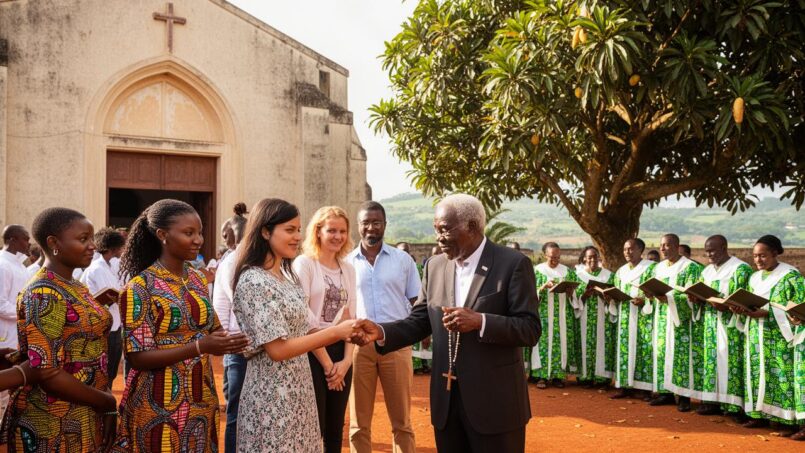
The greeting is almost ritualistic. A handshake with the right hand—sometimes enveloped by both hands—is the norm. Supporting the right hand by lightly placing the left on the forearm is a sign of regard. People often ask “Amakuru?” (“How are things?”), and respond “Ni meza” (“Things are fine”). Skipping this step to immediately get down to business is frowned upon, especially with elders or people of high status.
In religious contexts, it is important to greet elderly people, religious authorities, and heads of families first. A slight lowering of the head or upper body before an elder is a welcome gesture of modesty, particularly in rural areas. In conservative circles, a man should wait for a woman to extend her hand before initiating a handshake.
Physical displays of affection (hugs, kisses in public) are rare and sometimes frowned upon, even between spouses. Among close friends, however, the handshake may extend into an embrace, a pat on the shoulder, a brief hug—signs of affection and trust.
Speaking with Restraint
In a society marked by the weight of past conflicts, a climate of mistrust (also fueled by fear of witchcraft) and a strong emphasis on dignity, people avoid raised voices, aggressive gestures, and public scenes. Showing impatience, raising your voice at an employee or interlocutor, constantly interrupting, or laughing loudly in a solemn setting can be very poorly received.
Certain topics, such as politics, ethnic affiliation, the history of violence, or the role of communities during crises, are extremely sensitive. To succeed in a long-term expatriation, it is crucial to learn to steer conversations toward more neutral and consensual subjects, such as cuisine, nature, football, culture, music, or religion approached from a spiritual and non-partisan angle. When delicate subjects come up, it is recommended to listen actively rather than speak.
Photography and Privacy
In a country where religion, tradition, and dignity are intertwined, taking a photo is never innocent. Photographing a mourning ceremony, a religious festival, a traditional rite, or even simple passersby without asking permission can be interpreted as an intrusion, even a form of disrespect.
Asking politely, smiling, explaining what you intend to do with the images, accepting a refusal, and, if appropriate, offering a small pre-agreed tip in some contexts are habits appreciated. In places of worship, a yes from a responsible person is worth far more than a “no one told me no”.
Family Ceremonies and Rites of Passage
A large part of Burundian religiosity is expressed in the major moments of life rather than in theological debates. Birth, naming, marriage, funerals, harvests: at each stage, a combination of Christian, Muslim, or traditional gestures emerges depending on the family.
Birth and First Weeks
Birth, very often at home in rural areas, is surrounded by precautions. Pregnancy itself is sometimes hidden as long as possible, for fear of jealousy or spells supposedly cast by sorcerers. After delivery, the mother and child are surrounded by women from the family, neighbors, and traditional midwives.
After birth, a ‘coming out’ ceremony marks the return of the mother and child to the community. The child is presented to the extended family, and the mother receives gifts (money, drinks, flowers). An elder, often the paternal grandfather, then bestows the official names and nicknames according to a codified rite. In some traditions, the baby is turned toward the four cardinal points to place it under the symbolic protection of the entire world.
Christian families will add a sacramental dimension with baptism; Muslim families may organize a naming ceremony including recitation of verses, invocation, and sometimes a ritual sacrifice.
Mourning, Prayers, and Silence
Death gives rise to very structured rituals. Beyond religious services (funeral mass, Muslim prayers, scripture readings), a mourning period begins for the relatives, marked by abstaining from certain activities: no field work, no festivities, no sexual relations for the surviving spouse for a set time. Funeral vigils mix prayers, songs, speeches, and sometimes accounts of the deceased’s life.
If invited to a funeral as an expatriate, wear sober clothing, avoiding festive colors. Position yourself at the back if you are not family or from the same religious community. Follow others’ gestures (stand, sit, bow) and remain composed. Offer your condolences with simple words; expressing them in Kirundi is particularly appreciated.
Festivals, Drums, and the Sacred Dimension of Celebrations
The Burundian calendar is punctuated by a mix of national holidays, major Christian celebrations, Muslim festivals, and traditional festivities, often tied to the agricultural cycle.
A Land of Drums and Festivals
The royal drum, karyenda, is undoubtedly the most spectacular symbol. Originally linked to the monarchy and major state ceremonies, it is now inscribed on UNESCO’s Intangible Cultural Heritage list and resonates during festivals, national holidays, and sometimes even in Christian liturgies where the line between religious and cultural blurs.
Festivals like the Drum Festival in Gitega or the grand performances of the Master Drummers showcase this tradition. Added to this is a constellation of events:
Discover Burundi’s cultural richness through its national celebrations, agrarian rituals, and contemporary artistic events.
Celebrations of Independence Day and National Unity, blending official parades, traditional dances, songs, and drum performances.
Agrarian ceremonies of thanksgiving for harvests and blessing of seeds, combining ancestral rites and sometimes Christian prayers.
Artistic events where rap, reggae, gospel, choirs, and traditional troupes coexist, reflecting modern cultural diversity.
In villages, festivals often have a more directly religious character. Celebrating a good harvest, a marriage, or a return from exile is accompanied by prayers, symbolic libations for ancestors, ritual songs and dances.
Christmas, Easter, Ramadan, and Eids
The major Christian holidays—Christmas, Easter, All Saints’ Day—are public holidays marked by masses, processions, songs, and family meals. Churches fill up, sometimes for vigils lasting several hours with alternating Bible readings, polyphonic songs, and testimonies. Festive attire, often in colorful wax fabric, mingles with more classic imported clothing, reflecting the diversity of social backgrounds.
Ramadan, the fasting period, slows down daily life and concludes with generous family meals. The two Eids (al-Fitr and al-Adha) are marked by communal prayer, charity, family visits, and gestures of solidarity.
For a non-Muslim expatriate, taking this calendar into account in professional exchanges with Muslim colleagues—meeting times, lunch invitations—is a sign of consideration that is highly appreciated.
Religion, Peace, and Tensions: A Nuanced Landscape
In a country marked by decades of political violence and tensions between Hutu and Tutsi, religious institutions have played an ambivalent role. They have sometimes fueled divisions, but they have also served as refuges and places of mediation.
During conflicts, places of worship like churches and mosques served as asylum for hunted people. Religious leaders engaged in peace, reconciliation, and trauma-healing initiatives, notably through ecumenical or interfaith projects. For instance, the Interfaith Council of Burundi brings together Catholic, Protestant, Muslim, and Lutheran representatives to work on social cohesion, land dispute management, and community reconciliation.
Specific programs use religious rituals as support for healing: sharing sessions, common prayers, symbolic gestures, integrating dance, song, and even drumming into processes of “mending the social fabric.”
At the same time, the strict legal framework requiring registration of faith communities, surveillance of certain churches deemed too critical of the government, and the closure of unauthorized places of worship remind us that religious freedom, while recognized, remains under tension. For an expatriate, this means it is best to avoid publicly commenting on relations between the government and any given church, or implicit controversies between “major” historical churches and new evangelical movements.
In this abundant context, a few reflexes greatly facilitate integration.
First, learn a few words of Kirundi— Amahoro (hello/peace), Murakoze (thank you), Amakuru? (how are things?) —this opens doors. Using these phrases in church, at the mosque, in a family, or with a neighbor shows a willingness to engage with the culture.
Accepting an invitation to a religious or family event is an honor. As a non-believing observer, it is important to show respect by keeping a low profile and avoiding critical comments. If a situation, such as pressure to participate in a rite, makes you uncomfortable, you can calmly explain your position or politely decline to participate at that moment.
When choosing conversation topics, speaking about the spiritual dimension of life—what faith brings to people, how it helps them endure hardships—is often better received than launching into a theological debate or making comparisons between religions. Above all, avoid presenting others’ faith as “backward” or “superstitious,” even if some practices disconcert you.
In professional projects related to education, health, or rural development, collaborating with local religious structures (parishes, Muslim associations, evangelical churches) is often essential. Understanding their social role helps build stronger partnerships, while maintaining confessional neutrality if your organization requires it.
Finally, in your daily life, keeping a few simple references in mind—Sunday morning for Christians, the five calls to prayer for Muslims, discretion on sensitive subjects, priority given to elders in interactions—is often enough to avoid awkwardness. Respectful curiosity, more than exhaustive knowledge of every rite, remains the best compass.
Conclusion: A Faith That Structures Living Together
In Burundi, religion is neither a simple identity marker nor a strictly private matter. It is embodied in greetings, clothing, festivals, solidarities, tensions, ways of resolving conflicts, and facing grief. It unfolds in packed churches, neighborhood mosques, clearings where ancestors are invoked, faith-based schools, reconciliation programs, and prayer vigils where past violence is mourned.
For an expatriate, grasping the local religious landscape allows for a better understanding of social and professional behaviors. It explains, for example, refusals to attend meetings for religious reasons, insistent invitations to ceremonies, the profound impact of rumors linked to beliefs like witchcraft, or the central importance of community activities such as choirs or drum groups.
Respecting these practices is not about renouncing your own worldview; it is about recognizing that, for most Burundians, faith—Christian, Muslim, or ancestral—is a fundamental language for expressing suffering, hope, justice, and peace. It is on this foundation that the daily coexistence you are now called to participate in is built.
Disclaimer: The information provided on this website is for informational purposes only and does not constitute financial, legal, or professional advice. We encourage you to consult qualified experts before making any investment, real estate, or expatriation decisions. Although we strive to maintain up-to-date and accurate information, we do not guarantee the completeness, accuracy, or timeliness of the proposed content. As investment and expatriation involve risks, we disclaim any liability for potential losses or damages arising from the use of this site. Your use of this site confirms your acceptance of these terms and your understanding of the associated risks.

Cyril Jarnias is an independent expert in international wealth management with over 20 years of experience. As an expatriate himself, he is dedicated to helping individuals and business leaders build, protect, and pass on their wealth with complete peace of mind.
On his website, cyriljarnias.com, he shares his expertise on international real estate, offshore company formation, and expatriation.
Thanks to his expertise, he offers sound advice to optimize his clients' wealth management. Cyril Jarnias is also recognized for his appearances in many prestigious media outlets such as BFM Business, les Français de l’étranger, Le Figaro, Les Echos, and Mieux vivre votre argent, where he shares his knowledge and know-how in wealth management.





