
 Published on and written by Cyril Jarnias
Moving to the British Virgin Islands means entering a society where faith structures daily life, the calendar, and much of social life. For an expatriate, understanding this religious dimension is essential, not only to avoid missteps but especially to integrate into a close-knit, warm, and deeply believing island community.
This guide explains how religion structures local life, introduces the main churches, indicates appropriate behavior in a place of worship, and shows how spirituality intertwines with popular traditions, particularly through beliefs like Jumbies or Obeah.
A largely Christian territory, yet religiously diverse
The British Virgin Islands are officially a British Overseas Territory, but in daily life, it is above all a Caribbean, Black, and very Christian society that reveals itself. The preamble to the Constitution begins with a profession of faith in God, which sets the tone.
According to 2010 census data, more than 90% of residents who declare a religious affiliation identify as Christian. Protestants dominate overwhelmingly, with a mosaic of denominations. The table below provides an overview of the distribution of the main Christian groups within the population.
Weight of the main Christian denominations
| Denomination (2010) | Share of the population |
|---|---|
| Methodists | 17.6% |
| Church of God | 10.4% |
| Anglicans | 9.5% |
| Seventh-day Adventists | 9.0% |
| Pentecostals | 8.2% |
| Baptists | 7.4% |
| New Testament Church of God | 6.9% |
| Roman Catholics | 8.9% |
| Jehovah’s Witnesses | 2.5% |
Beyond this Christian bloc, the religious landscape remains varied. Hinduism and Islam are the other two major organized religions, even if they involve only a small minority. There are also marginal followers of Rastafari, Buddhism, Judaism, and the Bahá’í faith. A significant portion, around 8%, declares no religion, which does not prevent a very strong Christian cultural imprint.
Non-Christian religions and no religion
| Category (2010) | Share of the population |
|---|---|
| Hindus | 1.9% |
| Muslims | 0.9% |
| Rastafarians | 0.6% |
| Buddhists | 0.2% |
| Jews | 0.04% |
| Bahá’ís | 0.04% |
| No religion declared | 7.9% |
For an expatriate, this means that even if the majority of conversations and cultural references will be Christian-inspired (Bible, prayers, hymns, thanks to God…), it is possible to belong to other traditions or follow none without living in a hostile climate. The head of the BVI Islamic Society thus described relations as “very welcoming” with Christian communities, highlighting good interfaith cohesion.
A Methodist and Anglican heritage at the heart of local history
To understand the place of religion today, we must go back to the end of the 18th century. The first Christian missions aimed at the enslaved population arrived with the Methodists as early as 1789. Dr. Coke and Reverend William Hammett landed on Tortola in a context where official Anglicanism was mainly directed at the white planters.
Around 1,500 out of 8,000 people on the Tortola circuit claimed to be Methodists around 1796, the vast majority of whom were slaves.
This rapid spread forced the Church of England to react: an Anglican parish was finally established to regain a foothold in the colony, after having long served almost exclusively the white minority. This dual Methodist and Anglican heritage remains very visible today. Historic Methodist churches on Tortola, often with colorful stained glass, still host Sunday worship, and the local Anglican structure is integrated into the Episcopal Diocese of the Virgin Islands, affiliated with the Episcopal Church of the United States since 1963.
For an expatriate, these roots explain two prominent features of current practice: a strong tradition of Protestant liturgy and a social and educational dimension of the Church, especially in historically Black neighborhoods, where churches and chapels were places of community organization, literacy, and more broadly, symbolic resistance to the colonial order.
Sunday, the hub of religious and family life
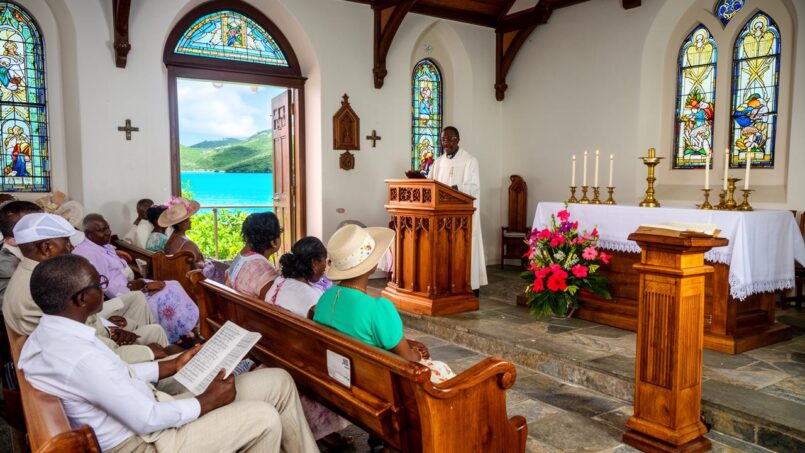
In the British Virgin Islands, Sunday is not just a day of rest. It is a day that combines religion, family, and sociability. Most Christian denominations hold their main service then, with high attendance and well-established dress codes.
The morning often begins with mass or the worship service, dressed neatly, what is locally called one’s “Sunday best”. Women frequently wear a dress or skirt with a blouse, sometimes a hat, stockings and heels. Men favor long pants, a long-sleeved shirt, and depending on the church, a tie or even a full suit. Jeans and shorts are frowned upon in many traditional denominations, although some non-denominational communities are more flexible.
After the church service, the big Sunday meal brings the family together around traditional dishes like roast chicken, fish in sauce, rice and peas, or macaroni and cheese. The afternoon is then devoted to calm, social activities: dominoes or card games, visits to neighbors, or informal chats in the shade of a porch. This atmosphere of collective relaxation is perfectly described by the term “liming,” common in the English-speaking Caribbean, which evokes spending time together casually, without a set agenda.
For an expatriate, accepting an invitation to lunch after a service, or offering to bring a dish to share yourself, is an excellent way to build bonds. It is often around these Sunday meals that conversations about faith, local politics, family anecdotes, and practical tips on island life intertwine.
What types of churches will you find on the ground?
Even though the Christian community is dominant, the local religious landscape is far from uniform. On Tortola as on the other large islands, you will encounter Methodist churches, Anglican parishes, Adventist chapels, large Baptist or Pentecostal complexes, and smaller assemblies, sometimes set up in converted commercial spaces.
Seventh-day Adventists: a structured network
The Adventists form one of the largest denominations, with around 9% of the population. Their organization is well structured around districts, particularly on Tortola.
Several Adventist districts there are attached to the North Caribbean Conference of Seventh-day Adventists. On Tortola, three zones share the island’s churches: a first district covers Road Town and another assembly called Sweet Redemptive; a second includes Carrot Bay and Belle Vue; a third encompasses Purcell, East End, Maranatha, and a Spanish-speaking group. All these communities use the same post office box in Road Town as their official address, illustrating both logistical centralization and the geographic dispersion of places of worship across the island.
On Virgin Gorda, a separate district, centered on The Valley, groups the main church and a group on Anegada. Again, a single pastorate provides spiritual oversight for these two island communities.
For an Adventist expatriate, the local church facilitates integration through familiar liturgical codes (Sabbath worship, emphasis on health, Bible study) and an extensive regional network, including contacts with pastors. For a non-Adventist wanting to discover it, it offers a lively glimpse of local piety, with dynamic singing and strong youth participation.
Anglicans and Episcopalians: liturgy, sacraments, and highlights
Anglican/Episcopal parishes offer a more formal liturgy, similar to what is found in Great Britain or the United States, but with a Caribbean flavor. In one of these churches, the typical weekly schedule includes a Eucharist with hymns as early as 7 a.m., Sunday school for children at 9 a.m., and then a more solemn service at 9:30 a.m., often sung by a choir and broadcast live online.
On weekdays, a Eucharist with intercessory prayers is held on Wednesday mornings, allowing intentions to be placed. On the fourth Wednesday of the month, a specific celebration is dedicated to the healing ministry, combining prayer, optional anointing, and spiritual accompaniment. During major liturgical feasts (Christmas, Easter, Pentecost…), solemn Eucharists are celebrated, potentially including incense, processions, and increased choir participation.
For an expatriate attached to Anglican/Episcopal liturgy, these parishes offer a familiar anchor. For others, they allow an understanding of the importance of rites in building a religious identity that is both local and embedded in a global tradition.
Evangelical and non-denominational churches: expressive Christianity
Alongside the historical traditions, a more charismatic Christianity is growing in prominence. Some large assemblies define themselves as “non-denominational,” with a strong Caribbean identity, contemporary music, very expressive services, and a strong focus on healing, deliverance, or spiritual “revival.”
An emblematic example is the New Life Baptist Church on Tortola, led by a local bishop with a senior pastor from his family. This church presents itself as Caribbean, heavily media-oriented, broadcasting services and major gatherings on regional airwaves and beyond. Regular events like healing campaigns or an annual “PowerPlus” conference illustrate this large-scale evangelical Christianity, both very local and integrated into wider Pentecostal networks in the Caribbean.
For English-speaking evangelical expatriates, these churches offer a familiar worship style (praise, energetic preaching, personal prayer) and are often very welcoming. For others, they represent a discovery of a more demonstrative Christianity, with long sermons, rhythmic singing, and active participation contrasting with the quieter liturgies of the historical churches.
Catholic churches, Jehovah’s Witnesses, and small communities
The Catholic community is smaller, with around 3,000 baptized members spread across two parishes and served by a few diocesan priests and religious. Masses are generally in English, sometimes with adaptations to account for the diversity of the faithful (Caribbeans, Europeans, North Americans, etc.). Jehovah’s Witnesses are also present, with about 250 members, including a group on Anegada.
Alongside these major families, there are smaller groups: Hindus and Muslims, generally linked to South Asian or Middle Eastern immigration; Rastafarians; Jews; Bahá’ís. Each represents less than 2% of the population, but they contribute to the religious diversity of the archipelago. Their presence reminds us that spiritual resources exist for expatriates of other faiths, even if the offerings are incomparable to those in large metropolises.
Where and how to attend a service?
Places of worship are spread across the main inhabited islands, often near urban centers or villages.
Information on services offered by different Christian churches on Tortola, British Virgin Islands.
Sunday service at 11 a.m. Located on Blackburn Highway, in the East End area.
Saturday vigil around 5:30 p.m. and Sunday morning service at 9 a.m.
Sunday service from 9 a.m. to 11 a.m. and Bible study Tuesday early evening. Active on social media. Located in the basement of the building in Road Town.
On Virgin Gorda, a Christian church in The Valley offers a Sunday morning service, around 9:30 a.m. Contact details for these various communities are public and regularly updated, demonstrating a willingness to welcome and be visible, including for those seeking to integrate coming from abroad.
One of the good practices for an expatriate is to do some research before spontaneously showing up at a service. Most churches now have an online presence, sometimes with live streaming of the service, allowing one to assess the community’s style: traditional liturgy or contemporary worship, size of the congregation, primary language, emphasis on music, etc.
Dress codes and attitudes to adopt in places of worship
British Virgin Islands society is generally more conservative regarding dress than what many expatriates encounter in other tourist islands. This conservatism intensifies when it comes to places of worship.
For church visits, even outside service times, it is expected that shoulders and knees be covered. Swimsuits, tank tops, mini-shorts, and very tight clothing have no place in a nave, even for a quick tourist look. The church is first and foremost a place of prayer, and only possibly a curiosity of heritage.
During a service, the expression “Sunday best” takes on its full meaning. For a woman, a dress or skirt below the knee with a top covering the shoulders, closed shoes or elegant sandals are perfectly appropriate. Some older women still wear hats, but this is not required. For a man, light-colored pants (like chinos) and a collared shirt, or even a tie depending on the denomination, are a respectful option suitable for the climate. Jeans may be tolerated in more relaxed evangelical assemblies but are still discouraged in historic churches.
Inside, one should speak in a low voice, especially when people are praying. Avoid moving around during key moments of the service (Scripture reading, sermon, prayers). Taking photos or videos is never automatic: it is best to ask permission from the leader present, especially if congregants appear in the frame.
Finally, keep in mind that in this culture, you do not ask a question or make a request without greeting first. Saying “Good morning” or “Good afternoon” before any interaction is a basic mark of politeness. Omitting this greeting can be perceived as abrupt, even disrespectful, especially from a foreigner.
Religious holidays, public holidays, and economic life
The official calendar of the British Virgin Islands is marked by many public holidays with a strong religious connotation. Christmas, Good Friday, Easter Monday, Pentecost (Whit Monday) punctuate the year, with almost complete closure of businesses and government offices on those days. Added to these are uniquely local celebrations, like the Emancipation Festival in early August, a mix of commemorating the end of slavery and a big public festival with parades, concerts, and religious events.
Number of public holidays with a religious or spiritual-history connection listed in the table.
Some major public holidays and commemorations
| Holiday / Public Holiday | Primary Nature |
|---|---|
| New Year’s Day | Civic holiday with Christian coloring |
| Good Friday | Christian holiday (crucifixion of Christ) |
| Easter Monday | Christian holiday (resurrection) |
| Whit Monday (Pentecost Monday) | Christian holiday (Holy Spirit) |
| Emancipation Monday/Tuesday/Wednesday | Commemoration of the abolition of slavery |
| Christmas Day (December 25) | Christian holiday |
| Boxing Day (December 26) | British tradition (day after Christmas) |
For an expatriate, these dates are not just calendar constraints. They reveal how political history, the legacy of slavery, and faith combine. The Emancipation Festival, for example, coexists with carnival, thanksgiving services, tributes to ancestors, and costumed parades. Participating, even as a discreet observer, allows one to grasp the strength of religious memory in the construction of collective identity.
On a practical level, one must anticipate office closures, restrictions (like the ban on selling alcohol on Good Friday before a certain time) and transport congestion near major events.
Between official faith and popular beliefs: Jumbies, Obeah, and spiritual protections
Behind the very Christian façade of British Virgin Islands society, popular beliefs from the Black Atlantic persist, often rarely admitted but widely shared. Two notions come up frequently: “Jumbies” and Obeah.
Jumbies are spirits, good or bad, believed to haunt the surroundings of houses or certain places, especially at night. You still find the semi-joking phrase “Don’t let the Jumbies get ya!” when saying goodbye to someone in the dark. It brings a smile, but refers to a very lively imagination: that of a world populated by invisible presences, both feared and respected.
Obeah is not a structured religion but a set of magico-spiritual practices, a synthesis of African, European, and Indigenous traditions. Historically present in former British Caribbean colonies, it relies on individual consultations with healers (Obeahmen or Obeahwomen). These practitioners are believed to be able to heal, protect, reveal a theft, influence legal proceedings, or break spells. Rituals use plants, prayers, amulets, and sometimes reinterpreted Christian symbols.
In the British Virgin Islands, Obeah was long explicitly prohibited by law. The old Obeah Act was repealed in 1997, but the current Penal Code still criminalizes presenting oneself as holding occult powers for fraudulent purposes, or using supposedly supernatural means to frighten others. Influential religious leaders, such as some Adventist or evangelical pastors, have publicly condemned these practices, calling them satanic or “not in line with God.”
For an expatriate, it is essential to recognize the cultural importance of local beliefs (like Jumbies or the evil eye) without judging them. Mockery or contempt can hurt, while ostentatious adherence to practices like Obeah, while displaying active church membership, can be perceived as contradictory.
The best approach is to listen, ask questions tactfully if the topic comes up, and respect the boundary that many locals themselves establish between their Christian faith and a universe of popular beliefs they both distrust and inherit.
Religion as a key to integration for expatriates
Beyond the specific case of the British Virgin Islands, many studies show that religion plays a decisive role in the lives of migrants. Research conducted in other contexts (United States, South Africa, Europe…) highlights that expatriates engaged in a faith community tend to feel less loneliness, adapt more quickly culturally, and benefit from stronger social support during their first months.
Expatriates integrated into a local religious community see their feelings of loneliness decrease by a quarter compared to those who remain on the sidelines.
In the context of the British Virgin Islands, where society is small and very relational, this anchoring role is even more pronounced. Attending a service, joining a youth group, singing in a choir, helping with a food drive or a charity event are all ways to meet people outside of work, be positively identified, and have doors opened.
This does not mean you should force yourself into a religious practice that doesn’t suit you. But if you are already a believer, or simply curious, crossing the threshold of a church can become one of the most powerful integration accelerators in the archipelago.
Finding your place: respect, patience, and openness
The golden rule for approaching the religious dimension of life in the British Virgin Islands boils down to three words: respect, patience, openness.
Respect means first adopting local codes: greeting systematically, using formal titles (Mr/Mrs/Ms + last name) until you are invited to use first names, dressing neatly in places of worship, avoiding overly demonstrative public displays of affection, especially near churches. It also means accepting that many daily conversations reference God, prayer, blessing, without systematically steering the discussion onto secular ground.
It is essential to adapt to the local pace of life, often called “island time,” where decisions and meetings may take longer than expected. Projects often follow informal circuits, including religious ones. Trying to speed up processes can be perceived negatively. Integrating into a faith community, even temporarily, helps understand this temporality that prioritizes human relationships over mere productivity.
Openness, finally, consists of letting yourself be surprised: by a hymn sung at full voice in a small wooden chapel, by a sermon that references both the Bible and the history of slavery, by a shared meal where you are served callaloo or fungi while being told that “God is good, all the time.” It means accepting to discover a majority Christianity that is neither that of American megachurches nor that of European cathedrals, but a unique blend of Methodist heritage, Pentecostal fervor, Anglican formality, and popular Creole traditions.
For an expatriate, the local faith is not an exotic backdrop, but a social language. Learning to understand it—even if you don’t speak it—is one of the best ways to feel, one day, a little less like a stranger in the British Virgin Islands.
Expatriate in the British Virgin Islands
Disclaimer: The information provided on this website is for informational purposes only and does not constitute financial, legal, or professional advice. We encourage you to consult qualified experts before making any investment, real estate, or expatriation decisions. Although we strive to maintain up-to-date and accurate information, we do not guarantee the completeness, accuracy, or timeliness of the proposed content. As investment and expatriation involve risks, we disclaim any liability for potential losses or damages arising from the use of this site. Your use of this site confirms your acceptance of these terms and your understanding of the associated risks.

Cyril Jarnias is an independent expert in international wealth management with over 20 years of experience. As an expatriate himself, he is dedicated to helping individuals and business leaders build, protect, and pass on their wealth with complete peace of mind.
On his website, cyriljarnias.com, he shares his expertise on international real estate, offshore company formation, and expatriation.
Thanks to his expertise, he offers sound advice to optimize his clients' wealth management. Cyril Jarnias is also recognized for his appearances in many prestigious media outlets such as BFM Business, les Français de l’étranger, Le Figaro, Les Echos, and Mieux vivre votre argent, where he shares his knowledge and know-how in wealth management.





