
 Published on and written by Cyril Jarnias
Settling in the British Virgin Islands means living year-round under the sun, in warm but rarely extreme heat, carried by the trade winds. On paper, the ultimate dream. In practice, this tropical savanna climate – humid, bright, sometimes oppressive – demands reflexes different from those acquired in Europe or North America. Between constant heat, rainy season, cyclone risk, managing humidity, sun, and water, an expat must learn to “think like an island.”
To thrive in the tropics, it’s essential to understand the local climate, adapt your wardrobe, set up your home to encourage natural ventilation, protect yourself from sun and humidity, prepare for hurricane season, and manage water resources wisely.
Understanding the Climate of the British Virgin Islands
The British Virgin Islands enjoy a tropical savanna climate, sometimes described as tropical maritime or monsoon. This means two essential things for an expat: heat is present twelve months a year, and the year is mostly divided between a dry season and a wet season, rather than between “winter” and “summer.”
Temperatures vary very little month to month. Days typically range between 25 °C and 31 °C, with an annual average around 27 °C. Nights remain mild, rarely below 22 °C. The feeling of heat actually depends more on humidity and wind than on the thermometer itself.
Conditions can be broken down into key climatic periods, which is useful for preparing your move, your activities, and even your home setup.
Seasons: Dry, Wet, and Cyclone Season
The dry season corresponds to winter months in the northern hemisphere, but without cold. From December to April, the air is slightly drier, rain is rarer, evenings are cooler, and sunshine is particularly generous, especially between February and April. This is the high tourist season, with generally the most pleasant weather for newcomers discovering the territory.
The rainy season runs from May to November, with a peak in rainfall and cyclone risk between August and October. During this period, the heat is heavy, the sea very warm, and humidity high. The rains, often violent but brief afternoon showers, usually don’t last all day, but the air remains saturated with water vapor.
To visualize these contrasts, we can compare average temperatures and precipitation by month.
Temperatures and Precipitation: What to Expect Year-Round
Temperature differences are small, but they are enough to modulate thermal comfort, especially at home or at work.
| Month | Avg Temp (°C) | Avg Max (°C) | Avg Min (°C) | Avg Rain (mm) | Sunshine (hrs/day) |
|---|---|---|---|---|---|
| January | ~26.4 | ~26.2 | ~24.8 | ~40–70 | 8 |
| February | ~26.5 | ~26.0 | ~24.7 | ~32 (driest) | 8 |
| March | ~26.4 | ~25.9 | ~24.8 | ~43 | 9 |
| April | ~27.4 | ~26.5 | ~25.4 | ~39–60 | 9 |
| May | ~27.9 | ~27.2 | ~26.0 | ~88–105 | 8 |
| June | ~29.1 | ~28.1 | ~27.0 | ~58–75 | 8 |
| July | ~29.4 | ~28.3 | ~27.2 | ~79–85 | 9 |
| August | ~29.7 | ~28.7 | ~27.6 | ~110 | 9 |
| September | ~29.7 | ~28.9 | ~27.8 | ~113–145 | 8 |
| October | ~29.2 | ~28.7 | ~27.6 | ~111–145 | 8 |
| November | ~27.9 | ~27.8 | ~26.5 | ~119–130 (very wet) | 7 |
| December | ~26.8 | ~26.9 | ~25.5 | ~52 | 7 |
The figures vary by source, but the trends are clear: a warm, humid mid-year (May–October) and a drier, slightly cooler “winter” (December–March). September, October, and November are the rainiest months, and the ones where the air is often heaviest with humidity.
Humidity, Wind, Clouds, and Sea: The Real Face of the Climate
Average annual humidity is around 76%. It drops to about 61% in March, climbing to around 69% in November. In practice, even a gentle walk can make you sweat, especially when the wind dies down.
The trade winds are essential for tempering the heat and making the climate bearable. Although it’s often windy, these breezes prevent the heat from becoming stifling. Note that July and August are the windiest months, while October is much calmer, which can make it feel heavier despite temperatures similar to other periods.
The sea, meanwhile, remains inviting all year. Water temperatures stay between 26 and 29 °C, peaking in September. This makes swimming, diving, sailing, and paddleboarding possible year-round.
| Month | Sea Temp (°C) |
|---|---|
| January | 26–27 |
| February | 26 |
| March | 26–27 |
| April | 26–27 |
| May | 27 |
| June | 28 |
| July | 28 |
| August | 28 |
| September | 29 (warmest) |
| October | 28–29 |
| November | 28 |
| December | 27 |
This marine mildness is an asset for cooling off naturally, provided you manage sun exposure properly and stay hydrated.
Dressing for Heat and Humidity: The Expat’s Wardrobe
In the British Virgin Islands, the wrong outfit comes at a cost: feeling suffocated, heavy sweating, skin irritation, and unpleasant odors. With daytime heat often near or above 29 °C and high humidity, the priority is to let the skin breathe and sweat evaporate.
Choice of fabric matters far more than shirt color or pant cut. Several properties count: the fabric’s ability to let air through, wick moisture, dry quickly, and avoid irritating the skin.
Fabrics to Favor
Lightweight natural fibers remain your best allies. Linen is arguably the most suitable fabric for this type of climate. Made from flax fibers, it offers a loose weave and exceptional breathability. Air circulates easily, moisture doesn’t stagnate, and even when slightly damp, it feels tolerable on the skin. It wrinkles quickly, but in the Caribbean, that rumpled look is almost part of the local style.
Chambray, a lightweight cotton fabric that resembles airy denim, is an excellent example of a textile suited to high heat. It absorbs sweat effectively, stays soft on the skin to limit irritation, and offers better breathability than classic jeans, all with a casual style.
Certain plant-based technical fibers, like Tencel (Lyocell) or bamboo-based fabrics, combine softness, efficient moisture wicking, quick drying, and odor resistance. They are ideal for everyday clothing that needs to be worn for long periods in a hot atmosphere. Blends like cotton-modal, Tencel-recycled polyester, or Tencel-nylon can offer a good compromise between comfort and durability, provided they are well-designed for heat.
Finally, ultra-lightweight merino wool may surprise: when well-chosen, it regulates temperature, wicks sweat, and delays odors, making it an interesting option for underwear or technical t-shirts, despite preconceptions linking wool to cold.
Fabrics to Avoid or Limit
Thick, non-breathable fabrics are a no-go. Classic denim, heavy jeans, and thick cotton sweatshirts absorb sweat without releasing it, stay damp, and heat up the body. They take forever to dry, which is very uncomfortable in already saturated air.
Cheap polyesters and some non-technical nylons often trap heat and moisture against the skin, and hold onto odors. While they can be suitable for specific sportswear, they are generally uncomfortable for daily wear in a humid climate.
Artificial fabrics like viscose, modal, or rayon may feel cool to the touch, but they absorb a lot of water and dry slowly. Worn in a muggy atmosphere, they can give the feeling of always-damp laundry.
Finally, delicate and tight-weave materials like pure silk, especially in heavy weights, are impractical for daily use: they retain heat and don’t handle sweat and repeated washing well.
Fit, Colors, and Everyday Tips
Beyond fabric, fit plays a major role. Clothes should allow air to circulate around the body. Straight-cut shirts, non-skinny t-shirts, flowing dresses, loose pants, and light long skirts let the breeze – ever-present on the islands – do its job as “natural air conditioning.”
Tight or clingy clothing traps heat and moisture, which can cause chafing, especially on thighs and underarms. For more comfort, it’s best to wear a single layer of lightweight clothing rather than layering multiple pieces.
Color choice also matters. Light tones reflect some solar radiation and stay cooler. Dark clothing, like black or navy, absorbs more heat. Under a powerful tropical sun, the difference is quickly noticeable.
A few simple habits round out a well-adapted expat’s toolkit: keep a spare shirt at the office to change into midday after being outside, carry a small scarf or light towel to dab sweat, choose underwear and socks in breathable, quick-drying materials like fine cotton or merino.
Setting Up Your Home: Leveraging Wind Over AC
In a humid tropical climate, living in a home designed for a temperate climate can quickly become a nightmare: stuffy rooms, hot walls, continuous AC, skyrocketing electricity bills. The challenge in the British Virgin Islands is to rely on natural ventilation and a few design principles to stay comfortable, limit dependence on air conditioning, and cope with the frequent power outages during hurricane season.
Natural Ventilation: Your Number One Weapon
The key idea is to move air. In a territory swept by trade winds, it would be a shame not to take advantage. The principle of cross-ventilation is simple: air must be able to enter through one side of the home and exit through the opposite side. This means having openings (windows, doors, louvers) on at least two sides of a room, ideally diagonally, so the flow covers the entire space.
Indoor temperature can drop by several degrees thanks to well-planned ventilation, reducing the need for air conditioning.
In an environment where nights are cooler, opening wide in the evening and at night to let in cooler air, then closing or filtering openings during the day to limit heat gain is an effective strategy. This “night flushing” lets you start the day with a naturally pre-cooled home.
Height, Windows, and Materials: Thinking Like a Tropical House
Several architectural features promote thermal comfort. A narrow house, with its long side oriented perpendicular to the prevailing trade winds, will catch the breeze better. Shallow rooms, open floor plans, partial or louvered partitions, and open hallways facilitate air movement.
Casement windows or adjustable louver windows are more effective than sliding windows at channeling wind. They can act like “sails” that deflect the breeze indoors. High openings – skylights, transoms, high windows, or vented grilles at the top of walls – allow hot air, which is lighter, to escape, reinforcing the “chimney effect” that draws cooler air from below.
The type of roof and its covering strongly influence indoor temperatures. A flat concrete roof exposed to the sun absorbs and radiates heat. Conversely, a sloped roof with ventilated attic space, gable vents, light-colored siding, or reflective roofing can reflect a significant portion of solar radiation. Using light-colored, even white, coatings can significantly reduce structure warming.
Interior materials can be chosen to store coolness rather than heat. Floors made of tile, stone, or polished concrete stay cooler to the touch and help dissipate body heat, provided they are protected from direct sun.
Shading, Vegetation, and Reducing Heat Gain
Limiting the amount of heat that enters the building is just as important as ventilating. Generous roof overhangs, verandas, pergolas, awnings, and exterior louvers reduce direct sunlight on facades, especially on the west and southwest, where the sun is lower and more aggressive in the late afternoon.
Planting evergreen trees or shrubs near the most exposed facades provides natural shade and creates cooler microclimates. Palms, bougainvillea, crotons, and other species adapted to the local climate don’t just decorate the garden; they transpire water, cool the immediate air, and filter radiation.
To reduce the thermal load inside, it’s advisable to close shutters, curtains, or blinds on windows exposed to full sun during the hottest hours, especially between 11am and 3pm. The effect is enhanced by using light-colored or reflective curtains.
Smart Use of Fans and Appliances
Ceiling fans can easily add 2 to 4 degrees of “feels-like” cooling without lowering the actual temperature. To be effective in hot weather, they should rotate in the direction that pushes air downward. Placed above main living areas – bed, sofa, dining table – they make the atmosphere more bearable, even when AC is off.
Window fans can be used either to bring in cool air (placed on the windward side) or to exhaust hot air (on the leeward side). In the kitchen and bathroom, exhaust fans prevent heat and water vapor from accumulating, which is crucial for limiting mold problems later on.
Finally, reducing the use of heat-generating appliances during the day contributes to home coolness: cook outdoors or in the evening rather than using the oven at noon, use efficient cooktops, shift dryer usage, and replace halogen lighting with LED.
Managing Humidity and Mold: A Daily Battle
In a climate where relative humidity regularly hovers around 70% to 80%, the fight against mold becomes routine. Fungal spores are everywhere in the air; they only need a damp, poorly ventilated, slightly warm surface to develop in a few days. Concrete walls can themselves absorb ambient humidity and give off that musty smell typical of tropical areas.
For an expat discovering this phenomenon, the key is to accept that you don’t eliminate humidity, you manage it. The goal is to keep indoor air in a range where mold and fungi don’t develop as easily, ideally below 60% relative humidity when possible.
Ventilate, Dehumidify, Use AC Smartly
The first line of defense remains air circulation. Opening windows whenever the weather allows, leaving interior doors ajar, and avoiding completely closed-off nooks delays the appearance of black or greenish spots in corners, behind furniture, or in closets.
When outdoor air is very humid, especially during the rainy season, a portable dehumidifier can be installed in a room to remove several liters of water from the air each day. Regular use reduces condensation on walls and limits mold growth on clothes, shoes, books, and furniture.
Air conditioning, when run with the fan set to “auto” rather than “on” continuously, removes some humidity while cooling the air. Setting the temperature around 22–26 °C in the rooms you use most, rather than cranking it to the minimum, helps avoid a thermal shock every time you step outside, contributes to better humidity control, and keeps electricity bills in check.
For second homes or frequent absences in a tropical area, it’s essential to program a dehumidifier or air conditioner with humidity control. This maintains minimal air treatment during periods of vacancy. In the wet season, a closed house without ventilation or dehumidification for several weeks inevitably leads to musty odors and stains.
Managing Water and Humidity at the Source
Many everyday situations promote mold. Storing still-slightly-damp clothes, leaving wet towels in a ball, forgetting to dry a puddle under a dripping AC unit, or neglecting a small leak after a rain shower are all invitations for fungi.
The habits to adopt are simple: dry laundry and towels completely before storing them; hang items with space around them; air out closets by occasionally leaving doors open; avoid pushing heavy furniture against exterior walls to allow air to circulate behind.
After heavy rains or a storm, promptly inspect risk areas (wall corners, ceilings, bottom of French doors, bathroom corners, closets near exterior walls) to detect mold or leaks early. Remove standing water quickly to limit structural absorption.
Cleaning and Repairing: Act Fast and Thoroughly
For superficial mold on tile, grout, or non-porous surfaces, cleaning with solutions based on diluted bleach or vinegar may be enough to kill the surface fungi. On porous materials like plaster, wood, or some textiles, cosmetic treatment is often insufficient when the infestation is significant: you need to replace or at least sand deep, or the mold will reappear.
If you are renting, reporting any persistent mold problem or water leak to the landlord or property manager promptly is essential, both for your health and to protect the property. In severe cases, a specialized professional may be needed to diagnose the source of moisture (leak, rising damp, structural condensation, ventilation defect) and propose lasting solutions: improved airflow, resealing, or installing more water-resistant materials.
Sun, UV, and Skin: Living Under Extreme Radiation
One of the most striking contrasts for an expat is the power of the sun in the British Virgin Islands. Even when the sky is partly cloudy or the breeze gives the illusion of moderate heat, UV levels remain very high. The territory lies in a band where the UV index regularly reaches values classified as “extreme.”
Local data show that UV indexes often exceed 11 at midday, with some days even hitting 12 or 13 depending on atmospheric conditions. In the Caribbean, it’s not unusual for a UV index to reach 14 around noon on neighboring islands. These levels mean that unprotected fair skin can start to burn in about fifteen minutes.
Understanding the UV Index to Adapt Your Behavior
The UV index is a barometer of solar risk. Between 6 and 7, the risk is already high; from 8, experts call it “very high,” and above 11, “extreme risk.” In these cases, it’s recommended to minimize direct sun exposure between 11am and 3pm, seek shade, and always protect yourself.
A good way to gauge UV intensity is to look at your shadow. If it’s shorter than you are tall, the sun is high and UV risk is strong. If it’s longer than you, intensity is lower. In the tropics, the period of high UV intensity typically runs from mid-morning to mid-afternoon.
Daily Protection: A New Habit to Build
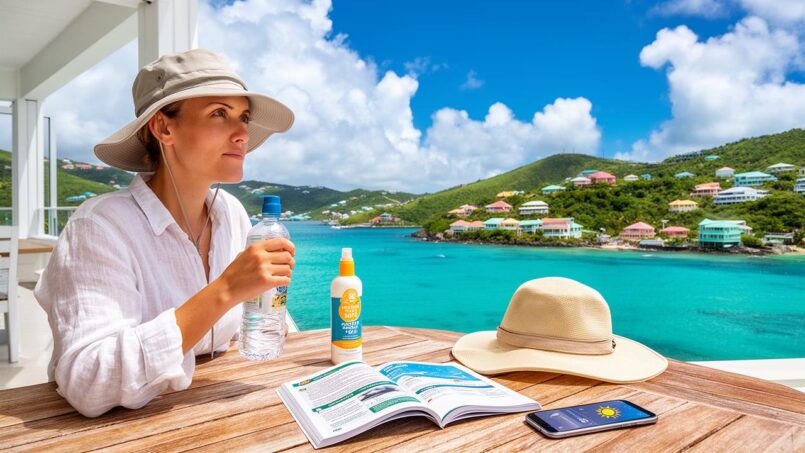
Living in the British Virgin Islands means making sun protection part of your daily routine, not just for beach days. Broad-spectrum (UVA/UVB) sunscreen with SPF at least 30, ideally 50, applied generously and reapplied every two hours, a wide-brimmed hat, UV-filtering sunglasses, and tightly woven or UV-protective clothing, are non-negotiable.
Reflection off water and sand almost doubles UV exposure. Even in the shade of an umbrella, UV rays reflect off the sea and reach your skin. For prolonged water activities (sailing, paddleboarding, etc.), wearing long-sleeved UV-protective swimwear (rash guards, UV shirts) is recommended to stay in the water for long periods without risk of sunburn.
Staying well hydrated also helps the body manage heat and sun better. Dehydration happens faster than you think in a hot, humid climate, especially with physical exertion. Drinking regularly, before you feel thirsty, and limiting alcohol and very sugary drinks during the hottest hours is a basic reflex.
Adapting to Hurricane Season: Preparation Over Panic
Between June and November, the British Virgin Islands enter the Atlantic hurricane season. The peak risk is from August to October, when the atmosphere is warmer, the sea very warm, and the air more unstable. While direct hurricane hits are statistically infrequent, the effects of tropical storms and hurricanes – high winds, torrential rain, storm surge, power and water outages – can profoundly disrupt daily life.
For an expat, the key is preparation. The territory has specialized services like the Department of Disaster Management, which issues official alerts, warning apps, and community preparedness guides. The local culture of prevention is well developed, and it’s important to integrate into it.
Plan Ahead Before Season: Documents, Insurance, Family Plan
Well before a threatening system is announced, several steps are worth taking. Update your home, health, vehicle, and boat insurance and understand the clauses related to storms and flooding is essential. For expats, checking the terms of travel insurance, expat contracts, or any employer-provided coverage will clarify what you’re covered for.
Keep copies of all important documents (passports, birth certificates, residence permits, contracts, medical prescriptions) in waterproof pouches, separate from the originals. This makes administrative procedures much easier if originals are lost or damaged. Additionally, foreign nationals are advised to anticipate renewal procedures for travel documents from abroad by contacting relevant consular services.
For families, agreeing on a communication and meeting point plan, with at least one contact reference outside the island, avoids a lot of stress in case of telecom breakdown.
Preparing Your Home and Boat
On a territory where the sea is ever-present and boating very common, a significant number of expats own or use boats. During hurricane season, securing a sailboat or yacht requires following precise procedures: choosing a sheltered anchorage or hauling out on land, removing anything that could fly off the deck, sealing all portholes, securing the dinghy, checking bilge pumps, closing seacocks, etc. securing the dinghy, checking bilge pumps, closing seacocks, etc.
To protect yourself, it’s essential to carry out preventive work and purchases: install sturdy shutters or storm panels on windows, reinforce light roof fixings, trim trees near the house, and locate water, gas, and electricity shut-off points. Outdoor objects (garden furniture, pots, BBQs) must be able to be brought indoors or securely tied down quickly.
Putting together an emergency kit for three to seven days of self-sufficiency is another important step: stores of drinking water (at least 4 liters per person per day), non-perishable and easy-to-prepare food, a camping stove, flashlight, battery or dynamo radio, spare batteries, basic first-aid kit and sufficient chronic medications, and supplies for pets.
During and After the Storm: Caution and Patience
When authorities issue watch, warning, or alert notices, following instructions (take shelter, avoid travel, secure property) remains the best protection. During a cyclone, the rule to stay indoors, away from windows and glass doors, in an interior room or hallway, applies to everyone, including the curious. The calm zone in the center of the system, the “eye,” can be deceptive, making you think the event is over when the second half, often more violent, hasn’t yet hit.
After a cyclone passes, expect a slow and uncomfortable period: blocked roads, fragile networks (electricity, water), and closed shops and schools. For an expat, it’s crucial to have anticipated this phase by stocking up (food, water), planning some self-sufficiency (properly ventilated generator, solar panels), and having alternative communication means.
Water: A Precious Resource in a Marine Paradise
Paradoxically, living surrounded by seawater doesn’t mean having unlimited fresh water. The British Virgin Islands rely heavily on desalination systems and aging networks that suffer from significant leaks. A considerable portion of the water produced never reaches the taps, lost in the pipes. Recurrent droughts further highlight the system’s vulnerability.
Local authorities have classified water as a national priority, with substantial investment plans in networks, reservoirs, and team training. But for an expat, adapting involves daily actions, because cuts, low pressure, or usage restrictions remain a reality, especially as combined water and energy tariffs are among the highest in the world.
Saving Water at Home: A Necessity, Not Just a “Green” Gesture
Reducing waste starts with tracking down leaks. A dripping faucet, a toilet that won’t stop running, a small leak under a sink can waste hundreds of liters over time. A simple trick is to put a few drops of food coloring in the toilet tank: if the color appears in the bowl without flushing, there’s a leak.
To reduce water consumption, several simple solutions exist: replace your showerheads with low-flow models, install faucet aerators, choose low-flush toilets or place a filled bottle in the tank to reduce volume per flush. These steps preserve comfort while saving money.
Habits inherited from climates where water flows abundantly need rethinking. Avoid letting water run while soaping up in the shower, adopt “navy showers” (wet, turn off, soap, rinse), turn off the tap while brushing teeth, wash dishes by filling a wash basin and rinse basin rather than running the tap continuously – these actions become natural after a few weeks.
Where possible, run the washing machine or dishwasher fully loaded, choose appropriate cycles, and if the appliance allows, use eco programs to significantly reduce water demand.
Water Reuse and Outdoor Tips
Another way to adapt is to reuse water that would otherwise go down the drain. The cold water that comes before the hot water when you open the tap can be collected in a bucket and used for watering plants, cleaning the floor, or rinsing equipment. Water used to wash fruits and vegetables, leftover water from pet bowls, or water collected from a dehumidifier (for non-edible plants) are all small reserves.
To save water and maintain a resilient green space, water early in the morning or late in the day to limit evaporation. Prioritize trees and shrubs that structure the landscape and provide shade. Choose local or drought-tolerant species, like cacti, aloes, bromeliads, or ornamental shrubs suited to full sun, to reduce dependence on heavy watering.
Applying a layer of organic mulch (grass clippings, wood chips, shredded leaves) at the base of plants limits evaporation and reduces water needs. Installing drip irrigation systems, which deliver water directly to plant roots rather than spraying the whole garden, increases the efficiency of every liter used.
Rainwater harvesting, via roofs and tanks, remains a valuable tool in the island context, although it must be aligned with local regulations and the quality of materials used.
Adopting the Island Rhythm: Adapting Your Daily Life to the Climate
Beyond the technical aspects, adapting to the climate of the British Virgin Islands also means rethinking how you organize your days. In a context of intense heat and light, sometimes fickle breezes, and hurricane season, life often follows different rhythms from those of a temperate metropolis.
Scheduling the most demanding physical activities and errands for the morning or late afternoon helps avoid heat stress and makes the most of the trade winds. Shopping, attending administrative appointments, walking in town or on trails between 11am and 3pm, especially from June to October, can quickly exhaust an unacclimatized body.
To reduce fatigue and the risk of sunburn, it’s advisable to plan outings with children during periods of lower solar intensity and when the air is more breathable. This practice is often already integrated into the organization of school, extracurricular activities, and leisure.
The climate also influences leisure choices. During the dry season, water activities, sailing, diving, and hiking are especially enjoyable. The wet season, despite rain and heavier heat, offers lush vegetation, very warm sea, and fewer crowds, which can be an advantage for those who prefer tranquility and accept some weather instability.
Conclusion: From Climate Shock to Tropical Art of Living
Moving to the British Virgin Islands isn’t just changing countries; it’s changing climates radically and permanently. Constant heat, high humidity, intense sun, rainy and cyclone season, the scarcity of fresh water, and the constant threat of mold impose a series of concrete adjustments.
For optimal comfort and resilience in the tropics, it is recommended to choose appropriate clothing, arrange your home to promote natural ventilation, maintain constant vigilance against humidity and sun, thoroughly prepare for hurricane season, and adopt mindful water management.
Over time, these constraints become reflexes, then a true art of living: you wake up earlier to enjoy the coolness, schedule activities around the sun’s rhythm, protect yourself without thinking, learn to read the sky and the wind, garden with local plants, and follow disaster management bulletins as naturally as you once checked the marine forecast. The climate of the British Virgin Islands then ceases to be a challenge and becomes what it is for its residents: an ally, provided you know how to respect it.
Disclaimer: The information provided on this website is for informational purposes only and does not constitute financial, legal, or professional advice. We encourage you to consult qualified experts before making any investment, real estate, or expatriation decisions. Although we strive to maintain up-to-date and accurate information, we do not guarantee the completeness, accuracy, or timeliness of the proposed content. As investment and expatriation involve risks, we disclaim any liability for potential losses or damages arising from the use of this site. Your use of this site confirms your acceptance of these terms and your understanding of the associated risks.

Cyril Jarnias is an independent expert in international wealth management with over 20 years of experience. As an expatriate himself, he is dedicated to helping individuals and business leaders build, protect, and pass on their wealth with complete peace of mind.
On his website, cyriljarnias.com, he shares his expertise on international real estate, offshore company formation, and expatriation.
Thanks to his expertise, he offers sound advice to optimize his clients' wealth management. Cyril Jarnias is also recognized for his appearances in many prestigious media outlets such as BFM Business, les Français de l’étranger, Le Figaro, Les Echos, and Mieux vivre votre argent, where he shares his knowledge and know-how in wealth management.





