
 Published on and written by Cyril Jarnias
In the middle of the Pacific, The impact of climate on real estate in Tuvalu is no longer a theoretical question. In this 26 km² atoll state, where no point rises more than 5 meters above sea level and the entire population lives within one kilometer of the coast, the climate is already redrawing the map of land, shaking customary rules, and forcing the state to invent a survival-oriented form of urban planning. But contrary to the simplistic narrative of a “country doomed to disappear,” Tuvalu is methodically building a strategy to remain habitable, protect its sovereignty, and adapt its housing stock.
A tiny territory, maximum pressure on land
The impact of climate on real estate in Tuvalu cannot be understood without recalling the country’s extreme smallness. Nine atolls and reef islands, 26 km² of land area, approximately 11,000 inhabitants, an average elevation of about 2 meters, a “summit” at 4.5 meters: any loss of land has direct consequences on housing, agricultural land, and infrastructure.
Approximately half of the built-up central area of Funafuti, the capital of Tuvalu, already lies below the mean sea level.
In this context, buildable land is not just scarce: it is physically threatened by erosion, flooding, and salinization, which drives up the cost of any real estate project and turns every parcel into an economic, social, and political issue.
When the sea enters homes: erosion, flooding, and salinization
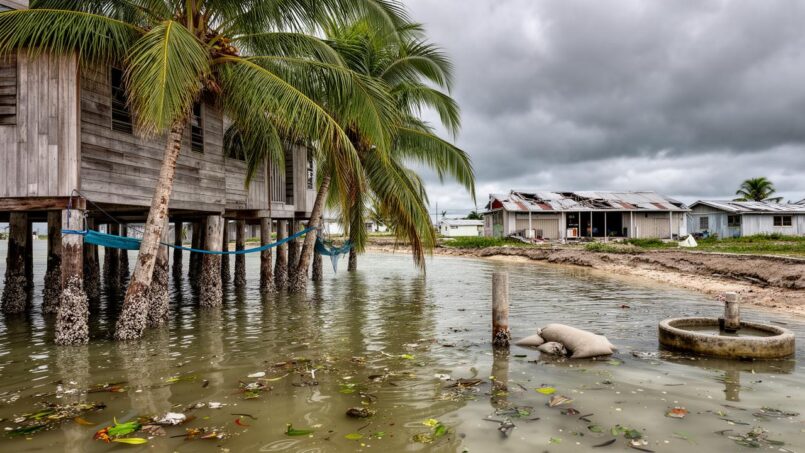
On the impact of climate on real estate in Tuvalu, the field evidence is unambiguous: the sea is gaining ground, sometimes dramatically. Residents see sections of coastline nibbled away, beaches disappearing, coconut groves swept away by waves, and even entire small islets wiped off the map. Spring tides – the famous “king tides” – now invade areas once spared, including Funafuti’s airport and residential neighborhoods.
Flooding episodes damage buildings and reduce land values by salinizing soils and the water table. On Fongafale, half the islet consists of former marshes filled with porous coral, where saltwater rises during high tides, contaminating wells and crops and turning agricultural plots into risky wasteland.
Geological studies show that the freshwater “lens” – that thin layer of drinkable water floating on saltwater in atolls – is already significantly thinned and brackish. This saltwater intrusion directly undermines the agricultural value of land: the pulaka (swamp taro) pits, a food and cultural staple, become salinized and unproductive. The land thus loses both its food-providing function and its residential appeal, weighing on the economic and symbolic value of ancestral lands.
Cyclones and storm surges: shocks that reshape housing
In addition to the slow trends of sea level rise, extreme events can reconfigure inhabited space overnight. Cyclone Pam in 2015, without even directly hitting Tuvalu, generated 3-to-5-meter waves that crossed the reefs of the outer islands and submerged entire villages. Over 45% of the population was temporarily displaced, often leaving behind heavily damaged homes.
On some islands, freshwater sources, crops, and seawalls were destroyed. The costs of rebuilding homes, roads, and coastal structures strain the public budget and delay other investments such as renovation or housing.
These cyclones have also left lasting scars on the local real estate market: some previously inhabited areas are now seen as “too dangerous,” especially on coasts exposed to the open ocean. Conversely, the rare hillocks or slightly elevated lands take on strategic importance and see their use value—and potentially their rental value—rise, in a context where outright land sales are prohibited by customary law.
Customary land rights complicate any spatial reorganization
The impact of climate on real estate in Tuvalu also plays out through rules of access to land. Almost all of the territory is governed by the kaitasi customary system, literally “eating from the same land.” Anyone living on and being fed by a plot is considered to have equal management rights to that land, alongside other members of the family group.
Concretely, this means that:
In Tuvalu, a single plot can bring together a large number of customary co-owners. No major decision—such as leasing land to the state, installing infrastructure, or reorganizing housing—can be made without everyone’s consent. Furthermore, land cannot be sold or alienated to non-Tuvaluans; it can only be leased or exchanged, and only among indigenous rights holders.
At the same time, approximately 5,000 of the 11,000 residents have no indigenous ties to any particular land. They therefore have no customary land rights, placing them in a position of great vulnerability to erosion: when the lowest areas must be evacuated or reallocated, these residents without customary rights are the most exposed to losing their homes and becoming “climate squatters” on others’ plots.
The area in square meters of a real estate project requiring negotiation of long-term leases with customary landowning families.
When adaptation creates new land: the reclamation strategy
Faced with this growing pressure, Tuvalu has chosen a radical path: creating new, elevated land designed from the outset to withstand projected sea levels beyond 2100. This is the core of the Tuvalu Coastal Adaptation Project (TCAP) and the Tuvalu Long-term Adaptation Plan (L‑TAP, “Te Lafiga o Tuvalu” – the Refuge of Tuvalu).
On Funafuti, several reclamation operations have been carried out in recent years. The first phase created 7.3 hectares of new land. A subsequent phase, TCAP 1A, added 8 additional hectares on Fogafale, the main islet. Another operation, launched in late 2022, consists of building a platform 780 meters by 100 meters, or 7.8 hectares, by dredging sand from the lagoon.
The principle involves sucking sediments from the lagoon, pumping them into geotubes or temporary dikes, then allowing the new land to dry and consolidate. The sophisticated planning sizes and raises the platforms to remain beyond the reach of sea-level rise and storm surges by 2100, with a margin for future elevation.
Here, for illustration, is the order of magnitude of new land gained from the sea in Funafuti:
| Reclamation project in Funafuti | Approximate area | Key features |
|---|---|---|
| Queen Elizabeth Park (QEP) redevelopment | ~7 ha | Central urban area, public land and convention center on fill |
| TCAP – first phase (Fongafale) | 7.3 ha | Funded by the Green Climate Fund, elevated land for “flood-free” zone |
| TCAP 1A – Fogafale extension | 8 ha | Elevated platform for housing, public facilities, and green spaces |
| Fongafale platform (2022–) | 7.8 ha | 780 m x 100 m, designed to remain beyond the reach of sea-level rise beyond 2100 |
In total, more than 30 hectares of new or elevated land are already planned or completed, representing more than 5% of the country’s total land area. For real estate, these land reclamations change everything: they finally offer relatively safe buildable sites where homes, schools, health centers, and new subdivisions can be built, according to a national land-use plan.
L-TAP: a refuge-oriented urban planning at the national scale
The Long-term Adaptation Plan (L‑TAP) goes even further: it projects the creation of 3.6 km² of raised land on Funafuti to ultimately provide a refuge for the population of all inhabited islands. In the logic of this plan, the capital becomes a kind of national “refuge city,” with a mosaic of elevated neighborhoods connected by a network of adapted roads, equipped with drainage and rainwater harvesting systems for drinking water.
The stated goal is to maintain the possibility of living in Tuvalu “beyond 2100,” without accepting total migration as inevitable. L-TAP thus articulates:
Planned developments to strengthen resilience against flood risks
Planned neighborhoods to accommodate families from vulnerable areas
Reservations for schools, hospitals, and administrative buildings outside recurrent flood zones
Cultural and leisure spaces to maintain quality of life and social resilience
Wharves, lagoon, and runways protected from flooding
This project is colossal at the country’s scale: the IMF estimates its cost at around 2 billion Australian dollars, equivalent to nearly twenty years of GDP. Financing this “survival urban plan” requires a very specific mix: climate adaptation funds (Green Climate Fund, bilateral donors such as Australia, New Zealand, or the European Union), mobilization of the Tuvalu Trust Fund (the country’s sovereign wealth fund), and revaluation of public capital (such as revenue from the .tv domain or fishing licenses).
Real estate, climate, and public finances: a fragile triangle
The real estate sector in Tuvalu cannot be read as a classic market with private developers, mortgage lenders, and land speculation. The economy is tiny, dependent on external aid, fishing licenses, the sovereign wealth fund, and diaspora remittances. Borrowing capacity is limited, local tax base narrow, and any natural disaster can represent 30% of GDP in damages and losses.
Yet the state must simultaneously finance:
Four categories of actions to deal with cyclones and storm surges
Creation of new safe neighborhoods through large-scale land reclamation.
Securing existing essential infrastructure: roads, schools, airstrips, and hospitals.
Ongoing maintenance of damage caused by cyclones and storm surges.
Floor elevation, structural reinforcement, and rainwater harvesting systems.
Public real estate projects are therefore designed not only as adaptation investments but also as macroeconomic buffers: they inject aid funds into the local economy, employ labor, improve land tenure security, and prevent the most exposed housing from becoming uninhabitable, with mass exodus abroad as a consequence.
Living in a gray zone: between vulnerability and resilience
Household surveys highlight a paradox at the heart of the impact of climate on real estate in Tuvalu. On one hand, 97% of households report having already experienced climate hazards (floods, droughts, saltwater intrusion). A majority believe migration would become necessary if these impacts further degrade their basic living conditions (water, food, housing). The environmental factors that could trigger a departure are very clearly identified: sea-level rise, saltwater intrusion, drought, floods.
The majority of Tuvaluans do not wish to emigrate en masse. A dynamic of “anti-displacement mobility” is emerging, favoring internal moves to culturally richer or safer areas. During the pandemic, families left the overcrowded capital for rural islands like Funafala, reconnecting with subsistence agriculture and customary ties, despite sometimes greater environmental exposure.
This dynamic complicates the real estate equation: the state plans a gradual concentration on Funafuti in the long term (via L-TAP), while observing short-term urban-to-rural flows driven by the search for quality of life, health, and cultural anchoring. For communities, preserving or reactivating villages on islets like Funafala, while knowing they are threatened over a horizon of several decades, is a strategy of active waiting: living fully “here and now” by reinvesting in ancestral land, while supporting national reclamation projects that could offer a future refuge.
International migration: economic safety valve, not a land solution
One of the particularities of the impact of climate on real estate in Tuvalu is how international migration is integrated into this strategy without being thought of as a way to “deflate” the domestic real estate market. Public policies are explicit: the goal is not to turn all Tuvaluans into climate refugees, but to open voluntary mobility pathways that strengthen the economic resilience of families and the country.
For a long time, Tuvaluans have migrated temporarily as seafarers, miners, or seasonal workers. Today, several schemes structure these movements:
The new Falepili treaty between Australia and Tuvalu grants a quota of 280 permanent residences per year for climate reasons.
In total, if you add up PAC, Falepili, and other programs, more than 4% of the population could theoretically access long-term international mobility each year. However, studies show that households with a migrant member are often less vulnerable to climate hazards: remittances allow them to raise a house, replace a roof, fund a rainwater collection system, or even invest in a small income-generating activity.
Each year, 280 people leave Tuvalu through the Falepili scheme, which, for a population of 11,000, accelerates depopulation and weakens the maintenance of real estate infrastructure and defenses.
Migration is therefore a double-edged variable for the impact of climate on real estate in Tuvalu: it financially strengthens some households and reduces pressure on a few densely populated areas, but it can also undermine the critical mass of population needed to maintain infrastructure, services, and social life in the new reclaimed neighborhoods.
Sovereignty through building: staying put as a political strategy
Contrary to some international initiatives, such as the Rising Nations Initiative which effectively assumes the inevitable relocation of Tuvaluans by 2050, the Tuvaluan state and civil society defend a clear line: sovereignty and culture must be maintained on indigenous territory until all adaptation options have been exhausted.
This position is expressed in several ways directly related to real estate:
In the amended Constitution, the state affirms its permanence even in the event of landmass loss and the permanence of its maritime boundaries. In the Te Sikulagi foreign policy, it is written that total relocation is not an acceptable solution. In the civil society report “Toku Fenua Toku Tofi,” local organizations recognize that forced displacement would negatively transform society and declare that no migration in the name of climate should occur without having explored all other adaptation options.
Excerpts from official documents and civil society
The construction of elevated land, adapted housing, and resilient infrastructure is therefore not just a technical planning policy: it is an act of sovereignty. Every house built on reclaimed land, every school moved out of a flood zone is a political gesture: Tuvalu continues to exist here, in its atolls, and not in an imposed exile.
A real estate economy without a classic market, but with real trade-offs
In most countries, talking about “real estate” evokes price per square meter, mortgage credit, private investors. In Tuvalu, almost none of that exists. Land is collective, sales are prohibited, bank credit is virtually non-existent, tourism is embryonic. Yet very concrete trade-offs arise every day:
Faced with limited public funds, three major dilemmas arise: invest in protecting densely populated but exposed areas, or prioritize land elevation with a controlled retreat from the lowest sectors; allocate new elevated land between housing, public facilities, and economic activities like commerce or port installations to reconcile resilience and revenue; and decide whether to maintain villages on exposed outer islands for cultural and food security reasons, despite high protection costs, or encourage population consolidation around better-defended hubs.
These trade-offs are often played out within the Falekaupule, the customary island councils, in consultation with technical ministries. They are complex because they involve non-monetary dimensions – culture, attachment to place, family history – that do not easily translate into budget lines.
Technologies, standards, and new forms of housing
For the impact of climate on real estate in Tuvalu to be something other than a scramble to keep ahead of the sea, the quality of construction on new land is crucial. Authorities, with support from regional bodies like the Pacific Community (SPC) or the Pacific Climate Program, are working to strengthen building standards:
– structures capable of withstanding cyclone winds;
– floor elevation above projected flood levels;
– integration of rainwater harvesting and sanitation systems adapted to salinized groundwater tables;
– use of materials resistant to saltwater corrosion.
Tools such as wave and flood modeling, LIDAR, help design reclamations and protection works, to avoid past mistakes: unplanned urbanization, poorly consolidated fill, lack of drainage, destruction of vegetative barriers.
In outer islands like Nanumea and Nanumaga, rather than large reclamations, the choice has been to elevate natural berms using “Berm Top Barriers,” light dikes following the shoreline. These operations do not create new buildable land, but they reduce the frequency of marine overtopping in villages, extending the useful life of existing housing stock.
Real estate, water, and agriculture: an inseparable trio
In Tuvalu, the quality of a plot is measured not only by its elevation but also by its ability to provide water and food. Recurrent droughts, such as those of 1997, 2011, and 2022, have shown the extreme fragility of rainwater storage systems and the dependence on emergency desalination units. During a drought episode, the state even had to ration consumption to 20 liters per person per day.
On increasingly saline lands, where wells are unfit for consumption and traditional crops are dying, the residential appeal of a plot diminishes, even if it is safe from waves. Conversely, a newly reclaimed neighborhood with communal cisterns, a water network, and elevated gardens gains strong attractiveness.
In the real estate planning of L-TAP and TCAP, these dimensions are integrated: the new built-up areas are designed with water collection and storage systems, and adapted agriculture programs (raised garden beds, more salt-tolerant varieties) are envisaged to maintain a minimum of local production, in order to avoid turning every safe neighborhood into mere dependence on costly imported goods.
Scientific research that nuances the narrative of disappearance
Since the 1990s, Tuvalu has often been presented as the archetype of the “country that will sink beneath the waves.” However, the most recent scientific work paints a more nuanced picture. A study from the University of Auckland showed that between the 1970s and 2014, the overall land area of Tuvalu’s islands increased slightly, thanks to natural sediment accumulation processes (inputs of sand and coral debris during storms, reef reshaping).
The land gained is not necessarily habitable or stable, and sea-level rise combined with extreme events could exceed the atolls’ natural adjustment capacity.
For the impact of climate on real estate in Tuvalu, this nuance is nevertheless essential. It means there is a window of opportunity, potentially several decades long, during which ambitious adaptation – reclamations, protections, habitat transformation – can maintain acceptable living conditions. Tuvalu’s policies are precisely built on this hypothesis: they bet on a habitable future provided massive investment is made now.
Real estate, climate justice, and external responsibilities
Behind every raised house in Tuvalu lies the question of who pays and who is responsible. The country emits only a minuscule amount of greenhouse gases – on the order of a few kilotons of CO₂, a negligible fraction of global emissions. Major emitters, meanwhile, continue to increase or only slowly reduce their carbon footprint.
For Tuvaluans, the idea of one day being “relocated” abroad without sufficient compensation, without guarantees of sovereignty or restoration of their livelihoods, is unacceptable. In international forums, the Tuvaluan delegation demands not only drastic emissions reductions to avoid the worst submersion scenarios, but also financing commensurate with the scale of needed reclamation, coastal protection, and internal relocations.
The impact of climate on real estate in Tuvalu thus becomes a real-world test for climate finance mechanisms: adaptation funds, “loss and damage” funds, reallocation of special drawing rights (SDRs) to finance massive protection and reclamation works. Tuvalu argues that these instruments should not create new debt, but come as a form of anticipatory compensation for externally caused damages.
What horizon for real estate in Tuvalu?
In the short term, real estate in Tuvalu will continue to be shaped by several simultaneous trends:
Accelerated deterioration of properties on the frontline coast, increasing maintenance costs. Gradual emergence of new, safer, planned reclaimed neighborhoods concentrating public investment and key functions. Maintenance of outer island villages, rich in identity but requiring targeted protections. International migration flows easing local demographic pressure, but raising long-term labor force issues.
In the medium to long term, Tuvalu’s real estate trajectory will largely depend on external choices. If global warming is stabilized at a relatively low level, current and planned reclamations could suffice to secure a significant portion of built-up territory, and the “stay in place” strategy would have strong chances of success. Conversely, if the world heads toward 2.5°C and above scenarios, with potential sea-level rises of several meters over coming centuries, the question of a profound redefinition of the relationship to territory – physical, legal, perhaps more digital – will arise acutely.
But for now, the message from Tuvalu is clear: real estate here is not a sector to be abandoned while waiting for the waters to rise. It is the central theater of a struggle for survival, dignity, and sovereignty. Raised reclamations, reinforced houses, reinvested villages, amended constitution, negotiated international treaties: everything converges toward the same goal, summed up by the Te Sikulagi foreign policy. Tuvalu does not want to be a symbol of disappearance, but a country that, facing climate change, chooses to remain standing on its own land.
Tuvalu
An estate project or a question? Contact us now to speak with a wealth management expert.
Disclaimer: The information provided on this website is for informational purposes only and does not constitute financial, legal, or professional advice. We encourage you to consult qualified experts before making any investment, real estate, or expatriation decisions. Although we strive to maintain up-to-date and accurate information, we do not guarantee the completeness, accuracy, or timeliness of the proposed content. As investment and expatriation involve risks, we disclaim any liability for potential losses or damages arising from the use of this site. Your use of this site confirms your acceptance of these terms and your understanding of the associated risks.

Cyril Jarnias is an independent expert in international wealth management with over 20 years of experience. As an expatriate himself, he is dedicated to helping individuals and business leaders build, protect, and pass on their wealth with complete peace of mind.
On his website, cyriljarnias.com, he shares his expertise on international real estate, offshore company formation, and expatriation.
Thanks to his expertise, he offers sound advice to optimize his clients' wealth management. Cyril Jarnias is also recognized for his appearances in many prestigious media outlets such as BFM Business, les Français de l’étranger, Le Figaro, Les Echos, and Mieux vivre votre argent, where he shares his knowledge and know-how in wealth management.





