
 Published on and written by Cyril Jarnias
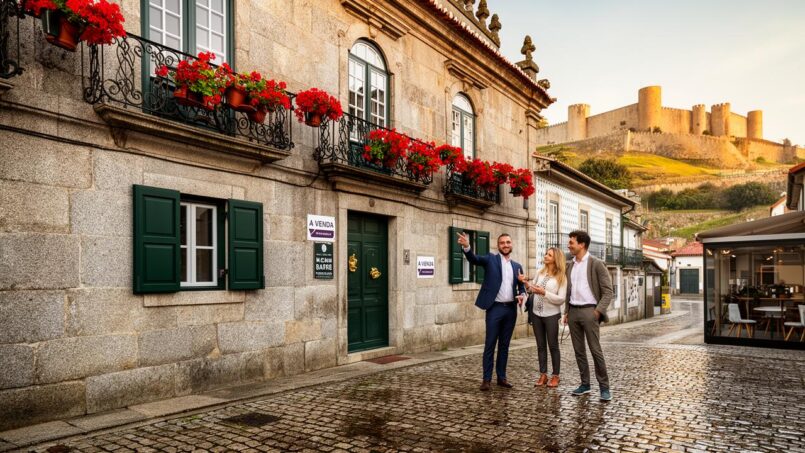
UNESCO-classified medieval city, the historic heart of the country and now a thriving university and technology hub, Guimarães ticks boxes rarely found combined in one place. For a real estate investor, the mix is powerful: exceptional heritage, a dynamic local economy, a resilient residential market, and prices still significantly more affordable than Lisbon, Cascais, or the Algarve.
Percentage increase in prices in Portugal in 2025 according to the content provided.
Guimarães: Between the Cradle of the Nation and a City of the Future
Guimarães is often described as the “cradle of the nation”, where the first king of Portugal laid the foundations of the kingdom. This national narrative is more than just a tourist slogan: it permeates the local identity, the care given to the medieval center, and the international visibility the city enjoys.
Guimarães’ historic center, with its cobblestone streets and traditional architecture, has been a UNESCO World Heritage site since 2001. Today, the city is a major economic hub, integrated into the Porto-Braga triangle and part of an industrial and innovation corridor that drives regional growth.
The universities, particularly the University of Minho campus in Azurém, attract Portuguese and international students, while emerging technology clusters retain a new generation of graduates. Add to this efficient road connections to Braga and Porto, and proximity to Porto Airport (Francisco Sá Carneiro), reachable in under an hour by car.
The result: the city appeals to a diverse audience – young professionals, families, retirees, expats – all seeking safety, authenticity, and long-term stability, in a context where major metropolises, Lisbon in particular, suffer from high price pressure and a lack of affordability.
A Robust Real Estate Market in a Portugal That’s Heating Up
To understand the appeal of Guimarães, you have to see it in the Portuguese context. Nationally, the numbers tell the story: in Q3 2025, the median price reached €2,111/m², up 16.1% year-on-year. Over twelve months, the country recorded about 167,000 transactions, with an estimated 15–18% increase in sales prices. The median home value exceeded €3,000/m² by end of 2025 according to some series, while Fitch and other analysts still foresee a 5–8% rise in 2026, with a cumulative growth expected between 20–30% over five years, and 40–60% over ten years.
In December 2025, the average property price in Guimarães reached an all-time high of €1,788/m².
Compared to €5,000/m² in Lisbon or over €4,700/m² in Cascais, Guimarães remains very affordable, even against the Porto metro area (€2,350/m² on average) or the Algarve (€3,203/m² in Q3 2025). Yet, the fundamentals that support value are clearly present: relative scarcity in historic areas, structural residential demand, university and tech support, and growing tourism revenues in the North.
Recent Price Trends in Guimarães
The table below provides a snapshot of the situation at the end of 2025 for the city:
| Indicator (Guimarães) | Value December 2025 | Annual Change |
|---|---|---|
| Average price per m² (overall) | €1,788 | +10.8% |
| Price per m² Q3 2025 | €1,652 | +19.2% |
| All-time high | €1,788/m² | – |
In detail, market data also shows a clear difference between apartments and houses: at the start of 2025, the median price for apartments was around €2,313/m², compared to about €1,480/m² for houses. This hierarchy reflects the premium placed on location (often more central for apartments) and the quality of new construction.
Neighborhood Mapping: Where to Put Your Money in Guimarães
Investing effectively means looking beyond the overall averages. Guimarães offers a mosaic of neighborhoods, each with its own audience, price dynamics, and appreciation potential.
Historic Center and UNESCO Zone: Prestige Under Supply Constraints
The medieval core, a UNESCO site, is the city’s heritage showpiece. Streets around Oliveira, São Paio, São Sebastião, and the Couros neighborhood concentrate old buildings, often already renovated, and a limited number of genuinely available properties.
In this area, prices per square meter can frequently reach the range of €3,500 to €4,000 for renovated townhouses or refurbished buildings. Local demand (families, professionals, retirees) mixes with investor interest targeting high-quality short-term rental products or charming residences. Supply is scarce, the urban fabric is protected, which limits major new construction and keeps upward pressure on prices.
In December 2025, the Oliveira – São Paio – São Sebastião sector in Lisbon showed an average price of €2,175/m², up 17.6% year-on-year. This price, which includes properties needing renovation and high-end products, illustrates the sustained appreciation dynamic of the historic center, seen both as an investment and a heritage asset.
Azurém: Academic Engine and Yield Hub
About 2 km from the historic center, Azurém is closely tied to university life via the University of Minho campus. Cafés, supermarkets, green spaces, road connections: the neighborhood is structured around the needs of a young, mobile population, while also accommodating workers in nearby industrial and tech zones.
The numbers are telling: in December 2025, the median price per m² reached €2,276, with an annual increase of 18.8%. Appreciation remains steady, driven by demand for studios and one- and two-bedroom apartments for students, as well as two- and three-bedroom units for young families.
For a buy-to-let investor, the Azurém neighborhood is considered one of the most stable and profitable segments in its region. The constant presence of students and university staff ensures a continuous flow of tenants. The market is particularly suited to medium and long-term rental strategies. It can also support a short-term rental offering, specifically targeting university stays, conferences, or scientific events.
Costa and Creixomil: Family Residential Belt
The parishes of Costa and Creixomil, along with Azurém, form a connected urban cluster. They offer schools, good healthcare infrastructure, and efficient links to the city center. Their quieter atmosphere makes them popular with families.
In December 2025, Creixomil posted a median price of €2,080/m², up 17.9% year-on-year. Costa stood at €2,142/m², with a slight annual decline (-3.8%) but following a previous phase of strong increases; statistics for these neighborhoods should be viewed over time rather than in isolation.
For the investor, these areas combine: high growth potential, attractive infrastructure, easy market access, and a favorable regulatory environment.
– prices still more accessible than the historic center,
– robust family rental demand,
– low vacancy rates,
– easy resale when households look to trade up or move closer to a specific school.
Two- and three-bedroom apartments, and even townhouses or semi-detached villas, are “core market” products here.
Other Sectors: São Jorge (Selho), Urgezes, Caldelas, Ronfe…
Beyond this first ring, several parishes deserve attention:
The neighborhoods of São Jorge (Selho), Urgezes, Caldelas, and Ronfe have distinct markets. São Jorge offers an attractive price (€1,599/m²) and strong growth (+18.7%), ideal for rental investments. Urgezes maintains a higher price (€1,875/m²) due to its centrality. Caldelas and Ronfe are undergoing changes, with Ronfe seeing medians above €2,300/m² for houses, reflecting demand for large plots.
These peripheral sectors often appeal to investors seeking lower entry points and a locally rooted clientele, with capital appreciation prospects tied to gradual infrastructure improvements and price pressure spreading from the center and Azurém.
Comparison of Selected Parishes in Guimarães (December 2025)
| Parish / Sector | Median Price per m² | Estimated Annual Change |
|---|---|---|
| Azurém | €2,276 | +18.8% |
| Costa | €2,142 | -3.8% |
| Creixomil | €2,080 | +17.9% |
| Oliveira – São Paio – São Sebastião | €2,175 | +17.6% |
| São Jorge (Selho) | €1,599 | +18.7% |
| Urgezes | €1,875 | ≈ -0.1% |
These figures confirm that sectors close to the center and the university campus sit at the top of the price range, while more outlying parishes remain slightly behind, potentially offering more room for growth.
Which Property Types to Favor in Guimarães?
The local market is divided into several promising segments, both for appreciation and rental yield.
Urban Apartments: The Core of the Market and Demand
Apartments, new or renovated, capture the bulk of demand. They appeal to students, young professionals, couples with or without children, and also some retirees seeking proximity to services.
A detailed analysis of yields by property type shows interesting profiles:
| Apartment Type | Average Price (€) | Average Monthly Rent (€) | Average Gross Yield |
|---|---|---|---|
| Studio | 180,000 | 630 | 4.18% |
| 1-Bed | 202,240 | 800 | 4.72% |
| 2-Bed | 259,900 | 850 | 3.92% |
| 3-Bed | 294,900 | 1,150 | 4.68% |
| 4-Bed+ | 315,000 | 1,330 | 5.05% |
We can see that very small and large unit types can offer higher gross yields, with two-bedroom units sometimes slightly less efficient in percentage terms, though they remain popular for resale liquidity. Three- and four-bedroom units are particularly suited for student shared housing or families, which can boost income.
A typical example is a renovated four-bedroom apartment in the Pencelo area, about 1.2 km from the Azurém campus: purchased for €168,000 and fully rented out by the room between €260 and €280 per month, it showed a gross yield of around 7.7%, well above the national average.
Single-Family Homes and Villas: A Long-Term Asset Strategy
Houses – often farther from the center – trade at lower per-square-meter values (around €1,480/m² median) but offer more space and land. They represent an interesting choice for a long-term asset strategy or as a future primary residence, while still generating decent rents.
The increase in construction costs nationally over the past four years.
Heritage Properties and Renovation Projects: Creating Value Through Work
Guimarães has a remarkable built heritage: 18th-century manor houses, traditional farms, mills, architect-designed homes, and downtown buildings ripe for conversion. Several examples on the market illustrate this potential: historic center buildings to be transformed into apartments (with approved projects ranging up to several dozen units), manor houses designed by renowned architects, or agricultural estates with vineyards producing Vinho Verde.
The price per square meter after renovation can exceed €4,000 for high-potential real estate assets, such as boutique hotels or charming residences, located near UNESCO zones or university hubs.
New Developments Near the University and New Programs
New developments around the Azurém campus or in parishes like Costa are attracting attention. Programs such as “Vess Living” in Costa or new residences adjacent to the campus offer one- to four-bedroom units intended for both permanent residents and buy-to-let investors.
New apartments benefit from new energy efficiency standards, highly valued by buyers, and generally resell at a premium over older properties. Nationally, new homes are more expensive than existing ones in 23 of the 24 largest municipalities, and their value has appreciated faster in recent years. Guimarães is no exception to this trend.
Rental Yields: Between Academic Stability and Seasonal Potential
Guimarães’ rental market relies primarily on medium and long-term strategies, which sets it apart from some coastal areas heavily dependent on the tourist season.
Structural Demand: Students, Workers, Families
The presence of the University of Minho and a strong industrial and services sector continuously fuels housing demand from:
– students and early-career researchers,
– academic and administrative staff,
– employees of innovative industries in the Porto–Braga corridor,
– local or newly arrived families.
This tenant base, mostly long-term, reduces vacancy risks. In neighborhoods like Azurém, Costa, or Creixomil, market experts describe low vacancy rates and easy resale of suitable products (one- and two-bedroom for students and singles, two- to four-bedroom for families).
The average rent in Guimarães is €10.3 per square meter.
Rental Performance by Property Type
In summary, the average gross yields observed in Guimarães by apartment type fall in the following range:
| Property Type | Approximate Average Gross Yield |
|---|---|
| Studios | ≈ 4.2% |
| 1-Bed | ≈ 4.7% |
| 2-Bed | ≈ 3.9% |
| 3-Bed | ≈ 4.7% |
| 4-Bed+ | ≈ 5.0% |
These yields compare to a national average of about 5.5% in early 2026, with cities like Braga or Setúbal showing typical gross yields between 5% and 6%. Guimarães sits slightly below these extremes on some segments but compensates with greater stability and capital appreciation that is already well underway.
Short-Term Rentals and Airbnb: A Card to Play with Care
While the city doesn’t compete in tourist volume with Lisbon or Porto, it does enjoy a steady flow of visitors drawn by heritage, cultural events, festivities like the Festas Gualterianas, and its growing international reputation.
Recent data on Airbnb performance in Guimarães shows:
Maximum financial and operational indicators observable for a high-performing tourist rental.
A revenue peak reaching up to $3,411 during the best periods.
A booking rate reaching approximately 62.4% during the strongest periods.
An average daily rate (ADR) of up to $174 during high season.
The top-performing properties (top 10%) generate over $3,356 per month, with nightly rates above $295. The median sits around $1,235 in monthly revenue, with an average nightly rate of $113. High season (July, August, September) shows average revenue around $2,561, an occupancy rate near 50%, and an average ADR of about $167.
The following table summarizes these order-of-magnitude figures:
| Airbnb Segment (monthly) | Average Revenue / Threshold | Typical ADR |
|---|---|---|
| Top 10% | ≥ $3,356 | ≥ $295 / night |
| Top 25% | ≥ $2,115 | ≥ $160 / night |
| Median | ≈ $1,235 | ≈ $113 / night |
| Bottom 25% | ≈ $612 | ≈ $85 / night |
For an investor, short-term rentals in Guimarães are not about massive tourist volume but a targeted yield supplement, especially on perfectly located properties (historic center, immediate proximity to monuments, views of the castle or Penha hill). It should be considered in light of municipal regulations on Alojamento Local, which remain subject to change in Portugal, but were generally reopened after a revision of certain restrictions at the end of 2024, with licenses now managed at the local level.
Taxation and Costs: What an Investor Must Anticipate
Buying and holding a property in Guimarães involves a set of tax costs comparable to the rest of Portugal. They must be factored in from the profitability calculation stage.
Acquisition Taxes
Upon purchase, two main taxes apply:
– IMT (Imposto Municipal sobre Transmissões), property transfer tax,
– Stamp Duty (Imposto de Selo).
IMT is calculated on the higher value between the purchase price and the tax value (VPT). For an urban residence, the scale is progressive, up to about 6-8% depending on the value and use (primary or secondary residence). For non-residential properties, a flat rate of 6.5% applies, while rural land is taxed at 5%. In the case of a purchase through an entity domiciled in a tax haven, the rate rises to 10%, with no possible exemption.
The Stamp Duty on acquisition is 0.8% of the property’s price or its tax value, whichever is higher.
Adding up IMT, Stamp Duty, notary fees, land registry fees, and legal fees, the initial acquisition costs often range between 7% and 12% of the property’s price.
Ongoing Holding Taxes
Each year, the owner pays:
– IMI (Imposto Municipal sobre Imóveis), the local property tax, calculated on the tax value (VPT). For urban properties, the rate varies, at the discretion of each municipality, between 0.3% and 0.45%. For rural properties, the rate is 0.8%.
– possibly AIMI (Adicional ao IMI), a form of wealth surtax. It only applies to individuals if the total VPT of urban properties exceeds €600,000 (or €1.2 million for a married couple filing jointly), with rates from 0.7% to 1.5% depending on the bracket. Companies are taxed at 0.4% on the total, and entities in privileged tax jurisdictions face a rate of 7.5%.
In addition to the purchase price, acquiring a property involves condominium fees, annual maintenance costs (generally estimated at 1% to 2% of the property’s value), as well as insurance costs and possible property management fees.
Taxation of Rental Income and Capital Gains
For a non-resident, rental income from a property in Guimarães is taxed in Portugal:
– 25% on residential rental income,
– 28% on non-residential rental income.
This rate applies to the net base (rent minus certain deductible expenses), noting that loan interest, depreciation, or AIMI are not always deductible depending on the case. Non-residents must also file an annual tax return in Portugal, while taking into account double taxation treaties with their country of tax residence.
Upon resale, the capital gain is also taxable. Half of the capital gain is included in taxable income and subject to Portugal’s progressive income tax scale, for both residents and non-residents (this represents a change from the previous flat-rate regime for non-residents). Mechanisms exist to mitigate this tax via reinvestment in certain types of assets, but they require specialized tax advice.
Acquisition Process: Securing Your Investment in Guimarães
The Portuguese legal framework is relatively transparent, but requires a series of steps to avoid unpleasant surprises.
1. NIF and Bank Account The foreign investor first obtains a NIF (tax identification number) from the Portuguese tax authority, and typically opens a local bank account to facilitate payments and direct debits.
2. Property Selection and Offer The search is often conducted through licensed real estate agents. Once a property is identified, negotiations lead to a preliminary agreement on price and terms.
The promissory purchase and sale agreement (CPCV) legally binds buyer and seller. It sets the price, the deadline for the final deed, and a deposit (10 to 30%). It contains conditions precedent (such as obtaining a loan). If the buyer defaults, they lose the deposit, while if the seller backs out, they usually must refund double the amount received.
4. Legal and Technical Due Diligence Before or alongside the signing of the CPCV, a lawyer verifies the property’s status:
– land registry certificate (ownership, mortgages, charges),
– “caderneta predial” (tax cadastre),
– use permit (for buildings built after 1951),
– energy certificate,
– planning compliance, absence of legal proceedings or municipal debts, and, if necessary, structural inspections or technical reports.
The final deed is signed before a notary, a lawyer, or at a public one-stop shop (Casa Pronta). The balance of the price is then paid, usually by bank check or secure transfer. Acquisition taxes (IMT and Stamp Duty) must be paid before this step.
6. Registration and Post-Completion Formalities The new owner registers their title at the land registry within 60 days of the deed. They also notify the tax authority of the change and switch utility contracts (water, electricity, gas, internet) and condominium accounts to their name.
Almost all of this procedure can be delegated to a lawyer via a power of attorney, which is particularly useful for non-resident investors.
Financing, Management, and Strategy: How to Structure Your Project
Most Portuguese banks finance non-resident buyers with a down payment typically between 30% and 40% of the price, i.e., a loan-to-value (LTV) ratio of 60 to 70%. Variable rates were around 3 to 3.5% in 2025, with forecasts of a gradual decline to the 1.4–2% range by 2026 if European monetary conditions ease.
To maximize net yield and reduce risks, investors can delegate property management to specialized companies. The Portuguese market offers various players, including managers for long-term rentals and operators for short-term rentals (like Airbnb), who handle all the steps.
– listing the property (photos, ads, dynamic pricing),
– managing reservations and tenant relations,
– coordinating cleaning, maintenance, and repairs,
– accounting and tax monitoring, with regular reporting to the owner.
Management fees typically range between 8% and 15% of rents, depending on the service level and the nature of the rental (long-term, medium-term, or short-term). For an investor based abroad, this delegation greatly simplifies operations and legal compliance (local rental licenses, tax filings, etc.).
Guimarães and Golden Visa: A Necessary Clarification
For over a decade, Portugal’s residence-by-investment program – the famous Golden Visa – boosted real estate investment across the country, including Guimarães. Until 2023, it was possible to obtain this residence permit by investing at least €500,000 in property, or even €350,000 for renovation projects, with lower thresholds in low-density areas.
Since autumn 2023 and the “Mais Habitação” law, the purchase of real estate (residential, commercial, or via real estate funds) no longer qualifies for a Golden Visa. The program still exists but is now focused on so-called “productive” investments: non-real estate venture capital funds, research funding, support for culture and heritage, or business and job creation.
Practically, this means that buying an apartment in Guimarães, no matter how sound financially, can no longer be presented as a route to Golden Visa eligibility for a new applicant. Holders of previous permits are protected by transitional provisions, but any communication suggesting that a current real estate investment entitles one to this program is out of step with the law.
For an investor who wants to combine residence in Portugal with real estate investment in Guimarães, other paths exist (standard residency, resident tax status, etc.), but they no longer rely solely on property purchase.
Why Guimarães Still Has Potential
At the end of this overview, several elements argue in favor of real estate investment in Guimarães in the years ahead.
First, the price differential with saturated markets remains significant. When Lisbon trades around €5,000/m² and Cascais sometimes exceeds €8,000/m², a city like Guimarães, at an average of €1,650–1,800/m², offers a much more affordable entry point, while being embedded in a dynamic regional economy and in a country where prices have already more than doubled in a decade.
Target gross yield for medium and long-term rental investments in Guimarães’ strategic sectors.
Finally, the city combines qualitative strengths that are hard to quantify but decisive for long-term value: UNESCO status, strong cultural identity, event calendar, growing reputation in the international press, nomination as European Green Capital, improving infrastructure (including at the regional level, with the Lisbon–Porto high-speed rail project that should boost the North’s attractiveness).
Guimarães is not a speculative “hot tip” driven by fashion, but a portfolio foundation city: a market where you can combine reasonable profitability, visibility on appreciation, and the pleasure of owning a property in a lively, safe, and welcoming city. Provided you carefully choose the neighborhood, calibrate your renovation budget, and surround yourself with the right partners (lawyer, banker, manager), investing in real estate in Guimarães increasingly looks like a rational bet on the rise of Northern Portugal.
For the serious investor
Disclaimer: The information provided on this website is for informational purposes only and does not constitute financial, legal, or professional advice. We encourage you to consult qualified experts before making any investment, real estate, or expatriation decisions. Although we strive to maintain up-to-date and accurate information, we do not guarantee the completeness, accuracy, or timeliness of the proposed content. As investment and expatriation involve risks, we disclaim any liability for potential losses or damages arising from the use of this site. Your use of this site confirms your acceptance of these terms and your understanding of the associated risks.

Cyril Jarnias is an independent expert in international wealth management with over 20 years of experience. As an expatriate himself, he is dedicated to helping individuals and business leaders build, protect, and pass on their wealth with complete peace of mind.
On his website, cyriljarnias.com, he shares his expertise on international real estate, offshore company formation, and expatriation.
Thanks to his expertise, he offers sound advice to optimize his clients' wealth management. Cyril Jarnias is also recognized for his appearances in many prestigious media outlets such as BFM Business, les Français de l’étranger, Le Figaro, Les Echos, and Mieux vivre votre argent, where he shares his knowledge and know-how in wealth management.





