
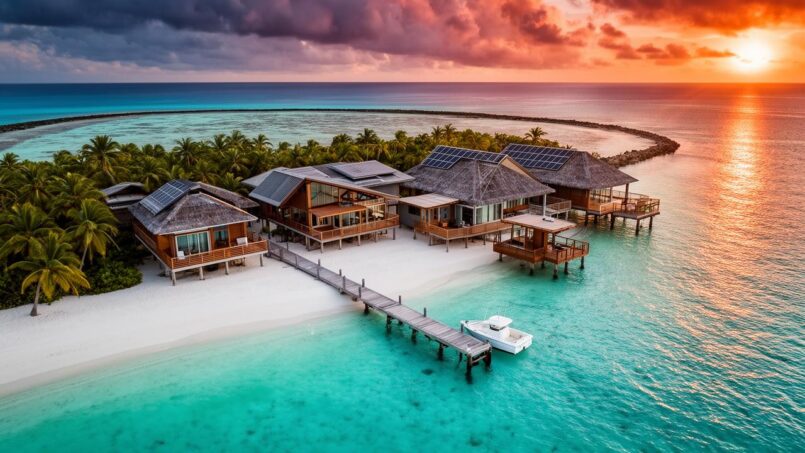
 Published on and written by Cyril Jarnias
Tuvalu spontaneously evokes the image of a lost paradise in the middle of the Pacific: translucent lagoon, coral atolls, preserved Polynesian culture, low population density. On paper, everything seems perfect for an ideal second home destination. But behind the postcard, the reality of land, economics, and especially climate transforms this dream into an ultra-confidential, regulated, and fragile market.
The second homes market in Tuvalu is atypical: very small territory, land rights influenced by custom, weak financial system, high exposure to sea-level rise, and a political will to protect the land and national identity.
A Tiny Country, a Limited Habitable Area
With only 26 square kilometers of land spread across nine islands, Tuvalu is one of the smallest countries in the world. The capital, Funafuti, and more specifically the islet of Fongafale, is home to about 6,000 of the country’s roughly 11,000 inhabitants—more than half the population. The rest is scattered in small communities across the other eight islands, often rural and largely subsistence-based.
The average elevation is less than 2 meters above sea level, and the country’s highest point, on the island of Niulakita, peaks at about 4.6 meters. Practically, this means that nearly all inhabited areas are within immediate reach of waves, king tides, and storm surges during cyclones.
This vulnerability is compounded by a lack of truly available land: on some islets like Fongafale, about half the surface consists of filled marshes and porous coral blocks, while elsewhere habitable strips of land are so narrow they are limited to a few dozen meters between the ocean and the lagoon.
In this context, talking about a “second home market” means talking about an area that is already scarce, contested, and fundamentally vital for residents before being a real estate product.
A Modest, Dependent, and Vulnerable Economy
Tuvalu’s GDP remains very modest in size (about 53 to 54 million US dollars around 2025, according to projections), with real growth typically between 2.5% and 4% during recent expansion years. The economy relies on a few pillars:
Main sources of revenue for the Tuvalu archipelago
Revenue from fishing licenses granted to foreign fleets
International aid and climate finance received
Remittances from Tuvaluans working abroad
Revenue generated by the Tuvalu Trust Fund
Revenue from the commercial exploitation of the .tv internet domain
Tourism, for its part, remains marginal: about 3,100 visitors in a recent year, the equivalent of a few planeloads of travelers. Tourist infrastructure remains extremely limited, mainly concentrated in Funafuti around small lodges and the only “official” hotel, the Vaiaku Lagi Hotel.
The following table provides a framework for the macroeconomic context, on which any attempt at a secondary real estate market indirectly depends:
| Indicator | Approximate Value |
|---|---|
| Total population | ~11,000 inhabitants |
| Land area | 26 km² |
| GDP (order of magnitude 2025) | 53.7 M USD |
| Real growth 2023 | 4.0% |
| Real growth 2024 | 3.1% |
| Annual tourists (approx. 2023) | 3,100 visitors |
| Currency | Australian dollar |
This small economy, highly dependent on the outside world and lacking a modern financial sector, strongly conditions the possibility of buying, financing, operating, and reselling a second home.
Customary Land Law Dominates: Land Is Not for Sale
The first key point for anyone interested in a second home in Tuvalu is simple: it is practically impossible to buy land in freehold, especially for a non-citizen.
The country operates on a customary tenure system in which land is traditionally held collectively by families or clans. One of the central concepts, often summarized by the term kaitasi – literally “eating from the same land” – expresses the idea that those who live on and derive sustenance from a plot share equivalent rights to it. Under this system, land is a common good, central to identity and social status, not a commodity.
Customary Land, Native Land, Crown Land: A Legal Mosaic
The legal framework draws from both customary law, texts inspired by British common law, and a series of specific statutes (Land and Title Act, Native Lands Act, Land Ownership Act, Foreshore and Land Reclamation Act, etc.). The main categories are as follows:
| Type of Land | Key Characteristics |
|---|---|
| Customary land | Collective family or clan ownership, inalienable to non-nationals, managed through custom and decisions of the Lands Courts. |
| Native land | Land held by Tuvaluans; sale to non-natives is prohibited, only leases are possible under strict conditions. |
| Crown land (State) | Land belonging to the Crown or the state; often used for public infrastructure, ports, airports, schools. |
The Native Lands Act goes very far in protecting indigenous land: the sale of native land to non-natives is prohibited, and any contrary transaction is declared null and void. Exceptions exist only for leases, usually long-term, and subject to ministerial approval.
Even the state does not own nearly all the land: it leases part of it from customary owners, including for infrastructure like Funafuti’s airport. This simple fact illustrates how deeply land remains, almost everywhere, a family matter before being a state matter.
Analysis of the land system
A Tangle of Co-Owners and Intertwined Rights
Over generations, inheritances and marriages between people from different islands have fragmented properties to the maximum. Parcels are small, and often held by many co-owners, sometimes scattered across different islands or even abroad. Every major decision—change of use, long-term lease, exchange—requires the agreement of a large number of people, greatly complicating any negotiation.
Land courts and island councils arbitrate disputes and validate leases, but the land registry is partial. Many rights are based on oral or customary agreements, creating legal uncertainty for investors.
For a foreign buyer seeking a second home, this translates into several structuring consequences:
– the practical impossibility of acquiring a classic title deed
– the need to go through a long-term lease
– a heavy negotiation involving multiple families and local authorities
– a high risk of disputes if everything is not carefully managed and documented
Foreigners Cannot Own the Land: Only Leasing Is Possible
The basic rule is clear: a non-Tuvaluan cannot hold land in freehold. The only way to enjoy a plot—and possibly build a house—is through a lease.
Leases of 30 to 99 Years, Under Strict Oversight
Laws and practice converge: foreigners may be granted long-term leases, often in a range of 30 to 99 years, for residential, tourist, agricultural, or commercial uses. But these leases are far from simple private contracts:
Land agreements must be approved by the competent minister (often the Minister of Lands or Justice), require validation by land courts if they involve native land, and must be judged compatible with community interests and resource protection.
Specific safeguards govern the signing: the court must especially verify that the lessor—the customary or native owner—retains enough land to ensure his subsistence and that of his dependents. The minister, for his part, must ensure that the terms are not “manifestly disadvantageous” to either party.
A Long and Often Opaque Administrative Process
For a foreigner, the typical sequence looks like this:
The process includes submitting a complete file to the competent ministry (identity, financial capacity, detailed project), followed by an administrative review that can take from a few weeks to several months. Then, lease negotiations take place with the numerous customary owners involved, before the agreement is drafted and reviewed by a local lawyer specialized in land law. Finally, the lease is registered with official registries, such as the Lands and Survey Department or the Leases Register.
At each step, obstacles can arise: disagreement within the owning family, latent disputes over plot boundaries, new demands from certain beneficiaries, or questions from authorities about the environmental impact of the project (proximity to the coastline, mangroves, coral reefs).
This complex, lengthy process helps keep the volume of foreign projects—including second homes—at an extremely low level.
A Nascent Real Estate Market with No Real Resale Market
Even in Funafuti, the most developed atoll, the “real estate market” in the classic sense remains embryonic. There are virtually no agencies, no structured listings, and very few sales transactions per se. The very notion of a second home market, in the sense of a dynamic segment of foreign owners, is therefore largely theoretical.
Prices, Rents, Credit: A Rudimentary System
The few available data points nevertheless sketch an order of magnitude:
| Real Estate Indicator (Order of Magnitude) | Approximate Value |
|---|---|
| Rent 1-bedroom, city center (40 m²) | 193 – 300 USD / month |
| Rent 3-bedroom, city center (80 m²) | 377 – 536 USD / month |
| Purchase apt. city center (price per m²) | ~1,000 – 1,400 USD |
| Purchase house outskirts (price per m²) | ~200 – 1,000 USD |
| Mortgage interest rate (20 years) | 5 – 11% / year |
These figures should be interpreted with caution. They reflect more a few isolated transactions or estimates than a structured market. Moreover:
There is no modern real estate credit. The banking system is very limited: no credit cards or ATMs. Prudential oversight is weak, and correspondent banking relationships with foreign entities are fragile.
The absence of property tax and capital gains tax on real estate could theoretically attract speculative investors. In practice, the combination of land constraints, climate constraints, and financial constraints almost completely neutralizes this appeal.
Valuation Largely Tied to Use, Not Resale
Under current conditions, the primary value of a property in Tuvalu—whether primary residence, second home, or tourist facility—is much more about the use one makes of it (housing, guesthouse activity, etc.) than the hope of reselling it at a high profit.
Serious projections also indicate that capital appreciation is, at best, very limited. Most analyses consider that possible economic returns come mainly from:
– cash flow generated by operations (tourist accommodation, micro-hotels, etc.)
– personal use (residence for repeated stays)
In this context, talking about a “secondary market”—in the sense of fluid resale to other buyers—is largely illusory. The pool of potential buyers remains tiny, mainly composed of Tuvaluans or a few institutions (state, donors).
The Overwhelming Weight of Climate: Building on the Edge of a Rising Sea
No second home project in Tuvalu can reasonably ignore the country’s central reality: sea-level rise and the intensification of climate hazards.
Measured but Already Destructive Sea-Level Rise
Tide gauge and satellite measurements indicate a mean sea-level rise around Tuvalu of about 4.7 to 5.9 mm per year since the 1990s, significantly higher than the global average. Over three decades, this has already translated into about 15 cm of rise.
Projections for the coming decades are unambiguous:
| Time Horizon | Relative Sea-Level Rise (relative to ~2005) |
|---|---|
| 2030 | ~11–12 cm (usual scenarios) |
| 2050 | ~22–27 cm |
| 2100 | 0.5–1.0 m (with an extreme scenario near 2 m) |
The consequences for land and real estate are major:
The drastic increase in marine flooding from 2050 onward will lead to progressive salinization of freshwater lenses and soils, making some areas unsuitable for agriculture or habitation, with a risk of permanent submersion of the lowest areas by the end of the century.
In Funafuti, studies estimate that in the absence of new protections, half the area of the capital could be regularly flooded by simple king tides by mid-century, and up to 95% by 2100.
Cyclones, King Tides, Saltwater Intrusion: A Cocktail of Risks
Beyond the slow but inexorable sea-level rise, Tuvalu experiences frequent shocks:
Cyclone Pam in 2015 displaced 45% of Tuvalu’s population and caused damage equivalent to more than a quarter of GDP
Projections explicitly mention, in high-emission scenarios, the possibility that many low-lying Pacific islands could become difficult to inhabit between 2060 and 2070. Tuvalu is regularly cited among the first candidates for this category.
For a second home owner, these elements translate into very concrete risks:
– repeated damage to buildings (roofs, frames, foundations, electrical systems)
– continuously increasing maintenance needs in a context where construction costs are already very high
– potential uninsurability of certain major risks, insurance markets being limited and premiums high
– possible, even total, depreciation of the property’s value if an area is deemed too exposed
Massive Adaptation: Dikes, Land Reclamation… and Uncertainties
Faced with this threat, Tuvalu is not standing still. The country is engaged in one of the most ambitious adaptation programs in the Pacific, which will, in the long term, have a direct impact on land availability and security for any form of residence—primary or secondary.
TCAP: Protecting and Raising Strategic Areas
One of the flagship projects is the Tuvalu Coastal Adaptation Project (TCAP), funded notably by the Green Climate Fund (USD 36 million) and the Tuvaluan government. It aims to build coastal protections, combine “hard” structures (seawalls, rock armoring) with “soft” solutions (beach nourishment), and most importantly raise key land areas.
The platform created by dredging lagoon sand at Fongafale, Funafuti, measures nearly 7.8 hectares to remain out of reach of waves beyond 2100.
The figures show the scale of the effort:
| TCAP Element | Indicative Value |
|---|---|
| Green Climate Fund financing | 36 M USD |
| Government of Tuvalu contribution | 2.9 M T$ |
| Total targeted protected coastline length | > 2,200 m (≈ 10% of vulnerable coasts) |
| New land reclaimed at Funafuti | ~7.8 hectares (raised platform) |
| Directly benefiting population | ~3,100 people (nearly 29% of pop.) |
Officially, these new lands are intended to eventually accommodate housing, public facilities, transport, health, and education infrastructure. They represent crucial land potential in a saturated and threatened country, but they are not designed to become a playground for luxury second homes.
L-TAP, “Tuvalu’s Refuge”: Reconfiguring the Country
Beyond TCAP, the government and UNDP are working on a Long-Term Adaptation Plan (L-TAP), nicknamed “Te Lafiga o Tuvalu”—Tuvalu’s Refuge. It aims, by the end of the century, to create about 3.6 km² of raised land, more than the current habitable area of some islands, to gradually relocate the population and infrastructure.
The spirit of this plan is twofold:
– to guarantee territorial and political continuity, even if parts of the current territory become uninhabitable
– to offer a safe space to maintain culture, language, and way of life, rather than relying on mass emigration
In this perspective, land becomes even more strategic: it is the foundation of collective survival in the long term. It is therefore unlikely that authorities will be very open to the idea of allocating raised land parcels to foreign second homes, unless integrated into carefully calibrated projects, such as eco-friendly micro-hotels.
A Land Culture Focused on Belonging, Not Speculation
One cannot understand the barriers to the second home market without returning to the almost sacred relationship Tuvaluans have with their land. Land is one of the three pillars of local culture (alongside family and faith). It is:
– a symbol of wealth and strength
– an identity marker
– the basis of food security (forests, coconut palms, taro patches, coastal fisheries)
The kaitasi custom implies that all occupants of a land are its co-guardians. Any major decision, such as a sale, requires consensus among co-owners. Selling to a foreigner with no blood ties is considered contrary to this collective vision.
Furthermore, about 5,000 of the 11,000 inhabitants have no direct indigenous connection to the land (e.g., through marriage or internal migration). They therefore have no customary land rights, which heightens tension around access to land, even for nationals.
In such a context, the idea of foreigners acquiring second homes can be perceived as additional competition for an already pressured resource.
Where Could Demand for Second Homes Concentrate?
If we nonetheless consider the hypothesis of second homes, three main configurations emerge.
Funafuti: The Only Plausible “Hub”
Funafuti concentrates the international airport, port, main government offices, most commerce, and the only national bank. It is also the island where the few commercial accommodations are located.
For a foreigner wanting a second home, it is practically the only realistic place, because:
– accessibility is better (flights, boats)
– services (health, electricity, internet) are less rudimentary
– demand for short-term rentals (officials, NGOs, passing visitors) is slightly stronger
Rents for 1 to 3-bedroom apartments are relatively low in absolute value, but high compared to local incomes. The scarcity of urban space and institutional demand increase land costs.
The Outer Islands: Extreme Charm, Limited Viability
The outer islands—Nanumea, Nanumaga, Nui, Niutao, Nukulaelae, Vaitupu, Niulakita, etc.—offer a much more traditional face: fishing, subsistence agriculture, largely locally built housing, very few tourist facilities (often simple homestays).
A second home there would mean voluntary isolation, with irregular sea connections, no commercial flights, very limited medical services, and heavy reliance on rainwater. For a foreigner, setting up such a project would involve:
The project benefits from strong integration with the local community but faces high logistical costs related to transporting materials and specialized labor, with maximum risk in the event of a cyclone or flooding.
However, it is the most relevant territory for those considering a hybrid project: part-time second home and small eco-friendly accommodation the rest of the time, in close partnership with villagers.
Raised Land Projects: Ultra-Strategic Land
The new raised platforms at Funafuti, funded by TCAP, will gradually host housing, schools, roads, and possibly new economic functions. In the very long term, they could potentially include some forms of semi-private accommodation, but always within a highly planned framework conditioned by the relocation needs of the population.
It would be illusory, for now, to consider these areas as available for the secondary residential market: their primary purpose is to provide a refuge for Tuvaluans themselves.
A Market That Exists Only on Paper: What Realistic Prospects?
Given all these constraints—customary, legal, logistical, climatic—it would be misleading to present Tuvalu as a “new destination for second homes.” In reality, this market exists only marginally, informally, and is mostly reserved for Tuvaluan nationals living abroad who return to build on their family land.
For a foreign investor, realistic prospects lie more in:
Three key approaches to combining tourism development, resilience, and local partnerships
Long-term leases for very targeted projects such as small lodges, guesthouses, or eco-tourism micro-structures.
Integration into joint ventures with local families or Kaupule, fostering shared management and community roots.
Financing resilient infrastructure (water, solar energy, elevated buildings) that can serve as a basis for occasional residential use.
Even in these cases, the dominant logic remains social utility and resilience, rather than the classic vacation home concept.
Very Low International Demand, but Potentially Growing
Tuvalu’s international profile stems mainly from its position as a symbol of the climate crisis. This status attracts a form of curiosity, even fascination, among some travelers or investors seeking a meaningful project.
But the combination of the following factors discourages most candidates:
– difficult access (few flights, limited sea connections)
– high construction costs due to imports and lack of economies of scale
– weak banking system, requiring equity or offshore financing
– complex and opaque land framework for the uninitiated
– climate risks and long-term uncertainty about site habitability
Only a very niche segment—patient investors, highly aware of climate issues, willing to accept returns based mainly on use rather than speculation—could consider Tuvalu as a project ground.
What Future for Residential Real Estate in Tuvalu?
The coming decades will be decisive. Several contradictory forces will shape the residential landscape:
– sea-level rise and increasing flooding may force the abandonment of some areas, but also the densification of raised land
– international climate finance (Green Climate Fund, ADB, bilateral donors) will secure pockets of habitability, but at high cost and for primarily national use
– pressure to migrate—internally to Funafuti first, externally later—will intensify, further reducing margins for leisure uses
– the symbolic value of land, as a vector of sovereignty and identity, will remain central in negotiations on any foreign-involved project
In this scenario, secondary residence does not disappear entirely, but it changes nature. It becomes:
– either the extension of a community project (guesthouse, training center, base for environmental projects)
– or the occasional use of a property primarily designed to strengthen local resilience (elevated building that can serve as a cyclone shelter, for example)
In other words, Tuvalu will likely never be a “second home market” in the sense applied to larger tourist islands. At best, it will remain a territory for experimenting with a highly regulated form of secondary housing, aligned with community needs and deeply infused with climate constraints.
Conclusion: A Market Impossible to Copy-Paste
For those dreaming of owning a vacation home on a Pacific atoll, Tuvalu embodies both absolute allure and the perfect counterexample. Yes, its lagoons, culture, and small scale make it unique. But precisely because it is tiny, vulnerable, and structured around protective customary law, the country cannot—and does not want to—open widely to a logic of foreign second-home ownership.
The second home market in Tuvalu is therefore, today, more a theoretical figure than a quantifiable reality. The few existing opportunities go through:
Prioritize long-term leases and projects adapted to local needs. Accept that the value of the property lies in its use, not resale. Understand the central role of land in Tuvaluan identity.
At a time when the country is committing billions (relative to its GDP) to creating raised land to survive sea-level rise, the goal is not to multiply second homes, but to guarantee a livable space for its own citizens. Any reflection on real estate in Tuvalu—including second homes—can only be framed this way: a territory that first fights to remain habitable, before being desirable.
A heritage project or a question? Contact us now to speak with a wealth management expert.
Disclaimer: The information provided on this website is for informational purposes only and does not constitute financial, legal, or professional advice. We encourage you to consult qualified experts before making any investment, real estate, or expatriation decisions. Although we strive to maintain up-to-date and accurate information, we do not guarantee the completeness, accuracy, or timeliness of the proposed content. As investment and expatriation involve risks, we disclaim any liability for potential losses or damages arising from the use of this site. Your use of this site confirms your acceptance of these terms and your understanding of the associated risks.

Cyril Jarnias is an independent expert in international wealth management with over 20 years of experience. As an expatriate himself, he is dedicated to helping individuals and business leaders build, protect, and pass on their wealth with complete peace of mind.
On his website, cyriljarnias.com, he shares his expertise on international real estate, offshore company formation, and expatriation.
Thanks to his expertise, he offers sound advice to optimize his clients' wealth management. Cyril Jarnias is also recognized for his appearances in many prestigious media outlets such as BFM Business, les Français de l’étranger, Le Figaro, Les Echos, and Mieux vivre votre argent, where he shares his knowledge and know-how in wealth management.





