
 Published on and written by Cyril Jarnias
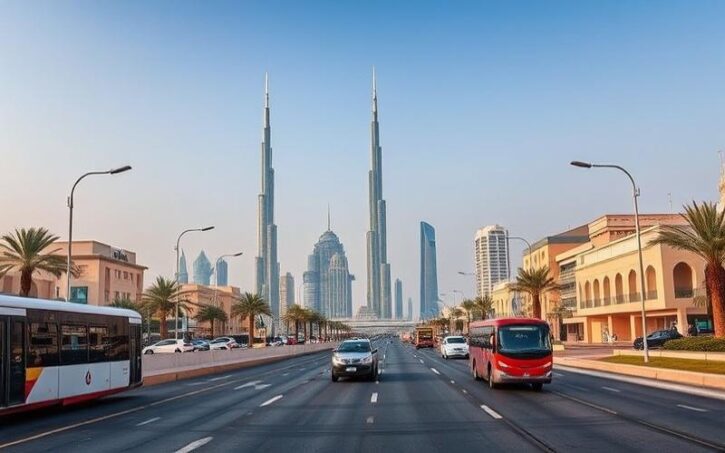
Traveling in the United Arab Emirates Without a Car is far from mission impossible. Between air-conditioned bus networks, an ultra-modern metro, trams, ferries, regulated taxis, and futuristic projects, the Emirates have heavily invested in public mobility. This practical guide explains, in clear English, how to use public transportation in the United Arab Emirates, with a concrete focus on Abu Dhabi and Dubai, where the offerings are most developed.
This guide includes route tips, price benchmarks, information on how payment cards work, essential rules to know, and an overview of the innovations that will transform travel in the country.
Understanding Who Manages What in Transportation
Before even getting on a bus, it’s useful to understand the “political map” of transportation in the United Arab Emirates. Each emirate has its own authority, but some projects are federal, like the future rail network.
In Abu Dhabi, the management of buses, taxis, and mobility projects falls under the Integrated Transport Centre (ITC), also known as the Abu Dhabi Mobility Centre. This body is part of the Department of Municipalities and Transport. Long-term planning relies on roadmaps like the Surface Transport Master Plan or the “Plan Abu Dhabi 2030” plan.
In Dubai, the Roads and Transport Authority (RTA) is the reference authority that oversees the entire transport network: automated metro, tram, buses, taxis, maritime network (abras, ferries, water bus), and the unified payment system. It also drives ambitious strategies in autonomous mobility, decarbonization, and accessibility.
In other emirates, local authorities handle buses and intercity taxis, for example the Sharjah Roads and Transport Authority (SRTA) in Sharjah or the Ras Al Khaimah Transport Authority (RAKTA) in RAK.
Finally, a federal player plays a growing role: Etihad Rail, the state railway company that is building a network of approximately 1,200 km to connect the seven emirates by train.
Overview of the Main Authorities
| Emirate / Level | Main Authority | Key Role |
|---|---|---|
| Abu Dhabi | Integrated Transport Centre (ITC – DMT) | Buses, taxis, planning, pricing |
| Dubai | Roads and Transport Authority (RTA) | Metro, tram, buses, taxis, maritime, tolls |
| Sharjah | Sharjah Roads and Transport Authority (SRTA) | Local and inter-emirate bus network |
| Ras Al Khaimah | Ras Al Khaimah Transport Authority (RAKTA) | Internal network and inter-emirate connections |
| Federal | Etihad Rail | National rail network |
This organization explains why payment systems, cards, and some rules still vary from one emirate to another, even though the trend is clearly toward more integration.
The Major Options for Getting Around Without a Car
In the United Arab Emirates, the trade-off is often between private driving and using public transport. Cars remain very common, but in major cities, more and more residents combine metro, bus, tram, taxis, and ride-hailing services, depending on the trip.
In practice, travelers have several families of solutions available:
An overview of available and developing transport modes in the UAE, ranging from backbone networks to innovative solutions.
Metro and tram in Dubai, future Abu Dhabi metro, and the national Etihad Rail network.
Very dense urban and intercity networks in Dubai and Abu Dhabi, more limited in other emirates.
Traditional abras, ferries, water buses, and water taxis, mainly in Dubai, along with ferries to some Abu Dhabi islands.
Services available throughout the country, including taxis and apps like Uber, Careem, and Hala.
Robotaxis, trackless trams, suspended sky pods, autonomous shuttles, and flying taxis, in experimental or deployment phases.
The choice depends on the location, the time, and your budget. In Dubai, the metro is often the backbone of a route. In Abu Dhabi, it’s more about buses, supplemented by taxis. In other emirates, intercity buses and taxis take over.
Paying for Your Trips: Nol, Hafilat, and Other Cards
It’s impossible to discuss public transportation in the United Arab Emirates without talking about contactless payment cards. Cash is gradually being phased out on city buses, and the cards are also used for other services like parking.
In Dubai: The Nol Card
In Dubai, the Nol card is mandatory for the metro, tram, most public buses, and some maritime transport (ferry, water bus). It’s a rechargeable chip card that you tap at entry and exit.
The main types of cards are: topographical, thematic, political, routes, maritime, and geological.
| Nol Card Type | Purchase Price (approx.) | Key Features |
|---|---|---|
| Red Ticket | 2 AED | Rechargeable ticket, up to 10 trips or 5 day passes, ideal for short stays |
| Silver | 25 AED (including 19 AED credit) | Valid for 5 years, standard use for residents and tourists |
| Gold | 25 AED (including 19 AED credit) | Access to Gold Class (premium cars), double fare |
| Blue | Free (with registration) | Discounts for students, seniors, People of Determination, social welfare recipients |
The fare system is zonal: the more zones you cross, the more the price increases. In “Silver” class, a short trip may cost around 3 AED, a route crossing several zones up to 7.5 AED. In Gold, fares are approximately doubled.
The Nol card is not just for public transport. It can also be used to pay for parking in some RTA public lots, as well as for small purchases at certain partner stores.
In Abu Dhabi: The Hafilat Card
In Abu Dhabi, city buses operate with the Hafilat Smart Card. Here too, cash payment is no longer accepted onboard. You must tap on and tap off so that the exact distance is calculated.
There are several versions of Hafilat:
| Hafilat Type | Indicative Price | Validity Period / Limit |
|---|---|---|
| Permanent anonymous card | 10 AED | 5 years |
| Temporary card | 5 AED | 14 days, rechargeable up to 150 AED |
| Personalized card | 5 AED | 5 years (or up to age 16 according to some sources) |
Fares can be loaded per trip or as passes. As a rough guide:
– weekly pass: 30 AED;
– monthly pass: 80 AED;
– annual student pass: 500 AED.
Low-income citizen families enrolled in social support programs benefit from capped fares: approximately 30 AED per week and 80 AED per month.
Bus Fares in Abu Dhabi: Key Benchmarks
The fare model introduced by the ITC distinguishes several service categories, while moving toward unification.
| Trip Type | Fare Basis Indicated |
|---|---|
| Local / urban trip | Flat 2 AED |
| Regional / suburban trip | 2 AED + 0.05 AED per km |
| Inter-emirate trip | 10 AED + 0.10 AED per km |
| Connections to Dubai / Al Ain | Approx. 25 AED one way |
Since the introduction of the “Standard Service” concept, the logic is simple: 2 AED boarding fee, then 0.05 AED per kilometer, capped at 5 AED for a trip over 60 km. Transfers between public bus lines do not incur a new boarding fee.
Children aged 10 and under travel for free. Seniors, People of Determination (people with disabilities), and one accompanying person for the latter can also benefit from free subscriptions.
Other Regional Cards
Other emirates also have their own cards:
– Masaar card in Ajman;
– Sayer card in Sharjah.
In practice, if you mainly stay in Dubai and Abu Dhabi, Nol and Hafilat will be your two main tools. For inter-emirate connections operated by Dubai RTA, the Nol card often remains the reference.
Getting Around Abu Dhabi by Public Transport
Abu Dhabi is the largest of the seven emirates and the federal capital. Long car-oriented, the city has undergone a massive expansion of the bus network over the past fifteen years, while waiting for the metro and train to arrive.
An Air-Conditioned, Dense, and Growing Bus Network
Public bus service began in 2008 with just four lines, free at launch. Since then, growth has been spectacular: in 2023, the fleet comprised 825 buses, and the network expanded to reach 124 lines in 2024. Trips exceeded 83 million journeys in a single year.
The network is divided into several categories:
– Local lines for central neighborhoods;
– City Express lines connecting hubs more quickly;
– Limited-stop lines;
– Regional connections to suburbs and cities within the emirate (Al Dhafra, etc.);
– Night services;
– Airport lines.
All buses and stops are air-conditioned, a significant advantage in a country where heat can be extreme for several months of the year. The fleet is a mix of models: conventional buses like the MAN Lion’s City, Mercedes Citaro, and Volvo, as well as alternative-fuel buses, electric or hydrogen, supplied by manufacturers such as Yutong and Wisdom Motor.
For women and families, the front rows are reserved for women and children, a rule best respected. As elsewhere in the country, eating or drinking onboard is prohibited.
Mapping, App, and On-Demand Services
For trip planning, the reference tool is the Darbi app (or Darb / Darbi depending on the version). It’s an interactive map powered by the ITC, offering multi-modal routes, real-time updates, and also allows you to top up some cards.
Hafilat cards can be purchased and recharged at bus stations, some supermarket branches like Lulu Hypermarket, and via vending machines: Ticket Vending Machines for purchase and top-up, Swift Recharge Machines for crediting only.
This is the base fare in dirhams for a trip on the Abu Dhabi Link on-demand bus service in the Al Shahama area.
Intercity Connections from Abu Dhabi
From the central station, also known as Al Wahda Bus Station, a set of express lines connects to major neighboring cities. Some key connections stand out:
– to Dubai: mainly via lines E100 and E101 operated by Dubai RTA, for about 25 AED per one-way trip;
– to Al Ain: line X90 connects Abu Dhabi to the inland city, for a similar cost;
– to the Al Dhafra region: a network of lines (X80, X86, X87, etc.) serves localities such as Ruwais, Madinat Zayed, Liwa, and Jebel Al Dhanna.
Inter-emirate fares remain competitive: around 25 to 35 AED to reach most other emirates on a modern, air-conditioned bus.
Ferries and Maritime Connections from Abu Dhabi
Abu Dhabi also operates some ferry connections, notably:
– the crossing between Dalma Island and Jebel Al Dhanna port;
– the line serving Al Aliah and Saadiyat Island.
Fares are clear and fixed: 100 AED per vehicle, 20 AED per adult or child over 12. Children under 12 travel free.
For tourists, a free shuttle service called “Experience Abu Dhabi Shuttle” connects various points of interest via several routes. There is also an “Abra Water Hopping” service operated by Captain Tony’s, charged at around 25 AED per passenger, more for leisure than daily transport.
New Developments: Trackless Tram and Future Metro Line
Abu Dhabi is not stopping at buses. The emirate is testing innovative solutions like the Autonomous Rapid Transit (ART), sometimes described as a trackless tram or “trackless tram”. These are articulated vehicles that move on “virtual rails” painted on the ground, without physical rails. A first test took place on Yas Island starting October 2023, and the system is supposed to integrate with standard bus fares.
In parallel, an Abu Dhabi metro is in the study/construction phase, with a proposed network of about 131 km. Eventually, it will complement the roles of buses and future Etihad Rail stations, connecting major districts and the airport.
Public Transport in Dubai: Metro, Tram, Buses, and Boats
In Dubai, the public transport network is one of the most advanced in the region. The automatic metro, opened in 2009, is the backbone of a highly integrated multi-modal system.
Dubai Metro: The Backbone of Urban Mobility
The Dubai Metro is fully automated and driverless. It has two main lines:
– the Red Line, which runs along Sheikh Zayed Road and connects the international airport (DXB) to districts like Deira, Downtown, Business Bay, Mall of the Emirates, Dubai Marina, and stations like UAE Exchange or Expo City;
– the Green Line, which mainly serves historic and commercial areas, notably around Dubai Creek, old Dubai, the souks, and hubs like BurJuman or Union.
In total, the network has 49 stations, all air-conditioned, with elevators, level platforms, and multiple accessibility features: tactile pathways, audio and visual announcements, accessible restrooms, platform screen doors, etc. Some stations are connected by covered walkways to major attractions, such as Dubai Mall or Burj Khalifa.
Trains consist of five cars: four in standard Silver class and one divided between a women/children section and Gold Class, which is more comfortable but twice as expensive. Two cars per train have reserved areas for women and children, marked by a pink line.
Frequencies are high, around 2 to 3 minutes during peak hours. Dubai boasts over 900,000 daily users on the metro, with constant improvements (extension to Expo City, planned Blue Line by 2029, etc.).
Dubai Tram: The Coastal Link
The Dubai Tram complements the metro along the waterfront. It runs about 10.6 km along the marina and Jumeirah Beach Residence (JBR), up to Al Sufouh. It serves, among others:
– JBR “The Walk”;
– Dubai Marina Mall;
– the Media City / Knowledge Village area.
Its 11 stations connect to two Red Line stations (Sobha Realty and Dubai Marina) and to the Palm Monorail via Palm Gateway. The design is similar to the metro, with enclosed, air-conditioned platforms, women/children zones, and a Gold car. Fares are simple: 3 AED in Silver class, 6 AED in Gold per trip, as the entire tram network is in a single fare zone.
A Vast Network of Urban and Intercity Buses
Dubai has over 1,500 public buses on nearly 193 lines. The RTA reports more than 119 internal lines, plus express lines, shuttles to metro stations (Metro Link), and about a dozen inter-emirate connections.
Buses are air-conditioned and equipped with Wi-Fi. For people with reduced mobility, many vehicles have retractable ramps, a dedicated space, and a wheelchair securement system. The driver must assist during boarding. Stops are announced via audio and visual systems.
Fares vary depending on the zones crossed, following the same model as the metro, typically between 3 and 7.5 AED in Silver class. Some services, like the Hatta Express (H02), cost 25 AED to connect Dubai Mall to Hatta.
Inter-Emirate Connections from Dubai
From Dubai, the RTA operates several intercity lines to other emirates, notably:
Presentation of the main RTA express bus lines connecting Dubai to other emirates, with approximate fares.
Lines: E100 (Al Ghubaiba – Abu Dhabi Central), E101 (Ibn Battuta – Abu Dhabi Central), E102 (Zayed Airport and Mussafah connection). General fare: 25 AED.
Lines: E301, E303, E303A, E304, E306, E307, E307A, E315, and the new E308 (Stadium to Jubail). Fares: between 10 and 12 AED.
Lines: E400 and E411. Fare: approximately 12 AED.
Line: E700. Fare: approximately 25 AED.
Line: E16 from Sabkha.
RTA inter-emirate buses are modern and equipped with free Wi-Fi. However, note that they are not always wheelchair accessible; some vehicles require climbing stairs.
Maritime Transport: Abras, Ferries, and Water Buses
In Dubai, water is also a mode of transport:
– traditional abras on Dubai Creek offer crossings for 1 AED between Deira and Bur Dubai, in a few minutes, with near-continuous frequency;
– the Water Bus in the marina operates several stops (Marina Walk, Marina Mall, Marina Promenade, etc.) with fares ranging from 3 to 11 AED depending on the number of stations;
– the Dubai Ferry offers longer coastal routes, for example between Dubai Marina, Bluewaters Island, Dubai Canal, and Al Ghubaiba, with tickets from 15 AED for short trips up to about 75 AED for full routes.
Most of these services accept the Nol card, with the notable exception of some tourist abras and the Palm Monorail, which have their own ticketing.
Taxis and Ride-Hailing: An Indispensable Link in the Network
Even with an efficient metro and numerous buses, taxis and ride-hailing are still essential in the United Arab Emirates, especially outside central areas or late at night.
Taxis in Abu Dhabi: Strict Regulation and Capped Prices
In Abu Dhabi, taxis are regulated by the Centre for Regulation of Transport by Hire Cars (TransAD). You can hail one on the street, book via the “Abu Dhabi Taxi” app, call 600 53 53 53, or use platforms like Uber and Careem.
The typical fare is structured as follows:
Per-kilometer rate in AED for taxi rides in Dubai.
Over 85% of taxis run on natural gas or are hybrids. Specific services exist: pink taxis driven by women for female passengers and children, wheelchair-accessible vehicles, etc. Seniors and People of Determination with a ministry card can enjoy a 50% discount.
Taxis in Dubai: Abundant and Relatively Affordable
In Dubai, the Dubai Taxi Corporation, under the RTA, manages a fleet of over 11,000 vehicles. They are recognizable by their cream color, sometimes topped with a colored roof. Taxis with a pink roof are reserved for women and families, driven by female drivers.
Fares are also highly standardized:
| Fare Component (Dubai) | Price Indication |
|---|---|
| Base fare (day) | Approx. 5 AED |
| Base fare (night) | Approx. 5.5 AED |
| Per km fee | 1.82 AED |
| Waiting time | ~0.50 AED per minute |
| Minimum fare | 12 AED |
| Airport surcharge | 25 AED at pickup |
To give rough estimates, a trip from Dubai Airport to Downtown / Dubai Mall often ranges between 60 and 100 AED, up to 95 AED to Dubai Marina, or about 110 AED to Palm Jumeirah. A taxi remains highly competitive, especially with multiple passengers.
Uber, Careem, Hala: Apps That Complement the Offering
Ride-hailing services are well established in both major emirates:
Ride-hailing apps like Uber and Careem segment their offerings to meet various needs. Uber, for example, offers a standard service (UberX) and premium options. Careem, meanwhile, offers several ranges (GO, Business) and even includes a unique service: Hala Taxi. The latter allows you to book RTA public taxis via the app, at regulated street fares, while adding digital advantages like real-time tracking and cashless payment.
Base fares for ride-hailing are similar to those of taxis, sometimes slightly higher, with surge pricing during high demand. Uber, for instance, can multiply its prices up to 2.5 times during peak hours, Careem around 1.5 times. In some independent tests, RTA taxis hailed on the street were found to be 20 to 40% cheaper than app estimates for the same routes.
Accessibility and Rights of “People of Determination”
The United Arab Emirates has developed a comprehensive legal framework around the rights of people with disabilities, officially referred to as “People of Determination.” Federal and local laws (such as Federal Law No. 29 of 2006 or certain Dubai-specific texts) govern equal access to transportation and public services.
Facilities on the Dubai Network
The Dubai Metro is often cited as an example of accessibility:
– elevators at all entrances and between levels;
– platforms level with the train floor, with a very small gap;
– tactile and visual signage;
– systematic audio announcements;
– reserved wheelchair spaces in several cars;
– accessible restrooms in every station.
Most urban buses in Dubai are equipped with a retractable ramp and a hydraulic kneeling system to reduce the step height. Additionally, air-conditioned bus shelters are designed for easy access.
People of Determination can obtain a special personalized Nol card, costing about 70 AED (including 20 AED initial credit), valid for five years, granting them free travel on Dubai metro and urban buses. The card can also be used to pay for other services like some parking or Water Bus trips.
Provisions in Abu Dhabi
In Abu Dhabi, the entire public bus fleet is announced as wheelchair accessible. People of Determination are entitled to unlimited free travel on urban buses in Abu Dhabi and its suburbs, as well as a 50% discount on intercity buses, for example to Al Dhafra or Al Ain.
Beneficiaries are exempt from certain tolls (Darb) for one vehicle, as well as registration or renewal fees. They also benefit from reduced rates on driver’s licenses. In addition, reserved parking spaces, located near station entrances, are systematically provided for them.
Adapted Taxis and Complementary Services
In both major cities, specially equipped taxis with ramps or lifts are available upon reservation. In Dubai, a few taxis of this type are managed by Dubai Taxi Corporation, equipped with restraint systems, respiratory equipment, onboard wheelchairs, and space for companions. In Abu Dhabi, TransAD also provides a fleet of accessible taxis, with a 50% discount for cardholders.
In this context, caution is still advised for inter-emirate connections: some long-distance bus lines are not yet equipped to accommodate a wheelchair without transfer.
Conduct Rules and Etiquette in Public Transport
The United Arab Emirates enforces strict regulations on public behavior, including in public transport. Some principles to keep in mind.
Dress should remain modest: shoulders and knees covered, no transparent or overly tight clothing, no offensive messages on T-shirts. Vehicles and stations have reserved areas for women and children, marked by floor markings (often pink) and signs. It is prohibited for men to stand there, even if standing.
Seats are reserved for priority passengers. It is forbidden to eat, drink, chew gum, or smoke, subject to fines. Vulgar behavior, public arguments, and excessive displays of affection are also prohibited.
During the month of Ramadan, adherence to rules is even stricter: it is forbidden to eat, drink, or smoke in public spaces during the day, even for non-Muslims. Line schedules are adjusted to accommodate major prayers, Iftar, and nighttime activities.
Projects That Will Revolutionize Mobility
The United Arab Emirates is not content with just running metro and buses: they are heavily investing in futuristic projects, for economic, environmental, and image reasons.
Etihad Rail and High-Speed Trains
The national Etihad Rail network, about 1,200 km long, is expected to launch passenger service by 2026. The planned trains can carry up to 400 passengers at 200 km/h. It is announced that the Abu Dhabi – Dubai journey will take about 57 minutes, and Abu Dhabi – Fujairah will take 105 minutes.
In parallel, a separate high-speed line project between Abu Dhabi and Dubai aims for a travel time of only 30 minutes, with top speeds of 350 km/h. Several stations are planned along this corridor, including on Reem Island, Yas Island, Saadiyat Island, near Zayed Airport, and near Al Maktoum Airport.
Metro, Tram, and Autonomous Systems
Dubai continues to expand its metro with the future Blue Line, 30 km and 14 new stations, expected to launch in 2029. The goal is to relieve now-congested road corridors and increase the number of metro + tram stations to 78. Two major interchange hubs, Union 71 (Deira) and Al Maktoum Hub (Bur Dubai), are under development to support this growth.
Abu Dhabi is already testing autonomous shuttles, such as WeRide robotaxis on Yas Island and modular pods, and is working to create a test center. Dubai has signed an agreement with Cruise to deploy driverless taxis, becoming the first city outside the US targeted by the company.
United Arab Emirates – Development of Autonomous Vehicles
Flying Taxis, Sky Pods, and Aerial Innovations
Another expected revolution is that of eVTOLs, these electric vertical takeoff and landing air taxis. Dubai has granted Joby Aviation an operational monopoly for several years for a network of flying taxis capable of carrying four passengers plus a pilot, at around 320 km/h and 160 km of range. First services are announced around 2026, with “vertiports” near Dubai Airport, Zabeel / Dubai Mall, Palm Jumeirah (Atlantis The Royal), and Dubai Marina.
Minimum number of vertiports planned for the fleet of electric vertical takeoff and landing aerial vehicles in Abu Dhabi.
On the water, a Seaglider concept – an electric hybrid between a boat and an airplane, moving on a ground effect above the water at about 290 km/h – is set to connect Dubai and Abu Dhabi for about 165 AED per trip.
Finally, suspended transport systems, the Sky Pods, as well as solutions like RAILBUS (vehicles on elevated rails made from recyclable materials and powered by solar) or Floc Duo Rail pods tested in Dubai, are under study. The goal is to create fast, automated, energy-efficient networks that will complement metro, tram, and bus.
How to Concretely Plan Your Trips
Given the multiplication of modes, apps, and cards, the best practical advice is to rely on official digital tools to plan your journeys.
Essential Apps
In Dubai, the RTA ecosystem is central:
– the RTA Dubai app bundles many services (information, parking payment, etc.);
– S’hail serves as a multi-modal trip planner: metro, tram, bus, ferries, taxis;
– Nol Pay allows you to check and top up your Nol balance;
– DTC Smart App lets you book a taxi from Dubai Taxi Corporation.
In Abu Dhabi, the ITC highlights:
Discover the essential tools and platforms to facilitate your travel and administrative procedures, along with support numbers available 24/7.
App for trip planning, parking management, and toll payment.
Complete your administrative procedures online in a simplified and centralized manner.
Contact customer service or order a taxi anytime via our dedicated support numbers.
International apps complete this picture, such as Google Maps, Moovit, or Transit, which rely on official data from the authorities to offer routes, sometimes even offline.
Choosing the Right Mode for Your Trip
For a stay centered on Dubai, the combination of metro + Nol card is often unbeatable in terms of cost and speed, provided you stay near a station. Areas like Dubai Marina, Downtown, Deira, or Business Bay are very well connected.
For getting around Abu Dhabi, the urban bus network is effective for most trips. However, to save time, especially when visiting major tourist sites like Sheikh Zayed Grand Mosque, Louvre Abu Dhabi, Qasr Al Watan, or Yas Island, it’s recommended to supplement your travel with taxis.
For traveling between emirates, intercity buses offer very competitive prices (about 25 AED for a Dubai – Abu Dhabi trip, for example), with a level of comfort largely sufficient for journeys of 1.5 to 2 hours. When Etihad Rail opens to passengers, the train will become a very serious competitor for these connections.
In Summary
Public transportation in the United Arab Emirates has experienced a spectacular rise, particularly in Abu Dhabi and Dubai. Driverless metro, air-conditioned buses, trams, regulated taxis, maritime services, robotaxis, future high-speed trains, and flying taxis: the country has clearly chosen to diversify its modes of travel to absorb a rapidly growing population and reduce car dependence.
To get around efficiently without a car in Dubai and Abu Dhabi, it is crucial to get the Nol card for Dubai, the Hafilat card for Abu Dhabi, and use the official trip planning apps. These solutions make public transport simpler, more economical, and more sustainable, especially by avoiding traffic jams during peak hours.
Disclaimer: The information provided on this website is for informational purposes only and does not constitute financial, legal, or professional advice. We encourage you to consult qualified experts before making any investment, real estate, or expatriation decisions. Although we strive to maintain up-to-date and accurate information, we do not guarantee the completeness, accuracy, or timeliness of the proposed content. As investment and expatriation involve risks, we disclaim any liability for potential losses or damages arising from the use of this site. Your use of this site confirms your acceptance of these terms and your understanding of the associated risks.

Cyril Jarnias is an independent expert in international wealth management with over 20 years of experience. As an expatriate himself, he is dedicated to helping individuals and business leaders build, protect, and pass on their wealth with complete peace of mind.
On his website, cyriljarnias.com, he shares his expertise on international real estate, offshore company formation, and expatriation.
Thanks to his expertise, he offers sound advice to optimize his clients' wealth management. Cyril Jarnias is also recognized for his appearances in many prestigious media outlets such as BFM Business, les Français de l’étranger, Le Figaro, Les Echos, and Mieux vivre votre argent, where he shares his knowledge and know-how in wealth management.





