
 Published on and written by Cyril Jarnias
wordpress
Dizzying rooftops, ultra‑trendy beach clubs, illuminated dhow cruises, desert safaris, and family‑friendly neighborhoods buzzing late into the night — night falls in the United Arab Emirates without ever truly turning the lights out. The postcard image of skyscrapers and giant malls only tells part of the story: as late afternoon fades, a different life begins, more festive, more musical, sometimes ultra‑luxurious, sometimes surprisingly affordable and family‑oriented.
Nightlife varies by emirate: Sharjah focuses on family and cultural activities, Dubai offers glamorous clubs open until dawn, Abu Dhabi features international concerts and refined bars, while Ajman rounds it out with friendly seaside spots.
Understanding the Nightlife Rules in the Emirates
The first key to enjoying nightlife in the United Arab Emirates is understanding the framework. Alcohol is only served in licensed establishments, mostly located in hotels or tourist complexes. In some emirates like Sharjah, its sale is simply prohibited, naturally steering the evening toward cultural, family, or outdoor activities.
The level of security is very high, security presence is highly visible, and tolerance for behavior deemed inappropriate is virtually zero. Public intoxication is banned, excessive displays of affection are frowned upon, and respecting local customs remains a red line not to be crossed, even at 2 a.m. on a rooftop.
Most clubs enforce an age limit (21 to 25) and require an original ID (passport, Emirates ID, or driver’s license). Digital copies are usually not accepted. Dress code is smart: dresses or jumpsuits for women, shirts, trousers, and dress shoes for men. Beachwear like flip-flops, shorts, and tank tops are prohibited.
Hours follow the heat: people go out late. Rooftop bars often open around 5‑6 p.m. for sunset drinks, but clubs don’t fill up until after 11 p.m. Many close around 3 a.m.; the liveliest ones, especially in Dubai, can go until 4 a.m.
Sharjah: Cultural and Family-Focused Nights
Sharjah, recognized by UNESCO as the Cultural Capital of the Arab World, offers a nightlife that bucks the “clubs and champagne” cliché. Alcohol sales are banned, setting the tone: people come here for seaside evenings, illuminated strolls, shows, and museums, rather than dancing until dawn.
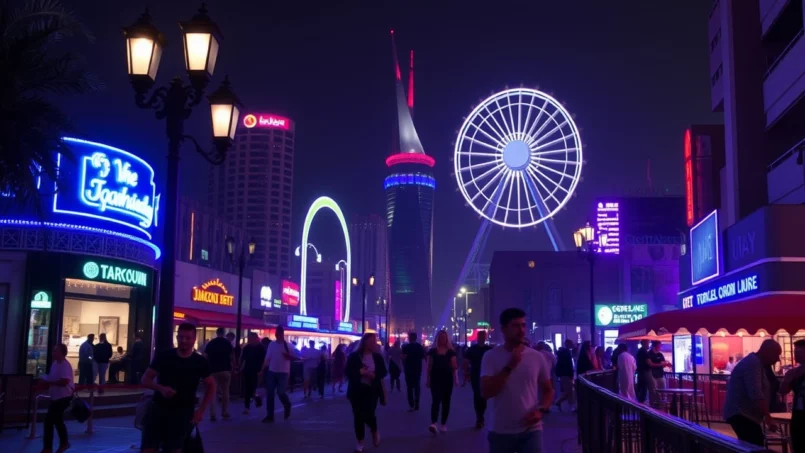
Al Qasba is a canal‑side district that really comes alive in the evening. Its illuminated facades, the Etisalat Eye of the Emirates Ferris wheel, café terraces, and restaurants draw families. You can take abra (traditional boat) rides along the canal and catch performances at small theaters. It’s a classic spot for dinner, a stroll, and enjoying the cooler winter temperatures (December to February) before heading home.
Nearby, Al Majaz Waterfront follows a similar concept, with a large park along the lagoon, a musical fountain, and restaurants lined up facing the water. As the evening unfolds, families stroll, kids play in designated areas, and couples settle on benches facing the fountain’s light shows.
The contrast with the historic core, the Heart of Sharjah, is striking. This area groups old buildings, souks, and restored alleyways. At nightfall, the Al Arsah Souk shops stay open, jewelry stalls are still busy, and the atmosphere feels more like a lively medina than an ultra‑modern city. Add the Blue Souk (Central Souk), brightly lit in the evening, and markets like the Sharjah Jubail Fish Market, and you get a nightlife centered on strolling, shopping, and conversation.
Despite the general alcohol ban, a few hotel‑related venues offer a more Western bar atmosphere: the Sharjah Wanderers Sports Club with a bar popular with expats, the Al Dallah lounge at the Hilton, The Clubhouse at the Sheraton Sharjah Beach Resort, and terraces like The Roof (Hilton rooftop), Sky Lounge (Corniche Hotel), or the Pool Bar at the Radisson Blu Resort. The vibe remains calm, more lounge than nightclub.
Of course, Sharjah isn’t isolated: it’s a short drive to Dubai or Ajman, which offer more festive evenings. But for those seeking peaceful, cultural, and family‑oriented nights, this is probably the most consistent emirate.
Dubai by Night: Clubs, Rooftops, and Beach Clubs
At the opposite end of the spectrum, Dubai proudly claims one of the most spectacular nightlife scenes in the world. Everything is designed for upscale tourism: sophisticated clubs, breathtaking rooftops, beach clubs that transform at sunset, dinner dhow cruises, and international concerts.
Key Nightlife Districts
The main areas where nightlife concentrates in Dubai almost form a tourist map of the city. Downtown Dubai, with the Burj Khalifa and Dubai Mall, draws evening crowds with its musical fountain shows, late‑night restaurants, and hotel bars overlooking the skyline. Palm Jumeirah, the palm‑shaped island, lines up luxury hotels, beach clubs, and sea‑view rooftops. Dubai Marina and JBR (Jumeirah Beach Residence) stay lively late, with a pedestrian promenade, beach bars, quayside restaurants, and residential towers. Along Sheikh Zayed Road, the main thoroughfare, five‑star hotels hide panoramic bars, private clubs, and lounges on their upper floors.
Alcohol is only served in licensed establishments, mostly within hotels. This has a side effect: many bars and clubs are located in resorts or hotel skyscrapers, often with spectacular views. So the skyline becomes the natural backdrop for countless evenings out.
Beach Clubs: From Lounger to Dance Floor
One of Dubai’s trademarks is its beach clubs that operate on a “day‑to‑night” principle. By day, you rent a lounger or cabana, have lunch with your feet in the sand, and monitor the Arabian Sea temperature. As the sun lowers, the music rises, lights come on, and the club gradually takes on the air of a mini‑festival.
Among the most iconic spots is Cove Beach. Set right on the waterfront, this club plays the chic card: private cabanas, pools, a Mediterranean restaurant (Sierra by COVEBEACH), the Rosé Lounge for sunset views of Ain Dubai, and the FUMAR Sheesha Lounge for premium shisha and cocktails. Resident or guest DJs host themed nights weekly. The venue also hosts private events and corporate parties, proof that the line between leisure and branding is sometimes thin in the Emirates.
Price in AED for a VIP sunbed or cabana on weekends at Bohemia club, amount deductible from consumption.
Prices give a good idea of where these places stand.
| Beach Club / Offer | Weekday (AED) | Weekend (AED) | Details |
|---|---|---|---|
| Bohemia – General Entry | 200 per person (Mon–Thu) | Depends on event | Deductible F&B |
| Bohemia – VIP Sunbed | 1,000 for 2 (Mon–Sun) | Same | Deductible F&B |
| Bohemia – Cabana | 2,000 (Mon–Thu, 4 pax) | 3,000 (Fri–Sun, 4 pax) | Deductible F&B |
| Kyma Beach – Lounger | 200 per person (weekday) | 250 per person (Sat–Sun) | Not deductible |
| Drift Beach – Lounger | 150 per person (weekday) | 200 per person (Sat–Sun) | Includes water bottle |
| White Beach – Lounger | 200 per person (weekday) | 250 per person (Sat–Sun) | Not deductible |
| Beach by FIVE – Sunbed | 200 (Mon–Wed, deductible) | 300 (Thu–Sun & holidays, deductible) | Sea‑view cabana from 1,500 AED |
In this competition for the ultimate experience, some clubs, like Playa Pacha Dubai, even import iconic European brands. The “Icons” concept, developed with Pacha Ibiza, runs a limited series of nights with curated house and techno line‑ups, light shows, anamorphic giant screens, and even drone shows. Entry is via fully deductible tickets: 200 AED for women, 300 to 500 AED for men, with different categories (sofa, sunbeds, VIP sofas), where the amount converts into a consumption credit. The idea is both to filter the crowd and to give the feeling that everything paid at the door ends up in your drinks and plates.
Clubs like O Beach Dubai or White Beach at Atlantis follow this same finely tuned pool party logic: VIP beds, cabanas, loud music, crafted lighting. Drift Beach and Summersalt focus more on aesthetics—loungers lined up facing the sunset, views of Dubai Marina or the Burj Al Arab—even if it means charging a premium for that postcard. Summersalt, for instance, offers day passes at 500 AED non‑deductible, or 800 AED with half usable on F&B, plus extras like complimentary snacks every hour.
Ladies’ Nights and Happy Hours: Hidden Deals
In a world not always kind to budgets, one phenomenon has grown enormously: ladies’ nights. Originally limited to Tuesdays, these discounted evenings for women now run throughout the week, peaking on Thursday, the eve of the local weekend for many workers.
Many Dubai venues (such as Asia Asia, Nazcaa, Lock, Stock & Barrel, Barasti, Paros, or SoBe) offer women‑only deals. These vary but often include a set number of drinks (e.g., 3 to 4 for 99 AED) and sometimes a fixed menu. Some offer 30–50% off food. More comprehensive packages range from 150 to 200 AED, giving nearly unlimited cocktails for 2 to 3 hours, occasionally with a meal included.
A few benchmarks help visualize these mechanics.
| Sample Ladies’ Night Offer | Indicative Price (AED) | Typical Contents |
|---|---|---|
| Entry‑level package | 59–99 | 3 drinks + discount on menu |
| Standard package | 120–150 | Unlimited drinks 2–3 hrs + 1 or 2 dishes |
| Premium package | 175–225 | 2–3 course menu + free‑flow wine or prosecco |
| Mixed offer (ladies & gents) | 200–325 | Full meal + free‑flow drinks + entertainment |
For men, the advantage is less spectacular, but some places still offer reduced prices to balance attendance. On a weekday, a couple or mixed group can dine and drink on a rooftop or in a live‑music lounge for a much more reasonable budget than on a Saturday in peak season, as long as they’ve checked the day’s offers in advance.
Happy hours round out the picture. Many bars like Pure Sky Lounge, Bar 44, or the Observatory in the Marina have late‑afternoon or early‑evening slots with discounted drinks, “buy one get one free,” or targeted reductions. For those willing to shift their schedule a bit and arrive before the big crowds, these windows let you enjoy a high‑end view or atmosphere at a contained cost.
Rooftops: Drinking Suspended Between Sea and Skyscraper
The skyline of Dubai is not just a backdrop; it has become a selling point. Rooftops follow one another, each highlighting its floor, its angle, its infinity pool, or its themed vibe.
Attiko, at the W Dubai Mina Seyahi, is a good example of this trend. On the 31st floor, this pan‑Asian lounge with a DJ offers cocktails around 75 AED, beers around 65 AED, and various programming like a “Sky Brunch” on Saturdays or a “Sunday Social” mixing sushi, sake, and live saxophone. Hours—open from late afternoon until 2 a.m.—match the city’s rhythm, from sunset cocktails to a lively late evening.
Located on the 54th floor of the Address Sky View, this venue offers a breathtaking view at 220 meters above the Dubai Fountain and Burj Khalifa. It combines a contemporary Asian restaurant, a SkyBar, and an infinity pool in a highly photogenic setting. The dress code is elegant, the music carefully curated, and it even offers custom marriage proposals including bouquets and cakes.
On Palm Jumeirah, CouCou Dubai, on the 52nd floor of The Palm Tower, offers 360‑degree views of the marina, the Burj Al Arab, and the Palm itself. Sophisticated Mediterranean cuisine, caviar menus, and truffle pizzas round out the picture. In the same vein, The Penthouse at the FIVE Palm Jumeirah mixes an adults‑only day club, glass‑walled pools, DJ parties, and marina skyline views.
Themed rooftops, like Monkey Bar (Berlin jungle decor), Paros (Greek vibe around a high‑rise pool), Amazonico (“jungle” terrace in DIFC), or ZETA Seventy Seven, perched on the 77th floor of the Address Beach Resort JBR, show just how far Dubai pushes the concept: dining dozens of stories high, facing Ain Dubai or the Gulf, becomes almost ordinary.
For those looking primarily for the view and atmosphere without necessarily breaking the bank, some places like Cielo Sky Lounge, Lolita Rooftop Bar, or Marbar Tapas at the Hilton Jumeirah offer slightly more accessible alternatives, with well‑timed happy hours and lower‑priced menus.
Clubs and Big Electronic Nights
On the indoor club front, the list is long: SKY 2.0, BLU Dubai, Soho Garden DXB, O Dubai – Lounge & Club, to name a few. They share several common traits: international DJ line‑ups, elaborate lighting design, VIP tables with high minimum spends, sometimes free entry but with mandatory consumption, and impeccable dress code requirements.
Many are attached to major hotels or complexes like Al Meydan, Al Habtoor City, or the Dubai Design District. Sky 2.0, for example, occupies a futuristic open‑air structure in d3, with giant screens and immersive sound systems. BLU Dubai, at the V Hotel in Al Habtoor City, closes at 4 a.m. and rotates international artists and themed nights. Soho Garden multiplies concepts between Meydan and Palm Jumeirah, combining clubbing spaces, lounges, restaurants, and sometimes even collaborations with European festivals.
In a more targeted vein, some clubs specialize in a specific crowd or vibe, whether it’s live‑band bars in Deira hotels like Makati Bar and Boracay Nightclub, very popular with Filipino communities, or Russian‑language parties in venues historically frequented by Eastern European clientele.
Abu Dhabi: Between Refined Waterfront and Major Concert Venues
Long in Dubai’s shadow when it comes to nightlife, Abu Dhabi has built up a more subtle offering in recent years, but often more varied than one might imagine. The federal capital leverages three assets: its new waterfront districts like Yas Bay Waterfront and Al Maryah Island, its five‑star hotel clubs and bars, and a surprisingly dense slate of international concerts.
Yas Island and Saadiyat: Clubs, Bars, and Beach Lounges
Yas Island, best known for its F1 circuit and theme parks, transforms at night into a hub of clubs and bars. Lock, Stock and Barrel has set up a huge pub here, a “big sports bar” style with live music, large screens, and a terrace. Venues like Iris Yas Island or White Abu Dhabi, touted as one of the largest indoor clubs in the country, attract a young crowd fond of hip‑hop, R&B, and urban sounds.
Discover exceptional spots to enjoy the vibrant atmosphere of Yas Bay, between beach, pool, and chic moments.
Mediterranean beach club on the water, featuring a heated infinity pool, jacuzzis, loungers (beds), and DJ sets with sea views.
A chic garden bar, perfect for an aperitif or a refined late‑night drink.
On Saadiyat Island, the tone is a bit more sophisticated. Buddha‑Bar Beach, for instance, combines an Asian restaurant, a terrace on the sand, signature cocktails, and a very polished musical atmosphere, often with a DJ and sometimes live jazz at the end of the week. Hotels like Park Hyatt or Saadiyat Rotana also house lounges such as Shala Beach Lounge or Hamilton’s Gastropub, which mix dining with lively evenings.
Rooftop Bars and Urban Lounges
Al Maryah Island, with its glass towers and The Galleria mall, concentrates some of the city’s most elegant bars. Hidden Bar, a gin‑focused lounge, overlooks the canal waters from the Rosewood, while Glo, in the same complex, plays the luminous rooftop card with lounge music. Nearby, COYA Abu Dhabi and Zuma offer both Peruvian or Japanese gastronomy and late‑night atmospheres, often with DJs.
Gives a fairly precise idea of what “having a drink with a view” means in Abu Dhabi: the city and coastline spread out 360 degrees, and the bar completes the experience with sophisticated cocktails and live music or discreet DJ sets depending on the night.
Ray’s Bar, on the 62nd floor of the Etihad Towers
Venues like Jazz and Fizz, atop the Sofitel Corniche, or Eclipse Terrace Lounge contribute to this culture of panoramic bars, more subdued than raucous, where people come as much for the setting as for what’s in their glass.
Pubs, Live Music, and More Casual Scenes
Abu Dhabi also maintains a tradition of Anglo‑Saxon pubs and live music bars anchored in hotels. Heroes Sports Bar at the Millennium Downtown, Porters English Pub at the Grand Millennium Al Wahda, McCafferty’s Irish Pub on Yas Island, and The Irish Vickers at WTC Mall are good examples. People come to watch a match on a big screen, listen to a band covering rock standards, join a quiz or bingo night, in a much more relaxed atmosphere than the Yas clubs.
Jazz and soul fans can head to the Jazz Bar at the Radisson Blu Corniche, Sorso at the Ritz‑Carlton, or certain hotel brasseries that regularly feature pianists and vocalists several nights a week.
An International‑Scale Concert Scene
The other face of Abu Dhabi’s nightlife is its concert programming. Saadiyat Island, the Etihad Arena on Yas Bay, Etihad Park, and the NYU Abu Dhabi campus host a steady stream of international artists over several months: pop stars, Arab singers, rock bands, DJs, classical composers.
Ticket prices reflect this diversity: some events start at 150–200 AED, while others, very premium, go above 2,000 AED for packages including VIP seats, catering, and extra services. The richest period is generally between autumn and spring, when the weather also allows outdoor festivals.
To stay updated, several platforms aggregate dates and sell tickets: the official Etihad Arena website, portals like Platinumlist, or the event pages of Visit Abu Dhabi and Yas Island. Specialized agencies even offer all‑inclusive packs, including transfers, VIP access, and add‑on experiences.
Ajman and the Smaller Emirates: Softer Nights
Just a few kilometers from Sharjah and Dubai, Ajman offers a more discreet side of Emirati nightlife. The corniche has a few bars and clubs, mainly in hotels, attracting a clientele of residents and tourists looking for quieter vibes than Dubai’s big‑name venues.
The 1897 Bar and the Lobby Lounge at the Kempinski Ajman offer a subdued atmosphere with live piano music and classic hotel decor. The Holiday Beach Club, right on the waterfront, provides a festive yet human‑scale ambiance. Finally, the Rangeela Outlet, located in a corniche tower, operates as a nightclub with a dedicated music lineup.
These spots don’t try to compete with their giant neighbors; they cater instead to those staying locally, who want to go out without getting back on the road, and who prefer intimate bars to clubs holding 1,000 people.
In the other Northern Emirates, nightlife often takes the form of waterfront strolls, night markets, late‑night cafés, and sometimes small hotel bars. Ras Al Khaimah, Fujairah, or Umm Al Quwain haven’t yet built scenes comparable to Dubai, but the atmosphere is more local, less shaped for international tourism.
When Night Doesn’t (Just) Mean Alcohol
One of the strengths of nightlife in the United Arab Emirates is its ability to offer something beyond bars and clubs without sacrificing energy. Especially between Dubai and Abu Dhabi, the range of family and cultural evening activities is impressive.
Dhow Cruises and Dinner on the Water
In Dubai, dhow cruises on the Creek or the Marina reinvent the traditional “restaurant evening.” You board for a two‑hour sail, often including a buffet dinner and sometimes a show (tanoura dance, live music). On Dubai Marina, these cruises glide past JBR, Bluewaters, Cayan Tower, and Ain Dubai, while the skyline reflects on the water.
Prices generally fall within a range of 100 to 300 AED per person, depending on the boat, buffet quality, and options (transfers, drinks, guaranteed upper deck, etc.). It’s a way to see the city at night without ending up on a dance floor, with family or friends.
In Abu Dhabi, dhow or modern boat cruises along the Corniche or around Lulu Island follow the same principle: nighttime views of palaces, illuminated towers, and beaches, dinner on board, sometimes traditional music.
Night Desert Safaris and Bedouin Camps
Another classic: desert safaris in the late afternoon. Excursions usually depart around 3 or 6 p.m., offering dune bashing in 4x4s, camel rides, sandboarding, sometimes quad biking, before reaching a Bedouin‑style camp. There, the evening continues around a barbecue, with shows (tanoura dance, sometimes belly dancing), falconry demonstrations, Arabic coffee, and local tastings.
In Dubai, operators like Platinum Heritage offer heritage‑focused safaris including desert navigation, stargazing, and nocturnal wildlife discovery. In Sharjah, calmer experiences are possible in desert parks or sites like Mleiha, often combining desert exploration with astronomy.
Nights at Malls and Theme Parks
In the Emirates, shopping malls are more than just retail galleries. Dubai Mall, for example, stays open until midnight, housing under its roof a giant aquarium, a virtual reality park, an ice rink, and dozens of restaurants. Mall of the Emirates hosts Ski Dubai, an indoor ski slope open until 11 p.m. Nearby, City Walk, La Mer, and JBR Walk animate the waterfront with shops, street food, and street performances.
Families can enjoy evening entertainment at theme parks. Dubai Parks and Resorts (Motiongate, Bollywood Parks, Legoland) offers evening parades and fireworks. Global Village, a seasonal cultural park, is open until midnight or 1 a.m., with pavilions from dozens of countries, shows, rides, and dining options.
In Abu Dhabi, the parks on Yas Island – Ferrari World, Yas Waterworld, Warner Bros. World, CLYMB – sometimes extend their hours, especially for special evenings, while museums like the Louvre Abu Dhabi organize nighttime exhibitions and events.
Strolls, Markets, and Historic Districts After Sundown
For those who prefer walking to the sound of speakers, certain areas truly come into their own after dark. In Dubai, Dubai Marina Walk, JBR Walk, Al Seef on Dubai Creek, and the historic Al Fahidi district light up and fill with pedestrians. The Deira souks – spices, gold – stay open until around 10 p.m., creating that classic Arab world night market atmosphere.
In Sharjah, the night markets, Al Majaz Waterfront, and Al Noor Island, an illuminated island park, turn the night into a discovery moment. In Abu Dhabi, the Corniche becomes a cool promenade, while some gardens or parks remain lively in the evening, especially in winter.
Choosing Your Evening Based on Your Profile
With such a wide range, the right question isn’t so much “what should I do tonight?” but “what kind of night do I feel like?” A few guidelines help steer the choice.
A couple on a short stay in Dubai, for example, could combine a sunset on a rooftop like CÉ LA VI, dinner at a panoramic restaurant (At.mosphere at Burj Khalifa, Asia Asia at Pier 7, SUSHISAMBA at Palm Tower), then a stop at a club like BLU Dubai or Sky 2.0. All while budgeting accordingly, especially on weekends, but taking advantage of a happy hour or ladies’ night depending on the day.
For families with children, recommended evening activities include: the Dubai Fountain show combined with a visit to Dubai Mall, a traditional dhow dinner cruise, or a visit to Global Village. In season, the Miracle Garden is an option, as is Dubai Garden Glow, a luminous sculpture park in Zabeel Park.
A group of friends into electronic music could structure their week around the programming of beach clubs (Bohemia, Playa Pacha, O Beach Dubai), big clubs (Soho Garden DXB, SKY 2.0, O Dubai), and special events, while keeping dress code and budget constraints in mind.
In Abu Dhabi, one could alternate an evening on Yas Bay Waterfront (Lock, Stock & Barrel, Siddharta Lounge, Asia Asia, Cafe Del Mar), a more chic night on Al Maryah Island (Hidden Bar, Zuma, COYA), and a concert or show at the Etihad Arena, topped off with a nighttime stroll along the Corniche or a visit to the illuminated Grand Mosque.
Budget, Season, Transport: Parameters Not to Forget
The season strongly influences how you experience the night in the Emirates. From October to April, the mild weather allows full use of terraces, beach clubs, rooftops, promenades, and desert safaris. In peak summer, with temperatures that can exceed 40°C (104°F), nightlife moves more indoors: air‑conditioned bars, malls, closed clubs, indoor theme parks.
Prices vary less by weather than by day of the week and type of event. A simplified table helps give an idea of an evening budget in Dubai or Abu Dhabi.
| Type of Evening | Average Budget per Person (AED) | Comments |
|---|---|---|
| Simple drink at a bar/happy hour | 50–150 | 1–2 drinks, no meal |
| Standard ladies’ night | 100–200 | Drinks + sometimes 1 dish |
| Dinner + a few drinks at a rooftop | 250–400 | Depends on venue’s standing |
| Beach club day + early evening | 300–800 | Entry + lounger + F&B |
| Clubbing with VIP table | 1,000+ | Minimum spend to share |
| Dhow dinner cruise | 100–300 | Transfers often extra |
| Evening desert safari (with dinner) | 150–300 | Depends on vehicle type and services |
On the transport front, most Emiratis and expats use private cars or taxis. In Dubai, the metro covers Downtown, Deira, and parts of the Marina well, but not all party districts (Palm Jumeirah, d3, Meydan, some Jumeirah areas). Taxis and ride‑hailing like Uber or Careem remain the most practical way to hop between venues in one evening, especially during peak hours (traffic is notoriously heavy from 5 to 8 p.m.). In Abu Dhabi, taxis are also the simplest solution, as the bus network is less suited to late‑night outings.
During Ramadan, establishment hours change, some clubs close or reduce activities, alcohol is less visible, and nightlife refocuses on iftars, cafés, and gatherings after the fast is broken.
One Night, Many Worlds
What stands out, ultimately, about nightlife in the United Arab Emirates is the coexistence of very different worlds within a relatively small area. Within a few kilometers, you can go from a traditional majlis sipping spiced coffee while listening to Nabati poetry, to a fiery pool party to European house music; from a family night market to a concert by an international star; from a historic souk lit by neon to an all‑glass rooftop suspended above the Gulf.
Far from being just a flashy backdrop, the Emirati night acts as a revealer: on one hand, a clear determination to attract the whole world with spectacular experiences; on the other, a deep loyalty to traditions of hospitality, family strolls, and respect for rhythms and seasons. Going out at night in the Emirates means navigating between these two poles—and accepting that, sometimes, the best evening isn’t necessarily the one that ends latest, but the one that manages to capture, for a few hours, that strange alchemy between desert, sea, and light.
The Emirati Night
Disclaimer: The information provided on this website is for informational purposes only and does not constitute financial, legal, or professional advice. We encourage you to consult qualified experts before making any investment, real estate, or expatriation decisions. Although we strive to maintain up-to-date and accurate information, we do not guarantee the completeness, accuracy, or timeliness of the proposed content. As investment and expatriation involve risks, we disclaim any liability for potential losses or damages arising from the use of this site. Your use of this site confirms your acceptance of these terms and your understanding of the associated risks.

Cyril Jarnias is an independent expert in international wealth management with over 20 years of experience. As an expatriate himself, he is dedicated to helping individuals and business leaders build, protect, and pass on their wealth with complete peace of mind.
On his website, cyriljarnias.com, he shares his expertise on international real estate, offshore company formation, and expatriation.
Thanks to his expertise, he offers sound advice to optimize his clients' wealth management. Cyril Jarnias is also recognized for his appearances in many prestigious media outlets such as BFM Business, les Français de l’étranger, Le Figaro, Les Echos, and Mieux vivre votre argent, where he shares his knowledge and know-how in wealth management.





