
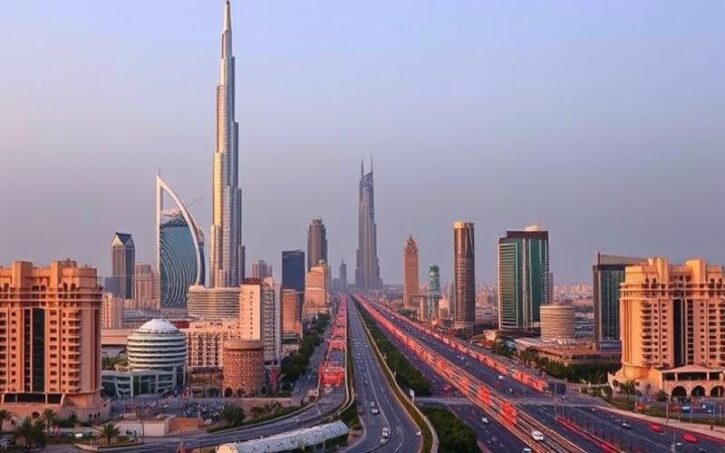
 Published on and written by Cyril Jarnias
Choosing to pursue higher education abroad in the United Arab Emirates means betting on a country that has made education, innovation, and welcoming international students a true national project. With a booming economy, ultramodern campuses, and dozens of branches of major Western universities, the destination has established itself as one of the most dynamic academic hubs in the world.
237000
More than 237,000 international students, from over 200 nationalities, pursue their studies in the United Arab Emirates.
In this landscape, it is essential before starting to understand how the system works, what the major universities are, the costs, visa procedures, scholarships, and career opportunities. That is what this article offers, based on recent data and detailed institutional information.
An Academic Hub at the Crossroads of Three Continents
The United Arab Emirates has positioned itself as a strategic crossroads between Europe, Asia, and Africa. This location, already decisive for trade and aviation, has become a major asset for higher education. Studying here means gaining direct exposure to fast-growing regional markets and global business networks.
Good to know:
The country offers a modern, safe, and well-equipped living environment, with infrastructure comparable to major global metropolises. Society is extremely cosmopolitan, made up of 85–88% expatriates from over 200 nationalities. Campuses reflect this diversity, offering a multicultural, English-speaking atmosphere while being rooted in a strong Arab and Muslim culture.
The government has clearly shown its educational ambition. Authorities aim to double the number of international students by 2033 and are heavily investing in universities, research, scholarships, and simplifying administrative procedures. In Dubai, for example, over 65 colleges and universities are listed, and there has been a nearly 29% increase in international enrollments in a single academic year.
A Highly Regulated Higher Education System
For an international student, one reassuring point is the solidity of the accreditation framework. The United Arab Emirates has implemented a multi-level quality control system, precisely to regulate the explosion in the number of institutions, especially in academic free zones.
Attention:
At the federal level, the Commission for Academic Accreditation (CAA) of the Ministry of Education licenses institutions and accredits programs outside of free zones. In Dubai, the Knowledge and Human Development Authority (KHDA) fulfills this role for campuses located in areas like Dubai International Academic City. Over 90% of accredited programs meet international standards, and many also have foreign accreditations (e.g., ABET for engineering, UK QAA).
The landscape is structured around several types of institutions. There are national universities such as United Arab Emirates University (UAEU), Khalifa University, and Zayed University; Emirati private universities (American University in Dubai, American University of Sharjah, Abu Dhabi University); branches of major foreign universities (Heriot‑Watt University Dubai, University of Birmingham Dubai, Middlesex University Dubai, University of Wollongong in Dubai, NYU Abu Dhabi, Sorbonne University Abu Dhabi, etc.); and numerous specialized schools in aviation, hospitality, medicine, business, or artificial intelligence.
Example:
The impact of the UAE’s educational ecosystem is illustrated by its performance in international rankings. Eleven Emirati universities appear in the QS World University Rankings, and several in the THE rankings. For example, Khalifa University ranks around the global top 200, while UAEU and the American University of Sharjah are in the top 300 according to recent editions. Furthermore, Canadian University Dubai is ranked first in Dubai in the QS city ranking for higher education.
Very Different but Complementary Student Cities
Although all seven emirates host academic institutions, three hubs dominate for higher education.
Dubai’s Educational Ecosystem
Dubai is the main higher education hub of the Emirates, attracting thousands of international students to dedicated academic zones.
Major Educational Hub
Over 35,000 recent international students, representing about 35% of enrollment in private universities.
Dubai International Academic City (DIAC)
Groups together 27 university campuses from 11 different countries.
Dubai Knowledge Park
Zone dedicated to vocational training and specialized schools.
Dubai International Financial Centre
Hosts prestigious business schools like London Business School or Bayes Business School.
Abu Dhabi, the federal capital, combines top-level research institutions and iconic international campuses. It is home to Khalifa University, NYU Abu Dhabi, Sorbonne University Abu Dhabi, as well as highly specialized schools like Mohamed bin Zayed University of Artificial Intelligence or Masdar Institute, dedicated to renewable energy and advanced technologies. Internship and career prospects are strengthened by the presence of large oil, energy, financial, and technology companies.
Tip:
Although less publicized, Sharjah has a major asset: the “University City,” a vast campus housing the American University of Sharjah, the University of Sharjah, and other institutions. The emirate cultivates an identity focused on education and culture. Its cost of living is slightly lower than Dubai or Abu Dhabi, while remaining easily accessible from these two metropolises via shuttle buses.
The other emirates are not left behind. Ras Al Khaimah hosts the American University of Ras Al Khaimah, Ajman has its own university, Al Ain is home to UAEU’s main campus, etc. This geographic diversity allows students to find quieter and more affordable environments, which are sometimes highly sought after by those studying medicine, engineering, or sciences.
Fields of Study Aligned with Economic Needs
For anyone considering higher education abroad in the United Arab Emirates, the question of high-demand fields is central. The country has built part of its academic strategy around alignment with its economy’s directions: diversification away from oil, industrial and technological upgrading, and development of high-value-added services.
Several broad families of disciplines emerge. Management sciences and business occupy a dominant place, with Bachelor’s and MBA programs in marketing, finance, logistics, luxury management, or hospitality. Many international business schools have opened a campus in the Emirates, such as London Business School, INSEAD in Abu Dhabi, S P Jain School of Global Management, Hult International Business School, and the management schools of Heriot‑Watt, Birmingham, or Wollongong.
International higher education institutions
Engineering and technology are the other major pillar. Universities like Khalifa University, UAEU, University of Sharjah, Abu Dhabi University, and branches like Heriot‑Watt Dubai and RIT Dubai offer programs in civil, mechanical, electrical, computer, and petroleum engineering, as well as cybersecurity, robotics, data science, and artificial intelligence. Some programs are accredited by ABET and other international agencies, facilitating recognition abroad.
Information and digital technologies are experiencing rapid growth. Master’s degrees in cybersecurity, big data, information systems, or business analytics are offered at University of Wollongong in Dubai, Canadian University Dubai, De Montfort University Dubai, and other American and British institutions based locally.
Tourism and hospitality constitute an iconic sector. The Emirates Academy of Hospitality Management, linked to the Jumeirah Group, is ranked first in Africa and the Middle East and among the very best hospitality and leisure schools worldwide. It trains executives for the region’s major hotels and resorts.
The country is also strongly developing medicine and health sciences through Gulf Medical University, Mohammed bin Rashid University of Medicine and Health Sciences, Fatima College of Health Sciences, and several university hospitals. Finally, law, international relations, design, media, architecture, and Islamic studies round out an already vast academic landscape.
Language of Instruction, Academic Culture, and Student Life
Linguistically, the situation is rather favorable for international students. Arabic is the official language and remains the main language of instruction in several public universities, but most private institutions and foreign campuses teach in English. For many undergraduate and graduate programs, English is the exclusive medium of instruction. Non-Arabic-speaking students sometimes take introductory Arabic courses, while Arab or Muslim students often have mandatory modules in Islamic studies or Arabic language.
Good to know:
Universities adopt an international pedagogical style, emphasizing group work, presentations, case studies, and projects with companies to develop critical thinking and practical application. Campuses are equipped with modern labs, digital libraries, language centers, fab labs, start-up incubators, and coworking spaces.
Student life revolves around clubs, associations, sports competitions, cultural festivals, and international weeks. Some universities, such as Canadian University Dubai, Middlesex University Dubai, and American University in Dubai, have success support centers, career development workshops, and counseling and wellness services. The diversity of the student population fosters cross-cultural exchanges, sometimes within the university residences themselves.
Academic Calendar and Possible Intakes
Most universities operate on a calendar similar to the North American model. The academic year generally runs from August/September to May/June, with breaks between semesters. Three main intake periods structure admissions.
The fall intake, starting in September, is the main one. It offers the widest range of programs, attracts the largest number of applicants, and is the most competitive. Many scholarships and fee reductions are also aligned with this intake.
Good to know:
A second admission period is possible around January for candidates who missed the fall intake. Although the program offering is slightly smaller, it remains significant at many universities.
Finally, a summer intake exists, generally between April and May. It is more limited, often aimed at remedial courses, short programs, foundation years, or very specific training. In some cases, it allows starting a “foundation year” before entering the first year of a bachelor’s degree.
Beyond this general framework, each institution sets its own application opening calendars, deadlines, and response dates. The most selective universities and highly demanded programs (engineering, medicine, MBA) have earlier deadlines, sometimes with early admission rounds.
Admission Requirements and Expected Academic Profile
Entry requirements vary from one institution to another, but general trends can be identified for undergraduate and graduate studies.
85
Minimum high school average percentage required by some programs at United Arab Emirates University for admission to a bachelor’s degree.
For master’s degrees, universities expect a relevant bachelor’s degree with a minimum GPA, often starting at 3.0/4.0. Some MBAs require at least one year of professional experience, sometimes more for Executive MBAs, as well as tests like the GMAT or GRE, although these exams are not systematically required in the country. Medical, legal, or specialized engineering programs may also require interviews, portfolios, or additional examinations.
5.5
Minimum IELTS score generally required for entry into a bachelor’s program at English-speaking universities.
Applicants must also provide a complete application package: application forms, passport copies, translated and certified transcripts, passport photos, CV, letter of motivation (Statement of Purpose), letters of recommendation, proof of financial means, and, in some cases, a certificate of equivalence for their diplomas from the local Ministry of Education. Document verification, often through attestation and legalization procedures, is a standard step.
Application Procedures and Platforms
Unlike some countries that use a centralized platform, the United Arab Emirates primarily operates through direct applications. Each university has its own online admissions portal, where the student creates an account, uploads supporting documents, pays application fees, and tracks the status of their application.
Application fees are generally non-refundable and often range between 200 and 500 UAE dirhams. Once the complete file is submitted, the institution reviews the application. The response time can vary from a few weeks to two months, depending on the volume of applications and the institution’s level.
Good to know:
The Ministry of Higher Education offers an electronic portal for the acceptance phase. It allows registering admission offers, accepting or declining a place, and sometimes centralizing administrative formalities. Its “smart” services have significantly reduced the number of documents to provide and processing times.
For students who prefer guidance, a multitude of education consulting firms operate in the market, particularly targeting India, North Africa, Southeast Asia, or Europe. These intermediaries help refine university choices, put together applications, prepare language tests, and anticipate visa procedures.
The Student Visa: A Required Step, but Largely Manageable
Studying in the United Arab Emirates necessarily involves obtaining a residence visa for study, except for citizens of Gulf Cooperation Council countries. This visa, often called a “student residence visa,” is typically sponsored by the university itself. In some cases, it can be sponsored by a parent or guardian already residing in the country.
Good to know:
After receiving an official admission letter from an accredited institution, the institution collects the required documents: valid passport (at least 6 months), passport photos, proof of tuition fee payment, health insurance certificate, academic attestations, and proof of accommodation. A first entry permit is then issued to allow travel.
Upon arrival, the student undergoes a medical examination at an approved center, generally including tests for certain infectious diseases. They also submit their biometric data to obtain their national ID card (Emirates ID). After these steps, the study residence is formalized, in the form of an electronic visa linked to the Emirates ID; a stamp in the passport is no longer always necessary.
Good to know:
The standard student visa is valid for one year and can be renewed annually under conditions: full-time enrollment, health insurance, and sufficient financial means. Specific formats exist, such as long-term visas offered by some universities or extended residence schemes for outstanding students, integrated into the logic of “Golden Visas” for talent and top graduates.
In terms of cost, the visa budget is often between 6,000 and 7,000 AED, including processing fees, medical examination, Emirates ID, mandatory health insurance, and any security deposits. Some universities include part of these costs in tuition fees or an administrative package. Processing times typically range from two to five weeks, but accelerated options exist for an additional fee.
Working While Studying: Possibilities and Limitations
More and more students want to finance part of their expenses or gain initial professional experience during their studies. The United Arab Emirates allows part-time work for international students, under conditions.
15-20
Maximum number of weekly work hours allowed for a student in the United Arab Emirates during course periods.
The most common jobs are in retail, restaurants, hospitality, events, administrative support, call centers, tutoring, or student services and labs on campus. In some academic or technology zones, many internships and student jobs are offered in partnership with local companies. Working without a permit is illegal and exposes both the student and employer to penalties.
Cost of Studies: A Significant but Adjustable Investment
Studying in the United Arab Emirates represents a real financial investment, but the cost differences between institutions are substantial. Education is free at public universities for citizens, but international students pay tuition fees.
For undergraduate studies, ranges generally vary from about 37,500 to 70,000 AED per year at many universities, with higher peaks for some prestigious institutions or specialized programs. Concrete examples show annual fees around 60,000–65,000 AED at University of Wollongong in Dubai, 55,000–80,000 AED at Heriot‑Watt University Dubai, 45,000–65,000 AED at Middlesex University Dubai, or 90,000–120,000 AED at American University in Dubai.
100000
Some master’s programs at American University of Sharjah exceed 100,000 AED in annual fees.
Added to this is the cost of living. On average, a student should budget between 3,000 and 6,500 AED per month for current expenses, excluding tuition. This budget includes accommodation, food, transportation, communications, and leisure. Dubai and Abu Dhabi are among the most expensive cities in the country, while Sharjah, Ajman, or Ras Al Khaimah are more affordable.
7000
The maximum monthly rent for a student studio in Dubai, depending on the neighborhood and standard.
To better visualize the order of magnitude of the main expense items, it is useful to reason in a table.
Example Monthly Budget for an International Student
| Expense Item | Indicative Range (AED/month) |
|---|---|
| Rent (shared room) | 1,500 – 3,000 |
| Rent (studio) | 3,500 – 7,000 |
| Groceries | 400 – 1,500 |
| Public transport | 80 – 350 |
| Electricity / water / AC | 300 – 800 |
| Home internet | 200 – 400 |
| Mobile phone | 100 – 230 |
| Miscellaneous / leisure | 400 – 800 |
Depending on lifestyle, the total can remain close to 4,000 AED or climb to 7,000 AED or more. An important element to factor into this equation is the nearly non-existent income tax: salaries are paid net of income tax, which significantly changes calculations for those planning to stay and work in the country after their studies.
Comparing Some Tuition Fees by University
To appreciate the diversity of fee levels, we can look at some concrete examples of well-established universities.
| University / Campus | Study Level | Estimated Annual (AED) |
|---|---|---|
| Middlesex University Dubai | Bachelor’s / Master’s | 45,000 – 65,000 |
| University of Wollongong in Dubai | Bachelor’s | 60,000 – 85,000 |
| Heriot‑Watt University Dubai | Bachelor’s | 55,000 – 80,000 |
| American University in Dubai | Bachelor’s | 90,000 – 120,000 |
| BITS Pilani Dubai Campus | Bachelor’s | 50,000 – 75,000 |
| United Arab Emirates University (e.g., BBA) | Specific Bachelor’s | ~69,000 |
| Abu Dhabi University | Bachelor’s | 45,000 – 64,000 |
| Canadian University Dubai | Bachelor’s | ~70,000 – 88,000 |
| British University in Dubai | Bachelor’s | 56,000 – 62,500 |
These amounts show that there is real room for maneuver. Between a large public research university, a branch of a British campus, or a high-end business school, the cost difference can be one to two times for a comparable level of study. Hence the importance of carefully analyzing one’s budget, available scholarships, and prospects for return on investment.
Scholarships and Financial Aid: A Lever Not to Be Overlooked
Facing these costs, universities and several Emirati foundations have put in place a highly developed arsenal of scholarships and financial aid. Schemes range from partial tuition fee reductions to full scholarships covering, in some cases, tuition, accommodation, insurance, and a living allowance.
20000
Maximum monthly allowance in AED that can be granted to certain doctoral students by Khalifa University.
In the private sector, Abu Dhabi University, American University of Sharjah, University of Sharjah, Canadian University Dubai, and British University in Dubai offer merit-based scholarships (based on grades), need-based aid, high-level sports scholarships, alumni scholarships, children of alumni, etc. These scholarships often result in reductions of 10% to 50% of tuition fees, sometimes more for the best profiles.
Good to know:
In addition to university programs, scholarships are offered by local foundations (Al Qasimi, Emirates Foundation, Dubai Cares) and government initiatives, often for strategic fields (STEM, AI, renewable energy, health). International students may also seek funding from organizations in their home country, which sometimes list the United Arab Emirates among their priority destinations.
The student must be aware of a crucial point: application deadlines for scholarships are very often earlier than admission deadlines. Therefore, it is necessary to start the process 12 to 15 months before the desired intake, in order to both submit university applications and scholarship files on time.
Student Accommodation: Residences, Roommates, and Key Areas
Housing is a key aspect of student life in the United Arab Emirates, especially since most international students cannot live with their parents. The range is varied, including university residences, private student residences, shared apartments, and independent studios.
2000-3000
Monthly rent in university residences in Abu Dhabi, Al Ain, or Sharjah, generally more affordable than in the private market.
In Dubai, a complete ecosystem of specialized operators has developed around academic zones. Dubai International Academic City and Dubai Knowledge Park are surrounded by student residences such as The Myriad Dubai, Yugo Dubailand, KSK Homes, or ESAW, which offer shared or private rooms, studios, and apartments, with a wide range of services. These residences position themselves as alternatives to traditional housing in neighborhoods like International City, Dubai Silicon Oasis, Al Nahda, or Deira, popular for their relatively affordable rents.
Good to know:
In Abu Dhabi, students can live in on-campus residences (such as at NYU Abu Dhabi or Sorbonne University Abu Dhabi) or opt for shared apartments in popular neighborhoods like Al Reem Island, Khalidiya, Al Wahda, or Al Muroor. Rents in these central areas are similar to those in Dubai.
Special attention should be paid to contract terms. In some cases, landlords require rent payments in several post-dated checks (quarterly or semi-annually), or even a single annual payment. Agency fees and security deposits are also added. Professionally managed student residences often offer more flexibility, with monthly payments and contracts aligned with the academic calendar.
Daily Life, Transportation, and Health
On a practical level, daily life is made easier by modern infrastructure. Dubai’s public transport network, consisting of metro, buses, and tram, covers many neighborhoods, including academic areas. Students can get reduced-rate transport cards. In Abu Dhabi, buses dominate the public transport landscape, supplemented by a wide range of taxis and ride-hailing services (Careem, Uber).
Good to know:
Most student residences in Dubai, whether university or private, offer free shuttle services to campuses and metro stations. This service helps reduce transport costs and road congestion. However, many students opt for a personal vehicle when possible, for more flexibility.
The healthcare system is based on very well-equipped private facilities. Health insurance is mandatory for all residents, including students. Universities often offer partnerships with insurers, with basic policies around 1,500–2,500 AED per year for international students. Lack of coverage can result in financial penalties, and healthcare costs without insurance can be very high.
Culture, Religion, and Social Codes: Integrating with Respect
Settling for several years in a country where Islam is the official religion means becoming familiar with certain cultural rules. In the United Arab Emirates, religious practice structures part of the rhythm of life, especially during the month of Ramadan, when most restaurants close during the day and residents and visitors are expected to avoid eating, drinking, or smoking in public before the breaking of the fast.
Dress codes in public places recommend a certain modesty: shoulders and knees covered, especially in government buildings, mosques, campuses, or more traditional neighborhoods. Public displays of affection are frowned upon and can even, in some cases, have legal consequences.
Example:
In the major Emirati cities, society offers a certain openness with diverse places of worship, a rich cultural life (museums, festivals, concerts), and a lively social scene, but it is strictly regulated. Universities help students adapt by organizing cultural orientations and visits to sites like the Sheikh Zayed Grand Mosque, the historic Al Fahidi neighborhood in Dubai, or the Louvre Abu Dhabi.
Functional use of Arabic is appreciated, even though English suffices in almost all situations. Knowing a few basic expressions is a sign of respect and often facilitates daily interactions.
After Graduation: Career Prospects and Work Visas
One of the major advantages of pursuing higher education abroad in the United Arab Emirates lies in the possible continuity between studies and professional integration. The country does not offer a single “post-study work visa” like some Anglo-Saxon nations, but rather a mosaic of statuses allowing graduates to stay and seek employment.
The first of these tools is the job search visa (“Jobseeker Visa”), valid for 60, 90, or 120 days, without an employer sponsor. It is intended for recent graduates (less than two years after graduation), holding at least a bachelor’s degree from a globally well-ranked university. This visa must be applied for after completing the program and allows searching for a job locally, without a direct link to the previous student visa.
Good to know:
After finding a job, the most common visa is a standard work visa, sponsored by the employer, generally valid for two years and renewable. For skilled profiles, the “Green Visa” offers five-year residency without a sponsor, subject to salary, qualification, and financial stability requirements. Freelancers and self-employed individuals can also obtain specific permits, often linked to free zones.
At the top of this hierarchy is the “Golden Visa,” valid for five or ten years, intended for investors, start-up founders, scientists, doctors, top athletes, and exceptionally brilliant students. Some graduates of master’s or doctoral programs, from high-ranking Emirati or international universities, may qualify depending on their academic results and field of expertise.
6
A majority of international graduates find a job in Dubai and Abu Dhabi within six months of obtaining their work visa.
In terms of income level, salaries vary obviously by sector. An average net salary around 15,000 AED per month is often cited as allowing a comfortable life for a single person in Dubai, thanks to the absence of income tax. Positions in project management, engineering, or financial analysis can far exceed these amounts, while more junior roles or certain services start at lower levels.
Building Your Study Plan: Some Strategic Benchmarks
To make the most of a decision to study in the United Arab Emirates, it is not enough to focus on rankings or campus photos. A structured approach is useful.
First, clarify your academic and professional goal. Programs in business, engineering, IT, health, or hospitality do not open the same doors, nor involve the same internships or alumni networks. It is essential to verify the alignment between the intended specialization and the economic sectors growing in the country.
Attention:
To compare universities, prioritize objective criteria: accreditations, regional rankings (e.g., QS Arab Region), partnerships with companies, employability rates, tuition fee structure, and scholarship availability. Prestigious campuses of foreign universities are not suitable for everyone, especially with a limited budget.
Finally, plan ahead. For a fall intake, it is prudent to start preparing applications from the previous year: language tests, assembling files, researching scholarships, contacting admissions and housing services, and financial preparation. This also leaves time to look into cultural, legal, and practical issues, to avoid unpleasant surprises.
A Demanding Destination, but Rich in Opportunities
Pursuing higher education abroad in the United Arab Emirates means accepting a certain level of demand, both academic, financial, and personal. The cost of studies and housing is significantly higher than in many students’ home countries, and adapting to a very different cultural environment is not automatic.
Good to know:
This destination offers education aligned with British, North American, or French standards, in a very safe living environment. It provides constant exposure to cultural diversity, a direct link to the business world, and career opportunities in an economy focused on knowledge and innovation. Moreover, there are legal possibilities to stay and work after graduation through a range of shorter or longer visas.
For students ready to carefully prepare their project, compare options, anticipate funding, and open up to a new culture, the United Arab Emirates can thus become much more than a simple step: a true springboard toward an international career.

Cyril Jarnias is an independent expert in international wealth management with over 20 years of experience. As an expatriate himself, he is dedicated to helping individuals and business leaders build, protect, and pass on their wealth with complete peace of mind.
On his website, cyriljarnias.com, he shares his expertise on international real estate, offshore company formation, and expatriation.
Thanks to his expertise, he offers sound advice to optimize his clients' wealth management. Cyril Jarnias is also recognized for his appearances in many prestigious media outlets such as BFM Business, les Français de l’étranger, Le Figaro, Les Echos, and Mieux vivre votre argent, where he shares his knowledge and know-how in wealth management.





