
 Published on and written by Cyril Jarnias
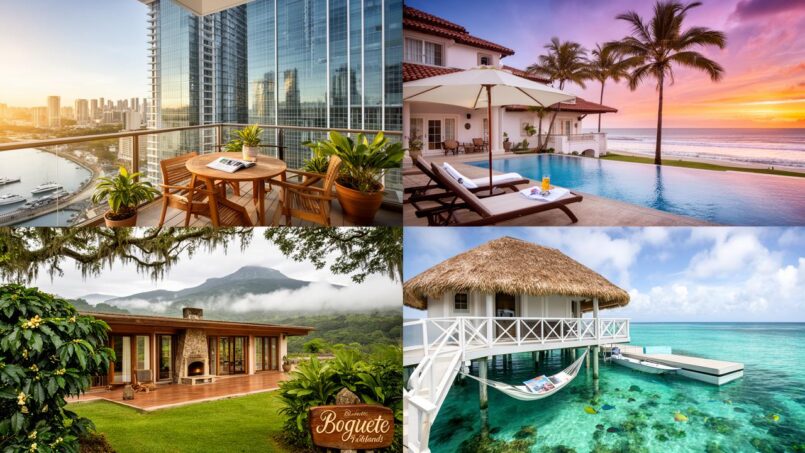
The Panamanian real estate market heading into 2026 is in a phase of controlled growth. After several years of gradual recovery, prices are rising without overheating, supported by an expanding economy, massive public investments in infrastructure, and a steady flow of foreign capital. In this landscape, four destinations are drawing the attention of international buyers and expats: Panama City, Coronado, Boquete, and Bocas del Toro.
Each Panamanian region has its specialty: the capital offers a dollarized metropolis with high rental yields, Coronado is a beach resort for retirees and remote workers, Boquete is a mountain retreat for pensioners and patient investors, and Bocas del Toro is a Caribbean paradise focused on seasonal rentals with strong price dynamics.
Understanding how prices, yields, appreciation rates, and ancillary costs stack up in these four markets has become essential for any purchase project in 2026. The available data now allows us to create a true comparative picture, far more meaningful than forum impressions or isolated listings.
Panama Real Estate Market Overview in 2026
Before zooming in on each destination, we need to place these four markets within the national context. In 2026, the median price of a home in Panama is around $160,000, while the average price climbs to $245,000 driven by high-end properties. Approximately 80% of transactions fall between $90,000 and $450,000, with the majority of buyers between $100,000 and $250,000.
The real estate market absorbs an annual transaction volume of $4.2 billion.
The table below summarizes the national ranges, useful for measuring the upward or downward deviation of the four destinations studied.
| National Indicator (Panama) | Approximate Value 2026 |
|---|---|
| Median home price | $160,000 |
| Average home price | $245,000 |
| Range of 80% of properties | $90,000 – $450,000 |
| “Realistic” entry range | $80,000 – $120,000 |
| Median price per sq. ft. (national) | $1,850/sq. ft. |
| Average price per sq. ft. (national) | $2,050/sq. ft. |
| Price growth 2024–2025 | +5.2% |
| Expected appreciation 2026 | +4% to +6% |
| Foreign share of transactions | 42% |
| Total transaction volume (2025) | $4.2 billion |
| Average inventory (months of supply) | 8.2 months |
Within this overall framework, Panama City, Coronado, Boquete, and Bocas del Toro each stand out with a radically different positioning in terms of price per square foot, buyer profile, rental yield, and liquidity.
Panama City: Capital of Yields and Condos
Panama City concentrates the bulk of the country’s condominium market. Approximately 70 to 75% of residential listings for sale are apartments or condos, with a total inventory of over 16,000 units when combining planned, under-construction, and recently delivered projects. Despite this vertical dominance, supply is no longer overflowing: the inventory of new condos has hit its lowest level in nine years, even as demand picks up.
Price Levels and Typical Ranges
In 2026, homes in the capital average around $210,000, well above the national average. Per-square-foot data confirms this premium: the median price is around $1,850/sq. ft., with the average near $1,950/sq. ft., or approximately $172 to $181 per square foot.
However, internal variations are significant depending on the neighborhood. In the most expensive areas like Punta Pacifica, Santa María, Costa del Este, or Casco Viejo, prices frequently reach $3,200 to $5,500/sq. ft. Conversely, more affordable neighborhoods such as Juan Díaz, Parque Lefevre, or Pueblo Nuevo remain between $1,300 and $1,800/sq. ft.
For an investor or future resident, some concrete benchmarks help with orientation:
| Property Type in Panama City (2026) | Typical Price Range |
|---|---|
| Studio / small 1-bedroom (entry-level) | $85,000 – $120,000 |
| “Standard” 1-bedroom | $230,000 – $280,000 |
| 2-bedroom (broad spectrum) | $250,000 – $400,000 |
| 3-bedroom (families, desirable neighborhoods) | $350,000 – $550,000 |
| High-end 1-bedroom condo | from $400,000 |
| Luxury 2–3 bedroom condo | $900,000 – $2.5 million |
| House or villa in a gated community | $650,000 on average |
| Penthouse / ultra-luxury | around $1.5 million (often more) |
The majority of listings in the city fall between $110,000 and $650,000. A budget of $100,000 to $140,000 generally buys an older 1-bedroom of 45–60 m² (approx. 480–650 sq. ft.) in secondary neighborhoods like Pueblo Nuevo or Parque Lefevre. At the other end, a range of $900,000 to $2.5 million opens the door to large apartments with ocean views on high floors in Punta Pacifica or Santa María, with hotel-style services, pools, 24/7 security, and concierge.
Key Neighborhoods and Price Dynamics
The capital is not a single homogeneous market. Some areas are appreciating significantly faster than average, driven by rental demand and major infrastructure projects. Costa del Este, San Francisco, and El Cangrejo consistently rank among the neighborhoods with the highest price increases.
Costa del Este records the highest increase at 5 to 6% per year since 2024, while San Francisco, El Cangrejo, and Casco Viejo (boosted by gentrification and tourism) show annual increases of 4 to 5%.
The following figures provide a comparative overview of price levels in 2026 in several emblematic sub-markets of Panama City.
| Panama City Neighborhood | Average Resale Price (≈ $/sq. ft.) | Average Pre-Construction Price (≈ $/sq. ft.) | Inventory Change (12 months) |
|---|---|---|---|
| Avenida Balboa | $2,400 | $3,300 | -29.5% |
| Casco Viejo | $3,800 | $4,300 | -59.4% |
| Costa del Este | $2,500 | $3,800 | -40.2% |
| El Cangrejo | $1,770 | $2,800 | -43.2% |
| Punta Pacifica | $2,200 (resale) / $4,200 (broader average) | $4,300 | -31% |
| San Francisco | $1,900 | $3,500 | -38% |
| Santa María | $2,900 | $3,800 | -52.4% |
This table illustrates two realities: first, the significant premium placed on new construction versus resale, with a surcharge of 15 to 35% per square foot. Second, the marked decline in inventory in nearly all premium neighborhoods, signaling that a significant portion of the post-pandemic surplus has been absorbed.
Rental Yields: A Major Advantage of the Capital
For investors, Panama City stands as the country’s rental income engine. The latest figures point to an average gross yield of around 7% per year for condos, with variations depending on quality and neighborhood.
Studios and small 1-bedroom units in neighborhoods like El Cangrejo, San Francisco, or parts of Bella Vista and Obarrio often exceed 8% gross yield, sometimes reaching over 9% in the best-managed cases.
After accounting for all costs—HOA fees, insurance, residual taxes, vacancy, management—most owners see net yields in the range of 3.5 to 6%. The best location/price combinations are typically found in central, well-served neighborhoods that do not (yet) carry the ultra-luxury premium.
Liquidity, Negotiation, and 2026 Outlook
On the liquidity front, time on market in the capital remains reasonable. In 2026, an apartment well-priced in a sought-after neighborhood often sells within 30 to 60 days, especially in Costa del Este, San Francisco, or El Cangrejo. Overall, most properties find a buyer within 90 to 120 days, though some overpriced towers may stay on the market for 4 to 6 months.
On average, the gap between the list price and final price in Panama City’s real estate market is 7 to 8%, often translating into a discount for the buyer.
For a buyer profile focused on yield and liquidity, the capital remains, among our four destinations, the most rational choice. The question remains whether it might be more interesting, in some cases, to move away from the skyline and prioritize the sea, the mountains, or white sand.
Coronado: The Beach Town for Retirees and Remote Workers
Located about an hour from Panama City via a four-lane highway, Coronado has become the symbol of planned Pacific beach resorts. Gated communities, an 18-hole golf course, marinas, shopping centers, private medical services: everything is designed for an audience of international retirees, affluent remote workers, and “lifestyle” investors who want the beach without sacrificing urban comfort.
How Much Does a Home in Coronado Cost in 2026?
Coronado is clearly positioned above the national average, but below the capital for high-end products. Data gathered for the “Coronado Beach Town” area indicates an average price per square foot of around $1,350, well below the $1,850–$1,950/sq. ft. in Panama City. However, overall budgets remain high because units are often larger and more oriented toward “house / beachfront condo.”
The price range below summarizes the typical residential market.
| Property Type in Coronado (2026) | Typical Price Range |
|---|---|
| Condo or small “entry-level” house | ≈ $180,000 – $250,000 |
| Standard 2–3 bedroom (condo / house) | $180,000 – $500,000 |
| “Classic” beachfront | $300,000 – $800,000 |
| Large upscale villas | from $800,000, frequently >$1 million |
| Ultra-luxury property (example cited) | up to $8 million for an estate with 8 suites |
| Buildable lot (depending on size / location) | From a few hundred thousand to >$2.5 million |
Added to this residential base are a number of exceptional properties (penthouses, villas with pools on large lots, etc.) that occasionally push the bar above $5 or $8 million. But the core market remains concentrated between $180,000 and $500,000 for standard condos and houses.
Appreciation and Yields: A Beach Market Accelerating
The available figures converge: Coronado is among the most dynamic markets in the country in terms of price increases. Over the 2024–2026 period, annual appreciation is estimated between 8 and 12%, well above the already solid national average.
Several factors fuel Coronado’s rise: improved road connections to Panama City attract city dwellers seeking second homes, while an influx of foreign retirees eligible for the Pensionado visa is drawn by the beach, infrastructure, and a secure, affordable lifestyle compared to Florida or California.
On the rental side, gross yields are around 5 to 7%, with strong seasonality. The North American winter months (December to March) see bookings explode and rents rise. Summer is quieter, although local demand partly offsets the slowdown. This “sawtooth” profile is typical of beach resorts: excellent months, but also slower periods that, when averaged over the year, slightly reduce the net yield.
Coronado vs. Panama City: Prices and Positioning
Compared to Panama City, Coronado appears as a compromise: cheaper per square foot than the capital’s premium neighborhoods, but more expensive than many inland areas or Boquete. Rental profitability is generally slightly lower than in Panama City’s best neighborhoods, but the prospect of capital appreciation (8 to 10% per year in some scenarios) more than compensates for those targeting gains over 5 to 10 years.
Coronado, as a seasonal second-home market, could face sharper corrections in an economic downturn. However, over the 2026–2028 horizon, it ranks among the coastal cities with the strongest increases, with 6 to 8% annual appreciation.
Boquete: Mountains, Retirement, and the Long Term
Climatically opposite to Coronado, Boquete rides on its image as the “land of eternal spring.” Nestled in the highlands of Chiriquí Province, this small mountain town has gradually gained status as an international retirement destination, appearing on most “top places to retire in Latin America” lists.
A Niche Market, Slower but Robust
Boquete does not behave like a speculative market. The number of truly attractive properties remains limited by topography and environmental constraints: buildable land with clear views, ideal climate, and decent access is scarce. This structural scarcity fuels steady appreciation, but at a more moderate pace than the coast: 2 to 4% per year in the highlands generally, around 5 to 8% per year over five years for the best-located properties in Boquete itself.
Selling a property in central Boquete or Alto Boquete can take from a few weeks to a few months, while an isolated house in the countryside often takes one to two years to find a buyer. This allows patient buyers to negotiate aggressively, but imposes significant illiquidity on sellers.
Price Levels in Boquete in 2026
Available data allows us to identify clear ranges, both by property type and by intra-urban location.
For houses, typical prices range between $250,000 and $1.5 million, with an average of $150,000 to $600,000 for modest properties or small estates nearby. Apartments, rarer but developing through projects like Pinoalto, generally range between $180,000 and $500,000. Land trades around $40,000 to $300,000 depending on size, view, and access to services.
In terms of price per square foot, neighborhood-level figures provide a useful overview.
| Boquete Area (District) | Approx. Median Price (Houses, $/sq. ft.) | Recent Change | Approx. Median Price (Apartments, $/sq. ft.) | Recent Change |
|---|---|---|---|---|
| Boquete (center) | ≈ $1,936/sq. ft. | — | ≈ $3,090/sq. ft. | +5% |
| Alto Boquete | ≈ $1,459/sq. ft. | +1% | ≈ $1,604/sq. ft. | +5% |
| Jaramillo | ≈ $2,367/sq. ft. | -4% | n/a | — |
| Caldera (Chiriquí) | ≈ $2,071/sq. ft. | — | n/a | — |
| Los Naranjos | ≈ $1,786/sq. ft. | — | n/a | — |
Boquete’s center stands out as the most expensive area for houses (around $1,936/sq. ft.) and apartments (over $3,000/sq. ft.), while Alto Boquete offers the most affordable entry point. This hierarchy perfectly reflects ground reality: the further from the town center, the lower the prices, but the more complex the property management becomes.
Rental Yields: Lifestyle Comfort Rather Than Cash Flow
Unlike Panama City or Bocas del Toro, Boquete is not a haven for high rental yields. Gross rates are often in the 5 to 6% range for well-positioned properties, sometimes lower (3 to 4%) on certain upscale mountain homes. This is a market more focused on primary or secondary residences, retirement, and long-term wealth appreciation.
Demand remains solid, driven by retirees, digital nomads, and eco-tourists. Occupancy rates are good in central areas, but isolated properties face issues like vegetation, difficult access, and a lack of professional management services.
A simple indicator reflects this positioning: where Bocas del Toro can achieve net yields exceeding 10% on certain highly targeted products, Boquete often manages 5 to 6% gross, or 3 to 4% net after expenses. This difference neatly sums up the investment philosophy: Boquete is for those who plan to live there, or move later, rather than those seeking a pure hands-off financial operation.
Structural Strengths: Climate, Visa, and “Discreet Luxury” Effects
What makes Boquete’s deep strength goes beyond the numbers. The climate is a major selling point: 18–24°C year-round, no need for air conditioning, which reduces both electricity bills and daily hassle. The town is close to David’s international airport, balancing the relative isolation of the mountains well.
Boquete benefits from the Pensionado visa and residence-by-investment programs. A real estate investment of $200,000 to $300,000 USD can lead to permanent residency, discounts on healthcare, leisure, and transportation, as well as tax advantages: no tax on foreign-source income and no inheritance tax.
Finally, an unexpected event gave Boquete global exposure: the record sale of Geisha coffee from Hacienda La Esmeralda at over $30,000 per kilogram. This episode propelled the region to the status of a luxury agro-tourism destination, somewhat like Napa Valley for wine. The high-end coffee ecosystem, coupled with residential projects like Pinoalto, fuels a gradual upscaling that is not yet fully reflected in real estate prices.
Bocas del Toro: Caribbean Hub for Tourism and Seasonal Rentals
Caribbean archipelago in the northwest of the country, Bocas del Toro has experienced a true real estate boom in recent years. The combined appeal of postcard beaches, surfing, ecotourism, and island life has transformed the region into one of the most “trendy” markets in Central America for vacation real estate.
A Particularly Aggressive Price-to-Potential Ratio
Compared to Panama City, Bocas del Toro remains objectively affordable to buy. Average prices per square foot are significantly lower than in the capital: while Panama City shows levels of $1,850 to $1,950/sq. ft. on average in 2026, the archipelago sits in an indicative range of $6,500 to $12,000 for a lot value (in specific data, some tables rather indicate $1,200/sq. ft. for standard residential). Above all, you can still find renovated two-bedroom houses starting at $180,000, a price almost impossible to find on the Panama City waterfront.
For beachfront properties, the price structure is as follows:
| Property Type in Bocas del Toro (2026) | Typical Price Range |
|---|---|
| “Standard” beachfront properties | $200,000 – $500,000 |
| Beachfront houses (broader range) | $250,000 – $850,000 |
| Non-beachfront island residential | $180,000 – $500,000 |
| Commercial / investment properties | $300,000 – $1.2 million |
| Buildable lots (depending on island and size) | $25,000 – $150,000 |
These levels remain very attractive when compared to rental potential. The best overwater homes—stilt bungalows, eco-villas—trade below $300,000 for entry-level, while comparable products in more mature Caribbean destinations would often sell with a significant premium.
Price Appreciation: A Trajectory Above the National Average
Bocas del Toro clearly stands out from the rest of the country in terms of appreciation rate. Over the past three years, beachfront properties have appreciated an average of 8.2% per year, far exceeding the gains seen on the mainland. Projections through 2026 anticipate this momentum continuing, with expected growth of 4 to 6% per year, with some analysts even forecasting that the archipelago will continue to outperform the national average.
The rise of eco-tourism projects, improved infrastructure, strict environmental regulations limiting available beachfront land, and the growth of remote work are boosting demand for high-end eco-friendly housing and small integrated communities, which could tighten the market in the coming years.
Rental Yields: The Power of Short-Term Rentals
The other major reason for Bocas’s success lies in seasonal rentals. The archipelago is described as an “Airbnb gold” market: strong tourist demand year-round, high occupancy rates, attractive daily rental rates, especially for well-managed and well-presented properties on platforms.
The data provided is particularly revealing and deserves close attention
– Beachfront houses generally generate 6 to 8% gross annual yield, with 6 to 10 months of rental per year.
– Condos/apartments show 5 to 7% gross yield, targeting a more stable digital nomad clientele.
– Some areas like Isla Carenero reach 6 to 9% gross yield, driven by remote worker demand.
Consolidated data from a 2026 dataset shows that the average Airbnb host in Bocas del Toro earns about $14,400 per year, with an average nightly rate of $162, an average occupancy rate near 32%, and a RevPAR (revenue per available room) of about $53. In practice, the best-located and best-managed properties far exceed these averages. The top 10% of listings achieve monthly revenues above $3,500, while the median is around $1,070.
In high season, from February to April, properties generate an average of over $2,300 in monthly revenue.
For a well-managed two-bedroom house, a conservative projection suggests about 110 rented nights over six months, at $130 per night, yielding $14,000 to $17,000 in gross annual revenue. The best-positioned properties, with quality finishes and professional management, exceed $20,000 per year. Relative to a purchase price of around $215,000 on some emblematic projects (like Las Molas), this leads to net returns above 10%, with estimated capital appreciation of around 5 to 8% per year.
Bocas vs. Panama City, Coronado, and Boquete: What Investor Profile?
Bocas del Toro attracts a very specific profile: investors willing to accept greater regulatory complexity (short-term rental, island management), a “low density” environment with few major chains, and a heavy dependence on international tourism. In exchange, gross yields are generally higher than in Panama City and Coronado, and past appreciation suggests potential outperformance in the medium term.
Compared to Boquete, the contrast is total. Where Boquete targets retirees and full-time residents willing to accept low liquidity and modest yields in exchange for a lifestyle, Bocas positions itself as a playground for more aggressive investors comfortable with tourism, hospitality, and seasonal cycles.
Direct Comparison: Panama City, Coronado, Boquete, and Bocas del Toro
Putting these four markets side by side helps clarify the trade-offs a buyer faces in 2026. Price per square foot, entry ticket, rental yield, appreciation speed, liquidity: all parameters vary significantly from one destination to another.
Average Prices and Entry Points
The first dimension to compare is acquisition cost. Even though the data is not strictly identical for each city (condo, house, beachfront, etc.), we can identify relevant orders of magnitude.
| Market (2026) | Approx. Average Residential Price | Approx. Average Price per sq. ft. | Main Typical Range |
|---|---|---|---|
| Panama City | ≈ $210,000 | $1,850–$1,950/sq. ft. | $110,000 – $650,000 (80% of listings) |
| Coronado | $180,000 – $500,000 (broad average) | ≈ $1,350/sq. ft. | $180,000 – $500,000 (condos/houses) |
| Boquete (center/surroundings) | $150,000 – $600,000 (houses/small fincas) | ≈ $1,800–$2,000/sq. ft. (center houses) / >$3,000/sq. ft. (apts.) | $250,000 – $1.5 million (typical houses) |
| Bocas del Toro | $95,000 – $400,000 (condos to beach houses) | ≈ $1,200/sq. ft. (standard residential) | $200,000 – $500,000 (beachfront) |
We can see that, for a median budget around $250,000 to $300,000, the buyer can:
– acquire a decently located 2-bedroom in Panama City,
– get a comfortable condo or house in Coronado,
– target a well-built house in Boquete,
– or buy a competitive beachfront property in Bocas del Toro.
The choice then depends less on financial capacity than on desired lifestyle and investment strategy (primary residence, retirement, rental yield, capital gain).
Price Appreciation: Which Is Rising Fastest?
Comparing the expected or observed appreciation speed across different areas reveals clear differences.
| Market | Observed / Estimated Appreciation | Main Comment |
|---|---|---|
| Panama City | ≈ 3–4%/year (entire city), 5–7% in best neighborhoods | Mature market, driven by rental demand and infrastructure |
| Coronado | 8–10%/year (even 8–12% over 2024–2026) | Coastal market in strong upward phase |
| Boquete (highlands) | 2–4%/year (5–8% for very good locations) | Long-term market, more modest returns |
| Bocas del Toro | ≈ 8.2%/year (beachfront over 3 years) | Emerging island market with strong dynamics |
Coronado and Bocas del Toro clearly appear as champions of recent appreciation and optimistic forecasts, driven by tourism and second homes. Panama City progresses at a more contained but steady pace, while Boquete positions itself as a “smooth” market of slow but solid value growth.
Rental Yields: The Cash Flow Hierarchy
In terms of rental income, the ranking shifts. Panama City, with its stable rents and high occupancy, rivals Bocas del Toro, while Coronado and Boquete appear more modest.
| Market | Typical Gross Rental Yield | Typical Net Yield | Dominant Rental Profile |
|---|---|---|---|
| Panama City | ≈ 7% gross (5–9% depending on neighborhood/quality) | ≈ 4–5% net (3.5–6% depending on building) | Long-term rentals, solvent expat and local clientele |
| Coronado | 5–7% gross | ≈ 3–4% net (depending on seasonality and costs) | Seasonal + long-term rentals, retirees and remote workers |
| Boquete | 5–6% gross (sometimes 3–4% on high-end) | ≈ 3–4% net | Long-term, retirees, nature-loving digital nomads |
| Bocas del Toro | 6–9% gross (even >10% on best properties) | ≈ 5–8% net in optimized cases | Short-term tourist rentals, Airbnb, digital nomads |
This grid highlights the strengths of each market:
Analysis of the four main areas for investing in rental real estate in Panama.
The most institutional option, offering predictable rental income and a broad, diverse tenant base.
The star of yields, but requires seasonal management and knowledge of short-term rental regulations.
A compromise between sea and income, but more sensitive to tourism cycles.
A source of complementary income, rarely explosive, for owners prioritizing quality of life.
Liquidity, Buyer Profile, and Optimal Strategy
Beyond the numbers, each market targets a specific type of buyer.
The typical buyer in Panama City is an expat, a local executive, a foreign investor diversifying their portfolio, or a residency-by-investment candidate with a budget of $200,000 to $300,000. They seek an easily resalable asset, eligible for standard bank financing, with sufficient market depth to absorb a property even in less favorable times.
Coronado, meanwhile, primarily attracts North American or European retirees, remote-working couples, and “lifestyle” investors who plan to rent in high season and occupy the property several months a year. A car is virtually indispensable, and social life revolves around gated communities, golf clubs, and private beaches.
Boquete appeals to those eyeing the mountains for the long term: retirees sensitive to temperate climate, families seeking a calmer, greener environment, investors willing to accept longer resale timelines in exchange for a market relatively protected by land scarcity. Fiscal advantages and visa programs play a key role here.
Bocas del Toro finally targets a mix of year-round residents, “climate migrants” wanting a tropical environment, highly mobile remote workers, and tourism investors. The market, smaller in unit count, is paradoxically very tight on good locations, with rental demand sometimes exceeding the supply of quality housing.
What 2026 Really Changes for the Buyer
The specificity of 2026 is less about a price explosion than about a market normalization in a context of strong foreign demand. Several cross-cutting trends deserve consideration, regardless of the choice between Panama City, Coronado, Boquete, or Bocas del Toro.
First, construction prices have risen significantly, driven by material and land costs. New developments sell at a noticeable premium, while well-located resale units are beginning to catch up in value. In the capital, the $180,000 to $300,000 segment is by far the most dynamic, with about 62 monthly sales and a 30% year-over-year increase in volume.
Supply is plummeting in the best micro-markets (Costa del Este, Casco Viejo, Bocas del Toro islands) with inventory declines of over 40 to 50% year-over-year. Combined with the return of institutional investors and the arrival of new buyers (e.g., Chinese in the pre-construction segment starting at $300,000), this contraction could partially close the window for buying at moderate prices in certain segments.
Finally, preferential mortgage rates regulated by recent legislation (with caps between 4 and 5.5% for certain first-time buyers) support domestic demand in ranges below $120,000. Even though this program mainly targets Panama’s middle class, it has a ripple effect on the entire lower end of the market, especially in the outskirts of Panama City and areas like Arraiján or La Chorrera.
In this context, choosing between Panama City, Coronado, Boquete, and Bocas del Toro comes down to balancing:
– a liquid, profitable urban market (Panama City),
– a beach resort with strong appreciation (Coronado),
– a long-term mountain retreat (Boquete),
– and a Caribbean archipelago ideal for short-term rentals (Bocas del Toro).
The 2026 buyer has arguably never had so much data to compare these options. But that doesn’t replace being on the ground. An extended visit to each location, meeting already-settled expats, and a detailed analysis of HOA fees and local rental rules remain essential before turning numbers into a purchase decision.
A wealth project or a question? Contact us now to speak with a wealth management expert.
Disclaimer: The information provided on this website is for informational purposes only and does not constitute financial, legal, or professional advice. We encourage you to consult qualified experts before making any investment, real estate, or expatriation decisions. Although we strive to maintain up-to-date and accurate information, we do not guarantee the completeness, accuracy, or timeliness of the proposed content. As investment and expatriation involve risks, we disclaim any liability for potential losses or damages arising from the use of this site. Your use of this site confirms your acceptance of these terms and your understanding of the associated risks.

Cyril Jarnias is an independent expert in international wealth management with over 20 years of experience. As an expatriate himself, he is dedicated to helping individuals and business leaders build, protect, and pass on their wealth with complete peace of mind.
On his website, cyriljarnias.com, he shares his expertise on international real estate, offshore company formation, and expatriation.
Thanks to his expertise, he offers sound advice to optimize his clients' wealth management. Cyril Jarnias is also recognized for his appearances in many prestigious media outlets such as BFM Business, les Français de l’étranger, Le Figaro, Les Echos, and Mieux vivre votre argent, where he shares his knowledge and know-how in wealth management.





