
 Published on and written by Cyril Jarnias
Investing in Real Estate in Seychelles is a dream for many foreigners, but the reality is far from a simple crush on a postcard beach. Between a recently lifted moratorium, designated zones, specific taxation, and the very unique status of Eden Island, the market is both attractive and technical. This guide provides a clear and operational overview of real estate on Mahé, Praslin, and Eden Island for foreign investors looking to structure a serious, profitable, and compliant project.
Understanding the Seychelles Legal Framework for Foreigners
Before comparing the villas of Beau Vallon to the apartments of Eden Island or the beaches of Praslin, you need to understand a key point: in Seychelles, a foreigner cannot buy anything, anywhere, or anyhow.
The legal framework is based on a mix of French-inspired civil law, English common law, and local statutes. For real estate, the key laws include the Land Registration Act, the Condominium Act, the Mortgage and Registration Act, the Civil Code, and most importantly the Immovable Property (Transfer Restriction) Act. This last act strictly governs non-Seychellois access to land ownership.
A non-Seychellois must obtain prior authorization from the competent minister via the Ministry of Lands and Housing. For investment projects, the Seychelles Investment Board (SIB) serves as a single point of contact.
The rule is clear: any real estate transaction involving a non-Seychellois without prior approval is void and may result in financial or even criminal penalties for the buyer.
A Lifted Moratorium but Stricter Conditions
From 2014 to early 2025, a moratorium froze most residential purchases by non-Seychellois. This moratorium was officially lifted in January 2025, and the Planning Authority published operational guidelines in March of the same year. The lifting does not mean full openness: the government used the reform to impose stricter safeguards.
Now, foreigners can only buy:
Real estate purchases by non-Seychellois are only possible within “Designated Areas” or through specifically approved programs, such as those at Eden Island, Pangia Beach, or Les Résidences at Meliã Seychelles.
These purchases are subject to value and area thresholds. For individual residences, the minimum value is about SCR 10 million for a house, with plots typically between 1,000 m² and 4,000 m². For vacant land, the rule is a surface area of 2,000 to 4,000 m² with a floor price of SCR 4,000/m². Exceptions are possible on a case-by-case basis for technical reasons (complex topography, security or privacy needs, etc.).
Some segments remain off-limits to non-Seychellois: agricultural land, sensitive environmental areas, subsidized housing, or social programs. On outer islands, foreigners typically only have access to long-term leases, not freehold.
Freehold vs. Leasehold: What You’re Really Buying
To properly reason about investment, it is essential to distinguish two types of rights: freehold and leasehold.
With freehold, the buyer owns the land and buildings indefinitely, with the ability to sell, mortgage, lease, or bequeath, subject to planning rules. This is the most complete form of ownership, the one most long-term investors seek.
With leasehold, the investor only buys a usage right for 25 to 99 years, subject to ground rent. The land belongs to a third party (often the state). At the end of the term, the rights may not be renewed, and buildings may revert to the lessor without full compensation, depending on the contract and law.
The drawbacks of a long lease are well known: depreciation in value as the lease term nears its end, renewal uncertainty, usage restrictions (loss of rights in case of unauthorized change of use), inability to protect against potential expropriation, and sometimes a sale price pitched at the level of a freehold even though, in practice, a leasehold is worth on average only about 20% of an equivalent freehold property.
In Seychelles, the combination of these two approaches is central to land policy: outer islands are largely managed as leasehold for foreigners, while Mahé, Praslin, and Eden Island offer genuine freehold opportunities within defined perimeters.
Eden Island: A Rare Freehold Exception in the Indian Ocean
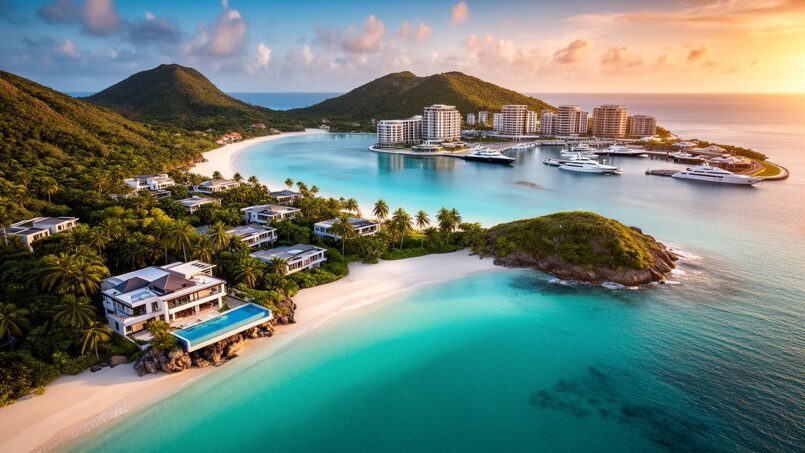
Eden Island holds a completely unique place in the Seychelles landscape. It is an artificial island connected to Mahé by a bridge, organized around a marina, private beaches, and a high-end residential park. Legally, it is also one of the very few places in the Indian Ocean – and one of very few in Seychelles – where a foreigner can become a full freehold owner without having to structure ownership through a lease or a local partner.
Legal Status and Ownership Structure
The developer of Eden Island entered into a key commercial agreement with the Seychelles government, which subdivided the island into two zones: a residential part and a commercial part including the bridge, seawall, and marina. The developer currently holds the freehold title to the residential portion and transfers this full ownership to each buyer.
Specifically:
– Maisons and villas are sold with individual freehold title,
– Apartments are sold as freehold under the Condominium Property Act (equivalent to a condominium),
– each residential unit may have an assigned berth (mooring), not in freehold but via a 99-year lease linking the unit owner and the management entity (Developer/Village Management Association). The annual or monthly rent is nominal, supplemented by a contribution to charges, maintenance, and berth management.
Residential lots at Eden Island are delivered furnished to international standards and fully equipped, making them “turnkey” products for foreign investors. This site is specifically designated by the government to allow freehold ownership by non-Seychellois, without the need to create a local structure or resort to a complex emphyteutic lease.
Who Owns What? Summary by Asset Type
| Element | Type of Right for Buyer | Key Features |
|---|---|---|
| Apartment | Freehold (Condominium Act) | Condominium, full ownership title, furnished and equipped |
| Maison | Individual Freehold | Full land title on plot and building |
| Villa | Individual Freehold | Large plot, often waterfront |
| Berth | 99-year Lease | Nominal rent + charges, tied to the unit, not separately transferable |
| Common Areas | Condominium / VMA | Managed by the Village Management Association |
Purchase Process on Eden Island
The acquisition process is well-defined and largely standardized. A reservation procedure allows you to secure a lot before signing.
For reservation:
– USD 5,000 for an apartment,
– USD 10,000 for a Maison,
– USD 20,000 for a villa.
These amounts are then included in the deposit upon signing the agreement of sale. The buyer has 14 days after receiving the contract to sign it and pay a first installment of 10%, which is placed in an escrow account. The balance of the price is secured either by an additional escrow deposit or a bank guarantee.
Payment terms differ depending on the type of property: apartment or maison/villa.
Staged payments based on construction progress: before start, after commencement, topping out, issuance of occupancy certificate, then final transfer.
10% upon signing, balance paid into escrow within 30 days, then disbursements upon land transfer, slab completion, roof completion, and handover.
Retentions are held at handover to cover any construction defects (up to USD 100,000 for a villa, USD 10,000 for a Maison, USD 10,000 for certain apartments). Once defects are rectified, these retentions are released to the seller.
Transaction Costs and Specific Taxation
Eden Island benefits from a special regime, more favorable than Seychelles common law for first transfers. The first sale of a plot from the developer to a buyer is exempt from stamp duty and sanction fees. For subsequent resales, duties are capped at 6.5% of the price (i.e., 5% stamp duty + 1.5% sanction fee).
In terms of taxation, the general Seychelles regime applies:
– no capital gains tax on real estate,
– no inheritance tax on real estate,
– immovable property tax at 0.5% of the property value for non-Seychellois (with certain exemptions and a first-year exemption for a first-time residential buyer after 2020).
For rental income from the rental pool at Eden Island, specific taxation applies: 12% tax on short-term rental income and 15% on long-term rentals, paid to the Seychelles authorities.
Residency and Non-Financial Benefits
One of the major advantages of Eden Island for a foreign investor is the link between property ownership and residency. The purchase of a property valued at over USD 1 million opens the possibility of a permanent residence card, while more generally, owners and up to six family members can apply for a renewable 5-year residence permit.
No specific amount is mentioned in the article regarding residence application fees.
– USD 1,000 in professional fees for preparing the application,
– SCR 1,000 processing fee,
– SCR 150,000 permit fee payable to the state for each accepted application, to be renewed every 5 years.
Finally, buying on Eden Island automatically grants membership in the Village Management Association (VMA), which manages security, maintenance, and common services – a crucial point for investors who do not reside year-round.
Price Levels and Returns
Price levels on Eden Island are among the highest in the country, but remain competitive by the standards of premium beach destinations.
Some benchmarks:
| Property Type | Indicative Price Range |
|---|---|
| 1-bedroom apartment | USD 350,000 to 450,000 (typical size 88–100 m²) |
| 2–3 bedroom apartment | USD 650,000 to 1,100,000 (up to 215 m²) |
| Maison | USD 1.2 to 2 million |
| Waterfront villa | USD 2.5 to 4.5 million (or more for prime locations) |
Apartments and villas show gross rental yields in the range of 4.5% to 7% depending on type and use (seasonal vs. long-term rental), with price appreciation potential supported by the scarcity of freehold supply open to foreigners in the country.
For an investor seeking simple, secure, and “plug & play” exposure in Seychelles, Eden Island thus represents the most straightforward option, provided you accept a high entry ticket and a relatively standardized management framework (condominium, VMA, strict rental rules, no subletting outside the system, etc.).
Mahé: The Heart of the Market and Diverse Opportunities
Mahé, the main island and home to the capital Victoria, concentrates the majority of the population, infrastructure, and investment. It offers the widest range of real estate products: waterfront villas, hillside homes with panoramic views, urban apartments, development plots, small rental properties, or tourist-oriented guesthouses.
Market Dynamics on Mahé
Recent research data shows a dynamic and resilient market:
| Indicator (Mahé) | Recent Value (Order of Magnitude) |
|---|---|
| Average price per m² | ~ SCR 10,900 |
| Average rental yield | ~ 4.2% to 4.9% |
| Annual price growth | +14% to +16% |
| Buyer profile | UHNW & international |
These averages mask significant disparities: some micro-areas of Mahé see price increases two to three times the national average. The most sought-after areas like Beau Vallon, Glacis, certain hills of Mont Fleuri, or the west coast attract strong pressure from international buyers.
Geography of Opportunities
The main areas of interest can be read as follows:
– North / Northwest (Beau Vallon, Bel Ombre, Glacis): iconic beaches, strong tourist rental demand, waterfront villas and perched houses with sunset views. This is the heart of the “postcard” market with high prices but liquidity and solid yields.
– Victoria and environs (English River, Mont Fleuri): apartments in low-rise buildings, small multi-family residences, convenient locations for expats working in town. Ideal for stable yield strategies.
– East and Southeast (Anse Royale, Au Cap, Anse aux Pins): quieter beaches, new contemporary residences, appreciation potential linked to infrastructure and sustainable tourism projects. Entry prices remain more affordable, while benefiting from future development.
– West (Port Glaud, Baie Ternay, Anse Soleil): mix of ultra-prime properties (notably integrated into resorts like Four Seasons Private Residences) and development land. Entry tickets are very high, but with a clearly ultra-luxury positioning.
In terms of indicative budgets:
| Property Type on Mahé | Approximate Price Range |
|---|---|
| Studio / 1-bedroom apartment | USD 100,000 to 180,000 |
| 2–3 bedroom apartment | USD 220,000 to 450,000 |
| 2–3 bedroom sea-view villa (mid-range) | USD 200,000 to 450,000 |
| Modern sea-view villa (high-end) | USD 600,000 to 2.5+ million |
| Ultra-luxury property like Four Seasons | up to USD 7 million and more |
Yield-oriented investors can target small 3–6 unit residences around Beau Vallon or Mont Fleuri with budgets USD 350,000 to 650,000, achieving gross yields of up to 6–8% with a mix of tourist/expat clientele.
Rental and Profitability
Mahé benefits from a steady flow of tourists, fueled by direct international flights and an established position in the luxury segment. Rental demand comes from:
– European vacationers,
– cruise passengers,
– corporate seminars,
– expatriates and international civil servants.
Rents vary widely by standard and location. As a practical reference, four levels of monthly budget can be distinguished:
| Monthly Rent Level (Mahé) | Typical Areas |
|---|---|
| USD 500–800 | Anse Royale, Takamaka (south) |
| USD 800–1,400 | Beau Vallon, Victoria/English River |
| USD 1,400–2,500 | Bel Ombre, northern hills |
| USD 2,500 and above | Eden Island, Four Seasons, ultra-prime properties |
For an investor using equity (since mortgages are hard for non-residents), a realistic goal is a gross yield of 4 to 6% on a standard residential property, potentially rising to 6–8% on optimized products (multi-unit, well-managed seasonal rentals) in the best micro-markets.
Purchase Procedure on Mahé
Outside Eden Island and a few designated programs, buying on Mahé as a foreigner necessarily requires obtaining a sanction. The typical path looks like this:
To buy a property in Seychelles as a foreigner, you must follow these steps: select a property in an authorized area, check its eligibility (minimum price and size) via a lawyer, sign a preliminary agreement with a 25% deposit with the notary, file a sanction application with the ministry (with passports, proof of funds, etc.), wait about 3 months for processing (sanction valid for 1 year), then finalize the sale by notarial deed with payment of duties and registration with the Land Registry.
Ancillary costs include:
Stamp duty for non-Seychellois can reach 18.5% of the purchase price of a house, combining registration duties and sanction duty.
For a foreign investor, the sum of taxes and fees can easily represent 15 to 20% of the acquisition price under the general regime, hence the value of modeling the project well and, when possible, favoring programs with reduced regimes (like Eden Island, Pangia Beach, Les Résidences at Meliã).
Praslin: A Rapidly Upscaling Resort Market
Praslin, the second largest island in the archipelago, combines several assets: spectacular scenery (UNESCO-listed Vallée de Mai, famous beaches like Anse Lazio), a more peaceful atmosphere than Mahé, and a real estate market undergoing major transformation, supported by the lifting of the moratorium and infrastructure development.
Prices, Yields, and Buyer Profile
Recent market data describes Praslin as a very attractive high-end secondary market:
| Indicator (Praslin) | Approximate Value |
|---|---|
| Average price per m² | ~ SCR 6,900 to 8,700 |
| Average rental yield | ~ 5.9% to 8.6% |
| Annual price growth | +13% to +14% |
| Buyer profile | HNW & “lifestyle” |
Prices on Praslin are on average about 20% higher than those in the capital (Victoria) for comparable properties, mainly because a significant proportion of properties are located on the beachfront or very close to the sea.
Areas like Grand Anse, Côte d’Or (Anse Volbert), or the vicinity of Anse Lazio concentrate high-end residential complexes, often geared towards vacation clientele and investors seeking a mixed-use property (personal use + tourist rental).
Property Types and Yield Structures
Praslin offers a spectrum from individual villas to small modern condominiums:
Discover the main categories of available real estate, from luxury waterfront villas to high-yield condominiums.
Located along Côte d’Or, Grand Anse, and Anse Lazio, these properties feature mature gardens, coco de mer palms, and unobstructed views. Used as high-end second homes or vacation houses, they offer strong resale value.
Around Grand Anse, large wooded plots with panoramas over the ocean and neighboring islands. Ideal for retirement projects or small tourist structures.
In Grand Anse, with infinity pools, gyms, and landscaped gardens. Shared management, high occupancy rates year-round, and net yields that can reach double digits in the best cases.
Rental demand on Praslin comes from:
– honeymoon couples,
– ecotourists attracted by Vallée de Mai and nature reserves,
– high-end clientele seeking a quieter alternative to Mahé,
– a growing community of long-term residents (retirees, tourism entrepreneurs).
Accessibility, Infrastructure, and Potential
Praslin is connected to Mahé by regular high-speed ferry services and short flights, with a modernized regional airport. Direct connections to hubs like Dubai or Mauritius are mentioned in some projects, enhancing international accessibility.
The island has facilities that enhance its appeal for long stays.
– expanding medical center,
– schools and educational campuses,
– shops and craft village (Domaine de Val des Près),
– high-level dining options associated with five-star resorts.
The prospects are all the more interesting since the lifting of the moratorium now allows foreigners to buy certain residential lots on Praslin, provided they meet the minimum value and plot size criteria, as well as obtain a Non-Citizen Property Purchase License and the accompanying sanction.
Example Rental Grids on Praslin
For rental investors, monthly rental budgets break down as follows:
| Monthly Rent Level (Praslin) | Typical Sectors |
|---|---|
| USD 500–800 | Grand’Anse (simple accommodations) |
| USD 800–1,400 | Anse Volbert / Côte d’Or |
| USD 1,400–2,500 | Vicinity of Anse Lazio, sea-view villas |
Well-positioned products, in managed condominiums or via a hotel operator, can achieve gross yields higher than those on Mahé, at the cost of sometimes slightly lower liquidity upon resale.
Taxation, Duties, and Recurring Costs: What a Foreign Investor Pays
Beyond the listed price, a successful real estate strategy relies on a thorough understanding of Seychelles taxation, which combines certain notable advantages and some particularities to anticipate.
Acquisition Taxes
The main items are:
– Stamp duty: generally 5% of the property value, applicable to both Seychellois and foreigners, with cases where the effective cost rises when including registration duties specific to non-residents.
– Sanction duty: for foreigners, an additional levy of 12% of the market value is the norm for residential acquisitions outside derogatory regimes. For condominiums and certain designated projects, the rate remains at 1.5%.
– Notary fees: in practice 1–2% of the price, covering drafting, title verification, and deposit with the land registry.
On Eden Island, the first sale is exempt from stamp duty and sanction fee, while resales are capped at 6.5%, thus improving net profitability compared to the general system.
Recurring Property Taxes
Contrary to the sometimes portrayed image of a total absence of property tax, the reality has become clearer in recent years for non-Seychellois. Since 2020, Seychelles introduced an Immovable Property Tax on properties held by foreigners, initially at 0.25% of the property value and raised to 0.5% from 2024. The current rate remains at 0.5%.
This tax comes with three obligations:
– registration with the tax authorities (Seychelles Revenue Commission),
– valuation of market value by an expert, renewed every five years,
– annual payment before December 31.
Penalties are SCR 50,000 for failure to register, SCR 3,000 for failure to file a valuation, plus late payment penalties. A one-year exemption applies for first residential purchases by non-Seychellois after January 1, 2020.
Several categories of properties may be permanently exempt: employee housing, conservation properties, embassy properties, bank repossessions, or residential properties for certain foreigners married to Seychellois.
Income Taxation and Other Taxes
The Seychelles system remains broadly favorable to investors:
– No capital gains tax: gains on resale are not taxed locally.
– No inheritance tax or wealth tax.
– Tax on rental income: for residential rentals, the levy is limited to 3% of gross income in certain frameworks; for commercial income, the rate follows the corporate tax regime (15% then 25% above a certain threshold).
– VAT: standard rate 15%, often included in the sale price of new units.
– Withholding tax: 15% on dividends, interest, royalties, etc., paid to non-residents.
This tax base, combined with freedom to repatriate funds (rents, capital, gains) and the absence of wealth tax, largely explains the interest of wealthy international clientele in this market.
Financing, Structuring, and Substance Requirements
Most foreign buyers in Seychelles finance their acquisitions in cash. Local banks grant mortgages, but conditions are stricter for non-residents: down payments of 20 to 40%, heavy documentation requirements, and sometimes restrictions on the type or location of the property. Interest rates are generally higher than in major developed countries.
In terms of structuring, a foreigner can buy:
– in own name,
– via a Seychelles company (the most common form for corporate investors),
– via a foreign company,
– via a condominium or partnership structure.
Seychelles companies and IBCs must prove real presence and activity in the country for certain activities (holding, finance, etc.) under the economic substance law. A purely “mailbox” company can no longer benefit from all tax advantages.
It is strongly recommended to use a Seychelles lawyer specializing in real estate to:
– secure the property title,
– verify the absence of mortgages or encumbrances,
– ensure the project complies with planning rules,
– structure ownership optimally (personal or via company).
Strategies for Foreign Investors: How to Use Mahé, Praslin, and Eden Island
The value of combining several geographies lies in the complementarity of profiles:
– Eden Island is ideal for a secure exposure strategy to a luxury market, with clear freehold, centralized management, good liquidity, and a direct link to residency.
– Mahé offers a mix of yield and capital appreciation, with opportunities in still-transforming neighborhoods (east and south) and a diversified rental market.
– Praslin represents a lifestyle growth bet, with sometimes higher yields and potential for upscaling as the island gains new infrastructure and recognition.
An investor could, for example, combine several types of assets or strategies to diversify their portfolio, mixing stocks, bonds, and alternative investments according to their objectives.
– an apartment on Eden Island as a primary base, easily rentable and eligible for residency rights,
– a small 3–4 unit residence in Beau Vallon to capture tourist flow on Mahé,
– a villa or condominium apartment in Grand Anse (Praslin) to target a yield/pleasure combination.
The key is to properly articulate objective (income, capital gains, residence, diversification), budget, horizon (short, medium, or long term), and regulatory risk tolerance. The recent lifting of the moratorium proves that the framework can evolve; it is therefore crucial to follow regulatory news and surround yourself with local professionals.
Conclusion: A Demanding but Promising Market for Prepared Investors
Real estate on Mahé, Praslin, and Eden Island is neither a constraint-free eldorado nor an impenetrable maze. It is a technical, regulated, and selective market, designed to attract quality foreign capital while protecting Seychellois access to land and preserving fragile environments.
Investors who take the time to:
To invest in Seychelles, you need to distinguish freehold from leasehold, know the Designated Areas and pre-approved programs, budget for sanction costs, stamp duty, and notary fees, model the annual tax and income taxation, and surround yourself with experienced Seychellois lawyers, notaries, and managers.
can build solid real estate portfolios, reconciling enjoyment of use, asset diversification, and measured returns.
Eden Island offers the most direct path to freehold ownership and residency in a highly controlled environment; Mahé remains the beating heart of the market, with greater depth and liquidity; Praslin, finally, embodies the rise of a secondary beach market with attractive fundamentals. For an informed foreign investor, these three pillars form a triangle of opportunities rare in the Indian Ocean.
Have a wealth management project or a question? Contact us now to speak with a wealth management expert.
Disclaimer: The information provided on this website is for informational purposes only and does not constitute financial, legal, or professional advice. We encourage you to consult qualified experts before making any investment, real estate, or expatriation decisions. Although we strive to maintain up-to-date and accurate information, we do not guarantee the completeness, accuracy, or timeliness of the proposed content. As investment and expatriation involve risks, we disclaim any liability for potential losses or damages arising from the use of this site. Your use of this site confirms your acceptance of these terms and your understanding of the associated risks.

Cyril Jarnias is an independent expert in international wealth management with over 20 years of experience. As an expatriate himself, he is dedicated to helping individuals and business leaders build, protect, and pass on their wealth with complete peace of mind.
On his website, cyriljarnias.com, he shares his expertise on international real estate, offshore company formation, and expatriation.
Thanks to his expertise, he offers sound advice to optimize his clients' wealth management. Cyril Jarnias is also recognized for his appearances in many prestigious media outlets such as BFM Business, les Français de l’étranger, Le Figaro, Les Echos, and Mieux vivre votre argent, where he shares his knowledge and know-how in wealth management.





