
 Published on and written by Cyril Jarnias
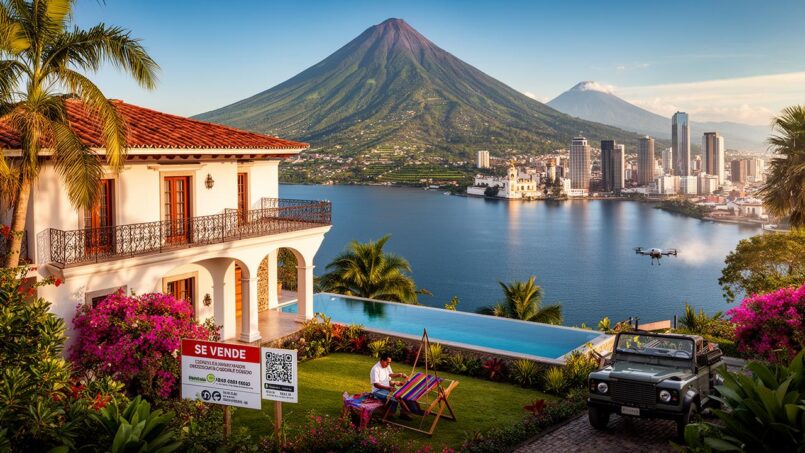
Guatemalan real estate is attracting more and more international investors, and three hubs stand out at the top of the list: Guatemala City, Antigua Guatemala, and the villages around Lake Atitlán. Each represents a very different risk, return, and regulatory profile. For a foreign investor, the potential is real – but so are the legal and administrative pitfalls, especially around the lake.
This land‑focused guide covers the legal framework for foreigners, prices, rental yields (including Airbnb), financing, and specific rules around Lake Atitlán.
General Framework: What Foreigners Can (and Cannot) Do
Before comparing Guatemala City, Antigua, and Lake Atitlán, we need to establish the baseline: how far can a foreigner go when it comes to property ownership in Guatemala?
In the vast majority of cases, Guatemalan law puts foreigners and nationals on nearly equal footing. A non-resident can buy a house, apartment, residential or commercial land in their own name, with no surface area quota, no mandatory local partner, and no specific investment-linked visa. The right to sell, rent, mortgage, develop, and transfer the property is, in permitted areas, the same as for a Guatemalan citizen.
The system is based on the Registro General de la Propiedad (RGP), which records titles in a finca‑folio‑libro format. Legal security comes not from a title insurance policy, but from the rigor of the notary and lawyer who trace the chain of title back 10 to 20 years, search for mortgages, liens, usufructs, and judicial annotations, and verify payment of property tax (IUSI).
The Constitutional Restrictions That Change the Game
The major exception lies in the strategic zones defined by the Constitution and the Law on State Reserve Areas. For a foreign investor, four strips to keep in mind:
– 15 km along all international borders
– 3 km along the seacoasts
– 200 m around the shores of all lakes, including Lake Atitlán
– 100 m along navigable rivers
In these strips, a foreigner cannot always hold direct full ownership in their own name. Along the land border, only “Guatemalan‑born” individuals or companies fully owned by them can own the land. On lake shores or coasts, the Constitution reserves at least the first 200 meters for the State, and management is often entrusted to a specialized agency, such as OCRET around Atitlán.
In practice, this means that:
– Outside the protected strips, a foreign investor can buy directly in their own name, whether in Guatemala City, Antigua Guatemala, or the hills beyond the 200 m of Lake Atitlán.
– Inside the 200 m strip around the lake, they cannot hold the land directly: they will need to use a Guatemalan company (sociedad anónima) that signs an OCRET lease, or remain a long-term renter.
– Within 15 km of the border, even the Guatemalan company may face additional limitations.
This balance—general openness, but protection of certain areas—makes Guatemala paradoxically simpler than other Latin American countries for urban purchases, but more technical as soon as you approach water or borders.
Guatemala City: Driving Market, Solid Returns, Highly Zoned Security
Economic capital of the country, Guatemala City concentrates most of the stock of modern offices, shopping centers, logistics parks, and vertical residences. For an investor, it is the deepest market, where macroeconomic trends—growth, remittances, urbanization—are most clearly visible.
Economic and Real Estate Dynamics
The Guatemalan economy is growing at a relatively stable pace, with GDP projections around 3.5 to 4% per year through 2028. Between January and October 2025, diaspora remittances exceeded $21 billion, nearly 20% of GDP. These currency flows directly support real estate demand, especially for middle- and upper-class apartments and homes in the capital.
The figures show: significant trends and results within the analyzed data.
– a cumulative increase in residential prices of about 15 to 25% over five years,
– an annual appreciation of 4 to 6%,
– gross rental yields of 5.7 to 8.4% in well-located areas,
– a low probability of a significant price drop in the short term, with plausible scenarios for the next 12 months ranging from 0 to 6% additional increase.
Approximately 813,000 m² of modern warehouses and industrial parks were recorded, nearly half of which are Class A.
Prices and Neighborhoods: From Budget to Ultra‑Prime
In Guatemala City, the hierarchy by zone is extremely pronounced, especially for houses in secure subdivisions and apartments in towers.
The broad ranges can be summarized as follows:
| Segment | Typical Location | Price per m² (approx.) | Sample Budget |
|---|---|---|---|
| Economic Periphery | Zones 7, 11, 18, 21, Mixco | $915–$1,070/m² | House $150–$200k USD |
| Premium Zones | Zones 10, 14, 15, 16 | $1,500–$2,000+/m² (up to $3,600) | Apartment $120–$300k USD (entry), houses $300–$900k USD |
| High-End Suburban | Gated communities on Carretera a El Salvador, upper Mixco | $150–$525k USD per house | Q1,150,000–Q4,000,000 |
In the most expensive enclaves (Zone 16 around Ciudad Cayalá, or residential pockets of Oakland in Zone 10, or Zone 14), new projects sell between $450,000 and $900,000 USD and up, with a 10 to 25% premium over older resales, due to newer seismic standards, better finishes, and highly secure residential complexes.
Rental Market and Yields
Rents follow the same geography. In the “safe zones” favored by expats (zones 10, 13, 14, 15, 16), modern 1‑bedroom apartments typically rent for:
| Zone | Monthly Rent 1‑Br (approx.) |
|---|---|
| Zona 10 | $500–$900 USD |
| Zona 14 | $600–$1,000 USD |
| Zona 15 (Vista Hermosa) | $400–$800 USD |
| Zona 16 (Ciudad Cayalá) | $700–$1,200 USD |
In intermediate neighborhoods (e.g., Zone 11), you’ll find rents of $300–$400 USD for simpler apartments, while luxury penthouses in Zone 14 can exceed $3,500 per month.
Rents relative to purchase prices offer gross yields of 8 to 10% in some sectors, especially for multi-family projects or housing aimed at young professionals. Additionally, quality new projects show annual capital appreciation of 4 to 6%, and up to 6 to 8% in highly sought-after developments connected to new transport arteries like Metro Riel.
Gated Communities: Top Product for the Upper‑Middle Class
The growth of gated communities (condominios and secure subdivisions) is at the core of the city and its outskirts. Officially, the discourse emphasizes security against urban crime; in reality, several factors combine: the search for social status, low trust in public action, and the logic of a private city where services (security, water, backup electricity, green spaces) are internalized.
For the investor, these complexes offer several advantages:
Gated communities present key advantages for real estate investment: structured demand, stability, and modern infrastructure.
Structural rental demand from families and expats, providing a solid base for investors.
More stable yields than in open neighborhoods, thanks to controlled management and lower volatility.
Easier resale thanks to the reputation of projects (Cayalá, Vista Hermosa, etc.), attracting buyers and tenants.
Modern infrastructure including underground parking, fiber optics, and generators for optimal comfort.
The downside: sometimes high homeowners’ association fees (24/7 security, maintenance, amenities), which can eat into the net yield. These must be factored into the business plan from the start.
Airbnb and Short‑Term Rentals in Guatemala City
The short‑term rental market in Guatemala City is less performant than in Antigua or around Lake Atitlán. Comparative data show that a typical listing in Antigua earns an average of about $14,900 USD per year with a 54% occupancy rate, roughly 40% more than a comparable property in Guatemala City. Nationwide, the average Guatemalan host earns around $550 USD per month on Airbnb, with an average occupancy rate of 40% (about 12 nights per month). Guatemala City sits below this average: around $460 USD per month.
For an investor focused on “Airbnb cash‑flow”, the capital can still work in the business districts (zones 9, 10, 14) with a well-positioned offering for business travel. But the heart of the rental market remains classic long‑term leasing, with a yield‑appreciation combination that few regional capitals can offer today.
Antigua Guatemala: Tourism, Short‑Term Rentals, and Controlled Yields
Antigua Guatemala plays in another category: that of the listed colonial tourist destination, where cobblestone streets, church ruins, and volcano views sustainably support demand, both for second homes and tourist rentals.
A Highly Touristic but Increasingly Competitive Market
On the short‑term rental side, Antigua is one of the most mature markets in the country. According to data from June 2025 to May 2026, it counts:
– approximately 1,600 to 1,900 active Airbnb listings depending on the source,
– an average occupancy rate around 54–55%,
– a median annual income of about $15,000 USD per property,
– an average nightly rate between $74 and $80 USD (with a majority range between $41 and $143 USD),
– a typical monthly income around $1,245 USD.
For a foreign investor, this sets the scene: the market is very deep, but competition is fierce. Supply has increased by about 26 to 45% in one year, which weighs on revenues and explains a recent drop of 2.9 to 13% in median incomes depending on the indicators used.
Performance can be summarized by quartiles as follows:
| Performance Segment | Typical Monthly Income | Approx. Annual Income |
|---|---|---|
| Top 10% | $3,100–$3,800+ USD | $37,000–$45,000+ USD |
| Top 25% | ≥ $2,039 USD | ≥ $24,000 USD |
| Median | ~$987–$1,245 USD | ~$14,900–$15,200 USD |
| Bottom 25% | ~$419 USD | ~$5,000 USD |
In other words, only very well‑located and very well‑managed properties reach the top tier; the majority sits around $1,000–$1,300 USD gross per month.
Marked Seasonality: Living with the Rollercoaster
Antigua lives by the rhythm of the tourist seasons. Demand peaks are concentrated between November and April, with an absolute peak in February‑March, during the Semana Santa (Holy Week) period and other festivities.
The data shows: results of the scientific study, market trends, population growth, and consumer behaviors.
– High season (March, December, November) around $2,054 USD monthly income, 49% occupancy and $129 USD average rate,
– Shoulder season around $1,677 USD and 42% occupancy,
– Low season (June, August, September) around $1,304 USD and 33% occupancy, with a slightly lower average rate ($124 USD).
September is consistently the weakest month, coinciding with the heart of the rainy season. Conversely, February is the month with the highest occupancy rate. During Holy Week, the best accommodations reach 80–90% occupancy and rates 25–40% above the median.
For an investor, this means that 60 to 70% of annual income can be concentrated in the dry season (November–April), as in the rest of the country. The model must incorporate very strong months, but also periods where cash‑flow barely covers fixed costs.
Customer Profile and Price Level
Antigua attracts a mixed clientele: about 56% of Airbnb travelers are international, but Guatemalans remain the largest national group. On the pricing side, the market is structured as follows:
– Average rate around $78 USD per night, median at $77 USD,
– 80% of listings fall between $41 and $143 USD per night,
– Top 10%: over $250 USD per night, often central colonial houses or villas with a view.
Income performance reflects this spectrum: a “good” property in the historic center, with exceptional decoration, professional management, and a high rating, can aim for 6 to 8% net yield after expenses, or even more for an optimized operation. However, most properties turn around 3.8 to 5.5% net yield, a level considered reasonable for a very touristy but mature city.
Rental yield analysis
Global estimates suggest:
| Indicator | Indicative Value in Antigua |
|---|---|
| Average gross yield | ~5.5% (range 4.5–6.5% depending on area) |
| Average net yield | ~3.8% |
| Gross yield considered “good” locally | ≥ 6% |
| Possible gross yield on exceptional operations | > 12% |
Residential Real Estate Prices in Antigua
Purchase prices reflect Antigua’s status as a sought‑after colonial destination, with strong constraints on new construction in the center (UNESCO, CNPAG). This scarcity supports prices, especially for restored houses.
The following ranges can be schematized:
| Type of Property in Antigua | Typical Price Range | Indicative Price per m² |
|---|---|---|
| Small apartment (60–80 m²) | $100,000–$200,000 USD | $1,680–$2,500/m² |
| Standard house (120–180 m²) | $150,000–$350,000 USD | $1,250–$2,000/m² |
| Restored colonial house | $250,000–$600,000 USD | $2,500–$5,640/m² |
| Luxury property with view | $500,000–$1,200,000+ USD | $4,000–$12,560/m² |
By tier, the “for sale” market can be read as follows:
| Tier | Description | Price Range |
|---|---|---|
| Entry Level | Modern condos on the outskirts (San Pedro Las Huertas, Jocotenango), small houses | $150,000–$300,000 USD |
| Mid‑Range | Houses with parking, secure condos, partially restored colonial houses | $300,000–$700,000 USD |
| Premium | Large colonial houses in the Center, haciendas with land, high‑end gated communities | $700,000–$2,500,000+ USD |
The average price per square meter generally hovers between $1,600 and $2,800 USD for standard properties, with much higher peaks in the listed historic center.
Neighborhoods, Costs, and Investment Strategy
In the city center (grid of calles and avenidas), rents are the highest, for both housing and commercial spaces. Supply is structurally limited by heritage protection, which supports prices but caps the potential for supply expansion.
Around it, certain sectors offer an interesting compromise for the investor:
Rents in Jocotenango, a neighboring town a 10‑minute walk north of Antigua’s colonial center, are 30 to 40% lower than in the center, often offering higher rental yields, especially for long‑term rentals.
For an Airbnb‑focused strategy, the priority remains walking distance to the central park and the quality of the experience (design, patio, volcano views). For a long‑stay/expat strategy, secure subdivisions on the outskirts of town (Antigua Gardens, Hacienda del Comendador, etc.) combine security, views, and family life.
Purchase Process and Due Diligence in Antigua
From a legal standpoint, buying in Antigua follows the same framework as the rest of the country:
– Obtaining a NIT (tax ID number) from SAT, possible with just a passport,
– Property search at the RGP: certificación de finca, verification of owners, property history, mortgages and annotations,
– Verification with the municipality: compliance with building permits, IUSI payment, zoning, any specific heritage constraints (CNPAG),
– Promise of sale (promesa de compraventa) with a 5–10% deposit,
– Signing of the escritura pública before the notary, payment of transfer taxes (3%) and VAT or stamp duty depending on the age of the property,
– Registration with the RGP and updating with the municipality.
Additional costs (taxes, notary, registration, certificates) generally run between 4 and 6.5% of the purchase price for a resale property. For a foreigner, possibly add 0.5 to 1.5% for international title insurance, especially for high amounts.
Around Lake Atitlán: The Promised Land of Tourist Returns, but a Regulatory Jungle
Lake Atitlán attracts both backpackers and North American retirees seeking mild climate and breathtaking views. For the investor, the promise is clear: high‑rate seasonal rentals on lake‑view properties, and a lower cost of living than Antigua or Guatemala City. But the legal and environmental reality is far more complex.
Lakeside Property: State Ownership, OCRET, and Local Companies
The first point to understand is radical: within a 200 m strip around the shores of Lake Atitlán, the Constitution reserves land ownership to the State. Operational management of this strip is entrusted to OCRET (Oficina de Control de Áreas de Reserva del Estado), an entity under the Ministry of Agriculture.
Specifically:
– The land in the first 200 meters belongs to the State, not the individual.
– Individuals (including Guatemalans) do not hold full ownership title to this fringe, but a lease contract (contrato de arrendamiento) with OCRET.
– The first 20 meters from the shore are原则上 non‑buildable: no lease can cover this fringe, and no construction should be there, including permanent structures like docks.
– At Atitlán, a foreigner cannot directly hold an OCRET contract: it must be held by a Guatemalan company (sociedad anónima) of which the foreigner is a shareholder.
Beyond the 200 m strip, the situation simplifies: you enter “classic” private property. A foreigner can then buy freely in their own name, provided the property has a clear title at the RGP. Many hillside houses with lake views fall into this case.
Prices and Types of Properties Around the Lake
The real estate market around the lake is very heterogeneous, depending on the villages (Panajachel, San Marcos La Laguna, Santa Catarina Palopó, San Pedro La Laguna, Santiago, etc.) and land tenure regimes (registered title, possession rights, communal lands).
Indicative ranges observed:
| Type of Property | Typical Price Range |
|---|---|
| Small rural plot | $15,000–$50,000 USD (depending on access and view) |
| Modest 2‑bedroom house | $100,000–$200,000 USD |
| 3‑bedroom house | $150,000–$300,000 USD |
| Lakeside house | $200,000–$500,000+ USD |
| Sloping lot with view (outside 200 m) | highly variable, often $50,000–$150,000 USD |
Note: many transactions are negotiated in US dollars, even if the deed is recorded in quetzales at the day’s rate (about 8 GTQ to 1 USD as of spring 2026).
Tourist Returns and Price Positioning
On short‑term rentals, Antigua and Lake Atitlán form the country’s premium duo. Nightly rates at Atitlán for quality lakeside properties often fall between $90 and $200 USD per night, a marked premium over the national average ($70 USD) or Guatemala City ($45–$95 USD).
Overall Guatemala data indicates:
– national average Airbnb monthly income: ~$550 USD,
– Antigua and Atitlán: average around $730 USD,
– Guatemala City: about $460 USD.
The best properties around Atitlán – large lakeside houses in Panajachel or Santa Catarina Palopó, for example – can generate $1,200 to $1,800 USD per month, levels comparable to the top 10% of Antigua, with highly seasonal occupancy (very busy dry season, quieter rainy season).
The other key element for the investor: the cost structure. The lake offers a lower cost of living and labor than Antigua or the capital, leaving more net margin on the high gross rents of a premium villa. But this margin can be eroded by environmental compliance costs and land title uncertainties.
Environmental Regulations and Permits: A Mandatory Step
The Atitlán basin is classified as a protected area. Several institutions are involved in any real estate or hotel project:
– CONAP (National Council of Protected Areas) for biodiversity aspects and protected areas,
– MARN (Ministry of Environment) for environmental licenses and wastewater discharges,
– INAB (National Forestry Institute) for any tree cutting,
– AMSCLAE (Authority for the Management of the Atitlán Basin) through municipalities for building permits and drilling,
– the municipalities and villages, which issue building permits (licencias de construcción).
For a single‑family home around the lake, the typical procedure includes:
The procedure includes architectural design, an environmental impact assessment (EIA) by a licensed engineer submitted to MARN for CONAP review (site visit), then obtaining an environmental license with a bond. Followed by a municipal building permit with AMSCLAE input in the Atitlán basin, and if necessary, INAB authorization for tree removal.
Any non‑domestic wastewater discharge exceeding 7 m³/day additionally requires a specific wastewater discharge permit issued by MARN, including:
– MARN administrative fees ranging from 3,000 to 10,000 GTQ,
– mandatory analyses by an accredited lab (5,000 to 25,000 GTQ),
– technical study by a licensed consultant (8,000 to 40,000 GTQ),
– total realistic cost of 16,000 to 75,000 GTQ, excluding investment in the treatment plant.
For large projects (investment > 5 million quetzales, projects within SIGAP protected areas, etc.), the environmental license becomes ” Category A,” the most demanding level of the Guatemalan system. It involves:
– a full EIA, supplemental studies (biodiversity, hydrology, air, noise, industrial risks, socio‑economics, archaeology…),
– a public consultation (notice in two newspapers, public meeting, receiving comments for 40 days),
– an overall cost ranging from 150,000 to over 1.5 million quetzales,
– timelines of 180 to 360 working days.
For a foreign investor targeting a hotel project or a luxury villa complex by the lake, this procedure is unavoidable and must be budgeted from the start, both financially and in terms of schedule.
Local Rules: The Strict Example of San Pedro La Laguna
Some municipalities go even further in regulation. San Pedro La Laguna, for example, adopted in 2025 a specific regulation for the “ecological rights of Grandmother Lake Atitlán”, which covers:
– the water body itself,
– the public beach,
– the adjacent agricultural zone,
– the streets and alleys of the municipality.
This regulation:
The law prohibits the privatization of beaches within a 10 m strip, sets fines from 300 to 50,000 quetzales for various infractions (construction, obstructing access, illegal dumping, sand extraction), mandates the use of organic inputs in the agricultural zone near the lake and minimum cultivation distances (e.g., corn 40 m from the beach) with an obligation to plant multiple crops and native trees, reinforces the ban on fish farming cages and regulates fishing, and requires wastewater treatment systems in homes.
For an investor, this means that each municipality around the lake can add its own layer of rules on top of national requirements. It is therefore essential to work with a local lawyer who knows the specific municipal ordinances (AMSCLAE regulations, municipal decrees, etc.).
Enhanced Due Diligence Around the Lake
Beyond environmental permits, the major difficulty around Atitlán lies in the often uneven quality of land titles. A significant portion of land is held:
– either as possession rights (derecho de posesión), without formal registration at the RGP,
– or as communal lands (ejido) managed by indigenous communities or municipalities, sometimes unsellable to foreigners.
A thorough due diligence must therefore include five parallel components:
1. Chain of title: trace the complete history at the RGP back to the original registration, verify there are no gaps, unrecorded transfers, or disputed annotations. 2. Liens and encumbrances: identify mortgages, judgments, easements, usufructs. 3. Authority to sell: ensure the seller is the registered owner or holds a valid notarized power of attorney (or a board resolution for a S.A.). 4. OCRET status: for properties within the 200 m zone, direct verification with OCRET of the lease status, absence of rent arrears, and compliance with the 20 m non‑buildable strip. 5. Municipal files: confirmation of permits, IUSI status, and absence of boundary disputes or known complaints.
The golden rule stated by practitioners: no deposit, no signed promise of sale until the lawyer has answered, with supporting evidence, a list of key questions based on primary sources (RGP, OCRET, municipality), and not solely on the seller’s statements.
Financing: What Options for a Foreign Investor?
Investing in Guatemala can be done entirely in cash – which is what most foreigners choose – or with leverage locally or internationally. Guatemalan mortgage credit exists, but is not as accessible to non‑residents as in Anglo‑Saxon countries.
Rates, Terms, and Local Conditions
Major banks (Banco Industrial, BAM, G&T Continental, BAC, Banrural, CHN) offer mortgage loans in quetzales or dollars, with the following ranges:
| Parameter | Typical Value |
|---|---|
| GTQ rate (well‑profiled residents) | 8–14% |
| USD rate (well‑profiled residents) | 5.5–10% |
| Current rate for qualified clients | 8–12% |
| Average rates mentioned in Guatemala City | ~6.5% on some products |
| Residential loan term | 10–25 years (sometimes up to 30 years) |
| Maximum age to apply for a loan | Approximately 65 years old |
For non‑resident foreigners, reality is more restrictive:
– rates often 1 to 2 points above those offered to residents,
– shorter terms (15–20 years maximum),
– down payment required of 30 to 40% (typical loan‑to‑value 60–70%),
– obligation to open a local account, present a NIT, proof of income (tax returns, pay stubs, or company financials), bank statements, credit reports from the home country, etc.
Guatemalans can sometimes benefit from a 20% down payment or less for a first purchase, thanks to the Mortgage Guarantee Fund (FHG), subject to price caps.
Overall, even if the law does not prohibit lending to non‑residents, banks remain cautious. In practice, files from non‑residents without local roots are rare.
Circumvention Strategies for Foreigners
Faced with these constraints, several strategies are used by foreign investors:
For a foreigner looking to invest in Guatemala, several options exist: obtain permanent residency, a DPI, and NIT (30‑40% down payment), have the loan taken out by a Guatemalan spouse or relative with a cash down payment, open a local account (BI, BAM, BAC) funded in foreign currency over 12‑24 months to build a banking relationship (often with a co‑borrower), buy in cash and then refinance locally, or create a S.A. as the borrower to hold multiple assets.
In parallel, many North Americans use credit lines or refinancing in their home country (home equity lines at 7–9%, for example), which are sometimes cheaper and easier to obtain than a local loan.
Additional Credit Costs
Financing applications involve: preparing a solid file, presenting a clear business plan, and demonstrating the project’s viability.
– an appraisal commissioned by the bank (around $300 USD),
– legal and notary fees between 1 and 2% of the loan amount,
– debt balance insurance (seguro de saldos deudores),
– possibly variable application fees.
The complete process, from application to closing, typically takes 60 to 90 days.
Acquisition Process: Common Points and Specifics
Whether you’re buying in Guatemala City, Antigua, or around Lake Atitlán (outside the 200 m strip), the basic logic remains the same:
To buy in Guatemala, first obtain a NIT (tax ID) with a passport. Find a property through agencies (Century 21, RE/MAX), Encuentra24, Facebook, or word of mouth. Hire an independent lawyer/notary who conducts due diligence: RGP certificate, chain of title, mortgages, IUSI, zoning, constraints (CNPAG in Antigua, AMSCLAE/MARN at the lake). A promise of sale (5-10% deposit) is optional but recommended. The public deed (escritura pública) includes payment of the balance, taxes (3% transfer, VAT/stamp duty), and property registration. Post-closing: update cadastre/IUSI, transfer meters, and subscribe to seismic insurance recommended.
Ancillary costs – taxes, notary, registration – generally represent 4 to 7% of the purchase price for a resale property. For new builds, VAT can bring the total bill to 13.5–15% above the net price.
How to Choose Between Guatemala City, Antigua, and Lake Atitlán?
Beyond the numbers, the choice of area depends on your investor profile, your time horizon, and your tolerance for regulatory risk.
– Guatemala City will suit investors seeking market depth, a relatively predictable rental yield/appreciation combination, and a rather long‑term strategy based on classic leasing. The best returns are found in well‑served middle‑class neighborhoods, with an emphasis on security (gated communities) and the market for young professionals and families.
Gross yields can exceed 12% for optimized short‑term rental operations in Antigua Guatemala, although the median hovers around 5 to 6%.
– Lake Atitlán offers the best view/price ratio, with very high nightly rate potential for lakeside or lake‑view houses. In return, it is the riskiest area from a legal and regulatory standpoint: constitution, OCRET, possession rights, communal lands, reinforced environmental regulation. A prudent foreign investor will often prefer parcels outside the 200 m strip, with a clear title, rather than diving into the labyrinth of OCRET leases without top‑tier legal support.
Guatemala offers a favorable legal framework for foreign investors, with a guarantee of equal treatment and free repatriation of capital. However, the risks mainly come from the quality of due diligence and the exceptions related to reserve zones, protected areas, and community easements.
For a foreign investor, the roadmap boils down to a few principles: never buy without an experienced local lawyer, demand an impeccable chain of title, factor in environmental compliance costs around the lake from the start, and accept that a property with a yield “too good to be true” in a sensitive zone often hides a title or permit problem. At that price, Guatemala City, Antigua Guatemala, and Lake Atitlán can form a highly performing trio within a well‑thought‑out international real estate portfolio.
Planning an investment or have a question? Contact us now to speak with a wealth management expert.
Disclaimer: The information provided on this website is for informational purposes only and does not constitute financial, legal, or professional advice. We encourage you to consult qualified experts before making any investment, real estate, or expatriation decisions. Although we strive to maintain up-to-date and accurate information, we do not guarantee the completeness, accuracy, or timeliness of the proposed content. As investment and expatriation involve risks, we disclaim any liability for potential losses or damages arising from the use of this site. Your use of this site confirms your acceptance of these terms and your understanding of the associated risks.

Cyril Jarnias is an independent expert in international wealth management with over 20 years of experience. As an expatriate himself, he is dedicated to helping individuals and business leaders build, protect, and pass on their wealth with complete peace of mind.
On his website, cyriljarnias.com, he shares his expertise on international real estate, offshore company formation, and expatriation.
Thanks to his expertise, he offers sound advice to optimize his clients' wealth management. Cyril Jarnias is also recognized for his appearances in many prestigious media outlets such as BFM Business, les Français de l’étranger, Le Figaro, Les Echos, and Mieux vivre votre argent, where he shares his knowledge and know-how in wealth management.





