
 Published on and written by Cyril Jarnias
Turkmenistan is increasingly presenting itself as a sporting nation. Long known primarily for its Akhal-Teke horses and its position on the Silk Road, it is now massively investing in stadiums, sports halls, major competitions, and athlete training. The result: one can now practice a surprisingly wide range of sports there, from the most classic team sports to traditional wrestling, including high-level weightlifting or horseback riding in the Karakum Desert.
Turkmenistan is developing its sporting identity through the promotion of its traditional wrestling “goreş,” a strong passion for football, and the development of gym fitness. These popular sports, highlighted during events like the Asian Indoor and Martial Arts Games, shape the lives of residents and offer cultural insight to visitors.
A Country That Makes Sport a State Policy
Turkmenistan’s sporting transformation is not just a societal trend; it is an asserted political direction. The government officially places health, physical activity, and the organization of major competitions at the heart of its modernization project. Specific laws govern practice (“On Physical Culture and Sport,” “On Professional Sport,” “On Horse Breeding and Equestrian Sports,” “On Youth Policy,” “On Volunteering,” “On Combating Doping in Sport”), while a slogan is seen everywhere: “Turkmenistan — the Land of Health and Enthusiasm.”
Number of international medals won by Turkmenistan in 2019, a spectacular increase from the 10 medals in 2007.
This policy framework directly influences the sports one can practice, and how.
Ashgabat 2017: A Turning Point for the Sporting Landscape
To understand the current rise of sports in Turkmenistan, one cannot overlook the 5th Asian Indoor and Martial Arts Games (AIMAG) organized in Ashgabat. For the first time, a city in Central Asia hosted this continental event. For the country, it was simultaneously an infrastructure test, an organizational laboratory, and a tremendous popularity booster for numerous sports.
The Ashgabat Olympic Complex, nicknamed “a city within a city,” covers nearly 157 hectares and includes over thirty facilities. Among them are a main stadium with 45,000 seats, a 6,000-seat indoor velodrome, an ice sports palace, Olympic swimming pools, wrestling and martial arts arenas, an indoor athletics center, a bowling alley, tennis courts, a para‑olympic and rehabilitation center, as well as an athletes’ village and a monorail serving the entire site.
The AIMAG brought together over 4,000 athletes from 62 countries across Asia and Oceania, with 348 events in 21 sports, from Olympic disciplines (athletics, track cycling, wrestling, swimming, 3×3 basketball, etc.) to more niche disciplines like dancesport, bowling, snooker, or belt wrestling. Turkmenistan excelled: 74 gold titles on the official medal table, and even 89 gold, 70 silver, and 86 bronze if one considers all the awards won by its athletes at the event.
The successful organization of the 2017 AIMAG in Ashgabat demonstrated that a major sporting event can generate a dual benefit: positive international media exposure (with over 500 journalists from 82 countries covering the quality of infrastructure and organization) and powerful national enthusiasm. This impact is seen in the discovery and adoption of previously unknown sports by young people in schools, clubs, and universities, directly inspiring new sporting vocations, as in weightlifting or wrestling.
“Goresh” Wrestling: A National Sport Within Reach
Among the truly identity-defining sports, wrestling holds a special place. Turkmenistan considers belt wrestling — called “goresh” — both a sporting discipline, a festive ritual, and an element of heritage. This form of upright combat, where opponents grab each other by belts or clothing to try to throw the other, has its roots in the 13th century and still accompanies major ceremonies, national holidays, and weddings.
Turkmenistan has transformed its traditional wrestling, goresh, into an instrument of sports diplomacy. A world federation was founded in Ashgabat in 2015, with structures established in over twenty countries across three continents. At the AIMAG, Turkmen wrestlers dominated their national style, winning 23 gold medals, thereby strengthening national pride around this practice.
For a practitioner, this sport has several advantages. It is rooted in daily life: wrestling mats and grounds can be found in many schools and villages, and clubs welcome both children and adults. It requires little equipment — belts, a mat, an outfit — and develops strength, explosiveness, balance, and respect for rules. It also lends itself very well to festive demonstrations, explaining its massive presence at public events.
has managed to make this discipline a symbol: it stands at the intersection of sport, tradition, and cultural diplomacy. For those seeking to practice a “typically Turkmen” sport, belt wrestling is undoubtedly the first choice.
Turkmenistan
Equestrian Sports: Riding the Akhal-Teke
It is difficult to talk about popular sports in Turkmenistan without mentioning the horse. The Akhal‑Teke, a local breed with a slender profile and often metallic coat, is a national emblem, sometimes presented as one of the oldest horse breeds in the world. Breeding and equestrian sports are described as a true “treasure” of the Turkmen people, supported at all levels by the authorities.
The state has developed a national network of modern equestrian complexes and organizes numerous equestrian events throughout the year.
Creation of several complexes including the International Akhal-Teke Equestrian Center near Ashgabat, the Ashgabat, Daşoguz, and Balkan complexes, the International Breeding Academy in Arkadag, and the National Equestrian Center.
Nearly every province now has a modern hippodrome, demonstrating the national importance placed on equestrian culture.
Marked by races, beauty contests, equestrian marathons, and show jumping competitions, culminating in the National Turkmen Horse Holiday.
A flagship event leading to several days of races, ceremonies, and celebrations dedicated to the Akhal-Teke horse.
A simple look at the typical structure of a major race day illustrates how structured these sports are. On the occasion of a recent holiday, seven races were organized at the Akhal‑Teke Hippodrome: several events over 1,200 m and 1,600 m, then two long-distance races over 1,800 m, each associated with a ministry or state complex that provided prizes and trophies. An equestrian marathon of 60 km in two stages through the foothills of the Kopetdag also brought together around twenty horses representing different institutions, with strict veterinary checks along the way.
For the public, these events are as much spectacles as they are competitions. For practitioners, they rely on a well-structured industry, with jockey training, breeding research centers, and even a university academy dedicated to hippology, equestrian sports, and traditional games. Riders train from childhood, and the country claims solid results in international equestrian competitions, notably in show jumping.
This equestrian culture is also reflected in outdoor activities accessible to visitors: horseback riding in the Geok‑dere canyons, multi‑day treks across the Karakum with overnight stays in yurts, or rides in the Koytendag mountains. Riding an Akhal‑Teke in its natural environment remains one of the most iconic sporting experiences one can have in Turkmenistan.
Example of an Equestrian Race Day
| Race | Distance | Owner of Winning Horse | Jockey | Type of Main Prize |
|---|---|---|---|---|
| 1 | 1,200 m | Akhal‑Teke Equestrian Complex of the Presidency | Mr. Kichigulov | Financial‑Economic Complex |
| 2 | 1,200 m | State Association of the Food Industry | K. Polayev | Oil and Gas Complex |
| 3 | 1,200 m | Ministry of Industry and Production of Construction Materials | Y. Allanazarov | Trade Complex |
| 4 | 1,600 m | National Border Service | H. Nazkuliyev | Transport and Communication Complex |
| 5 | 1,600 m | Akhal‑Teke Equestrian Complex of the Presidency | S. Chariyev | Construction and Industry Complex |
| 6 | 1,800 m | Akhal‑Teke Equestrian Complex of the Presidency | Sh. Myradov | Agro‑Industrial Complex |
| 7 | 1,800 m | Akhal‑Teke Equestrian Complex of the Presidency | B. Agamyradov | Main Presidential Cup and Prizes |
For an experienced rider as well as a simple enthusiast, the country therefore offers a great variety of practices: racing, trekking, show jumping, vaulting, or traditional equestrian games.
Football: The Mass Sport
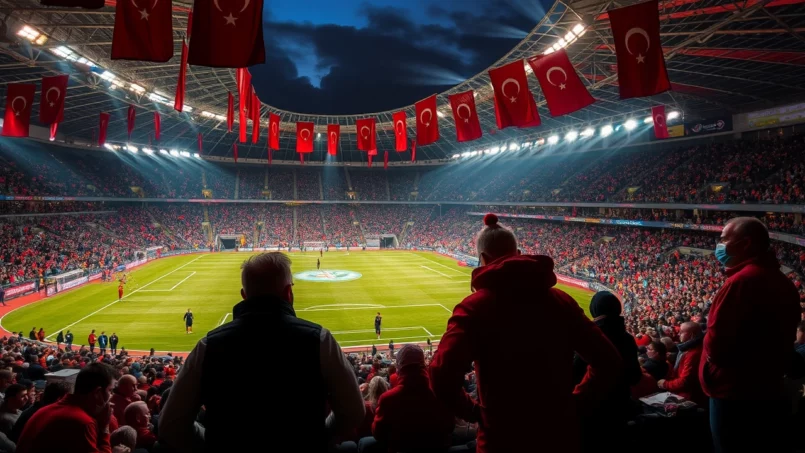
If there is one discipline that unites the entire country, it is football. Long practiced under the USSR, it remains the most popular sport today, both in stadiums and on the streets. The number of players is estimated at nearly 250,000, overseen by about 40 affiliated clubs and around thirty official referees.
The Football Federation of Turkmenistan, founded in 1992, has been affiliated with FIFA and the AFC since 1994. The national championship is structured around the Ýokary Liga (first division) and the Birinji Liga (second division). A youth championship, with specific rules on age and foreign players, complements the system to promote the emergence of local talent.
Some Data on Turkmen Football
| Element | Main Data |
|---|---|
| Football Status | Most popular sport in the country |
| National Federation | Created in 1992, FIFA/AFC member since 1994 |
| Top League | Ýokary Liga (since 1992) |
| Number of Clubs (Structure) | About 40 clubs, 820 players, 30 referees |
| Most Successful Club | Altyn Asyr (8 champion titles, 24 domestic trophies) |
| National Stadium | Saparmourat Turkmenbachi Olympic Stadium (45,000 seats) |
| Main “Home” Stadium | Köpetdag Stadium (26,503 seats, renovated in 2015) |
The championship remains dominated by a few big names, like Altyn Asyr, Köpetdag, or Arkadag, but practice is especially very widespread, from the capital to provincial towns. Grass or synthetic fields, multi‑purpose stadiums in the Olympic complex, corporate club facilities: there is no shortage of playing spaces.
The national team, nicknamed “The Green Men”, alternates between feats (AFC Challenge Cup finals, participation in the 2004 Asian Cup, good wins in qualifiers) and quieter periods, but remains followed fervently. For many young people, football remains the simplest gateway to regular sporting practice.
Weightlifting: A High‑Level National Sport
If wrestling is a national sport in the cultural sense, weightlifting almost is in the institutional sense. Turkmenistan quickly rose in the landscape of this discipline, to the point of hosting, in Ashgabat, the World Championships of the International Weightlifting Federation (IWF) in 2018. It was the first time the country hosted a world‑level competition of this kind, with nearly 800 athletes from about a hundred countries.
The 2018 World Championships in Ashgabat in Numbers
| Indicator | Estimated Value |
|---|---|
| Participating Athletes | ~800 |
| Countries Represented | ~100 |
| Staff (Coaches, Referees, etc.) | ~300 coaches, 45 referees and doctors |
| IWF Personnel, Media, Staff | ~1,500 accredited people (including 70 media) |
| Total Number of Medals | 201 (67 gold, 67 silver, 67 bronze) |
| Volunteers | ~500, primarily from universities |
Beyond the event, the entire sector was structured: national federation created in 2007, modern training center, close cooperation with the World Anti‑Doping Agency (WADA), talent identification from adolescence, and schooling‑training at the Ashgabat Olympic Center. The country counts nearly 300 registered licensed weightlifters, but many more actual practitioners.
Total number of medals won by the Turkmen delegation at the Durres Youth World Championships, including 6 gold.
For young Turkmen, weightlifting is becoming a credible path to excellence. The model to follow is clear: integration into the national program, daily training, adjusted studies at the Olympic Center, then access to regional, continental, and world competitions. From a practice standpoint, weightlifting gyms are developing in major cities, and some training centers are accessible to supervised amateurs.
Martial Arts and Combat Sports: A Hub of Practitioners
The organization of the AIMAG highlighted the extent of Turkmen people’s taste for martial arts and combat sports. Of the 21 sports in the program, a large portion concerned these disciplines: taekwondo (WTF), kick‑boxing, muay‑thai, sambo, kurash, jiu‑jitsu, as well as different forms of wrestling (Greco‑Roman, belt, goresh). The country even invited renowned foreign coaches to structure high‑level training.
Estimated total number of regular practitioners of martial arts, wrestling, and boxing in the region.
International successes exist: a Turkmen taekwondo school stands out with dozens of medals in international tournaments, karatekas set records, wrestlers accumulate titles and podiums at regional competitions. The state encourages this dynamic, notably through the “Turkmenistan‑Sport” TV channel and national tournaments that serve as showcases.
For the average practitioner, combat gyms are numerous in the residential neighborhoods of major cities, often integrated into multi‑sports complexes or cultural centers. One can practice Olympic taekwondo as well as wushu, karate, or amateur boxing.
Major Olympic Disciplines: Athletics, Swimming, Basketball, Volleyball…
Beyond this structural trio (wrestling, equestrian, weightlifting), one finds in Turkmenistan a very broad base of classic sports, each with its community of practitioners.
Athletics, introduced to the country as early as the 1920s, mobilizes at least 150,000 enthusiasts, from the simple park runner to competitors. Indoor events, revived during Ashgabat 2017, earned the country its first continental medal in athletics at those Games, thanks to the women’s 4 x 400 m relay.
Volleyball brings together nearly 75,000 practitioners in Turkmenistan, benefiting from the appeal of international competitions.
Swimming benefits directly from the infrastructure of the Ashgabat Olympic Complex, which houses the world’s largest indoor swimming pool according to Guinness World Records. Making year‑round training possible, even in a country with a strong desert component.
Finally, disciplines like gymnastics (20,000 estimated practitioners), tennis (supported by a junior festival organized with UNICEF), table tennis (15,000 players), or cycling are gradually gaining ground, driven by a very strong national discourse on health and physical activity.
Fitness and Gyms: An Emerging Market
Unlike very entrenched traditional sports, the culture of indoor fitness is only in its infancy in Turkmenistan. The fitness sector is progressing rapidly on a Central Asian scale, but the country still only represents about 3% of the total quality club space in the region.
In Ashgabat, there are 17 “good quality” gyms for about 728,000 inhabitants, barely 10 m² of fitness space per 1,000 people, which is the lowest level among major Central Asian cities. The clubs are roughly divided between “Business” tier (54% of space) and “Economy” tier (46%), with no true “Premium” offer at this stage.
The Fitness Market in Ashgabat (Estimate)
| Indicator | Approximate Value |
|---|---|
| Number of “Quality” Clubs | 17 |
| Total Space | 10,224 m² |
| Business‑class Share | 54% |
| Economy‑class Share | 46% |
| Integrated Pools | 0% of surveyed clubs |
| Martial Arts / Spa Areas | 0% (saunas, hammams, spas virtually absent) |
| Clubs with Fitness Bar | ~71% |
| Clubs with Group Classes | ~41% |
Prices, meanwhile, reflect a still limited market: the average monthly membership fee is around 174 dollars, with about 105 dollars for an entry‑level club and nearly 243 dollars for a “Business” club. Amounts significantly higher than in cities of neighboring countries like Kazakhstan or Uzbekistan, while the median income level in the region is around 480 dollars. Another sign of a market under construction: the low digital presence of clubs, very few are active on social media and most do not have their own website.
Number of gyms planned for Turkmenistan in 2025, an increase of over 13% in two years.
For residents, this still limited offer is compensated by the presence of gyms in major hotels, corporate clubs, and university complexes. For visitors, facilities like Ashgabat Fitness Club, Kopetdag Fitness Club, some hotel or diplomatic residence spa‑fitness centers offer memberships or temporary access, sometimes at more moderate rates than the national average.
Cycling: From Urban Rides to Record‑Setting Demonstrations
Cycling is another example of a discipline promoted by the top levels of the state. A presidential resolution aimed to modernize cycling infrastructure and massively encourage practice. The initiative even led to international recognition: at Turkmenistan’s proposal, the UN General Assembly proclaimed June 3 as “World Bicycle Day.”
Number of participants in a cycling training session at Ashgabat’s multi‑functional stadium on June 1, 2018.
Beyond the symbol, a modern indoor velodrome hosts track cycling competitions, integrated into the AIMAG program. Bike lanes and adapted roads also allow for recreational practice, particularly on days dedicated to health or ecology.
For enthusiasts, cycling practice therefore oscillates between leisure (rides, family outings, urban commuting) and participation in highly publicized mass events.
Winter Sports: A Curiosity in the Heart of the Desert
Turkmenistan has never participated in the Winter Olympic Games, yet it has embarked on developing ice sports. A winter sports complex in Ashgabat, a “Galkan” center, and a multi‑functional complex in the Avaza tourist zone house ice rinks and infrastructure for hockey, figure skating, and short‑track.
The national team won a tournament at the 2017 Asian Winter Games in Sapporo, qualifying it for the next edition. National championships are now regularly organized, indicating a growing community of players. However, this expansion remains limited by the high cost and technical requirements of the necessary facilities.
For a resident of Ashgabat, it is now possible to learn to skate, practice hockey, or even take figure skating lessons — a proposition unthinkable just a few decades ago in this desert country.
Major Events as Drivers of Practice
Whether it is the AIMAG, the Weightlifting World Championships, the “Amul‑Khazar” rally, or windsurfing competitions in Avaza, Turkmenistan relies heavily on international events to popularize sports among its population. Each time, the same pattern is set in motion: major infrastructure works, communication campaigns, structured student volunteer programs, training of judges, doctors, coaches, and officials, then capitalizing on the competition’s legacy.
The AIMAG volunteers, primarily students, illustrate the positive spillover effects of major events. Trained in hospitality, languages, and sports organization, they gained practical experience. Concrete benefits include better mastery of foreign languages, acquisition of new skills, and inspiration to engage in sports practice.
This strategy is found at all levels. Youth policy, laws on volunteering, and close cooperation with UN agencies are intertwined in a broader narrative: sport as a tool for peace, cultural dialogue, and sustainable development.
Active Tourism: When Travel Becomes Sport
Alongside organized and regulated sport, Turkmenistan also bets on adventure tourism where sporting practice is at the heart of the experience. The country touts its hikes in gorges and canyons (Yangykala, Kopetdag, Koytendag), its treks in the Karakum Desert, its camps under the stars near the Darvaza gas crater, its swims in sulfurous underground lakes like Kow‑Ata or Kainar Baba, or its tours combining horseback riding, hiking, and exploration of archaeological sites.
Specialized agencies offer tours combining several physical activities like walking, ridge climbing, horseback riding, swimming, and sometimes mountain biking or 4×4 on sandy trails. The goal is to discover the country in motion and use physical effort as a means to access its extreme landscapes.
For the traveler, this means that a visit will almost always combine a cultural dimension (ancient sites like Merv, Nisa, Kunya‑Urgench) and a sporting dimension (hiking, overnight camping, horseback rides, swimming in a cave‑lake). A way to further anchor the image of Turkmenistan as the “Land of Health and High Spirit.”
What This Means for a Daily Practitioner
Beyond the big numbers and spectacular events, what does this bustle mean for someone living or staying in Turkmenistan who wants to practice a sport?
For a Turkmen, the range of possibilities is broader than ever: football fields, wrestling mats, martial arts halls, multi‑sports complexes in regional capitals, hippodromes, basketball and volleyball clubs, modern pools in Ashgabat, recent weight rooms. In schools and universities, sports activities are encouraged, often with a very competitive dimension at the local or regional level.
For foreigners, access to some public facilities may be reserved for nationals and travel is regulated, sometimes requiring the use of agencies for border areas. However, the offer remains varied: fitness in major hotels, private clubs by subscription, horseback riding, hiking, swimming at Caspian tourist centers, and guided desert or mountain treks.
The main limitation lies in the cost of certain modern practices (indoor fitness notably) and the relative scarcity of information online. Many clubs do not have websites or social media presence, and it remains common to need to go through local contacts, public structures, or hotels to identify the right places.
A Sporting Mosaic Between Tradition and Modernity
From the wrestling mat set up for a village festival to the ultra‑modern stadiums of the Ashgabat Olympic Complex, Turkmenistan today offers an astonishingly broad spectrum of sports to practice. Some are deeply rooted — goresh wrestling, Akhal‑Teke horseback riding — perpetuating a centuries‑old warrior and pastoral culture. Others are resolutely contemporary: indoor fitness, ice hockey, racket sports, modern Olympic disciplines.
In between, a whole range of team and individual sports, from martial arts to cycling, including weightlifting, serves as a bridge between tradition and modernity. The guiding principle remains the same: making sport a lever for public health, international prestige, and social cohesion.
For those seeking a country where one can wrestle on a mat at a festival as much as attend a world‑class weightlifting competition, gallop on an Akhal‑Teke in a canyon, or play basketball in a brand‑new hall, Turkmenistan now stands out as a playing field as surprising as it is varied.
Disclaimer: The information provided on this website is for informational purposes only and does not constitute financial, legal, or professional advice. We encourage you to consult qualified experts before making any investment, real estate, or expatriation decisions. Although we strive to maintain up-to-date and accurate information, we do not guarantee the completeness, accuracy, or timeliness of the proposed content. As investment and expatriation involve risks, we disclaim any liability for potential losses or damages arising from the use of this site. Your use of this site confirms your acceptance of these terms and your understanding of the associated risks.

Cyril Jarnias is an independent expert in international wealth management with over 20 years of experience. As an expatriate himself, he is dedicated to helping individuals and business leaders build, protect, and pass on their wealth with complete peace of mind.
On his website, cyriljarnias.com, he shares his expertise on international real estate, offshore company formation, and expatriation.
Thanks to his expertise, he offers sound advice to optimize his clients' wealth management. Cyril Jarnias is also recognized for his appearances in many prestigious media outlets such as BFM Business, les Français de l’étranger, Le Figaro, Les Echos, and Mieux vivre votre argent, where he shares his knowledge and know-how in wealth management.





