
 Published on and written by Cyril Jarnias
Moving to Turkmenistan means entering a world where national identity, tribal heritage, Islam, and a highly centralized state intertwine. For an expatriate, understanding this religious landscape—simultaneously very Muslim, officially secular, and tightly controlled by the authorities—is essential to avoid missteps, build relationships, and correctly interpret what lies behind everyday gestures.
This guide provides a practical overview of local religious practices, their political framework, and daily behaviors to adopt. Its goal is not spiritual or proselytizing; it simply aims to help you live in harmony with your environment.
Religious Panorama of Turkmenistan
Turkmenistan is officially a secular state, but the society remains overwhelmingly Muslim and very conservative in terms of values. To gauge the importance of religion in the local landscape, a few statistical benchmarks help provide context.
A Clear Sunni Majority
Various estimates converge on a simple reality: Islam, in its Sunni version, holds an overwhelming majority in the country. The percentages vary across surveys, but all paint the same picture.
| Indicator / Source | Share of Muslims | Share of Christians (incl. Orthodox) | Other Religions |
|---|---|---|---|
| U.S. Estimate 2022 (Scenario 1) | 89% (mostly Sunni) | 9% Orthodox | 2% other |
| U.S. Estimate 2022 (Scenario 2) | 93% Muslims | 6.4% Orthodox | 0.6% other |
| Report 2020 (other source) | 95.8% Muslims | 6.4% Christians | – |
The vast majority of Turkmen define themselves as Sunni Muslims, sometimes without rigorous practice, but with a strong identity-based attachment. For an expatriate, this means that many social, family, and celebratory customs are rooted in an Islamic framework, even though the state proclaims itself secular.
Religious Minorities and Subtle Diversity
Christianity constitutes the second major religious family. It is mainly represented by the Russian Orthodox Church, around which most Russians, Armenians, and some ethnic Poles or Germans living in the country gather. There are twelve Orthodox churches, four of them in Ashgabat, led by an archpriest based in the capital.
This is the estimated number of people of Jewish faith living in Afghanistan.
A “Turkmen” Islam Between Tradition, Sufism, and Nomadic Heritage
To grasp the religious atmosphere, it is useful to understand that Islam in Turkmenistan is not a copy of Middle Eastern models. Historically, the faith spread through Sufi masters, who became protective figures for clans and tribes. From this emerged a fabric of beliefs blending:
This illustration groups several elements characteristic of the region’s beliefs and customs. It includes the veneration of ancestors and local saints, life cycle rituals (such as birth, marriage, and funerals) which possess strong symbolic content, as well as practices stemming from pre-Islamic Turkic beliefs. These latter manifest, for example, in offerings to trees, incantations to ward off wolves, or rituals related to fertility.
The institution of övlat – so-called “holy” tribes considered blessed ancestral lineages – is an emblematic example of this. This syncretism still permeates rural life, even though its most visible forms have sometimes been marginalized by modernity and state surveillance.
For an expatriate, this means that certain gestures – visiting mausoleums, stories of miracles associated with local saints, extreme respect for certain elders – carry implicit religious significance, even if they don’t necessarily resemble “classic” Islamic practices.
A Secular State… But Ultra-Controlling
On paper, the Constitution guarantees freedom of religion, affirms the separation of state and religious institutions, and proclaims the country’s secular character. In practice, the system relies on tight control of anything related to religion.
A Very Restrictive Legal Framework
At the heart of this apparatus is the Law on Freedom of Conscience and Religious Organizations, tightened in 2016. It imposes a mandatory registration regime on all communities of believers.
| Element of the Legal Framework | Content / Practical Consequence |
|---|---|
| Mandatory Registration | Every community must be registered with the Ministry of Justice to be authorized to operate. |
| Member Threshold | 50 adult citizens for a “religious organization”; between 5 and 50 for a “religious group” with more limited status. |
| Renewal | Periodic re-registration (approximately every three years) and upon any change of address or statutes. |
| Activities of Unregistered Groups | Illegal: any gathering, worship, dissemination of literature, or proselytism can lead to fines, searches, or even detention. |
| Places of Worship | Heavy urban planning oversight; worship in private homes is in principle prohibited, although some temporary exceptions exist for a few registered groups. |
| Religious Attire in Public | Prohibited for non-clergy, which limits the visible expression of certain affiliations. |
In practice, this places minorities and unrecognized movements in a highly vulnerable position. For an expatriate, it is important to be aware: participating in undeclared religious meetings, hosting organized worship activities at home by unregistered groups, or importing religious literature without authorization can, at best, raise questions, and at worst, be interpreted as an offense.
SCROEERIR and the Council for Religious Affairs: The Official “Filters”
The control apparatus relies on a specialized state commission, the SCROEERIR (State Commission for Religious Organizations and Expertise of Religious Information Resources), successor to the Council for Religious Affairs. This body:
The state supervises the appointment of Sunni and Orthodox religious leaders, controls the construction of mosques and churches, authorizes or refuses the import and circulation of all religious literature, and evaluates registration requests from religious groups.
Its composition, dominated by Sunni imams, the Orthodox representative, and government officials, leaves little room for minorities. Security forces (notably a specialized unit of the Ministry of the Interior) provide the executive arm for these decisions, with surveillance of many gatherings.
In Turkmenistan, religion is culturally very present but strictly controlled by the state. It is strongly advised not to openly criticize this system, whether in conversations with Turkmen colleagues or on any written, physical, or digital medium.
A State Promoting a National Islam
Paradoxically, while restricting religious freedom, the authorities stage a “national” Islam tightly controlled by the state. It funds monumental mosques (in Ashgabat, Gökdepe, Gypjak, including the famous Türkmenbaşy Ruhy Mosque), sponsors iftars during Ramadan or official pilgrimages to Mecca for a number of faithful well below the international quota.
During the Niyazov era, the personal book of the former president, the Ruhnama, was imposed in mosques and schools, sometimes placed on the same lectern as the Quran. Even though that period is over, it left its mark on how religion is used as a tool to legitimize power.
Ramadan, Holidays, and the Religious Calendar in Daily Life
Even in a country where practice can sometimes seem less visible than in some Middle Eastern societies, the Islamic calendar structures social life. For an expatriate, two aspects are particularly important: the month of Ramadan and the major holidays.
Living in Turkmenistan During Ramadan
Ramadan is the ninth month of the Islamic lunar calendar. Adult Muslims who are able fast between dawn and sunset: no food, no drink, no tobacco, nor behaviors considered morally reprehensible during the day. At night, the fast is broken by the iftar meal, preceded by a glass of water and often a few dates, according to a tradition shared across the Muslim world. Before dawn, those fasting take a light meal, suhoor.
In Turkmenistan, the authorities closely monitor Islam, but the population remains attached to this month of fasting and solidarity. Observance is generally less strict than in the Gulf or Afghanistan: not all restaurants are closed during the day, access to food and even alcohol remains possible, especially for foreigners and in more “official” places like certain hotels.
Nevertheless, a few unspoken rules apply to expatriates:
– Avoid eating, drinking, or smoking conspicuously on the street or at the office during the day, especially in the presence of observant colleagues
– Maintain even more modest attire than usual
– Accept any invitations to iftar gratefully, as it’s a privileged moment for building relationships.
Ramadan evenings often take on a more lively character: streets more active after sunset, family meals, visits. In some areas, community iftars may be organized in mosques or public structures, although state control limits large informal gatherings.
A particular tradition, *Gadyr gijesi* (Night of Destiny / Night of Forgiveness), considered a night of great spiritual value in the final days of the month, gives rise to more intense prayers and acts of sharing (distributing sweets, visiting neighbors).
Tradition of Gadyr gijesi
Eid al‑Fitr (Oraza Bayram) and Eid al‑Adha (Kurban Bayramy)
The two major Islamic holidays are recognized as national holidays. They are both religious events and key moments of social cohesion.
| Holiday | Local Name | Significance | Key Practices |
|---|---|---|---|
| Eid al‑Fitr | Oraza Bayram | End of the month of Ramadan | Collective prayer, family visits, festive meals, giving to the poor (Zakat al‑Fitr), gifts for children. |
| Eid al‑Adha | Kurban Bayramy | Commemoration of Abraham’s Sacrifice | Morning prayer, ritual sacrifice (sheep, goat, sometimes cattle), sharing meat with relatives and the needy. |
The exact dates, determined by the moon and confirmed by presidential decree for the civil calendar, vary each year. These are times when families gather, visit the graves of loved ones, prepare traditional dishes (plov, shashlik, samsa), and increase their generosity. For an expatriate, it is wise to expect professional activity to slow down significantly or even stop: it’s better to avoid scheduling important meetings on these dates and expect difficult access to government offices.
It is appreciated to offer best wishes to local colleagues and contacts, for example using simple phrases in Russian or Turkmen, or in English depending on the context, while remaining restrained and respectful.
Mosques and Prayer Practices: How to Behave as a Visitor
Mosques, in Turkmenistan as elsewhere, are both places of prayer and urban landmarks, especially the large mosques built by the state. Many people consider themselves believers without necessarily attending mosque regularly; for many, Islam is primarily a culture, a heritage.
What a Mosque Is and What You’ll Find There
Turkmen mosques incorporate the classic elements of Islamic architecture:
– A large prayer hall oriented towards Mecca, indicated by a niche called a mihrab
– Sometimes one or more minarets, from which the call to prayer (adhan) is broadcast
– A minbar (pulpit) from which the imam delivers the Friday sermon
– A dedicated area for ablutions (wudu), where the faithful wash their hands, face, and feet before prayer.
Some religious edifices transcend their primary function to embody political or identity projects, while still respecting the common rules of Muslim practice.
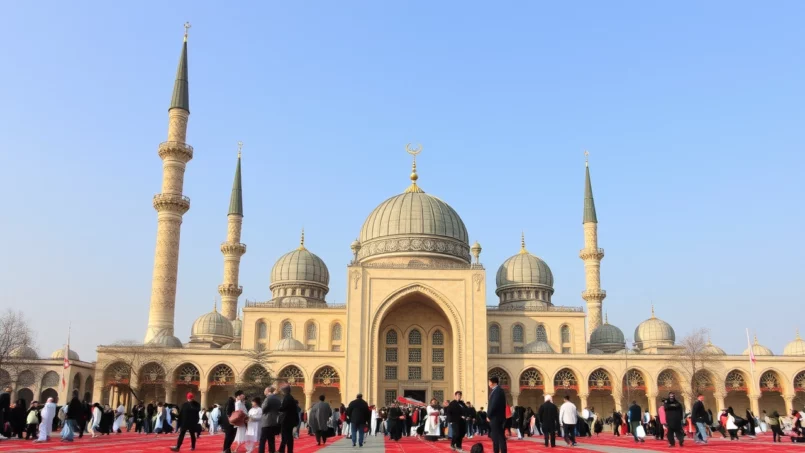
This gigantic mosque, located near Ashgabat, is a striking example of an edifice that embodies a political or identity project more than a simple place of worship.
Visiting these mosques remains subject to the rules of decency and respect common to the entire Muslim world.
Expected Dress Code and Attitude
Entering a mosque, even as a simple visitor, requires respecting an implicit but very clear code of conduct. The following principles apply almost everywhere in the country.
For men, it is expected:
– Legs covered (long pants rather than shorts)
– Shoulders covered (avoid tank tops, low-cut t-shirts)
– Modest, non-transparent clothing, without provocative slogans
– Removing shoes before entering the prayer hall (have clean socks ready).
For women, the norm is stricter:
– Arms and legs covered (long skirt or loose pants, long sleeves)
– Clothing loose, not tight-fitting or translucent
– Discreet neckline
– A scarf covering the hair in the prayer hall and, as a precaution, within the mosque grounds in general.
Children should follow the same rules of modesty adapted to their age. For everyone, a calm attitude is required: no loud conversations, phone on silent, slow movements, and respect for people praying by avoiding walking in front of them.
Visits, Photos, and Separation of Spaces
Many mosques practice strict gender separation: separate rooms for women, or a gallery on the upper floor or at the back of the main hall. A visitor must never try to enter the space reserved for the opposite sex, even just “to see what it looks like.”
Photography is a delicate point. As a general rule:
– It is advisable to ask for permission from a person in charge or staff before taking out a camera
– Absolutely avoid photographing worshippers in the midst of prayer without their explicit consent
– In some places, no photos are tolerated in the prayer hall.
By extension, this caution also applies to other sites with religious connotations (mausoleums, old cemeteries, local pilgrimage sites).
Culture, Religion, and Social Life: What an Expatriate Must Understand
In Turkmenistan, the line between the religious, cultural, and political is often blurred. To navigate this, one must accept the idea that seemingly “folkloric” or, conversely, very nationalistic gestures can have an implicit spiritual dimension.
Rites of Passage, Hospitality, and Respect for Elders
The family is the central nucleus of society. Many key moments (boys’ circumcision, weddings, funerals) are accompanied by prayers, references to God, and customs sometimes inherited from the nomadic or Sufi past. Elderly men, clan elders, representatives of “holy” tribes receive quasi-sacred respect; challenging their word in public, mocking them, or showing impatience can be seen as a far more serious insult than mere rudeness.
Hospitality is a core value, inherited from the Silk Road traditions of welcoming guests. Being invited is an honor. Systematically refusing tea or a meal, or eating without complimenting it, is seen as disrespectful and puts the host in an awkward position. Therefore, it is recommended to accept your host’s offers with gratitude.
– Remove your shoes upon entering a home
– Bring a small gift (pastries, fruit, flowers in odd numbers)
– Wait for the eldest or head of the household to start eating
– Taste everything, if possible, and praise the quality of the meal.
These gestures don’t all have religious value in the strict sense, but they are rooted in an imaginary where generosity and blessing go hand in hand.
Anthropologist or social science researcher
Discretion Regarding Politics and Religion
The Turkmen regime is extremely sensitive to issues of social control, and religion is part of this. Two red lines converge here: criticism of the state and religious discourse deemed “foreign” or “extremist.” For an expatriate, caution dictates avoiding:
– Critical conversations about the government, its leaders, or its surveillance system, especially in public or online
– Aggressive theological debates, evangelizing, or any initiative interpretable as proselytism
– Deprecating judgments about local customs (for example, labeling as “superstition” what your interlocutors consider a respected tradition).
Asking open questions, listening, showing sincere interest without trying to “correct” or “enlighten” others’ beliefs remains the best posture.
Religious Minorities and Sensitivity to Conversions
While Turkmen society has long been relatively tolerant of religious diversity, the situation for minorities and converts remains fragile in the current context.
Christian, Baha’i, Jewish, Hindu Communities…
Russian Orthodox and, to a lesser extent, Armenian Apostolic believers have more or less visible places of worship, notably in Ashgabat. Protestants, Adventists, Pentecostals, Baptists, Jehovah’s Witnesses, Baha’is, or Krishna devotees make up a much more discreet landscape, sometimes forced to operate “under the radar” to avoid trouble.
Although historically present, Judaism no longer has an official synagogue in Turkmenistan, the last one having been converted into a gymnasium in the Soviet era. Religious practices now take place in private spaces, without official recognition as a distinct religious community.
This discretion means that a foreign expatriate belonging to one of these religions must avoid confusing relative social tolerance with institutional freedom. Highly visibly displaying group religious activities, organizing missionary meetings at home, or distributing large quantities of literature can be interpreted as a direct challenge to the system.
Turkmen Converts: A Particularly Delicate Situation
The case of ethnic Turkmen who change their religion (particularly to little-known Protestant churches) is especially sensitive. These individuals are often seen as having broken with their national and family heritage. They may face:
– Ostracism or pressure from their entourage
– Professional difficulties
– Increased attention from the authorities.
For a believing expatriate, it is crucial to understand that actively encouraging a Turkmen to change their religion does not merely belong to the private sphere. Such action is likely to trigger serious social and legal problems, especially if it is interpreted as foreign missionary activity.
Ramadan, Working Hours, and Professional Life
Beyond the private sphere, the month of fasting and the major holidays influence the functioning of the workplace. Even though Turkmenistan doesn’t always follow the same models as Gulf countries, certain general trends observed in many Muslim states are found here.
During Ramadan, working days, especially in the civil service, are often shorter or more flexible, with intense activity in the morning tapering off in the afternoon. Colleagues’ concentration may vary due to later nights, additional prayers, and iftar preparations, generally leading to a drop in productivity.
To best manage this period in a professional context:
– Prioritize important meetings in the morning
– Avoid scheduling appointments around iftar time
– Forgo working lunches or “quick” coffee meetings
– Build some leeway into delivery or approval deadlines.
Offering a small Ramadan greeting, expressing understanding of the constraints of this period, and, if the opportunity arises, participating in a corporate iftar are generally greatly appreciated.
Rules of Conduct in Public Spaces: Modesty, Gestures, Photography
Whether concerning religious practices strictly speaking or social norms influenced by religion, certain behaviors are expected in public spaces.
Daily Dress Code
Turkmen society is conservative, particularly outside of Ashgabat. To avoid causing offense:
– Expatriate women are advised to cover shoulders and knees at a minimum, opting for long skirts or pants and non-revealing tops; keeping a scarf in your bag allows you to adapt quickly to the unexpected (mosque visit, more traditional village, official meeting)
– Men would do well to forgo shorts and tank tops in the city, choosing pants and shirts or t-shirts with sleeves.
This modesty in dress applies not only to religious sites but to daily life, transport, markets, public festivities.
Gestures and Interactions
Certain gestures, harmless elsewhere, can be poorly received:
In public, it is preferable to avoid overly intimate displays of affection like hugging or kissing, as they are generally frowned upon. To point at someone, it’s impolite to use your index finger; use your open hand instead. Also, avoid pointing the soles of your feet toward someone, especially an elder, as this gesture is considered disrespectful.
In greetings, handshakes are the norm between men, but with women, it’s better to wait for them to extend their hand. If they don’t, a slight nod, accompanied by a smile, is sufficient.
Photography: Between Curiosity and Red Lines
Photography is a minefield in Turkmenistan, more for political than religious reasons, but with important implications for worship practices.
It is strictly prohibited to photograph:
Buildings considered strategic, such as the presidential palace, ministries, airports, and military or police installations, as well as guards and security forces on duty, constitute specific points of interest.
Before taking out a camera or smartphone in front of an official site, it’s best to check for a visible prohibition sign or discreetly ask an agent on site. In religious spaces, other precautions apply:
– Always ask permission before photographing people, especially while praying, mourning, or in an intimate context
– Avoid taking pictures during an ongoing ceremony (wedding, funeral, collective prayers)
– Respect any signs prohibiting photos in certain areas of a mosque, mausoleum, or cemetery.
A discreet telephoto lens, used in moderation, can sometimes capture the atmosphere without disturbing or exposing identifiable individuals.
Food, Halal, and Daily Practices
Even though the report doesn’t specifically detail halal offerings in Turkmenistan, unlike Kazakhstan, the fact that over 90% of the population identifies as Muslim implies that dietary habits largely conform to classic rules: no pork, wariness of alcohol, ritual slaughter for meat.
A Muslim expatriate will naturally find dishes compatible with their lifestyle, such as plov, shashlik, lagman, manti, or samsa. While alcoholic beverages exist, their public consumption remains relatively contained. During Ramadan, this consumption may shift more to the evening.
Non-Muslim expatriates, for their part, would do well to adjust certain habits:
– Avoid systematically offering alcohol during meetings with Turkmen colleagues, unless you know they are open to it
– Do not insist when an interlocutor refuses a drink or dish for religious reasons
– Inquire discreetly before bringing a food gift (some products containing pork, non-halal gelatin, or alcohol can cause discomfort).
Interfaith, Neutrality, and International Image
Turkmenistan likes to present itself as a neutral country, a promoter of peace and dialogue. Its permanent neutrality is recognized by the UN, and the capital periodically hosts international conferences, including on themes of youth and interreligious dialogue.
Despite an official discourse advocating tolerance and coexistence, the country scores very low on international assessments of religious freedom. It is considered one of the most difficult states for some believers, like Christians from minority groups, who live in daily fear of checks or sanctions.
For an expatriate, the point is not to resolve this paradox but to be aware of it, in order to understand why some interlocutors become very cautious when it comes to talking about religion or politics, even in seemingly informal circles.
In Summary: Adopt a Posture of Informed Respect
Living in Turkmenistan as an expatriate means navigating an environment where:
– The vast majority of residents identify as Sunni Muslims, even if levels of practice vary
– Local Islam remains marked by Sufi history and Turkic-nomadic traditions
– The state closely controls all religious expressions, especially those perceived as “imported”
– Minorities exist but operate within a restrictive legal and social framework.
In this context, a few simple reflexes allow for adaptation:
For a harmonious stay, it is advisable to find out in advance about Ramadan, the dates of major religious holidays and their impact on social and professional life. Adopt modest attire, especially in places of worship and rural areas. Scrupulously respect codes of conduct in mosques, private homes, and during ceremonies. Avoid all proselytism and maintain absolute discretion regarding your political views or criticisms. Finally, always ask for explicit permission before photographing people or rituals.
With this framework, Turkmenistan ceases to be a “closed country” seen only through the prism of its political regime and reveals a society where hospitality, identity pride, and a deeply rooted Islam coexist with a hyper-present state. Integrating tactfully means accepting to enter this balancing act, making knowledge of local religious practices a genuine tool for understanding the country.
Disclaimer: The information provided on this website is for informational purposes only and does not constitute financial, legal, or professional advice. We encourage you to consult qualified experts before making any investment, real estate, or expatriation decisions. Although we strive to maintain up-to-date and accurate information, we do not guarantee the completeness, accuracy, or timeliness of the proposed content. As investment and expatriation involve risks, we disclaim any liability for potential losses or damages arising from the use of this site. Your use of this site confirms your acceptance of these terms and your understanding of the associated risks.

Cyril Jarnias is an independent expert in international wealth management with over 20 years of experience. As an expatriate himself, he is dedicated to helping individuals and business leaders build, protect, and pass on their wealth with complete peace of mind.
On his website, cyriljarnias.com, he shares his expertise on international real estate, offshore company formation, and expatriation.
Thanks to his expertise, he offers sound advice to optimize his clients' wealth management. Cyril Jarnias is also recognized for his appearances in many prestigious media outlets such as BFM Business, les Français de l’étranger, Le Figaro, Les Echos, and Mieux vivre votre argent, where he shares his knowledge and know-how in wealth management.





