
 Published on and written by Cyril Jarnias
Traveling to Antigua and Barbuda without renting a car is entirely possible, provided you understand how the local transport system works. Between private minibuses, ferries, regulated taxis, and connections to Barbuda, the archipelago offers a dense but sometimes confusing network for a visitor. This practical guide gathers the essential information for using public transportation in Antigua and Barbuda, clearly explaining the options, costs, key routes, and system limitations.
Understanding the Transportation Context in Antigua and Barbuda
Antigua and Barbuda consists of two main islands: Antigua, the more populous one, well-connected by road, and Barbuda, smaller, wilder, and with far less infrastructure. Antigua’s roads are fully paved, winding but generally in good condition, with a maximum speed of 40 mph (about 65 km/h) and driving on the left. They connect parishes, villages, and communities, and signage is present on main arteries.
Saint John’s is the nerve center of the transport network, concentrating most bus departures and arrivals, the main cruise port (Heritage Quay, Deepwater Harbour), and V.C. Bird International Airport. However, sidewalks are scarce outside the city center, making walking along roads often uncomfortable.
The transportation system is hybrid: buses are operated by private owners under the supervision of the transport authority, taxis are strictly regulated by the government with official fares, and sea and air connections between Antigua and Barbuda are provided by a few specialized companies. License plates serve as a useful visual cue: “BUS” for public transport minibuses, “TX” for taxis, all on a yellow background.
Public Buses in Antigua: The Affordable Backbone of the Network
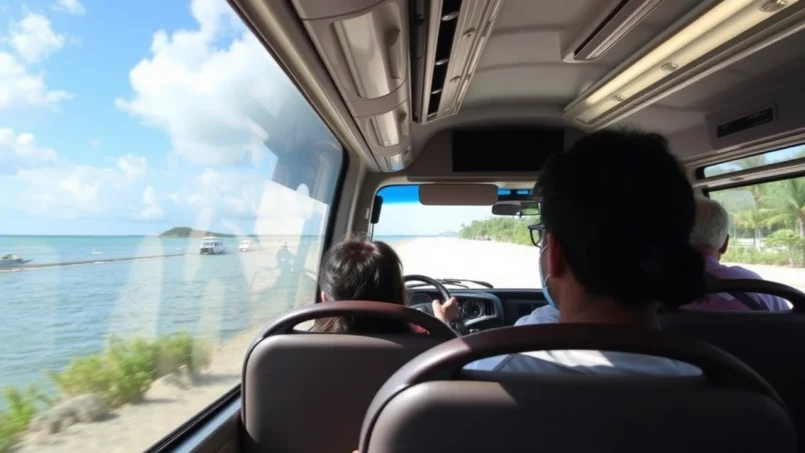
In Antigua, public transport relies mainly on private minibuses that function as public buses. These are typically white or silver vans, with about 12 to 15 seats, bearing yellow plates marked “BUS”. They run on set routes, identified by a number displayed on the windshield (often a small disc stuck on the right side).
The principle is simple: a very extensive network, very low prices, but a flexible, almost informal organization. Buses mostly run from 5:30 AM to 6:00-7:00 PM, with a sharp drop in frequency after nightfall and little to no service after 7:30 PM. They connect Saint John’s to almost all villages in Antigua, as well as several renowned beaches, but they do not serve the airport or the main tourist area in the north directly (except for a particular line crossing the area).
The buses are particularly popular with locals: it’s the economical option par excellence, ideal for a visitor with time and a tight budget, less suitable for those with a tight schedule or time constraints.
The Two Main Bus Terminals in Saint John’s
The network is organized around two distinct terminals in Saint John’s, each covering a sector of the island. This often means going through the capital to change direction.
| Bus Station | Approximate Location | Main Areas Served |
|---|---|---|
| West Bus Station | Market Street, near the central market | West coast, south of the island, center (Jolly Harbour, English Harbour, Old Road…) |
| East Bus Station | Independence Avenue, near the Botanical Garden | Northeast coast, villages of Saint Philip, Willikies area, Bethesda, Freetown… |
The West Bus Station is the one most frequented by visitors, as it’s where buses depart for English Harbour, Nelson’s Dockyard, Jolly Harbour, and several southwest beaches. It is located a few minutes’ walk from the cruise port, across the market.
The East Bus Station, located on Independence Avenue, mainly serves villages in the east and northeast of Antigua, as well as the Willikies area and the vicinity of the airport via certain bus lines.
How to Take the Bus in Practice
On paper, each line has a typical route, but there is no strict posted schedule. In reality, buses leave the station when they are sufficiently full, meaning that on very busy routes, the wait is short (5 to 15 minutes), while on less demanded trips, you may have to wait longer.
In town, official stops are marked by red and white signs reading “No parking – Bus Stop”. But in practice, the system functions more like a shared taxi service: you simply stand by the roadside, signal the bus (a hand gesture is enough), and check with the driver for the destination. To get off, you simply call out “Bus Stop!” for the driver to stop at the desired point along the route.
Payment is exclusively in cash, in Eastern Caribbean dollars (XCD). The fares, regulated by the Transport Authority, are very affordable. For a trip starting from Saint John’s, the driver asks for the destination and collects the fare before departure. For a return trip to Saint John’s, payment is usually made upon disembarking. Change is given for reasonable amounts. A night surcharge (about 1.75 times the normal fare) applies between 10:00 PM and 5:00 AM, although most lines have very little traffic during this period.
Fares and Example Bus Trips
Prices vary by distance but remain modest on the scale of a tourist stay. Here are some examples of typical connections, in Eastern Caribbean dollars (XCD):
| Public Bus Route | Approximate Fare (XCD) | Comment |
|---|---|---|
| Saint John’s – English Harbour | 3.75 XCD | Line 17, very frequent |
| Saint John’s – Jolly Harbour | 2.75 XCD | Lines 20 or 22 |
| Saint John’s – Dickenson Bay | 2.25 XCD | Line 50 |
| Saint John’s – Willikies | 3.25 XCD | Line 33 |
| Saint John’s – Darkwood Beach | 3.00 XCD | Line 22 |
| Saint John’s – Airport Road | 2.25 XCD | Via certain lines including 42 |
To get an overview, an unofficial website, busstopanu.com, provides maps, example routes, and fare indications. The Moovit app also lists bus lines and stops, useful for navigating on the ground.
Major Lines to Know
Certain lines are constantly mentioned when talking about tourist travel in Antigua. They generally depart from the West Bus Station.
| Line Number | Main Route (Simplified) | Approximate Travel Time |
|---|---|---|
| 17 | Saint John’s – All Saints – Liberta – Falmouth – Cobbs Cross – English Harbour / Nelson’s Dockyard | 35 to 60 minutes depending on traffic |
| 20 | Saint John’s – Golden Grove – Ebenezer – Jennings – Bolans – Jolly Harbour | 30 to 40 minutes |
| 22 | Saint John’s – Golden Grove – Jennings – Bolans – Crabbs Hill – Johnsons Point – Urlings – Old Road | 40 to 60 minutes |
| 33 | Saint John’s – direction Willikies (Saint Philip) | About 1 hour 15 minutes |
| 42 | Saint John’s (West Bus Station) – downtown – East Bus Station – Airport Road – Coolidge – Free Trade Zone | About 45 minutes between airport and downtown |
| 50 | Saint John’s – Dickenson Bay Street – Villa – Yorks – Dickenson Bay | 15 to 25 minutes |
| 54 | Saint John’s – Friars Hill Road – Woods Mall | Short trip to commercial area |
Line 17 is particularly strategic: it serves English Harbour and has Nelson’s Dockyard, a UNESCO World Heritage site, as its terminus. It departs from the West Bus Station and functions like a classic minivan, with vehicles often waiting to fill up before leaving.
Lines 20 and 22 serve the busy Jolly Harbour area and, beyond that, the southwest beaches (Darkwood Beach, Turners Beach, Morris Bay…) for line 22. Together, they can reach a combined frequency of five to six buses per hour.
Line 50 allows access to Dickenson Bay, a major beach in the northwest, with an average of two to three trips per hour.
Accessing Beaches and Tourist Sites by Bus
For a traveler wanting to explore without a car, the bus is an effective solution for several iconic beaches. The key is to know how close the bus actually gets you to the sand.
| Beach / Site | Bus Line(s) | Walking Distance from Stop |
|---|---|---|
| Darkwood Beach | 22 | About 100 m, beach close to the road |
| Turners Beach | 22 | About 100 m |
| Morris Bay | 22 | About 100 m |
| Jolly Beach (Jolly Harbour) | 20 or 22 | About 1 km from the main intersection |
| Pigeon Point Beach | 17 (to English Harbour) | About 1 km walk from the village |
| Windward Beach | 17 (English Harbour) | About 1 km walk |
| Dickenson Bay | 50 | Stop nearby, short walk depending on location |
| Runaway Bay | 50 or other northwest bus | Variable access, irregular service |
In practice, to get from Jolly Harbour to Nelson’s Dockyard, you often need to combine two buses: first a line 20 to Valley Road, then line 17 to English Harbour and the dockyard. The entire journey remains very economical (about 3 USD) but can take over an hour and a half depending on connections.
Safety, Accessibility, and Bus Limitations
Antigua’s minibuses are generally considered safe during the day. The atmosphere is often lively, with music and a very local vibe. Nevertheless, several points deserve emphasis:
Bus service becomes scarce after nightfall and some sections are poorly lit, making late travel inadvisable. Most vehicles are not wheelchair accessible due to access via narrow steps. Schedules are not guaranteed, which can compromise a timely return for a cruise ship or flight. Finally, some tourist areas in the north and the airport are poorly served by the classic network, although line 42 connects Airport Road to the downtown area.
To more easily follow routes and anticipate connections, the Moovit app and busstopanu.com website can serve as near real-time or supplementary information sources.
Taxis: The Flexible, Regulated Alternative
When the bus isn’t running, when traveling in a group, carrying luggage, or returning after sunset, taxis become the most convenient solution. In Antigua, they are omnipresent: at the airport, in front of major hotels, near popular beaches, at the Heritage Quay and Redcliffe Quay cruise terminals, and in downtown Saint John’s.
Taxis are identified by their yellow plates marked “TX”. They do not have meters, but their fares are set by the government, which publishes an official price list for major routes. This list should be displayed or available on board, and fares are indicated in both Eastern Caribbean dollars (EC$) and US dollars (US$).
How They Work and Negotiation
Fares are flat rates per vehicle for a one-way trip (transfer rate), typically for 1 to 4 passengers. Beyond four people, a surcharge is applied, often around 25% or as a fixed additional amount per passenger. There are also hourly rates for customized tours (about 24 USD or 64 XCD per hour for bookings of at least two hours), as well as waiting fees of 5 USD / 12 XCD per half hour.
Fares from the airport or the deep-water port in Saint John’s are generally 2 to 4 USD higher than from other points on the island. Payment is made in cash, in Eastern Caribbean dollars (EC$) or US dollars (US$), and it is imperative to agree on the price before departure. For a beach trip, it is recommended to negotiate a round-trip fare that includes driver waiting time, rather than relying on the random availability of a taxi for the return.
Example Taxi Fares
Here are some typical routes with price ranges from recent data (indicative fares for 1–4 people):
| Taxi Route | Approximate Fare (USD / XCD) |
|---|---|
| Saint John’s – Jolly Harbour | ~20 USD / 54 XCD |
| Saint John’s – English Harbour / Nelson’s Dockyard | ~25 USD / 67 XCD |
| Saint John’s – Long Bay | ~27 USD / 72 XCD |
| Saint John’s – Dickenson Bay | ~13 USD / 35 XCD |
| V.C. Bird Airport – Saint John’s | ~7 USD (older schedule, varies by source) |
| Airport – Nelson’s Dockyard or Shirley Heights | ~21 USD (older schedule) |
| English Harbour – Half Moon Bay | 15 USD / 40 XCD |
| English Harbour – Galleon Beach | 7 USD / 18 XCD |
| English Harbour – Jolly Harbour | 25 USD / 67 XCD |
Some cruise guides mention higher fares for identical trips (e.g., 40–50 USD between Saint John’s and Nelson’s Dockyard). The difference is often explained by the inclusion of waiting time, photo stops, or tourist detours. In general, it’s always best to confirm if the price is for a one-way trip, a round trip, or a tour with multiple stops.
Maximum number of people covered by ‘beach round-trip’ fares to estimate the budget.
| Beach Destination (from main tourist area) | Estimated Round-Trip Price (USD) |
|---|---|
| Galley Bay, Hawksbill, Deep Bay, Runaway Beach, Fort James Beach | ~40 USD |
| Ffryes Bay, Darkwood Beach, Turners Beach, Valley Church, Crab Hill Beach | ~80 USD |
| Carlisle Bay Beach, Pigeon Point Beach | ~92 USD |
| Long Bay Beach | ~96 USD |
| Half Moon Bay Beach | ~176 USD |
Many taxi drivers also serve as guides: they offer island tours including Nelson’s Dockyard, Shirley Heights, southwest beaches, or viewpoints like Fort James. Agencies such as Lawrence of Antigua, Scenic Tours Antigua, or Barry Taxi & Tours combine transfers and tourist commentary, with possible pickup at the cruise port or hotel.
Taxis and Accessibility
Adapted taxis with ramps or wheelchair lifts exist in Antigua, but they must be booked in advance and sometimes incur a slight extra cost. Operators like Barry Taxi & Tours explicitly state they can provide accessible vehicles. For travelers with reduced mobility, booking several days or even weeks ahead remains the best strategy.
International ride-hailing platforms (Uber, Lyft) are not available in Antigua and Barbuda, although some local services have launched their own booking apps or pre-order systems like Welcome Pickups for airport transfers.
Between Antigua and Barbuda: Ferries and Small Planes
Getting from the main island to Barbuda involves crossing about 55 km of sea. Two main families of solutions exist: the ferry and planes (or helicopters).
Ferries Between Antigua and Barbuda
Two ferry companies provide regular connections between Saint John’s and Barbuda: Barbuda Express and Island Escape Ferry. Both use a dedicated dock in the large Deepwater Harbour port in Saint John’s. In Barbuda, ships dock in a port in the south of the island, about 6 km from Codrington, the only town.
| Company | Travel Time | Frequency | One-Way Fare (USD / XCD) | Round-Trip Fare (USD / XCD) |
|---|---|---|---|---|
| Barbuda Express | ~1 h 30 | 1 crossing per day (6 days/week depending on season) | 55 USD / 150 XCD | 100 USD / 270 XCD |
| Island Escape Ferry | ~1 h 30 | Regular service, 5 days/week | 50 USD / 135 XCD | 90 USD / 240 XCD |
Barbuda Express operates a wave-piercing catamaran and two monohulls (Typhoon Express and Leeward Express) capable of carrying both passengers and freight. The service runs one to six days a week depending on sources and seasons, with typical schedules: departure from Saint John’s in the morning (sometimes 6:30 AM) and return in the afternoon around 3:00 or 3:45 PM, with some variations (e.g., noon departure on Sunday). Detailed schedules are published on the company’s official website.
Discover the services and amenities offered onboard our ferry for a pleasant crossing.
Vessel with a stated capacity of 150 passengers.
Air-conditioned main cabin for maximum traveler comfort.
Access to an upper deck to enjoy the view in the open air.
Beverage and snack service available onboard.
Tickets can be purchased at the dock in Saint John’s or in shops in Codrington (e.g., Nedd’s Grocery), and booking is strongly advised on Fridays, Saturdays, and holidays. During busy periods, the company may close boarding up to one hour before the theoretical departure time when the boat is full. Platforms like Ferryhopper facilitate schedule searches and booking modifications for certain companies.
The journey takes about 90 minutes under normal conditions. However, the sea can be rough, with a risk of seasickness for sensitive individuals. Captains closely monitor the weather and do not hesitate to delay or cancel a departure when conditions become unfavorable.
Barbuda Express offers full-day excursions including the sea crossing, a visit to the Frigate Bird Sanctuary and historic caves, a local cuisine lunch, and free time for swimming on the famous pink sand beaches. The price for this day trip is approximately 174 USD per person.
Flights Between Antigua and Barbuda
For those wanting to save time or avoid the swell, small planes connect Antigua to Barbuda in about twenty minutes. The company BMN Airways operates this route with propeller planes seating about eight people, departing from the old international terminal at V.C. Bird Airport. Barbuda’s airport is in the center of Codrington, avoiding a road transfer from the port.
Flights are offered at least once daily in the low season and two to three times daily in the peak winter season. Prices are fixed, independent of the purchase date: 81 USD for a one-way trip, 162 USD for a round trip. Given the limited number of seats, it is recommended to book at least a month in advance on the dedicated online platform.
More exclusive alternatives exist, such as helicopter transfers operated by Calvinair in about fifteen minutes, or charter flights provided by FlyMontserrat for groups of up to nine people.
Getting Around Barbuda: Almost Everything by Reservation
Unlike Antigua, Barbuda has no official bus network nor international car rental companies. Automobile traffic is very limited, with paved roads essentially limited to a single main axis connecting the southern port to Codrington, with many potholes. Other roads are often dirt or in poor condition.
A few vehicles and bicycles can be rented, but this requires prior organization, often by phone, with local operators listed on barbudaful.net/visiting. There is no official taxi service; any vehicle can serve as an impromptu taxi, with no guarantee of price or availability. Local authorities advise against relying on a spontaneous system.
In this context, the golden rule for a stay in Barbuda is to never arrive without having pre-booked transportation – whether for port–Codrington transfers, trips to beaches, or visits like the Frigate Bird Sanctuary. Without a prepared solution, a visitor risks being dependent on the goodwill of residents or forced to walk long distances, sometimes under scorching sun.
V.C. Bird Airport and Access to Other Transportation Modes
V.C. Bird International Airport is the gateway for virtually all commercial flights to Antigua and Barbuda. It is located on the north coast of Antigua, near Saint John’s. In addition to long-haul flights from North America and Europe (airlines like American Airlines, Air Canada, British Airways, Virgin Atlantic, Caribbean Airlines, LIAT…), the airport also serves as a base for regional airlines and flights to Barbuda.
From a ground transportation perspective, the airport is served directly by taxis waiting for each flight arrival. There is, strictly speaking, no dedicated public bus line to the airport, but certain lines (like the 42) pass by Airport Road and connect the Coolidge area to the rest of Saint John’s, with possible connections to the bus terminals. Most visitors, however, choose taxis or pre-booked private transfers, which are simpler with luggage.
The airport is described as largely accessible to people with reduced mobility, with elevators, ramps, adapted restrooms, wheelchair assistance to be booked when purchasing the ticket, adapted parking, and internal shuttles.
Other Modes of Transport: Walking, Minibus Taxis, Rentals, and Tours
In addition to buses, taxis, ferries, and flights, several other options exist for getting around or sightseeing without necessarily driving yourself.
“Minibus taxis” – sometimes called “dollar vans” or “jitneys” – operate on relatively fixed routes, somewhere between a bus and a shared taxi. They are cheap and immerse the visitor in daily local life, sometimes at the cost of a few detours and basic comfort.
Walking is ideal for discovering concentrated areas like the historic center of Saint John’s, Nelson’s Dockyard, Shirley Heights, or the surroundings of Fort James. However, be aware of the lack of sidewalks outside the city center and the heat, which can make some long walks tiring.
Organized tours are abundantly available, almost always including transport from your accommodation: catamaran excursions along the coast, days combining Nelson’s Dockyard, Shirley Heights, and beaches, cultural circuits, snorkeling, etc. From the point of view of a traveler who refuses to drive and doesn’t want to juggle buses, these “all-inclusive” tours are often a good compromise.
Accessibility and Travelers with Reduced Mobility
Antigua has made significant progress in accessibility, especially around the airport and major hotels. Many establishments offer adapted rooms with walk-in showers, and several major attractions like Nelson’s Dockyard or Shirley Heights have features facilitating access (though it is still preferable to confirm exact conditions before visiting).
For transportation, a few adapted taxis exist but require advance booking. Public buses are generally not wheelchair accessible (minivan configuration with steps). Medical equipment rental services (manual/electric wheelchairs, mobility scooters, walking aids) are available, with daily costs between 20 and 50 USD and possible delivery to the hotel, subject to booking two to three weeks in advance.
In Barbuda, the absence of structured public transport and the poor condition of most roads make the situation more complicated for travelers with reduced mobility; meticulous preparation with local operators is essential.
Practical Tips for Using Public Transport in Antigua and Barbuda
Traveling without a car in the archipelago relies on a combination of anticipation and flexibility. Three elements structure the experience: available time, budget, and the desired level of comfort.
Buses are very affordable and perfect for exploring villages and beaches during the day, without a fixed schedule to adhere to. However, their departures depend on filling up and schedules are neither posted nor guaranteed. For a precise return to the port or airport, plan a large safety margin or opt for a taxi.
Taxis, on the other hand, offer simplicity and speed, especially for reaching remote beaches or moving around in the evening. Their regulation and the presence of official fare lists provide reassurance, even if prices sometimes vary based on negotiation and included services (waiting time, intermediate stops, guided commentary). In many cases, sharing a taxi among four people results in a per-person cost that is still reasonable compared to the bus + walk alternative.
To get from Antigua to Barbuda, two main options exist: the ferry, more economical but subject to weather conditions and fixed schedules, and the plane, more expensive but fast and convenient, particularly recommended for short stays. It is advisable to book all trips in advance, including ground transfers on site in Barbuda.
By intelligently combining minibuses, taxis, ferries, and, if needed, organized tours, it is entirely possible to enjoy Antigua and Barbuda without getting behind the wheel of a car. The secret lies in knowing the strengths and limitations of each mode of transport, planning essential connections, and leaving some leeway for the unexpected – which, in the Caribbean, is also part of the journey.
Disclaimer: The information provided on this website is for informational purposes only and does not constitute financial, legal, or professional advice. We encourage you to consult qualified experts before making any investment, real estate, or expatriation decisions. Although we strive to maintain up-to-date and accurate information, we do not guarantee the completeness, accuracy, or timeliness of the proposed content. As investment and expatriation involve risks, we disclaim any liability for potential losses or damages arising from the use of this site. Your use of this site confirms your acceptance of these terms and your understanding of the associated risks.

Cyril Jarnias is an independent expert in international wealth management with over 20 years of experience. As an expatriate himself, he is dedicated to helping individuals and business leaders build, protect, and pass on their wealth with complete peace of mind.
On his website, cyriljarnias.com, he shares his expertise on international real estate, offshore company formation, and expatriation.
Thanks to his expertise, he offers sound advice to optimize his clients' wealth management. Cyril Jarnias is also recognized for his appearances in many prestigious media outlets such as BFM Business, les Français de l’étranger, Le Figaro, Les Echos, and Mieux vivre votre argent, where he shares his knowledge and know-how in wealth management.





