
 Published on and written by Cyril Jarnias
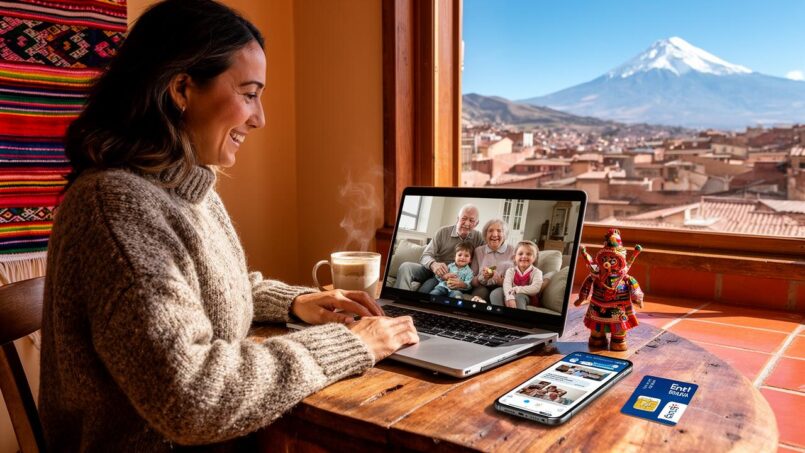
Traveling to Bolivia often means accepting being geographically distant from family and friends. But this country, where over 90% of the population owns a cell phone and where mobile internet is now the primary gateway to the web, offers many solutions for staying connected daily. Between local SIM cards, eSIMs, messaging apps, international calls, Wi‑Fi, VPNs, and even postal mail, it’s entirely possible to share your journey without blowing your budget – provided you understand how connectivity works on the ground.
Network quality varies greatly by region. It is excellent in major cities but becomes spotty and less reliable in remote areas like the Altiplano, the Amazon rainforest, or the Salar de Uyuni. It’s essential to plan your means of communication accordingly.
Understanding connectivity in Bolivia before you go
Bolivia is a country of contrasts, and its digital infrastructure reflects these disparities. In cities, internet access has become almost commonplace. In the countryside, it’s a different story.
Internet access concerns about 70% of the population, or roughly 8.7 million users, and over 90% of those who connect do so via their cell phones. There are approximately 13.5 million mobile connections, which represents more than 100% of the population, a sign that many people own multiple SIM cards.
Only 38% of rural inhabitants use the internet, versus 78% in cities, revealing a significant digital divide.
In practice, this means that in La Paz, Santa Cruz, Cochabamba, or Sucre, you’ll have a good chance of making video calls, sending photos, and working remotely, even if the network can be congested during peak hours. But in areas like Uyuni, the South Lipez, or parts of the Amazon, the connection can become very slow, intermittent, or even non-existent.
The main mobile operators
Three major players dominate the Bolivian mobile market: Entel, Tigo, and Viva, along with some smaller operators.
Their strengths and weaknesses can be summarized as follows:
| Operator | Type | Approx. Internet Market Share | Strengths | Main Limitations |
|---|---|---|---|---|
| Entel | Public (incumbent) | ~45% | Broadest coverage, 4G covering ~87% of the population, present in 219 municipalities | Customer service often Spanish-only, internet described as expensive and sometimes slow |
| Tigo | Private | ~41% | Robust 4G/LTE in cities, good speeds in major urban and tourist areas | Coverage drops outside cities |
| Viva | Private | ~4% | Often cheap prepaid plans, high speeds where network is present | Much more limited coverage, quality very variable outside major centers |
For the broadest possible coverage, especially if you plan to go to the Andean regions, the Salar de Uyuni, or isolated villages, it is recommended to use either Entel or Tigo (or an eSIM connected to these networks).
Local SIM card or roaming: The choice that changes everything
The first question to settle to stay connected in Bolivia is simple: use the roaming from your home carrier or buy a local SIM card (physical or eSIM).
Most of the time, international roaming from your home country is the most expensive solution. Many travelers still receive bills of several hundred euros after leaving data roaming enabled without checking the rates.
For stays longer than a few days, buying a local prepaid SIM card generally remains the most economical and practical choice. You get a Bolivian number to call hotels, taxis, or local agencies, and you can buy reasonably priced data plans for calls via WhatsApp, maps, translations, etc.
How much does a SIM card cost in Bolivia?
The good news: the SIM card itself is inexpensive. Generally, it costs around 10 Bolivianos, or about $1.50.
The three major operators have similar prices for the card alone:
| Operator | SIM Price (BOB) | Specific Advantages |
|---|---|---|
| Entel | 10 BOB | Good coverage, many plans combining minutes + data |
| Tigo | 10 BOB | Good 4G in cities, handy app to manage your credit |
| Viva | 10 BOB | Includes 10 BOB of credit valid for 60 days |
However, be aware: buying just the SIM is not enough. You then need to top up credit, then exchange it for a “paquete” (data or mixed plan). Using credit directly to browse without a plan is very inefficient.
The starting price in Bolivianos for weekly plans with several gigabytes of data.
Here are some examples of Entel prepaid plans:
| Plan Name | Price (BOB) | Included Data | Additional Benefits | Validity |
|---|---|---|---|---|
| Navegador 10 | 10 | 1 GB | Unlimited WhatsApp, 2 local min | 5 days |
| Navegador 15 | 15 | 1.5 GB | Unlimited WhatsApp, 4 local min | 10 days |
| Hablador 10 | 10 | 100 MB | 12 local min | 5 days |
| Hablador 30 | 30 | 300 MB | 38 local min | 15 days |
| Hablador 100 | 100 | 1 GB | 130 local min | 30 days |
You can quickly see the advantage of choosing a plan including unlimited WhatsApp: even with little data, you can continue to send messages and voice notes to your loved ones, or even make a few audio calls.
How to buy and activate a local SIM
You can buy a SIM card upon arrival in Bolivia at:
– Official stores of Entel, Tigo, or Viva (often called “multicentros” or operator shops)
– Kiosks and small shops in major cities
– Some supermarkets, pharmacies, and electronics stores
– International airports (La Paz – El Alto, Santa Cruz – Viru Viru), although prices may be a bit higher there
In Bolivia, legislation requires the registration of all SIM cards in the name of their end user. This means that every active SIM card must be formally associated with the identity of the person using it.
– You must present your original passport (not a copy, not a photo)
– The seller scans your passport and enters your information into the system
– Some operators may ask for a photo, or even take a fingerprint
– Registration is usually done on the spot in a few minutes
It is highly recommended to buy the SIM from an official store rather than from an informal reseller. This avoids the risks of faulty activation or registration errors that could complicate blocking or loss of the card.
Once the SIM is inserted into your unlocked phone, all that’s left is to:
1. Top up credit (in cash at the counter, via recharge vouchers, or at partner stores). 2. Dial the operator’s USSD code (e.g., *123#) or use its official app (Mi Entel, Mi Tigo, etc.) to purchase a data plan. 3. Check your phone settings to ensure mobile data is enabled and that the APN has configured automatically.
eSIM: Stay connected without changing cards
If your smartphone is eSIM compatible (iPhone XR/XS and newer, Google Pixel 3 and up, many recent Samsung models…), you can opt for a 100% digital solution. This is especially handy if you don’t want to remove your original SIM or if you’re traveling through multiple countries.
Advantages of eSIMs for Bolivia
– Remote activation: you buy online before departure and receive a QR code by email.
– No risk of losing your original SIM card.
– Ability to keep your usual number for verification SMS (banking, online services) while using Bolivian data via the eSIM.
– Rates often more competitive than traditional roaming, especially for a trip of a few weeks.
eSIM plans for Bolivia, typically offered between $20 and $60 for the duration of a stay, often offer a better value than roaming and can be simpler to manage than a local SIM card, which sometimes requires registration.
Some eSIM providers for Bolivia
Many international providers offer eSIMs that work on local networks (often Tigo or Viva). The main ones mentioned in the data are:
| Provider | Local Network Used | Example Bolivia Plans | Installation |
|---|---|---|---|
| eSIM4 | Tigo | 1 GB/7 days at $8.98, 5 GB/30 days at $27.98, unlimited 3 days at $21.98 | QR code, instant delivery, 24/7 support |
| Airalo | Tigo LTE | 1 GB/7 days at $8.50, 5 GB/30 days at $36.00 | QR code, mobile app, hotspot allowed |
| Saily | 3G/4G/LTE Partners | 1 GB/7 days at $7.59, 10 GB/30 days at $46.54 | App + QR code |
| aloSIM | – | 1 GB/7 days at $6.50, 20 GB/30 days at $45.00 | QR code, possible promo |
| Nomad | Viva + Tigo | 1 GB/7 days at $8, 10 GB/30 days at $29 | App, eSIM profile download |
| GigSky | Entel, Viva, Tigo | 100 MB/7 days free, 5 GB/30 days at $21.19 | App, multiple plans |
| Holafly | – | Unlimited data from 1 to 90 days, starting at €19 | QR code |
| Ubigi | – | 500 MB to 20 GB / 30 days, starting at $2.90 | QR code, 4G/5G |
In practice, the choice depends on: individual needs, available resources, and specific constraints.
– Your length of stay (7, 15, 30 days or more)
– Your estimated consumption (messaging only, frequent video calls, remote work…)
– Your budget and willingness (or not) to manage top-ups
eSIM4 is a preferred option for Bolivia thanks to its direct partnership with the Tigo operator, very simple installation, and 24/7 customer service. Other providers like Airalo, aloSIM, Nomad, and Holafly are also widely used by travelers.
How to install an eSIM step by step
The process is generally the same for all providers:
1. Check that your phone is both unlocked and eSIM compatible. 2. Purchase a Bolivia (or South America / Global) plan on the provider’s website or app. 3. Provide an email address to receive the QR code and instructions. 4. On your smartphone, go to cellular/mobile settings, choose “Add Cellular Plan” or equivalent. 5. Scan the QR code and follow the on-screen instructions. 6. Upon arrival in Bolivia, activate the eSIM and data roaming for that profile.
Once the eSIM is active, you can continue to use messaging apps, GPS navigation, video calls, etc., as if you were at home.
Managing costs: Avoiding “bill shock” while roaming
Even if you use a local SIM or eSIM, it’s essential to know how to manage your phone to avoid unpleasant surprises.
Turning off data roaming on your original SIM
Before you take off, it’s wise to disable data roaming on your primary line. Depending on your phone:
– iPhone: Settings > Cellular > [your line] > turn off “Data Roaming“.
– Android (generic): Settings > Network & Internet > SIMs > select the SIM > turn off “Data Roaming”.
– Samsung: Settings > Connections > Mobile networks > turn off “Data Roaming”.
You can then activate data only on the local SIM or eSIM, while potentially still being able to receive SMS (e.g., for banking).
Reducing your data consumption
Data in Bolivia is expensive for the average Bolivian (1 GB of mobile data costs about 40 to 55 Bolivianos, or roughly 3% of the monthly minimum wage), but remains affordable for many travelers. However, if the connection is slow, downloading large files can become a pain, and every MB counts when you’re on a limited plan.
It’s beneficial to develop and integrate a few useful habits into your daily routine. These positive automatic behaviors allow you to gain efficiency, reduce stress, and improve personal or professional organization.
– Download offline maps in advance on Google Maps or Maps.me for isolated regions (Uyuni, Amazon).
– Turn off automatic app updates, especially over mobile data.
– Block background usage for data-hungry apps (social media, cloud, etc.).
– Activate “Data Saver” mode in your phone’s settings.
– Save long video calls for times when you’re on decent Wi-Fi.
Relying on Wi-Fi when possible
In major cities like La Paz, Sucre, Santa Cruz, or Cochabamba, many hotels, hostels, and cafes offer free Wi-Fi. The quality varies greatly, but it’s often sufficient for messages and small photos.
In many establishments in Spain, it’s common to see signs reading ‘Free Wi-Fi’. To ask for the password, a simple and common phrase to use is: “¿Cuál es la clave de wifi, por favor?” (What’s the Wi-Fi password, please?).
You can also find:
– Public Wi-Fi zones in some parks and central squares (“Zonas Wifi”)
– Cybercafés (“Puntos de Internet”) where you pay by the hour to access a computer or paid Wi-Fi
– Coworking spaces with much more stable internet, very useful if you work remotely
On the other hand, in small towns like Sorata or Coroico, or in Uyuni, travelers describe connections as “painful,” sometimes limited to a few kilobits per second… Enough for a text message, but not for a video call with the whole family.
Apps for talking and messaging with loved ones
Once connected, it’s time to choose the right apps to stay in touch.
WhatsApp, queen of communication in Bolivia
WhatsApp is omnipresent in Latin America, and Bolivia is no exception. According to one study (GlobalWebIndex), WhatsApp usage in Latin America is 61% compared to only 7% in North America. In other words: if your loved ones use WhatsApp, it’s the most natural tool to use.
Many local operators even include unlimited WhatsApp in their plans (like Entel with its “Navegador” plans), making it particularly attractive for:
Essential features for staying in touch during your trip, according to local habits
Send text messages, photos, videos, and documents to share your discoveries.
Send long voice notes, the favorite communication reflex of many Bolivians.
Make audio, or even video, calls when network quality allows.
Create family or friend groups to share highlights of your trip.
Telegram, Signal, and other alternatives
Other apps are widely available and can serve as a safety net if WhatsApp has issues or if you’re looking for more privacy:
For private exchanges, Signal is recommended for its default end-to-end encryption. Telegram, with its advanced encryption, is suitable for sharing large files or creating channels. For audio/video calls, options like Skype, Google Meet, Viber, LINE, iMessage, or Google Messages (RCS) exist depending on your contacts’ habits.
The key is to agree with your loved ones, before you leave, on 1 or 2 common apps (e.g., WhatsApp + Telegram), to avoid juggling a dozen messaging apps.
Messaging apps without a number or offline: Special cases
Some apps mentioned in the data, like BitChat, work via Bluetooth over very short distances, without internet or a phone number. This is interesting for communicating within a group of travelers on the same bus or in the same refuge without network coverage, but it won’t help you talk to your family back in Europe or Canada.
Calling landlines or mobiles abroad cheaply
Messaging apps aren’t always enough. You may need to call your grandmother’s landline, or the cell phone of a loved one who doesn’t use the internet.
In this case, several international VoIP calling services allow you to call regular phone numbers at rates often much lower than your operator’s roaming rates.
Useful international calling services
Among the services mentioned:
Overview of several VoIP and international calling services offering competitive rates to contact Bolivia, with welcome offers and various features.
Subsidiary of IDT Corporation. Offers $2 free credit upon sign-up. Bolivia rates: $0.12/min (landline), $0.166/min (mobile), $0.217/min (rural).
Calls to +190 countries and mobile top-ups in +100 countries. Rates starting at $0.14/min to Bolivia. Monthly subscriptions and referral program ($3 credit offered).
Economical alternative to Skype with calls via local access numbers. Savings up to 90% (e.g., 50 Bolivianos for 725 min to the USA).
Web/app service with first free call. Promises cost reductions up to 90% compared to traditional operators.
Rebtel, Talk360, JustCall: allow calling landlines and mobiles without the recipient needing an app or internet connection.
The principle is often the same: you load credit via credit card, PayPal, etc., then the app converts your international calls into local-network calls on their end, optimizing costs. From your point of view, you just need either Wi-Fi or data on your local SIM/eSIM.
How to dial international numbers correctly
To call a Bolivian number from a country like the United States, the classic structure is:
– 011 (US international dialing prefix)
– 591 (Bolivia country code)
– then the area code and number
From inside Bolivia using a VoIP app, you usually just need to enter the number in international format (with the country code like +33, +41, +1, etc.) and let the app handle the dialing and call automatically.
Using a VPN for safer and freer communication
Another tool that can prove very useful for staying in touch with loved ones is a VPN (Virtual Private Network). It doesn’t provide the connection itself, but secures and routes the traffic you generate, which can have several benefits.
Why a VPN is useful in Bolivia
– Securing your exchanges on public Wi-Fi in hotels, cafes, airports, where the risk of data interception is real.
– Accessing certain services or websites blocked or restricted in Bolivia for political or geographical reasons.
– Watching streaming platforms that don’t offer the same catalog locally (US Netflix, BBC iPlayer, Hulu, etc.), if you’re sharing a movie or series “simultaneously” with someone back home.
– Accessing your home country’s banking services that sometimes block logins from certain countries.
Using a VPN is legal in Bolivia for normal use. However, national law offers little protection of personal data and the government can access information held by internet service providers. It’s important to note that illegal activities remain prohibited, with or without a VPN.
How a VPN works in practice
A VPN encrypts all your traffic between your device and a server located elsewhere in the world. Your apparent IP address becomes that of the server, which:
This service masks your real location and prevents your internet provider, users on the same Wi-Fi network, or certain third parties from monitoring your online activities. It also allows you to simulate being in another country.
Many providers offer servers in Latin America, sometimes directly in Bolivia, but this isn’t essential for staying in touch with your loved ones. Choosing a server in your home country can, for example, make it easier to access your usual online services.
Examples of VPN providers mentioned
Without detailing all commercial services, a few names come up:
– Urban VPN, VeePN, Telleport, FineVPN: offer free versions with Bolivian or Latin American servers, sometimes limited in speed or features.
– ExpressVPN, NordVPN, Private Internet Access, Surfshark: widely used international paid services, with strong encryption guarantees, “no-logs” policies, and performance.
In all cases, setup is generally simple: download the app, log in, choose a country, and tap “connect”.
When the internet is absent: Mail, packages, and postcards
Even if the modern obsession is to send everything in real-time, let’s not forget that it’s also possible to stay in touch in other ways: a handwritten letter from La Paz or a postcard from Sucre often have a sentimental value that a simple WhatsApp message will never have.
Sending mail from Bolivia
The public postal service, Correos Bolivia, allows sending letters, postcards, and small packages to most countries in the world (a member of the Universal Postal Union). The basic cost for a simple international shipment remains modest, often between a dozen and sixty Bolivianos depending on weight and destination.
Traveler accounts in La Paz mention for example:
– About 350 Bolivianos to send a 5 kg package to Canada, delivered in about three weeks.
– Between 600 and 700 Bolivianos for packages of 3 to 4 kg to the United Kingdom.
The main post office, located near the Witches’ Market (Mercado de las Brujas), is a classic starting point. Be prepared to sometimes provide photocopies of your passport (often charged 1 Boliviano for two copies). Packaging may be done on-site or remain your responsibility, depending on the branch and the time.
For your loved ones, receiving a package of souvenirs (Andean textiles, handicrafts, etc.) has a special flavor, especially since products are generally very affordable in Bolivia.
Private courier services
For more urgent or more secure shipments (important documents, valuables), companies like FedEx or OCS operate in Bolivia, with shorter delivery times (1 to 5 days to North America or Europe) but at significantly higher prices than regular mail.
Managing the time difference for live calls
Bolivia has a precious asset for organizing calls: it does not observe Daylight Saving Time and remains all year at UTC‑4 (Bolivia Time, BOT). La Paz, Sucre, Cochabamba, and Santa Cruz are all on the same time.
This greatly simplifies organizing calls, especially over time, because you won’t have to juggle local time changes. However, the difference will vary for your loved ones if their country does change time in spring or fall.
Some useful reference points
– Compared to Western Europe (France, Spain, Germany): Bolivia is generally 5 hours behind during European winter and 6 hours behind during summer (Daylight Saving Time).
– Compared to North America (East Coast, e.g., New York): Bolivia is 1 hour ahead in winter and the same time during summer (EDT).
– Compared to Peru or Colombia: Bolivia is 1 hour ahead.
– Compared to Argentina or southern Brazil: Bolivia is 1 hour behind.
– Compared to China: there is a 12-hour difference (when it’s noon in Beijing, it’s midnight in Bolivia).
In practice, for a conversation with Europe, the most comfortable slots are often:
– Between 8 AM and 1 PM in Bolivia, which corresponds to the afternoon in Europe.
With North America (East Coast):
– Between 9 AM and 6 PM in Bolivia, i.e., 8 AM–5 PM on the East Coast in winter.
It’s better to set possible “windows” for live calls with your loved ones from the start, and the rest of the time favor asynchronous messages (voice notes, videos, photos) that everyone will check when they can.
Adapting your communication habits to the local culture
Staying in touch with those far away doesn’t prevent you from respecting the customs of the country you’re in, especially in a country as attached to politeness and family as Bolivia.
A few points to keep in mind:
In Bolivia, prioritize human connections and discretion. Share updates with your loved ones and local families, but avoid noisy or intrusive behavior in public places. Be aware that internet access is often limited and expensive for residents, so use shared Wi-Fi sparingly. In traditional or religious spaces, always ask permission before filming or photographing people.
In summary: Building a connectivity strategy before departure
To stay at ease and truly reachable from Bolivia, it’s best to prepare the connectivity question a little before boarding the plane.
A balanced approach might look like this:
– Before departure:
– Check that your phone is unlocked and eSIM compatible if needed.
– Disable data roaming on your original SIM, download offline maps and the chosen messaging apps (WhatsApp, Telegram, Signal…).
– Consider purchasing a Bolivia eSIM or South America one to have data upon landing.
Upon arrival, get a prepaid Entel or Tigo SIM card from an official retail point, presenting your passport. Choose a plan including 1 to 3 GB of data and, ideally, unlimited WhatsApp. Remember to immediately test sending messages and an audio call to verify everything is working.
– During the trip:
– Use Wi-Fi opportunistically in hotels, cafes, and coworking spaces for large video calls or sending bulky photos.
– Activate a VPN on public networks to protect your sensitive accounts (banking, email, work documents).
– Consider an international calling service like BOSS Revolution, Yolla, or mytello to reach loved ones who don’t use the internet.
– Accept that in the Salar de Uyuni, in some parts of the Amazon, or in small villages, there will be phases of “digital silence.” That is often the price to pay for enjoying one of the most raw and pristine countries on the continent.
With good preparation, it’s possible to stay well connected in Bolivia to share experiences, reassure loved ones, manage remote tasks, or send souvenirs. The country is no longer a digitally isolated zone, but the essence of the journey remains to be lived off-screen.
Disclaimer: The information provided on this website is for informational purposes only and does not constitute financial, legal, or professional advice. We encourage you to consult qualified experts before making any investment, real estate, or expatriation decisions. Although we strive to maintain up-to-date and accurate information, we do not guarantee the completeness, accuracy, or timeliness of the proposed content. As investment and expatriation involve risks, we disclaim any liability for potential losses or damages arising from the use of this site. Your use of this site confirms your acceptance of these terms and your understanding of the associated risks.

Cyril Jarnias is an independent expert in international wealth management with over 20 years of experience. As an expatriate himself, he is dedicated to helping individuals and business leaders build, protect, and pass on their wealth with complete peace of mind.
On his website, cyriljarnias.com, he shares his expertise on international real estate, offshore company formation, and expatriation.
Thanks to his expertise, he offers sound advice to optimize his clients' wealth management. Cyril Jarnias is also recognized for his appearances in many prestigious media outlets such as BFM Business, les Français de l’étranger, Le Figaro, Les Echos, and Mieux vivre votre argent, where he shares his knowledge and know-how in wealth management.





