
 Published on and written by Cyril Jarnias
Traveling in Bolivia means accepting that every journey is part of the adventure. Between Andean mountains, the Altiplano, the Amazon jungle, and sprawling cities, getting around is never trivial. Public transportation is cheap, often efficient, sometimes chaotic, and requires a good dose of flexibility. This practical guide gathers essential information to understand the system, choose the right means of transport, and avoid the main pitfalls.
Understanding Bolivia’s Transportation Landscape
Bolivia was built on a territory difficult to connect: mountain roads clinging to canyon walls, floodplains, high plateaus over 3,500 meters above sea level. The result: transportation options are numerous, but rarely straightforward.
The bus is the dominant mode of transport for all types of journeys. The railway network is limited, boats are essential in the Amazon, and planes are primarily used to save time on very long distances.
In this context, the success of a trip often depends on three factors: planning ahead, staying flexible with schedules, and accepting that a “regular service” can be a rather relative concept. Schedules change, roads get blocked, weather dictates the rules, and protests can immobilize a road for hours, even days.
Major Modes of Transport: What to Know Before Boarding
In Bolivia, urban and intercity transport relies on a mosaic of formal and informal modes. The key is knowing which one to use in which context.
Long-Distance Buses: The Backbone of the Country
Intercity buses, called flotas, are the skeleton of national travel. They connect almost all major cities, most medium-sized towns, and even some isolated hamlets. They are operated by a multitude of private companies, from small family businesses to large national operators.
The routes are often long: an 8 to 12-hour trip is common, and one reported example even mentions an 18-hour journey. Routes like La Paz–Sucre (about 14 hours), Santa Cruz–Yacuiba (10 hours), or Potosí–Villazón (12 hours) are done almost exclusively at night to save on a hotel night.
Buses come in several comfort levels:
– standard, often worn-out seats, sometimes without heating at high altitude,
– modern buses with reclining seats and television,
– semi-cama (seats reclining to about 140°),
– cama (up to about 160°),
– and, on a few very busy routes, premium services with seats that recline almost horizontally, WiFi, blankets, toilets, and a snack or even a meal.
Night buses between La Paz and Uyuni illustrate this upgrade well: some companies offer “suite” buses with bunk-style seats, heating, USB ports, blankets, toilets, and hot drinks, for a journey of about 10 hours entirely on paved roads.
The maximum fare in bolivianos for many standard bus routes in Bolivia.
Urban and Semi-Urban Buses: Micros, Minibús, Trufis, and Colectivos
The world of Bolivian urban buses can be confusing at first. The categories are not always clearly defined, but we can distinguish several main types.
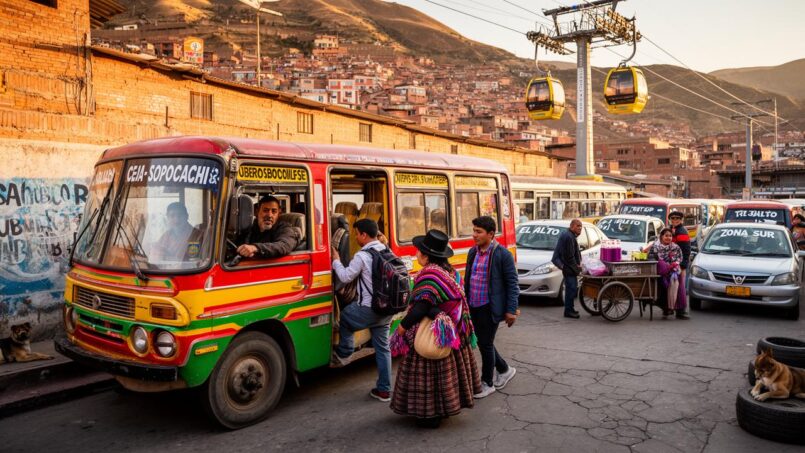
Micros are small buses or minibuses that crisscross cities on fixed routes. Main destinations are indicated on signs placed behind the windshield, sometimes shouted by a driver’s assistant. They stop on demand, leave once reasonably full, and run with very high frequency on major routes. The fare is standardized in many cities: around 1 boliviano for a single ride, about 0.15 USD.
Minibús or minis are vans with about fifteen seats, ubiquitous in La Paz and El Alto. A voceador (crier) is often hanging from the sliding door, loudly announcing the neighborhoods served and collecting coins. Passengers get on and off wherever they want along the route, making the service very flexible but also contributing to traffic jams.
Trufis are a hybrid between shared taxis and minibuses. They are small cars or vans on predefined routes, often between a city and nearby towns. They leave when full, don’t always follow a precise schedule, but offer a quick alternative for short or medium distances. The price is around 3 bolivianos for a short intercity trip, and can reach 40 to 50 bolivianos for longer distances in a shared taxi.
Example of intercity transport in Argentina: the *colectivos* or *buses provinciales*. These are medium-sized vehicles, often imported old school buses, that connect towns and countryside within the same department. They operate without strict schedules, leaving only when full, and frequently travel on dirt roads, making the comfort of the journey very variable.
Taxis: Indispensable, Cheap, but to be Used with Caution
Taxis are ubiquitous in both large and small cities. They are cheap compared to Western standards, but almost none use a meter: you must negotiate the price before getting in.
A ride within the city generally costs a few bolivianos, rarely more than 15 BOB (about 2 USD) in the center. Longer trips, for example between the north and south zones of La Paz, run around 30 to 40 BOB, while a trip between El Alto Airport and the center can cost 70 to 80 BOB. Fares are often understood “per person” rather than for the whole vehicle, which sometimes surprises visitors.
Two main categories coexist: street taxis, which can be any car with a “taxi” sign, and radio taxis, connected to a dispatch center, identifiable by a roof sign with a name and number. The latter are more expensive but safer, especially at night or when leaving bus terminals.
In major cities, apps like Easy Taxi or services like Uber, Yango, or Didi allow you to book a ride with GPS tracking, the driver’s name and license plate, adding a valuable level of security.
Trains, Trucks, and Boats: Niche Alternatives
The Bolivian railway network has lost much of its reach. Two main lines remain: the Andean line connecting Oruro, Uyuni, Tupiza, and Villazón, then onward to Chile, and the eastern line running from Santa Cruz to Quijarro, on the Brazilian border, or to Yacuiba. These trains, operated by companies like Empresa Ferroviaria Andina, offer calmer journeys than the bus, with spectacular landscapes over the Altiplano, but they are infrequent, their schedules can change, and they aren’t necessarily faster.
In some remote regions, in the absence of buses, it is common to travel in the back of a truck (camión) or pickup (camioneta), among the goods. This mode of transport is less comfortable, slightly cheaper, and aimed mainly at very flexible travelers.
In the Bolivian Amazon, especially around Trinidad or Rurrenabaque, riverways remain essential. River boats provide connections between isolated communities, following the rhythm of the rivers’ rise and fall.
Planes: Saving Time on Long Distances
Faced with long, sometimes dangerous or block-prone roads, flying can be a reasonable option. Daily flights connect La Paz, Santa Cruz, Sucre, Cochabamba, but also Tarija, Trinidad, or some Amazonian localities. The national airline BoA (Boliviana de Aviación) has the densest network and is still considered the most reliable; private companies like EcoJet complement the offering.
Average prices are around 70 USD for a domestic one-way ticket, 120 USD for a round-trip off-peak. This is much more expensive than the bus, but the time saved can be considerable, and especially appreciated on notoriously difficult routes, like La Paz–Rurrenabaque.
Buses in Detail: How to Use Them City by City and on Major Routes
For those who want to travel as close to everyday Bolivian life as possible, understanding how buses work is essential. From the national terminal to the neighborhood minibus, the codes remain fairly consistent from one city to another.
Bus Terminals: The Heart of Long-Distance Travel
Major cities have centralized land terminals, called Terminal de Buses or Terminal Terrestre. This is the case in La Paz, Oruro, Potosí, Cochabamba, Sucre (Chuquisaca), Santa Cruz, Tarija, Beni, Pando, Yacuiba, etc. Each terminal houses dozens of ticket counters for different companies.
Before boarding, you almost always have to pay a small terminal fee, between 1 and 3 bolivianos, at the boletas window. A ticket is issued and checked at boarding time. It’s a detail that sometimes surprises but is part of the ritual.
To get a ticket, three options coexist:
To travel by bus in Bolivia, three main options are available to travelers: advance purchase at the company’s ticket window (recommended before peak periods like holidays, festivals, and weekends), online purchase via platforms like TicketsBolivia or BusBud (slightly more expensive by a few bolivianos but very convenient from abroad), or same-day purchase, which remains possible on many routes outside of high season.
Once there, the atmosphere is often very lively, sometimes chaotic: shouters, street vendors, garbled announcements, unclear signs. Arriving at least 30 minutes before departure allows you to find the right counter, exchange an electronic reservation for a paper ticket if necessary, pay the terminal fee, and locate the gate.
A Few Major Routes by the Numbers
To get an idea of distances, durations, and price ranges, here is an overview of several routes heavily used by travelers:
| Route | Indicative Frequency | Approx. Duration | Distance (km) | Average Price (USD) |
|---|---|---|---|---|
| La Paz – Oruro | approx. every 30 min | 3 h | 225 | 5 |
| La Paz – Sucre | evenings only | 14 h | 500 | 15 |
| La Paz – Cochabamba | morning + evening | 6 h | 350 | 10 |
| La Paz – Potosí | evening departures | 7 h | 550 | 12 |
| La Paz – Copacabana | a few buses per day | 3.5 h | 165 | 2 |
| Potosí – Sucre | several times a day | 3–4 h | 156–165 | 3–4 |
| Potosí – Uyuni | morning + evening | 8 h | 210 | 6 |
| Sucre – Cochabamba | evenings | 12 h | 280 | 10 |
| Santa Cruz – Cochabamba | morning + evening | 8 h | 445 | 10 |
| Oruro – Uyuni | evenings | 7 h | 310 | 5 |
Prices remain indicative: some premium companies will charge more for a cama or suite service, others will undercut prices with older buses.
Special Case: The Sucre–Potosí Connection
Among the routes most frequented by travelers, the Sucre–Potosí road is almost a textbook case. The two cities, about 156 km apart, are connected by a pleasant, relatively direct paved road. The official journey time is between 3 and 4 hours, depending on the company and stops.
That’s the fare in bolivianos for a standard bus service, about 3 USD.
Some active companies on this route are, for example, Trans Emperador, Trans Real Audiencia, Trans Alonso de Ibáñez, El Dorado, or Trans Caminante, among others. In both directions:
– in Sucre, buses depart from the main bus terminal, on Avenida Ostria Gutiérrez, a few minutes by taxi from the center,
– in Potosí, they arrive at the Nueva Terminal de Buses, Avenida Las Banderas, about twenty minutes by taxi from the historic center.
A small terminal tax of 2 bolivianos is added to the ticket price.
For this route, intercity shared taxis, called trufis, are an option. They are faster (2-3 hour trip) and cost about 45 to 60 bolivianos per person. The price varies depending on whether the vehicle is shared or privatized through a hotel.
Night Buses: Comfort, Safety, and Realities
On long distances, traveling at night saves time and money, but requires some precautions. Buses often leave between 8 p.m. and 10 p.m. to arrive between 4 a.m. and 6 a.m. in a terminal that is sometimes still deserted.
Semi-cama, cama, or suite services offer a better experience: reclining seats, sometimes blankets, heating, toilets, movies, and a snack. Yet, even under these conditions, keep in mind:
– that roads can still be winding, unpaved, or poorly maintained,
– that drivers may drive long stretches non-stop,
– and that temperature variations are significant on the Altiplano, with heaters not always being reliable.
Regarding safety, the most frequent risks are thefts on board, especially when passengers are sleeping. It is therefore advisable to keep passport, money, and valuables on your person, in a money belt or hidden pouch, and to keep your bag within reach, rather than in the overhead compartments or at your feet.
The Quiet Revolution of Mi Teleférico in La Paz and El Alto
While most Bolivian cities remain dominated by informal buses and minibuses, the metropolitan area of La Paz–El Alto underwent a major upheaval with the arrival of Mi Teleférico, a network of urban cable cars that has become iconic.
An Aerial Metro Above the Altiplano
La Paz, over 3,650 meters above sea level, and El Alto, perched beyond 4,000 meters, form a metropolitan area of nearly 2.8 million inhabitants. Every day, nearly 440,000 people commute from El Alto to La Paz to work or study. The congested road easily took an hour, sometimes more, to climb or descend the 400-meter altitude difference between the sunken center of La Paz and the Altiplano plateau.
That’s the total number of passengers transported by the Mi Teleférico network in ten years of operation.
Travel time between La Paz and El Alto went from about an hour by road to 10–20 minutes in a cabin, with departures every 12 seconds during peak hours. On some sections, the duration is only 10 minutes, with a capacity that can reach 6,000 passengers per hour per line.
Fares, Schedules, and Tickets
One of the system’s strengths is its price: a single trip on one line costs 3 bolivianos, about 0.40 USD. Students, seniors, and people with disabilities get a 50% discount, at 1.50 bolivianos. There are also tickets allowing multiple line changes or all-day travel.
Summary of main observed fares in the network:
| Ticket / Usage | Price (BOB) | Main Details |
|---|---|---|
| Single trip (1 line) | 3 | Entry + exit on the same line |
| Trip with connection (2+ lines) | 5 | Includes line change |
| Circuit ticket (approx. 6 lines) | 11 | Multi-line tourist route |
| Rechargeable Mi Teleférico Card | 30 | Includes 10 BOB credit; trips at 3 BOB, transfers at 2 BOB |
| Unlimited day pass | 25 | Unlimited trips for one day |
| Reduced fare (students, seniors, disabled) | 1.5 | 50% discount on single trip |
The cabins operate continuously for about 17 hours a day, generally from 6 a.m. to 11 p.m. (slight adjustments depending on the line). No reservations possible: you show up at the station, buy your ticket at the booth or kiosk, and board.
A Tool for Social Integration as Much as Mobility
Mi Teleférico is not just an efficient means of transport: it has become a symbol of reduced inequality. El Alto, a city with an Aymara majority, poorer and rapidly growing, is now connected to downtown La Paz by a safe, fast, and affordable mode. Residents of El Alto have easier access to jobs, services, and study places in the capital, while residents of La Paz can more easily reach outlying neighborhoods.
Estimated daily economic gain per person due to time saved commuting.
The system is also exemplary in terms of accessibility: elevators, ramps, tactile paving in stations, adapted cabins, and trained staff to assist people with reduced mobility or sensory disabilities. It is the country’s first public transport network designed from the start for these groups.
Mi Teleférico, the urban cable car network in La Paz, operates without direct operating subsidies. The public company that manages it keeps its revenue after taxes and had already generated a cumulative surplus of several million dollars just a few years after opening. This financial performance is remarkable in a national context where many public services are usually deficit-ridden.
A Full-Fledged Urban Tourism Network
For a visitor, Mi Teleférico is both a way to get around and an attraction. Some lines offer spectacular views of the La Paz canyon, the summit of Illimani, or the neighborhoods of El Alto covered in colorful houses and cholets, those flamboyant buildings designed by architect Freddy Mamani.
The different lines each have their own interest: the Red between downtown and El Alto for a complete panorama, the Yellow above the historic center and the Witches’ Market, the Green towards the more affluent Zona Sur and the Valle de la Luna area, the Orange and Blue to access the huge markets of El Alto.
Combined with a minibus or taxi, the cable car becomes a key link in efficient multimodal itineraries. Apps like Yango, associated with the TuRuta app, even integrate Mi Teleférico’s ten lines into their route planners, with estimated time, schedules, and, for some buses, real-time tracking.
Getting Around Major Cities: La Paz, Cochabamba, Santa Cruz, and Others
Urban systems vary greatly from one city to another, but some strong trends emerge, especially in La Paz, the city most advanced in diversifying its offerings.
La Paz–El Alto: A Laboratory of Multi-Modality
Besides Mi Teleférico, the metropolitan area has several families of public transport.
Micros and minibús dominate the space, with regulated fares: around 1.50 BOB for a micro, and about 2 BOB for a minibus on standard sections. Heading towards the more distant south zone, these fares increase slightly, up to 1.80–2.60 BOB.
The municipality has developed a network of modern buses, PumaKatari, which runs on well-defined routes with designated stops. These buses, with a capacity of about 61 passengers, are more reliable and better managed than informal services, with clear pricing (2 to 2.50 BOB per ride, slightly less with a dedicated card). They run almost 24/7, with less frequent service at night.
Information on fares and conditions for purchasing and recharging transport cards.
The card is purchased with an initial credit of 5 to 50 BOB (Bolivianos). It is then recharged based on the bus lines used.
The standard fare applies to all users not eligible for a discount. The cost depends on the line used.
Available at 1.50 BOB for those under 18, over 60, and disabled persons. Proof of eligibility is required.
Children under 5 travel free on the La Paz Bus network.
The city also had to manage a sensitive issue: minibus fare increases. In 2025, an adjustment to 2.40 BOB for short sections and 3 BOB for long ones triggered strikes and negotiations, illustrating how transport is at the heart of social tensions.
For the visitor, a key phrase to remember: to get off a micro or minibus, you announce “Bajo en la esquina” (I’m getting off at the corner), or press a stop button if the vehicle is equipped with one.
Cochabamba: Between Informal Transport and Light Rail
Cochabamba, in the center of the country, is a major road junction. Its bus terminal is known to be better organized than average, with frequent connections to La Paz, Santa Cruz, and Sucre.
In the city, micros and trufis dominate, as elsewhere, with very low fares. Apps like Trufi, born here, help residents and visitors navigate the labyrinth of informal lines. This open-source app maps bus and minibus routes and now serves as a base for other tools in other cities, like Quirqui Rutas for the Oruro carnival.
Cochabamba has Mi Tren, an electric light rail system. Its first line (Yellow) connects the airport to Maica over about 3.9 km. Although the network is still limited, it represents a city modernization project and offers accessibility standards similar to Mi Teleférico.
Santa Cruz de la Sierra: Economic Capital and Bus Jungle
Santa Cruz, a large lowland metropolis, has an extensive network of urban buses (micros) and minibuses, complemented by heavy taxi use. The city has neither metro nor tram, but a few digital tools facilitate movement, like the Cruzero app which lists micro lines, their color codes, and their routes.
The city suffers from heavy congestion during rush hour, but it’s also a major hub for trips to the Amazon, the Chaco, or Brazil, via its bimodal terminal (bus + train).
Other Cities: Sucre, Potosí, Oruro, Tarija and Beyond
In medium-sized cities like Sucre, Potosí, Oruro, or Tarija, the winning combination remains simple: micros for economical trips, taxis for comfort and simplicity, sometimes a few minibus lines. Fares remain low and operate on a pay-as-you-go basis, without a real subscription system.
Some cities, like Trinidad or Cobija, give an important place to local modes: mototaxis, rickshaw tricycles, etc. In most cases, you pay in cash, with small bills, and don’t expect a ticket.
Apps, Online Tickets, and New Regulations: Digital to the Rescue
The rise of smartphones has accelerated the spread of tools designed to tame the apparent chaos of Bolivian transport.
Several applications have become established in different contexts:
Presentation of the main local apps offering route calculation and transport information solutions in different Bolivian cities.
Pioneering, offers multimodal routes combining walking, bus, minibus, taxi, and sometimes cable car. Its open-source code serves as a base for other local variations.
Designed in a few weeks for the carnival, based on the Trufi platform and using the standard GTFS data format, also allowing planning analysis.
Via the “Transporte” function in its app, offers route calculations combining bus, minibus, and Mi Teleférico, with estimated times and real-time GPS tracking for some journeys.
Lists *micros* (buses) by colors and routes to facilitate movement in the city.
These tools don’t yet cover the entire country, but they reflect a broader movement: the transition from a completely informal system to an ecosystem where data is gradually collected, structured, and then made available to the public.
Online Ticketing and Platforms
For long distances, several sites now allow you to compare schedules and prices, then book a ticket: TicketsBolivia, EnBus, BusBud, or even regional platforms like Bus Tickets Peru on some international routes. They may not list all companies, but provide a useful base, with an English interface for some.
A national app allows you to buy tickets for all lines in the country, choose your seat online, and check prices in real-time. It eliminates the need to physically go to the terminals.
A Legal Framework for Transport Apps
Aware of the rapid growth of digital services related to transport, the Bolivian state has established a national registry for passenger transport applications. This registry aims to regulate, secure, and oversee the use of these apps, whether for ride-sharing, VTC-type taxis, or traveler information.
The stated goal: protect user rights, enhance safety, while recognizing the role of these platforms in modernizing a fragmented sector.
Fares, Budgets, and Cost Comparisons
Traveling in Bolivia by public transport remains, overall, extraordinarily cheap. But the differences between modes can be significant.
Cost of Urban Travel
In most cities, a ride on urban collective transport (micro, minibus) costs around 1 to 3 bolivianos, about 0.15 to 0.45 USD. In La Paz, average cost estimates mention 2.35 BOB for a single public transport ticket, and about 183 BOB (26 USD) for a theoretical monthly pass.
That’s the fare in bolivianos for a trip on the Mi Teleférico cable car, positioned as a faster and more reliable option than the bus.
In major cities, a taxi ride or via a VTC app often comes to 3–4 USD for a standard urban distance, sometimes less for short trips.
Cost of Intercity Travel
To compare buses and planes, a summary table gives a good idea of average orders of magnitude:
| Mode / ticket type | Average one-way price (USD) | Comment |
|---|---|---|
| Intercity bus (standard) | 12 | 10–50 BOB on many routes |
| Intercity bus (round-trip) | 24 | Can go up to 40 USD in high season |
| Domestic flight (one-way) | 70 | Variable by route and season |
| Domestic flight (round-trip) | 120 | Up to 200 USD during peak periods |
Thus, a Santa Cruz–La Paz trip costing 17 USD by bus will be around 75 USD by plane. Santa Cruz–Cochabamba will be more around 9 USD by bus and 40 USD by plane.
For a tight budget, the bus remains unbeatable. For a traveler in a hurry or wanting to avoid routes with a problematic reputation, a bus + plane combination can be relevant.
Accessibility, Inequalities, and New Public Services
Bolivian public transport is not just a logistical matter: it reflects social and territorial inequalities, but also the efforts undertaken to reduce them.
A Capacity Deficit Across the Country
One study mentions a simple indicator: a goal of at least 93 places in collective transport per 1,000 inhabitants per municipality. Only a small minority of Bolivian municipalities reach this threshold; the vast majority remain below, with significant gaps. This translates, in daily life, into packed buses, long waiting times, especially in the periphery and rural areas, and a heavy reliance on informal solutions such as private cars converted into taxis, trucks, or camionetas.
In this context, public initiatives like Mi Teleférico, municipal buses PumaKatari and ChikiTiti in La Paz, or Wayna Bus in El Alto, have helped increase supply, but population growth and rural exodus keep pressure on the system.
Accessibility for People with Disabilities
The traditional Bolivian bus system is not designed for people with reduced mobility: lack of ramps, spaces for wheelchairs, audible or tactile signage. A few buses in major cities have ramps and reserved seats, but this remains the exception.
Preferential fare in bolivianos (BOB) applied to people with disabilities to use Mi Teleférico.
Between 2014 and 2018, tens of thousands of people with disabilities, students, and seniors benefited from these fares, generating substantial savings for these groups.
Social Initiatives and Employment
Mi Teleférico has also implemented training and insertion programs, especially for youth and women, in a traditionally male-dominated sector. Hundreds of employees have been trained, nearly 4% of the workforce are people with disabilities, and more than a third of employees are women.
These initiatives show how a transport project can go beyond the simple function of mobility to become a lever for social development.
Safety, Risks, and Practical Advice
No guide on transportation in Bolivia would be complete without addressing the question of safety, both road and criminal.
Road Risks
Bolivian roads suffer from many handicaps: unpaved sections, lack of signage, absence of guardrails or emergency lanes, narrow mountain roads where implicit priority goes to the vehicle going uphill. The famous old Yungas road, nicknamed the “Death Road,” is the most emblematic example, even though a safer alternative road exists today.
Accidents involving buses are frequent: overloading, insufficient maintenance, reckless driving, driver fatigue all play a role. Premium tourist services and a few reputable companies (like some Trans Copacabana or Todo Turismo lines on La Paz–Uyuni) have better standards, but don’t eliminate the risk.
To reduce your exposure to risks when traveling, it is recommended to choose quality buses for long journeys, opt for daytime travel in difficult mountain areas, and, when possible, substitute a particularly tricky section with a domestic flight.
Crime and Theft
Major bus stations, markets, crowded micros, and night buses are prime locations for pickpockets and thieves. The most common techniques: distraction (stain on clothing, jostling), discreetly cutting bags, or rifling through luggage in the hold, sometimes with staff complicity.
A few simple rules help reduce the risks:
– keep your valuables on you, not in the large bag in the hold,
– keep your day bag physically in contact (on your lap, attached to your arm or leg),
– avoid falling into deep sleep with your belongings out of reach,
– do not accept food or drink from perfect strangers on buses or trains.
In some cities like La Paz and Santa Cruz, fake taxis may carry out ‘express kidnappings’, forcing the victim to withdraw money from an ATM. To protect yourself, it is advisable to use radio taxis or VTCs via an app, always note the license plate and driver’s name, and avoid getting into a taxi already occupied.
Blockades, Strikes, and Unforeseen Events
Road blockades and transport strikes can paralyze entire regions, cut off access to airports, bus terminals, and borders. They are sometimes announced, sometimes spontaneous. When a blockade is in place, it is generally not advisable to try to cross it on foot or by vehicle.
A good practice is to:
– allow a margin of one or two days for critical connections (e.g., international flight),
– stay informed via local media, social networks, or road management websites,
– and keep some budget for a plan B (last-minute domestic flight, change of itinerary).
Practical Tips for Using Bolivian Transport Well
Beyond numbers and systems, a few habits greatly facilitate the traveler’s life.
Learning a few phrases in Spanish makes a considerable difference: asking “¿Dónde va este micro?” (where does this bus go?), indicating “Me deja en la esquina, por favor” (let me off at the corner, please), or checking “¿Cuánto cuesta hasta el centro?” (how much to the center?) solves 90% of situations.
It is advisable to have small bills on you (1, 2, 5, 10 BOB) to avoid change problems, especially with drivers who don’t always have change for a 100 BOB bill. Also, in very crowded areas, it is necessary to keep an eye on your belongings, adopting an attitude that is neither paranoid nor naive.
Finally, accepting that transport is part of the Bolivian experience – unpredictable, lively, noisy – allows you to better appreciate those hours spent in a brightly painted micro, a Mi Teleférico cabin gliding above the roofs of El Alto, or a night bus speeding across the Altiplano towards Uyuni.
In a country where few municipalities yet reach satisfactory levels of public transport supply, each new structured bus line, each cable car line, each navigation app that maps thousands of informal minibuses represents a step towards a more readable and equitable system, for residents and visitors alike.
Disclaimer: The information provided on this website is for informational purposes only and does not constitute financial, legal, or professional advice. We encourage you to consult qualified experts before making any investment, real estate, or expatriation decisions. Although we strive to maintain up-to-date and accurate information, we do not guarantee the completeness, accuracy, or timeliness of the proposed content. As investment and expatriation involve risks, we disclaim any liability for potential losses or damages arising from the use of this site. Your use of this site confirms your acceptance of these terms and your understanding of the associated risks.

Cyril Jarnias is an independent expert in international wealth management with over 20 years of experience. As an expatriate himself, he is dedicated to helping individuals and business leaders build, protect, and pass on their wealth with complete peace of mind.
On his website, cyriljarnias.com, he shares his expertise on international real estate, offshore company formation, and expatriation.
Thanks to his expertise, he offers sound advice to optimize his clients' wealth management. Cyril Jarnias is also recognized for his appearances in many prestigious media outlets such as BFM Business, les Français de l’étranger, Le Figaro, Les Echos, and Mieux vivre votre argent, where he shares his knowledge and know-how in wealth management.





