
 Published on and written by Cyril Jarnias
Moving abroad is no longer just about finding housing and opening a bank account. To build a successful professional life in Bolivia, the real leverage is your network. In a country where personal trust often carries as much weight as diplomas, developing strong relationships can make the difference between a stagnant career and a cascade of opportunities.
In Bolivia, personal relationships take precedence over business transactions. For an expatriate, it is crucial to understand this logic and build a network by targeting the appropriate venues, events, and platforms, regardless of their professional specialty.
Understanding the Bolivian Playing Field
Before even handing out your business cards, it’s useful to grasp the context in which you will be networking. Bolivia is an Andean country, deeply marked by a cultural mosaic: Catholic Spanish heritage, Andean traditions, and no fewer than 36 recognized indigenous cultures. This diversity is reflected in ways of working, negotiating, and building trust.
Bolivia’s major economic cities have distinct approaches. Santa Cruz, the economic heart and investment hub, is characterized by a dynamic pace and a warm relational style. La Paz, the administrative capital at 3,600 meters altitude, adopts a more formal culture, influenced by institutions and hierarchy. Cochabamba, with its mild climate and growing entrepreneurial scene, offers an intermediate setting and active urban life.
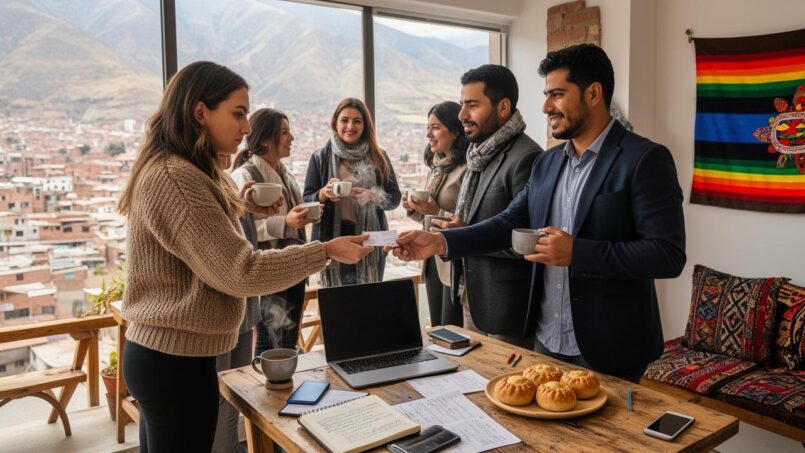
Across the country, personal and family ties remain central. Entering a professional network often means being co-opted into a circle where loyalty counts at least as much as technical skill. This importance of “personalismo” implies that an expat will need to invest time in human relationships: extended coffees, business lunches, dinners, social events. Wanting to get straight to the point without these steps can be interpreted as coldness or arrogance.
The pace of business is generally slower than in cultures like France, the United States, or Germany. Decisions are often made at a high hierarchical level, removed from daily discussions, requiring patience, an absence of pressure on deadlines, and acceptance of several meetings before a deal is finalized.
Communication Codes: Key to Effective Networking
In Bolivia, professional communication blends formalism, human warmth, and great attention to non-verbal signals. For an expat, reading these codes well and responding appropriately is fundamental to gaining the trust of counterparts.
The main working language is Spanish, although Quechua and Aymara are also spoken in some contexts. English is used in tech or international circles, but relying on it exclusively is a strategic mistake. Making the effort to speak Spanish, even imperfectly, quickly establishes a climate of goodwill and respect.
Bolivians frequently use indirect language, especially to express disagreement or deliver bad news. A “we’ll see” or a “maybe later” can mean a polite refusal. Similarly, a direct “no” is often avoided to preserve group harmony. Learning to decode these nuances is essential to avoid misinterpreting promises or openings that are not actually there.
Important interactions are best done face-to-face (coffee, lunch, events). WhatsApp is the essential tool for logistics (confirmation, sending documents, follow-up). Not using it or responding slowly can be perceived as a lack of interest.
Direct eye contact is appreciated, it expresses frankness and respect. Frequently looking away can be interpreted as a sign of discomfort or insincerity. Conversely, being rigid and distant can cool off counterparts: it’s about finding the right balance between professionalism and friendliness.
Entering Expat Circles: An Essential Springboard
When arriving in Bolivia, one of the fastest ways to avoid isolation and start building your network is to join established expatriate communities. They offer both practical support – housing, procedures, schools, healthcare – and an initial pool of professional contacts.
Among the most useful platforms is InterNations, the largest global network for people living abroad, present in 420 cities and with a specific community in Bolivia. Registration is free and provides access to official events as well as smaller thematic groups. In practice, this can range from after-work parties in a business district to weekend hikes or discoveries of local gastronomy.
The InterNations forums are a valuable resource for obtaining practical information on local life (cost of living, neighborhoods, schools, healthcare, safety) and for professional networking, allowing you to identify people working in the same sector, a target company, or a similar position.
Another important gateway is the BoliviaBella community, designed as a space for exchange between foreigners and locals. You’ll find discussions directly related to an expat’s daily life: residency procedures, banking, retirement questions, teaching opportunities, finding a doctor, or understanding the real estate market. This type of platform helps you move beyond the role of a simple tourist and position yourself as a full-fledged resident.
Created by an expat living near Santa Cruz, this group serves as an open discussion forum. It brings together diverse profiles such as humanitarian workers, tech freelancers, entrepreneurs, retirees, and binational families. It is a key resource for quickly getting feedback on practical topics: neighborhood recommendations, international schools, immigration-specialized lawyers, or reliable coworking spaces.
For those considering more structured support, specialized services like Bolivia Expat Services offer relocation, procedural assistance, and residency acquisition services. Beyond simplifying paperwork, these intermediaries often have well-stocked address books in local business circles, which can be valuable for getting referred to decision-makers.
LinkedIn and Online Groups: The Global Network for Local Integration
Over 1.3 million Bolivians are registered on LinkedIn. The country has a structured online ecosystem, where professionals from all sectors connect, exchange, and spot opportunities. For an expat, LinkedIn becomes an essential bridge between remote preparation and on-the-ground networking.
Available data shows that 83% of professionals have already created new sector-specific contacts thanks to social networks, and 62% have found job opportunities there. Ignoring this tool would mean depriving yourself of a large part of the hidden market.
Key steps to adapt your professional profile to the Bolivian job market and maximize your visibility.
Create a summary in Spanish or bilingual, and incorporate relevant keywords for target sectors such as agribusiness, energy, fintech, education, and information technology.
Showcase your overseas experiences that may interest local employers or partners, emphasizing transferable skills.
Then, use search filters to identify key profiles in Bolivia: HR managers, startup founders, executives in telecoms or banking, chamber of commerce leaders, consultants. A personalized outreach, clearly explaining your project in Bolivia and what you can bring, significantly increases the chances of a response.
LinkedIn allows you to be a member of up to 50 thematic groups, a useful lever for expats.
More targeted groups by profile – Expat Women Entrepreneurs, Expat Women, Trailing Spouse Network, Families in Global Transition – can also be relevant for building an initial circle of people facing the same challenges: work-life balance, business creation, career change, etc.
On the ground, it’s useful to identify local tech and business influencers – some reports mention figures like Andrea Villarroel or experts in AI and blockchain – and follow their publications. Commenting pertinently, sharing their content with added analysis, and then meeting them at events or conferences allows you to gradually move from virtual to real.
Betting on Tech and Innovation: A Booming Ecosystem
Bolivia is not yet among the global tech giants, but its digital sector is growing rapidly, supported by public policies and dynamic private actors. The tech market was projected at $1.2 billion with an annual growth rate of about 8.2%, and the country already has two cities in the top 1000 global startup hubs.
The most dynamic areas for startups are artificial intelligence, blockchain, renewable energy, e-commerce, and fintech. Examples like AgriTech Solutions ($2.5 million raised), DeltaX ($1 million), or Mo.bi illustrate this movement. For expats with a tech, data, product, or entrepreneurship profile, these sectors offer fertile ground for networking and career opportunities.
Support structures like Bolivia Tech Hub and Startup Bolivia support tech entrepreneurs, organize meetups, incubate projects, and connect developers, investors, designers, and mentors. The Startup Bolivia initiative, in particular, aims to structure a national entrepreneurial ecosystem, which translates concretely into hackathons, acceleration programs, and regular events.
These gatherings are an opportunity to meet various key players in innovation (founders, financiers, developers, public officials). An expat can showcase their specific expertise (product, international marketing, agile methodologies, fundraising) to quickly be identified as a valuable resource.
Examples of Tech Events for Networking
The Bolivian calendar is full of tech events. A list of “top” events mentions, for example, the Bolivia Tech Summit, La Paz Startup Weekends, Santa Cruz Tech Meetups, DevFest Cochabamba, conferences dedicated to AI and blockchain, or series like Tarija Tech Talks or Pando Innovators Meetup.
To provide a synthesized overview, here is a look at some key formats:
| Event / Format | Main City | Type of Activities | Networking Interest for Expats |
|---|---|---|---|
| Bolivia Tech Summit | La Paz | Conferences, panels, booths | Meet national and international tech leaders |
| La Paz Startup Weekend | La Paz | 54-hour marathon, startup creation | Co-create a project, find co-founders and mentors |
| Santa Cruz Tech Meetup | Santa Cruz | Workshops, talks, hackathons | Integrate into the largest local tech community |
| DevFest Cochabamba | Cochabamba | Google Developer Group conferences | Contact developers, trainers, GDG, recruiters |
| Bolivia AI & Machine Learning Conference | La Paz | Focus on AI, ML, conferences & workshops | Position yourself in new data technologies |
| Women Who Code La Paz | La Paz | Bi-monthly meetups | Female tech network, mentoring, mutual support |
| Tarija Tech Talks | Tarija | Local meetings, conferences | Explore a smaller but very accessible ecosystem |
Including these types of events in your schedule becomes a full-fledged networking strategy: speaking as a presenter, offering a workshop, supporting a hackathon as a mentor, moderating a panel discussion. Each contribution makes you more visible and facilitates trust-based connections.
Santa Cruz: Economic Capital and Relational Hub
For an expat settling in, Santa Cruz de la Sierra often appears as a logical choice. It is the largest city in the country, its economic engine, and the main recipient of foreign investment. The Equipetrol and Urubó neighborhoods concentrate a large part of business life and expats, with hotels, restaurants, trendy cafes, and coworking spaces.
The infrastructure is more modern, internet access is more reliable, and services tailored to an international clientele are multiplying: bilingual schools, private clinics, gyms, shopping malls. Many expats working for NGOs, mining companies, service firms, or startups choose to settle there.
In Santa Cruz, the Expocruz event hosts the Rueda Internacional de Negocios, organized by the CAINCO chamber of commerce. This platform brings together companies from about twenty countries over three days through speed networking, training sessions, and project presentation spaces. For an expat entrepreneur or consultant, participating is an effective shortcut to generate dozens of potential professional contacts in very little time.
Here is an example of Santa Cruz’s role in the networking ecosystem:
| Dimension | Role of Santa Cruz in Bolivia |
|---|---|
| Economic Weight | Main center for investment and exports |
| Major Events | Expocruz, Rueda Internacional de Negocios, ICC / CAINCO forums |
| Expat Community | Significant concentration in Equipetrol, Urubó and neighboring areas |
| Opportunities for Families | Presence of international and bilingual schools |
| Tech & Innovation | Santa Cruz Tech Meetup, presence of incubators and startups |
Add to this international meetings that specifically choose Santa Cruz for its status as a regional hub, such as certain summits of Chambers of Commerce of the Americas or CAF (Latin American development bank) meetings. Attending them allows you to meet both Bolivian actors and foreign decision-makers (ministers, large company executives, international organization officials).
La Paz, Cochabamba, Sucre, Tarija: Complementary Scenes
La Paz, the administrative capital, remains essential for anyone wishing to work with institutions, large public companies, international NGOs, or multilateral organizations. The neighborhoods of the Zona Sur – Calacoto, San Miguel – as well as Sopocachi attract students, young professionals, and expats in a more cosmopolitan environment. There you’ll find coworking spaces (Impact Hub, La Paz Co-working, etc.) where actors from the social economy, freelancers, developers, and consultants cross paths.
Cochabamba, with its mild climate and more relaxed atmosphere, is establishing itself as an interesting hub for tech and entrepreneurial profiles seeking a balance between quality of life and urban dynamism. Various meetups and events are organized there, such as DevFest Cochabamba, affiliated with the local Google Developers Group network.
Sucre, the constitutional capital and a UNESCO World Heritage site, is suitable for people seeking a peaceful living environment, a moderate cost of living, and Spanish language immersion. Networking there is possible in a more intimate way through language schools, the local university, community life, and initiatives related to tourism and services.
Tarija, a wine city known for its peaceful atmosphere, hosts events like Tarija Tech Talks which, despite a more modest scale, offer direct access to local entrepreneurs and decision-makers.
An expat can choose a main city for their base – often Santa Cruz or La Paz – and then regularly organize trips to these other centers to expand their network. Affordable bus connections or domestic flights (for example with airlines like Boliviana de Aviación) make this strategy realistic.
Leveraging Academic Networks and Mentoring Programs
Bolivian universities are not just educational institutions: they are also crossroads of professional relationships. The Bolivian Catholic University, for example, has an active alumni network. Among its known alumni are fintech founders or artificial intelligence researchers for major international groups. Participating in university conferences, speaking as a guest, offering workshops, or supervising student projects are all ways to enter these networks.
Programs like Conecta Mentora connect experienced professionals (often linked to the United States and Bolivia) with high-potential young Bolivians. This mentoring aims to support their professional and personal projects, develop their skills, and strengthen their leadership ambitions.
This program, supported by the U.S. Embassy and founded by former Fulbright scholars, includes training components, workshops, impact projects aligned with the Sustainable Development Goals, and structured support. For an expat with solid experience and ready to commit as a mentor, joining this type of initiative allows for building deep relationships with the future generation of Bolivian executives and leaders – while expanding their own network towards institutions on both sides.
Programs like MB Mentoring in Bolivia structure pathways for young lawyers, focused on skills transfer. These initiatives, although targeting specific audiences, reveal a growing trend towards mentoring. An expat can participate in them or draw inspiration to propose similar activities in their sector (trainings, coaching, discussion circles).
Volunteering and Social Engagement: Networking Through Contribution
Another way to build a strong network, especially when arriving without contacts, is to get involved in non-profit organizations, environmental projects, or social initiatives. Structures like Sustainable Bolivia, for example, connect volunteers with local needs in education, sports, communication, research, art, or community development.
These missions can be in urban or isolated settings, often in collaboration with local universities and research centers, for example in the Amazon. They offer much more than a humanitarian or ecological dimension: they allow integration into valuable networks of researchers, teachers, social entrepreneurs, and public actors, significantly expanding the expat’s professional and personal circle.
Getting involved as a volunteer by highlighting your skills – project management, digital communication, fundraising, training, technical expertise – creates a very strong bond of trust. You no longer present yourself merely as a “foreigner who came to do business,” but as a long-term partner ready to invest time and energy for the benefit of the community. The returns, in terms of reputation and social capital, are often considerable.
The Decisive Role of Mastering Spanish
In a country where business is mostly conducted in Spanish, improving your command of the language is in itself a networking strategy. Not only does it facilitate communication, but it opens doors to deeper networks, beyond internationalized circles.
A private Bolivian university offers an intensive language and culture program for foreigners. Structured in 120-hour modules, it combines daily classes, cultural visits, and field activities. This program allows students to progress from a beginner level to a level sufficient to follow university courses in Spanish, while giving them access to clubs, associations, and student projects.
Some schools or platforms specialized in business Spanish also offer courses focused on professional skills: writing formal emails, negotiating, presenting a project, participating in meetings, understanding the subtleties of business etiquette. For an expat who will interact with banks, authorities, industrial partners, or major accounts, this type of training is an asset.
The impact of language on networking can be summarized as follows:
| Level of Spanish | Type of Network Primarily Accessible |
|---|---|
| Very Low (A1) | English-speaking expat communities, bilingual international events |
| Intermediate (B1–B2) | Local ecosystems (SMEs, tech, NGOs, universities, coworking spaces) |
| Advanced (C1–C2) | Decision-making circles, complex negotiations, influence in projects |
The goal is not necessarily to achieve perfection, but to cross the threshold that allows for spontaneous conversations, jokes, cultural nuances – in short, the informal dimension where the best opportunities often arise.
Respecting Social Codes: From Greetings to the Dinner Table
Successful networking requires a good grasp of the details that, cumulatively, build the image you project. In Bolivia, greetings remain important: a firm handshake, direct eye contact, a smile, or even a kiss on the cheek between men and women or between women when the relationship is already established. Greet each person individually upon arrival and departure, starting with the oldest person or the one highest in the hierarchy.
The use of professional titles (Ingeniero, Doctor, Licenciado) is very important, both verbally and on business cards. In a professional context, the formal “usted” is systematically used until your counterpart explicitly suggests switching to the informal “tú.” For some people from very established families, the use of “usted” may even persist in friendly relationships.
Lunches and dinners play a central role in building relationships. Being invited to a meal or inviting partners yourself to a well-regarded restaurant is an appreciated gesture. Conversations there are often more personal: family, news, politics, sports. Wanting to talk exclusively business can be perceived as inappropriate. Toasts, discovering Bolivian dishes, and respecting customs (waiting for the host to start, keeping hands visible on the table, avoiding leaving too much food) are all small positive signals.
It is common to offer a thoughtful gift (book, bottle, local specialty, chocolate, small art object) when invited to a home dinner or for a special event. Avoid gifts that are too luxurious to avoid making people uncomfortable. The recipient may open the gift later, after the guest has left, unless it is something to be shared immediately.
Managing Hierarchy, Negotiation, and Time
In Bolivian companies, hierarchy is generally clear. Important decisions come from the top and superiors are rarely contradicted in public. For an expat, displaying too much egalitarianism from the start can create misunderstandings. It’s better to recognize hierarchical lines, address requests at the appropriate level, and avoid putting a local colleague in an awkward position by asking them to openly contradict their superior.
During negotiations, the main objective is to establish a lasting relationship rather than maximizing a one-time gain. To do this, it is essential to demonstrate patience and flexibility, and to seek “win-win” solutions. Avoid aggressive tactics or ultimatums, which risk producing the opposite of the desired effect.
Deadlines and schedules remain flexible. In a professional setting, the expat benefits from being punctual, even if local counterparts may arrive late. Systematically confirming appointments the day before and a few hours before – ideally via WhatsApp – reduces the risk of last-minute cancellations. For projects, it’s wise to build in margins to absorb delays and to clarify expectations from the start, without imposing unrealistic timelines.
Specific Challenges for Female Expats
Bolivian society remains marked by a certain degree of machismo, even though things are evolving, especially in tech, education, or NGOs. Women hold important leadership positions – such as the first country director for Microsoft or CEOs of medical startups – but many foreign professionals note that they have to work harder to establish their credibility.
For a female expat, it is crucial to highlight her qualifications, experience, and results from the first professional interactions. At the same time, it’s important to remain attentive to the boundary between friendliness and familiarity, as gestures or attitudes perceived as harmless in a European context can be interpreted as romantic or flirtatious signals, which could complicate professional relationships later on.
Integrating into women’s networks – for example, groups dedicated to women in tech in La Paz, or online communities of expat entrepreneurs – helps share strategies, exchange local best practices, and find support in ambiguous situations.
Building a Coherent Networking Strategy
Faced with a diversity of options, it’s easy to get scattered. Structuring your networking like a real project significantly increases your chances of success. One possible approach can be broken down into several intersecting areas:
1. Expat Circle: Join InterNations, BoliviaBella, “Expats in Bolivia,” thematic LinkedIn groups, to quickly get your bearings, find support, and make some initial local professional contacts.
2. Local Professional Circle: Choose 2 or 3 key communities (for example, a tech meetup, a chamber of commerce, an innovation hub, a sector association) to attend regularly. Just being present is not enough: offer help, give a presentation, introduce contacts, co-organize an event.
Participating in university programs, mentoring, or student groups as a speaker or mentor allows you to develop a dual network: with experienced professionals (professors, program managers) and with the country’s future talent.
3. Community / Social Circle: Get involved in an NGO, a social project, an environmental initiative, a sports or cultural club. There you build a network less directly related to “business,” but often more durable and deep.
4. Digital Circle: Maintain the relationship via LinkedIn and WhatsApp; share relevant content related to Bolivia, highlight local successes, comment on economic and tech news. A coherent digital presence reinforces the image built on the ground.
Consistency is key. In Bolivia, trust is measured over time: responding to messages, honoring commitments, participating regularly, being present when needed. Through meetings, coffees, conferences, and messages, your circle of friends and partners widens. And one day, it’s no longer just you looking for contacts: your network starts thinking of you when an opportunity arises.
Advice for network development in Bolivia
—
Developing your professional network in Bolivia, for an expat, is not at all a purely opportunistic endeavor. It means accepting a different conception of time, hierarchy, and relationships, where you primarily build human connections. These, in time, transform into collaborations, projects, businesses, jobs, mentors, and lasting friendships. In a country where “who you know” often counts as much as “what you know how to do,” this alchemy becomes your best asset.
Disclaimer: The information provided on this website is for informational purposes only and does not constitute financial, legal, or professional advice. We encourage you to consult qualified experts before making any investment, real estate, or expatriation decisions. Although we strive to maintain up-to-date and accurate information, we do not guarantee the completeness, accuracy, or timeliness of the proposed content. As investment and expatriation involve risks, we disclaim any liability for potential losses or damages arising from the use of this site. Your use of this site confirms your acceptance of these terms and your understanding of the associated risks.

Cyril Jarnias is an independent expert in international wealth management with over 20 years of experience. As an expatriate himself, he is dedicated to helping individuals and business leaders build, protect, and pass on their wealth with complete peace of mind.
On his website, cyriljarnias.com, he shares his expertise on international real estate, offshore company formation, and expatriation.
Thanks to his expertise, he offers sound advice to optimize his clients' wealth management. Cyril Jarnias is also recognized for his appearances in many prestigious media outlets such as BFM Business, les Français de l’étranger, Le Figaro, Les Echos, and Mieux vivre votre argent, where he shares his knowledge and know-how in wealth management.





