
 Published on and written by Cyril Jarnias
White sand, turquoise sea, idyllic climate, and official slogan “One Happy Island”: on paper, expatriating to Aruba sounds like a dream come true. Yet behind the postcard, life on this small Caribbean island – a constituent country of the Kingdom of the Netherlands – also comes with its share of very real constraints: cost of living, dependence on tourism, residency procedures, environmental pressure, cultural adaptation…
This article offers a comprehensive analysis based on the latest economic, fiscal, climate, and social data on the island. It aims to help you objectively assess whether this “paradise” truly matches your expat life project.
An exceptional geographical and climate setting
Aruba stands out first for its location and climate. The island lies in the southern Caribbean Sea, near the Venezuelan coast, outside the main hurricane belt. This position significantly reduces the risk of major cyclones compared to other Caribbean destinations.
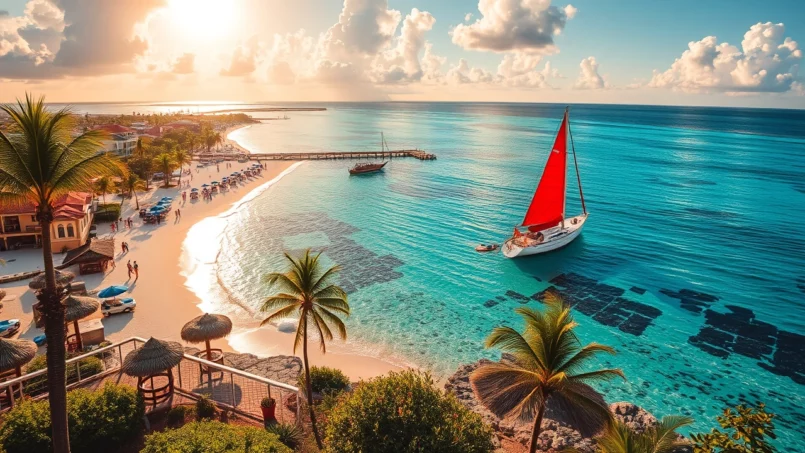
Aruba enjoys a very sunny and warm climate (28-30°C on average), with little rainfall and constant trade winds that temper the heat. Its relative aridity avoids the stifling humidity of other islands. The living environment features potable tap water (desalinated), crystal-clear sea, renowned beaches like Eagle Beach, dunes near the California Lighthouse, and coves ideal for snorkeling, such as Boca Catalina.
At the same time, Aruba also offers a wilder side, with desert landscapes, cacti, and rock formations in Arikok National Park, which covers nearly a fifth of the territory. Hiking, swimming in natural pools, exploring dunes or wave-battered cliffs round out the purely beachy image.
Increase in average air temperature since 1980 in this region, illustrating the tangible impact of global warming.
For a future resident, this means two things: a gorgeous natural environment that is very accessible daily, but also a growing vulnerability to heat, potential water shortages, and ecosystem degradation on which the island’s appeal directly depends.
A multicultural society and a “poco poco” culture
With about 110,000 inhabitants and more than 90 nationalities from over 130 countries, Aruba is one of the most diverse societies in the region. This mosaic is reflected in language – Papiamento and Dutch as official languages, English and Spanish widely spoken – but also in cuisine, festivals, religious traditions, and daily life.
The local lifestyle is often described by the expression “poco poco,” literally “slowly, slowly”. The idea: avoid stress, enjoy the present, and don’t get overwhelmed by urgency. In practice, this translates into a slow island culture where people take time to chat, gather on doorsteps, at beach bars, or around a barbecue. Locals are known for being friendly and welcoming, especially aware of the importance of tourism and expats to the economy.
For a newcomer, the social climate offers real advantages. You can feel safe, as the crime rate is low and the island is considered one of the safest in the Caribbean. Expats often report a warm community, very active online forums and groups, and ease in making contacts through work, outdoor activities, or volunteering. The coexistence of many cultures means differences, including in sexual orientation or lifestyle, are generally well accepted.
But this “poco poco” culture can also become a hurdle. For those coming from fast-paced metropolises, adapting to the local tempo is one of the main shocks. Administrative procedures, responses from some public or private services, or the way urgency is handled can seem slow, even unmotivated. Many studies in cross-cultural psychology show that this phase of “culture shock” – after the honeymoon of the first weeks – leads to a drop in productivity, sometimes family tensions, and a high rate of early return. It is estimated that globally, nearly half of expatriations end in failure (return earlier than planned), and personal and family adaptation difficulties account for nearly half of the identified causes.
In Aruba, integration can be hindered by a language barrier (Dutch or Papiamento), different social codes, and a work pace perceived as less rigorous. It requires patience, cultural curiosity, flexibility, and a genuine willingness to become part of local life.
Languages: asset and challenge for integration
On the linguistic front, Aruba offers both advantages and difficulties for the expat.
The first positive aspect is widespread multilingualism. Papiamento, the local Creole language, and Dutch are official. English is very widely understood and used, especially in tourism and services, and Spanish is common due to proximity to South America. It’s not unusual to hear a conversation mixing all four languages. An English or Spanish speaker can get by daily without much trouble, especially in restaurants, shops, hotels, or leisure activities.
Proficiency in Dutch and/or Papiamento is essential to access skilled jobs, interact with the administration, attend school in the public system (where Dutch is predominant in secondary school), or receive medical care. Without this knowledge, school options are limited to private international schools, which are often expensive.
Therefore, those planning a long-term settlement are advised to at least start learning Papiamento, which greatly facilitates social interactions, or Dutch if aiming for positions in administration, education, healthcare, or certain professional services. Dutch nationals have a slight linguistic and administrative advantage, as road signs are in Dutch and local law is largely inspired by Dutch law.
A high standard of living… and a cost of living that follows
One of the most sensitive points for an expat in Aruba is undoubtedly the cost of living.
The island’s economy is considered modern and high-income for the region, with a GDP per capita of about $26,000 USD, relatively low unemployment, and high labor productivity. But this prosperity relies heavily on tourism and massive imports: food, consumer goods, fuel, materials… Almost everything arrives by ship or plane, with customs duties that can reach up to 57% (though many products hover around 12%).
The cost of living excluding rent can be more than 30% higher than in some European countries.
To illustrate this reality, here are some benchmarks in Aruban florins (AWG) and US dollars to give you an idea.
Examples of monthly costs and basic goods
| Expense category | Typical amount (AWG) | Approx. equivalent (USD) |
|---|---|---|
| Monthly budget for one person | ≈ 3,600 AWG | ≈ 2,000 USD |
| Monthly budget for a family of four | ≈ 7,900 AWG | ≈ 4,400 USD |
| Rent for 85 m² apartment in expensive area | ≈ 2,500 AWG | ≈ 1,400 USD |
| Rent for 45 m² studio in standard area | ≈ 1,250 AWG | ≈ 700 USD |
| Utilities (85 m², 2 people) | ≈ 300 AWG | ≈ 170 USD |
| Monthly internet | ≈ 54 AWG | ≈ 30 USD |
On the food side, the same trend applies.
Examples of food prices
| Product | Typical price (AWG) | Comment |
|---|---|---|
| Lunch with daily special | ≈ 25 AWG | Simple restaurant |
| Fast-food combo meal | ≈ 14 AWG | International chain type |
| 500 g chicken breast | ≈ 7 AWG | |
| 1 L whole milk | ≈ 4.4 AWG | |
| Dozen eggs | ≈ 6 AWG | |
| 1 kg tomatoes | ≈ 8 AWG | |
| Local beer 0.5 L (supermarket) | ≈ 6 AWG | |
| Bottle of decent wine | ≈ 65 AWG | Imported table wine |
Leisure, transportation, and service expenses follow the same logic: a gym membership in town runs around 185 AWG, a movie ticket about 11–15 AWG, a beer at a neighborhood bar around 11 AWG, a cocktail close to 18 AWG. Gasoline is also expensive by North American or European standards, though the exact differential depends on global fluctuations.
Tips for adjusting your budget and lifestyle when settling on the island.
Prioritize locally available products and frequent restaurants with Aruban prices rather than tourist establishments to reduce your expenses.
Adopt a more modest consumption pattern and avoid replicating your original habits identically to keep the overall bill down.
For a family, especially with children enrolled in international schools, the monthly budget remains substantial and requires careful planning.
Housing: a tight market with significant disparities
Finding housing is one of the critical steps of expatriating to Aruba. The island is small, the most attractive areas are heavily tourist-oriented, and land pressure is high, especially on the northwestern coast between Oranjestad and Palm Beach.
Noord concentrates a large part of upscale tourism and is one of the most sought-after areas for expats. It features major hotels, restaurants, shops, and direct access to flagship beaches. This convenience comes at a price: rents here are among the highest on the island, especially in gated communities or complexes with pools.
Rent ranges
| Type of housing | Area | Typical monthly rent |
|---|---|---|
| Furnished studio 45 m² | Expensive area | ≈ 1,850 AWG (≈ 1,000 USD) |
| Furnished studio 45 m² | Standard area | ≈ 1,250 AWG (≈ 700 USD) |
| 1-bedroom apartment in city center | 600–1,000 USD | |
| 3-bedroom apartment in city center | 1,500–2,500 USD | |
| 3-bedroom villa in gated community (purchase) | ≈ 420,000 USD (real example) |
Gated communities like Tierra del Sol Resort & Golf or Gold Coast Aruba offer a very secure living environment with pools, golf courses, security, and sometimes gyms. They particularly attract retirees, expatriate executives, and wealthy families, but widen the gap between residents embedded in these micro-communities and the local population.
Flat property tax rate applied to non-residents, compared to a progressive scale for residents.
To get started, the most realistic strategy is often to book temporary accommodation – a furnished apartment, guesthouse, or small hotel – for a few weeks in Noord or Oranjestad, while visiting long-term rental properties, understanding neighborhoods, and negotiating terms. Several addresses are frequently recommended to newcomers for this transition phase, from “budget” rentals to more upscale family villas.
Mobility: a car is almost indispensable
Another reality sometimes underestimated before arrival: transportation organization. Aruba does have a bus network (Arubus) connecting Oranjestad, the airport, hotel areas, and some neighborhoods. Fares remain reasonable given the local cost of living, and day or monthly passes are available. Similarly, taxis are regulated, require an official license, and fares are set by the government.
The infrastructure is primarily designed for vehicles, with often discontinuous sidewalks and few bike lanes. The heat makes walking or cycling unpleasant, complicating daily errands and access to beaches without a personal car.
Examples of transportation costs
| Transport item | Typical amount |
|---|---|
| Single bus ticket | ≈ 2.75 AWG |
| Monthly bus pass | ≈ 40–150 AWG (depending on plan) |
| Taxi starting fare | ≈ 7–20 USD |
| Gasoline (1 L) | ≈ 1.1 AWG (≈ 0.6 USD, variable) |
| Average monthly cost of car ownership | ≈ 600 AWG (fuel, insurance, maintenance) |
Services like Uber or Lyft are not available, limiting alternatives to taxis, car rental, or buying a used vehicle (often from departing expats). For many long-term residents, owning a car becomes simply indispensable, adding a significant expense to an already tight budget.
Safety, healthcare, services: a solid foundation for settling in
In terms of safety, Aruba presents a very reassuring profile. Violent crime rates are low, especially in tourist and residential areas frequented by expats. The most common offenses involve petty theft, opportunistic burglaries, or theft from vehicles, particularly during festive periods like Carnival. The island is also a transit point for drug trafficking between South America and northern markets, which generates a risk of organized crime, but the police are relatively well-equipped, with over 600 officers and a dedicated tourist zone unit.
Basic precautions still apply: don’t leave valuables visible in cars, avoid isolated places at night, be vigilant during large festivals, and don’t underestimate the severity of local drug laws regarding possession or use. Overall, however, many residents report feeling safer in Aruba than in some major cities in their home countries.
On the healthcare front, the island has a system considered among the best in the Caribbean. The Dr. Horacio Oduber Hospital in Oranjestad is the main hospital, with about 280 beds, modern equipment, and many specialties. It is complemented by a medical center in San Nicolas, private clinics in Noord, recent laboratories, and a non-profit heart institute. Four major medical centers cover the territory, ensuring good basic coverage.
Aruba has a mandatory health insurance (AZV) covering residents and foreign workers for general and specialized care, hospitalization, and many medications. Some care, like dental care, remains partially out-of-pocket. For serious conditions requiring medical evacuation abroad, supplementary international insurance covering these costs is strongly recommended.
Pharmacies (“botikas”) are well-stocked, but do not fill prescriptions from abroad: you need to see a local doctor to renew a treatment. However, practitioners and healthcare staff often speak several languages, including English, which eases communication for expats.
Immigration, work, and residency: a strict framework to anticipate
The most beautiful beach in the world doesn’t make up for poorly prepared stay procedures. In Aruba, the issue of right to stay and work is a central point of any expatriation project.
The competent immigration authority is the Departamento di Integracion, Maneho y Admision di Stranhero (DIMAS). For short stays, regulations are relatively flexible. Most visitors can stay as tourists for up to 30 days, with possible extensions up to 90 or 180 days depending on nationality (with specific conditions for Americans, Dutch nationals, or holders of certain foreign visas and residence permits). As a tourist, it is forbidden to work for an Aruban entity or earn local income. Remote work for an employer based abroad is allowed within certain limits, but does not grant resident status.
For a stay longer than a few months in Aruba, a change of status is required (work permit, residence permit, independent retiree status, etc.). Obtaining a work permit is subject to the principle of local preference: an employer can only hire a foreigner if they prove to the Department of Labor (DPL) that no Aruban or already established resident candidate is available for the position.
This system has several very concrete implications:
– It is extremely difficult to arrive without a contract and hope to “find on the spot” a skilled job;
– The work permit is usually tied to a specific employer and position for a limited duration (often one year, sometimes less in seasonal hospitality);
– Changing employers or functions typically requires a new application, with the risk of temporarily losing the right to work;
– Any work without a permit is illegal, exposes both employee and employer to penalties, and compromises chances of obtaining future visas.
For long-term stays, especially for retirees, you generally need to provide: proof of sufficient resources, a clean criminal record, medical certificates attesting to absence of contagious diseases, and sometimes specific vaccinations (such as yellow fever if coming from an endemic area). Non-active individuals must prove they can support themselves without working locally.
In parallel, Aruba has designed specific programs like the “One Happy Workation” for American remote workers, offering the possibility to reside and telework for up to 90 days. But these are temporary stays, with no right to access the Aruban labor market or automatic path to a residence permit.
Overall, Aruba’s legal environment strongly protects the local labor market and requires thorough preparation in advance. Anticipating processing times (several weeks to several months for some permits), avoiding travel while an application is pending (which can result in entry refusal), and ensuring compliance at all times is essential to prevent the expat dream from turning into an administrative headache.
Job market: opportunities and limitations
For those who manage to get through the permit process, the job market offers both real opportunities and structural limits.
Aruba’s economy is highly specialized. Tourism – hotels, casinos, cruises, restaurants, water sports – accounts for 70 to 90% of economic activity depending on estimates, and more than 88% of jobs are directly or indirectly linked to this sector. Other branches include commerce, some offshore financial activities, construction, public services, healthcare, education, professional services, and a small amount of agriculture or local production.
The hospitality, food service, and leisure sectors actively seek profiles such as front desk, housekeeping, restaurant, bar, entertainment, spa, water sports, revenue management, and hotel management. These positions can offer significant perks like housing, meals, and the possibility of substantial tips. Contracts are often seasonal, lasting 3 to 6 months, especially during peak seasons (December to April and mid-summer).
Other sectors are also hiring: nurses, doctors, lab technicians, teachers, logistics specialists, IT professionals, accountants, lawyers, compliance experts, project managers, specialists in renewable energy or sustainability. The government’s stated aim is to diversify the economy toward technology, international finance, clean energy, circularity, and even new industries like regulated hemp/cannabis.
Curacao’s economy is diversifying, but it remains heavily dependent on tourism. For a highly skilled expat, job opportunities exist but are limited in number. Competition with local and regional candidates is strong. In this context, proficiency in multiple languages, especially Dutch, English, and Spanish, is a decisive advantage to stand out.
One element to factor in is the gap between the general salary level and the cost of living. The average net monthly salary is around $2,000 USD, which is significantly lower than the average in North America or Western Europe. Yet, as we’ve seen, everyday expenses are often higher than overseas or in Europe. Even if some expat contracts compensate with benefits in kind (housing, vehicle, expatriation bonus), it’s wise not to overestimate your financial leeway.
Taxation: a progressive system, not a tax haven
Aruba offers taxation perceived as attractive for businesses and certain investors, but it is not a tax haven in the classic sense for individuals.
For tax residents – those whose vital interests (family, work, assets) are in Aruba – income tax is progressive and can reach a top bracket of around 52% on the highest incomes. Non-residents are only taxed on certain types of Aruban-source income (employment exercised on the island, as a director of an Aruban company, local business activity, etc.), but at the same progressive rates on that income.
Employment income, professional profits, and rental income are taxable. Interest from savings accounts is exempt from tax under certain conditions. Capital gains are not subject to a separate tax, but may be taxed as part of income tax in specific cases, such as the sale of substantial shareholdings or investment properties.
Several deductions are available on the tax return, including for standard professional expenses, mortgage interest, certain life insurance policies, exceptional medical expenses, and donations, each subject to caps. Self-employed workers may qualify for a small specific deduction. It’s important to note that tax residents generally have access to more deduction possibilities than non-residents.
In terms of indirect taxes, Aruba applies a turnover tax (and various additional levies) similar to VAT, though not always called that. It applies to goods and services sold locally and is passed on to prices. Import duties, sometimes high, complete the picture, along with specific taxes on cigarettes, alcohol, fuel and a tourist levy that indirectly impacts accommodation prices.
Property tax is progressive for residents and proportional for non-residents and companies. Real estate acquisitions are subject to transfer taxes (3% then 6% depending on value), plus notary and agent fees. Wealth tax and inheritance/gift taxes were abolished in 2018, but real estate transfers remain subject to transfer duties.
Internationally, Aruba has introduced incentive regimes to attract certain investments. Companies established in free zones may benefit from a very reduced corporate tax rate (around 2% in some cases), exemptions on certain participation income, or relief on import duties for capital goods. These regimes are regulated and evolve regularly to remain compliant with OECD international standards.
For the expatriate, the key point is to understand that, unless in a very specific status, you will be taxed according to significant progressive brackets, and may need to manage a double tax obligation with your home country in the absence of a double taxation treaty. Appropriate tax planning – without seeking abusive optimization – is therefore recommended, especially for Americans, who remain taxable in the US even when living permanently in Aruba.
Environment, overtourism, and long-term vulnerabilities
Another aspect to seriously consider before settling in Aruba is the sustainability of the model on which the island relies.
Mass tourism, rapid population growth, urbanization alongside critical infrastructure (hotels, ports, power plants, water and sewage networks): all this creates intense pressure on a tiny territory, nearly devoid of arable land, extremely dependent on food and energy imports.
Studies reveal high exposure to climate change effects, including: more frequent extreme heat threatening an aging population, localized flood risks, coastal erosion, sargassum proliferation harming tourism and ecosystems, and pressure on freshwater resources already dependent on desalination.
Coral reefs, which directly generate a significant share of tourism spending (over 20% according to some estimates), have seen their coverage decline by more than half in three decades. Seagrass beds are retreating, mangroves – which cover just over one percent of the island’s surface – are fragmented. Dunes, highly vulnerable to unplanned construction and off-road vehicle traffic, are eroding.
The government has established a National Climate Resilience Council and is planning long-term actions. These include ecosystem restoration, revision of coastal urban planning, strengthening energy and water security, promoting renewable energy, supporting “climate-smart” agriculture, and diversifying tourism toward sustainable models. A fragile balance persists despite these initiatives.
For an expat, these issues are not just abstract or activist. They affect daily comfort (number of sweltering hot days, sea water quality, presence of algae on beaches), energy bills (more frequent air conditioning, risk of blackouts during consumption peaks), access to certain services (infrastructure damaged by floods, for example), and even the value of a coastal real estate investment in the medium to long term.
Social life, leisure, education: a pleasant but limited environment
Life in Aruba offers a rich range of leisure activities for an island of this size: beach of course, but also snorkeling, diving, kite-surfing, paddleboarding, hiking in Arikok Park or up to Hooiberg with its hundreds of steps, boat trips, beach barbecues, concerts at beach bars like Bugaloe or MooMba, colorful street art in San Nicolas, discovering local cuisine at spots like Zeerovers (ultra-fresh fish), Nos Clubhuis (Sunday barbecue), or Local Store (local dishes at more affordable prices).
For fans of more urban nightlife, however, the offerings remain limited: few clubs, a cultural scene inevitably more restricted than in New York, Montreal, Paris, or Amsterdam. The island has festivals, a renowned Carnival, and community events, but the entertainment is on the scale of a small island society.
The public education system, inspired by the Dutch model, is largely free for residents, but instruction is mostly in Dutch starting in secondary school, which can pose integration difficulties for non-Dutch-speaking children. Alternatives exist with private, religious schools, and international institutions like the International School of Aruba, which offers an English-language curriculum from kindergarten through high school following an American approach. These solutions, suitable for expat children, involve significant tuition fees, potentially exceeding €7,000 per year for elementary and much higher for secondary.
For higher education, the main institution is the University of Aruba, offering programs in law, management, tourism, arts, and sciences. A significant portion of local youth study abroad, especially in the Netherlands, the United States, or other Caribbean islands, and do not always return, creating a brain drain that authorities are trying to curb.
For expats with teenagers or young adults, it’s essential to carefully weigh available options, the language of instruction, and long-term prospects. A few years’ expatriation during elementary or early secondary school will be easier to manage than a permanent settlement with a full university plan on the island.
Pros and cons: weighing the balance before leaving
At the end of this overview, a few key trends clearly emerge.
On the pros side of expatriating to Aruba, we find:
– a spectacular natural environment, with world-class beaches, a sunny climate, and low hurricane risk;
– a high level of safety, a relaxed atmosphere, and a sense of hospitality regularly praised;
– a multicultural, multilingual society where English and Spanish are widely understood;
– a solid healthcare system for the region, with mandatory insurance covering foreign residents;
– a dynamic job market in tourism and services, with recurring demand for certain profiles;
– attractive taxation for certain businesses or strategic investments;
– a social life focused on the outdoors, the sea, and leisure, promoting a better work-life balance.
The cons essentially relate to: limitations of certain features, the potential cost, and the need for user training.
Expatriating to Costa Rica presents several challenges to consider: high cost of living (food, housing, education), a vulnerable economy dependent on tourism, strict immigration procedures, the necessity of a car, cultural shock related to the pace of life, limited urban infrastructure, and growing vulnerability to climate change.
At its core, Aruba is neither a tax haven nor simply an open-air resort. It is a small, complex society, both prosperous and fragile, very open to the world but careful to protect its social fabric and labor market.
For certain profiles, expatriation to Aruba can offer an exceptional quality of life. This includes retirees with stable income, supervised remote workers, hospitality and tourism professionals, couples without children, or families willing to bear the cost of international school. Success in this project depends on careful budget calibration, strict adherence to immigration rules, and a sincere commitment to learning local cultural and social codes.
For others – young families on a tight budget, workers hoping to “find something on the spot” without a contract or clear plan, people primarily seeking the vibrant cultural life of a big city – the island, after the initial enthusiasm, may reveal limits that are hard to overcome.
Before packing your bags, it’s best to consider Aruba not as a groundless utopia, but for what it really is: a “One Happy Island” for those who come knowingly, prepared financially, administratively, and mentally to embrace both its strengths and its fragilities.
Disclaimer: The information provided on this website is for informational purposes only and does not constitute financial, legal, or professional advice. We encourage you to consult qualified experts before making any investment, real estate, or expatriation decisions. Although we strive to maintain up-to-date and accurate information, we do not guarantee the completeness, accuracy, or timeliness of the proposed content. As investment and expatriation involve risks, we disclaim any liability for potential losses or damages arising from the use of this site. Your use of this site confirms your acceptance of these terms and your understanding of the associated risks.

Cyril Jarnias is an independent expert in international wealth management with over 20 years of experience. As an expatriate himself, he is dedicated to helping individuals and business leaders build, protect, and pass on their wealth with complete peace of mind.
On his website, cyriljarnias.com, he shares his expertise on international real estate, offshore company formation, and expatriation.
Thanks to his expertise, he offers sound advice to optimize his clients' wealth management. Cyril Jarnias is also recognized for his appearances in many prestigious media outlets such as BFM Business, les Français de l’étranger, Le Figaro, Les Echos, and Mieux vivre votre argent, where he shares his knowledge and know-how in wealth management.





