
 Published on and written by Cyril Jarnias
Nestled between the lush green hills of the Rift Valley and the deep waters of Lake Tanganyika, Burundi remains largely unknown to travelers. Yet this small East African country packs an astonishing variety of landscapes, parks, lakes, and unique cultural sites into a tiny territory. From tropical montane forest, fine sandy beaches, royal sanctuaries, and memorial museums, the must-see tourist sites in Burundi trace a true journey of discovery through the country’s nature, history, and soul.
Understanding the Framework: Climate, Seasons, and the Best Time to Explore the Country
Before diving into the absolute must-see places, it helps to understand the rhythm of the seasons, because here the weather largely dictates access to the parks, animal sightings, and even the atmosphere of the landscapes.
The country enjoys a tropical highland climate with pleasant average temperatures of 68°F to 73°F (20–23°C). The terrain moderates equatorial heat, making mountain hikes very comfortable. Lower areas, such as the Rusizi plains and the shores of Lake Tanganyika, can experience higher temperatures.
The climate calendar is based on four distinct seasons. Two dry periods, June to August and December to January, alternate with two rainy seasons, February to May and September to November. The long dry season from June to August is considered the best time to explore the national parks, hike the summits, or enjoy the lake beaches: roads are more passable, trails less muddy, and the sky often clear, especially in July, which averages about 70% sunshine.
For wildlife viewing, favor the dry season, as animals gather around water points and the sparser vegetation makes sightings easier. For landscapes and birdwatching, the rainy season (March to May) is ideal, offering spectacular waterfalls and vibrant greenery, though some trails may become difficult to access.
To better visualize this seasonal rhythm, here’s a quick summary:
| Approximate Period | Type of Season | Tourism Advantages | Main Limitations |
|---|---|---|---|
| June – August | Long dry season | Clear skies, passable roads, excellent for safaris & hiking | Landscapes slightly less green |
| December – January | Short dry season | Good weather compromise, chimpanzees easier to track in Kibira | Warmer period, year-end crowds |
| February – May | Long rainy season | Waterfalls at their peak, lush landscapes, excellent birding | Muddy trails, some access tricky |
| September – November | Short rainy season | Green landscapes, tea harvest (September), fewer tourists | Frequent showers, reduced visibility in the bush |
Within this climate framework, each Burundian site reveals a different face depending on when you visit. The country is best explored by cleverly combining dry seasons for the parks and shoulder seasons for waterfalls and culture.
Bujumbura and Lake Tanganyika: Beaches, Monuments, and the Country’s Gateway
Almost every trip begins in Bujumbura, a large city perched on the northeastern shore of Lake Tanganyika. Once the capital, it remains the country’s main air, economic, and cultural hub. Its charm doesn’t lie in a collection of “grand monuments,” but in a surprising mix of a relaxed lakefront, colonial architecture, bustling markets, and memorial sites.
The Shores of Lake Tanganyika: The Freshwater Giant
Lake Tanganyika is one of the centerpieces of the Burundian landscape. The world’s second-largest freshwater lake by volume and depth, it descends to nearly 1,470 meters (4,823 feet) and stretches over 670 kilometers (416 miles). The intense blue waters host more than 300 species of fish, of which about 95% are endemic. Cichlids are particularly abundant, with over 250 species recorded, making the lake a paradise for biologists… and for divers and sport fishermen alike.
On the Burundian shore of Lake Tanganyika, Bujumbura’s beaches like Saga Beach, Uzuri Beach, ‘Karera’ beaches, or Sanga Resort Beach are iconic relaxation spots. They offer strips of sand perfect for swimming, lounging, and watching spectacular sunsets. In the late afternoon, Burundians gather there to play soccer on the sand, sip a cool drink, or share a plate of grilled fish.
Water activities include swimming, kayaking, paddleboarding, traditional boat rides, sunset cruises, and sport fishing for Nile Perch or Sangala Pamba, which can weigh up to a hundred kilos (220 lbs). The waters are generally calm and warm, but the windiest periods, in October–November, can stir up the surface and limit some activities.
On a practical note, access to the beaches near the city is often free, and boat excursions can be negotiated for a few dozen dollars depending on duration and type of vessel. For budget travelers, it’s possible to spend an entire day by the water with no costs other than food.
For a quick overview of what the lake offers on the Burundian side:
| Lake Tanganyika Feature (Burundi Side) | Key Characteristics | Highlight Activities |
|---|---|---|
| Saga, Uzuri & other urban beaches | Sand, clear water, lively local atmosphere | Swimming, sunbathing, cafes, fish dishes |
| Fishing village & port of Bujumbura | Boats, fish markets, daily life of fishermen | Canoe trips, photography, cultural immersion |
| Rusizi area (northern end of lake) | Rusizi delta, aquatic fauna and birds | Boat safaris, hippo & crocodile watching |
| Nyanza-Lac & southern coast | Fishing hamlets, small beaches, historical memorials | Relaxation, fishing, village excursions |
Beyond the landscape, the lake flavors local cuisine. “Mukeke”, Tanganyika’s signature fish, is enjoyed grilled, accompanied by plantains, rice, or cassava. Small fried “ndagala” fish are sold in markets and on beaches, often served with skewers and tropical fruits.
Monuments and Urban Sites of Bujumbura
Just a few streets from the lakefront, Bujumbura reveals its historical landmarks. The city retains visible traces of the Belgian period in some colonial buildings, as well as more recent markers of the country’s turbulent history.
The Monument to Unity, a symbol of national reconciliation, and the Mausoleum of Prince Louis Rwagasore, a figure of independence, are essential sites for understanding Burundi’s political memory. The visit can be complemented by other mausoleums dedicated to independence heroes.
Nearby, the Regina Mundi Cathedral also draws the eye with its colorful stained glass and imposing architecture. To grasp the more religious and social dimension of the country, many visitors appreciate stopping here, as well as at the Living Church or the French Institute of Burundi, often lively with exhibitions or cultural events.
Discover the atmosphere and signature products of the central market, the city’s lively heart.
Fresh fruits, spices, textiles, wooden handicrafts, pottery, and woven baskets.
Enjoy classics: ugali, matoke, isombe, and small skewers.
Pastries inspired by French tradition: baguettes, quiches, and viennoiseries.
The Living Museum and “Behind the Scenes” of Burundian Culture
Still in Bujumbura, the Living Museum holds a special place. Conceived as a mix between a small zoo and a cultural center, it gathers reptiles, crocodiles, monkeys, birds, an aquarium, a botanical garden, and reconstructions of traditional huts. On one site, you can observe local wildlife, discover medicinal plants, watch craft demonstrations, and sometimes see dances or percussion performances.
The Living Museum functions as a living introduction to Burundian rural traditions: model houses, farming tools, everyday objects show how communities organize around agriculture, livestock, and community rituals.
Rusizi National Park: The Most Accessible Safari in the Country
Just about fifteen kilometers (9 miles) separate Bujumbura from Rusizi National Park. That’s what makes it the most visited park in the country: in a few minutes you go from urban traffic to hippos lounging in the muddy waters of the river.
The park is located on the floodplains of the Rusizi River at its mouth into Lake Tanganyika. It comprises a vast wetland ecosystem with marshes, gallery forests, grassy savanna, and papyrus zones. Wildlife includes hippos, Nile crocodiles, sitatunga (swamp antelope), warthogs, buffalo, vervet monkeys, and baboons. Elephants are sometimes mentioned but not universally confirmed.
One of the park’s most famous legends revolves around “Gustave”, a giant crocodile notoriously known for attacks on humans, reaching near-mythical status in the region.
Yet Rusizi’s great strength remains its birdlife. Over 200 bird species have been recorded here, including herons, ibises, African fish eagles, cormorants, whistling ducks, pelicans, bee-eaters, weavers, and migratory terns. Birdwatchers find prime spots in the observation towers and along the riverbanks.
The park’s main activities are boat safaris, guided walks, and off-road vehicle trips.
The dry season, from June to September, is ideal for visiting: water levels are more stable, trails are accessible, and visibility is better. In the rainy season, some areas may flood, but the colors and density of the vegetation completely transform the scenery.
For travelers short on time, Rusizi is often combined with a half-day in the city or on the lake beaches, making it a perfect nature escape from Bujumbura.
Kibira National Park: Immersion in the Great Montane Forest
Leaving the lakeshore to ascend the highlands of the northwest, you enter a completely different world: that of mists and the montane forest of Kibira National Park. Situated between 1,550 and 2,660 meters (5,085–8,727 feet) above sea level, on the Congo–Nile watershed divide, this park of about 40,000 hectares (99,000 acres) is the largest block of tropical montane forest in Burundi.
It extends southward from Rwanda’s Nyungwe National Park, with which it forms a major ecological continuum at the heart of the Albertine Rift. This is where the country’s last great montane forests survive, once much more extensive but largely converted to farmland.
Kibira, a former royal hunting ground, is now a bastion of biodiversity. Nearly a hundred mammal species are recorded, including several primates: chimpanzees, black-and-white colobus, baboons, red-tailed monkeys, vervets, blue monkeys. Elephants, buffalo, duikers, and even giant forest squirrels find refuge here. Over 200 bird species complete the inventory, with emblematic species like the great blue turaco, the gray parrot, and the bar-breasted barbet.
The forest is a massive water tower: many rivers originate here, feeding crops and towns downstream. For neighboring communities, this massif has a sacred as well as ecological dimension.
Main activities include hiking, nature walks, and birdwatching. Chimpanzee tracking, rarer here, requires a special permit and an experienced guide. Unlike some other sites, Kibira’s chimpanzees are not fully habituated to humans, making each encounter especially precious.
Access is mainly from Bujumbura (about 1–2 hours by road), via the tea plantations of Teza and Rwegura or the tourist village of Busekera. These vast tea fields on the slopes create beautiful panoramas where the bright green of the crops contrasts with the dark of the forest.
Seasonal choice is crucial. The long dry season from June to September facilitates hiking and limits mud, while the short dry period of December–January is often considered one of the best times for chimpanzee tracking, as more abundant food makes them less mobile. The rainy seasons, March to May and September to November, cloak the park in impressive lushness and benefit birders, though trails become slicker.
To summarize the characteristics of the three main national parks:
| National Park | Location & Main Environment | Emblematic Wildlife | Key Activities |
|---|---|---|---|
| Rusizi | Floodplains and river delta near Bujumbura | Hippos, crocodiles, sitatunga, waterbirds | Boat safaris, birdwatching, guided walks |
| Kibira | Montane forest on the Congo–Nile ridge | Chimpanzees, colobus, elephants, turacos | Hiking, primate tracking, birdwatching |
| Ruvubu | Savanna, gallery forests, and eastern hills | Buffalo, antelopes, hippos, primates, large raptors | Safaris, walking, wildlife & flora observation |
Ruvubu National Park: The Forgotten Great Savanna of the East
Less known than Rusizi or Kibira, Ruvubu National Park is nonetheless the country’s largest, covering over 50,000 hectares (123,500 acres). Located in the east and northeast, it stretches along the Ruvubu River, from which it takes its name. The park preserves the last large expanses of natural savanna still relatively intact in Burundi.
The park hosts a wide variety of animals: buffalo, antelopes (waterbucks, duikers, topis, reedbucks), warthogs, hippos, and Nile crocodiles. It also holds several primates (olive baboons, vervet monkeys, red colobus, blue monkeys, galagos), felines like leopards and panthers, and occasionally lions from Tanzania.
For birders, Ruvubu is a goldmine, with over 300 bird species recorded: crowned cranes, pelicans, ibises, yellow-billed storks, papyrus gonoleks, sunbirds, warblers, babblers… Its designation as a Ramsar wetland attests to its ecological importance.
Ruvubu National Park offers several activities to explore the savanna: vehicle safaris, guided walks, and boat trips on the river. Accommodation options are more limited than in Bujumbura: you can stay in the nearby town of Muyinga or choose camping inside the park. Access requires a journey of over 200 km (124 miles) from the capital, but it allows for an authentic experience in an environment still untouched by mass tourism.
As with the other parks, the long dry season (June–August) significantly improves viewing and travel conditions, while the March–May rains make trails and roads heavier, though offering beautifully green landscapes.
Forests and Nature Reserves: Bururi, Kigwena, Rwihinda, Vyanda…
Beyond the big national parks, Burundi is home to several smaller but highly interesting nature reserves for those wanting to delve deeper into its ecosystems.
This reserve, located in southern Burundi, protects the last remnants of montane forest in the region over more than 3,000 hectares (7,400 acres). It harbors remarkable biodiversity: over 350 plant species, about 200 bird species, and at least five primate species. Among the latter is the Burundi red monkey, an endemic species, as well as chimpanzees, reputedly easier to spot here than in other forests. Marked trails allow visitors to reach viewpoints offering panoramas over the surrounding hills and valleys.
Further southwest, the Kigwena Nature Reserve borders the shore of Lake Tanganyika. This small lowland forest, of a “peri-Guinean” type, features vegetation close to that of the Congo Basin. Large trees like Terminalia superba or Albizia zygia form a dense canopy, beneath which move groups of monkeys, baboons, hippos occasionally coming from the lake, as well as several snake species, including the African rock python and cobras. Butterflies are particularly abundant here.
The Lake Rwihinda Nature Reserve, nicknamed ‘Bird Lake’ and located near Kirundo on the Rwandan border, is a prime site for observing numerous migratory bird species from Europe and Asia, such as herons, cormorants, cranes, pelicans, and egrets. Excursions are usually done by barge for silent navigation among reeds and floating islets.
The Rumonge Reserve, partly forested, and the Vyanda Forest, where local community eco-guards (supported by NGOs like the Jane Goodall Institute) watch over primates and trees, round out this set of more off-the-beaten-path sites, suitable for travelers wanting to step away from the most known circuits.
Waterfalls, Faults, and Springs: The Spectacular Landscapes
The must-see natural sites of Burundi are not limited to parks and forests. The land of “a thousand hills” is also characterized by waterfalls, impressive gorges, and mythical springs that dot the territory.
Karera Waterfalls: An Amphitheater of Cascades
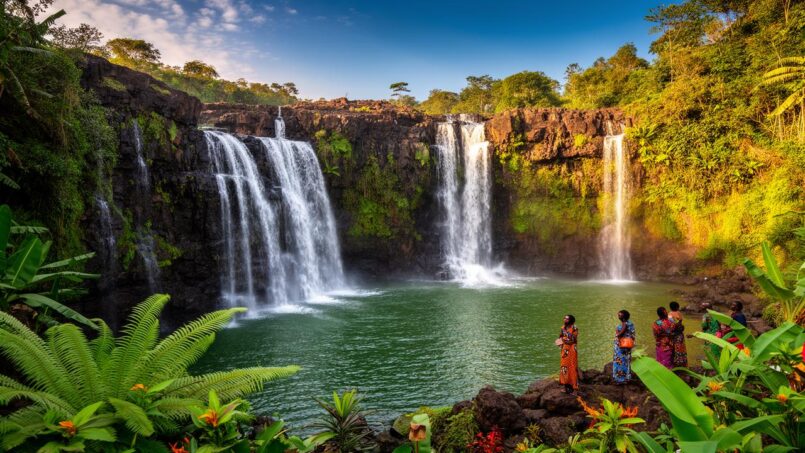
The Karera Waterfalls (also called Kagera Falls) are among the most photographed landscapes in the country. Located in the Rutana region, they form a set of several cascades spread across different rock levels, surrounded by lush vegetation. There are several main falls and secondary trickles that, during the rainy season, create a veritable aquatic amphitheater setting.
This natural site holds great cultural importance, serving as a gathering place for rituals and celebrations of local communities for centuries. For an optimal visit, the period from late September to early November, corresponding to the short rainy season, is recommended. This is when the waterfall flow is at its peak, while avoiding the extreme conditions of the long rainy season.
Hiking trails allow you to move from one viewpoint to another, cross footbridges, and descend near the pools, where some travelers swim in natural swimming holes formed by erosion.
Nyakazu Fault and the Central Gorges
Also in the Rutana region, the Nyakazu Fault – also called the “German Fault” – offers a striking panorama over a deep ravine where hills suddenly split open, recalling the geological dynamics of the Rift Valley. This site attracts geology enthusiasts, photographers, and hikers alike, who can explore trails winding through meadows, groves, and tea fields.
Located in central Burundi in Mwaro Province, these falls are a sacred site surrounded by ancestral beliefs. Water is central to myths linked to ancestors, fertility, and protection of the territory, making the place a sanctuary for locals.
The Source of the Nile: At the Origins of a Legendary River
Burundi also claims one of the southernmost points considered the source of the Nile. Near the town of Rutovu, a small monument marks a water spring identified by explorers in 1937 as the southernmost “source” of the great river. The modest site is appealing as much for its symbolic value – being at the “beginning” of the Nile – as for the surrounding landscape of hills.
This spring is not the only one linked to the Nile: the site of Gasumo, in Bururi Province, is also among places associated with the river’s origin. Here again, cultural and scientific dimensions intersect, blending local rituals and geographical debates.
Gitega: Political Capital, Cultural Heart
Located inland, Gitega has regained its status as the political capital, but it is also, and above all, the country’s major cultural center. From here, you can easily radiate out to some of Burundi’s most emblematic sites, especially those linked to the former monarchy.
The National Museum of Gitega: The Country’s Material Memory
The National Museum of Gitega, considered the country’s main museum institution, occupies a colonial-style building surrounded by gardens. Founded in the 1950s to preserve objects threatened by modernization, it houses a rich collection of ethnographic, historical, and artistic artifacts.
The various rooms trace the history of the pre-colonial kingdom, the German and Belgian periods, and then the struggle for independence led notably by Prince Louis Rwagasore. You’ll find traditional weapons (spears, shields), musical instruments, drums, pottery, textiles, clothing like the “umushanana,” traditional medicine tools, masks, and ritual “ibihanga” sculptures representing ancestors and spirits.
One gallery displays historical photographs, such as Bujumbura in 1896, reduced to a few tents and a tree, or royal court scenes. The museum also documents painful episodes of the country’s history, such as civil war, ethnic violence, and genocides, without shying away from them.
Despite the richness of its collections, the institution suffers from a lack of resources, limited exhibition space, and low international visibility. Projects exist to digitize collections and modernize displays, but the museum remains, as is, an essential stop for understanding the country’s history. Guided tours, offered by passionate staff, greatly help in reading these objects.
The Gishora Drum Sanctuary: At the Heart of the Royal Drum
Just seven kilometers (4.3 miles) from downtown Gitega, on a hill easily accessible by the Ngozi road, lies one of the country’s most fascinating sites: the Gishora Royal Drum Sanctuary.
Founded at the end of the 19th century by King Mwezi Gisabo, following a military victory, this sanctuary was intended to protect sacred drums and to thank an elder who had helped the sovereign during his escape. It also served as a refuge during resistance against colonial forces.
The Gishora site is a reconstructed traditional palace, featuring thatched enclosures, a royal residence, and themed huts (kitchen, bedroom, wives, council). Its heart is the Inkiranya, the enclosure of the sacred drums.
Among these drums, two bear the names Ruciteme (“the one for whom land is cleared”) and Murimirwa (“the one for whom land is cultivated”). They are never struck: their purpose is symbolic, linked to the fertility of the land and the king’s role as guarantor of abundance.
The site’s guardians are the Batimbo (or Abatimbo), descendants of a lineage of master drummers and drum makers, the Abanyigisaka. They are the ones who perpetuate the tradition of the “ritual royal drum dance,” inscribed on UNESCO’s Representative List of the Intangible Cultural Heritage of Humanity in 2014.
During a performance, at least a dozen drums are arranged in a semicircle around a central drum. The total number always remains odd. Some drums maintain a basic rhythm, while others, guided by the lead drum, develop variations. Two or three drummers dance as they strike their instruments, to the sound of heroic songs and recited poems. The gestures, precise and powerful, express strength, unity, and the continuity of the nation. Burundians consider this practice one of the pillars of their identity.
At Gishora, visitors witness these demonstrations in a context that goes far beyond a “folkloric performance”: stories are told of key episodes of royal history, explanations are given about drum making, the rules surrounding their use, and the transmission of knowledge through hands-on apprenticeship. Men are the only ones allowed to strike the drums, while women participate through dance and song.
This sanctuary, often presented as an essential part of any trip to Burundi, is at once an artistic site, living spirituality, and an educational center for local youth. Its visit ideally complements that of the Gitega Museum, providing the sonic, bodily, and ritual dimension that exhibition halls alone cannot convey.
Other Historical and Cultural Sites: Palaces, Memorials, Living Art
Around Gitega, several former royal sites – Banga, Mugamba, Muramvya – recall the political geography of the ancient kingdom. Muramvya, in particular, was one of the historical capitals, with its palaces, royal tombs, and enthronement sites. In this region, drummers and Intore dancers still extend the symbolic warrior spirit of the court: no real combat, but acrobatic choreographies, spears handled with virtuosity, and songs exalting courage and dignity.
Sites like Buta, Kibimba, or Gutumba are dedicated to victims of the violence and genocides of recent history. They are intended for an audience ready to face this type of visit and are essential for a complete understanding of the country, beyond its picturesque landscapes.
In the towns of Ngozi, Kayanza, or Rumonge, markets offer another face of culture: woven baskets, pottery, masks, sculptures, colorful fabrics, beads, and decorative panels made from dyed papyrus are displayed by the dozens. Some “ibihanga” sculptures represent ancestors or spirits invoked during rituals. The transmission of these artisanal skills is now supported by structures like the Burundi Cultural Center or the Institute of National Museums.
Rumonge, Nyanza-Lac, and the Southern Lake: Beaches, Forests, and Explorers’ Memories
The southern lakeshore of Lake Tanganyika, around Rumonge and Nyanza-Lac, combines wilder beaches, nature reserves, and historical sites. Rumonge, once a center for the palm oil trade, is now appreciated for its coves, lake views, and proximity to the Rumonge Nature Reserve and Kigwena Forest.
Nyanza-Lac was a key passage point for European explorers seeking the sources of the Nile, as evidenced by the Burton-Speke memorial. Today, the site is first and foremost a lively fishing village, where you can observe daily life with nets spread on the shores and colorful boats returning at dawn.
The Mugara hot springs, nearby, are another curiosity: these thermal waters, to which locals attribute healing properties, are often included in tourism circuits combining nature and culture in the south of the country.
When to Go and How to Link the “Must-Sees”?
The diversity of Burundian sites invites you to think of the trip as a succession of complementary “tableaus”: beaches and lake, montane forests, savannas, waterfalls, royal sanctuaries, museums. The climate, as we’ve seen, does impose certain precautions.
In practice, the months of June to August represent an excellent compromise: dry and relatively cool weather, passable roads, optimal wildlife viewing in Rusizi, Kibira, and Ruvubu parks. Waterfalls remain active, though their flow is less impressive than in the rainy season. December and January are another good option, especially for primate lovers aiming for chimpanzee tracking in Kibira.
The periods from February to May and September to November offer lush landscapes, spectacular waterfalls, and lakes and marshes rich in birdlife. However, trails can be difficult to access during these seasons.
A classic travel outline over about ten days could, for example, be organized as follows: arrival in Bujumbura and discovery of Lake Tanganyika, the beach, and the Living Museum; excursion to Rusizi; climb to Kibira and the tea plantations; move to Gitega with visits to the National Museum and the Gishora sanctuary; detour to Karera Waterfalls, Nyakazu Fault, and the Source of the Nile; possible return via Rumonge, its southern beaches, and Kigwena, before heading back to Bujumbura.
A Discreet Jewel to Preserve
The must-see tourist sites in Burundi bear witness to a country that is both fragile and resilient. Fragile because its parks and reserves cover only a little over 5% of the territory, and because population pressure, conversion of forests into fields, and poaching have severely depleted wildlife populations. Resilient because despite these pressures, national institutions – like the Institute for Environment and Nature Conservation – and local communities continue to fight to protect spaces, strengthen ranger teams, and develop ecotourism.
In a context of modest tourist flows, every visitor has an impact. To contribute directly to the enhancement and protection of natural and cultural heritage, it is advisable to: choose guides and operators committed to ecotourism; sometimes accept simple accommodation conditions; and scrupulously follow park rules (do not disturb wildlife, limit waste, stay on marked trails).
Burundi is not a mass destination, and that is perhaps its greatest strength. Between a mythical lake, intimate parks, forests inhabited by spirits, and drums that resonate like a beating heart, the country offers a rare experience: that of a journey where each site, far from the crowds, seems to speak to you almost in a whisper.
Disclaimer: The information provided on this website is for informational purposes only and does not constitute financial, legal, or professional advice. We encourage you to consult qualified experts before making any investment, real estate, or expatriation decisions. Although we strive to maintain up-to-date and accurate information, we do not guarantee the completeness, accuracy, or timeliness of the proposed content. As investment and expatriation involve risks, we disclaim any liability for potential losses or damages arising from the use of this site. Your use of this site confirms your acceptance of these terms and your understanding of the associated risks.

Cyril Jarnias is an independent expert in international wealth management with over 20 years of experience. As an expatriate himself, he is dedicated to helping individuals and business leaders build, protect, and pass on their wealth with complete peace of mind.
On his website, cyriljarnias.com, he shares his expertise on international real estate, offshore company formation, and expatriation.
Thanks to his expertise, he offers sound advice to optimize his clients' wealth management. Cyril Jarnias is also recognized for his appearances in many prestigious media outlets such as BFM Business, les Français de l’étranger, Le Figaro, Les Echos, and Mieux vivre votre argent, where he shares his knowledge and know-how in wealth management.





