
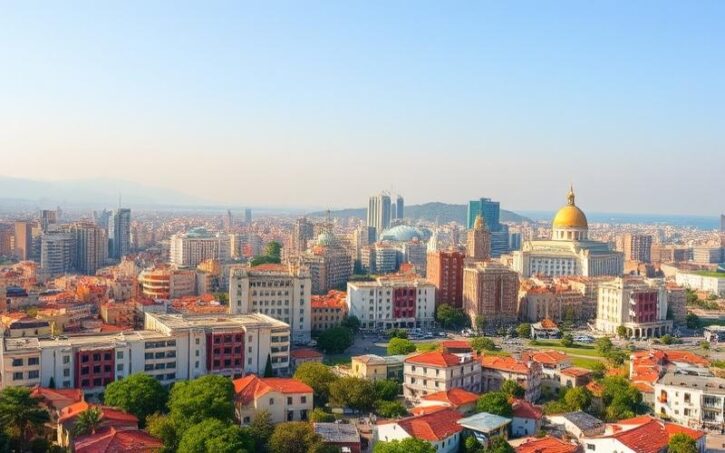
 Published on and written by Cyril Jarnias
Moving to Lebanon as an expatriate means accepting a country of extreme contrasts: renowned hospitality, a vibrant cultural life, and an appealing Mediterranean setting, but also a deep economic crisis, an unstable currency, and a security situation that requires close monitoring. This guide provides a very concrete overview for preparing a move to Lebanon, particularly to Beirut, without glossing over the current difficulties.
Understanding the Context: Lebanon’s Strengths and Vulnerabilities
Moving to Lebanon should not be improvised. The country has about 6 million inhabitants in just over 10,000 km², with a high population density concentrated around Beirut, its economic and cultural center. The millennia-old history, Phoenician, Greek, Roman, and Ottoman remains, religious diversity (18 recognized communities), and linguistic plurality (Arabic, French, English) make it a unique place in the Middle East.
Percentage loss in value of the Lebanese pound over a year and a half, at the heart of the severe financial crisis gripping the country.
The table below summarizes some key indicators useful for an expatriate.
| Indicator | Value / Situation |
|---|---|
| Total Population | Approx. 6 million |
| Beirut Population | Approx. 2 to 2.4 million |
| Area | 10,452 km² |
| Official Currency | Lebanese pound (LBP) |
| Political System | Parliamentary democracy with power-sharing along sectarian lines |
| Security Index (Lebanon) | 35 (overall risk considered high) |
| Security Index (Beirut) | 54 (medium overall risk) |
| Annual Visitors | Approx. 1.16 million tourists |
| Climate | Mediterranean: hot summers, mild and rainy winters |
For an expatriation project, it is essential not to limit oneself to the cliché of “the Paris of the East”: one must integrate the economic, security, and administrative dimensions into their preparations.
Entry Formalities, Visa, and Work
Before buying a ticket, you must clarify the status under which you plan to enter and stay in Lebanon: tourist, employee, student, investor, spouse of a Lebanese national, etc. Visa regimes are numerous and sometimes complex.
Entering Lebanon: Passport, Visa, and Conditions
In practice, most foreigners require a visa to enter. Some are eligible for a visa on arrival, while others must obtain prior authorization.
Rules vary by nationality, but several essential points concern all potential expatriates:
– the passport must be valid for at least 3 months after the planned end of the stay, with at least two blank pages;
– any passport bearing an Israeli visa or stamp leads to entry refusal, or even detention for questioning;
– “visa runs” (leaving the country for a few days to reset the length of stay) are not accepted: Lebanon can refuse entry to those who abuse this.
Citizens of many European, North American, Australian, and Asian countries can obtain a one-month visa, renewable twice, upon arrival in Lebanon. For this, they must present a valid passport with no trace of travel to Israel, a return ticket, an address of stay in Lebanon, and a local phone number or contact.
Other nationalities must obtain, before travel, authorization from the General Security (Directorate General of General Security) or submit a complete file to the Lebanese embassy, with processing times that can take several weeks.
Finally, people of Lebanese origin holding a Lebanese ID card, a passport (even expired), or a Lebanese civil status document are exempt from a visa, even if traveling with a foreign passport.
Working in Lebanon: Work Permit and Residence
Engaging in professional activity in Lebanon almost always involves a dual process: an appropriate entry visa and a work permit, accompanied by a residence permit.
In Lebanon, the principle is that the local employer acts as a sponsor for a foreign employee. Concretely, this employer is responsible for the necessary legal and administrative procedures, such as obtaining the work permit and visa, and guarantees compliance with employment and residence conditions.
– must submit a pre-approval application to the Ministry of Labor, justifying the hiring of a foreigner (theoretically due to a lack of suitable local candidates);
– provides the administration with company documents (commercial register, various certificates, letter of motivation for hiring);
– ensures the file is submitted to General Security once approval from the ministry is obtained.
For the expatriate, the documents typically required include:
– a passport valid for at least 6 months;
– an employment contract in Arabic detailing duties, duration, salary, benefits, and termination conditions;
– diplomas and experience certificates, often legalized and translated into Arabic;
– a criminal record extract;
– a medical certificate (often done once in the country);
– insurance or proof of health coverage.
The work permit process can take from 1 to 3 months, or longer for complex cases. Once obtained, the expatriate can apply for a one-year, renewable residence permit, usually including the spouse and minor children as dependents. Note: dependent children are not entitled to work based solely on this permit.
In practice, many foreigners start by entering on a tourist visa, then switch to a resident-worker status once an employer is found and the application is accepted. It is important to understand that working in Lebanon without a work permit is illegal and can lead to fines, deportation, and a travel ban.
What About Digital Nomads?
Lebanon does not have a specific visa for digital nomads. Technically, any activity generating income from Lebanese territory should be accompanied by a work permit. Many freelancers or remote workers enter as tourists and continue working for foreign clients, but this practice remains legally gray and can be problematic in case of inspection or dispute.
Cost of Living and Budget: What to Expect?
With the sharp fall of the Lebanese pound and a dual exchange rate system (official and black market), assessing the cost of living has become a tricky exercise. Nevertheless, some estimates provide a general idea.
For an expatriate in Beirut, living in comfortable but not luxurious conditions, specialized platforms estimate:
– monthly expenses excluding rent around $700 to $750 for a single person;
– total budget (including housing) around $1,250 to $1,300 for a single person;
– for a family of four, a cost of $2,100 to $2,200 excluding rent, and a bit over $3,000 with housing.
In LBP, the approximate figures provided by some studies are as follows.
| Profile | Estimated Monthly Cost Lebanon (LBP) | Estimated Monthly Cost Beirut (LBP) |
|---|---|---|
| Single Person | ≈ 236,990,270 LBP | ≈ 174,566,089 LBP |
| Family of Four | ≈ 620,139,471 LBP | ≈ 428,802,704 LBP |
Given the exchange rate volatility and the massive reliance on cash payments, these figures are more benchmarks than certainties.
Housing: Rentals and Property Purchases
Housing will likely be your largest expense. Beirut is more expensive than the rest of the country, especially in central areas and those favored by expatriates.
The following estimates provide a realistic range of monthly rents.
| Type of Housing | Area | Monthly Range (USD) | Average (USD) |
|---|---|---|---|
| Studio / 1-bedroom in city center (Beirut) | Center | 500 – 1,600 | ≈ 842 |
| 1-bedroom on Beirut outskirts | Outskirts | 300 – 500 | ≈ 372 |
| 3-bedroom in city center (Beirut) | Center | 1,500 – 5,500 | ≈ 1,983 |
| 3-bedroom on Beirut outskirts | Outskirts | 500 – 3,250 | ≈ 950 |
| Room in shared apartment (Beirut) | Various neighborhoods | 200 – 400 | — |
| Furnished apartment (Beirut) | Various neighborhoods | 400 – 1,200 | — |
In the rest of the country, rents drop significantly. A room in a city center in another major city can be found between $300 and $1,300, with averages much lower than in Beirut.
For purchases, prices per square meter remain high in the capital, even though the crisis has deflated part of the real estate bubble.
| Location | Price per m² (approx.) |
|---|---|
| Apartment, Beirut center | ≈ 2,827 USD/m² |
| House/apartment in suburb | ≈ 1,901 USD/m² |
| Medium city center | ≈ 1,970 – 1,970 USD/m² (equivalent) |
Expatriates often note that Lebanon allows land ownership by foreigners, which can be an advantage for an investment or retirement project, but the procedures remain complex.
Food, Restaurants, and Groceries
Lebanese cuisine is a strong point, and eating out can remain relatively affordable depending on the place.
For a restaurant meal, the following averages are observed: dish prices, wait times, service quality, and customer satisfaction.
– meal in a cheap, small restaurant: $6 to $25, average around $11;
– meal for two in a mid-range restaurant: $50 to $100, average around $60;
– fast-food meal: around $8;
– simple lunch in the business district: around 2.1 million LBP (equivalent varies according to current rate);
– sandwich to go: $4 to $6.
Regarding drinks:
– local beer at a bar (pint): $2 to $5 ($4 average);
– imported beer: $3 to $6 ($5 average);
– cappuccino: $1.5 to $6 (about $3.30);
– small bottle of soda: around $1.80;
– small bottle of water in a restaurant: around $0.80.
In supermarkets, prices are generally more advantageous than in restaurants, though they can be surprising for some imported products.
| Product (Beirut) | Range / Average Price |
|---|---|
| Milk (1 liter) | ≈ 1.7 USD |
| White Bread (1 lb) | 0.36 – 2.72 USD (≈ 0.68 average) |
| White Rice (1 kg) | ≈ 1.9 USD |
| Dozen Eggs | 1.6 – 6 USD (≈ 3.05 average) |
| Local Cheese (0.5 kg) | 2.27 – 11.34 USD (≈ 4.59) |
| Chicken Fillets (0.5 kg) | 1.81 – 5.58 USD (≈ 4.28) |
| Beef (0.5 kg, round) | 4.08 – 6.35 USD (≈ 5.16) |
| 1.5-liter Water Bottle | 0.30 – 1 USD (≈ 0.51) |
| Mid-Range Bottle of Wine | 4.44 – 15 USD (≈ 10) |
| Pack of Marlboro (20 cigarettes) | 2 – 4 USD (≈ 2.55) |
Transportation, Telecom, and Other Common Expenses
Public transportation is underdeveloped and roads can be dangerous. Many expatriates combine taxis, ride-hailing (Uber is well-established), and possibly a personal car.
Some iconic places and monuments often mentioned in the Lebanese capital.
Central square and historical symbol of Beirut, named in memory of Lebanese nationalists executed by the Ottomans in 1916.
Famous seafront promenade along the Mediterranean, a favorite relaxation and meeting spot for Beirutis.
Iconic offshore rock formation with its two natural arches, a symbol of the city.
Main archaeological museum of Lebanon, housing a vast collection of antiquities tracing the country’s history.
Area rebuilt after the war, blending restored historic architecture with modern developments, economic and social heart.
Large modern Ottoman-style mosque, recognizable by its blue domes, located near Martyrs’ Square.
– public transport ticket (bus/minibus): $0.60 to $3, $2 on average;
– monthly transport pass: around $70;
– taxi starting fare: $4 to $9, with a cost per mile around $2.80;
– shared taxi service “serveece”: about $1.50 for 1 to 6 km;
– intra-city minibus: about $0.66;
– inter-city bus: about $1.66.
Gasoline is relatively expensive for a resource-poor producing country: around $0.9 per liter of gasoline.
For utilities and telecoms:
| Expense Item (monthly, Beirut) | Price Range |
|---|---|
| Electricity, Heating, Water, Garbage (85 m²) | 100 – 400 USD (≈ 182 average) |
| Fixed Internet (≥ 60 Mbps, unlimited) | 25 – 70 USD (≈ 38 average) |
| Mobile Plan with 10 GB+ | 10 – 35 USD (≈ 21 average) |
| Prepaid Data 5 GB | 8 – 15 USD |
One must include in their budget a subscription to a private generator to compensate for power outages, common in both urban and rural areas.
Leisure, Education, and Health: Key Budget Items
Lebanon offers a rich social life: gyms, bars, cinemas, skiing in winter, beaches in summer. Some average costs:
| Activity / Service | Estimated Cost |
|---|---|
| Monthly Gym Membership | 35 – 150 USD (≈ 66 average) |
| Tennis Court Rental (1 hr, weekend) | 15 – 45 USD (≈ 31 average) |
| Cinema Ticket | 5 – 15 USD (≈ 10 average) |
| Ski Rental/Day | 15 – 25 USD |
| Ski Pass/Day | 40 – 60 USD |
| Simple Haircut | ≈ 8 USD |
Education is a major expense for expatriate families. Lebanese public schools are overwhelmingly attended by modest-income locals and refugees, and the level is considered inferior to that of private international schools, which enroll the majority of expatriate children.
Average fees observed:
| Type of Institution / Level | Indicative Cost |
|---|---|
| Private Nursery / Preschool (month) | 250 – 525 USD (≈ 363 average / child) |
| International Primary School (year) | 3,000 – 12,500 USD (≈ 6,188 average) |
Banking System, Accounts, and Money Management
In a country with a monetary crisis, banking is a central issue. The sector remains modern and connected, but it is regulated by the Banque du Liban (BDL) and subject to a strict freeze on foreign currency deposits since 2023, with restrictions on transfers abroad.
Legal Framework and Banking Practices
Lebanese banks operate under the supervision of the Banque du Liban, with enhanced measures for anti-money laundering (AML) and know-your-customer (KYC) compliance. Banking secrecy, long a hallmark of the country, has been reformed, though Lebanon remains attractive for creating holdings and offshore companies.
Multi-currency accounts (LBP, USD, EUR, GBP…) are available. But in practice, the use of dollars is highly regulated, with limited withdrawals and official rates often disconnected from the real market. Credit card payments remain limited; cash dominates, and access to cash itself can be restricted by withdrawal limits.
Opening an Account in Lebanon as an Expatriate
Expatriates, non-residents, and foreigners can open an account, but banks apply strict procedures. Generally, you will be asked for:
– a valid passport or official ID;
– proof of address (utility bill, rental lease, residence certificate);
– proof of income or employment contract;
– a letter explaining the purpose of the account (salary, daily expenses, investment…);
– sometimes a bank reference letter from another bank.
Some foreign banks, like HSBC, offer to assist their clients in opening local accounts, sometimes even before departure, with global account management and international cards. However, they do not do this for all countries in the same way; for Canada, for example, HSBC directs clients to RBC.
Expatriates creating a company in Lebanon can be assisted by local law firms, such as a Beirut-based firm specializing in forming companies (SARL, SAL, offshore, branches) and opening professional accounts, including remotely via power of attorney, by preparing and legalizing the necessary documents. The announced timeframe for opening a professional account is generally between 5 and 15 business days when the file is complete.
Examples of Banking Products
Some institutions illustrate the variety of offerings, even though the crisis has profoundly changed practice.
Daily withdrawal limit in Lebanese pounds for the Dynamic Account of a bank in Achrafieh.
– A regional bank like the National Bank of Kuwait (NBK) is present in Lebanon and offers current accounts in LBP, USD, and other major currencies. Opening a current account there typically requires:
– a minimum deposit on the order of $1,500 USD or equivalent;
– a minimum average monthly balance above 10 million LBP (or equivalent) to avoid monthly fees (about 15,000 LBP if this threshold is not met);
– in-person attendance at the branch with a residence certificate issued by the mayor, an ID or passport, and proof (employer letter, bank statements for six months, or a utility bill).
NBK also offers online and mobile banking services (NBK Online, NBK Mobile) appreciated by expatriates.
Security of Payment Methods
In an environment marked by economic uncertainty, some prudent rules apply:
– never disclose your PIN, memorize it rather than write it down;
– protect debit/credit cards from physical damage;
– always check the displayed amount before authorizing a payment;
– monitor statements regularly to detect suspicious transactions;
– report any lost or stolen card immediately.
Finding Housing: Rental Market, Contracts, and Charges
The Lebanese rental market is particularly dynamic, with offerings ranging from small urban studios to mountain villas with sea views.
Types of Housing and Popular Neighborhoods
In Beirut, expatriates often gravitate towards: lively neighborhoods, international restaurants, and modern shopping malls.
– modern apartments in central neighborhoods like Achrafieh, Hamra, Verdun, or Gemmayze;
– more spacious housing in calmer suburbs of Matn or Kesrouane;
– villas or traditional houses more common in the mountains (Rabieh, Yarze, Adma…) or on the northern coast (Jbeil/Byblos, Batroun).
Since Lebanese often live with their parents for a long time, shared apartments are frequently occupied by foreigners, making it a good entry point for an expatriate on a tight budget.
For stays of a few weeks or months, many opt for:
Discover different temporary housing solutions, ideal for business stays or transitions, offering comfort and simplicity.
Fully equipped apartments managed with hotel-like services for a comfortable, hassle-free stay.
À la carte accommodations via online platforms, perfect for short, personalized stays.
Intermediate solutions with online contracts for extended stays, between hotels and classic rentals.
Rental Contracts, Obligations, and Hidden Costs
Lebanese rental law generally provides for annual contracts, with a particularity: legally, a standard lease binds the owner for three years. During these three years, they cannot increase the rent or evict the tenant as long as the tenant fulfills their obligations. At the end of the period, a new contract can be signed with rent renegotiation.
In practice, some points are important:
Agencies mainly offer one-year renewable leases. Owners often request six months to a year’s rent in advance, and a security deposit of two to three months is common. The lease may not be registered with the municipality (to reduce the owner’s fees), which decreases the tenant’s legal security. Monthly payments as in Europe remain a minority practice.
Beyond rent, several charges may remain the occupant’s responsibility:
– the municipal tax (around 5.5% of the rental value), logically the tenant’s responsibility;
– water: an annual subscription to the water authority (e.g., around $65 per year), plus potentially purchasing water by tanker truck in summer (about $70 per month in some areas);
– building maintenance fees: lighting of common areas, elevator, concierge, generator for common areas;
– maintenance of the heating/cooling system (to be negotiated in the lease);
– subscription to the building or neighborhood generator (often billed per ampere, around $60 for 5 A);
– home insurance, the tenant’s responsibility.
To sign a lease, the documents usually requested are a copy of the passport or ID card, or the company statutes if the contract is in the company’s name.
Health: Getting Medical Care in Lebanon
Despite the crisis, Lebanon maintains a reputation for medical quality, especially in Beirut, with a number of doctors per capita among the highest in the Middle East. This does not mean, however, that access to care is easy or cheap.
Public vs. Private: Two Parallel Worlds
The health system is dominated by the private sector (about 90% of the supply), while the Ministry of Health manages a network of primary healthcare centers (PHC) and public hospitals.
In theory, Lebanese residents have access to public healthcare, and foreigners can also benefit. But the public sector suffers from:
– long waiting times;
– shortages of medicine and equipment;
– infrastructure weakened by the financial crisis, the pandemic, and the Beirut port explosion.
The cost in dollars of a simple consultation with a general practitioner in Lebanon, in the private sector.
Health Insurance: An Absolute Priority
In this context, subscribing to solid international insurance is practically essential for an expatriate, especially since:
– many visas require proof of health insurance covering at least several tens of thousands of dollars;
– most hospitals require payment in advance or a guarantor (insurer, employer);
– the Lebanese public social security system (NSSF) only covers a portion of local workers and reimburses less and less, leaving most patients to bear the bulk of costs.
A good expatriate insurance policy should include: covers medical care, civil liability insurance, accident coverage, medical evacuation, legal protection, and 24/7 assistance.
– coverage for hospital and outpatient care in Lebanon;
– medical evacuation to a neighboring country if needed;
– coverage in other countries in the region for business or tourist travel.
Specific Health Risks
As everywhere, common diseases related to water or food exist: traveler’s diarrhea, parasitic infections (including giardiasis), cholera risk during certain outbreaks. Air pollution levels often exceed international recommendations, particularly in Beirut, which can affect asthmatic or frail individuals.
HIV/AIDS remains a concern, though the country does not practice systematic screening of travelers on this criterion.
For women, access to quality pregnancy monitoring is possible, especially in large cities. Over 95% of births occur in a hospital setting. However, abortion is illegal except in rare exceptions, with severe penalties.
Education, Language, and Family Integration
For families, access to a good school is often a decisive factor. Lebanon is atypical in the region: over 70% of students attend private schools, and the country has a long tradition of French, American, or bilingual institutions.
School System and Options for Expatriates
Education is structured into: courses, seminars, workshops, group projects, and internships.
– preschool (3-5 years);
– basic education (6-14 years), divided into primary and intermediate;
– secondary (15-18 years).
The Ministry of Education imposes a national curriculum that even international schools must integrate, but many add their own programs (IB, French, British, or American curricula).
For an expatriate, the most natural options are international schools, often located around Beirut, offering:
– bilingual or trilingual instruction (Arabic, French, English);
– recognition of international diplomas (French Baccalaureate, IB, High School Diploma, etc.);
– good infrastructure (labs, libraries, sports facilities).
These schools are, however, expensive for a local budget, and some practice selective admission (tests, interviews, review of academic records).
At the university level, institutions like the American University of Beirut (AUB), Université Saint-Joseph (USJ), or Lebanese American University (LAU) offer quality programs, often accredited by international agencies.
Languages and Daily Life
Arabic is the official language, but spoken Lebanese (Levantine dialect) is ubiquitous in the streets. French benefits from a specific legal status and remains very common, especially in some Christian circles. English has gained enormous ground over the last two decades, particularly in business, the digital sector, and higher education.
In Lebanon, particularly in urban areas like Beirut, people commonly switch between Arabic, French, and English in their interactions. A typical phrase like “Hi, kifak, ça va?” (a mix of English, Lebanese Arabic, and French) illustrates this hybrid linguistic practice. For a francophone expatriate, it is thus possible to communicate effectively in daily life using mainly French and English. However, learning a few basics of Lebanese Arabic remains a significant asset for better social integration.
Culture, Social Codes, and Daily Life
Moving to Lebanon also means learning specific social codes, heavily marked by family, religion, and the importance of personal relationships.
Values and Social Relations
The family plays a central role: patriarchal structure, strong duties towards parents, and marked respect for elders. Bonds of solidarity extend far beyond the nuclear family to include cousins, uncles, aunts…
Honor, reputation, generosity, and hospitality are defining values. Inviting, offering, insisting that a guest eat more, multiplying small attentions—all this is part of daily life. For an expatriate, it is important to accept this warmth while learning to set boundaries tactfully.
In daily interactions, communication is often indirect: direct confrontations are avoided, nuances are used, and humor is frequent. Expressions like “Inshallah” (if God wills) or “Yalla” (let’s go / hurry up) punctuate exchanges.
Gestures and body language are very significant. Posture, moderate eye contact, and expressive use of hands are important. Hugs and cheek kisses are common among close friends, men and women alike, except in certain conservative circles.
Dress Codes and Religion
In Beirut and major cities, Western attire is the norm, with a strong influence of international trends. Elegance, neatness, and style are appreciated. In rural or more conservative areas, traditional and more covering clothing is more visible.
For an expatriate, dressing in a “smart casual” style in the city poses no problem. However, when visiting a mosque, church, or conservative place, it is expected:
– to cover shoulders and knees;
– for women, sometimes to wear a headscarf in mosques;
– to avoid public displays of affection.
Lebanon is characterized by strong religious diversity, with the coexistence of Islam (Sunni and Shiite), Christianity (Maronite, Orthodox, Catholic, Protestant), and other communities like Druze and Jews. Holidays of different confessions punctuate public life. During Ramadan, it is recommended to avoid eating or drinking openly in public during the day, especially in Muslim neighborhoods.
Social Life, Networking, and Expatriate Communities
Many foreigners fear isolation when moving. In Beirut, there are several levers for building a network:
– platforms like InterNations regularly organize events for expatriates, with thematic groups (gastronomy, culture, sports);
– apps dedicated to friendly meetups facilitate weekly outings with new people sharing the same interests;
– hiking groups (Mashaweer, Vamos Todos, Esprit-Nomade, for example cited in local resources) offer mountain excursions, ideal for discovering the country and socializing;
– cafés, bars, cultural festivals (Baalbek, Byblos…), and the famous Beirut nightlife provide fertile ground for meeting people.
Lebanese people being generally sociable, multilingual, and curious, an open and respectful expatriate has a good chance of quickly building a circle of friends.
Security, Risks, and Precautions
No guide on moving to Lebanon can ignore the security question. The country is classified as having a high overall risk, though the perception on the ground varies greatly by area.
Security Situation: A Mosaic of Risks
At the national level, foreign authorities mention:
The country presents a significant terrorist risk (presence of ISIS, Hezbollah), risks of occasional armed clashes (in the Bekaa, near the Israeli and Syrian borders, in certain Palestinian refugee camps, and in the southern suburbs of Beirut), frequent protests that can block major routes, the presence of mines and unexploded ordnance (south of the Litani and along the Syrian border), and rising crime (burglaries, thefts, home invasions) in the context of the crisis.
Beirut, in comparison, shows a medium risk level, with a security index of 54. Street crime (pickpocketing, scams) exists but remains at a level comparable to many major metropolises. The risk of violent assault is more linked to particular circumstances (local conflicts, sensitive neighborhoods) than to the daily life of the average expatriate.
Practical Safety Tips for an Expatriate
For a relocation project, a few habits can help reduce exposure to risks:
For a safe stay, it is crucial to choose your neighborhood of residence carefully by checking its reputation and avoiding areas advised against by embassies. Prioritize official taxis, ride-hailing services (like Uber), or organized transfers over informal shared taxis, especially at night. Avoid demonstrations, large political gatherings, and border areas. Stay alert to safety instructions in case of natural disaster (forest fires, earthquakes, etc.). Follow your embassy’s recommendations and register on consular lists. Finally, keep an emergency kit at home (water, food, medicine) in anticipation of potential road blockages or prolonged outages.
Taxation, Resident Status, and Obligations
For expatriates staying long-term in Lebanon, the tax question should not be underestimated. The country operates on a modified territoriality principle and specific rules define tax residence.
When Do You Become a Tax Resident in Lebanon?
An individual is considered a tax resident if they meet one of the following criteria:
– presence of more than 183 days within a 12-month period (excluding transit days at the airport and purely medical stays);
– possession of a permanent home in Lebanon (a dwelling regularly used by the person and/or their family);
– engagement in a licensed professional or independent activity in Lebanon.
Residents are taxed on their worldwide income, while non-residents are taxed only on their Lebanese-sourced income. In practice, the system is complex and affected by the crisis and currency issues, but it should be considered that any income related to activity in Lebanon is potentially taxable.
Income Tax and Other Taxes
The Lebanese income tax is progressive, with brackets from 2% to 25%, in Lebanese pounds. Thresholds have been regularly adjusted to account for inflation. Salaries, income from independent activity, and individual business profits are targeted.
Other levies exist:
The standard rate of value-added tax (VAT) applicable.
For an expatriate, it is essential to verify:
– the existence or not of a tax treaty between their country of origin and Lebanon (Lebanon has over 30 treaties, but not with all countries);
– the consequences regarding potential double taxation;
– the impact of their activity (employed, independent, entrepreneur) on their status in both countries.
American citizens and a few other nationalities taxed on the basis of citizenship must, in addition, continue to declare their worldwide income in their country of origin, even in case of prolonged residence in Lebanon.
In Summary: Is It Reasonable to Move to Lebanon Today?
Lebanon offers expatriates a concentration of rare experiences: a warm social fabric, a world-renowned gastronomy, vibrant nightlife and culture, landscapes ranging from Mediterranean beaches to snowy peaks, and a resilient, multilingual, and often highly educated population.
But it also imposes heavy constraints:
– an unprecedented monetary and banking crisis, with severe restrictions on foreign currency accounts;
– high inflation and a multi-rate system;
– an unstable political context, with terrorist risk and latent regional tensions;
– infrastructure (electricity, water, public health) under severe strain.
For an expatriate, ensuring a successful move therefore requires:
For a successful expatriation in the Middle East, it is crucial: to properly prepare your residence and work status, in close connection with an employer, lawyer, or specialized advisor; to build a prudent budget, including margins for contingencies (exchange rates, price increases, health costs); to carefully choose your neighborhood of residence and school, if applicable; to prioritize solid international health coverage; and to stay regularly informed about the security situation.
For those who accept this complexity, Lebanon can offer a life experience of exceptional human richness. The key is to enter with eyes wide open, combining fascination for the local culture and lucidity about the country’s economic and political realities.
Disclaimer: The information provided on this website is for informational purposes only and does not constitute financial, legal, or professional advice. We encourage you to consult qualified experts before making any investment, real estate, or expatriation decisions. Although we strive to maintain up-to-date and accurate information, we do not guarantee the completeness, accuracy, or timeliness of the proposed content. As investment and expatriation involve risks, we disclaim any liability for potential losses or damages arising from the use of this site. Your use of this site confirms your acceptance of these terms and your understanding of the associated risks.

Cyril Jarnias is an independent expert in international wealth management with over 20 years of experience. As an expatriate himself, he is dedicated to helping individuals and business leaders build, protect, and pass on their wealth with complete peace of mind.
On his website, cyriljarnias.com, he shares his expertise on international real estate, offshore company formation, and expatriation.
Thanks to his expertise, he offers sound advice to optimize his clients' wealth management. Cyril Jarnias is also recognized for his appearances in many prestigious media outlets such as BFM Business, les Français de l’étranger, Le Figaro, Les Echos, and Mieux vivre votre argent, where he shares his knowledge and know-how in wealth management.





