
 Published on and written by Cyril Jarnias
Expatriating to Pakistan is not just about changing countries, climates, or living standards. It means entering a highly codified social, religious, and professional universe, where family, honor, hierarchy, and religion structure nearly every aspect of daily life. For an expat, understanding these codes in advance makes the difference between a chaotic relocation and a smooth integration.
This article provides practical guidelines on the main cultural differences to know before settling in Pakistan. The goal is to avoid missteps, better understand social situations, and gain the trust of local contacts, going beyond simple stereotypes.
A Society of Family and the Collective
Before even talking about work or administrative procedures, you need to understand the foundation of Pakistani society: collectivism and the centrality of the extended family.
In Pakistan, an individual is defined first by their family network. The concept of “family” goes far beyond the nuclear household: it includes close and distant relatives, members of the same clan or tribe, longtime friends, and neighbors. It is to this extended group that primary loyalty is owed, ahead of the company, the administration, or even certain formal rules.
In many cultures, what Western expats interpret as nepotism is often seen locally as a practice of security and trust. For instance, hiring a cousin, a childhood friend, or a trusted neighbor is perceived as a guarantee of mutual loyalty and a natural way to ensure business stays in reliable hands, rather than as a scandalous favoritism.
However, the family is considered a very private and protected space. The women of the family, in particular, are seen as needing to be sheltered from outside influences. For an expat, this means two important things: avoid asking direct questions about the women of the household (wife, sisters, daughters) and understand that some seemingly purely “professional” decisions may actually be influenced by family considerations.
Religion, Isochronicity, and Daily Rhythm
Pakistan is an Islamic republic. Islam and culture are intertwined, to the point that a large part of social codes, politeness, and the holiday calendar derive from religion.
Weight of Islam in Daily Life
The majority of the population is Muslim, and social etiquette largely comes from Islamic practices and South Asian traditions. Five daily prayers structure the day, and meeting times or travel plans may be adjusted to observe them. In a professional setting, it is common for a meeting to be interrupted for prayer and then resumed.
Ramadan is an important spiritual period during which practitioners fast from dawn to sunset, abstaining from eating, drinking, and smoking. This naturally impacts the work rhythm: hours are often adjusted, energy tends to drop later in the day, and productivity follows a slower tempo. It is therefore advisable to avoid scheduling critical meetings in the late afternoon or business lunches in the middle of the day during this period.
Daytime dining is heavily restricted for Muslims, and non-Muslims are invited, out of respect, to avoid eating, drinking, or smoking conspicuously in front of those who are fasting. Many laws regulate the sale of food and drinks during this month, especially in public spaces.
Religious Holidays and the Calendar
Major holidays, such as Eid al-Fitr (marking the end of Ramadan) and Eid al-Adha (the Festival of Sacrifice), clearly disrupt economic life. Offices close, many people leave big cities to join their families, and social life centers on prayers, visits, and shared meals.
During Eid al-Adha, ritual sacrifices and the sharing of meat underscore values of generosity and solidarity. For an expat, it is crucial to understand that these family and religious obligations clearly take precedence over professional deadlines during this period.
Other key times, such as the month of Muharram and the day of Ashura (especially significant for Shia Muslims), or special nights of prayer like Shab-e-Barat, can lead to processions, gatherings, sometimes tensions, and also impact travel and work organization.
Language, Greetings, and Daily Communication
For a newcomer, how you say hello, ask a question, or express disagreement often matters more than the message itself. In Pakistan, relationships are built through a highly codified communication style, where politeness and preserving “izzat”—honor, dignity—are fundamental.
Greeting Properly: More Than a Formality
From the very first encounter, the greeting sets the tone. The classic verbal greeting is “As-salamu alaikum”—“Wa-alaikum as-salaam” in response. Using this phrase, even as a foreigner, is generally very appreciated.
Handshakes are common, especially among men, who may also hug or pat each other on the shoulder. Between men and women, physical contact is more regulated, particularly in conservative environments. An expat should never spontaneously extend a hand to a woman; they should wait for her to initiate or give a clear signal. A foreign woman should let the man take the lead: some will offer a handshake, others a verbal greeting with the right hand over the heart.
A detail often overlooked by newcomers: the right hand is the only acceptable one for greeting, receiving an object, giving a gift, or eating. The left hand is associated with intimate hygiene; using it to hand something over can be perceived as outright insulting.
Indirect, Nuanced… and Highly Contextual
Pakistani communication is typically high-context: what is not said counts as much, if not more, than the words used. A “yes” can mean “maybe,” “we’ll see,” “I don’t want to say no,” or a genuine “yes.” The systematic use of terms like “inshallah” reinforces this nuance: the agreement remains, in many minds, contingent on circumstances and the will of God.
Saying “no” bluntly is often avoided, as it risks causing loss of face for the interlocutor or creating discomfort. Instead, phrases like “we’ll try,” “it will be difficult,” “let’s see later,” or simply an eloquent silence are used. For an expat, this means learning to read gestures, expressions, hesitations, and asking open-ended questions to clarify without putting the person in a difficult spot.
Speaking calmly and controlling your tone is essential. Avoid overly large or abrupt gestures, which can be perceived as aggressive. Interpersonal distance is often shorter than in Northern Europe: standing close is not an intrusion, and backing away can be interpreted as rejection.
The Art of Small Talk… and Personal Questions
Another frequent shock for expats: the boundary between private life and professional life is not the same. From the first meeting, it is normal to be asked if you are married, how many children you have, where your family is from, what your religion is, sometimes your salary or long-term plans. These questions are not intended as intrusive; they serve to place the person within a network of relationships and responsibilities.
On the other hand, directly asking someone about his wife, his daughter, or his sister is very frowned upon. One speaks of “your family” in a broad sense, without focusing on the women. Understanding this implicit boundary game will prevent you from unintentionally making your interlocutor uncomfortable or shocked.
Hierarchy, Work, and Management: The Weight of Rank
In the workplace, Pakistan is the exact opposite of very flat, egalitarian management cultures. It is an openly hierarchical environment where age, title, and position carry significant weight.
The Boss as a Father Figure
In many companies, the leader is perceived both as an authority and as a parental figure. The image of the “paternalistic boss” remains very strong: he is expected to give clear instructions, make all important decisions, and even sometimes help his employees with personal problems.
A young professional, returning from a stay in Europe, publicly criticized his manager’s strategy during a meeting. This action, which might have been perceived as frankness and engagement in a Northern European culture, was experienced as an affront and humiliation of the boss in front of his team. As a result, the professional was sidelined from important assignments, illustrating the importance of loyalty and visible respect towards superiors in this context.
The best practice for an expat is to reserve disagreements for private, one-on-one discussions, with great tact. Phrases like “With your experience, how do you see…?” or “If I may, I’d like to suggest…” allow you to propose a different idea while reaffirming the interlocutor’s superiority.
Chain of Command and the Role of Titles
In a classic Pakistani organization, the hierarchical chain is very clear. Going over your direct supervisor to contact the CEO can be perceived as betrayal. Decisions come from the top and flow down through levels; middle managers are expected to transmit instructions, not to question strategy.
Professional titles (engineer, doctor, professor) carry strong symbolic value and should be used on formal materials (business cards, emails, nameplates) and in oral interaction (interviews) as a mark of respect. Avoid using first names spontaneously, even if the person introduces themselves that way in English; prioritize using the title until an explicit invitation allows you to do otherwise.
Contrasting Management Styles: A Trap for Expats
Misunderstandings are common, in both directions. Pakistani managers expatriated to Nordic countries may seem too directive and distant; conversely, Western managers in Pakistan who try to “break the hierarchy” by acting like “buddies” sometimes lose credibility, as this style blurs reference points.
An expat arriving from a very participatory environment will therefore need to adjust their expectations. Don’t interpret a colleague’s silence as lack of engagement, understand that asking “What do you think?” can make the person uncomfortable if no one else has spoken before them, and accept that some employees prefer receiving clear instructions rather than vague delegation.
Relationships, “Sifarish,” and Networks: The Power of Connection
In Pakistan, you don’t just do business with a company; you do business with people and their networks.
Building Trust First
In the Pakistani business world, personal relationship often precedes the contract. Initial meetings serve to “size up” the other person: you talk about health, family, travel, sometimes cricket, much more than about figures or deadlines. It is not uncommon to leave a first meeting without having discussed the substance of the project. For a busy expat, this might seem unproductive; in reality, it is often an indispensable step for concrete discussions to move forward later.
It is nourished by human warmth, hospitality, and consistency of behavior over time. Once trust is established, partnerships are often stable and lasting, with a genuine willingness to support each other.
The concept of “rishta”
The Logic of “Sifarish”
A term that often comes up when talking about networks in Pakistan: “sifarish”. It refers to the art of mobilizing your connections to obtain a recommendation, a job, a promotion, a service. A well-placed friend, a cousin in a bank, a former classmate at the ministry… These personal contacts play an enormous role in accessing certain opportunities.
In Pakistan, the system of recruitment and professional advancement heavily values networks and personal relationships, which benefits well-connected individuals and can disadvantage those who rely only on a strong CV. This reality is subject to increasing local criticism, with calls for more meritocratic practices. For an expat, it is crucial not to ignore this relational dimension. The recommended approach is to accept it as an established fact of the labor market, while building and showcasing your own credibility through seriousness, competence, and reliability.
Mentioning a mutually respected contact, being introduced by someone trustworthy, or simply accepting dinner invitations and repeated cups of tea are powerful levers for carving out a place.
Negotiating in Pakistan: Patience, Flexibility, and Saving Face
Expats are often surprised by the time required to close a deal, get a signature, or simply move a file forward in the administration.
A “Fluid” Time and Pervasive Bureaucracy
Pakistani culture is described as a “fluid” time culture: punctuality is valued, especially in the modern private sector, but delays, last-minute rescheduling, even meetings rearranged without explanation are not uncommon. Administrations are often very bureaucratic, with multiple validation chains. Sometimes several visits are needed to accomplish a theoretically simple task.
For an expat, the key is patience. Pressuring an interlocutor for an immediate decision, threatening to break off negotiations, or expressing exasperation over a delay is counterproductive, as it can damage the long-term relationship. It is better to incorporate this structural slowness into planning from the start and to prioritize regular, polite follow-ups rather than ultimatums.
The Art of Local Negotiation
Pakistanis have a reputation as seasoned negotiators. Haggling over a price, debating terms at length, exploring multiple scenarios are all part of the normal game, whether at the bazaar or in a boardroom. The displayed price is rarely the final word, and the relational dimension sometimes weighs as much as the contract clauses.
The application of agreements can be more flexible than in some Western countries, with adjustments possible depending on the context, the relationship, or the economic situation. A good personal relationship and ongoing communication are often more effective than a rigid contract used in a confrontational manner.
For an expat, adopting a respectful attitude, avoiding aggressive pressure, staying calm even if the discussion heats up (and sometimes switches to Urdu) are essential reflexes to maintain the trust of your partners.
Social Codes, Gender, and Daily Life
Settling in Pakistan also means living in a society where gender roles are still strongly defined, even if profound changes are underway.
Traditional Roles and Evolving Trends
Historically, Pakistani society is patriarchal and paternalistic. The man is seen as the primary breadwinner and decision-maker for the household; the woman is responsible for the home, children, and family cohesion. The concept of feminine modesty is highly valued, and a woman’s reputation often conditions part of her family’s reputation.
However, the landscape is changing. More and more women are pursuing higher education, entering the job market, including in fields long dominated by men, such as engineering or management. In large cities, it is no longer rare to meet couples who share responsibilities more equally, nor women in leadership positions.
Although progress has been made, female labor force participation remains very low in South Asia, with persistent cultural, familial, and institutional barriers. For a female expat, this can translate into opportunities to be recognized as a full professional, but also into being perceived as an ‘exception’ in still very male-dominated environments.
Public Behavior, Dress Code, and Safety
On a daily level, a few guidelines are essential, especially for foreign women. Dress should remain modest: shoulders and knees covered, non-formfitting and non-transparent clothing. Adopting the traditional “shalwar kameez” (long tunic and wide trousers) is often the easiest way to blend in, while being comfortable and appropriate. A headscarf is not mandatory everywhere, but it is useful to have one for mosques or more conservative places.
Public displays of affection are highly frowned upon, even for married couples. Cohabitation outside marriage is theoretically illegal, although sometimes tolerated for foreigners in certain contexts. Homosexuality is criminalized, exposing 2SLGBTQI+ individuals to discrimination and real risks, requiring extreme discretion.
Alcohol is another sensitive topic. It is forbidden for Muslims. Non-Muslims can obtain licenses to consume, but drinking in public, being drunk, or offering alcohol to a Muslim are serious offenses. Likewise, openly criticizing Islam, the Prophet, or religious symbols is a criminal offense that can have very serious consequences.
For women, street harassment exists, especially in crowded places and public transport. Traveling during the day, using reliable transportation (ride-sharing services, recommended taxis, private drivers), avoiding isolated areas at night, and maintaining a confident demeanor are recommended precautions.
Professional Etiquette: Details That Matter
Beyond management and hierarchy, professional life in Pakistan follows a series of subtle codes.
Punctuality… and Flexibility
In large private companies, European-style punctuality is increasingly valued, and arriving on time for an appointment is a sign of seriousness. But you have to contend with a local practice where meetings can start late, be cut short, or interrupted by drop-in visitors, urgent calls, or religious obligations.
As a guest, it is best to be on time, or even slightly early, even if it means waiting. On the other hand, you should be tolerant if your counterparts arrive later or briefly leave the room: this is part of a culture of the “open door” and handling multiple requests simultaneously.
Welcome, Tea, and Hospitality
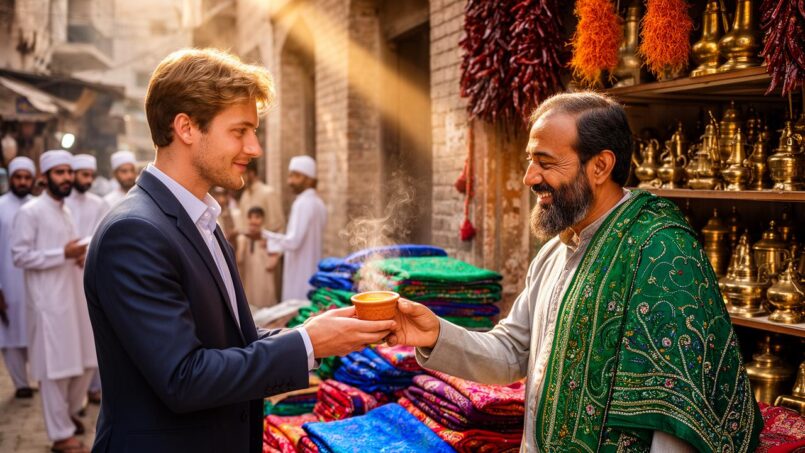
Hospitality is at the heart of interactions. Offering tea, coffee, biscuits, or snacks to a visitor is almost reflexive. Consistently refusing these offers can be perceived as cold or discourteous. Accepting at least one drink, thanking warmly, and showing curiosity about local cuisine are simple ways to build rapport.
When invited to a halal meal, it is highly appreciated to observe certain rules: remove your shoes if the hosts are barefoot, let elders be served first, eat only with the right hand, and politely accept being served seconds the first time. In return, inviting your hosts to a meal that respects halal rules (no pork, no alcohol, and meat from lawful sources) is a highly valued gesture.
Gifts, Business Cards, and Correspondence
Giving a small gift at a first important meeting or after closing a deal is welcome, provided you respect a few red lines: no alcohol, no pork products, nothing too ostentatious that could resemble a bribe. A book, a quality pen, a typical product from your country are safe options. Present the gift with both hands (or at least with the right), and don’t be offended if your interlocutor doesn’t open it immediately: in many contexts, it is opened later, in private.
Business cards should clearly display your title and degrees, ideally in English. It is advisable to exchange them at the beginning of a meeting. When you receive one, pause to read it carefully, then put it away with care. These simple gestures demonstrate respect for your interlocutor.
In professional emails, formal wording, polite greetings, and thanks for the time given are the norm. Writing too abruptly or telegraphically can come across as disdain.
Living Conditions, Cost, and City of Relocation: What Cultural Impact?
Even though the core of this article is cultural, how you experience your expatriation also depends on the city chosen, the neighborhood, and the standard of living.
Major Cities, Atmosphere, and Social Norms
The majority of expats settle in Islamabad, Lahore, or Karachi. These three metropolises each have their own character and slightly different cultural environment.
– Islamabad, the federal capital, is a planned city, greener, calmer, often described as safer. The presence of embassies, NGOs, and international organizations attracts an educated crowd in frequent contact with foreigners. Gender norms are sometimes a bit more relaxed, especially in certain upscale neighborhoods. However, rents are slightly above the national average.
– Lahore, the cultural capital, is denser, noisier, famous for its markets, cuisine, and artistic life. Expats mainly live in neighborhoods like DHA, Gulberg, or Model Town, where comfort standards are close to those of the local upper-middle class. The cost of living remains very low compared to Western standards.
Karachi, a port megacity, is the economic heart of Pakistan. Its cosmopolitan social life is characterized by a modern urban scene with shopping malls, diverse restaurants, and residential areas like DHA and Clifton. The city has strong cultural diversity, but also sharp social contrasts, heavy traffic, and a population density that can be surprising.
In these large cities, expats tend to cluster in residential enclaves (DHA, Bahria Town, Cantonments…) with 24/7 security, private schools and shopping centers. Living in these bubbles reduces cultural friction – but increases the risk of staying locked in an “expat bubble,” cut off from the broader social reality.
Cost of Living: Cheap, but Not Culturally Neutral
Pakistan is one of the cheapest countries in the world for an expat. Cost of living indices show levels about three times lower than the global average and far behind major Western capitals. An expat can live comfortably on a modest monthly budget compared to what would be needed in London, New York, or Sydney.
In some local contexts, hiring a driver, a maid, or a cook is not limited to an elite. A foreign household with an average income can thus employ several people, which inserts them into domestic social relationships involving expectations, hierarchies, and responsibilities specific to the local culture.
Knowing how to treat your domestic staff, how to set a fair salary, how to manage the distance between familiarity and respect for status is a cultural difference in itself. Many expats in cheaper countries underestimate the managerial and human dimension of this situation.
Services, Health, and Insurance: What It Changes Daily
In terms of health, the most important difference for an expat is the near-mandatory reliance on the private sector. Public hospitals are theoretically accessible to citizens, but they are overcrowded, inconsistent in quality and equipment. Foreigners, on the other hand, turn to private clinics and hospitals in big cities, where doctors are often trained abroad, speak English, and offer satisfactory, even very high-level services in some flagship establishments.
Costs remain significantly lower than in the West for a consultation or even hospitalization, but they are significant enough to make private health insurance almost indispensable. Not having it exposes you to out-of-pocket payments in case of a major emergency, medical evacuation, or chronic illness. This dependence on the private sector also means including an insurance premium in your budget and choosing hospitals suited to your place of residence.
What Not to Do: Sensitive Topics and Red Lines
Some mistakes, even without bad intentions, can have disproportionate consequences, ranging from social ostracism to serious legal trouble.
Among the most sensitive are:
– Criticizing or mocking Islam, the Prophet, the Quran, or local religious practices. The legislation on blasphemy is extremely strict, and even remarks perceived as ambiguous can provoke violent reactions.
– Engaging in heated political discussions, especially about relations with neighboring countries, military matters, or regional tensions. Security institutions are an extremely delicate topic.
It is forbidden to photograph sensitive infrastructure (bridges, airports, military installations, some public buildings) without authorization. Arrests and fines have been issued for photos taken near these sites, even if they seemed innocuous.
– Posting highly critical comments on social media about the government, the military, or public officials. In a context of enhanced surveillance of online content, this can have serious consequences.
– Adopting loud, aggressive, or drunken behavior in public. Public drunkenness can lead to detention, and behavior deemed “rude” will be severely judged socially.
When in doubt about a behavior, a photo, an online post, the safest reflex remains restraint.
Managing Culture Shock and Breaking Out of the “Expat Bubble”
Even with good preparation, most expats go through different phases: enthusiasm in the first weeks, then fatigue, irritation with administrative delays, unspoken rules, or gender norms, before finding a new balance.
Recognizing this cycle – honeymoon, frustration, adjustment, adaptation – helps not to dramatize moments of discouragement. Building a support network is essential: trusted colleagues, more experienced expats, helpful neighbors, sometimes a mental health professional accessible via teleconsultation.
Learning a few phrases in Urdu, especially greetings, polite expressions, and everyday vocabulary, transforms the quality of relationships. It demonstrates respect, reduces misunderstandings, and allows you to move beyond interactions limited to English, which is often reserved for a privileged urban circle.
Above all, it is useful to seek balance: not staying only among foreigners, but not forcing an impossible total assimilation. Participating in mixed activities – sports, associations, cultural events – in the neighborhoods where you live, frequenting local spots (while staying safety-conscious), exchanging with colleagues beyond the strict work framework are all ways to see Pakistan as more than just a temporary assignment backdrop.
Conclusion: Respect, Observe, Adjust
Expatriating to Pakistan requires letting go of certain “automatic” reflexes imported from your home country. Here, the individual comes after the family, direct speech after politeness, immediate performance after the relationship, displayed equality after respect for hierarchies.
It is neither better nor worse: it is different. The more these differences are understood beforehand, the less they are experienced as personal attacks and the more it becomes possible to navigate with flexibility, anticipate misunderstandings, and build trusting relationships.
To avoid misunderstandings and gain effectiveness in an intercultural context, it is essential to adopt certain reflexes: observe carefully before judging, ask questions with humility, adapt your mode of expression to your interlocutors, deeply respect their religious sensitivities, and be particularly attentive to notions of honor and ‘social face’ (reputation and dignity preserved in public).
Pakistan is a country of extreme contrasts: very conservative on some points, surprisingly flexible or warm on others; bureaucratic and slow, but also capable of impressive creativity and resourcefulness; marked by real constraints for certain groups, but also by dynamics of profound change, especially among urban youth.
For the expat who accepts to enter this complex game and respect its rules, the experience can be difficult but extraordinarily rich. Understanding these cultural differences before leaving is already taking a decisive step towards a successful expatriation in Pakistan.
Disclaimer: The information provided on this website is for informational purposes only and does not constitute financial, legal, or professional advice. We encourage you to consult qualified experts before making any investment, real estate, or expatriation decisions. Although we strive to maintain up-to-date and accurate information, we do not guarantee the completeness, accuracy, or timeliness of the proposed content. As investment and expatriation involve risks, we disclaim any liability for potential losses or damages arising from the use of this site. Your use of this site confirms your acceptance of these terms and your understanding of the associated risks.

Cyril Jarnias is an independent expert in international wealth management with over 20 years of experience. As an expatriate himself, he is dedicated to helping individuals and business leaders build, protect, and pass on their wealth with complete peace of mind.
On his website, cyriljarnias.com, he shares his expertise on international real estate, offshore company formation, and expatriation.
Thanks to his expertise, he offers sound advice to optimize his clients' wealth management. Cyril Jarnias is also recognized for his appearances in many prestigious media outlets such as BFM Business, les Français de l’étranger, Le Figaro, Les Echos, and Mieux vivre votre argent, where he shares his knowledge and know-how in wealth management.





