
 Published on and written by Cyril Jarnias
Getting a passport in Pakistan has become easier, faster, and significantly more secure than a few years ago. With the widespread adoption of biometric passports, the launch of e-Passports, the ability to pay fees online, and remote verification via the Pak-ID app, the system has been thoroughly modernized. But this modernization comes with specific rules, different procedures depending on age, passport type, or situation (first application, renewal, loss), and a fairly complex fee schedule.
This practical guide explains the procedure for obtaining a Pakistani passport, whether you are in Pakistan or abroad, adult, minor, public sector employee, or dual national. It helps you prepare your application correctly to avoid rejections, and to understand the actual timelines and costs.
Understanding the Pakistani Passport System
The standard document issued to every citizen is the Machine Readable Passport (MRP), compliant with the standards of the International Civil Aviation Organization (ICAO). There is now an electronic version, the e-Passport, which integrates a contactless chip (NFC) containing your biometric data, personal information, a unique identifier, and a digital signature.
For an MRP or e-Passport, the photo, signature, and fingerprints must be captured on-site and cross-checked against the NADRA database, which manages national identity cards.
The competent authority is the Directorate General of Immigration & Passports (DGIP or DGI&P), under the Ministry of Interior. Applications are submitted:
– at Regional Passport Offices (RPO) and Executive Passport Offices (EPO) in Pakistan;
– at diplomatic missions (embassies and consulates) for Pakistanis abroad;
– or, for certain categories and renewals, via the online portal and associated mobile application.
For most adults, two main options coexist: the classic procedure by physically visiting an office, or the online procedure including remote biometric verification through Pak-ID for passport-compatible services.
Different Types of Passports and Their Categories
The first decision to make before starting an application is the type of booklet and processing mode. Pakistan issues:
– ordinary passports (MRP) for all citizens;
– e-Passports, more expensive but more secure, compliant with the latest ICAO specifications;
– official and diplomatic passports reserved for specific categories;
– Emergency Travel Documents for a quick return to the country in certain situations.
Ordinary booklets come in three formats: 36, 72, or 100 pages. The higher the page count, the higher the fees. In terms of validity, two regimes coexist: 5 years or 10 years. Children up to 15 years old can only get a 5-year passport, while those over 15 can choose 5 or 10 years.
The example mentioned identifies three main ways to improve processing speed. These ways can include hardware optimization (e.g., using faster processors), software optimization (via more efficient algorithms), and system architecture improvement (e.g., reducing bottlenecks). These combined approaches can significantly speed up the execution of IT tasks.
– “Normal” category: official processing time of 21 working days in Pakistan;
– “Urgent” category: stated processing time of 5 working days;
– “Fast Track” category: processing time of 2 working days in cities where this service is available.
e-Passports follow a similar logic, but with different timelines and fees: higher, in exchange for a higher level of security and an electronically readable chip at borders.
Quick Comparison MRP vs. e-Passport
Although the application procedure remains broadly similar, a few practical differences exist:
| Feature | MRP (Machine Readable Passport) | e-Passport (Electronic Passport) |
|---|---|---|
| Biometric support | Printed data + barcode | Contactless NFC chip integrating biometrics and digital signature |
| ICAO compliance | Yes | Yes (latest e-passport standards) |
| Booklet types | 36 / 72 / 100 pages | 36 / 72 pages (depending on fee schedule) |
| Fees | Lower | Higher |
| Security | Enhanced compared to old manual ones | Maximum security (anti-forgery, anti-usurpation) |
| Application procedure | In-person at RPO or e-services + Pak-ID | Same as MRP (same documents, same process) |
| Availability | Nationally and at missions abroad | Issued nationwide from field offices |
For the majority of occasional travelers, a standard MRP in urgent mode is sufficient. Frequent travelers, those who often travel to countries with strict biometric requirements, or those who want maximum security are more interested in the e-Passport.
Eligibility Requirements and the Central Role of NADRA
The right to a passport is recognized for every Pakistani citizen, subject to meeting legal formalities. The primary condition is to have a valid NADRA identity document. Without a CNIC, NICOP, Smart ID, Juvenile Card, or CRC, no application can be processed. For those under 18, a B-Form (Form B) or a Family Registration Certificate (FRC) can serve as an identification basis when they do not yet have a CNIC.
The passport issuance system is directly linked to the NADRA database, so any discrepancy (name spelling, date of birth, marital status) can cause the application to be blocked. For married women, if they want their spouse’s name to appear on their passport, it must first be recorded on their NADRA card. Updating your information with NADRA beforehand is therefore essential before applying for a passport.
For citizens abroad, the NICOP or Smart ID remains the reference. Foreign residence cards, visas, green cards, or residence permits never replace the NADRA document, but are added as proof of legal status in the country of residence.
Where and How to Submit Your Application
Two main circuits coexist for obtaining a Pakistani passport: the in-person process and the increasingly comprehensive online process.
In-Person Applications at RPOs and Missions
In Pakistan, applications are submitted at Regional Passport Offices, Executive Passport Offices, or certain NADRA Mega Centers that include passport counters. Some facilities offer extended hours, even 24/7, notably:
| City | Office | Stated Hours |
|---|---|---|
| Islamabad | RPO G‑10/4 / Senior Citizen Branch | 24/7 service (morning, evening, night) |
| Lahore | RPO Garden Town | 24/7 service |
| Lahore | Mega Center Egerton Road | Morning, evening, night |
| Lahore | Mega Center Peco Road | Morning, evening |
| Lahore | Mega Center Sanda Road | Morning, evening |
| Karachi | RPO Awami Markaz | 24/7 service |
| Karachi | Mega Center Nazimabad | Morning, evening, night |
Elsewhere, most offices operate during the day, with a submission slot in the morning and a collection slot in the afternoon. Abroad, embassies and consulates process applications, often by mandatory appointment, with specific submission and delivery hours.
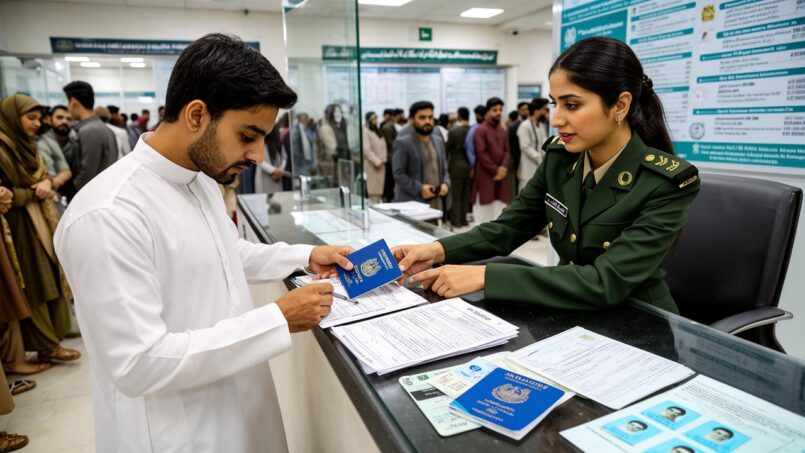
The in-person submission process follows a precise sequence: taking a ticket, fee verification, photo capture, biometric collection (fingerprints and signature), data entry, information review, possible interview with an Assistant Director, and then receipt of a slip with the tracking number and estimated collection date.
Online Applications: DGIP Portal and Pak-ID App
The major development in recent years is the expansion of online services for MRP (and e-Passport): creating an account on the DGIP e-Services portal, filling out the form, uploading documents, online payment, and remote biometric verification via the Pak-ID app.
The procedure unfolds in several logical steps:
The key steps to apply for a Pakistani passport through the DGIP online portal.
Create an account on the DGIP website with email and phone, followed by validation via link/code and activation of enhanced authentication (e.g., Google Authenticator).
Enter personal information, delivery address, passport details, and upload scanned supporting documents.
A Tracking ID (Passport Tracking ID) is generated, essential for online biometrics and subsequent tracking of the application.
Link with the Pak-ID mobile app (Android/iOS) for fingerprint capture and facial verification.
Pay the fees by bank card (Visa/Mastercard) or via local solutions connected to the PSID (EasyPaisa, JazzCash, online banking).
Final submission of the application and regular status monitoring from the personal dashboard.
The DGIP emphasizes one point: without successful biometric verification, an online application cannot be finalized. The system provides a two-step method: capture of four fingerprints via the smartphone camera, then, in case of repeated failure, automatic switch to facial verification via selfie. In case of complete failure, the application may be rejected, with an invitation to visit a physical center.
Required Documents: Adults, Minors, Dual Nationals, Special Cases
One of the main reasons for passport application rejection is missing, incorrect, or non-compliant documents. So it’s best to meticulously gather everything required for your category.
Basic Documents for Everyone
The foundation of the application always relies on a few essential items:
– a valid and original NADRA document: CNIC, NICOP, Smart National ID Card, Juvenile Card, or CRC depending on age;
– a photocopy of the NADRA document;
– the old passport, for a renewal, with photocopies of the first two pages and the observations page if applicable;
– passport photos conforming to DGIP specifications; for online procedures, you also need to provide a digital portrait and, sometimes, a compressed photo meeting a maximum size (less than 20 KB for some forms);
– proof of fee payment: bank receipt, paid PSID, or card payment confirmation.
For dual nationals, the foreign passport must be presented and copied. It helps document dual nationality status and facilitates certain checks without replacing the Pakistani passport.
Adult Application (18 years and older)
An adult must also provide proof of civil status and residence:
For a Pakistani passport application, it is mandatory to provide: a valid CNIC, NICOP, or Smart ID; an updated card in case of marriage (with spouse’s name if desired); proof of local or foreign address; for residents abroad, proof of legal status (visa, residence card, etc.); and for government employees, a No Objection Certificate (NOC).
For a renewal, the expired passport (or one expiring within six to twelve months depending on the case) is the key document: it serves as the basis for revalidating already known information.
Minor Application (Under 18)
Rules have been tightened for children: endorsement on a parent’s passport, previously allowed, is now prohibited by ICAO standards. Each minor must have their own MRP or e-Passport.
The presence of both parents is generally required when submitting the application in person. If one parent is absent, a notarized power of attorney or NOC (No Objection Certificate) authenticated by the Ministry of Foreign Affairs or a diplomatic mission must be provided. If parents are separated or divorced, a legalized custody order from a competent court must specify which parent is authorized to submit the application.
Depending on age:
– for those under 10, a NICOP or a NADRA Child Registration Certificate (CRC) is sufficient, supplemented by a B-Form or FRC if the CNIC has not yet been obtained;
– for those 10–18, a NICOP, Juvenile Card, or biometric CRC (with photo and fingerprints) is required;
– in all cases, the CNIC of both parents and, for renewals, the child’s previous passport must be presented.
Page of the document where the child places their thumbprint to replace the signature, left for girls and right for boys.
Special Cases: Lost, Stolen, Damaged, or Full Passport
When a passport has been lost or stolen, the first step is to file a police report (FIR). Without this document, no reissuance will be initiated. The DGIP also applies substantially higher fees in case of loss, and doubles the fee again in case of a second loss. If the lost passport was not issued by the same consular post where you are submitting the application, the office must first have it verified by the original issuing authority, which can add a delay of one month or more.
In case of a damaged passport that is no longer usable, a new MRP is granted upon presentation of the old document and payment of the reissuance fee. When there are no blank pages left, this is called a reprint for an “exhausted” booklet: the procedure is similar to a standard application, but the DGIP reminds that this category cannot be invoked as long as blank pages remain available.
Steps for an In-Person Application: From Counter to Decision
In Pakistan as well as at missions abroad, the structure of the process is highly standardized. In practice, a visit to the RPO proceeds as follows.
The first step is to get a token at the welcome counter. At the time the token is issued, a photo of the applicant is already taken. This token number then governs the entire process: display of your turn, internal tracking, and later, external tracking.
Two options exist: either the online payment has already been made via a PSID, or the applicant must go to the bank counter at the center or the designated agency to deposit the exact amount. After payment at the agency, the deposit receipt must be entered into the system.
The third step focuses on biometrics. At the specialized station, the officer captures your fingerprints (usually four fingers) and, depending on procedures, your digital signature. The data is immediately transmitted to the central system, which compares it with the NADRA record corresponding to the CNIC/NICOP provided.
The data entry phase involves entering or verifying all personal information (identity, contact details, status). The system simultaneously performs a check against the Exit Control List (ECL/BL) to detect any alerts. Any alert may result in the application being placed on hold for investigation.
Finally, the Assistant Director reviews the entire application for a brief interview and a final decision. If everything is in order, the application is accepted, the processing category (Normal, Urgent, Fast Track) is validated, and a submission receipt is issued indicating the theoretical collection date, the token or tracking number, and the type of booklet ordered.
Under normal circumstances, this entire process does not exceed half an hour. In practice, technical issues (connectivity, equipment failure) can lengthen the visit to up to two hours.
Remote Biometrics: The Role of the Pak-ID App
For online procedures, biometrics are done from home using the Pak-ID app, developed by NADRA. This app, compatible with Android and iOS, is used for many government services (identity cards, civil status verification) and now includes a specific module for the DGIP.
After linking their online application, the user follows the guided steps: the phone camera captures fingerprints in a precise sequence, then the integrity of the images is checked. If quality is insufficient or recognition fails, an alternative verification by facial recognition is offered. You must then take a selfie in good lighting conditions, with a neutral background, to confirm that the person holding the phone is indeed the CNIC holder.
This selfie is not used for printing on the passport, but exclusively for identity verification. Once the biometrics are validated, the application status is automatically updated on the DGIP portal. No additional physical appointment for fingerprints is then required.
The DGIP recommends using a stable internet connection, a phone with a clean lens, and sufficient lighting. In case of repeated blocking, it may help to close and restart the app. If, despite several attempts, the verification fails, the service may reject the online application and require a physical center visit.
Passport Fees: Understanding the Schedule and Options
The passport fee schedule in Pakistan is multi-criteria: number of pages, validity period, processing type (Normal, Urgent, Fast Track) and, for e-Passports, specific status. Added to this are sometimes service fees, taxes, and additional costs for special cases (loss, correction, etc.).
Examples of MRP Fees (Ordinary Passport)
For a standard MRP, the main levels are as follows, excluding optional services:
| Validity / Pages | Category | Base Fee (PKR) |
|---|---|---|
| 5 years, 36 pages | Normal | 4,500 |
| 5 years, 36 pages | Urgent | 7,500 |
| 10 years, 36 pages | Normal | 6,700 |
| 10 years, 36 pages | Urgent | 11,200 |
| 5 years, 72 pages | Normal | 8,200 |
| 5 years, 72 pages | Urgent | 13,500 |
| 10 years, 72 pages | Normal | 12,400 |
| 10 years, 72 pages | Urgent | 20,500 |
| 5 years, 100 pages | Normal | 9,000 |
| 5 years, 100 pages | Urgent | 18,000 |
| 10 years, 100 pages | Normal | 13,500 |
| 10 years, 100 pages | Urgent | 25,000 |
Many presentations add an internal service fee (1,000 PKR) to the base amount, giving e.g., a total of 5,500 PKR for a 36-page normal 5-year passport, or 8,500 PKR for a 36-page urgent 5-year passport. Recent explanatory videos use this scheme to explain to the public the actual total cost paid at the counter.
The Fast Track category is available in about forty cities, applying higher fees for a processing time of 2 working days.
| Validity / Pages | Fast Track – Fee (PKR) |
|---|---|
| 5 years, 36 pages | 12,500 |
| 5 years, 72 pages | 18,500 |
| 5 years, 100 pages | 23,000 |
| 10 years, 36 pages | 16,200 |
| 10 years, 72 pages | 25,200 |
| 10 years, 100 pages | 32,000 |
In case of loss, costs increase significantly, and double again for a second loss. Some schedules symbolically mention amounts “72” and “144” PKR to illustrate this relative doubling, but in practice, total amounts for a lost booklet remain aligned with the passport type’s fee schedule, plus a substantial penalty.
e-Passport Fees
For e-Passports, the base levels are higher than those for MRPs, reflecting embedded technology and the electronic chip.
| Validity / Pages | Category | Fee (PKR) |
|---|---|---|
| 5 years, 36 pages | Normal | 9,000 |
| 5 years, 36 pages | Urgent | 15,000 |
| 10 years, 36 pages | Normal | 13,500 |
| 10 years, 36 pages | Urgent | 22,500 |
| 5 years, 72 pages | Normal | 16,500 |
| 5 years, 72 pages | Urgent | 27,000 |
Again, service fees and taxes may be added. The DGIP recommends always checking the updated fee schedule on its website before preparing an application, as revisions are regular.
Payment Methods
In Pakistan, the state is clearly pushing towards dematerialization. For domestic applications, payments can be made via:
Several options are available for paying passport fees in Pakistan, from bank cards to mobile methods.
Online payment via Visa or Mastercard directly on the DGIP portal.
Generated via the Passport Fee Asaan app or the e-Payment Web Portal. Usable to pay online, at ATMs, via mobile wallets (JazzCash, EasyPaisa), or at bank branches of the 1-Link network.
Cash payment directly at bank counters located in some Regional Passport Offices (RPO).
Minor additional lines exist for SMS notification services, police verification, or lamination, but they remain marginal compared to the total amount.
Abroad, each consulate defines its payment methods: money order or cashier’s check in the US, card payment or bank transfer in Europe, etc. Cash is often prohibited, as are personal checks.
It is important to remember that all passport fees are non-refundable, even if the application is rejected.
Official Timelines, Actual Delays, and Application Tracking
The official DGIP timelines are clear: 21 working days for a normal application, 5 working days for an urgent application, 2 days for Fast Track, and a range of 15 to 20 days for the e-Passport. These periods start once the application is complete and accepted (fees paid, biometrics validated, preliminary checks done).
In reality, “normal” passports can sometimes take two months or more, especially during periods of high demand or technical production issues. “Urgent” passports often exceed the 10 to 15-day mark, sometimes even 20 days. Applications from abroad, which involve shuttle between the mission and DGIP headquarters in Islamabad, often stretch beyond theoretical timelines.
Testimonials on passport processing times
To navigate this uncertainty, the tracking system plays an important role. Several channels exist:
– the DGIP online platform (dgip.gov.pk), which allows checking the status using a token number, CNIC, or phone number;
– SMS, by sending the token number to designated short codes (9988, 8400);
– official hotlines, with numbers such as 051‑9212829 or 051‑111‑344‑777;
– specific portals of certain missions abroad (e.g., a dedicated site for a consulate in Dubai).
The system displays several statuses such as “Application Accepted,” “Data Entry,” “Printing,” “Dispatched,” or “Complete! Ready to pickup.” The message “No record found” indicates the application is not yet in production or the document has already been collected and archived. In case of persistent problems, the DGIP advises contacting the RPO or consulate that processed the application, with the submission receipt.
Once the passport is produced, it is shipped to the office chosen for delivery, or sent by registered mail in countries where this service is offered. In Islamabad and Rawalpindi, a home delivery service already exists and is expected to be extended to other cities.
Also keep in mind that a passport not collected within one month of the collection date is destroyed according to current policy. For families, however, it is possible for a single member to come and collect all newly issued passports at once.
Why an Application May Be Rejected and How to Avoid It
Although the DGIP has not published an exhaustive list of rejection grounds for Pakistan, the most frequent reasons, largely common to other systems, revolve around a few areas.
Passport applications can be rejected for several reasons: errors in the form (incorrect names/dates, missing mandatory fields, incorrect placement of information, unofficial nicknames); document-related issues (expired, illegible, or incomplete NADRA document, absence of NOC for public employees or custody order, CNIC not updated after marriage, use of false documents which can lead to prosecution); negative verification checks (unfavorable police report, address untraceable, criminal record, inclusion on a control list, travel restrictions); serious financial problems or debts to the state; failure to pay fees correctly; faulty biometrics (illegible fingerprints, discrepancies with NADRA data, failed facial verification); and signature not matching identity documents.
In case of refusal, the first action is to understand the exact cause, which is generally notified. If the reason is rectifiable (missing document, clerical error), it is often possible to correct and resubmit a complete application within a short time. For more serious disputes (judicial litigation, nationality issues), you will need to go through additional steps with the relevant authorities before hoping for a green light from the DGIP.
Specific Services: Hajj, Renewals, Emergency Cases
In parallel with the passport process itself, some related arrangements are worth noting.
For Pakistani Hajj pilgrims, a free biometric verification system is mandatory. This procedure, required by Saudi authorities, is separate from the passport application. In major Pakistani cities, it is done without an appointment at Tasheer centers in 10 to 15 minutes: documents are simply scanned and immediately returned. For Pakistanis residing abroad, this step must be done via the Saudi Visa Bio app, not at physical centers.
Renewals generally follow the same rules as first-time applications, with some flexibilities: a passport can be renewed up to one year before its expiration, and up to six months after, or even longer, subject to additional supporting documents. The key document remains the old passport, accompanied by an updated CNIC.
In emergency situations, temporary travel documents or passports issued within 24 hours may be considered for an immediate return to Pakistan, provided the legal situation of the person is clear and there are no restrictions on their travel.
Practical Tips for a Successful Application
Numerous user experiences and recent system developments suggest some best practices for smoothly obtaining a Pakistani passport.
It is crucial to plan ahead: starting the renewal process several months before the expiration date avoids being caught by longer production times than expected. It is also wise to check, beforehand, the consistency of all NADRA data (name spelling, date of birth, marital status) with the information that will appear on the passport.
For a successful online application, ensure you have clear scans of all documents and a passport photo of the required dimensions. Also check that your smartphone works properly for biometrics via Pak-ID. Remember to compress images to the required size while maintaining quality, and check that text on CNIC or visa photos is perfectly legible. Finally, fill in every field of the form carefully to avoid rejection.
On-site, arriving early at the RPO or consulate, with the application neatly organized, helps move through the different counters smoothly. It is advisable to keep on hand both a paper and electronic copy of the receipt, token number, or Tracking ID, and to note down the contact details (hotline or email) of the office where the application was submitted.
For tracking a passport, it is recommended to use only the official channels of the Directorate General of Immigration and Passports (DGIP) and diplomatic missions abroad. Avoid private websites that promise direct access to databases. If you have serious doubts about a passport’s status, the most reliable method for up-to-date information is to contact the RPO or the relevant consulate directly.
—
Obtaining a Pakistani passport today is a structured process, supported by a solid technical infrastructure and high security standards. The downside of this sophistication is a lower tolerance for approximations: every detail counts, from the updated CNIC to document scans, including fingerprint capture via a smartphone. But for those who prepare their application correctly and follow the steps described, the system’s modernization – online payment, e-Passport, home biometrics, digital tracking – represents a real gain in time and convenience, both in Pakistan and abroad.
Disclaimer: The information provided on this website is for informational purposes only and does not constitute financial, legal, or professional advice. We encourage you to consult qualified experts before making any investment, real estate, or expatriation decisions. Although we strive to maintain up-to-date and accurate information, we do not guarantee the completeness, accuracy, or timeliness of the proposed content. As investment and expatriation involve risks, we disclaim any liability for potential losses or damages arising from the use of this site. Your use of this site confirms your acceptance of these terms and your understanding of the associated risks.

Cyril Jarnias is an independent expert in international wealth management with over 20 years of experience. As an expatriate himself, he is dedicated to helping individuals and business leaders build, protect, and pass on their wealth with complete peace of mind.
On his website, cyriljarnias.com, he shares his expertise on international real estate, offshore company formation, and expatriation.
Thanks to his expertise, he offers sound advice to optimize his clients' wealth management. Cyril Jarnias is also recognized for his appearances in many prestigious media outlets such as BFM Business, les Français de l’étranger, Le Figaro, Les Echos, and Mieux vivre votre argent, where he shares his knowledge and know-how in wealth management.





