
 Published on and written by Cyril Jarnias
Moving to Palau with English in your pocket is enough to work, study, or handle administrative tasks. But to truly enter Palauan society, understand conversations at the market, jokes with your host family, or village meetings, you need another passport: the local language, Palauan, which locals call a tekoi er a Belau.
For an expatriate, learning Palauan represents a linguistic challenge but is a powerful accelerator for integration in Palau. It transforms daily life. Specific resources exist to facilitate this learning.
Why Palauan really matters for an expatriate
Palauan is one of the two official languages of the country, along with English. It is the native language of about 17,000 people and, according to national figures, over 60% of residents use it as their main daily language. In practice, about 80% of the population over five years old speaks it at home.
In institutions, English dominates: government, justice, business, secondary and higher education, tourism. Yet, in villages, families, markets, and customary meetings, it is Palauan that carries the emotions, implications, and a good part of social life.
For an expatriate, this implies several very concrete things.
Get into the habit of using Palauan greetings and thanks, like *Alii* to say hello and *Ke kmal mesaul* to express your gratitude, rather than limiting yourself to English. This effort, even modest and imperfect, is highly appreciated by Palauans and immediately transforms their perception of you as a foreigner.
Furthermore, Palauan is direct access to local culture, traditional songs, oral stories, conversations about fishing or clan decisions. One can live in Palau using only English, but then remains on the periphery of what constitutes the soul of the country.
Finally, learning a language known to be difficult like Palauan, with its rich grammar and specific pronunciations, is excellent cognitive training and a professional asset for people working in cooperation, education, research, sustainable tourism, or marine conservation.
Understanding the linguistic landscape of Palau
Before diving in, it’s useful to grasp the linguistic environment in which you will operate. In Palau, several languages coexist, with different official statuses depending on the islands.
Here is a simplified overview of the spoken languages, based on census data and official texts.
Approximate distribution of spoken languages
| Language | Estimated share of the population | Status / notes |
|---|---|---|
| Palauan | ~64.7% | Official language of the country (except island exceptions) |
| English | ~9.4% | Official language, very present in administration |
| Filipino (Tagalog, etc.) | ~13.5% | Significant Filipino diaspora |
| Chinese | ~5.7% | Notable Chinese community |
| Carolinian | ~1.5% | Neighboring Micronesian language |
| Japanese | ~1.5% | Mainly elderly people, official language in Angaur |
| Other Asian and various languages | ~5–6% | Various communities |
In addition, there are special situations:
– in Sonsorol, Sonsorolese and English are official,
– in Tobi, Tobi and English,
– in Angaur, Angaur, Japanese, and English.
For an expatriate living in the main areas of Palau, proficiency in English is necessary for daily functioning, while learning Palauan is crucial for genuine social and cultural integration.
What does Palauan look like? An overview to get your bearings
Palauan belongs to the large Austronesian family, more precisely to the Malayo-Polynesian subgroup, but it has the particularity of not having any identified very close “cousins.” It also differs from neighboring Oceanic languages, making it a particularly interesting subject for linguists.
Pronunciation: few sounds, but pitfalls
The sound system of Palauan is relatively compact: about ten consonants and six vowels. But behind this apparent simplicity lie rules quite confusing for a French or English speaker.
Some key points useful for beginners:
Another surprising feature for a beginner: when a word starts with a vowel, a supporting [ŋ] often slips in front (for example ŋak for “I, me”), which can give the impression that this sound pops up everywhere.
Writing: a well-thought-out Latin alphabet
Palauan is written with the Latin alphabet, in an orthography standardized in the early 1970s by a Palauan spelling committee, in collaboration with the University of Hawaii. The basic principle is quite reassuring for the learner: “one phoneme, one symbol” as much as possible.
The alphabet includes: 26 letters.
– twelve “native” consonants,
– six consonants for borrowings (to note sounds from Japanese, English, etc.),
– ten vowels, including several officially recognized vowel sequences (about twenty “diphthongs” or vowel sequences in one syllable).
For an expatriate, once the main rules of correspondence between graphemes and sounds are mastered, reading a text aloud quickly becomes feasible, even without understanding all the meaning.
Some spelling choices have evolved: for example, the schwa was once noted by an “ę” with an ogonek in some grammars, but this notation has been abandoned in favor of a simple “e”, which simplifies life for beginners.
Grammar: rich, structured, very different from European languages
Palauan grammar is much farther from English or French than, for example, Tagalog or Indonesian, despite the Austronesian kinship.
Some structuring differences:
Unlike French (SVO), the basic word order in Palauan is VOS, as in ‘Eats the fish Peter’ for ‘Peter eats the fish’. The language does not use articles. Possession is marked by suffixes that vary according to the type of noun, shifting the stress. For example, ‘tebel’ (table) becomes ‘tebelek’ (my table). The plural is marked by the prefix ‘re-‘ only for human nouns.
An important example for daily life: the future is constructed with mo + verb. This same mo has a broader meaning of change of state (“to become”), which adds a semantic component to its memorization. We also find perfective and imperfective markers that transform the root form, sometimes by deleting an initial consonant or adding an infix.
For the expatriate, this means not getting discouraged if verb forms seem unstable at first. The important thing, in the first weeks, is not to master complete paradigms, but to recognize key verbs in a few frequent constructions.
The first words to master to survive… and start a conversation
In an environment where everyone speaks English, one might be tempted to neglect the basics. Yet, a few dozen Palauan words and expressions are enough to change the tone of all your interactions.
We can distinguish three groups of phrases: greetings and politeness, practical daily management, and slightly more personal exchanges (introductions, family, health).
Greeting, thanking, being polite
Here is a small sample of formulas heard everywhere and that are valuable to know how to pronounce.
| Function | Palauan | Approximate meaning in English |
|---|---|---|
| Hello / hi (formal) | Alii | Hello, hi |
| Good morning | Ungil tutau | Good morning |
| Good morning (late morning) | Ungil chodochosong | Good morning (late morning) |
| Good afternoon | Ungil sueleb / Ungil iita sils | Good afternoon |
| Good evening | Ungil kebesengei | Good evening |
| Goodbye | Mechikung / Mechikung me a uriul | Goodbye, see you later |
| Thank you (formal) | Ke kmal mesaul | Thank you very much |
| Thank you (common) | Ke mesulang / Mesulang | Thank you |
| Thank you (very familiar) | Sulang | Thanks (very casual) |
| Please | Adang / Choll | Please |
| Sorry | Komeng / Kora | Pardon, sorry |
A simple complete greeting, like “Alii, ng ungil tutau” (“Hello, good morning”), followed by a “Ke ua ngarang?” (“How are you?”) and a “Ke kmal mesaul” when leaving, creates a warm atmosphere with most interlocutors.
Saying yes, no, and managing misunderstanding
For a beginner, it is essential to quickly learn to say “yes”, “no”, “I don’t understand”, “can you repeat?”.
| Basic expression | Palauan | Approximate translation |
|---|---|---|
| Yes | Choi / O’ / Oi | Yes (various forms) |
| No | Ng diak | No / there isn’t |
| Maybe | Locha | Maybe |
| I don’t know | Ngaukai | I don’t know |
| I understand | Ak medengei | I understand |
| I don’t understand | Ng dial kudengei | I don’t understand |
| Speak more slowly, please | Bo mokokau el melekoi | Speak slowly, please |
| Repeat, please | Mluut el molekoi | Repeat, please |
Being able to say “Ng dial kudengei, bo mokokau el melekoi” (“I don’t understand, speak more slowly”) is often the key to turning a blocked exchange into an impromptu mini-lesson with a kindly speaker.
Introducing yourself and talking a bit about yourself
Palauans are curious to know where foreigners living among them come from. Mastering a few phrases to introduce yourself creates an immediate bridge.
| Idea | Palauan | Comment |
|---|---|---|
| What’s your name? | Ng techa ngklem ? | To ask for the first name |
| My name is… | A ngklek a … | “My name is…” |
| Where are you from? | Kę chad ęr kęr ęl beluu ? | Lit. “You are a person from which country?” |
| I am from… | Ak chad ęr a … | “I am a person from…” |
| Where were you born? | Kę mlechell ęr kęr ęl beluu ? | “You were born in which country?” |
| I was born in… | Ak mlechell ęr a … | “I was born in…” |
| How old are you? | Ng tela rekim ? | Lit. “What is your number of years?” |
| I am … years old | Ng … a rekik | “My years are …” |
A phrase like “Ak chad ęr a Frans” (“I am from France”) or Ak chad ęr a Belguim (if borrowing the English name) is often enough to start a discussion about your home country.
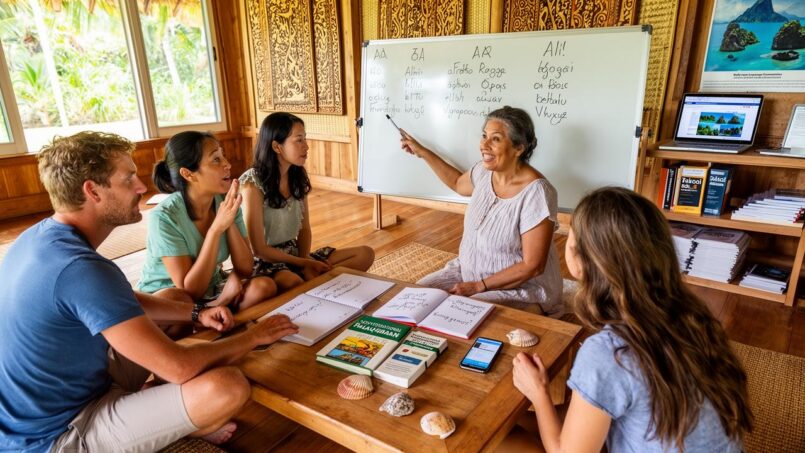
Where and how to learn: courses, resources, and immersion
For an expatriate, the classic dilemma is the same as elsewhere: should one aim mainly for structured courses, or dive into immersion and “learn on the go”? Research on language learning shows that the combination of both is most effective: a solid base in class, then lots of practice in real life.
In Palau, several types of resources exist, even if the online offering is more developed than classic mainstream apps (Palauan is not yet available on Duolingo, for example).
Palau Community College: structured courses to go far
The Palau Community College (PCC), based in Koror, plays a central role in local training. Even though many courses are in English (business, environmental science, etc.), the college also offers Palauan language and culture teachings.
For example, you can find:
– a Conversational Palauan (PW 101) course dedicated to the basics of vocabulary, pronunciation, grammar, and useful sentence structures in social or professional situations,
– a Palauan Language and Culture course that, beyond language, covers history, arts, traditional forms like song (chelitakl), stories (cheldecheduch), or dance (ngloik),
– more advanced courses, like PW 119 (Advanced Palauan Grammar) where you work on spelling, reading more complex texts, and writing two- to three-page essays with correct spelling,
– PW 189 (Palauan Literature) which explores Palauan literature and how it reflects traditional values and social changes.
For expatriates on long stays (cooperation, research, secondment), enrolling in a Palauan course, even a beginner one, provides a structured learning framework, defined progression, and personalized feedback from a qualified teacher.
These courses can be taken as part of a degree program (associate degree in education, liberal arts, etc.) or as isolated units, sometimes non-credit, making them accessible even to those without a full academic project.
Tekinged.com: the reference online portal
For independent work, the site tekinged.com is an essential resource. It is a linguistic portal dedicated to Palauan, officially supported by the Palau Language Commission since 2015.
Its core is a very rich online Palauan-English dictionary: over 26,000 Palauan words, grouped into about 8,500 families, with nearly 3,000 example sentences and over 250 proverbs. The database is regularly updated, and users can report errors or suggest additions by email.
For a learner, this dictionary has several advantages:
– it distinguishes parts of speech (noun, verb, adjective…), which helps understand sentence structure,
– it provides examples in context, allowing you to see how verbs conjugate, how possessive suffixes attach to nouns,
– it integrates perfective and imperfective forms, spelling variants, and unifies them under a base entry (for example, the different forms of medengei “to know, to understand”).
Tekinged also offers a Dosuub section with explanations on pronunciation, common errors, affixes, numbers, grammar, as well as a page dedicated to common phrases. You’ll find many expressions that you can listen to, repeat, and integrate into your survival vocabulary.
The site offers a collection of children’s books and textbooks in the Palauan language, often available for free or in digital format.
Discover fundamental works like ‘Palauan Alphabet’ to learn the basics of the language.
Explore a selection of traditional tales and illustrated stories for young readers.
Access translated works, like the Palauan version of ‘Charlotte’s Web’.
All titles are classified by school level and theme for easier searching.
For an expatriate, reading children’s books in Palauan may seem childish, but it is actually one of the most effective ways to quickly develop written comprehension and vocabulary, especially if you read alongside the English translation when available.
“Speaking Palauan” collections and other bilingual books
A series of books titled Speaking Palauan was originally designed to help Palauan children, including those born abroad, learn their heritage language. These works contain simple words, phrases, traditional colors, the alphabet, etc.
Even though they primarily target a young audience, they are excellent resources for beginner expatriates:
– they start with concrete, everyday vocabulary (body, house, colors, animals),
– they offer a bilingual Palauan-English approach,
– they are often illustrated, allowing you to directly associate image and word without systematic mental translation.
You can also find thematic books in Palauan with English translation, such as books on body parts or shapes and colors, available on online platforms.
Books with religious or cultural purposes complete the offering, for example Teach Me to Pray in Palauan (five simple Christian prayers in Palauan and English) or My First Palauan 200 Picture Word Book, a picture book of 200 words.
For an adult learner, these materials are perfect for:
– anchoring concrete vocabulary,
– working on pronunciation from small, easy-to-repeat words,
– revising in a light way, with children or Palauan friends.
Phrasebooks, conversation courses, and apps
There are Palauan conversation guides for travelers, with the most useful phrases for ordering at a restaurant, asking for a price, finding your way, etc. Some are sold as small manuals or integrated into courses for business travelers.
Local schools or private institutions offer Palauan courses for professional purposes, often in private lessons or small groups. These trainings are designed to meet concrete needs in the workplace, such as understanding colleagues, leading a simple meeting, or communicating with Palauan clients.
On the digital side, while major platforms like Duolingo or Babbel do not yet offer Palauan, you can still repurpose several generic tools:
– flashcard apps like Anki to create your own cards from vocabulary lists on tekinged.com or from books,
– tutoring platforms like Preply, Verbling, or others to search, if possible, for an online Palauan teacher (even though the offering is still very limited for this specific language),
– language exchange apps (Tandem, HelloTalk, etc.) – the important thing is to explicitly mention “Palauan / Palau” in your profile to be spotted by the few registered speakers.
Local media and online content
Even though audiovisual production in Palauan is not abundant, you can find:
– YouTube videos like “Learn basic Palauan”, sometimes hosted by young Palauans explaining greetings, numbers, essential phrases,
– excerpts of traditional songs, dances, commented ceremonies,
– blogs or short texts in Palauan, useful for getting used to the written language.
For the learner, the goal is not to understand everything right away, but to get familiar with the musicality of the language, identify already known words, and “let the ear work.”
What research says: immersion, classroom, or both?
Studies on foreign language learning, whether on French, Spanish, or other languages, converge on one point: immersion is decisive for developing oral fluency, listening comprehension, and social ease, while classroom learning is more effective for consolidating grammar, reading, writing.
In other words:
– the classroom gives you the structures,
– immersion gives you spontaneity.
Work conducted over several decades shows that learners in an immersive context acquire:
– better pronunciation,
– finer listening comprehension,
– more developed pragmatic competence (knowing when to use which formula, at what level of formality, with what implications).
But they may have more written grammar errors if this dimension is not specifically worked on.
For an expatriate in Palau, this argues for a mixed strategy:
To learn Palauan, an effective approach combines three steps. First, it is crucial to take a foundation of structured courses (at Palau Community College or with a tutor) to master grammatical basics like verb logic, pronouns, possession, and word order. Second, you must dive into immersion very early, even clumsily: greet neighbors, try to open and close an exchange while shopping, or participate in cultural workshops. Finally, multiply real micro-situations where the language is necessary: ask for a price, explain that you don’t understand well, simply tell about your day, and accept being corrected.
A neurological study on adults learning an invented language showed that only those who benefited from immersion-type training developed brain patterns close to those of natives for grammar processing. Even though Palauan is more complex than an experimental mini-language, the principle remains valid: natural, interactive exposure plays a key role in the long-term installation of the language in the brain.
Concrete method for an expatriate: from arrival to the first months
Applying these broad principles to the Palauan context requires taking two factors into account:
– you operate in an environment where almost everyone speaks English,
– Palauan is considered difficult, particularly for French and English speakers.
This can encourage linguistic laziness. The solution is to create a framework, a routine, and a few rules of the game for yourself.
The 4 first basic objectives
In the first weeks, instead of aiming for vague “mastery”, aim for four very concrete objectives:
1. Know how to greet, introduce yourself, and thank in Palauan without hesitation.
2. Be able to express that you don’t understand, and ask to repeat or speak more slowly.
3. Know how to ask basic information (“Where is…?”, “How much does it cost?”, “What is your name?”).
4. Integrate about thirty everyday verbs and nouns (eat, drink, house, water, work, school, friends, family).
This is the percentage of the most frequent vocabulary that allows you to cover 80% of real situations in Palauan, according to the 80/20 rule.
Rely on the most frequent words
Here is a small excerpt of this type of frequency list, which can guide your first memory cards.
| Palauan word | Category | Main meaning |
|---|---|---|
| a | modifier | if, when |
| el | conjunction / link | who, that, which |
| er | preposition | at, in, of (depending on context) |
| e | conjunction | and, then, but |
| ngii | emphatic pronoun | he/she/it (non-human too) |
| mo | auxiliary | future / to become |
| diak | stative verb | to not be, to not exist |
| chad | noun | person, human being |
| ungil | stative verb | good, well |
| beluu | noun | country, village, place |
| tekoi | noun | word, language, speech, action |
| blai | noun | house, home, family |
| kall | noun | food |
| medengei | transitive stative verb | to know, to understand |
| chelechang | noun | now, today, nowadays |
| tekengel | possessed noun | speech, language, matter, subject |
By learning these words with examples and pronunciation, you will already be able to decipher a large number of statements heard around you.
A typical learning day in Palau
Imagine a day for an expatriate who wants to make real progress:
This routine illustrates structured linguistic immersion throughout the day. In the morning, 20 minutes of active review with Anki cards. During the commute or breakfast, listen to a recording and practice “shadowing.” During the workday, integrate greetings and simple phrases into interactions. In the afternoon, participate in a course or workshop if possible. In the evening, 10 minutes of reading aloud simple material, like a children’s book or phrase lists, followed by checking the translation.
This short but regular routine (15–30 minutes of targeted work + real interactions) is infinitely more effective than a big weekly block of three hours.
Immerse yourself in the culture to better retain the language
In Palau, the language is intimately linked to culture, traditional kinship structures, and the relationship to the ocean and land. Language learning therefore greatly benefits from relying on opportunities for cultural participation.
Workshops, museums, community life
Workshops on weaving, carving, painting, or traditional dance are sometimes offered by museums, cultural centers, or heritage projects. Even if English remains present, simply being present at these activities exposes you to natural Palauan, vocabulary related to objects, actions, instructions.
The important thing is to dare:
– ask for the Palauan name of objects you handle,
– repeat out loud,
– note down afterward a few words to add to your memory cards.
Host families, neighborhood, religious communities
Many expatriates live in private residences or staff housing, but seeking to get closer to a local family – even through regular visits – is a fantastic immersion opportunity.
Churches and other religious communities are conducive places to listen to and practice the Palauan language through prayers, songs, and readings. To facilitate understanding and participation, works such as *Teach Me to Pray in Palauan* can serve as useful support.
Palauans generally have a sense of hospitality: they won’t expect you to speak perfectly, but will often be delighted to help you correct a sentence or find a word.
Managing specific difficulties of Palauan
For a Western expatriate, several points can be particularly confusing.
Complex verb grammar
Palauan verbs often change form according to tense, aspect, transitivity, and the possible presence of incorporated object pronouns. You encounter perfective, imperfective, causative, directional forms, etc.
Rather than trying to master everything at once, it is more realistic to:
To master verbs in Palauan, it is recommended to: memorize the forms of essential verbs (like eat, drink, go, come, speak, know, like) in common sentences; learn to spot frequent tense markers (like ‘mo’ for future, ‘mla’ for existential past, or imperfective prefixes ‘-l’, ‘-ng’, ‘m-‘); and finally, allow yourself to use simplified forms at the beginning of learning, while accepting corrections to progress.
Word order and absence of articles
The VOS organization can give an impression of “disorder” for a French speaker. Again, massive exposure to complete sentences helps internalize the pattern. Reading or listening to basic dialogues, repeating out loud, then trying to improvise short sentences following the same scheme allows for more secure progress than a purely theoretical approach.
In the absence of articles ‘the’, ‘a’, ‘an’, it is necessary to adopt a new reflex. Rather than mentally translating each word, you must accept that the language expresses notions of specificity and generality differently.
“Floating” vowels and prosody
The alternation between [ɛ] and [ə], diphthongs, the insertion of [ŋ] before certain vowels, all of this can be confusing at first. The only realistic solution is:
– listen to a lot of Palauan,
– record yourself repeating model sentences,
– compare and adjust, ideally with feedback from a native speaker.
The good news is that most Palauans are used to hearing foreigners butcher their language and remain indulgent, as long as the effort and respect are there.
For expatriate children: leveraging school and youth resources
Expatriate families with children often find themselves in international or private schools, where English dominates, sometimes with other languages of instruction (American programs, IB, etc.). Palauan is variably present there.
Children can still benefit:
Initiatives aimed at integrating and valuing Palauan language and culture in education and activities.
Integration of Palauan language and culture courses into public school programs.
Introduction to the language through projects, workshops, and educational outings.
Availability of youth books in Palauan, from tekinged.com or local publishers and authors like Gerard Aflague.
The Speaking Palauan series and bilingual picture books are particularly suitable for family learning, where parents and children discover vocabulary together. Repetition through images, nursery rhymes, and little stories is a very natural way to anchor the language in the young.
For parents, this can also be a motivation lever: learn to help the child with Palauan homework, or conversely, let the child serve as a “teacher” to teach parents what they learned at school.
Measuring progress and staying motivated
A common difficulty, in a context where English is enough for practical life, is maintaining motivation in the medium term. Several strategies can help:
To effectively learn a language like Palauan, it is crucial to set measurable and concrete goals, such as holding a five-minute conversation in the language within three months or reading a children’s story without help within a year. Use available assessment tests when possible. Finally, document your progress by keeping traces of your productions, like audio recordings, a diary, or short videos, to visualize your evolution.
One of the collateral benefits is that learning Palauan deepens not only your understanding of Palauan society, but also your own relationship to language, identity, and the way a small island community articulates tradition and modernity.
In conclusion: making language a gesture of respect
In Palau, English opens administrative, academic, professional doors. Palauan, on the other hand, opens the doors of homes, end-of-day conversations, village decisions, jokes that are never translated.
Learning the local language, even at a modest level, is perceived as a strong gesture of respect. It shows that you are not just coming to consume an exceptional landscape, but that you accept to be transformed, at least a little, by the culture that inhabits it.
With courses at Palau Community College, online resources like tekinged.com, bilingual books, cultural workshops, and above all the kindness of a community ready to hear you stammer Alii, ke ua ngarang?, you have everything you need to make Palauan more than just a “plus” on your expatriate CV: a genuine link with your host country.
Disclaimer: The information provided on this website is for informational purposes only and does not constitute financial, legal, or professional advice. We encourage you to consult qualified experts before making any investment, real estate, or expatriation decisions. Although we strive to maintain up-to-date and accurate information, we do not guarantee the completeness, accuracy, or timeliness of the proposed content. As investment and expatriation involve risks, we disclaim any liability for potential losses or damages arising from the use of this site. Your use of this site confirms your acceptance of these terms and your understanding of the associated risks.

Cyril Jarnias is an independent expert in international wealth management with over 20 years of experience. As an expatriate himself, he is dedicated to helping individuals and business leaders build, protect, and pass on their wealth with complete peace of mind.
On his website, cyriljarnias.com, he shares his expertise on international real estate, offshore company formation, and expatriation.
Thanks to his expertise, he offers sound advice to optimize his clients' wealth management. Cyril Jarnias is also recognized for his appearances in many prestigious media outlets such as BFM Business, les Français de l’étranger, Le Figaro, Les Echos, and Mieux vivre votre argent, where he shares his knowledge and know-how in wealth management.





