
 Published on and written by Cyril Jarnias
For a long time, getting around in Palau meant having your own car or relying on a taxi. In just a few years, the landscape has begun to change: a fledgling bus network has emerged, the issue of accessibility has entered public debate, and “eco-friendly” projects have been launched with support from Japan. But the system remains young, limited, and far from meeting everyone’s needs, especially people with disabilities.
This practical guide details how the public transport network works, what travelers can realistically expect, and the specific implications for people with reduced mobility or disabilities.
Understanding the Palauan context: small country, big challenges
Palau is an archipelago of fewer than 20,000 people, spread across several islands. The political capital is Ngerulmud, on Babeldaob, while the main town, where economic and tourist activity is concentrated, is Koror. Roman Tmetuchl International Airport is located in Airai, in southern Babeldaob, about a fifteen-minute drive from Koror.
This context explains part of the transport specifics:
This is the length, in miles, of the paved road network on Babeldaob Island, supplemented by the paved roads of Koror.
The Palauan authorities themselves acknowledge that public land transport is “underdeveloped” and only really began about two years ago, with a few buses on a limited route. The country still relies heavily on private cars, taxis, and private shuttles.
The bus system in Palau: what actually exists
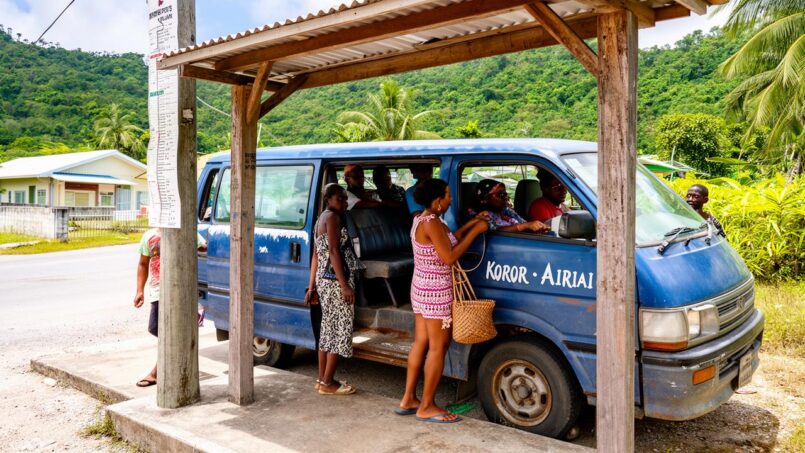
The core of modern public land transport in Palau is the bus system set up with support from the JICA (Japan International Cooperation Agency) as part of the “Eco-friendly Transportation System” project. The buses used include those donated for the 2022 Our Ocean conference.
A network under construction between Koror and Babeldaob
The main lines connect Koror and Babeldaob, with strategic stops at Airai and in the busiest areas. The system is structured around a few routes:
– a daytime line connecting Airai (specifically the Supercenter) to Koror, with an extension to Malakal (Ice Box Park)
– services between PNCC headquarters in Airai and hubs like Palau Pacific Resort (Ngarkebesang) or the Division of Maritime Security in Malakal
– “East Coast” and “West Coast” routes on Babeldaob that allow reaching Koror
A concrete example is the bus line connecting WCTC shopping center in Koror and Surangel’s Supercenter in Babeldaob. This service runs five times a day, Monday through Friday only, and offers an extremely modest transport fare.
| Route | Approximate travel time | Frequency | Indicative fare |
|---|---|---|---|
| WCTC Koror → Surangel’s Supercenter (Babeldaob) | ~12 minutes | 5× per day (Mon–Fri) | 1 USD |
| Koror → Airai (by car) | ~13 minutes | – | – |
| Koror → Babeldaob (by road) | ~15 minutes | – | – |
Alongside this “standard” service, a special service serves the 680 Night Market, a market held at the Japan-Palau Friendship Bridge at least twice a month. A dedicated shuttle runs to and from this event, with schedules, stops, and fares published in advance.
Recent improvements to the bus service
The authorities have gradually adjusted the system based on user feedback. A series of significant changes has been implemented:
As of April 1, the Koror daytime bus line runs Monday through Friday (excluding holidays) instead of two days. The route is extended to Ice Box Park in Malakal, with six round trips daily maintained despite the extension. A new midday service has been introduced to reduce wait times, and stops have been reorganized (new stops at True Value, JP Friendship Bridge Airai side, Ernguul Park, Old Age Center; stops at Klubed and Culture Center removed).
These adjustments reflect a genuine effort to make the service more useful on a daily basis, even though we are still far from a dense, frequent urban network.
Schedules and frequency: what to expect
Buses do not run every 10 minutes. The general framework is more like a scheduled shuttle service found in small towns:
– 6 to 8 rotations per day on some main routes
– service on weekdays, with little or no service on weekends, depending on the line
– morning and evening schedules to connect residential areas of Babeldaob to Koror, supplemented by a midday trip
It is therefore highly recommended to check current schedules. The official tourism website (pristineparadisepalau.com) and the dedicated “Daytime Bus Service” page typically provide updated timetables. A phone number is also available for inquiries: (680) 488‑2626.
Fares, tickets, and discounts
One of the strong points of the Palau bus system is its cost, particularly low for both travelers and residents.
For lines established under the eco-friendly project, the standard fare is 2 USD per trip. Discounts are available:
| User category | Fare per trip |
|---|---|
| Adult (standard fare) | 2 USD |
| Elementary school student | 1 USD |
| Seniors (65 and older) | 1 USD |
| Persons with disabilities | 1 USD |
| Out-of-school child accompanied by an adult | Free |
On some local routes, an even lower price has been observed, such as 1 USD for the WCTC–Surangel’s Supercenter trip. Overall, the bus is therefore the most economical option, far ahead of taxis.
In central Koror, the BBI Shuttle functions as an evening urban shuttle. For 7 USD per person, the ticket is valid for a full week and allows unlimited hop-on, hop-off along Koror’s main artery, between key points like Palau Pacific Resort and Palau Royal Resort. It’s a cost-effective solution for visitors staying in town.
Buses, shuttles, taxis: how to get around daily
Even though a fledgling public transport system exists, the reality of getting around Palau remains hybrid: you juggle buses, private shuttles, taxis, and sometimes car or bike rentals.
Koror: the town where you walk… and take taxis
Koror is the main urban area of Palau, but its size is modest. For very short trips, walking is often the simplest solution, especially along the main road (Route 1), where shops, restaurants, and services are concentrated.
Taxis are numerous and easy to call, especially through hotels, restaurants, or activity centers, which are happy to call a driver for their customers. The two major companies in Koror are City Cab and KOROR Taxi 101. The common practice is not a meter but a flat-rate system based on pick-up and drop-off points. Drivers have a rate sheet that you can ask to see.
Some price references:
| Typical route | Approximate price range |
|---|---|
| Short trips within central Koror | ≈ 5 USD minimum |
| Palau Pacific Resort ↔ central Koror | 6–8 USD (rarely more than 10 USD) |
| Airport → Koror (one-way) | 20–30 USD (≈ 30 USD often cited) |
| Koror → Babeldaob (by taxi) | 10–30 USD depending on destination |
Taxis may apply a night surcharge, around 20% after dark. It is strongly recommended to agree on the fare before getting in, as some drivers may try to overcharge tourists. Payment is almost exclusively in cash, in US dollars.
Optimize your trips during an extended stay by adopting practical strategies for simpler, more cost-effective travel.
For an extended stay, it is recommended to negotiate a package deal with a single taxi driver whom you contact for all your trips.
This practice simplifies trip planning and usually results in more consistent and favorable rates.
The BBI Shuttle and other urban shuttles
For evenings in Koror, the BBI Shuttle plays an interesting role. Two vehicles run in opposite directions along the main downtown street, serving hotels, restaurants, shops, and major resorts like Palau Pacific and Palau Royal. The weekly ticket (7 USD) makes the service attractive for those who go out often in the evening.
In addition, many hotels, dive shops, and activity centers offer their own shuttles. They most often operate:
– between the airport and hotels or resorts
– between accommodations and dive bases or excursion departure points
– between hotels and partner restaurants
For many divers or tourists visiting exclusively for boat trips, these shuttles are sufficient to cover all travel needs, making car rental unnecessary.
Car rental, biking, and other individual solutions
Even though this guide focuses on public transport, it is impossible to ignore the central role of rental cars in Palau. Major international agencies (Alamo, Avis, Budget, Enterprise, Hertz, National, Payless) are present, with counters at the airport or in Koror. The average price is around 60 USD per day, with “good deals” around 55 USD if booked in advance. The small car, like a Nissan Versa, is the most common and economical model.
For short stays in Koror and Babeldaob, biking can be a pleasant alternative. A rental company like Island Bicycle Rental offers GIANT brand mountain bikes, delivered and picked up directly at your accommodation, with helmet, storage bag, poncho, odometer, and map. Rates are around 20 USD per day, with possible discounts for multi-day rentals. Since the roads on the Koror–Babeldaob axis are fairly good and traffic is relatively calm, this can work for confident cyclists.
Scooters are sometimes mentioned as an option, in the range of 25–30 USD per day, but their actual availability in Palau is more limited than in other Asian destinations.
Inter-island transport: public ferries, private boats, and constraints
Palau is a country of islands, and part of travel happens on the water. Even though maritime transport is more a matter of state ferries and private boats than “public transport” in the strict sense, it remains essential for understanding accessibility between islands.
State ferries: an economical but infrequent option
The Palauan government operates maritime services to several inhabited islands from Koror, including:
– Peleliu, known for its World War II sites
– Angaur, a small island south of Peleliu
– Kayangel, an atoll north of Babeldaob
The minimum price in USD for a ferry ticket for residents, though tourists often pay more.
Their main drawback is frequency: departures may only occur once or twice a week, or even every two weeks for Kayangel, with schedules subject to change due to weather or operational constraints. Reservations are not always possible; boarding is often on a first-come, first-served basis, requiring an early arrival at the dock.
Private boats: flexibility but high cost
To reach certain islands at specific times, or to travel directly between two secondary islands (e.g., Peleliu and Angaur, not connected by a direct official ferry), there is often no choice but to use a private boat.
Private transfers cost between 50 and over 300 USD depending on distance and type of service.
Maritime accessibility for people with disabilities
The Palauan public authorities have recognized the importance of making maritime transport accessible as well. In their exchanges with the UN Committee on the Rights of Persons with Disabilities, they emphasized the need to acquire adapted boats, in addition to land vehicles.
A notable project is the accessibility ramps at Ngermalk and Airai, which allow people with reduced mobility to access the sea for leisure, serving as models of inclusive design. However, these initiatives remain fragmentary and have not yet translated into a genuine network of accessible public boats.
Accessibility and disability: a transport system that is still largely exclusionary
One of the most striking observations in the landscape of Palauan transport concerns people with disabilities. Legally, the law prohibits discrimination based on physical or mental disability, and this prohibition is enforced. But in practice, accessibility remains very limited.
The official picture: inaccessible buses, rare sidewalks
During the review of Palau’s initial report by the Committee on the Rights of Persons with Disabilities, the Palauan delegation acknowledged that:
– public transport is still very underdeveloped
– the bus system is barely a few years old
– no bus currently in service is equipped to accommodate wheelchair users
– sidewalks are rare across the country
At the same time, there is no law imposing accessibility standards for transport, communications, and public buildings. The only specific requirement: each national building open to the public must reserve at least one parking space for people with disabilities, near the main entrance.
In other words, the general prohibition of discrimination coexists with a regulatory vacuum in terms of concrete accessibility, resulting in a daily life full of obstacles for those affected.
Ongoing initiatives: coordination committee and specialized vehicles
Palau has nonetheless taken several important steps in recent years. With the adoption of RPPL 11‑36, a Coordinating Committee on Persons with Disabilities and a dedicated Bureau were created. This structure brings together several ministers (Justice, Finance, Health), representatives of organizations of persons with disabilities, governors, and religious or community actors. This is the first time such representation has been mandated by law, giving people with disabilities more direct access to decision-makers.
The state has purchased a few vehicles, including at least one van equipped for people with disabilities, available on request for trips to essential services. However, with only one or two vans available at the national level, this offering remains highly insufficient compared to actual needs.
The government is considering a fundamental question: should the entire public transport network be required to become accessible, or is it acceptable to develop a parallel specialized system, with a sufficient fleet of adapted vehicles? The UN Committee has clearly expressed its concerns about the lack of accessible public transport, suggesting that a strictly segregated approach would be insufficient in the long term.
Palau estimates that 3 to 4% of its population lives with a disability, or about 2,600 people. An assistance fund for persons with severe disabilities (RPPL 11‑11) and a grant for the education of children with disabilities have been established, covering nearly 186 children and seniors. Omekesang, the main disability NGO, is simultaneously running a campaign to fund a wheelchair-accessible van and a 12-seat minibus to facilitate trips to school, hospital, or community activities.
Some peripheral transport-related services also contribute to inclusion, such as:
– a meal program for people aged 55 and over, homebound individuals, and adults with special health needs
– a housing accessibility audit project, particularly for seniors, intended to serve as the basis for a broader “independent living” plan
– training of 22 teachers in assistive technologies to promote inclusive education
But when it comes to mobility, families very often remain on the front line and bear the cost of transporting their loved ones with disabilities, due to the lack of suitable public transport solutions.
Transport, climate, and development: why the eco-friendly bus is strategic
Behind the buses running between Airai, Koror, and Malakal lies a broader issue than simple urban mobility. Palau, a country particularly exposed to climate change, sees this system as a tool to reduce dependence on private cars, combat rising fuel costs, and lower emissions.
The “Eco-friendly Public Transportation System” project, carried out with JICA and Palau’s Ministry of Human Resources, Culture, Tourism and Development, is part of a broader roadmap:
Transport development strategy for Koror and Babeldaob, aiming to improve mobility and sustainability.
Phased deployment and commissioning of the existing bus network, with a target date of 2026.
Development of a comprehensive transport strategy for the islands of Koror and Babeldaob, with a horizon of 2030.
Explicit reduction of traffic congestion, CO₂ emissions, and dependence on private cars.
This project is integrated into the Palau Development Plan 2023‑2026, which aims to “improve the quality of life for present and future generations” by combining environmental protection, climate resilience, and economic recovery. The development of land and maritime transport is among sectoral priorities, with a particular focus on improving connections to outer islands for health and essential services reasons.
Long-term directions even mention the establishment of a renewable-energy-powered maritime transport system, showing that the thinking goes beyond roads.
Transport, human rights, and participation: what international bodies say
During the review of Palau by the Committee on the Rights of Persons with Disabilities, many experts emphasized the systemic dimension of transport barriers. They posed a series of questions that remained partly unanswered:
– how to integrate accessibility requirements into all public procurement for infrastructure and transport?
– what specific measures to ensure mobility, access to information, and disaster warning procedures for persons with disabilities?
– how to ensure the participation of persons with disabilities, especially women and children, in transport planning and mobility policies?
The Palauan delegation acknowledges that aligning national laws with the Convention on the Rights of Persons with Disabilities is a challenge. There is still no national strategy for information and awareness about disability. Furthermore, training for professionals (doctors, teachers, employers, judicial staff) on specific needs is still at an early stage of development.
Around elections, the issue of accessibility of polling stations, braille ballots, and participation of persons with intellectual disabilities was also raised. Authorities admitted that the current system, where an official votes on behalf of a blind person, compromises confidentiality, and that legislation barring electoral participation of persons with mental or intellectual disabilities needs to be revised.
These elements show that the debate on transport goes far beyond technicalities and touches on the exercise of fundamental rights: moving to work, study, receive medical care, and participate in democratic life.
Practical tips for using public transport in Palau
For a traveler or resident, making the most of the current system means working with its strengths and limitations.
Using buses requires good planning: check updated schedules, take note of service days (often Monday through Friday), anticipate connections if coming from Babeldaob and needing to catch a boat in Malakal. The fare is advantageous, but frequency remains low, meaning you have to organize your day around the bus rather than the other way around.
The BBI Shuttle is very convenient for evening trips if your accommodation is near its route. Buying a weekly ticket at 7 USD is economical if you go out regularly for dinner or drinks.
For sea trips, checking public ferry information remains crucial if traveling on a tight budget. But given limited frequencies, most travelers combine public transport and private transfers arranged by tourism providers.
People with disabilities must, still today, consider that the public transport system is not designed for them, especially when moving in a wheelchair. Even though discounts exist on buses and an adapted van can be mobilized occasionally, the most realistic approach is often to coordinate travel with family, social services, the Omekesang NGO, or private providers willing to adapt their vehicles.
Public transport in Palau tomorrow: toward more inclusion?
Despite its shortcomings, the Palauan system is at a turning point. A specific institutional framework for disability now exists, with a Coordinating Committee and a Bureau of Persons with Disabilities. A transport development plan through 2030 is being prepared. Model accessibility ramps have been built in Ngermalk and Airai. Adapted vehicles have been acquired, even if too few. Bus lines are gradually lengthening and becoming denser.
The challenges remain considerable, but the message reiterated by the authorities is one of commitment to building a more inclusive society, working with development partners, UN agencies, civil society, and the private sector.
Jeffrey Antol, Presidential Advisor Gaafar J. Uherbelau
For travelers, this means it is possible—and even advisable—to use the existing public transport, especially the buses and shuttles, accepting their still-experimental nature. For Palauans, the gradual strengthening of these services, if accompanied by a real leap in accessibility, could transform the relationship to travel, reduce car dependence, ease household budgets, and open public space to everyone, regardless of physical or sensory abilities.
The archipelago’s transport network is limited by the country’s size and certain constraints, but it embodies a desire to reconcile development, environment, and human rights. Understanding its logic allows you to use it to explore the islands and immerse yourself in local life.
Disclaimer: The information provided on this website is for informational purposes only and does not constitute financial, legal, or professional advice. We encourage you to consult qualified experts before making any investment, real estate, or expatriation decisions. Although we strive to maintain up-to-date and accurate information, we do not guarantee the completeness, accuracy, or timeliness of the proposed content. As investment and expatriation involve risks, we disclaim any liability for potential losses or damages arising from the use of this site. Your use of this site confirms your acceptance of these terms and your understanding of the associated risks.

Cyril Jarnias is an independent expert in international wealth management with over 20 years of experience. As an expatriate himself, he is dedicated to helping individuals and business leaders build, protect, and pass on their wealth with complete peace of mind.
On his website, cyriljarnias.com, he shares his expertise on international real estate, offshore company formation, and expatriation.
Thanks to his expertise, he offers sound advice to optimize his clients' wealth management. Cyril Jarnias is also recognized for his appearances in many prestigious media outlets such as BFM Business, les Français de l’étranger, Le Figaro, Les Echos, and Mieux vivre votre argent, where he shares his knowledge and know-how in wealth management.





