
 Published on and written by Cyril Jarnias
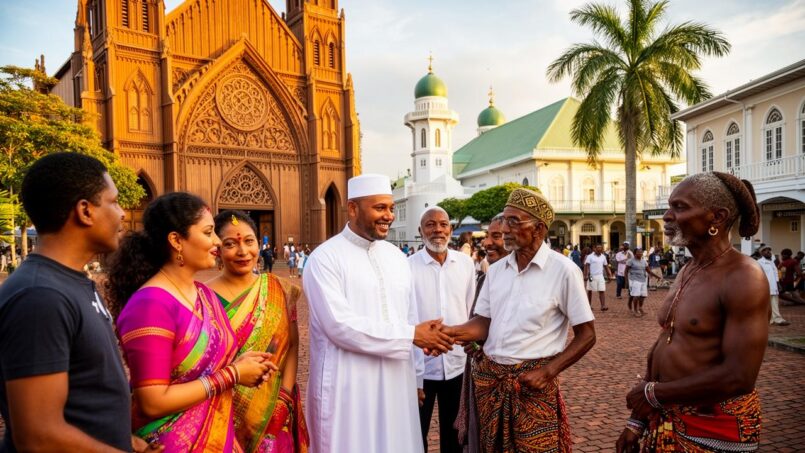
Settling in Suriname means entering one of the most dense and peaceful religious landscapes on the planet. The country is regularly cited among the most spiritually diverse states, and this diversity is lived not through confrontation, but through an almost everyday coexistence. For an expatriate, this richness is an opportunity, provided you understand it at least a little and know how to behave tactfully.
This guide aims to ease your integration into Suriname by familiarizing you with local religious practices. It helps you avoid missteps and build harmonious relationships with those around you, while respecting what the population considers sacred.
A country where almost every neighborhood has its temple, mosque, and church
Suriname stands out for a religious mosaic directly stemming from its migration history. According to the 2012 census, the population is mainly divided between Christians (48.4%), Hindus (22.3%), Muslims (13.9%), followers of Winti (1.8%) and Javanism (0.8%), along with other minorities (Jews, Baha’is, Buddhists, Mormons, etc.) and about 7.5% with no declared religion.
This diversity is also reflected in ethnic origins: Hindustanis (descendants of Indians) are mostly Hindu, with a significant portion being Muslim or Christian; Javanese are mainly Muslim or Christian; Maroons and a large part of the Creole population are Christian, but many incorporate Winti or traditional practices into their faith.
This article summarizes the main religious groups and their demographic weight to measure this diversity.
Table 1 – Major religious families in Suriname (2012 census)
| Religion / main current | Estimated share of population | Key observations |
|---|---|---|
| Christianity (total) | 48.4% | Includes Catholics, Pentecostals, Moravians, Reformed, Lutherans |
| Hinduisms (Sanatani, Arya Samaj…) | 22.3% | Strong Hindustani presence in coastal districts |
| Islam (Sunni, Ahmadi, others) | 13.9% | Muslim community among Hindustanis and Javanese |
| Winti | 1.8% | Afro-Surinamese religion, very alive in Maroon communities |
| Javanism (Kejawèn) | 0.8% | Javanese syncretic practice |
| Other religions | 2.1% | Jews, Baha’is, Buddhists, etc. |
| No declared religion | 7.5% | Atheism or agnosticism |
In this context, religious tolerance is both a social value and a state policy. The Constitution guarantees freedom of worship, prohibits religious discrimination, and penalizes “incitement to religious hatred.” The state funds registered religious organizations, employs Hindu, Muslim, Catholic, and Protestant chaplains in the military, and officially participates in the major festivals of all communities.
For an expatriate, this means that religious affiliation strongly structures public life… but the widely shared rule of the game remains mutual respect.
Paramaribo, showcase of religious coexistence
In Paramaribo, this coexistence takes a nearly spectacular form. A few streets are enough to go from a Moravian church to a Catholic basilica, then to a Hindu mandir or a mosque.
The capital concentrates several iconic sites, which are as many reference points for understanding local sensitivities.
Table 2 – Some major places of worship in Paramaribo
| Place of worship | Main tradition | Particularities for expatriates |
|---|---|---|
| St. Peter and Paul Cathedral | Christianity (Catholic) | Huge wooden structure, important Sunday services |
| Grote Stadskerk (Mamakerki) | Christianity (Moravian) | Large Moravian church, major social and historical role |
| Arya Dewaker Mandir | Hinduisms (Arya Samaj) | Largest Hindu temple in the country, modern octagonal architecture |
| S.I.V. Mosque | Islam (Sunni Muslims) | Downtown mosque, open continuously on weekdays |
| Mosque on Keizerstraat | Islam | Famous for its century-old coexistence with the neighboring synagogue |
| Neveh Shalom Synagogue | Judaism | Wooden synagogue with sand-covered floor, symbol of an ancient Jewish presence |
The juxtaposition of the Keizerstraat mosque and the Neveh Shalom synagogue has become an international symbol: they even share a parking lot, and this peaceful proximity has lasted for over a century. For a newcomer, this image sums up the local spirit quite well: strong identities, distinct practices, but a determined refusal of religious conflict.
Dress code and attitudes: what is expected of you
In daily life, especially in Paramaribo, the tropical climate calls for light clothing. However, the unwritten rule remains modesty. Avoid ultra-tight or very revealing outfits outside of beaches and pools. In town, even for shopping, it is better to be “covered” than in a swimsuit or tank top.
Outside the capital and in religious spaces (temples, mosques, churches), the requirement for modest dress increases. You are expected to cover your shoulders and knees. Favor loose, clean, discreet clothing and closed-toe shoes rather than flip-flops.
Entering someone’s home follows another code: it is common to remove your shoes and leave them on the porch. Arriving with a small gift – chocolate, a specialty from your country – is seen as a nice gesture, though not mandatory. On the other hand, asking overly intimate questions right away is poorly received: intrusive curiosity is associated with gossip.
Understanding Christian practice: from Moravians to Pentecostals
Christianity represents the largest religious bloc in the country, but it is itself very fragmented. Catholics, mission churches, Pentecostal movements, and the Moravian Church share the space.
The Moravian Church holds a special place. Descended from a Protestant tradition born in Bohemia in the 15th century, it established itself in Suriname as early as the 18th century, with a strong missionary orientation. Today, nearly 10% of Surinamese are Moravian, making it the main Protestant denomination and a decisive social actor, notably through schools, clinics, and development projects.
Between 1830 and the abolition of slavery in 1863, Moravian missionaries played a pivotal role in Suriname’s colonial society. They accompanied social change by educating, treating, and catechizing enslaved populations. This historical action explains why, even today, many Maroons (communities descended from escaped slaves) and Christian Creoles maintain a strong connection with this Church.
For an expatriate, attending a Sunday service – Catholic or Protestant – is a good way to see how faith is lived daily. You will find:
– an emphasis on family and neat dress (shirt, dress or skirt covering the knees, no tank tops);
– liturgies that are sometimes very formal (among Moravians) or very expressive (in Pentecostal churches);
– a strong social dimension: after the service, people chat, exchange news, and plan charitable actions.
Believing expatriates often find an anchor here, but even without a particular faith, going with a local friend helps you better understand what Sunday means for many Surinamese.
Diving into Surinamese Hinduism: between Indian tradition and local culture
Hinduism is the second largest religion in the country. The numbers testify to its deep-rooted presence: more than 120,000 Hindus in the early 2010s, or over 20% of the population, with a particularly strong presence in the coastal districts of Nickerie, Wanica, and Saramacca.
Suriname’s Hindustani community mainly descends from indentured laborers who came from northern India during the colonial era. The relative flexibility of Dutch policies toward their religion allowed for a stronger cultural development than elsewhere in the Caribbean. Today, reading sacred texts like the Bhagavad Gita, the Ramcharitmanas, or the Ramayana is widespread, and the use of the Sarnami Hindustani language remains very alive.
Two major currents structure the Hindu landscape:
Table 3 – Main Hindu currents in Suriname (2012)
| Hindu current | Share of total population | Distinctive traits |
|---|---|---|
| Sanatani Hindus | 18% | “Traditional” Hinduisms from North India |
| Arya Samaj | 3.1% | Reformist current, emphasis on the Vedas and monotheism |
| Other forms of Hinduism | 1.2% | More local practices or specific movements |
The Arya Dewaker Mandir in Paramaribo embodies this synthesis between modernity and fidelity to Vedic texts. Its white octagonal architecture, without statues, with a dome roof and stained glass, reflects the principles of the Arya Samaj, which emphasizes simplicity, reading the Vedas, and criticism of certain ritual practices. The temple functions as both a place of worship, an education center, and a cultural space.
For an expatriate, a few pointers are useful when visiting a mandir or a Hindu ritual:
For a respectful visit to a Hindu temple, wear covered and modest attire (shoulders and knees covered, non-transparent or too tight clothing). Remove your shoes before entering. Inside, speak softly, put your phone on silent, and avoid turning your back or feet toward the altar. Always ask permission before taking photos, especially of people or rituals. If you are offered *prasad* (blessed food), accept it gratefully, preferably with both hands, even if you only consume a small amount.
It is perfectly acceptable to ask questions after the ceremony; most worshippers enjoy explaining their practices, especially if the curiosity is respectful.
Surinamese Islam: open mosques, discreet Ramadan, and exemplary coexistence
With nearly 14% of Muslims, Suriname has one of the highest proportions of Islamic faithful in the Americas. Islam was reintroduced in the 19th century by indentured laborers from India and Java. Today, Sunni communities dominate, alongside Ahmadis and more syncretic traditions.
Practice is characterized by a great adaptability to the pluralistic context: mosques actively participate in interfaith dialogue, Islamic organizations are involved in education, social work, and joint projects with other denominations.
For an expatriate, three elements deserve special attention.
Ramadan and daily life
During the month of Ramadan, many Muslims fast from dawn to sunset. This does not mean you cannot eat or drink in public, but in neighborhoods with a strong Muslim presence, discretion is appreciated: avoid eating conspicuously in front of fasting colleagues, refrain from smoking in confined spaces, be understanding if some adjust their schedules.
Visiting a mosque
Access for non-Muslims varies by country and mosque. In Suriname, several places of worship, such as the S.I.V. Mosque or the Mosque on Keizerstraat, willingly welcome respectful visitors. A few simple rules will make a good impression:
To visit a mosque, it is essential to follow certain rules of conduct and dress. Wear clothing that covers your arms and legs, and for women, bring a scarf for your hair. Remove your shoes before entering the prayer hall and place them on the provided shelves. Never walk in front of someone who is praying. Speak softly, turn off your phone ringer, and always ask permission before photographing the interior, avoiding filming or photographing worshippers without their explicit consent.
Table 4 – Minimal code for a mosque visit
| Element | Recommended attitude |
|---|---|
| Dress | Shoulders and legs covered, loose clothing; scarf for women |
| Shoes | Remove before the prayer hall |
| Photography | Possible but always after permission |
| Behavior | Discretion, silence, no familiar gestures in the prayer hall |
The coexistence with the neighboring synagogue, participation in interfaith events, and joint statements (for example, joint declarations with the Jewish community against hate speech) are all signs of a local Muslim culture deeply rooted in the pursuit of social peace.
Winti: the Afro-Surinamese religion you need to learn to name
For many Surinamese of African descent, Winti is not just a religion, but a way of being in the world. This tradition, born on the plantations from Akan, Fon, Kongo, Yoruba, and other African belief systems, survived slavery, legal prohibition (from 1874 to 1971), and missionary pressure.
The Winti religion revolves around three fundamental elements: a distant creator god (Anana), a pantheon of spirits (the Winti) organized into families (earth, air, water, forest), and ancestor worship. These spirits, forces of nature and psyche, each have a duality: a beneficial aspect (*boen-sé*) and a potentially harmful aspect (*ogri-sé*). Some, like the Ampuku, can possess individuals to heal, punish, or deliver messages.
Rituals, often called Winti Prey, combine drums, songs, dances, and possession trances. To an outside eye, they may seem spectacular, but they are primarily moments of putting the invisible world in order: appeasing an offended spirit, lifting a curse (wisi), rebalancing the relationship between the living and the ancestors.
For an expatriate, two points are crucial:
Winti is neither folklore nor an “exotic superstition.” It is a recognized religion, with priests officially appointed by the state, capable of legally performing marriages. Some rituals are private, sometimes secret. Attending them requires an explicit invitation, and the use of phones or cameras is generally unwelcome.
Winti religion, recognized by the state since 2014
In the Maroon villages of the interior, where Winti is practiced in a particularly structured way, it is essential to go through a local guide, ask permission before entering, adhere to instructions, including regarding restricted areas or not photographing certain sacred objects.
Indigenous peoples, Maroons, Javanese, Hindustanis: the importance of traditions “on top of” official religion
Beyond the major denominations, a significant portion of the population – about 3% if we only count those who explicitly declare themselves followers of traditional religions – follows spiritual practices specific to indigenous peoples or Maroons.
Among Indigenous peoples, religious life is centered on nature (forest, rivers, animals) and includes healing, hunting, and rite-of-passage rituals led by shamans (piaiman). Among Maroons, the practice of the Winti cult is often combined with Christianity; the same person may attend Mass on Sunday and participate in Winti rituals with family, sometimes with the approval of their pastor.
Javanese and Hindustanis may also blend Islam or Hinduism with older practices (Javanese Kejawèn, village rites), resulting in a religious landscape where boundaries are sometimes blurry, but everyone knows very well what belongs to the Church, the mosque, the temple, or the family courtyard.
For the expatriate, the challenge is less about understanding everything than about respecting the fact that certain customs have a sacred dimension, even if they are not labeled as “religion” in the Western sense.
Religious festivals: when the calendar sets the rhythm of professional life
Suriname has an impressive number of public holidays, reflecting its pluralism. Between Christian festivals (Christmas, Easter), Hindu ones (Phagwa/Holi, Divali), Muslim ones (Eid al-Fitr, Eid al-Adha), and national commemorations with a sometimes spiritual tone (Keti Koti, Day of the Maroons, Indigenous Peoples Day, Chinese New Year), the year is punctuated by a succession of high points.
For an expatriate, local festival dates have two major impacts: they change the availability of interlocutors (with offices often closed and increased social time) and represent fantastic opportunities to enter the local culture.
Table 5 – Major religious festivals and what an expatriate needs to know
| Festival | Main tradition | Practical particularities for expatriates |
|---|---|---|
| Phagwa (Holi) | Hinduism | National holiday, throwing colored powders, family atmosphere open to non-Hindus; avoid fragile clothing, protect phone and devices |
| Divali | Hinduism | Festival of Lights, oil lamps and candles, prayers, sweets; very symbolic evening at Independence Square in Paramaribo |
| Eid al-Fitr | Islam | End of Ramadan, special prayers, visits, distribution of sweets; be discreet with photos, wishing “Eid Mubarak” is appreciated |
| Eid al-Adha | Islam | Feast of Sacrifice, ritual animal slaughter, sharing of meat and charity; avoid external judgment about the practice, even if it surprises |
| Christmas, Easter | Christianity | Public holidays, religious services, family meals, two days off for Christmas (December 25 and 26) |
| Keti Koti | Memorial (abolition of slavery) | Strong commemorative and sometimes spiritual dimension for Afro-Surinamese; ceremonies, parades, concerts, debates |
During these festivals, the best approach is to ask your colleagues or neighbors what they mean to them. Many will be happy to explain, invite you to share a meal, or attend part of the celebrations.
In the workplace, taking these high points into account is essential: avoid scheduling key meetings on the morning of Eid or the eve of Divali, understand that an employee may request specific availability to attend a service, accept that productivity is not the top priority on those days.
Visiting places of worship: a gentle learning experience
Whether it is the imposing St. Peter and Paul Cathedral, the Arya Dewaker Mandir, the S.I.V. Mosque, or a small Pentecostal church in a neighborhood, the basic rules are similar:
– present yourself in appropriate attire;
– keep your voice down, turn off your phone ringer;
– follow the example of worshippers: stand, sit, stay in the back if you are simply observing;
– avoid intimate gestures (hugging, effusive displays) within the premises;
– ask before taking photos, especially during prayers.
In some Hindu temples, mosques, and churches, men and women may be separated. It is advisable to respect this practice without comment to avoid any tension.
Finally, in Indigenous and Maroon villages, entry into the community itself often requires permission. You do not simply step off a boat or car to wander around: you introduce yourself to the chief or a representative, explain the purpose of your visit, and accept the instructions (accessible areas, what you can or cannot photograph, possible participation in rituals).
Social behaviors to avoid: what may offend without you knowing it
In a country where religion deeply permeates culture, certain behaviors that are harmless elsewhere become sensitive:
It is recommended to avoid displaying overly strong signs of affection in public, especially in rural areas or near places of worship. Also refrain from joking about religion, using stereotypes or caricatures, even in a humorous tone, and insist on debating theology in a place of worship. Wearing beach attire in town, in hotel lobbies, or near temples is inappropriate. Finally, do not directly question the practice of a ritual (such as ritual slaughter, possession in Winti, or offerings), as direct moral criticism is often perceived as an aggression.
Another topic to handle with caution: homosexuality. Highly visible expressions of sexual diversity may cause discomfort, especially in conservative religious circles. There is a small LGBTQ+ community in Paramaribo, but the social norm remains discreet, particularly for men.
Building connections: how religion can become a bridge, not a wall
Suriname’s religious diversity can be intimidating. In reality, it offers multiple entry points for the expatriate. A few reflexes can help you turn it into a resource rather than a source of anxiety.
First, learning a few basic greetings in the appropriate language and religious reference earns you points: “Goeiedag” in Dutch, “Moi” in Sranan Tongo, “Namaste” (hands together) for a Hindustani neighbor, “Assalamu alaykum” for a Muslim colleague, with the “Wa alaykum salam” in response. This attention to codes shows a respect that goes beyond a simple “hello.”
Accept invitations to cultural and religious events (festivals, services, iftar meals, Divali, Phagwa) while respecting the dress code and asking permission before taking photos. To concretely support the communities, you can make a donation in a temple offering box, participate in charity collections at a church or mosque, or directly buy crafts produced by a Maroon or Indigenous village.
Finally, understand that religion can also be a politically sensitive subject. Some parties have ethno-religious strongholds (Hindus, Javanese Muslims, Protestants), and even though the Constitution prevents any requirement of faith to join them, affinities are strong. It is best to avoid projecting imported debates onto the Surinamese context (for example, about veils, French-style secularism, or the role of churches in the state) without knowing the local nuances.
What Surinamese tolerance expects in return
Suriname rightly boasts a very high level of religious freedom. The authorities receive top scores on these issues in several international assessments, and inter-religious crises remain rare, often quickly defused by structures like the Inter-Religious Council (IRIS), which brings together Hindu, Muslim, and Catholic organizations to dialogue among themselves and with the state.
Religious tolerance in Suriname is not a given and depends on daily reflexes. As an expatriate, you are observed: your attire near a temple, your attitude toward a procession, and your silence during a prayer are all signs of respect.
In return, this respectful attitude opens doors: people will explain to you what a Winti Prey is, show you how to receive prasad in a temple, greet you with a sincere “Eid Mubarak,” and invite you to share a festive meal during Christmas or Keti Koti.
Suriname is characterized by a peaceful religious diversity where Moravian, Hindu (mandirs), Muslim (minarets), and Winti symbols coexist, sometimes on the same street. Understanding local practices means accepting this plurality and contributing to maintaining this harmonious coexistence, which is a shared responsibility for all.
By adapting to these expectations, you are not just avoiding awkwardness: you are participating, on your own scale, in one of the few places in the world where such spiritual diversity coexists without collapsing into conflict. And for many Surinamese, it is precisely this quiet achievement that makes their country proud.
Disclaimer: The information provided on this website is for informational purposes only and does not constitute financial, legal, or professional advice. We encourage you to consult qualified experts before making any investment, real estate, or expatriation decisions. Although we strive to maintain up-to-date and accurate information, we do not guarantee the completeness, accuracy, or timeliness of the proposed content. As investment and expatriation involve risks, we disclaim any liability for potential losses or damages arising from the use of this site. Your use of this site confirms your acceptance of these terms and your understanding of the associated risks.

Cyril Jarnias is an independent expert in international wealth management with over 20 years of experience. As an expatriate himself, he is dedicated to helping individuals and business leaders build, protect, and pass on their wealth with complete peace of mind.
On his website, cyriljarnias.com, he shares his expertise on international real estate, offshore company formation, and expatriation.
Thanks to his expertise, he offers sound advice to optimize his clients' wealth management. Cyril Jarnias is also recognized for his appearances in many prestigious media outlets such as BFM Business, les Français de l’étranger, Le Figaro, Les Echos, and Mieux vivre votre argent, where he shares his knowledge and know-how in wealth management.





