
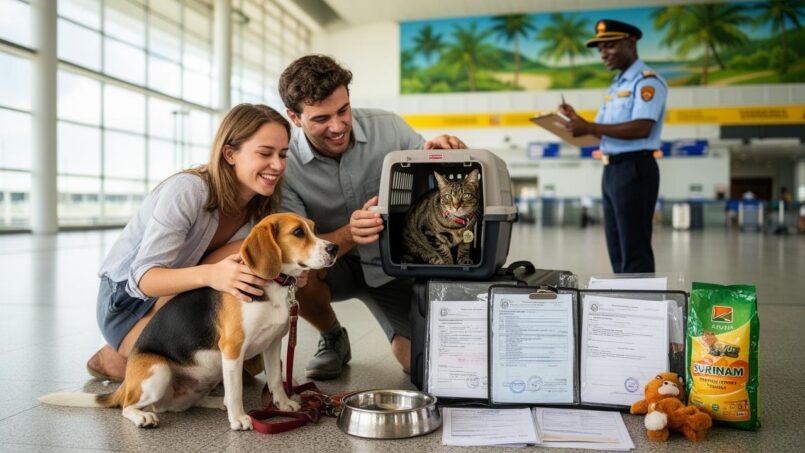
 Published on and written by Cyril Jarnias
Moving to Suriname with your dog, cat, or other companion is not a decision to be taken lightly. Between the health requirements, the specifics of airlines, the tropical climate, and finding suitable housing, the topic is far broader than just a plane ticket. This guide provides a comprehensive and practical overview to prepare for an expatriation with pets to Suriname, based solely on available regulatory and factual information.
Understanding the Context: Living with Pets in Suriname
Before diving into paperwork and certificates, it is helpful to understand the environment your pet will be living in.
In Suriname, pets are very common, especially in urban areas. Dogs and cats are the most frequent companions, but you will also find birds, fish, and small mammals. In Paramaribo and major cities, veterinary services and pet stores are generally accessible, which is reassuring for medical follow-up or buying food and supplies.
The country offers a very green and quiet living environment, but this generous nature requires increased vigilance against parasites (ticks, fleas, mosquitoes) and tropical diseases, for both humans and animals. Authorities and veterinarians also encourage spaying and neutering to limit the stray population.
Finally, most expatriates settle in Paramaribo and its surroundings, where the supply of housing with gardens, and even pools, is quite varied. This urban concentration facilitates access to veterinary clinics and pet services.
Competent Authorities and Regulatory Framework
Animal imports are regulated by the Ministry of Agriculture, Livestock and Fisheries (Ministerie van Landbouw, Veeteelt en Visserij – LVV). Within the ministry, it is the Onderdirectoraat Veeteelt (Directorate of Livestock) and the Veterinaire Dienst / Veterinaire Inspectie (Veterinary Service / Veterinary Inspection) that handle authorizations and controls concretely.
The official contact details provided are as follows:
| Authority | Role | Contact Information (Paramaribo) |
|---|---|---|
| Ministerie van Landbouw, Veeteelt en Visserij – Onderdirectoraat Veeteelt | Issuance of veterinary permits, definition of health policy | Letitia Vriesdelaan 8–10, Paramaribo – Tel.: (597) 479112 (ext. 2101) – Fax: (597) 424407 / 404407 |
| Veterinaire Inspectie / Veterinaire Dienst | Border control, animal inspection, permit validation | Under the authority of the LVV |
An essential point: the concept of a “pet passport” for Suriname does not refer to a single document comparable to the European pet passport, but rather a set of required documents (identification, rabies vaccination, health certificate, etc.). This dossier must be prepared in the country of departure, validated by the attending veterinarian, and then, if applicable, by the official veterinary services of the country of origin.
Allowed Animal Categories and Restrictions
Suriname focuses its regulations on domestic dogs and cats, which includes assistance or service dogs and cats. Some animals are subject to strict restrictions.
For dogs and cats:
– “Classic” dogs and cats are eligible for import, provided all health requirements are met.
– Wolf hybrids as well as Savannah or Bengal-type cats can only be imported if they are at least 5 generations removed from their wild ancestor. In practice, this requires strong genealogical proof.
For other pets:
Birds, invertebrates, tropical fish, reptiles, amphibians, and small mammals (rodents, rabbits, etc.) do not require a rabies vaccine to enter Suriname. However, they may be subject to other requirements such as a health certificate, quarantine, or specific permits. Additionally, many species, especially certain turtles, parrots, and exotic animals, are protected by CITES. For these animals, it is imperative to obtain the required permits from the wildlife protection authorities of the country of origin and Suriname.
In summary, for a domestic dog or cat, the path is clearly marked. For exotic species, preparation must necessarily involve a thorough check with the competent authorities of each country involved.
Point of Entry into Suriname and Modes of Transport
Pets must necessarily enter Suriname via the Johan Adolf Pengel International Airport, also known as Zanderij International Airport, located near Paramaribo. This is where major international flights transit and where veterinary control upon arrival takes place.
Several airlines serve this airport, some accepting animal transport:
| Airline | Type of Animal Transport to Suriname (based on available information) |
|---|---|
| Caribbean Airlines | Animals in the hold (checked baggage) or as cargo; assistance dogs accepted in the cabin under conditions; no regular pets in the cabin to Suriname |
| Suriname Airways | Animals in the cabin for dogs and cats only, subject to weight and size conditions; animals in the hold for larger ones or as cargo |
| KLM, JetAir Caribbean | Accept animal transport, but according to each airline’s own policies (cabin/hold/cargo) |
Animals can travel:
Pets can travel by plane in three main ways. In the cabin, if the airline allows it on the flight, subject to strict weight and container size restrictions. In the hold as checked baggage, a common option for medium to large dogs and cats. As freight (cargo), especially for animals traveling alone, very large animals, or when the destination country’s regulations require it.
For an expatriation, it is generally advisable to choose a direct flight or, if that is not possible, an itinerary with a single short layover and without changing airlines, to avoid additional customs and veterinary procedures in the transit country.
Step-by-Step Procedures for Importing a Dog or Cat to Suriname
All formalities must be completed in the country of origin, and in a logical order. Each step is important, as a failure can result in quarantine, refusal of the animal, or even euthanasia upon arrival.
Step 1: Identification by Microchip
Even if Surinamese regulations do not always explicitly mention an identification requirement, all sources converge on a strong recommendation: an animal intended to travel must be microchipped.
Key points:
– Use a 15-digit microchip compliant with the ISO 11784/11785 standard.
– Ensure that all documents (vaccination certificates, health certificate, official forms) mention the microchip number.
– If the animal already has a non-ISO standard chip, its owner must provide a compatible reader to the Surinamese authorities.
– The implantation must be done by a veterinarian or trained personnel, with a traceability document provided (chip brand, date, implantation site).
In North American or European systems, the sequence is clear: implant the chip, then vaccinate against rabies. This scheme, even if Suriname does not explicitly state it, remains a practice to adopt, especially with a view to a possible return to the EU or the United States.
Step 2: Rabies Vaccination and Other Vaccines
The rabies vaccine is the central element of health requirements.
For Suriname:
– Rabies vaccination is mandatory for all dogs and cats.
– It must be performed between 21 days and 12 months before entry into the territory.
– Some official sources mention a minimum of 30 days before arrival. To be on the safe side, it is prudent to aim for at least 30 days.
– Proof of vaccination must appear on:
– an official rabies certificate,
– or a vaccination record issued by a public authority,
– or an EU pet passport where applicable.
At each vaccination, the veterinarian must imperatively record in the animal’s health record: the date of the injection, the type of vaccine administered, the vaccine batch number, and its expiration date. They must also affix their signature and professional stamp on the document to make it official and valid.
In addition to rabies, certain vaccinations are strongly recommended, or even required:
For dogs:
– Distemper,
– Hepatitis,
– Parvovirus,
– Leptospirosis (may, according to texts, be administered upon arrival, but it is wiser to have it done beforehand).
For cats:
– Feline viral rhinotracheitis,
– Panleukopenia,
– Feline leukemia,
– Leptospirosis (recommended, possible upon arrival).
Ideally, all these vaccines should be listed on the international health certificate that will accompany the animal.
Step 3: Rabies Serological Test (Titer) – Useful Mainly for Return
Suriname does not require a rabies titer test (antibody count against rabies) for entry of a dog or cat, regardless of the country of origin and rabies status.
However:
– The World Organisation for Animal Health classifies Suriname as a high-risk country for rabies.
– If you plan a future return to a very strict country (e.g., the European Union or the United States), it is strongly advised to have a titer test done in the country of origin, before departure, or in a country with controlled rabies status.
– This test does not replace the rabies vaccination in any way. It is an additional step to meet the requirements of the ultimate destination country.
Concretely, for a long-term expatriation project in Suriname but with a possibility of return, it is better to build a dossier from the start that is compatible with the rules of highly regulated areas (EU, USA): chip implanted before vaccination, up-to-date rabies vaccine, serological titer correctly dated and performed in an approved laboratory.
Step 4: Antiparasitic Treatments
Before arrival in Suriname, the animal must receive:
– a treatment against internal parasites, especially Echinococcus multilocularis,
– a treatment against external parasites, particularly fleas and ticks.
These treatments must be administered very shortly before departure, according to the timeframe recommended by the veterinarian (often within days before travel). They are recorded:
– either in the health certificate,
– or on a separate document, signed by the veterinarian.
This step is not only administrative: in a hot and humid climate like Suriname’s, parasites thrive, and an untreated animal can quickly develop serious conditions (ehrlichiosis, anaplasmosis, allergic dermatitis, etc.).
Step 5: International Health Certificate
The health certificate (or international veterinary certificate) is an essential document.
Its essential characteristics:
– It must be issued by a licensed veterinarian in the country of origin.
– It is generally valid if issued within 7 days of entry into Suriname (some sources mention a maximum of 14 days, but it is prudent to stick with 7 days).
– It must certify, at a minimum, that:
– the animal has been clinically examined,
– it shows no signs of contagious disease or external parasitism,
– it is fit to travel,
– it does not originate from an area under rabies health restrictions.
– It must detail identification information (species, breed, sex, age, color, microchip number) and summarize vaccinations and antiparasitic treatments.
– It must then be validated by an official veterinarian (competent authority of the country of origin), who signs or countersigns the document on behalf of the administration.
In some countries, this validation requires making an appointment with the Ministry of Agriculture or an official veterinary service. Therefore, it is important to plan ahead.
Step 6: Import Permit – Only in Certain Cases
Suriname distinguishes between animals traveling with their owner and those arriving without human accompaniment.
– Animal accompanied by its owner (most common case in expatriation) No import authorization is required if all other conditions are met (vaccinations, health certificate, etc.).
For an unaccompanied animal or one transported as cargo, an import permit issued by the Ministry of Agriculture, Livestock and Fisheries is mandatory. The application must be addressed to the Onderdirectoraat Veeteelt. The review of the file focuses on the completeness and accuracy of the information, its consistency with government policy, and its impact on human and animal health safety.
The announced processing times for a complete file are between 3 and 15 working days. The decision (acceptance or refusal with reasons) can be appealed to the director of the ministry.
In any case, the authorities must be informed in advance of the animal’s arrival (at least 48 to 72 hours before), in order to arrange for a veterinarian to be present at the airport.
Step 7: Prior Notification and Inspection upon Arrival
At least 48 to 72 hours before arrival, the owner or their representative must communicate to the Surinamese veterinary services:
– the scheduled date and time of arrival,
– the flight number,
– the point of entry (Johan Adolf Pengel International Airport),
– the owner’s contact details in the country.
Upon arrival:
– an official veterinarian carries out the verification of documents (health certificate, proof of rabies vaccination, antiparasitic treatments, possible permit).
– a quick clinical examination of the animal is performed to ensure it shows no signs of disease transmissible to humans or other animals.
If everything is in order:
– the animal is released, and entry is formalized.
In case of an irregularity (incomplete documents, animal appearing sick):
– the veterinarian may impose additional tests, quarantine, return to the country of origin, or even euthanasia as a last resort. All associated expenses (veterinary fees, quarantine boarding, return transport) are entirely the owner’s responsibility.
Some official instructions also mention a two-week isolation period after arrival, during which the dog should not have close contact with other animals, unless special authorization is granted by the veterinary administration.
Airline Policies: Focus on Caribbean Airlines and Suriname Airways
Complying with Surinamese regulations is not enough: each airline has its own rules regarding animal transport.
Caribbean Airlines: What You Need to Know for a Flight to Suriname
Caribbean Airlines serves Suriname and accepts the transport of animals, but in a regulated manner.
The main points:
On international flights, only properly trained assistance dogs are allowed free of charge in the cabin, subject to conditions (advance notice, harness, behavior). Regular pets (cats/dogs) and emotional support animals on tickets issued since July 2021 are not allowed in the cabin and must travel in the hold.
For animals transported as checked baggage:
– dogs and cats can travel in the hold.
– the owner must notify the airline at least 72 hours before departure.
– maximum weight (animal + crate): 70 lb (32 kg).
– maximum dimensions (sum of length + width + height): 115 inches (292 cm), and maximum crate length: 75 inches (191 cm).
– the crate must be IATA compliant.
– animals travel in a ventilated hold, with temperature and pressure comparable to the cabin.
– during layovers shorter than about 3 hours, the airline handles the transfer of the crate from one aircraft to another.
Fees indicated for Caribbean Airlines:
| Type of Transport | Route | Reported Rates |
|---|---|---|
| Animal in hold (checked baggage) | Domestic flights (Trinidad and Tobago) | 3.00 TTD per kg per leg |
| Animal in hold (checked baggage) | International flights from Canada | 150 USD or 230 CAD per leg |
For animals shipped as cargo:
– Caribbean Airlines transports, via its cargo division, a wide variety of animals: dogs, cats, monkeys, birds, hamsters, reptiles, tropical fish, horses, zoo animals, etc.
– you must contact Caribbean Cargo (tel. 868 669 3000) for a quote and reservation details.
Temperature restrictions apply:
Maximum temperature in degrees Celsius above which animal transport is not permitted at airports on the itinerary.
Suriname Airways: Animal Transport Capabilities
Suriname Airways also offers animal transport on its flights:
– In the cabin: only dogs and cats are accepted, subject to:
– a maximum weight (animal + bag/crate) of approximately 8 kg,
– maximum container dimensions of approximately 43 × 31 × 20 cm.
– In the hold: heavier or larger animals travel as checked baggage, up to approximately 55 kg (crate included).
– The airline limits the total number of crates per flight (e.g., maximum 5 crates, depending on the aircraft type).
In all cases, the crate must be IATA approved, allow the animal to stand, turn around, and lie down comfortably, with a secure locking system and bowls accessible from the outside.
Choosing and Preparing the Travel Crate
The travel crate is a key element, both for meeting airline rules and for the comfort and safety of the animal.
Recommended characteristics:
The crate must be made of rigid plastic with an integrated metal door, excluding wood and plastic doors. It must provide sufficient height for the animal to stand upright with its head raised and space to turn around and lie down. For brachycephalic dogs, a size larger than standard is recommended. The crate must have two fixed bowls accessible from the outside. Only one animal per crate is allowed, except for two young animals of the same species (<6 months and <9 kg each) or puppies/kittens (<4 months) with their mother.
Before the big day, it is recommended to familiarize the animal with the crate several weeks, or even months, in advance, by placing its bedding, toys, and letting it enter and exit freely. An animal discovering its crate at the airport will experience more stress.
Managing the Tropical Climate and Health Risks in Suriname
Suriname has a hot and humid tropical climate year-round. For an animal accustomed to a temperate climate, adaptation requires precautions.
Main challenges:
In the summer, domestic pets are exposed to several dangers. Dogs, especially brachycephalic breeds (bulldogs, pugs), are at risk of heatstroke and dehydration. External parasites like ticks (vectors of ehrlichiosis), fleas (causing allergies), and mosquitoes (transmitters of heartworm) are more active. Stagnant water may contain the bacteria Leptospira or the parasite Giardia, responsible for diseases. Humidity promotes skin problems (fungal infections, infections). Finally, poor air quality due to smoke can worsen respiratory issues.
To limit these risks, some practices are essential:
– avoid outings in direct sunlight during the hottest hours (usually between 10 a.m. and 4 p.m.),
– provide permanent access to fresh, clean water,
– provide shaded areas, or even an air-conditioned or ventilated room,
– use regular antiparasitic treatments covering fleas, ticks, and mosquitoes,
– concentrate physical activity early in the morning or in the evening,
– monitor the skin and coat, especially in long-haired or wrinkled-skin animals.
For exotic animals (rabbits, rodents, reptiles, amphibians), controlling temperature and humidity in the terrarium or cage is even more critical. Reptiles, for example, require a precise thermal gradient and daily UVB lighting to stay healthy.
Finding Housing with a Pet in Paramaribo and the Rest of Suriname
Once travel and health concerns are resolved, you still need to find a suitable home for the whole family, including the pet. The supply of “pet-friendly” housing in Paramaribo and the country is real, especially through platforms like Airbnb or hotels that accept animals.
Available data on pet-friendly vacation rentals in the Paramaribo district indicates:
| Indicator (Pet-Friendly Vacation Rentals – Paramaribo District) | Indicative Value |
|---|---|
| Total number of properties | Approximately 70 |
| Total number of reviews | 380–450 depending on source |
| Properties suitable for families | 30–40 |
| Properties with a pool | 10–20 |
| Accommodations with a dedicated workspace | Approximately 30 |
| Base price per night | From around 10 USD (before taxes and fees) |
Several types of pet-friendly accommodations are listed: modern apartments (Butterfly Apartments), renovated colonial houses, villas in secure residences, houses surrounded by nature, etc. Some residences and hotels like Max Garden and Pool or villas on the outskirts of Paramaribo also welcome animals, sometimes for an additional fee.
The policies of “pet-friendly” hotels generally follow the same principles as in other countries. This often includes additional fees for the pet, restrictions on the size or number of animals allowed, the requirement that the animal be leashed in common areas, and the owner’s responsibility for any damage. These rules aim to ensure the comfort of all guests.
– rooms with easy-to-clean flooring,
– possible provision of baskets, bowls, blankets,
– cleaning fees or pet surcharges billed per night or per stay,
– sometimes pet sitting, walking services, or access to fenced green spaces.
It is essential to confirm directly with the establishment:
– the type of animals accepted (size, species),
– the maximum number per room,
– any security deposits or fees,
– the movement rules (animal allowed only in the room or also in certain common areas).
Comparison, Transit, and Return: Don’t Just Think About the Outbound Trip
An expatriation is not limited to arriving in Suriname. You must consider future travels: vacations abroad, return to the country of origin, transfer to another country.
Two key points to keep in mind:
Suriname is classified as a high-risk country for rabies. A dog that has stayed there is considered at high risk. Destination countries may require a rabies titer test (≥ 0.5 IU/mL), a compliant vaccination certificate (with chip scanned before injection), and compliance with sometimes long waiting periods after blood sampling.
– 2. The specific rules of certain transit or destination countries For example, the United States applies strict conditions for dogs from high-risk countries:
– dog at least 16 weeks old at the time of arrival,
– valid rabies vaccination performed on an already chipped animal,
– rabies antibody titer test performed in an approved laboratory, at least 30 days after vaccination,
– prior administrative steps (forms to submit, chip scans upon arrival, etc.).
To import an animal into the European Union, you must follow a strict sequence: 1) implantation of an identification microchip, 2) rabies vaccination, then 3) a serological test (mandatory for risk countries). This procedure is followed by a mandatory waiting period before entry into the territory.
Practical conclusion: when preparing your departure for Suriname, adopt from the outset a scheme compatible with the strictest requirements (ISO chip, well-dated rabies vaccine, possible titer). This will save you from having to redo, in an emergency and sometimes under more complex conditions, heavy procedures when leaving the country.
Practical Tips for a Stress-Free Flight
Beyond administrative requirements, a few reflexes contribute to a more comfortable trip for the animal:
Consult your veterinarian several weeks before departure to check fitness for travel, adjust diet, and discuss options to limit stress (sedatives are often discouraged on planes). Limit food and water just before the flight: a light meal a few hours before, then small amounts of water. Prepare the travel crate with absorbent bedding, a piece of clothing with your scent, and a familiar toy. Arrive early at the airport for smooth check-in and avoid itineraries with long layovers, especially in countries with extreme climates or strict regulations.
For service dogs or assistance dogs allowed in the cabin, you must:
– adhere strictly to the airline’s requirements (training, identification, cleanliness, behavior),
– notify the airline early enough (more than 48 hours in advance for Caribbean Airlines),
– plan for floor space in front of the seat, without obstructing other passengers or emergency exits.
Considering Alternative Solutions: Private Jet, Specialized Freight
For certain expatriate profiles (large animals, breeds sensitive to heat, specific medical situations), the constraints of commercial flights can be difficult to reconcile with the animal’s well-being.
One option mentioned is the “pet-friendly” private jet:
When traveling in the cabin, the animal can stay at the owner’s feet, on their lap, or next to them. This mode of transport eliminates the stress associated with the hold and guarantees a controlled temperature environment. While costs are significantly higher, it is possible to reduce them by opting for a shared flight.
Specialized animal freight carriers can also handle the logistics (cargo booking, customs formalities, transit). In any case, even on a private jet, the regulations of the arrival country (here Suriname) remain applicable.
And Once Settled: Organizing Daily Life with Your Pet
Once the entry stage is successfully completed, daily life in Suriname with a pet is based on a few pillars:
For a peaceful stay with your dog in Suriname, prioritize residential neighborhoods in Paramaribo with a fenced garden and check the proximity of walking areas. Quickly identify a trusted veterinarian in a major city for routine care and emergencies. Maintain a rigorous antiparasitic treatment against tropical risks (fleas, ticks, mosquitoes) and be vigilant about water quality. Spaying/neutering is recommended. Finally, prepare an emergency kit and an evacuation plan for your pet in case of extreme weather events.
Summary: Key Points Not to Overlook Before Leaving for Suriname with Your Pet
Expatriation to Suriname with a pet relies on a precise sequence of steps:
To import an animal into Suriname, follow these essential steps: identify it with an ISO microchip, vaccinate it against rabies within the required timeframe (21 to 30 days minimum before departure, maximum validity 12 months), and complete other recommended vaccinations. Treat it against internal and external parasites just before importation. Obtain an international health certificate issued by a veterinarian and validated by the official veterinary authority of the country of origin. Check if an import permit is necessary, especially for unaccompanied animals or those transported as cargo. Notify the Surinamese veterinary services of the arrival 48 to 72 hours in advance. Choose the airline and type of transport (cabin, hold, or cargo) carefully and prepare an IATA-approved crate. Finally, anticipate the rules of third countries and those applicable for a future return, particularly regarding rabies (titer and waiting periods).
Once these formalities are completed and arrival is validated by the Surinamese Veterinary Service, you can truly enjoy life in Suriname with your companion: walks in the green neighborhoods of Paramaribo, nature excursions, supervised swims, and more generally, a gentler pace of life in the tropics.
The regulatory framework is demanding but clear. By strictly respecting it and relying on the most recent official information, your expatriation project with a pet to Suriname can go smoothly, both for your companion and for you.
Disclaimer: The information provided on this website is for informational purposes only and does not constitute financial, legal, or professional advice. We encourage you to consult qualified experts before making any investment, real estate, or expatriation decisions. Although we strive to maintain up-to-date and accurate information, we do not guarantee the completeness, accuracy, or timeliness of the proposed content. As investment and expatriation involve risks, we disclaim any liability for potential losses or damages arising from the use of this site. Your use of this site confirms your acceptance of these terms and your understanding of the associated risks.

Cyril Jarnias is an independent expert in international wealth management with over 20 years of experience. As an expatriate himself, he is dedicated to helping individuals and business leaders build, protect, and pass on their wealth with complete peace of mind.
On his website, cyriljarnias.com, he shares his expertise on international real estate, offshore company formation, and expatriation.
Thanks to his expertise, he offers sound advice to optimize his clients' wealth management. Cyril Jarnias is also recognized for his appearances in many prestigious media outlets such as BFM Business, les Français de l’étranger, Le Figaro, Les Echos, and Mieux vivre votre argent, where he shares his knowledge and know-how in wealth management.





