
 Published on and written by Cyril Jarnias
Expatriating to Suriname, a small tropical country wedged between French Guiana, Guyana, Brazil, and the Atlantic Ocean, is something like choosing a “blind spot” on the map of South America. A former Dutch colony, largely covered by Amazon rainforest and still very little visited by tourists, the Republic of Suriname attracts a handful of expatriation candidates seeking calm, greenery, and a gentler cost of living.
Behind its image as the ‘best-kept secret in South America’, the country presents several challenges: a humid climate vulnerable to climate change, an uneven healthcare system, very low local salaries, fragile infrastructure, and slow administration. It is essential to take these parameters into account before settling in.
This article offers a detailed overview of the advantages and disadvantages of expatriation in Suriname, based on the latest economic, social, environmental, and climate data.
A tropical country that is both Caribbean and Amazonian
Suriname is officially the only Dutch-speaking country in South America. Its capital, Paramaribo, concentrates most of the economic activity, services, and expatriate community. The country has just over half a million inhabitants, nearly half of whom live in the Paramaribo metropolitan area.
The average annual rainfall in Suriname is about 2,200 mm, with regional variations.
Inland, it is a completely different world: about 91% of the territory is covered by tropical rainforest, of which 13% enjoys protected area status. This exceptional forest cover makes Suriname one of the most forested countries on the planet, a paradise for nature lovers, rivers, and adventure tourism.
A unique cultural mosaic
One of the great strengths of Suriname, and a real asset for expatriation, lies in its ethnic and religious diversity. A legacy of the colonial plantation history, the population includes Hindustanis, Creoles, Javanese, Maroons (descendants of escaped slaves), Chinese, indigenous peoples, and descendants of Europeans. Added to this are Caribbean, Indian, African, Asian, European, and North American influences.
Suriname is often cited for its peaceful religious coexistence, where mosques, Hindu temples, churches, and Afro-Surinamese or indigenous places of worship stand side by side. A striking example is the mosque and synagogue located right next to each other in the heart of Paramaribo. Major religious festivals like Holi, Eid, Christmas, Chinese New Year, and indigenous celebrations mark the year and give rise to numerous public holidays and events.
For an expatriate, this diversity translates into a generally welcoming society, curious about foreigners and proud to share its culture, cuisine, and traditions. Social life is characterized by a certain looseness regarding punctuality, a fairly early daily rhythm, and a pronounced taste for late parties where food takes center stage.
Cost of living: clear advantage… if your income comes from abroad
One of the major arguments in favor of Suriname is the differential in cost of living compared to Western Europe or North America. But this “good deal” is only really a good deal for people with income from outside the country (remote work, retirement, contract paid in hard currency).
Typical spending levels
Various price surveys converge on a cost of living for a single person around 800 to 1,200 dollars per month, including housing, under comfortable but not necessarily luxurious conditions. Finer ranges allow for better orientation.
Average monthly budget (in US dollars)
| Profile | Monthly expenses with rent | Monthly expenses without rent |
|---|---|---|
| Single person – average | 879 | 602 |
| Single person – tight budget | ≈ 686 | – |
| Single person – high-end | up to 2,931 | – |
| Couple – average | 2,032.75 | 1,482.75 |
| Family of 4 – average | 2,839.50 | 2,124.50 |
These figures include food, transportation, housing, current expenses, based on data collected mainly in Paramaribo.
Compared to the United States, Suriname is overall about 35 to 50% cheaper, with rents up to 70% lower. In Paramaribo, the cost of living is, for example, 41% lower than in São Paulo or 62% lower than in Amsterdam.
Housing: spacious houses at relatively moderate prices
Housing is one of the areas where the differential is most visible. It is often possible to rent individual houses with a garden, sometimes a pool, for amounts that remain low compared to major Western cities.
Sample housing prices
| Type of housing | Location | Average monthly rent (USD) |
|---|---|---|
| Furnished studio 45 m² | “Normal” area | ≈ 116 |
| Furnished studio 45 m² | “Expensive” area | ≈ 222 |
| 1-bedroom apartment (40 m²) | City center | ≈ 340 (range 301–1,273) |
| 1-bedroom apartment | Less central area | ≈ 195–400 |
| 3-bedroom apartment (80 m²) | City center | ≈ 1,070 |
| 3-bedroom apartment | More affordable area | ≈ 503 |
| Furnished house / apartment 85 m² | “Normal” area | ≈ 383 |
| Furnished house / apartment 85 m² | “Expensive” area | ≈ 1,054 |
In neighborhoods popular with expats in Paramaribo (Rainville, Zorg en Hoop, Blauwgrond, some parts of Kwatta or Morgenstond), rents for a one-bedroom apartment typically range between 300 and 600 dollars per month. Large family homes can go above 1,000 dollars.
Mortgage credit remains expensive, with interest rates around 15–16% over 20 years, limiting home purchases for local residents.
Utilities, internet, and transportation
Electricity, water, and other utility bills remain modest as long as you don’t run the air conditioners day and night. An average apartment typically ranges between 25 and 60 dollars per month in utilities, excluding heavy use of air conditioning. In practice, given the heat and humidity, many expats see their bills climb rather to 40–100 dollars once they cool multiple rooms.
High-speed internet connections remain expensive and relatively slow by international standards. An unlimited fixed-line subscription around 50–60 Mbps costs about thirty dollars. Mobile plans with 10 GB and calls run around 25–26 dollars.
Gasoline is more expensive than elsewhere, and the public bus network, while cheap, is impractical and sometimes precarious in terms of safety and comfort. In practice, most expats choose to buy a car, an essential piece of equipment for getting around, especially with a family.
Common costs (approximate ranges)
| Item | Indicative cost |
|---|---|
| Utilities for single person | ≈ 24–40 USD / month |
| Fixed internet 50–60 Mbps | ≈ 29 USD / month |
| Mobile plan 10 GB+ | ≈ 26 USD / month |
| Local bus ticket | ≈ 0.47 USD |
| Monthly transport pass (varies by source) | ≈ 18–90 USD |
| Gasoline | ≈ 1.07 USD / liter |
The big pitfall: very low local salaries
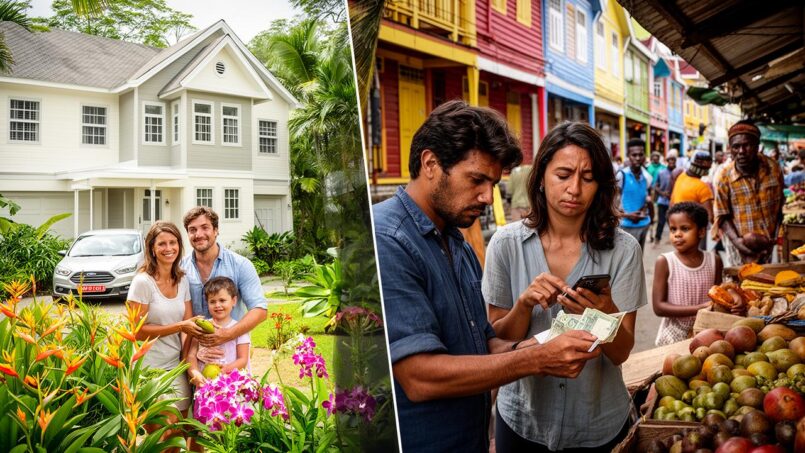
If Suriname appears affordable by the standards of a Western income, the perspective changes completely when you look at the salary level on the ground. The gap between income and cost of living is one of the main obstacles to expatriation for those who plan to live on a local salary.
Various sources estimate the average net salary between 270 and 400 dollars per month for many jobs. On other statistical bases, the average remuneration is around 5,281 SRD per month, or about 270–280 dollars at the exchange rate used in the estimates.
This concretely means that, for a resident paid locally, the costs of urban living in Paramaribo can represent more than three times their average salary. With a local income, one must therefore adopt a very frugal lifestyle, often far from the standards expats from high-income countries are accustomed to.
For an expatriate whose salary is paid by a foreign company, an international organization, an NGO, or for a remote worker paid in hard currency, the situation is radically different: Suriname then becomes a generally affordable country, allowing access to spacious housing, private services (international school, clinics, leisure), and a few extras, all while respecting a reasonable budget.
Job market: small opportunities, heavy bureaucracy
The Surinamese economy is fragile, heavily dependent on natural resources (mining, agriculture, forests) and a few service activities. The job market is narrow and competition for skilled positions is real.
Where are the jobs?
Salaried activities are mainly concentrated in Paramaribo and, to a lesser extent, in Lelydorp and Brokopondo. Key employment sectors are natural resources (gold, bauxite, agriculture), logistics, trade, education, healthcare, hospitality and food service, and services.
For expats, the most interesting positions are generally found in subsidiaries of multinationals, diplomatic organizations, large NGOs, or certain international projects. These jobs have the advantage of often being paid in hard currency or on scales more favorable than local standards.
In the domestic private sector, salaries are low, and prospects for advancement are limited. For an expat without a rare skill or a contract already signed, hoping to “find on the ground” a well-paid position is more the exception than the rule.
Remote work and digital nomads
On paper, Suriname ticks several boxes for the remote worker lifestyle: reasonable cost of living, time zone compatible with Europe and North America, a nascent community of digital nomads in Paramaribo.
In practice, the main limitation remains the quality of the internet connection (3–4 Mbps on average in many places, even if faster offers exist) which can complicate video conferences and heavy transfers. For professions less dependent on high bandwidth (consultants, writers, online accountants, remote therapists), the country can nevertheless represent an attractive economic base, provided one accepts a less-than-perfect digital infrastructure.
There is currently no specific visa designed for digital nomads: remote workers must fit into the frameworks of short-stay visas, regular work visas, or, where applicable, residence permits.
Working legally: permits, visas, and administrative slowness
To engage in salaried work on site, a foreigner must, except in certain cases, hold a work permit, complemented by an entry visa and a residence permit. The employer is legally responsible for obtaining this permit before the work begins. They must prove that no Surinamese or resident candidate is able to fill the position, which often involves publishing job ads and justifying this to the authorities.
The different categories of permits depending on the sector, and key administrative steps in the application process.
Existence of a general permit and specific permits, such as for the gold mining sector, depending on the activity.
The procedure involves at least the Ministry of Labor and the Ministry of Justice and Police.
Heavy file including: criminal record extracts, medical certificates, translated diplomas, proof of experience, company statutes, and tax compliance certificate.
Announced processing times vary between one to two months for the simplest cases and several months for more complex files. The general consensus remains the same: the procedure is slow, bureaucratic, and requires starting well in advance.
For spouses and children, “dependent” residence permits exist, but do not automatically grant the right to work. A spouse who wishes to work must, in principle, obtain their own work permit.
Healthcare: an accessible but uneven system, especially outside the capital
On paper, Suriname has a healthcare system combining public institutions and private clinics, with mandatory basic coverage for residents. In practice, the quality and accessibility of care vary greatly depending on whether you live in Paramaribo or in the interior.
Hospitals and clinics
In Paramaribo are concentrated the main hospital infrastructures – both public and private. The Académisch Ziekenhuis Paramaribo (AZP), a teaching hospital, serves as the national referral center for complex cases. Other private facilities, such as Diakonessenhuis or St. Vincentius Ziekenhuis, offer faster care and a higher level of equipment, but at a higher cost, often not fully covered by basic insurance.
Outside the capital, hospitals are fewer and less well-equipped. In remote regions (Brokopondo, Sipaliwini), care is mainly provided by the ‘Medical Mission’, a subsidized private network of about fifty dispensaries, sometimes accessible only by boat. For serious emergencies, a transfer to Paramaribo is often necessary, with travel times that can reach several hours, combining road and canoe.
Quality of care and limitations
Even in the city, the Surinamese healthcare system suffers from several handicaps: shortages of certain specialists, chronic lack of equipment and medications, waiting times in the public sector, imperfect continuity between primary and secondary care. Doctors often treat high volumes of patients, and equipment can be temporarily lacking, even for some basic procedures.
For all these reasons, some expats and wealthier Surinamese choose, for major or highly specialized interventions, to seek treatment abroad (Netherlands, neighboring countries, or even farther), relying on international insurance including medical evacuation.
Health insurance: an item not to be overlooked for expats
Residents, including foreigners, are supposed to participate in the basic insurance system, co-financed by the employer and employee, with state coverage for the youngest and oldest. But reimbursement caps and exclusions make this coverage insufficient for those who wish to access the best care, especially in the private sector.
Most expats therefore supplement this local insurance with international health insurance, covering private care on site and possible evacuation to a country with more comprehensive medical facilities. This is a significant additional cost, but one that is clearly part of the ‘structural disadvantages’ of expatriation in Suriname.
Advice for expats in Suriname
Health and environmental risks
The tropical context implies other constraints: malaria-carrying mosquitoes in some areas, dengue, Zika, waterborne diseases, presence of snakes, venomous insects, caimans in rivers. Tap water is chlorinated, but new arrivals are generally advised to prefer bottled water, especially outside Paramaribo.
Basic precautions (mosquito nets, repellents, appropriate vaccinations, closed-toe shoes in the forest, well-stocked first aid kits) are part of daily life for an expat in Suriname, particularly if they live or regularly stay in the interior.
Climate and environment: a green paradise, but vulnerable to climate change
Environmentally, Suriname is a paradoxical case. Extremely forested, low CO₂ emitter per capita and long presented as a “negative carbon footprint country,” it is also very vulnerable to the impacts of climate change, especially in its coastal zone.
A structured climate policy… but still fragile in implementation
The country has a National Adaptation Plan (NAP) covering the period 2019‑2029, based on a climate strategy adopted as early as 2014 and integrated into its successive development plans. This plan aims to reduce the impacts of climate change and integrate adaptation into all sectors.
Identified priorities include, in particular, water, energy, forests, and agriculture in the short term, as well as mining, tourism, infrastructure, and housing in the medium term. Cross-cutting sectors such as health, education, disaster risk reduction, and land use planning are also considered.
The plan’s implementation faces several obstacles: the prolonged absence of a clear coordinating entity, lack of awareness of the plan among some institutional actors, insufficient financial resources and technical skills, and difficulties in aligning actions across different ministries.
Concrete risks for residents
For an expat considering living in the coastal zone – in other words, virtually all cases – these climate vulnerabilities are not abstract. The coastal strip, where Paramaribo and the main agricultural areas are located, is low-lying, sometimes just a few meters above sea level. It is threatened by sea-level rise, coastal erosion, saltwater intrusion into groundwater and soils, flooding, and storms.
Consequences already observed include salinization of soils and groundwater, which weakens traditional crops like rice and coconut, and increases the economic vulnerability of certain rural regions, particularly the Coronie district, identified as especially exposed.
More intense dry seasons reduce access to fresh water and increase the risk of forest fires. Additionally, rising temperatures make daily life more difficult, especially for people not acclimated to a permanently hot and humid climate.
Local adaptation and resilience
Faced with these challenges, concrete measures have been initiated: integrated coastal zone management, protection and restoration of mangroves which serve as a “natural barrier,” implementation of rainwater harvesting systems, development of salt- and drought-tolerant crops, strengthening of hydrometeorological equipment to improve flood forecasting, pilot projects for climate-smart agriculture.
For an expat involved in the environment, agriculture, urban planning, or development sectors, Suriname therefore offers an exciting field of action, with many projects supported by international donors, from the Green Climate Fund to the Global Environment Facility.
Nevertheless, for daily life, this reality translates into a need for adaptation: choosing the location of one’s home carefully (avoiding the most flood-prone areas), being aware of seasonal risks, accepting that part of the infrastructure (roads, sanitation) is regularly tested by the weather.
Education: limited public system, expensive international schools
For families with children, the school question is often decisive. In Suriname, it deserves to be examined carefully.
Public education: in Dutch and of uneven quality
The education system is modeled on the Dutch system, with compulsory schooling from age 6 and theoretically free primary and lower secondary education. The language of instruction is exclusively Dutch, which can be an asset for French-speaking or English-speaking children wishing to learn this language, but a barrier for others.
Recurring problems in the public system are lack of resources, still very traditional pedagogy, strong disparities between the capital and the interior, and a significant dropout rate before the end of secondary school. For an expat from Europe or North America, the general level and teaching conditions are often considered below expected standards.
International schools: a real asset… for those who can pay
In Paramaribo, two international schools play a key role for expats: QSI International School of Suriname and International Academy of Suriname (IAS).
Annual tuition in dollars for students aged 5 and up at QSI.
IAS, for its part, offers a North American education from kindergarten through high school, on an affirmed Christian basis, with instruction in English oriented toward international higher education. Tuition fees range between 9,000 and 10,350 dollars per year, excluding other fees. Many children of diplomats attend this school.
For expat families, tuition fees at these schools represent a major expense item, potentially equaling or exceeding the rest of monthly expenses. It is crucial to include them in the expatriation budget to avoid significant financial consequences.
Some testimonials from former parents also mention limitations: historical lack of standardization of certain content, tension between academic requirements and pronounced religious orientation for some schools, variable quality of teaching staff over time. It is therefore strongly recommended to visit the schools, talk with parents on site, and not rely solely on official brochures.
Safety, crime, and daily life
On the security front, Suriname shows mixed indicators. Violent crime is lower than in some neighboring countries, but petty crime is far from negligible, and security infrastructure is limited.
Crime and risk areas
The most frequent offenses in the capital and its outskirts are pickpocketing, bag snatching, burglaries, sometimes carjackings. Foreigners, perceived as wealthier, can be prime targets for opportunists. Some areas of Paramaribo, as well as towns like Albina or Moengo, are known to be more sensitive, especially at night.
At the same time, problems with drug trafficking and banditry exist in border areas and in the interior, where police presence is sparser. Tourist expeditions into the jungle or on the river should preferably be led by reputable operators registered with tourism authorities, and avoid improvisation.
Expat perceptions and precautionary measures
International indicators rank Suriname in an overall “medium” risk category, with a perception of safety that varies by neighborhood. Middle-class and expat residential neighborhoods are often guarded by private security guards, and most families systematically lock their doors, install grilles, and avoid walking alone at night.
Apply common-sense advice: be discreet with your valuables, stay vigilant at ATMs, avoid isolated streets after dark, never leave visible items in a vehicle, and inform yourself about neighborhoods before renting. Additionally, be aware that having very light skin can, in some contexts, reinforce the perception of financial ease and attract implicit expectations or attempts at overcharging, requiring particular attention.
For women alone, the risk level is considered medium: the main constraints lie in occasional street harassment, necessary caution at night, and the need to learn about social norms, especially in more traditional communities.
Social tolerance and minorities
Legally, homosexual relations are decriminalized, but same-sex marriage is not recognized, and there is no specific legal protection against discrimination towards LGBTQ+ people. In practice, the social climate is not particularly favorable to the public expression of non-conforming sexual orientation or gender identity, especially outside certain urban circles. Caution is therefore advisable for same-sex couples considering settling.
Daily culture: slowness, improvisation, and human warmth
Living in Suriname also means accepting a certain relationship with time and organization. Punctuality is relative, administration is slow, and the ability to improvise is often the best ally to overcome obstacles.
Social life and daily rhythm
Many Surinamese start their day very early, with typical workdays from 7 a.m. to 3 p.m., followed by an afternoon break before social life picks up again in full swing in the evening. Family or neighborhood parties can stretch into the early morning, in an often very open atmosphere, where it’s not uncommon to leave with takeaway dishes prepared by the hosts.
Cost of a dinner for two people in a mid-range restaurant in Suriname.
Languages: a true patchwork
Dutch is the official language of administration, public schools, and justice. But in daily life, Sranan Tongo (an English-based creole) largely dominates, especially in informal exchanges. Added to this is an impressive linguistic diversity: Sarnami (Indo-Surinamese), Surinamese Javanese, Maroon languages (Saramaccan, Ndyuka), indigenous languages, Chinese languages (Hakka, Mandarin, Cantonese).
English is widely spoken in urban, commercial, and international circles, facilitating life for English-speaking expats. However, learning some basic Sranan Tongo and familiarizing yourself with the rudiments of Dutch remains an asset for better integration, understanding administrative procedures, and building trusted relationships.
Expatriation in Suriname: typical profile of those for whom the country is a good choice
Throughout the data and testimonials, a profile emerges for whom Suriname can be an excellent choice for expatriation.
These are people who:
These are mainly people who have income from outside the country (remote workers, retirees, employees of international organizations or large companies). They are prepared to cope with a humid tropical environment, incomplete infrastructure, and slow administration. Their motivation lies in seeking a calmer, greener living environment with a strong sense of community and a mixed cultural life, rather than a hyper-connected metropolis. They accept dedicating a significant budget to private healthcare and, if necessary, international schooling for their children. Finally, they sometimes wish to get involved in development projects, forest conservation, climate adaptation, or social action.
Conversely, for a young graduate with no external resources, who hopes to find in Suriname a level of comfort similar to that of a wealthy country based on a local salary, the risk of disillusionment is significant. Similarly, a family with teenagers in a general academic track may have to decide between the high cost of international schools and giving up certain academic ambitions, if they turn to the local system.
Assessment: an endearing country, between potential and fragilities
In the end, Suriname offers a rare combination: lush nature, extreme cultural diversity, reduced cost of living for those paid in hard currency, modest human density, an overall relaxed pace of life. For certain profiles of expats, this cocktail can be irresistible.
But the disadvantages are just as real: very low salaries, insufficient road and digital infrastructure, imperfect healthcare system especially outside the capital, burdensome administration, vulnerability to climate change, occasional insecurity, environment sometimes hostile for certain minorities.
Expatriation in Suriname requires careful preparation. It is essential to secure your income, anticipate school and medical needs, and research neighborhoods. Understanding the legal framework for visas and work permits is crucial. Finally, expect a certain amount of the unexpected and accept a often slower pace of life.
For those who take the plunge with full knowledge of the facts, the country nonetheless has strong arguments: a sense of hospitality often highlighted, an expat community still modest but active, a feeling of living “elsewhere” without being completely cut off from the world, and the possibility, on a daily basis, of having the forest, rivers, and ocean as a backdrop.
Disclaimer: The information provided on this website is for informational purposes only and does not constitute financial, legal, or professional advice. We encourage you to consult qualified experts before making any investment, real estate, or expatriation decisions. Although we strive to maintain up-to-date and accurate information, we do not guarantee the completeness, accuracy, or timeliness of the proposed content. As investment and expatriation involve risks, we disclaim any liability for potential losses or damages arising from the use of this site. Your use of this site confirms your acceptance of these terms and your understanding of the associated risks.

Cyril Jarnias is an independent expert in international wealth management with over 20 years of experience. As an expatriate himself, he is dedicated to helping individuals and business leaders build, protect, and pass on their wealth with complete peace of mind.
On his website, cyriljarnias.com, he shares his expertise on international real estate, offshore company formation, and expatriation.
Thanks to his expertise, he offers sound advice to optimize his clients' wealth management. Cyril Jarnias is also recognized for his appearances in many prestigious media outlets such as BFM Business, les Français de l’étranger, Le Figaro, Les Echos, and Mieux vivre votre argent, where he shares his knowledge and know-how in wealth management.





