
 Published on and written by Cyril Jarnias
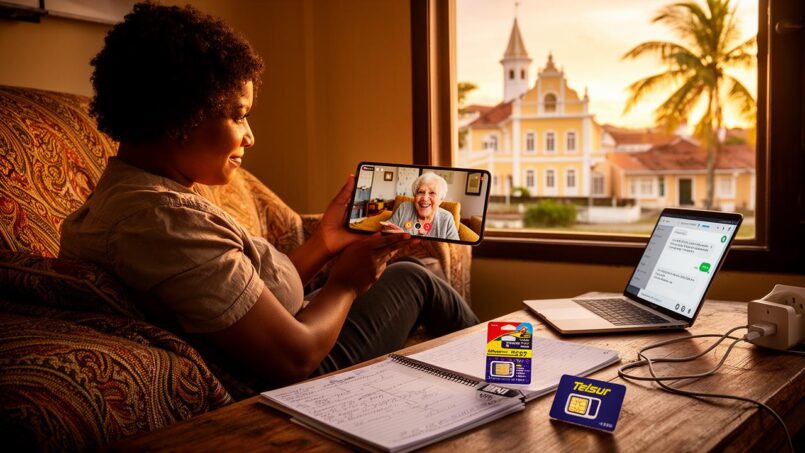
Traveling to Suriname is often an opportunity to discover spectacular nature and a mosaic of cultures. But whether you settle for a few months in Paramaribo or head into the interior for a few days of adventure, a question quickly comes up: how to keep in touch with your family, friends, and colleagues back in Europe, North America, or elsewhere, without breaking the bank or losing touch with daily life?
The country has a developed telecom ecosystem, although the infrastructure lags behind the standards of the most connected countries. Several options exist to stay in touch: local SIM cards, eSIMs, free Wi-Fi, messaging apps, and international calling services. It’s important to understand how the network works, local usage habits, and some cultural codes to facilitate communication.
Understanding the Telecommunications Landscape in Suriname
Suriname is a small South American country, with its population mainly concentrated in the capital Paramaribo and coastal towns. This geographical detail is far from trivial: it largely explains the distribution of network coverage.
As of the end of 2025, there were approximately 953,000 active mobile connections, nearly 149% of the population.
On the internet side, the situation is mixed. In early 2025, about 500,000 people were connected, representing a penetration rate of 78.4% of the population. 4G LTE mobile networks cover Paramaribo and the main coastal towns adequately, but the forested interior remains largely a dead zone. In urban areas, mobile speeds typically range between 5 and 25 Mbps, with a measured median around 48 Mbps in 2024 for the best areas. As soon as you move away from the main routes, coverage drops to 3G, 2G, or disappears altogether in parts of Central Suriname or near the most remote nature reserves.
To stay in touch from Suriname, you need to adapt your communication tools to the available network coverage. In Paramaribo, 4G allows for video calls, video conferencing, and sending high-definition photos. However, during an expedition along the Suriname River or toward Raleighvallen, the connection is limited: plan to send delayed messages and take advantage of occasional Wi-Fi access points in accommodations.
Mobile Operators: Telesur and Digicel
The Surinamese mobile market is dominated by two players: Telesur and Digicel.
Telesur, the historical operator founded in 1999, remains the national leader. It is generally considered to offer the best coverage, especially in Paramaribo, the main urban centers, and a good part of the inhabited interior areas. Digicel, an international group present throughout the Caribbean, has been in Suriname since 2007. It offers competitive plans, with good coverage around the capital, but a less extensive network than Telesur in the most remote regions.
Technically, Suriname operates on GSM/3G/4G networks using the 850 and 1900 MHz frequency bands. Consequently, most modern and unlocked GSM smartphones are compatible without issues.
For a visitor or expatriate, the choice of operator largely depends on where you plan to spend most of your time. If your daily life revolves around Paramaribo, either operator will do. If you plan long excursions into the interior (Maroon villages, nature reserves, remote river areas), the advantage leans clearly toward Telesur, whose coverage there is considered more reliable.
Local SIM Cards: The Simplest and Cheapest Solution
To stay reachable and continue calling or sending messages abroad without blowing your budget, the most recommended option is buying a local prepaid SIM card.
The process is relatively simple: upon arrival at Johan Adolf Pengel International Airport (PBM), at a Telesur or Digicel store in Paramaribo, or at an authorized reseller, you purchase a SIM card. The price is around 5 to 10 USD, with at least some call credit included. For instance, at Telesur, a SIM costs 110 SRD (about 3.61 USD) with a few local minutes. Digicel offers the same price, with an included call credit of 65 SRD.
Regulations require each card to be registered with a valid ID document, typically your passport. Expect 15 to 30 minutes for the entire process: providing information, copying the document, activating the line. Activation is often instantaneous, but it’s not uncommon to wait a few minutes for the network to recognize you.
Once you have your local SIM card, you get a Surinamese number. This allows you to make local calls at reasonable rates, send SMS, and purchase data plans. You can also use your usual messaging apps (like WhatsApp, Messenger, or Skype) to contact your loved ones abroad.
Example of Mobile Rates at Telesur
Telesur offers a range of prepaid data plans. Here is an overview of some benchmark offers, converted using an indicative rate of 1 USD ≈ 30.44 SRD:
| Plan type | Price (SRD) | Approx. price (USD) | Data volume | Validity |
|---|---|---|---|---|
| 12-hour data plan | 25 | 0.82 | 150 MB | 12 hours |
| 1-day data plan | 49 | 1.61 | 2,560 MB | 1 day |
| 3-day data plan | 97 | 3.19 | 4,608 MB | 3 days |
| 7-day data plan | 243 | 8.00 | 10,752 MB | 7 days |
| 30-day data plan | 731 | 24.03 | 25,600 MB | 30 days |
| 30-day Giga plan | 2,914 | 95.74 | 92,160 MB | 30 days |
For those who don’t need voice and mainly want data, Telesur also sells “data only” plans on a 30-day basis, without 5G access:
| 30-day data only plan | Price (SRD) | Approx. price (USD) | Data |
|---|---|---|---|
| Option 1 | 434 | 14.26 | 7,168 MB |
| Option 2 | 677 | 22.21 | 16,384 MB |
| Option 3 | 919 | 30.22 | 29,184 MB |
For a long-term stay, postpaid offers are available, for example with 5 to 85 GB per month costing about 10 to 95 euros.
Prepaid Offers at Digicel
Digicel positions itself with “Prime Bundles” that combine general data and dedicated data for certain apps (social networks or specific services). A few examples:
| Digicel Prime plan | Price (SRD) | Approx. price (USD) | Global data | Data per targeted app | Validity |
|---|---|---|---|---|---|
| Daily Prime | 60 | 1.97 | 2.5 GB | 1 GB/app | 1 day |
| 3-Day Prime | 115 | 3.78 | 4.5 GB | 3 GB/app | 3 days |
| 7-Day Prime | 294 | 9.66 | 10.5 GB | 7 GB/app | 7 days |
| 30-Day Prime | 855 | 28.11 | 25 GB | 30 GB/app | 30 days |
In postpaid, Digicel targets heavy users with packs including unlimited calls and SMS, from 15 to 50 GB per month, for the equivalent of 20 to 36 euros.
With a budget of 10 to 20 dollars, a traveler can buy a mobile data plan of a few gigabytes, valid for several days or weeks. This volume is sufficient for regular video calls, sending photos, checking social media, and using messaging apps like WhatsApp throughout their stay.
Activation, Top-ups, and Validity Period
Activating a physical SIM follows the classic pattern: insert the card, possibly enter a PIN code, then check in the settings that mobile data is enabled and the Telesur or Digicel network is selected. Some operators send a welcome SMS explaining how to subscribe to different plans (via SMS codes or through their website/app).
Prepaid cards are valid up to a certain period of inactivity; after that, the line may be deactivated. Tourist plans have durations ranging from one day to thirty days. It is therefore advisable to do a final check before leaving the country, or even remove the local SIM to avoid any surprise roaming charges when you are back home.
Top-ups can be bought everywhere: supermarkets, small shops, gas stations, kiosks. You then enter a USSD code or a dedicated phone number, or use the operator’s app when Wi-Fi or data is available.
eSIM: Stay Reachable on Your Original Number
For those who don’t want to juggle physical SIM cards, eSIMs are an increasingly practical alternative, provided you have a recent, compatible smartphone (many Apple, Google, Samsung models).
An eSIM is a digital profile loaded into the phone via a QR code. The major advantage, for staying in touch with loved ones from Suriname, is the ability to keep your original SIM card active. You can thus keep your usual number to receive banking SMS, important calls, or validation codes, while using the local data from the eSIM for your daily communications (WhatsApp, internet calls, emails, social networks).
Discover the main international operators offering eSIM plans for traveling to Suriname.
Offers a variety of local and regional data plans for Suriname, with easy activation via its app.
Offers eSIM plans with unlimited data specific to Suriname, focused on travelers’ needs.
Provides flexible eSIM plans for Suriname, allowing top-ups and country changes on demand.
Aggregator offering eSIMs from several operators for Suriname, with instant digital delivery.
| eSIM Provider | Key Features for Suriname |
|---|---|
| eSIM.net | Data plans for Suriname, instant connection, no roaming fees. |
| Sim Local | Local Digicel “data only” eSIM, possible discount via promo code. |
| Nomad | eSIM with 4G/5G access, need to enable “Data roaming” for the Nomad profile. |
| Gigago | Offers from 1 GB/7 days at about 6.50 USD up to nearly 50 USD for higher volumes. |
| Holafly | eSIM with unlimited data, instant activation, built-in VPN, tethering possible (about 500 MB/day), 24/7 support. |
eSIMs use local networks (often Digicel) and rely on the same 4G/5G infrastructure as physical SIM cards. Their main advantage, besides simplicity, is that you can prepare everything before boarding the plane. Once in Paramaribo, you just scan the QR code received by email, activate the line, and, if needed, switch your apps to the eSIM data.
For short stays (one to seven days) concentrated in the city, this model is particularly well-suited: no local paperwork, no waiting in line at a store, no passport needed for registration. For longer stays, a local physical SIM may be cheaper.
Free Wi-Fi, Cafés, and Libraries: Staying Connected Without a SIM Card
Beyond mobile networks, another way to keep in touch is to rely on the many Wi-Fi hotspots available in urban areas.
In Paramaribo, virtually all serious accommodations—hotels, guesthouses, apartment-hotels—include Wi-Fi for their guests. Large establishments like the Hotel Torarica or Krasnapolsky provide access via individual codes, usually after a purchase at the bar or restaurant. Other places, like certain cafés or restaurants in the city, offer open networks, sometimes a bit slow and congested, but sufficient for sending messages or photos via WhatsApp or Messenger.
The Centrale Bibliotheek Suriname offers free internet access to its visitors. It’s a quiet place, ideal for working or making video calls, especially at times compatible with Europe.
Outside the capital, the pattern repeats in Lelydorp or in tourist spots like Domburg: many hotels and cafés offer Wi-Fi, but quality varies. A cybercafé in Domburg charges about 1 euro per hour on its own computers, or offers a code to connect with your phone or laptop.
Even in the rainforest, some resorts like Kabalebo or near Raleighvallen offer Wi-Fi access. The connection is often limited, available mainly in common areas, but allows sending messages or preparing your communications.
Several apps help locate Wi-Fi hotspots worldwide, including in Suriname:
| App / Service | Main function for Wi-Fi in Suriname |
|---|---|
| WiFi Map | Community map, over 100 million shared passwords, usable in more than 200 countries. |
| Wi‑Fi Space | Hotspot map, possibility to add new points with SSID and password. |
| Wiman | Automatic connection to the best free network nearby, offline downloadable maps. |
| OpenWiFiMap, Hotspotr, Wi-FiHotSpotList | Hotspot databases, useful for finding access in urban areas. |
The major drawback of free Wi-Fi is security: open networks are far from safe. To avoid unpleasant surprises, it’s advisable to use a VPN, especially if you check your bank accounts, send sensitive documents, or connect to professional services.
Roaming, Pocket Wi-Fi, Calling Cards: Other Options
On paper, international roaming with your home operator is the simplest solution: you land, turn on your phone, everything works. In practice, for staying in touch regularly from Suriname, it’s often the most expensive strategy. Roaming rates to this country generally remain very high, with a risk of a surprise bill, especially if you use data for video or forget to disable automatic updates.
These small portable routers, rentable before or after departure, create a private Wi-Fi network by connecting to the local mobile network, allowing multiple devices to connect. They are handy for families or professional teams, but require managing battery life, carrying an extra item, and are often more expensive than a simple local data plan.
Finally, for voice calls to Surinamese landlines and mobiles from abroad, some “virtual calling card” services offer competitive rates. The offers highlighted in comparison sites indicate rates around 29.8 to 46.5 US cents per minute depending on whether you call a landline or mobile, with plans featuring a small weekly subscription or simply prepaid credit. These solutions can be interesting for your loved ones in Europe or North America, who want to call you frequently on your Surinamese line without using the internet.
Messaging Apps: The Real Heart of Communications
Beyond the infrastructure, usage habits are what matter most for staying in touch. Suriname is very connected to social networks and messaging apps: in early 2025, about 54.8% of the population had an active account on at least one social platform, a figure that rose to 56.4% by the end of 2025. Among internet users, over 70% regularly use social media.
In this landscape, several apps dominate:
Percentage of respondents considering WhatsApp their most-used social platform, ahead of Facebook.
For your communications from Suriname, this means that by connecting to WhatsApp, Facebook Messenger, or even Skype or Zoom, you will cover almost all needs: encrypted messages, audio calls, video conferences, sending documents or photos.
A few useful features to keep in mind:
WhatsApp offers free voice and video calls over the Internet, group conversations, and end-to-end encryption. Messenger allows audio and video calls, including to landlines in some countries via specific gateways. Telegram offers large groups (up to several hundred members) and secure audio/video calls, but is less used locally. Apps like Viber, LINE, WeChat, or KakaoTalk are mainly important in their home countries; they can be useful if your contacts use them, but don’t play a key role in Suriname.
On the ground, the most effective combination is often: a local SIM card or eSIM for data, and WhatsApp/Facebook for all calls and messages. Financially, this allows you to almost completely avoid roaming costs and limit paid “classic” calls to a few cases (banks, administrations, emergency services).
SMS, Classic Calls, and Professional Services
SMS still exists, both for individuals and businesses, especially for alerts, appointment confirmations, or security codes. Within the country, it’s still a widely used channel. However, for “two-way” uses (long exchanges, customer service), the infrastructure does not always allow businesses to receive replies to sent SMS, pushing economic players toward WhatsApp, web forms, or emails.
When traveling, an eSIM allows you to keep your home operator’s line primarily for receiving secure SMS (bank, online services), while avoiding the high costs of voice and data usage on that line abroad.
On the side of “classic” phone calls abroad, costs remain high if you dial an international number directly from your Surinamese mobile or from a European number roaming in Suriname. Hence the interest, for your loved ones, in using either app-based calls or specialized services offering prepaid minutes at reduced rates to +597.
Time Zones: Scheduling Calls Without Waking Everyone Up
Staying in touch also means successfully talking at reasonable hours for everyone. Suriname uses a single time zone, Suriname Time (SRT), fixed at UTC‑3. The country does not observe daylight saving time. The advantage: the offset remains stable year-round on the Surinamese side. The downside: it varies for your European or North American contacts, who change their clocks twice a year.
Some useful benchmarks:
The time difference between Suriname (UTC-3) and other regions varies by season and time zone. Compared to Central Europe (France, Belgium, Netherlands, Germany), Suriname is 4 hours behind in winter (CET, UTC+1) and 5 hours behind in summer (CEST, UTC+2). Compared to the United Kingdom, the gap is 3 hours in winter (GMT, UTC+0) and 4 hours in summer (BST, UTC+1). Compared to New York, Suriname is 2 hours ahead in winter (EST, UTC-5) and 1 hour ahead in summer (EDT, UTC-4). Finally, Sydney (Eastern Australia) is always 13 to 14 hours ahead of Suriname, depending on whether it’s on standard time (AEST) or daylight saving time (AEDT).
In practice, for a call between Paramaribo and Central Europe, a good time window is between 8 a.m. and 2 p.m. Suriname time, which corresponds to noon‑6 p.m. in continental Europe in winter, and 1 p.m.‑7 p.m. in summer. Between Suriname and the U.S. East Coast, late morning in Paramaribo works well for an early start in New York.
It’s important to account for time zone differences and seasonal changes (like daylight saving time/winter time) in Europe to avoid missed appointments or phone calls at inappropriate hours, such as dawn.
Cultural Customs and Politeness Codes in Communication
Staying connected is not just about bandwidth. It’s also about understanding at least a little how Surinamese people communicate, including remotely.
The country is marked by great ethnic diversity: Hindustani, Creoles, Javanese, Maroons, Indigenous peoples, and other groups coexist, each bringing its own codes. The official language is Dutch, but English is widely understood in the city. A large part of the population, especially young people, also speaks Sranan Tongo, which serves as a lingua franca. Other languages like Sarnami (Caribbean Hindustani), Javanese, or various Maroon and Indigenous languages are common.
In exchanges, the tone is generally warm and polite. Refusals are often expressed indirectly rather than with a blunt ‘no.’ During phone calls or video conferences, it is appreciated to start with sincere greetings (like ‘Goedemorgen’ or ‘Goedenavond’) and ask about family. Using respectful forms ‘Meneer’ (Sir) and ‘Mevrouw’ (Madam) is important with older people or in a professional context.
Online, this politeness is reflected: you greet, take time to reply (sometimes with a delay, as punctuality is not always strict in the private sphere), avoid sensitive topics like politics or religious debates when you don’t know the person well. Surinamese society is proud of its diversity and relative harmony; discriminatory remarks or blunt criticism about ethnicity or religion are particularly frowned upon.
In public, adopt a certain reserve and avoid overly visible or loud displays of affection so as not to embarrass those around you. In private, exchanges can be much warmer and more expressive, including laughter, virtual hugs, and extended family conversations.
Practical Strategies for Staying in Touch Every Day
Once the environment is set, how do you concretely arrange your communications from Suriname?
For a short trip, especially concentrated in Paramaribo and the larger cities, the following combination is often optimal: eSIM or local SIM with a small data plan (2 to 5 GB), systematic use of WhatsApp and Messenger for calls, and scouting out a few bars/hotels with Wi-Fi for long video conversations. Costs remain contained, setup is quick, and you stay reachable wherever 4G is available.
For a stay of several months, especially in Paramaribo or a well-covered coastal area, opt for a monthly plan of 20 to 30 GB from Telesur or Digicel. This comfortably covers remote work, moderate streaming, and frequent video calls. The flexibility of prepaid cards allows you to adjust the data volume as needed, for example increasing usage during holidays to maintain contact with family.
In the case of work or missions in the interior, caution is advised: inquire in advance about accommodations equipped with Wi-Fi (resorts, camps, lodges), plan specific times to make or receive calls, inform your loved ones that you may be unreachable for several hours or even days. Messaging apps will work in “store and forward” mode: messages sent from abroad will arrive as soon as you regain a connection.
For your loved ones in Europe or North America, the most economical tip is for them to also use apps like WhatsApp, Messenger, Telegram, or Skype, favoring calls over a Wi-Fi connection both on their end and yours. As a supplement, some may subscribe to small “voice credit” offers to call your Surinamese number if necessary, but these classic phone calls should ideally remain exceptional.
Conclusion: Plan Ahead a Little, Enjoy the Rest
Suriname is not an ultra-connected zone like some major metropolises, but today it offers all the necessary tools to stay in close contact with your loved ones, provided you plan ahead a bit. Understanding the distribution of coverage between Paramaribo and the interior, choosing wisely between a local SIM and an eSIM, getting familiar with the dominant messaging apps (WhatsApp and Facebook first), accounting for the time difference, and respecting a few cultural codes are enough to turn a stay in Suriname into a living interlude, without breaking ties with those who matter.
Between a video call from a downtown café, a voice message sent from a riverside lodge, or a call scheduled precisely to match your loved ones’ hours in Europe, the means to stay connected are plentiful. And that might be one of the pleasures of Suriname: being able to immerse yourself in unique nature and culture, while staying just a few clicks away from your family, friends, and daily life on the other side of the world.
Disclaimer: The information provided on this website is for informational purposes only and does not constitute financial, legal, or professional advice. We encourage you to consult qualified experts before making any investment, real estate, or expatriation decisions. Although we strive to maintain up-to-date and accurate information, we do not guarantee the completeness, accuracy, or timeliness of the proposed content. As investment and expatriation involve risks, we disclaim any liability for potential losses or damages arising from the use of this site. Your use of this site confirms your acceptance of these terms and your understanding of the associated risks.

Cyril Jarnias is an independent expert in international wealth management with over 20 years of experience. As an expatriate himself, he is dedicated to helping individuals and business leaders build, protect, and pass on their wealth with complete peace of mind.
On his website, cyriljarnias.com, he shares his expertise on international real estate, offshore company formation, and expatriation.
Thanks to his expertise, he offers sound advice to optimize his clients' wealth management. Cyril Jarnias is also recognized for his appearances in many prestigious media outlets such as BFM Business, les Français de l’étranger, Le Figaro, Les Echos, and Mieux vivre votre argent, where he shares his knowledge and know-how in wealth management.





