
 Published on and written by Cyril Jarnias
The Albanian real estate market is experiencing one of the most dynamic periods in its history. Driven by a spectacular tourism boom, the prospect of European Union membership, and vast infrastructure projects, Albania is seeing prices rise at a pace nearly unmatched in Europe. Between January 2025 and January 2026, national prices rose by approximately 18% nominally, compared to an average of 3–4% in the EU. In the most sought-after coastal cities, annual increases flirt with 25–40%.
The four Albanian cities have distinct profiles, risk levels, and potential for capital gains, but they are central to the market’s reconfiguration with contrasting scenarios for 2026.
A National Market Overheating… Starting to Normalize
On a national scale, the numbers tell the story. The average price hovers around €1,600–1,620 per square meter for a standard home, or about €160,000 for a 100 m² apartment. The price range within which 80% of purchases fall is between €75,000 and €280,000, still below many Mediterranean destinations, but the gap is closing fast.
Growth for 2025–2026 is estimated at 18–26% annually, placing Albania among Europe’s fastest residential markets. For 2026, however, projections point to a more moderate increase of around 7–12% over the year, with a central scenario of about 5–8% per year. Even under this more cautious assumption, the pace remains well above the European average.
Number of foreign visitors expected in Japan in 2025, up 6.6% from the previous year.
In this overall landscape, Tirana, Durres, Vlore, and Saranda play very different roles. The capital dominates in size and liquidity. Durres offers the most affordable entry point to the sea. Vlore emerges as the major “growth + yield” bet on the Riviera. And Saranda concentrates the profits from short-term rentals, but also the signs of a possible overheating.
Tirana: Economic Heart, High Prices, and Debate Over Continued Growth
Tirana is the keystone of the Albanian market. It concentrates jobs, universities, corporate headquarters, and institutions, while attracting a steady flow of population from the rest of the country. The real estate market there is primarily domestic, although foreigners are beginning to play a more visible role in certain neighborhoods.
In 2026, prices in the capital are already at levels close to some Western European cities for premium locations. The average ticket for a standard purchase far exceeds €2,000/m², and prestige areas flirt with values well above that.
Here is a synthetic overview of the price ranges advertised in Tirana:
| Indicator | 2026 Value (approx.) |
|---|---|
| Min. price €/m² (city) | €1,800 |
| Max. price €/m² (city) | €5,000 |
| Average price €/m² (overall Tirana) | €2,000–2,300 |
| New developments (common range) | €2,300–2,700/m² |
| Tax reference Blloku (ALL/m²) | 228,400 ALL ≈ €2,300/m² |
| 2026 trend forecast | +5 to +7% (base scenario) |
| 2026 forecast range (analysts) | +2 to +12% depending on scenario |
| Recent annual increase (year-over-year) | 14 to 22% depending on segment |
Neighborhoods around the artificial lake (Liqeni Artificial) and Blloku illustrate this move upmarket. Around the lake, tax references exceed €2,200/m², while market prices can go well beyond, especially in new residences with views and amenities. In Blloku, some programs already exceed €4,000–5,000/m²; some experts even mention the possibility of ultra-luxury reaching €10,000/m² within a decade if EU membership materializes.
A Polarized Market Between Expensive Center and Still-Accessible Periphery
This price level, however, does not apply to the entire city. The outskirts of Tirana remain much more affordable, with values ranging from €900 to €1,300/m² in areas like Kamza, Paskuqani, or Unaza e Madhe. Forecasts for 2026 indicate that the strongest demand lies in these sectors, particularly among young households seeking affordable housing.
Central Tirana suffers from accessibility issues with a price-to-income ratio exceeding 19, well above the European average. Sales volume dropped after the 2022 peak and stabilized in 2025, creating an anomaly: fewer transactions but prices still rising, driven by construction costs, local taxation, and investors insensitive to increases.
This contrast also shows in the rental market. Apartment rents hover around a median of €600 and an average of €765, with well-located studios and two-bedroom units that can exceed €800 per month. For villas, the market is much smaller, with a median rent of about €1,500 and an average near €2,530, a sign that these properties cater to a narrow circle of very high-income households or expatriates.
Announced Stability or a New Wave of Increases?
For 2026, professionals’ views diverge slightly. Some players, notably agencies like Century 21 Albania, anticipate price stability in Tirana over the next two years, with a more selective market and increases concentrated mainly in the periphery. Other scenarios, supported by past growth figures and continued infrastructure, still suggest an overall increase of 5–7% for the city, with potential peaks of 12% in the most prominent neighborhoods like Astir, Kombinat, Lapraka, or Zogu i Zi.
The real estate market is increasingly segmented: on one hand, the mass market is still driven by affordability and real demand, especially for 2- or 3-bedroom family apartments in the suburbs or gentrifying neighborhoods; on the other hand, the premium segment functions as a specialized investment instrument, where buyers aim for capital preservation and long-term capital gains rather than immediate rental yield.
Durres: The Most Affordable Gateway to the Sea
Durres holds a special place in the Albanian coastal landscape. Both the country’s main port and a beach town about thirty kilometers from Tirana, it combines a local residential market, second homes, and short-term rentals. However, compared to other major coastal destinations, it remains the most affordable market.
Price levels here are clearly lower than in Vlore or Saranda. Average values are around €1,300/m², with a wide range between the cheapest neighborhoods and well-located buildings near the sea or the center.
| Indicator | 2026 Value (approx.) |
|---|---|
| Min. price €/m² | €800 |
| Max. price €/m² | €1,800 |
| Average price €/m² | €1,300–1,350 |
| Standard apartments (value range) | €900–1,500/m² |
| Well-located apartments, sea view | €1,400–1,800/m² |
| 2026 trend | +6 to +8% |
| Recent annual growth | 5–10% |
| Median apartment price | ≈ €94,500 |
| Median villa price | ≈ €500,000 |
On the rental side, median monthly rents are around €400, driven by both long-term rentals—facilitated by proximity to the capital—and summer tourist demand. Gross yields generally range between 4 and 9%, depending on location and property quality.
A Still “Practical” Market but Caught Up by Rising References
Durres is often described as a “practical” or volume market, with a high proportion of Albanian buyers seeking a mixed primary residence / seaside pied-à-terre solution. For foreign investors, the appeal lies more in the combination of “low entry price + potential for appreciation thanks to infrastructure.”
Official reference prices for the port area have increased by 196% since January 1, 2026.
This rise in references is a structural factor driving up prices. It adds to the increase in labor costs and taxation, even though construction materials remain relatively stable. For now, Durres retains a more modest position than the southern beaches, but the gap is narrowing, especially as new high-end projects, notably along the Durres–Lalzit Bay axis, already reach €2,200–4,800/m² for frontline residences.
Vlore: The Balance Between Price, Growth, and Yield
Vlore is scaling up. Long seen as a quieter alternative to Durres, it is now emerging as one of the most sought-after markets for those seeking a compromise between growth potential, rental yield, and still relatively contained prices.
The city benefits from a dual dynamic. On one hand, a booming tourist demand is driving up prices along the waterfront, especially along the Lungomare promenade and the Uji i Ftohtë area. On the other, the arrival of Vlore International Airport, operational for commercial flights from 2025–2026, is transforming the southern Riviera into a destination directly accessible from abroad, without transiting through Tirana.
Price figures reflect this repositioning.
| Indicator | 2026 Value (approx.) |
|---|---|
| Min. price €/m² | €1,300 |
| Max. price €/m² | €4,000 (waterfront, premium projects) |
| Average price €/m² (city) | €2,000–2,400 |
| New developments (city) | €1,300–1,800/m² |
| Sea-view apartments (front line) | €2,200–3,500/m² (peaks at €4,000) |
| 2026 trend | +7 to +9%, some sectors 10–15% |
| Recent annual growth (waterfront) | 22–28% |
| Median villa price | ≈ €1,000,000 |
| Typical rental yield | 8–11% depending on location |
In central neighborhoods, prices range around €1,600–1,800/m² for standard properties, while prime Lungomare frontlines frequently reach €3,500/m² and more in new high-end residences. New tax references reflect this upscaling: the Lungomare zone is valued at about 140,000 ALL/m², while Sazan Island benefits from a record reference of 200,000 ALL/m², a sign of an ultra-premium positioning driven by large international projects.
Vlore, New Hub of the Albanian Riviera
The airport’s impact goes beyond the city itself. Neighboring localities like Orikum and Radhimë benefit from a “second-ring effect”, with annual increases estimated between 8 and 12%. In these areas, waterfront apartments can still be bought for €1,000–1,350/m², but projections place them significantly higher by 2028 if the current dynamic holds, with potential cumulative gains of 13–50% over a few years, excluding rental income.
The micro-markets most exposed to international tourism could see their values increase by 25 to 40% thanks to new infrastructure.
A Market Still Competitive Against Mediterranean Rivals
Compared to rivals like Croatia, Greece, or Italy, Vlore remains significantly cheaper. Good-quality sea-view apartments there often range between €2,200 and €3,000/m², whereas comparable properties in Dalmatia or the Greek islands can easily exceed €3,500–4,500/m². Market studies estimate that, overall, Albanian prices remain 40–50% below comparable Mediterranean destinations, although this gap is closing rapidly.
Vlore offers an average annual yield of 8 to 11% on rentals, supported by growing tourist demand and a deeper long-term rental market. It combines this with one of the country’s most interesting appreciation potentials.
Saranda: Capital of Short-Term Rentals, a Market Under Pressure
Saranda holds a unique place in Albania’s real estate geography. It is the country’s main short-term rental platform, almost exclusively geared toward foreign tourists. The city enjoys 300 sunny days a year, immediate proximity to the island of Corfu (and thus its airport), and the presence of iconic sites like Butrint National Park.
In 2026, prices here reach levels that rival those of expensive Tirana neighborhoods, while local purchasing power remains much lower. The observed price ranges confirm this rise in power.
| Indicator | 2026 Value (approx.) |
|---|---|
| Min. price €/m² | €1,400 |
| Max. price €/m² | €3,000 (peaks at €3,500–4,000) |
| Average price €/m² (city) | €1,900 |
| City center (2025) | €1,600–1,800/m² |
| Sea-view apartments (waterfront) | €2,200–3,000/m² (penthouses up to €3,500) |
| New developments 500–1,000 m from sea | €2,000–2,500/m² |
| Older properties, secondary | €1,200–1,500/m² |
| 2026 trend | +6 to +8% (some sectors 10–18%) |
| Annual growth 2025 (certain areas) | 25 to 58% |
| Median housing price (with Vlore) | €160,000–186,000 |
| Short-term rental yield | 9–12% (high season, high occupancy) |
In practice, virtually no frontline property under €3,000/m² remains on the most sought-after waterfront sections. New upscale projects, with high-end finishes and panoramic views, are often positioned between €2,500 and €3,500/m². Saranda’s appeal to investors lies in these high rental yields, with occupancy rates that can reach 80–90% during peak season and high daily rates for well-located studios and small apartments.
A Market Flirting with a Bubble
This dynamism, however, has a downside. Local professionals already report a decline in purchase demand, on the order of 50% according to some agencies, even as prices have jumped more than 25% in a year on the best locations. The tax reference increases for the city, effective from early 2026 (+53% for all of Saranda, with five new cadastral zones), will mechanically raise construction costs and taxation, further fueling price pressure.
Several signals call for caution: a shock to international tourism (geopolitical crisis, recession in Europe, tightening of platform rules) could lower occupancy rates and test investment models based on very optimistic yields, with some analysts citing a bubble risk if prices continue to soar without demand adjustment.
For now, the combination of “high yields + land scarcity + prospect of a regional airport” maintains upward pressure, but price forecasts for 2026 (around +6 to +8% on average, more on the waterfront) occur in a context where the median local income no longer has much relation to the level of values displayed.
2026 Comparison: Tirana, Durres, Vlore, Saranda at a Glance
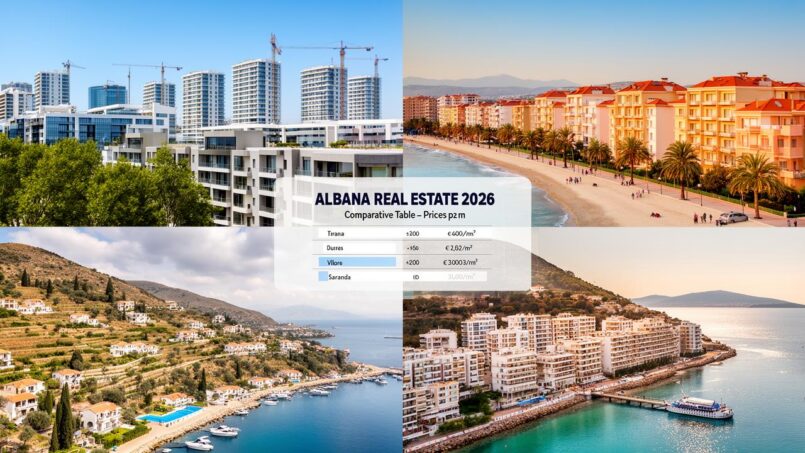
To put the four cities into perspective, a comparative table helps visualize differences in price levels, dynamics, and investment profiles.
| City | Min. price €/m² | Max. price €/m² | Average price €/m² (approx.) | Announced 2026 trend | Dominant profile |
|---|---|---|---|---|---|
| Tirana | 1,800 | 5,000 | 2,000–2,300 | +5 to +7% | Capital, domestic market, expensive center, growing periphery |
| Durres | 800 | 1,800 | 1,300–1,350 | +6 to +8% | Affordable coast, mix residence/leisure, moderate yield profile |
| Vlore | 1,300 | 4,000 | 2,000–2,400 | +7 to +9% (Lungomare 10–15%) | Price/yield balance market, booming Riviera hub |
| Saranda | 1,400 | 3,000+ | ≈ 1,900 | +6 to +8% (some sectors 10–18%) | Short-term rental capital, high yields, risk of overheating |
These figures should be read with nuance. Within each city, gaps between micro-markets can be extreme: an old apartment without an elevator on a third line has nothing in common with a new penthouse by the sea or a two-bedroom in a gentrifying neighborhood. Moreover, official reference prices (in lek) remain below actual transaction prices in the most sought-after areas, complicating direct reading of administrative statistics.
The Effect of New Tax References: A Silent Shock on the Coast
A cross-cutting element, rarely visible in commercial brochures, concerns the reform of reference prices decided by the government. After a first major revision for the sole municipality of Tirana in 2023 (average increase of 30.8% compared to 2018), the executive extended the update in 2025–2026 to all districts, effective January 1, 2026, except for the capital which had already been reassessed.
Percentage increase for the Durres port/marina area, the largest rise among cadastral zones multiplied by almost two.
For end buyers, the effect is twofold. On one hand, these increases inflate builders’ bills (via the infrastructure impact tax, indexed to value), which they then pass on into selling prices. On the other hand, they strengthen tax transparency, limiting under-declarations. In the short term, this contributes to rising list prices for new apartments, especially on the coast. In the medium term, it could slow marginally profitable projects, stabilizing supply.
Foreign Demand, Structural Driver of the Increase
It is impossible to understand the trajectories of Tirana, Durres, Vlore, and Saranda without returning to the growing weight of foreign buyers. They would represent about 24% of transactions, with a majority of EU citizens (about 61% of non-resident buyers). Traditional neighbors come first: Kosovo, North Macedonia, Italy, Greece, often for second homes or moderate investments. But over the past two years, flows from Poland, Czech Republic, Germany, United Kingdom, Nordic countries have intensified significantly.
Analysis of real estate movement targeting four key markets: Tirana, Durres, Vlore, and Saranda.
Attracts for its liquidity and resale prospects.
Appeals to Central European buyers seeking affordable prices near the capital.
Particularly attractive to Italians and Germans, boosted by its new airport and port.
Concentrates seasonal yield investments (Ksamil, Himare, Dhermi).
The reasons are recurrent: prices still low compared to Croatia, Spain, or Greece, double-digit tourist growth, reasonable taxation, a relatively simple purchase process for non-residents (no restrictions for apartments and houses, capital gains tax of 15% on resale, main requirement to obtain an Albanian tax number). Added to this are rental yields often announced between 8 and 12% in coastal cities, and even up to 15% in some optimistic scenarios for the most performing resorts.
High yields in tourism involve increased risks: strong seasonality, dependence on international platforms, off-season vacancy, and regulatory uncertainties. However, the influx of more than 12 million tourists in 2025 and the expected progression in 2026 support the model.
Growth Expected to Moderate but Last
By 2030, the most commonly cited projections point to a cumulative increase in real estate prices of 20 to 40% at the national level, or even 30 to 45% over the five years 2026–2031 and 60 to 95% over ten years. Converted to an annual pace, this would average 5 to 8% per year, with significant variations between markets.
Analysts identify three risks that could weigh on the economic trajectory: affordability fatigue due to prices disconnected from local wages, especially in Tirana and on the coast; a tourism shock linked to a European economic crisis, regional tensions, or extreme climate events; and an excess of supply in some micro-markets where too many similar programs arrive at the same time.
For 2026 specifically, the plausible range of change at the national level is estimated between a slight decline (up to –5% in secondary areas with oversupply) and an increase of 10 to 15% in the best-performing micro-markets, such as the Saranda waterfront, certain sections of Lungomare in Vlore, or highly demanded neighborhoods in Tirana. The national average would likely fall between stability and +8%, marking a phase of “normalization” after the spectacular jumps of 2024–early 2025.
How to Read the Signals in 2026, City by City?
To conclude, it is useful to summarize the key takeaways for each of the markets studied, keeping in mind that any purchase decision depends on a detailed analysis of the property, neighborhood, and strategy (personal use, long-term rental, short-term rental, medium-term resale).
In Tirana, the key question is no longer so much whether prices are high – they already are – but where growth remains justified by fundamentals. Central premium neighborhoods seem to have absorbed much of the catch-up, with signs of local demand fatigue. Conversely, areas undergoing transformation (Astir, Kombinat, Lapraka, Zogu i Zi) and certain suburban segments still offer growth potential, especially for well-located new apartments at prices per square meter closer to household capacity.
In Durres, properties remain affordable (about €1,000/m²), but port and Tirana-Durres corridor development projects signal future increases. The tax reference has soared 196% in the port area, indicating potential as a hub. However, coastal competition and uneven construction quality require rigorous project selection.
In Vlore, everything converges toward an upscaling scenario. The airport changes the game, foreign demand keeps growing, and flagship neighborhoods like Lungomare or Uji i Ftohtë are already seeing double-digit annual increases. The main risk is not so much a lack of demand but the temptation to overpay for overpriced projects, while many second-line properties or nearby localities like Orikum offer a much better price-to-yield ratio.
Saranda remains strong for seasonal yields and tourist appeal, but the widening gap between sales prices, local incomes, and transaction volume suggests an imminent overheating in some segments. The ideal window for investment is closing, exposing late buyers to high prices without a safety margin.
Underlying it all, one constant remains: despite the price surge, Albania in 2026 is still cheaper than most of its Mediterranean rivals, while offering growth and yield prospects that attract increasing capital. Tirana, Durres, Vlore, and Saranda represent four very different faces of this opportunity. To take advantage of it, it is no longer enough to simply “bet on Albania”; one must now choose one’s city, neighborhood, property type… and accept that, in such a fast-moving market, the era of simple speculative bets may be giving way to a more selective and demanding approach.
A wealth project or a question? Contact us now to speak with a wealth management expert.
Disclaimer: The information provided on this website is for informational purposes only and does not constitute financial, legal, or professional advice. We encourage you to consult qualified experts before making any investment, real estate, or expatriation decisions. Although we strive to maintain up-to-date and accurate information, we do not guarantee the completeness, accuracy, or timeliness of the proposed content. As investment and expatriation involve risks, we disclaim any liability for potential losses or damages arising from the use of this site. Your use of this site confirms your acceptance of these terms and your understanding of the associated risks.

Cyril Jarnias is an independent expert in international wealth management with over 20 years of experience. As an expatriate himself, he is dedicated to helping individuals and business leaders build, protect, and pass on their wealth with complete peace of mind.
On his website, cyriljarnias.com, he shares his expertise on international real estate, offshore company formation, and expatriation.
Thanks to his expertise, he offers sound advice to optimize his clients' wealth management. Cyril Jarnias is also recognized for his appearances in many prestigious media outlets such as BFM Business, les Français de l’étranger, Le Figaro, Les Echos, and Mieux vivre votre argent, where he shares his knowledge and know-how in wealth management.





