
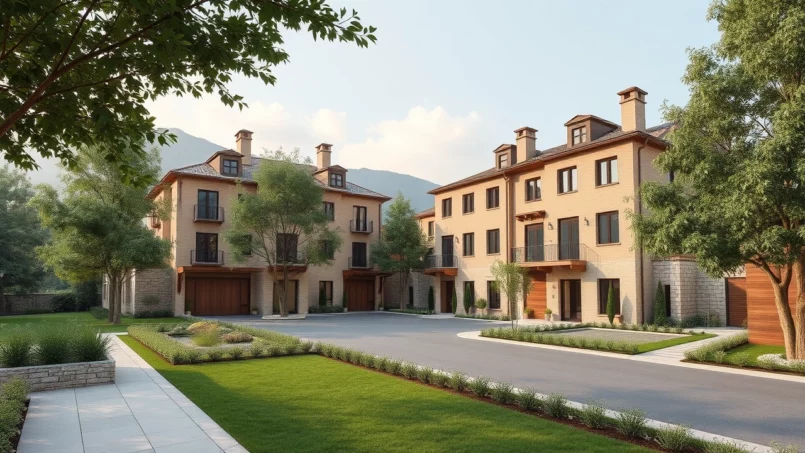
 Published on and written by Cyril Jarnias
Located on the banks of the Osum River, a UNESCO World Heritage site nicknamed the “city of a thousand windows,” Berat is attracting more and more travelers… and investors. While Tirana, Saranda, and Vlorë concentrate most of the big projects, Berat is quietly carving a niche for those seeking character, culture, and long-term value rather than coastal frenzy.
Investing in Berat is a bet on a unique historic center, driven by the growth of cultural tourism, targeted infrastructure projects, and still moderate national taxation. However, it means accepting the specific constraints of UNESCO status, a tighter real estate market, and particular risks regarding land and renovation work.
A National Real Estate Market in Controlled Overheating
To understand the Berat opportunity, you first need to look at Albania as a whole. The country has been one of the most dynamic residential markets in Europe in recent years. The Bank of Albania measured national price increases of up to 41.7% year-on-year in 2024–early 2025. Over the 12 months leading into early 2026, prices are estimated to have risen another 18 to 26%.
The average national price for a 100 m² home is around 17 million lek (approximately €160,000), or an average price of about €1,600/m². Nearly 80% of transactions fall within a range of 8 to 30 million lek (approximately €75,000 to €280,000), which gives an idea of the budgets dominating the market.
Expected cumulative increase in real estate prices in Albania over the next five years.
Foreigners now play a decisive role in this dynamism. In the first half of 2024, approximately 27% of sales were concluded by non-residents, mainly from the European Union, not counting the diaspora and a growing number of American or Middle Eastern investors. By early 2026, foreign buyers account for around 24% of transactions nationwide.
This boom is driven by a combination of factors: an economy growing at around 3.6–4% per year, unemployment down to about 9%, inflation hovering around 2%, tourism accounting for nearly 20% of GDP, and the prospect of European Union membership which lends credibility to reforms and reassures investors.
Berat: A Niche Market in a UNESCO City
Alongside the rise of major cities and coastal areas, Berat occupies a unique position. The city has been a UNESCO World Heritage site since 2008, as part of the “Historic Centers of Berat and Gjirokastër” inscription. It is famous for its layered historic neighborhoods – Mangalemi, Gorica, Kala – and for the coexistence of Ottoman mosques, Byzantine churches, and museums on the same streets.
This setting explains why Berat is cited in national analyses as an emerging hub for:
– traditional stone houses to restore
– small units like boutique hotels or guesthouses
– cultural tourism and wine tourism projects
Unlike beach resorts, the goal here is not explosive profitability over three summer months, but a positioning on a resilient “charm” segment, driven by:
Discover the main tourist attractions of Albania, organized by interest to help plan your trip.
For visitors interested in heritage, museums, and the country’s religious history.
Circuits combining the discovery of World Heritage cities (Berat, Gjirokastër) and the beauties of the Albanian coastline.
For hiking and nature enthusiasts, attracted by Tomorri Park and the spectacular Osum Canyon gorges.
Discover the development of wine tourism and renowned estates in the region.
Price Levels and Entry Ticket in Berat
Available data points to a lower price range than major metropolises, but not bargain-basement given the UNESCO label. For housing in Berat, estimates suggest:
– an average price between about €800 and €1,200/m² for built property
– a slightly wider range, often cited around €1,000 to €2,000/m² depending on location and condition
For historic stone houses to renovate or already operated as accommodation, budgets typically fall between €80,000 and €250,000. With a budget of around €95,000, it is considered realistic to target a historic house within the UNESCO perimeter, depending on the extent of work needed.
The table below broadly summarizes Berat’s positioning within the national price scale.
| Location | Market Type | Indicative Price Range/m² | Dominant Profile |
|---|---|---|---|
| Tirana Center | Capital, prime | €2,000 – €3,000+ | Urban, offices, long-term rental |
| Vlorë (waterfront) | Tourist coast | €1,000 – €1,800 | Second homes, Airbnb |
| Sarandë (new prime) | Very touristy coast | €1,500 – €2,500+ | Intensive seasonal rental |
| Berat | Inland UNESCO city | €800 – €1,200 (average) | Heritage, boutique hotels |
| Gjirokastër | UNESCO city | < €500 (raw old building) | Heavy renovation, guesthouses |
In this landscape, Berat positions itself as an intermediate option: more expensive than some unlabeled inland cities, cheaper than the metropolises and premium coastline, but with a clearly identified cultural and tourism potential.
Concrete Example of a Property for Sale
Listed properties illustrate the diversity of supply. For example:
Discover this single-story villa, fully furnished, located on Rruga Punetori in Berat. A spacious property on a large plot, offered at an attractive price.
Built area of 99 m² on a 645 m² plot. The villa includes a living room, separate kitchen, 2 bedrooms, and 1 bathroom.
Property sold fully furnished. Attractive selling price: €55,000.
That is an overall price well under €600/m² if considering only the built area. At the other end of the spectrum, another listing refers to a property at €280,000 (reference BRS-315-1b), typical of budgets for large houses or small hotel structures in the region.
While these examples alone don’t define the market, they confirm a key point: in Berat, an investor can still acquire a property with a garden, even expansion potential, for the price of a studio in a European capital.
How the State Controls Prices in Berat: Cadastral “Reference Prices”
To regulate taxation and bring the tax base closer to real prices, the Albanian Ministry of Finance has published reference values per square meter for each district, including Berat. These reference prices are calculated from registered sales contracts between 2022 and 2024, collected by the National Cadastre Agency.
The methodology relies on a strict selection of transactions (only apartments and buildings), conversion of amounts into lek at the average exchange rate, recalculation of price per m² per contract, then aggregation by cadastral blocks. Outliers or values clearly below reference prices are excluded from the analysis.
Cities are then zoned based on:
– proximity to the center
– major road axes
– development hubs
– historic zones
– coastal criteria (for maritime municipalities, which does not apply to Berat)
Real estate transaction results are published as geographic files (such as shape or .kmz formats). These files indicate, for each block, the number of transactions and the average price per square meter. For an investor, this reference price data is crucial for two reasons: it provides an objective basis for market analysis and allows accurate property valuation by geographic area.
1. They serve as the basis for calculating transfer taxes and, indirectly, registration fees. 2. They limit the possibility of under-declaring the sale price to reduce tax, because the administration compares the contractual value to the benchmark.
Investing in Berat therefore requires checking both the market asking price and the reference price applicable to the cadastral block. A transaction concluded well above the reference is not a problem in itself, but a transaction below the reference could be rejected or reassessed for tax purposes.
Tourism in Berat: Real Demand, But Highly Seasonal
The appeal of a rental investment in Berat depends on the city’s ability to attract visitors. Data from short-term rental platforms provides initial insight.
Over the period November 2024 – October 2025, Berat recorded 214 active listings on Airbnb. The market operates within a still lightly regulated framework, which facilitates entry but requires anticipating possible tightening in the medium term, following the debates on seasonal rentals in Europe.
The average figures are informative:
| Indicator (Airbnb, Berat) | Median / Average Value |
|---|---|
| Number of active listings | 214 |
| Median monthly revenue | USD 313 |
| Median occupancy rate | 21% |
| Average daily rate (ADR) | USD 46 |
In high season (August, July, September), average revenue rises to about USD 746 per month, with an occupancy rate around 41.4% and an average rate of USD 59 per night. Conversely, during the low months (March, November, December), average monthly revenue drops to USD 267, occupancy to 17.8%, with an average price around USD 52.
The contrast between the best and worst months is marked:
| Period | Typical Monthly Revenue | Occupancy Rate | Average ADR |
|---|---|---|---|
| Peak Month | ~USD 824 | 44.1% | USD 60 |
| Slowest Month | ~USD 242 | 16.3% | USD 50 |
This confirms two realities:
Berat has a real Airbnb market, though modest in size. It is important to note that seasonality is strong: a business model based solely on short-term rentals must therefore account for periods of low occupancy.
On average, listings are booked with a lead time of 43 days (63 days for August). The supply structure is dominated by small units:
– 56.5% of listings are entire homes
– 42.1% are private rooms
– 46.7% of listings have one bedroom
– Average capacity is 3.2 people, with units for two guests being the most common
Most hosts offer a one-night minimum stay (93.5% of listings) and a “Flexible” cancellation policy (81.3%). Unsurprisingly, essential amenities for travelers – Wi-Fi, air conditioning – have become the norm.
Who Comes to Berat?
Data shows that the clientele for short-term rentals in Berat is almost exclusively international (100% of guests recorded in the sample), with a strong presence of German and French visitors. Half of this clientele belongs to the youngest generations (post-2000, Gen Z/Alpha), accustomed to booking on mobile, comparing reviews, and prioritizing “authentic” experiences.
Guests communicate mainly in English and French. To stand out, it is advantageous to describe your accommodation in both languages, showcase it with professional photos, and add a narrative about the history of the place.
Possible Performance for the Best Properties
Top operators manage to significantly outperform the median. One identified host, managing four properties in Berat, generated around USD 40,800 in gross revenue over a year, with an average rating of 4.84/5 and over 700 reviews.
Some properties stand out particularly:
– Villa Athina in Berat Castle – since 1741
– 1800/Centre/Old Town/City View/6 Guests
– N’Gorice, A Unique Stay
– Magnolia Luxury Penthouse
– Hera Guest House 1
These examples illustrate the type of product that performs well: accommodations in the heart of the historic fabric (Kala, Mangalemi, Gorica), with strong architectural identity, a view or historical element, and a careful positioning in terms of decoration and storytelling.
Returns and Price Dynamics: What Can an Investor Expect in Berat?
National analyses place the expected gross rental yield in Berat within a range of 4 to 6%. This is lower than the best beachfront spots, but higher than some very expensive metropolitan cores.
At the same time, annual price appreciation there is estimated between 3 and 5% over the medium term, a relatively moderate pace compared to Tirana or the most speculative coastal areas, but stronger than many small inland towns lacking tourist appeal.
This profile places Berat in a special category:
An investment in old real estate, particularly in classified properties or those located in UNESCO sectors, can offer a reasonable return without being explosive. Appreciation occurs steadily over time, without sudden spikes. The capital gain is mainly linked to the rarity of certain properties, their UNESCO status, and quality renovations that preserve character while improving comfort.
For an investor, the prevailing logic is therefore less about a quick “flip” than about long-term holding, with:
– a sometimes heavy renovation and compliance phase for traditional houses
– a gradual increase in occupancy rate, as the accommodation’s reputation builds
– a capital gain outlook over 10 years, supported by the rise of cultural tourism, infrastructure projects, and Albania’s EU accession process
Where to Invest in Berat: Neighborhoods and Micro-Locations to Target
Berat’s urban layout is based on three historic neighborhoods – Mangalemi, Gorica, and Kala (the citadel) – complemented by newer areas. For a rental or hotel project, location is key.
Mangalemi and Rrëza e Kalasë
Mangalemi is the iconic sloping neighborhood, with its white houses featuring countless windows facing the river. At its foot, Rrëza e Kalasë (literally “at the foot of the castle”) offers accommodations with a very strong historical atmosphere, with direct views of the fortress.
For an investor, these areas combine: growth opportunities and yield potential.
The sector benefits from structurally strong tourist demand and reduced vacancy risk in high season. However, the built environment is often protected, which implies stricter renovation constraints.
Properties are more expensive there, but nightly stays also sell more easily and at rates above the Berat average.
Gorica
On the other side of the Osum River, connected to Mangalemi by a stone arch bridge, Gorica is quieter, more residential. Here you will find:
– traditional houses slightly less exposed than those in Mangalemi
– a very photogenic environment, appreciated for the sweeping views of the city
For a project combining personal use and partial rental, Gorica offers an interesting compromise: charm and authenticity, but with a bit more space and sometimes less stretched prices.
Other Areas: Bregas, Gergori, Baba Sokak, Kujtim…
On the outskirts or nearby, several areas are identified as promising for more “alternative” short-term rentals:
Discover the neighborhoods and surroundings of Berat to choose the accommodation that best suits your trip.
Ideal for hiking, nature, and outdoor sports enthusiasts, with accommodations geared toward these activities.
Away from the center, this area is surrounded by vineyards and wine cellars, perfect for wine tourism.
A lively and vibrant neighborhood, very popular with young people and creatives, and close to nightlife.
A developing area that harmoniously blends traditional architecture and modern constructions.
These locations, less obvious than the UNESCO neighborhoods, may suit tighter budgets or hospitality concepts targeting niches (cycle tourism, creative retreat, yoga or writing retreats, etc.).
The Weight of UNESCO: Opportunities… and Constraints
Being in a UNESCO city is a powerful marketing argument: it reassures tourists, guarantees a certain level of urban landscape protection, and supports the long-term value of the land. But this label also comes with stricter rules.
The general framework is provided by the 1972 World Heritage Convention and its Operational Guidelines, regularly updated. Signatory states, including Albania, are obligated to:
– identify, protect, conserve, and transmit the property to future generations
– integrate heritage protection into planning policies
– establish a management system (plan or documented arrangement) covering the property, its buffer zone, and its environment
Concretely, in Berat, this means that:
Any major construction or renovation project within the UNESCO perimeter must be assessed for its impact on the site’s Outstanding Universal Value. For significant projects, a Heritage Impact Assessment (HIA) may be required. The State is obligated to inform the World Heritage Committee of any project likely to affect the site before any irreversible decision is made.
For an investor, the main risk is not so much a total ban on construction but rather:
Construction projects may face additional delays due to impact assessments, as well as limitations on materials, heights, added volumes, and facade alterations. In some extreme cases, a permit already issued may even be modified or revoked if the project proves incompatible with the State’s international commitments.
International investment law recognizes that heritage protection is part of the sovereign prerogatives of states. Arbitration disputes have already pitted investors against states over classified sites (for example, a tourism project near the Egyptian pyramids or the expansion of a natural park in Costa Rica). Case law shows that the State may be justified in stopping a project to protect a site, even if compensation may be due.
In Berat, this suggests two major cautions:
– avoid overly aggressive visual or architectural projects within the UNESCO perimeter
– ensure, before buying a property with high transformation potential, that local authorities and heritage bodies have been consulted and that constraints are clearly identified
Infrastructure: A Discrete but Strategic Lever for Berat
The rise of Berat depends not only on its historic center. Several targeted infrastructure projects, largely financed by the World Bank, the European Union, and the European Bank for Reconstruction and Development (EBRD), aim to improve accessibility and the quality of public spaces.
Among the most notable:
The estimated cost, in billions of lek, of the new 58-60 km road between Berat and Ballaban to improve the connection with Përmet and Tepelenë.
Some of these operations are part of the Integrated Urban and Tourism Development Program (PIUTD), with a budget of $20 million for Berat and Përmet (of which $15 million for Berat), and another program, the Albania Infrastructure and Tourism-Enabling Project, supported by the EU and the EBRD.
The maximum real estate premium observed for properties near a major completed infrastructure project in Albania.
Taxation and Regulatory Framework: Still an Attractive Environment
One of Albania’s main arguments for investors is its relatively mild tax regime on real estate.
At Purchase and Resale
The main acquisition costs remain contained:
– transfer/presentation tax around 2–3% of the declared value, tied to reference prices
– notary fees generally around 0.3–0.5% of the price (often a few hundred euros)
– modest registration fees (around €50–100)
– agency commissions (often 2–3%, usually paid by the seller, but sometimes shared)
In total, most analyses estimate transaction costs in an overall range of 3 to 5% of the property price.
Upon resale of a property, capital gains are taxed at 15% for individuals. It is calculated on the positive difference between the sale price (or the reference value if higher) and the acquisition price, the latter being adjustable for certain costs. The taxable base is reduced by a tax depreciation of 1% per year, capped at 30% of the reference value. Additionally, intra-family transfers may be exempt under certain conditions.
During Operation
For a rental investment in Berat, the main taxation concerns:
– income tax on rental income, at a flat rate of 15% on net income (rent – deductible expenses), for those not registered as a business
– annual property tax, low, around 0.05% of the property value for residential, higher for commercial
– if applicable, 20% VAT on hotel service provisions, if the activity is structured as a business exceeding certain thresholds
Amount in euros of the fixed tax per bed for short-term rentals, with a projected increase to €50.
Foreigners’ Rights
Legally, foreigners can freely purchase apartments, houses, and commercial buildings in Berat, on the same basis as Albanian nationals. Restrictions mainly concern the acquisition of agricultural land or plots with strategic importance, which generally require setting up a local company.
Owning a property can support a residence permit application, although it does not automatically grant residency. There is no strict “golden visa” tied to real estate purchase, but ownership can demonstrate the ability to house oneself and meet one’s needs.
Specific Risks: What UNESCO and Land History Imply
Investing in Berat means benefiting from a favorable tax environment and a growing tourism market, but it is not without risks.
Property Titles and Land Disputes
As in the rest of the country, the legacy of collectivization and nationalizations of the 20th century makes the land issue delicate. It is estimated that nearly 70% of civil cases in Albania involve property disputes. Many buildings have been erected without permits (around 440,000 structures nationwide), and the cadastral base, though modernized, long suffered from incomplete data.
In Berat, where the historic heritage is old and fragmented, these issues must be taken very seriously:
To secure a real estate transaction, it is crucial to systematically check property certificates with the Cadastre Agency. It is also recommended to cross-reference this information with municipal records and archives if necessary. Ensure that all potential heirs or co-owners are properly identified and included as parties to the contract. Finally, be wary of offers for properties that seem “too good to be true” at abnormally low prices, which may indicate risk or fraud.
An experienced local lawyer, well-versed in the intricacies of UNESCO zones, is an essential investment in the overall budget.
Heritage Constraints and Regulatory Risks
As we have seen, protection by UNESCO involves tighter control over renovation and construction projects. A poorly designed project may be refused permits at an advanced stage, or may need to be substantially reworked to meet the recommendations of a Heritage Impact Assessment.
The risk is not solely that of a black-and-white rejection, but also:
– cost overruns due to the need to use specific materials or techniques
– additional administrative delays, difficult to reconcile with tight construction schedules or costly financing
– potential litigation if authorities revise their position in light of UNESCO opinions or its advisory bodies (ICOMOS, ICCROM)
At the national level, the trend is toward strengthening the framework: the cadastre law (111/2018) and the modernization of the real estate registration system (ALBSREP) aim to secure rights and increase transparency. But, at the same time, compliance with heritage standards is being taken more seriously, particularly under pressure from commitments made during EU accession negotiations.
What Type of Investor for Berat?
All these characteristics paint a fairly clear profile: Berat is more suited to patient, heritage-conscious investors than to those seeking “quick returns.”
Those Who Can Make the Most of Berat
– Lovers of old stones, ready to manage – or have managed – the renovation of a traditional house with strong aesthetic value.
– Cultural or niche tourism entrepreneurs (creative retreats, workshops, wine tourism), who know how to build a comprehensive offer (accommodation + experience).
– Long-term investors looking to allocate part of their portfolio away from the most volatile markets (Sarandë, premium coastline), betting on the relative stability and rarity of UNESCO properties.
– Families or couples wishing to combine personal use (second home) with seasonal rental, accepting a more modest financial return but significant usage value.
Those for Whom Berat Is Less Suitable
– Ultra cash-flow oriented investors, seeking 8–12% immediate gross yield.
– Carriers of highly standardized projects (new buildings, large-scale residences), which are difficult to integrate into the historic fabric.
– Profiles impatient with administrative delays, lengthy negotiations, and adjustments imposed along the way.
Concrete Investment Strategies in Berat
Based on these elements, several strategies emerge.
1. Renovation of a Traditional House for Mixed Use
A typical scenario involves acquiring a historic house in the Mangalemi, Gorica, or Rrëza e Kalasë neighborhoods, for a budget of €100,000 to €200,000, then undertaking a renovation respectful of local architectural standards.
The property is then operated as a short-term rental for part of the year, with the remaining time reserved for owner use. Gross yield can be in the 4–6% range, with potential capital appreciation driven by the rarity of this type of product once renovated.
This strategy requires: conducting a thorough analysis of objectives, understanding stakeholder needs, and defining clear performance indicators.
For a renovation project in a UNESCO sector, it is crucial to collaborate with an architect familiar with UNESCO constraints. Significant costs related to structure, roofing, networks, insulation, and finishes must be anticipated. Finally, the layout must balance modern comfort with preserving the authenticity of the place.
2. Small Guesthouse / Boutique Hotel in a UNESCO Neighborhood
With a higher budget (€200,000 to €400,000), some investors target ensembles of several rooms with common spaces and limited services, halfway between Airbnb and a small hotel.
The idea is to capitalize on:
– the demand for immersive stays in the heart of the historic city
– the possibility of operating with a reduced team, even remotely with a local manager
– per-room pricing that helps smooth seasonality (groups, small events, etc.)
The main challenge is to stand out from the many already well-established and highly rated guesthouses, particularly through design, services, and customer experience.
3. House or Apartment on the Outskirts for Long-Term Rental
Finally, it is possible to target newer properties on the outskirts of Berat at lower per-square-meter prices, to rent them long-term to local residents or workers linked to tourism and infrastructure projects.
This approach offers: a structured framework, better understanding of processes, and adaptive support for participants.
– a lower entry ticket
– simplified management compared to short-term
– potentially stable yield, without seasonal peaks
But it remains dependent on the evolution of the local rental market, which is less documented than in large cities, and the demographics of a medium-sized town in a country where the overall population is shrinking, even if urban centers are filling up.
In Perspective: Berat in Albania’s Trajectory
In the coming years, the evolution of Berat will depend on three major national movements:
Target of annual visitors in millions for Albania by 2030, as part of its tourism growth and upscaling.
In this context, Berat occupies a complementary role to the coastal stars: it embodies historical depth, culture, and inland landscapes. Public investments (roads, bridges, enhancement of Tomorri Park, urban regeneration) clearly show that the State and its international partners count on this city as a pillar of southern tourism circuits.
For an investor, this means that: precise evaluation of opportunities and risks is crucial to maximize returns.
The assumption of growing tourist flows to Berat is credible, suggesting that the value of the most iconic or best-located properties could strengthen over the long term. However, to turn this potential into concrete results, rigorous discipline in asset selection, thorough legal due diligence, and mastery of heritage constraints will be decisive.
Investing in real estate in Berat is therefore neither a surefire bet nor a blind adventure. It is a measured long-term wager, at the crossroads of heritage and economy, in an Albania redefining its image and place in Europe. For those who accept this timeframe and complexity, the city of a thousand windows still offers, behind its white facades, opportunities that the major real estate investment circuits have not yet fully absorbed.
Disclaimer: The information provided on this website is for informational purposes only and does not constitute financial, legal, or professional advice. We encourage you to consult qualified experts before making any investment, real estate, or expatriation decisions. Although we strive to maintain up-to-date and accurate information, we do not guarantee the completeness, accuracy, or timeliness of the proposed content. As investment and expatriation involve risks, we disclaim any liability for potential losses or damages arising from the use of this site. Your use of this site confirms your acceptance of these terms and your understanding of the associated risks.

Cyril Jarnias is an independent expert in international wealth management with over 20 years of experience. As an expatriate himself, he is dedicated to helping individuals and business leaders build, protect, and pass on their wealth with complete peace of mind.
On his website, cyriljarnias.com, he shares his expertise on international real estate, offshore company formation, and expatriation.
Thanks to his expertise, he offers sound advice to optimize his clients' wealth management. Cyril Jarnias is also recognized for his appearances in many prestigious media outlets such as BFM Business, les Français de l’étranger, Le Figaro, Les Echos, and Mieux vivre votre argent, where he shares his knowledge and know-how in wealth management.





