
 Published on and written by Cyril Jarnias
Wedged between the Adriatic and Ionian Seas, Vlorë has emerged as one of the most dynamic real estate markets in the Balkans. A major port, university town, seaside resort, and now an air hub, it concentrates nearly all the drivers pushing prices upward: infrastructure, international tourism, cultural offerings, and ambitious urban projects. For an investor, the question is no longer whether there is potential, but rather how to position yourself smartly without overlooking the risks of a market still taking shape.
An Albanian Market Booming, with Vlorë in the Front Line
Before zooming in on Vlorë, it’s important to gauge how much the entire country is undergoing a revaluation. Albania is often described as one of the “last affordable frontiers” of European real estate. Recent data confirm this impression: over the past few years, residential prices have climbed by about 18% to over 25% per year nationally, with spikes exceeding 40% according to some indices.
The average price of a 100 m² home in Albania, a market that remains accessible to many foreign investors.
The drivers are clear: tourism accounting for nearly 20% of GDP, foreign visitor numbers nearly double pre-pandemic levels, a growing economy, an aggressive infrastructure policy, and European Union accession negotiations officially underway. In this context, major coastal cities like Vlorë and Sarandë are recording the most dramatic increases.
Vlorë, the country’s second-largest port, combines many advantages. Prices along its waterfront have sometimes jumped between 25% and 58% in a single year in some micro-neighborhoods. Over five years, certain market segments have gained 80% to 120%. This momentum is no longer just expat blog chatter: it is documented by several studies and specialized platforms.
Vlorë, a Strategic Crossroads Between Two Seas
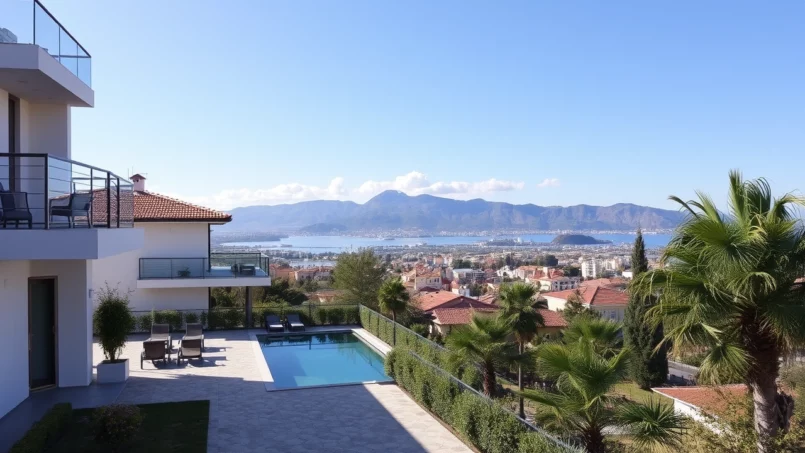
Vlorë is not a small beach town stuck in the summer season. It is a real city of nearly 100,000 residents, the country’s second port, a regional economic center, and the symbolic capital of Albanian independence. Its geographic location is unique: it’s exactly where the Adriatic and Ionian Seas meet, at the foot of the Ceraunian Mountains, with views over the Bay of Vlorë and Sazan Island.
The region offers a variety of coastal landscapes: from urban beaches along the Lungomare to wild coves toward Radhimë and Orikum. Access to the bays of Jalë, Dhërmi, and Himara is made easier by the modern tunnel bypassing the Llogara Pass. To the north, the Narta Lagoon, with its flamingos and oysters, holds strong eco-tourism potential.
Unlike some resorts like Ksamil that live almost exclusively on tourism from June to September, Vlorë has a diversified economy: port activities, fishing, agro-industry (olive oil, bitumen, agricultural products), a university, naval installations, and a lively downtown area year-round. For an investor, this means a rental market that doesn’t completely vanish in winter, especially for well-located properties.
The Pincer Effect of Infrastructure: Airport, Tunnel, Bypasses, Marinas
What sets Vlorë apart from other Albanian coastal towns is the simultaneity of several major infrastructure projects. Where some markets can only rely on tourism, Vlorë benefits from a bundle of transformative projects.
A New International Airport 15 Minutes from the Center
The Vlorë International Airport is the most discussed element among analysts. Built for approximately €104 million by an international consortium, featuring a 3.2 km runway capable of handling any aircraft type and a capacity of up to 2 million passengers per year, it is located just about fifteen minutes from the city center.
Direct connections to major European capitals (London, Frankfurt, Rome, Warsaw) will transform access to the Southern Riviera, saving visitors from landing in Tirana followed by a 2- to 2.5-hour drive. Studies predict this airport could increase coastal real estate values by 15% to 25% within 3 to 5 years, with the greatest impact on the areas closest and best connected to Vlorë.
There are precedents: in Tivat, Montenegro, the airport opening was followed by a 40% rise in apartment prices within two years. Without mechanically copying that scenario, Vlorë is clearly playing a comparable card.
A Tunnel That Shortens the Riviera
Another key piece is the Llogara Tunnel, recently opened to traffic. At nearly 5.9 km long, it cuts travel time between the Vlorë region and the heart of the Riviera, on the Palasa side, from over 30 minutes to under 10. Where the winding road once discouraged some tourists, access is now smooth and predictable.
High-end projects like Green Coast Resort & Residences or Folie Village in Jalë benefit from a major advantage: their proximity to an international airport and a large city, a rare combination at this price level along the Mediterranean. This accessibility strengthens their positioning as showcases of Albanian premium tourism.
Bypass, Roadways, and a XXL Waterfront
The road effort is not limited to the tunnel. The Vlorë Bypass – approximately 29 km of road – skirts the city, eases traffic, and improves connections between the north (Levan, Fier, Tirana) and the south (Dukati, Orikum, Riviera). Impact studies cite reduced travel times, fewer accidents, and better urban structuring, with a resulting boost in residential attractiveness for neighborhoods relieved of through traffic.
We can summarize some of these key infrastructure projects in a table to visualize their real estate impact:
| Project | Key Features | Expected Real Estate Impact |
|---|---|---|
| Vlorë International Airport | 3.2 km runway, 2M passengers/year, 15 min from center | Price increase of 15‑25% over 3‑5 years in the region |
| Llogara Tunnel | 5.9 km, Vlorë–Palasa travel time reduced to ~7 min | Accelerated appreciation of Palasa–Jalë–Dhërmi resorts |
| Vlorë Bypass | ~29 km, link Levan–Vlorë–south, secondary road | Better accessibility, reduced congestion, land value increase |
| Cold Water–Radhimë–Orikum Road | 11 km with bike path, promenade, urbanization of Radhimë | Tourist requalification, expected price rise |
| Lungomare 3 & 4 | Extension of the promenade to Orikum | Continuous waterfront, maximum tourist appeal |
In addition to these major projects, there are finer interventions: redevelopment of markets and shopping streets, standardization of sidewalks, creation of green spaces and street furniture, restoration of historic facades. All contribute to repositioning Vlorë as a modern seaside city, with a promenade aiming for nothing less than the title of the longest developed waterfront in the Mediterranean.
Neighborhood Mapping and Price Levels in Vlorë
For an investor, the key is to understand the fine geography of the market. In Vlorë, the price gap between a second-line apartment and a sea-facing penthouse on the Lungomare is considerable, but the logic of appreciation remains consistent.
City Center: The Rental Backbone
The historic and commercial center mainly appeals to those targeting year-round rental yield. Close to services, government offices, the university, and offering an urban lifestyle, new apartments generally sell for between €1,300 and €1,800/m². A 35 m² studio can be found for around €50,000, a 70 m² with parking from €90,000, and a 100 m² with two bathrooms around €130,000 to €140,000 if it has a view or higher-end finishes.
Long-term rents for this type of property are most often between €350 and €500 per month, driven by demand from students, local workers, and a small community of digital nomads attracted by the cost of living and climate.
Waterfront and First Line: The Kingdom of Seasonal Rentals
Along the urban coastline, in the area known as Lungomare and more broadly on the first coastal line, prices are soaring. For an apartment with direct sea view, prices generally range from €1,500 to €2,500/m², with penthouses and premium units exceeding €3,000/m² and potentially reaching €3,500/m² or more for some very high-end projects.
The estimates below provide a concrete idea of typical spending amounts for different categories.
Average estimated spend between €45 and €65 per visit.
Average estimated spend between €25 and €40 per person.
Average estimated spend between €60 and €80 per tank.
Average estimated spend between €15 and €30 per activity.
Average estimated spend between €50 and €120 per purchase.
Average estimated spend between €200 and €500 per item.
| Area / Property | Indicative Price (2025) |
|---|---|
| Studio 35 m², no sea view | ~€50,000 |
| Studio 35 m², with sea view | ~€65,000 |
| Apartment 70 m², no sea view | ~€90,000 |
| Apartment 70 m², with sea view | ~€110,000 |
| Apartment 100 m², 2 bathrooms, no sea view | ~€120,000 |
| Apartment 100 m², 2 bathrooms, sea view | ~€140,000 |
| 1-bedroom in Lungomare | From ~€130,000 |
| 2-bedroom in Lungomare | From ~€190,000 |
| Sea view property in Lungomare | From approximately €250,000 |
These prices remain, according to several comparisons, 50% to 100% lower than those seen on comparable quality locations in Croatia, Italy, or Greece. In other words, Vlorë positions itself as a Mediterranean Riviera “at half price”, which explains the growing appetite from foreigners.
Uji i Ftohtë: Compromise Between Price, Quiet, and Potential
Uji i Ftohtë, literally “Cold Water,” is a residential neighborhood south of the center, about a 10-minute walk from the sea. Less flashy than the Lungomare, it attracts investors looking for a balance between relatively affordable prices, beach access, tranquility, and growth potential.
Price ranges are gentler than elsewhere: a two-bedroom starts around €100,000, a three-bedroom around €140,000, and a sea-view apartment from €200,000. Many new residences offer playgrounds, parking, and various services, while local infrastructure continues to improve.
Many buyers choose this area for summer rentals and personal use in winter or off-season, making it an interesting compromise for a mixed second home/investment.
Radhimë, Orikum, Green Coast, Jalë: The Southern Corridor Overheating
Further south, Radhimë and Orikum feature resorts, tourist residences, and busy beaches. Resort apartments have sometimes seen their prices jump by 67% to 88% year over year, even though the clientele sought is sometimes more “budget” than in ultra-exclusive bays like Jalë.
Developments like Green Coast Resort & Residences and the private villages in Jalë Bay (such as Folie Village) clearly target a high-end clientele, with luxury villas, carefully planned urbanism, and an eco-responsible orientation. These areas are seen as safe long-term bets, but require a high entry capital.
Rental Yields Combining Season and Winter
One of the major attractions of Vlorë for a non-resident investor is the combination of a strong tourist season and off-season rental demand. The sea is swimmable from May to October, with a particularly intense peak season in July-August and shoulder months (May-June, September-October) increasingly popular.
High Season Revenue
The observed figures in the short-term rental market are explicit. For a typical investment:
| Period | Property Type | Average Nightly Rate | Indicative Occupancy Rate |
|---|---|---|---|
| July–August | Studio 35 m² | €50–65/night | ~90% |
| July–August | Apartment 50 m² | €70–90/night | ~90% |
| July–August | “Premium” Apartment | €100–150/night | ~95% |
| May, June, Sept., Oct. | Studio 35 m² | €40–55/night | ~75% |
| May, June, Sept., Oct. | Apartment 50 m² | €60–80/night | ~75% |
| May, June, Sept., Oct. | Premium | €90–120/night | ~80% |
A concrete example often cited is that of a 50 m² apartment valued at €90,000. By combining high season (July-August), mid-season, and winter rental, the theoretical annual revenue comes to about €11,500, with estimated annual costs of €4,875 (utilities, management fees around 25%). Net profit comes out to around €6,625, representing a gross yield of about 12.8% and a net yield around 7.3%.
Figures naturally vary depending on the exact location, property quality, and management efficiency, but they illustrate Vlorë’s capacity to generate yields that are highly competitive compared to other Mediterranean destinations.
Long-Term Winter Rentals
One of Vlorë’s specific strengths compared to purely tourist villages is the existence of a winter rental market. From November to April, studios and apartments can be rented as follows:
– studios: €250–350/month
– standard apartments: €350–500/month
– premium properties: €500–800/month
Demand comes from students, local business workers, government employees, and also from foreign remote workers attracted by coworking subscriptions at $100–150 per month and a cost of living far below that of Western Europe.
Students, local workers, government employees, and foreign remote workers
Overall, annual gross yields in Vlorë for well-managed properties are most often between 4.5% and 6% for long-term rentals, and between 7% and 9% for short-term rentals. Post-airport full opening projections even go up to 8–10% in the tourist segment.
Vlorë vs. Other Albanian Cities
To appreciate Vlorë’s risk/return profile, it helps to compare it to other key destinations in the country.
Tirana, the capital and largest residential market, shows square meter prices between €2,000 and €2,800 in central neighborhoods. Increases have been strong (up to 20–23% annually in the best areas), with gross rental yields of 4.5% to 8% depending on property type and lease. It is the choice for investors primarily seeking stability and liquidity: demand is constant and resale is faster (often within 3 to 6 months).
The estimated rental yield for real estate properties in Durrës is between 6% and 9%.
Sarandë, near Greece, has experienced a price explosion similar to Ksamil, with annual increases of 10–15% and valuations sometimes tripling or quadrupling in five years in the most sought-after areas. Tourist yields are very high (6–9% or more), but reliance on tourism is much more pronounced than in Vlorë.
Vlorë sits in the middle: a city large enough to have its own economic fabric, yet positioned on a coastal corridor in full boom, with an airport, tunnel, marina, and international resorts on the horizon. In short, a hybrid market combining growth, solid seasonal rental income, and potential for personal enjoyment of the property.
Purchase Conditions for Foreigners: Open but Demanding Framework
From a legal standpoint, Albania is rather welcoming to foreign investors. A non-resident can freely purchase apartments, houses, villas, and commercial premises, rent them out, resell them, and bequeath them. There is no quota per nationality or strict limitation on the number of properties.
To purchase agricultural land or a vacant plot in Albania, a foreigner must either be a national of a country with a reciprocity agreement with Albania, establish an Albanian law company, or invest in a construction worth at least three times the value of the land. In practice, non-resident investors in Vlorë often prefer buying apartments, which include a share of the land and avoid these restrictions.
The purchase process is overseen by a notary, who drafts the final deed in Albanian and supervises the legal compliance of the transaction. A typical outline includes:
Acquiring a property in Albania follows a specific procedure: 1) Selection of the property and price negotiation. 2) Legal verification of the title deed (certificate, cadastral documents, absence of mortgages or disputes, building permit) by a lawyer or notary. 3) Signing of a preliminary contract and payment of a deposit (generally 10% for resale, more for off-plan new builds). 4) Preparation of documents, translations, and obtaining an Albanian tax number for the buyer. 5) Signing of the final deed before a notary, with simultaneous translation if necessary. 6) Final registration with the National Cadastre Agency, which issues the electronic property certificate.
The transaction can be completed remotely via a duly legalized and apostilled power of attorney, allowing an investor to finalize the purchase without traveling to Albania, provided they rely on a trusted intermediary.
Acquisition costs (excluding the property price) remain contained: generally a total of 3% to 5% of the price, covering transfer taxes (around 2–3%), notary and registration fees, translations, and possibly lawyer or agency fees. The annual property tax is very low (around 0.05% of the cadastral value for residential), and rental income is taxed at a flat rate of 15% after deducting eligible expenses. Upon resale, a 15% capital gains tax applies, with certain exemptions after long-term holding depending on the case.
Access to Financing and Payment Plans
The market is still largely dominated by cash purchases, especially for foreigners. Albanian banks theoretically offer mortgages to non-residents, but in practice several obstacles exist: high down payment requirements (often 30% to 40% equity), need to prove stable income (sometimes within Albania), lengthy application processes, and review times that can take several months.
This is the interest rate, as a percentage, for real estate loans in Albanian lek, the local currency.
A common alternative for new build programs in Vlorë is to use payment plans offered by developers: a 20% to 30% down payment at reservation, followed by periodic payments tied to construction progress, typically interest-free, until completion. This formula allows smoothing the financial effort while potentially benefiting from the property’s appreciation between the “off-plan” stage and delivery.
Rental Management and the Platform Market (e.g., Airbnb)
Managing a property remotely in Vlorë has become much easier thanks to the rise of a network of specialized rental management agencies on the Albanian Riviera. Local companies handle listing on platforms (Airbnb, Booking…), professional photography, reservation management, cleaning, maintenance, and financial reporting.
Management fees typically represent 10% of gross revenue for standard long-term rental management.
The Airbnb boom in Albania illustrates market appetite: in 2024, there were over 21,000 listings on the platform in the country, up from barely 5,300 three years earlier. Revenue reached approximately €85 million, nearly double the 2023 figure. Average daily rates in high season peaked around €80–90 per night nationally, with occupancy rates exceeding 70% in August.
Only 18% of tourists stay in hotels; the rest choose alternative accommodations, revealing strong demand for quality properties, especially in coastal cities like Vlorë.
Albanian authorities are, however, starting to tighten the reins somewhat: discussions exist on introducing taxes per bed per year for tourist rentals, as well as better-regulated taxation. For now, these measures remain relatively modest, but they are among the elements to factor into net yield projections.
A Booming Market, But Not Without Risks
Behind the spectacular price curves and attractive yields, Vlorë remains an emerging market country, with its share of complexities and potential pitfalls.
One of the main risks relates to Albania’s agricultural and land history. The country has long suffered from incomplete or contested property titles, informal occupations, construction without permits (several hundred thousand irregular buildings are estimated), and an incomplete cadastre. Even though a vast program of digitization and registry update is underway, land disputes still represent a significant portion of civil cases in courts.
Along the coast, real estate pressure can lead to construction of questionable quality (insulation, waterproofing, installations) and risky off-plan purchases, with delays, specification changes, or administrative difficulties.
Authorities have responded with new construction legislation meant to improve transparency: apartments are now supposed to be registered in the cadastre from the construction phase, and developers must take out insurance covering structural defects for ten years after delivery. But here again, vigilance remains key, and the choice of developer is crucial.
Two major economic risks are identified: an ‘affordability fatigue’ due to rising prices against stagnant incomes, potentially squeezing out part of domestic demand, and a heavy dependence on international tourism, vulnerable to exogenous shocks (health, geopolitical, etc.).
Finally, market liquidity is not that of a major European capital: along the coast, a property can take six to twelve months to resell outside of peak season, or longer for atypical or poorly located products. Investors with a short or highly speculative horizon should take this into account.
What Investor Profile for Vlorë?
Based on these elements, Vlorë seems particularly suited to several profiles:
– the “mixed strategy” investor seeking both a sunny pied-à-terre, substantial seasonal rental income, and capital appreciation over a few years;
– the retiree or near-retiree anticipating increasing personal use of the property, with summer rentals to offset their investment;
– the international investor willing to accept a bit more legal complexity and volatility in exchange for higher potential appreciation than in already mature markets.
A highly risk-averse investor who prioritizes liquidity and stability above all should instead target central Tirana or major EU capitals. These markets offer greater security, but with potentially lower yield and appreciation prospects.
What sets Vlorë apart is this rare combination in today’s Mediterranean: spectacular waterfront, strong tourism growth, costs still significantly lower than neighbors, a brand-new international airport, a tunnel bringing some of the region’s most beautiful bays closer, and a vibrant urban market year-round.
For those who agree to surround themselves with the right professionals (lawyer, notary, manager, experienced agent), conduct thorough due diligence on property titles and construction quality, and think with a horizon of at least five to ten years, investing in real estate in Vlorë no longer seems like an exotic bet, but rather one of the most structured opportunities on the new European Riviera.
Disclaimer: The information provided on this website is for informational purposes only and does not constitute financial, legal, or professional advice. We encourage you to consult qualified experts before making any investment, real estate, or expatriation decisions. Although we strive to maintain up-to-date and accurate information, we do not guarantee the completeness, accuracy, or timeliness of the proposed content. As investment and expatriation involve risks, we disclaim any liability for potential losses or damages arising from the use of this site. Your use of this site confirms your acceptance of these terms and your understanding of the associated risks.

Cyril Jarnias is an independent expert in international wealth management with over 20 years of experience. As an expatriate himself, he is dedicated to helping individuals and business leaders build, protect, and pass on their wealth with complete peace of mind.
On his website, cyriljarnias.com, he shares his expertise on international real estate, offshore company formation, and expatriation.
Thanks to his expertise, he offers sound advice to optimize his clients' wealth management. Cyril Jarnias is also recognized for his appearances in many prestigious media outlets such as BFM Business, les Français de l’étranger, Le Figaro, Les Echos, and Mieux vivre votre argent, where he shares his knowledge and know-how in wealth management.





