
 Published on and written by Cyril Jarnias
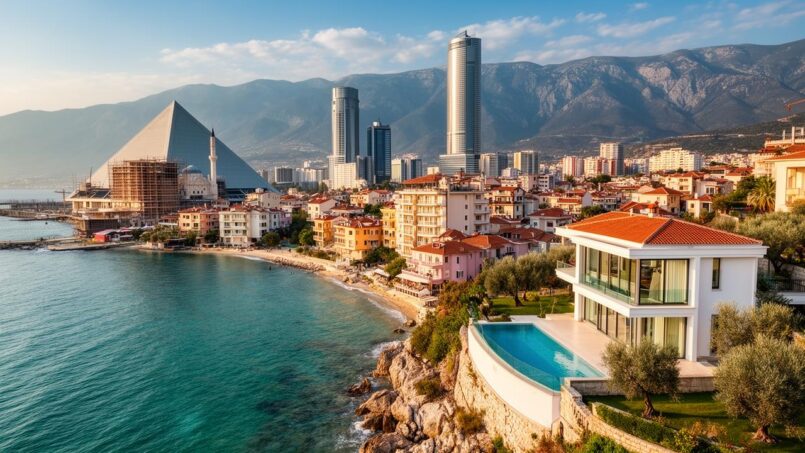
Albania, Balkans, Mediterranean, still affordable prices, high rental yield, and EU accession momentum: the mix is attracting more and more foreign capital. Tirana, Durres, and the Albanian Riviera now concentrate most of the international investors’ interest, each with a very distinct profile. On one side, the capital, economic engine and most liquid market in the country. On the other, the major port of Durres, the most active development corridor in the Western Balkans. Finally, the Riviera, a tourism showcase combining turquoise sea, new infrastructure, and rapid appreciation.
This guide details recent data for Albania’s three investment hubs, including price per square meter, yields, growth prospects, the legal framework for foreigners, and taxation, to help a non-resident investor understand where, what, and how to buy.
Why Albania Has Become a Real Estate Hotspot in the Balkans
The Albanian real estate market is going through one of the most dynamic phases in its history. The numbers speak for themselves: residential prices have risen about 18 to 26% in one year, with increases of 20 to 30% in the most sought-after coastal areas. Tirana has seen values climb more than 30% over twelve months, while prices have increased by 90 to 140% over the past decade.
Yet this surge has not erased the country’s major advantage: even after these hikes, values remain 40 to 50% below comparable markets in the Mediterranean (Croatia, Spain, Italy, Greek islands). The combination of “still-low prices + strong growth” is precisely what attracts private investors.
The number of visitors to Albania is growing by 15% per year, after nearly doubling compared to pre-Covid with over 12 million tourists.
Rental yields complete the picture. Nationwide, they often range between 6 and 9% gross, with peaks of 12–15% in some highly seasonal beach resorts. In comparison, most Western European capitals offer at best 3–5% gross. In other words: Albania still offers an atypically favorable risk/return profile for a European country on the threshold of the EU.
Foreigners’ Rights, Visas, and Residency: What You Need to Know Before Buying
On the legal front, Albania has progressively opened up to foreign capital. The basic principle is simple: a non-resident can buy an apartment, house, villa, or commercial space in full ownership, under the same conditions as an Albanian citizen, with no quotas or local partner requirements.
A foreigner cannot directly own agricultural land, but can bypass this limitation by setting up an Albanian company (sh.p.k.) in 10 to 14 days for 500 to 1,500 euros. Urban properties do not have this constraint.
Another point to keep in mind: the coastal strip within about 200 meters of the shoreline may be subject to specific cadastral classifications. It is therefore essential to have a lawyer or notary verify the exact status of the plot and the associated building permits, especially on the Riviera and around Durres.
Buying real estate in Albania does not require a visa or resident status. Most foreigners can sign the deed during a tourist stay (up to 90 days out of 180). The United States has a special regime allowing a one-year stay without a permit. However, to live or work, a residence permit is required. There is a specific permit for ‘real estate owner,’ based on a threshold of property size or value.
In parallel, Albania has created a “Unique Permit” for investors, covering several types of investment (real estate, business, government bonds). Recent legislative changes have raised the minimums: 300,000 € for real estate and 100,000 € for a business investment or government bonds are mentioned, though not all sources are yet harmonized. This path offers a renewable residence permit, but it is not a passive “golden visa”: the beneficiary must prove the reality and continuity of their investment.
How a Real Estate Purchase in Albania Actually Works
Regardless of the target city, the legal mechanics are very similar. They revolve around the notary/cadastre pair, with a key role given to financial transparency.
The search usually begins through local agencies or portals like Property.al, Shpi.al, or Realting.com for foreign buyers. An on-site visit is essential, especially since construction quality varies greatly from one project to another. Agencies typically charge 1 to 2% commission, sometimes up to 3% for more complex transactions.
Once an agreement is reached, a reservation document or memorandum of understanding (“Memorandum of Understanding”) is signed, with a deposit often of 1,000 € or 5% of the price, to lock in the property for one to four weeks. On the resale market, a “kontratë paraprake” (pre-contract) is then signed before a notary, setting the price, payment schedule, penalties, and conditions precedent. The deposit typically rises to 10% for an existing property, and rather 30% for an off-plan purchase or new construction.
Between this pre-contract and the final deed, the lawyer (or notary, if no lawyer is hired) conducts legal due diligence: verification of the cadastral “kartela,” ownership certificate, absence of mortgages or easements, conformity of building permits, status of water and electricity meters, and the seller’s identity and authority. Due to the history of restitutions and unpermitted construction, this phase is not a formality: it is the buyer’s real insurance policy.
Final payment is made by bank transfer in euros to the notary’s account. Any amount over 1,000 € must go through the banking system (anti-money laundering requirement). The final deed is only signed after receiving the funds. The contract is drafted in Albanian, possibly bilingual, with a sworn interpreter if needed. The buyer can be represented by an apostilled power of attorney.
After signing, the notary registers the deed with the National Cadastre Agency (ASHK). Within a few days to a few weeks, the buyer receives an official ownership certificate (paper and electronic version via the e-Albania platform). The escrowed funds are then released to the seller. In practice, a full purchase – from reservation to registration – takes three to six weeks.
Taxation: Acquisition Costs, Annual Taxes, and Rental Income
On the tax front, Albania is significantly milder than most EU countries for a real estate investor. Initial transaction costs are generally between 3 and 5% of the property value, including taxes and fees, excluding any agency commission.
The main charge at acquisition is the transfer tax, around 2 to 3% of the declared value. This rate varies slightly by municipality and property type. Notaries apply a regulated fee scale, with fees typically around 0.5 to 1% of the sale price, including 20% VAT, so about 150 to 450 € for a standard apartment. Cadastral registration costs around 80 €.
Property tax for a residential apartment is generally 0.05% of the cadastral value.
Rental income vehicles are subject to an income tax of 15% on declared rents. For long-term leases (annual contracts), expenses can be deducted to some extent. For short-term rentals like Airbnb, this rate also applies, but the tax base is often gross revenue. The country has also started to regulate this segment more strictly with the introduction of per-bed fees and the requirement to register tourist accommodations.
Capital gains on resale are taxed at 15% of the difference between the sale price and the acquisition price (including documented expenses). Keep all purchase and renovation invoices. There is no wealth tax, and close family transfers are exempt from inheritance tax.
Tirana: Capital, Economic Engine, and Most Expensive Market in the Country
Tirana concentrates growth, employment, and the majority of transactions. It is also where prices have soared the most: apartments have risen more than 30% in one year, and overall values have doubled since 2020 in many neighborhoods. The reasons are multiple: internal migration from rural areas, massive development of the tertiary sector, arrival of international companies, gentrification of large parts of the city center, and a shortage of available land in prime areas.
The price landscape is very contrasted. In hyper-central neighborhoods like Blloku, the Artificial Lake (Liqeni Artificial), or around Skanderbeg Square, it is not uncommon to easily exceed 3,000 € per square meter in recent developments, with peaks of 4,000–5,000 €/m² for the most luxurious projects. At the other extreme, peripheral areas like Kombinat, Astir, Yzberisht, or Lapraka remain much more affordable, often between 1,000 and 1,500 €/m², while now benefiting from better road connections.
Summary of the general price ranges observed in the Albanian capital
Rent for a city-center apartment: 400–600 € per month. Purchase per m²: 1,500–2,500 €.
Meal at an inexpensive restaurant: 5–8 €. Monthly groceries for one person: 150–200 €.
Bus ticket: 0.40 €. City taxi ride: 5–10 €. Monthly pass: 15 €.
Electricity, water, and heating bill (85 m² apartment): 80–120 € per month. Internet: 15–20 €.
| Tirana Sector | Indicative Price Range (€/m²) | Trends and Investment Profile |
|---|---|---|
| Blloku, Liqeni Artificial, city center | 2,500 – 3,500+ | Prime, strong demand, Airbnb and long term, high prestige |
| Pazari i Ri, Skanderbeg, Tirana e Re | 2,000 – 3,000 | Hyper center, gentrification, very high liquidity |
| Komuna e Parisit, 21 Dhjetori | 1,700 – 2,500 | Rising neighborhoods, good price/rent balance |
| Don Bosko, Ali Demi, Qyteti Studenti | 1,300 – 1,900 | Solid rental yields, strong student and family demand |
| Astir, Kombinat, Yzberisht, Lapraka | 1,000 – 1,500 | Periphery undergoing redevelopment, high appreciation potential |
Beyond the absolute price level, the key in Tirana is understanding neighborhood-specific dynamics. Blloku is the symbol of the trendy city: bars, restaurants, boutiques, nightlife. Properties there are expensive, but the international demand for small upscale apartments is constant, with high Airbnb occupancy rates (50–60%). The historic center around Skanderbeg and the New Bazaar (Pazari i Ri) appeals through walkability, charm, and tourist appeal.
Komuna e Parisit and 21 Dhjetori illustrate the gentrification wave. These areas, combining new buildings, shops, schools, and accessibility, already show rapid increases, but rents are rising in parallel, keeping yields still attractive. Astir, Kashar, Yzberisht, or Kombinat benefit from the Ring Road extensions and planned bus rapid transit: these are “value plays,” where prices are projected to grow by 12 to 20% per year in the short term, more than the capital’s average.
Gross yields for well-located apartments range from 5 to 7%, with micro-locations like Qyteti Studenti, Don Bosko, Ali Demi, or Astir reaching 6–7% thanks to demand from young professionals and students. In Blloku or near the lake, yields are 4–5%, offset by a better capital growth profile and appreciation prospects.
For a foreign investor, the most relevant strategy in Tirana often involves targeting small units (studios and 1–2 bedrooms) in very “livable” areas: Blloku, Tirana e Re, around the Artificial Lake, Pazari i Ri, or Komuna e Parisit. These properties rent easily, both long-term and short-term, and remain liquid on resale even in a market correction. In rising peripheral neighborhoods, the angle is more capital appreciation: buying below 1,500 €/m² in areas directly impacted by new roads or major projects.
Durres: Coastal Gateway, Solid Rental Market, and Still Affordable Prices
Just 30 minutes by road from Tirana, Durres plays a dual role: the country’s main port and the first beach resort easily accessible from the capital. The Tirana–Durres corridor is now considered the most active development axis in the Western Balkans, driven by a planned highway expansion, port modernization, creation of a high-end marina, and a series of resorts in Lalzi Bay.
Yet prices here remain well below those of the Southern Riviera. According to available data, most apartments trade between 1,200 and 1,800 €/m², with extremes: around 800 €/m² for older properties farther from the sea, up to 2,500–3,000 €/m² for seafront units in the most sought-after areas like Vollga or Currila.
The market structure of Durres can be summarized as follows:
| Segment / Durres Neighborhood | Indicative Prices (€/m²) | Property Profile and Demand |
|---|---|---|
| Shkozet, Spitallë, inner periphery | 700 – 1,100 | Budget residential, strong local demand, high yield |
| City center, inland areas (Rrashbull…) | 1,100 – 1,600 | Existing apartments, medium budget, year-round tenants |
| Plazh, Golem (2nd–3rd line) | 1,200 – 1,800 | Holiday homes, mix of seasonal and long-term rental |
| Vollga, Currila, prime seafront | 1,800 – 2,800+ | New sea-view developments, strong diaspora and foreign clientele |
| Coastal villas (Lalzi Bay, premium zones) | 1,000 – 1,800 (€/m² equivalent) | 3–5 bedroom houses, pool, budgets from 250,000 to 1.3 M€ |
Durres offers a particularly interesting yield profile. Annual rents generate on average 5.5 to 6% gross, with peaks at 7–8% in some secondary neighborhoods like Shkozet or Spitallë, where purchase prices are lower but local demand is steady (employees, students, workers commuting to Tirana). On the coast (Plazh, Golem, Vollga), seasonal rentals add a layer of profitability: in high season, studios and one-bedrooms frequently rent for 60 to 80 € per night at Golem, up to 100 € and more at Currila, with a very high occupancy rate from June to September.
The net yield after management fees and 15% tax on a rental investment in Durres is about 4%, a competitive rate for a growing coastal city.
Upcoming major projects – particularly the transformation of the port into a high-end yacht marina (Durrës Yachts & Marina, a multi-billion project) and the continued residential development around Lalzi Bay – should continue to support demand. Forecasts point to an annual price increase of around 6 to 8% on average for the city, and up to 10–12% in seafront micro-markets. In the longer term, the prospect of Durres’ coastline being repositioned in the range of Adriatic “lifestyle” destinations suggests further appreciation.
For a foreign investor, Durres is the ‘yield’ link in an Albanian portfolio: low entry ticket (55,000 to 95,000 € for a one-bedroom seafront), sustained annual rental income, liquid market, and diversification between seasonal and annual rentals.
The Albanian Riviera: Explosive Growth, Airport Effect, and Europe’s Last “Unindexed” Coastline
The Albanian Riviera, stretching from Vlora to Saranda via Himara, Dhermi, Jala, Borsh, and Ksamil, has become in just a few years the most media-covered segment in the country. Landscapes reminiscent of the Greek islands, deep blue sea comparable to Corfu, still-preserved coves, stone villages that can be turned into eco-lodges, villas integrated into the topography… The aesthetic argument is obvious, but for an investor, it is primarily the figures that draw attention.
Prices on the Riviera still start, in some areas, around 900 €/m², but they quickly climb to 1,800 €/m² and beyond in the most “Instagrammable” zones. On the seafront in Vlora, apartments already reach 1,800 to 3,500 €/m². In Ksamil, upscale pre-sale developments sell for between 3,000 and 5,500 €/m². In Saranda, sea views flirt with 2,000–3,000 €/m², or more in premium residences. On the ultra-high-end spots of Dhermi and Jala, villas far exceed 750,000 €.
A simplified overview by sub-zone of the Riviera helps visualize the valuation gap:
| Albanian Riviera Zone | Indicative Prices (€/m²) | Yields and Market Dynamics |
|---|---|---|
| Vlora (Lungomare, broader seafront) | 1,800 – 3,500 | Annual increase 22–28%, yield 8–11% on short-term rentals |
| Riviera “heart” (Palasa, Dhermi, Jala) | 2,000 – 4,000+ | Trophy assets market, villas > 750 k€, strong international demand |
| Saranda (center, seafront) | 1,800 – 3,000+ | Yields 8–10%, very high Airbnb performance, maximum liquidity |
| Ksamil | 3,000 – 5,500 (branded developments) | Prices already comparable to some Greek islands, foreign funds |
| Borsh, Qeparo, Lukovë, Piqeras | 900 – 1,800 (sea view) | 30–50% cheaper than Saranda/Ksamil, strong appreciation potential |
The peculiarity of the Riviera is that it is both the most expensive segment in the country and, paradoxically, one of the most “undervalued” when compared to similar-quality shores in Greece or Croatia. Analysts estimate that similar seafront properties still cost three to four times more in those neighboring countries. This differential fuels the thesis of the “last unindexed luxury coastline in continental Europe.”
On the yield side, the numbers are impressive. Short-term rentals in high season easily reach 80 to 200 € per night for well-located apartments, up to 300 € or more in Ksamil for branded or ultra-high-end units. Year-round, Saranda boasts gross yields of 8 to 10%, thanks to an extended season compared to purely summer resorts, and overall return on investment can reach up to 16% per year in some cases (combining appreciation and rentals).
Values along the coast in areas directly connected to Vlora airport and the Llogara tunnel are expected to increase by 15 to 25%.
The Riviera lends itself to two practical approaches: buying an apartment in an already well-equipped town like Saranda or Vlora, aiming for rental yield and easier resale, or a longer-term bet on a still-sparsely-built village (Borsh, Piqeras, some hamlets above Himara), targeting future appreciation, possibly through a villa or boutique-hotel project. In the first case, you play the “immediate cash-flow” card; in the second, the land appreciation card.
Comparing Tirana, Durres, and the Riviera: Which Profile for Which Investor?
Investing in Albania is not just about choosing a “trendy” city. Each market corresponds to a different risk profile and investment horizon. A simple reading grid is to look at three criteria: current rental yield, appreciation potential, and risk level (liquidity, dependence on tourism, cyclicality).
The table below provides a synthetic comparison:
| Zone | Typical Gross Rental Yield | Appreciation Potential (5–10 years) | Main Risk | Suitable Investor Profile |
|---|---|---|---|---|
| Tirana (central) | 5 – 7% | +30 to +60% over 5 years, +70 to +110% over 10 years | Overheating risk, possible correction | Long-term investor, oriented toward urban stability |
| Tirana (periphery) | 6 – 8% | Expected outperformance, Astir areas etc. | Uneven quality, reliance on infrastructure | Value hunter, mid-range budget |
| Durres (city/core) | 5 – 7% | +6 to +10% / year, gradual appreciation | Sensitivity to Adriatic tourism cycle | Regular income, mixed rental/sale strategies |
| Durres (seafront) | 6 – 9% (short term) | +10 to +12% / year in prime pockets | Strong season, more volatile market | Yield-seeking investor looking for entry-level |
| Riviera (Vlora, Saranda) | 7 – 10% | +25 to +40% / year in recent years | Accelerated cycle, overbidding risk | Growth investor, medium/long-term horizon |
| Riviera (villages) | 5 – 8% (if rented) | 10–15% / year projected after airport opening | Lower liquidity, delay risk | Visionary, development project or UHNWI resale |
For a foreign investor diversifying their portfolio, a often-recommended strategy is to “put one foot in Tirana and one foot on the coast”: a small apartment in a lively central neighborhood of the capital for stability and year-round demand, complemented by a vacation property (apartment in Durres or on the Riviera) generating higher seasonal income and potential personal use.
Risks, Pitfalls, and Best Practices
The Albanian dynamic is appealing, but it is not without risks. The Central Bank has signaled a risk of cyclical overvaluation, and several indicators (price increases far outpacing wage growth, mortgage credit surging more than 30% in one year) call for caution. A temporary correction in some overheated segments, especially on the ultra-premium southern coast, cannot be ruled out.
Although digitization and controls have improved, cases of unpermitted construction, land disputes, and partial cadastral registrations still persist.
To reduce these risks, a few simple principles apply systematically. First, never skip hiring an independent lawyer, who is neither the promoter’s nor the agency’s counsel. Second, demand and analyze the key documents: recent ownership certificate, cadastral “kartela,” cadastral plan, building permit and certificate of conformity for new buildings, status of condominium charges and utility bills. Finally, prioritize neighborhoods with a liquid and deep market – central Tirana, Durres-Plazh, Saranda seafront, Vlora Lungomare – rather than very isolated locations, unless you have a specific development project.
The Airbnb strategy exposes you to income drops in a crisis or oversupply. Tirana and Durres are less vulnerable thanks to domestic demand, unlike Riviera villages, which are nearly single-sector.
In Conclusion: How to Structure a First Investment in Albania
For a foreign investor approaching the Albanian market for the first time, the question is not just “where to buy”, but “how to enter a fast-accelerating market prudently”.
A recommended approach is to start with a simple property (1–2 bedroom apartment) in well-known neighborhoods: Blloku, Pazari i Ri, or Komuna e Parisit in Tirana; Plazh or Golem in Durres; or the seafront in Saranda or Vlora for the Riviera. The entry budget is 70,000 to 200,000 € depending on the city, with a gross yield of 5 to 9% and annual appreciation of 6 to 15% depending on the segment.
Then, once familiar with the legal framework, taxation, and local service providers (notary, lawyer, property manager), it becomes possible to consider more ambitious setups: buying through a company to hold land, renovating a stone house on the Riviera, a small bed-and-breakfast or boutique hotel project, using local credit in lek or euros.
In a transitioning market like Albania, maintain strict discipline: compare price per square meter with neighboring cities and countries, check the consistency between rents and purchase values, choose locations with long-term defensibility (infrastructure, sustainable appeal, depth of demand), and avoid purely speculative purchases based on marketing plans with no substance.
Tirana, Durres, and the Albanian Riviera today offer a unique array of opportunities for foreign investors willing to take a bit of calculated risk. Provided you approach the market methodically, surround yourself with the right professionals, and aim for holding periods of at least five to ten years, these three destinations can form the core of an offensive real estate strategy on the eastern edge of the Mediterranean.
A wealth project or a question? Contact us now to speak with a wealth management expert.
Disclaimer: The information provided on this website is for informational purposes only and does not constitute financial, legal, or professional advice. We encourage you to consult qualified experts before making any investment, real estate, or expatriation decisions. Although we strive to maintain up-to-date and accurate information, we do not guarantee the completeness, accuracy, or timeliness of the proposed content. As investment and expatriation involve risks, we disclaim any liability for potential losses or damages arising from the use of this site. Your use of this site confirms your acceptance of these terms and your understanding of the associated risks.

Cyril Jarnias is an independent expert in international wealth management with over 20 years of experience. As an expatriate himself, he is dedicated to helping individuals and business leaders build, protect, and pass on their wealth with complete peace of mind.
On his website, cyriljarnias.com, he shares his expertise on international real estate, offshore company formation, and expatriation.
Thanks to his expertise, he offers sound advice to optimize his clients' wealth management. Cyril Jarnias is also recognized for his appearances in many prestigious media outlets such as BFM Business, les Français de l’étranger, Le Figaro, Les Echos, and Mieux vivre votre argent, where he shares his knowledge and know-how in wealth management.





