
 Published on and written by Cyril Jarnias
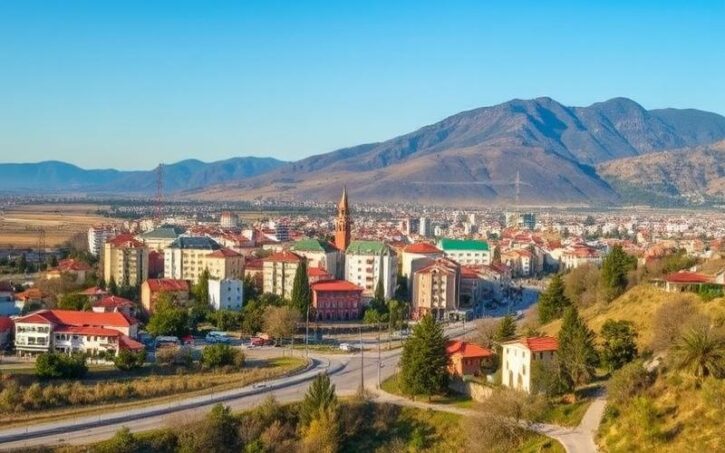
Located in northwestern Albania, at the foot of the Albanian Alps and on the edge of the largest lake in the Balkans, Shkodër is increasingly attracting curious travelers, tourists… and a few investors. The city boasts a millennia-old history, a dense cultural heritage, and a spectacular natural environment, all while remaining significantly cheaper than Tirana, Vlorë, or Sarandë. But behind this image of a “hotbed of opportunity,” the real estate reality is much more mixed: a low-liquidity market, often modest returns, a demanding legal framework, and still fragile economic data.
This article analyzes the Shkodër real estate market by cross-referencing numerical data, field observations, the legal framework, and infrastructure projects. Its goal is to assess the real relevance of an investment in this city and to identify the type of investor best suited to this opportunity.
Shkodër, Crossroads of Northern Albania
Shkodër is one of the oldest cities in Albania and a historic cultural center of the country. The municipality covers 873 km² and includes 11 administrative units (including the city of Shkodër and Velipojë on the coast). Approximately 203,600 inhabitants live in the municipality, with just over 100,000 in the city itself; 43% of the population resides in rural areas, which represent 98% of the municipal territory.
The city is located 98 km from Tirana, the Albanian capital.
The natural environment is a major asset: Lake Shkodër, of which 149 km² are on Albanian territory, is classified as a biogenetic reserve of European importance; the Buna and Kiri rivers form a vast hydrological system; Theth National Park (2,630 ha) is one of the country’s most important, serving as the heart of mountain and hiking tourism. Velipoja, in the southwest of the municipality, offers 14 km of sandy beach.
The city thus combines three structuring assets for real estate: a north–south and east–west crossroads position, a natural environment exploitable for tourism (lake, sea, mountain), and a status as a regional economic center for northern Albania.
An Economy in Transition, Between Potential and Fragility
Shkodër is presented by authorities as one of the main drivers of economic development in the north of the country. It is home to 5,509 businesses, including 1,210 large and 4,299 small enterprises, with 25,058 employed people (32% in the public sector, 68% in the private sector). The dominant sectors are trade, services, manufacturing, and construction (53 companies in the latter sector).
The local economy is based on both: the production, distribution, and consumption of goods and services within a given community.
An overview of the main economic activities in the region, combining industry, agriculture, and rapidly developing services.
A varied industrial fabric in the peripheral area: footwear, textile manufacturing, electrical materials, duralumin, wood, tobacco, meat, and agri-food.
A strong rural base (43% of the population) with agriculture, livestock, dairy, honey, olives, forest products, and fishing (about 13,000 quintals of fish per year from the lake).
A dynamic sector driven by finance (14 banks, microcredit, insurance), healthcare, education, trade, and especially tourism.
Labor costs are among the lowest in the region, with a relatively skilled workforce thanks to vocational schools and the local university. Knowledge of Italian, English, and German is an asset appreciated by foreign investors.
At the same time, the context remains that of a country with a low GDP per capita, marked by high emigration, perceived high corruption, and a judicial system overloaded with land disputes. Shkodër is located in one of the regions with the lowest per capita GDP in Europe. This duality – growth potential and structural fragility – is directly reflected in the real estate market.
Cost of Living and Salaries: An Affordable City
Shkodër stands out with a cost of living below the Albanian average: about 17.4% cheaper, according to aggregated data. For a single person, the total monthly budget (including rent) ranges between $558 and $852, of which $474 to $479 is for expenses excluding housing. For a family of four, monthly expenses including housing are estimated between $1,737 and $1,870.
Average net salaries in Albania are around $487–580 (or 48,700 ALL in lek), which barely covers a single person’s monthly expenses. This moderate gap between income and cost of living limits the purchasing power of local rental demand. Consequently, the real estate market cannot align rents with levels seen in Tirana or on the Adriatic coast without risking detachment from the country’s economic reality.
Housing costs remain modest: for an 85 m² apartment, basic utilities (electricity, heating, water, waste) range between $38.8 and $77.6 per month for a single person, and $59.8 to $95 for a family. High-speed internet (50–60 Mbps and above) costs about $15 to $17. All of this contributes to making the city attractive for profiles with international incomes (digital nomads, foreign retirees, remote workers).
Price Levels: Shkodër, a “Cheap” Market on the Albanian Scale
The various sources converge: prices in Shkodër remain significantly lower than those in Tirana or the highly sought-after coastal towns. But they are not uniform, and a clear distinction must be made between the center, the old town, the periphery, and recent constructions.
Table 1 – Price Ranges for Real Estate in Shkodër
| Market Segment | Indicative Price per m² (Purchase) | Summary Comment |
|---|---|---|
| Old town, house needing renovation | ≈ €1,300/m² before work | Example: €170,000 for 130 m², renovation needed |
| Old town, total cost after renovation | ≈ €1,500/m² (purchase + work) | Renovation estimated at €150/m² |
| Recent apartment, excellent location (center) | ≈ €600/m² | Example: €63,000 for 98 m², building about 10 years old |
| Old apartments, outside center | ≈ €400/m² | Run-down units, not very attractive |
| New projects “European standard,” outside center | ≈ €1,000/m² | Targeting middle class/diaspora |
| Wide range mentioned in other sources | €900–€1,800/m² | Depending on location and quality |
These figures are corroborated by more aggregated data, which estimates prices between €600 and €1,000/m² for “emerging zones” like Shkodër, and up to €1,800/m² for the best-located properties.
Average price of a 100 m² apartment nationally in Albania.
Rental Market: Moderate Rents, Highly Variable Returns
Rents in Shkodër reflect this reasonable price level and limited local purchasing power. In practice, for long-term rentals:
Table 2 – Average Monthly Rents in Shkodër (Standard Rental)
| Type of Accommodation | Location | Average Monthly Rent (USD) | Observations |
|---|---|---|---|
| 1 bedroom (studio/1BR) | City Center | ≈ 294–348 | Aggregated data |
| 1 bedroom (studio/1BR) | Outside Center | ≈ 209–318 | |
| 3 bedrooms (3BR) | City Center | ≈ 336–357 | |
| 3 bedrooms (3BR) | Outside Center | ≈ 327–352 | Center/outside gap is small |
Converted to euros, these rents remain low, often around €200–300 for a family apartment. Another source provides specific examples: an apartment of 98 m² on the main square, purchased for €63,000, could rent for about €225 per month once furnished.
Comparative data by apartment type for Shkodër indicates:
Table 3 – Average Returns by Property Type (National Comparative Data)
| Apartment Type | Average Purchase Price | Average Monthly Rent | Estimated Gross Yield |
|---|---|---|---|
| Studio | €36,000 | €171 | ≈ 5.69% |
| 1 Bedroom | €50,000 | €188 | ≈ 4.51% |
| 2 Bedrooms | €65,000 | €200 | ≈ 3.69% |
| 3 Bedrooms | €73,000 | €213 | ≈ 3.51% |
The average gross rental yield thus hovers around 4.3–4.4% for long-term rentals, slightly above 3–4% for some properties in the center, but far from the 6–8% that can be targeted in certain Balkan markets.
The price and rent data indicate modest gross returns for standard residential rental investment in Shkodër. The price-to-rent ratio is approximately 31.5 in the center (gross yield ~3.17%) and 21.6 on the periphery (gross yield ~4.62%). An investor seeking spectacular short-term gross returns will not find them in this market.
Short-Term Rentals and Tourism: A Real Opportunity but Far from a Goldmine
The rise of tourism in Albania – over 6 million foreign visitors in a recent half-year, a national increase of more than 20% year-on-year – is beginning to reach Shkodër, particularly as a gateway to the Albanian Alps (Theth, Valbona) and as a base to explore the lake shared with Montenegro.
The supply of Airbnb-type rentals is still modest nationally, but significant locally:
Approximately 326 active listings are recorded in the greater Shkodër region, dominated by entire homes and characterized by strong seasonality.
Table 4 – Key Airbnb Indicators in Shkodër (Approximate Figures)
| Indicator | Greater Shkodër Region | Shkodër County |
|---|---|---|
| Number of active listings | ≈ 326 | ≈ 80 |
| Share of entire homes | ≈ 88.3% | ≈ 92.5% |
| ADR (average nightly rate, peak) | ≈ $73 (August) | ≈ $57 (July) |
| Median annual ADR | ≈ $46 | ≈ $43 |
| Median monthly revenue | ≈ $412 | ≈ $378 |
| Top 10% monthly revenue | > $1,459 | ≈ $896 |
| Average occupancy rate (peak) | ≈ 44.3% | ≈ 48% |
| Median occupancy rate | ≈ 26% | ≈ 27% |
These figures show that a small number of very well-positioned properties (lake view, stylish design, central location, professional management) perform decently. But for most homes, the high season is short, the shoulder season is timid, and months like March or November are nearly flat.
An investor studied converting a 130 m² house in the old town into four Airbnb studios. With a purchase price of €170,000 and renovation costs estimated at €19,500 (i.e., €150/m²), the total investment cost is about €195,000. Assuming a maximum nightly rate of €30 and 50 nights per year per studio, the annual gross revenue would be around €6,000. After deducting expenses, management fees, and taxes (approximately half of gross revenue), the net annual yield would drop below 2%.
In other words, tourism does generate rental demand, but the price level of properties (especially those bought dearly by the diaspora) and seasonality limit net profitability. Very Airbnb-oriented projects must be modeled with great caution.
A Low-Liquidity Market, Heavily Influenced by the Diaspora
One of the most striking features of the Shkodër market is its very low liquidity. One testimonial mentions that a major local agency manages to sell only about one property per month on average. While this figure has no absolute statistical value, it reflects a common feeling: transactions are rare, slow, and often dependent on informal networks.
A significant portion of real estate buyers in Tirana come from the Albanian diaspora living in Italy, Germany, France, or Scandinavia. These buyers often pay in cash, sometimes without seeking profitability, motivated by an attachment to the city or a desire to secure a “home country” asset. This dynamic means that prices in certain segments (city centers, new buildings, character homes) do not reflect the real capacity of the rental or tourism market to generate income, resulting in low rental yields.
The market is also fragmented: many properties are not listed online, negotiations go through family or friends networks, and price transparency remains very relative. For a foreign investor, this makes it harder to access “good deals” without relying on reliable local intermediaries.
Legal and Tax Environment: Open but Demanding
On paper, Albania is fairly welcoming to foreign investors in urban real estate. Non-residents can purchase apartments, houses, and commercial properties with rights similar to those of citizens: buy, sell, rent, inherit. Residency in Albania is not required to purchase, but the purchase does not automatically grant a residence permit (although it can facilitate an application by demonstrating ties to the country).
Foreigners cannot directly own agricultural land beyond certain limits. For this type of acquisition, it is necessary to set up an Albanian company or a structure where the investment is at least three times the value of the land. This restriction is less problematic for residential real estate in areas like inner Shkodër or Velipoja, but it becomes critical for bare, rural, or peri-urban land.
Taxation on real estate remains moderate overall:
Tax rate on rental income and capital gains on real estate in Albania
The corporate income tax rate (15%) and progressive personal income tax (0%, 13%, 23%) may apply to investment structures; agricultural taxation is specific but hardly concerns a purely urban investor.
On a practical level, the purchase process must be done before a notary, with title verification and registration with the cadastre. But the historical weakness of land registers is a real danger: more than 70% of civil court cases involve land disputes; hundreds of thousands of buildings were built without permits; regularization is slow. Hence a clear recommendation for any investor in Shkodër: never skip the step of a thorough property check (titles, easements, potential co-owners, zoning compliance), ideally through an experienced local lawyer.
Financing and Interest Rates: A Very “Cash” Market
Albania is still an economy largely dominated by cash: more than 90% of payments are made in cash, and real estate transactions are no exception, even though payments over €1,000 must, in principle, go through bank transfers for compliance reasons.
Albanian banks offer mortgages, with more favorable conditions for residents with local income than for non-residents. Rates for a 20-year loan are around 5% in Shkodër, but can reach 7% to 9% nationally, depending on currency, profile, and year. The loan-to-value (LTV) ratio is generally between 60% and 70%, requiring a substantial down payment.
For a foreigner, obtaining local financing is possible but complicated: most foreign real estate investors operating in Shkodër therefore do so with their own funds. This market structure further accentuates the weight of the diaspora (strong cash payment capacity) and limits speculative borrowing as seen in other countries.
Infrastructure: A Medium-Term Value Lever
Several local and national projects could, over time, change the attractiveness of certain areas of Shkodër and thus real estate values.
Among the flagship programs:
Amount in euros of European Union financing for the infrastructure and tourism program in Albania, via the EBRD.
These programs, if carried out successfully, could strengthen the value of certain micro-areas: renovated lakefront, improved road access to Theth and the Alps, better service to Velipoja. For a patient investor, positioning oneself near these axes, before the full completion of the works, can be a bet on capital appreciation rather than immediate rental yield.
Who Invests (and Who Should Invest) in Shkodër?
Three main categories of players emerge.
First, the Albanian diaspora, which remains the main driver of purchases. These buyers often prioritize sentiment and wealth security over financial returns: an apartment for summer vacations, a renovated family home, a small building to house or help relatives, etc. Their behavior supports prices in certain segments, without seeking fine profitability.
Foreign investors in Shkodër are mainly Italians, Germans, French, and Brits, often digital nomads or retirees. They are attracted by the low cost of living, nature, and a human-scale pace of life. For them, real estate represents both a home and a means of diversifying assets at an affordable entry price.
Finally, a few developers or more structured tourism operators are interested in historic buildings in the center, industrial brownfields, or development zones identified by the municipality (former airport, industrial zone, Velipoja–Rrjoll axis, city center, lakefront). The strategy is to create charming accommodations, guesthouses, or small hotel units targeting eco-tourism and cultural tourism. Again, the logic is less about gross rental yield per se and more about a long-term project, backed by the rise of regional tourism.
Objective Advantages for an Investor
Several factors argue in favor of real estate investment in Shkodër, under certain conditions.
First, entry prices remain low by European and even Albanian standards. Where €160,000 buys barely 100 m² at the national average, the same amount in Shkodër can finance an ambitious renovation project or several medium-sized apartments in decent areas.
Second, the quality of life and cost of living offer a competitive advantage for profiles with international incomes. A digital nomad or foreign retiree can live comfortably in Shkodër, with a good internet connection, accessible basic services, and a significant cultural offering (museums, theater, festivals), at a total cost significantly lower than Western Europe.
The tourism potential is real in the medium term, thanks to proximity to Montenegro (whose high-end tourism is growing strongly), still-preserved nature, an image of “the next trendy destination,” and the multiplication of infrastructure projects supported by the EU and EBRD. As tourism develops, demand for quality accommodations, renovated houses, and family-run guesthouses is likely to increase.
Finally, the market being low-competition and under-professionalized, a well-informed investor who surrounds themselves with strong local skills (lawyer, architect, renovation company, property manager) can sometimes obtain better negotiation terms than on saturated markets. Albanian business culture values negotiation: starting 5 to 10% below the asking price is common, especially if paying cash.
Limits and Risks Not to Be Overlooked
But the warning signs are numerous and must be taken seriously.
The first is low liquidity: exiting an investment in Shkodër can take time, sometimes more than ten months to resell an apartment even in a nationally dynamic context. In such a tight market, an urgent need for liquidity may require a significant discount upon resale.
Returns can be very modest, as illustrated by a net yield below 2% for a house converted to Airbnb. A high purchase price, short season, and limited occupancy rate are enough to compromise profitability, even in a favorable tax environment.
Third limitation: data quality. Many rent and price statistics rely on a small sample of declarations, sometimes fewer than ten prices recorded for certain categories. These figures must therefore be handled with caution and systematically cross-checked with field research (visits, interviews, actual rent collections).
Between incomplete property titles, complex successions, unregularized constructions, and a sometimes unreliable cadastre, the risk of disputes is real. Delays in updating registers, legalization procedures, and judicial slowness require meticulous due diligence.
Finally, Albania’s macroeconomic and political context carries its share of uncertainty: corruption, influence of the informal economy, frequent legal reforms. Even as the country moves toward better European integration, this environment is not suitable for all types of investors.
What Strategies Can Still Make Sense in Shkodër?
In this nuanced landscape, certain approaches seem more relevant than others.
A first strategy is to invest for personal use, with a secondary financial objective. An expat, digital nomad, or retiree who wants to live in Shkodër can buy a quality apartment in a central or lake-area neighborhood, enjoy a reduced cost of living, and possibly cover part of their expenses by renting the property out for a few months a year. Here, the main goal is not maximizing returns but securing a long-term lifestyle.
This approach targets low-priced properties (around €400/m²) on the periphery, whose value could increase thanks to new infrastructure (roads, beautification of the Velipoja coastline, development of the lake shores at Shiroka). The goal is capital appreciation over 5 to 10 years, without prioritizing rental income. It carries high geographic risk and potential rental vacancy periods.
A third approach involves renovating heritage-value buildings (old town, traditional houses) to turn them into guesthouses or boutique hotels. This strategy aligns with the municipal policy of promoting cultural and eco-responsible tourism, and may benefit from implicit support (administrative ease, promotion in tourism marketing, etc.). But it requires a sharp sense of product (authenticity, design, hospitality quality) and solid operational management, more so than a simple apartment rental investment.
Some institutional investors may target land in specific economic zones defined by the municipality, such as the former airport, the industrial zone, the Shkodër–Koplik or Shkodër–Vau Dejës axes, and the Velipoja–Rrjoll area. These long-term investments could benefit from the development of light industry, cross-border logistics, or beachfront hospitality, but require strong local roots.
What Shkodër Is Not (Yet)
To conclude, it is useful to state clearly what Shkodër is not.
It is not a booming beach resort like Sarandë, where prices are soaring and the tourist season now extends to six months. Nor is it Tirana, where internal demographic pressure concentrates over 30% of the national population and the real estate market benefits from strong structural demand.
It is not, for now, a market with high absolute rental yields. With average gross yields around 4%, sometimes 5–6% on very well-managed studios, Shkodër sits at the lower end of the Balkan range for purely wealth-preservation investment.
Shkodër Real Estate Market Analysis
Finally, it is not a highly liquid market: you must accept engaging in it as a “frontier” market, where resale is slower, negotiation more informal, and success more dependent on local networks.
Conclusion: For Which Profile Is Shkodër Worth It?
Investing in real estate in Shkodër only makes sense if you accept the city for what it is: a city of culture and nature, in a country still in transition, with a low-maturity real estate market driven by the diaspora and mixed-use purposes (second home, lifestyle projects), more than by financial optimization calculations.
For an investor seeking high, secure, and easily resalable rental returns, the answer is rather negative: low liquidity, moderate returns, and legal risks call for caution, even suggesting looking at other better-structured Balkan destinations.
For a patient investor comfortable with emerging markets, Shkodër in Albania can represent an interesting bet. This strategy requires getting involved locally, conducting rigorous due diligence, and adding value through renovation and niche positioning (niche tourism, character accommodations, high-end furnished rentals for expats and nomads). The advantages are a low entry ticket, a pleasant city to live in, and promising appreciation potential, driven by better connectivity of northern Albania with its neighbors and tourism development.
In short, Shkodër is neither the real estate Eldorado that some promotional pitches sometimes suggest, nor a city to systematically avoid. It is a demanding market that rewards deep knowledge of the terrain, local roots, and patience far more than the hunt for quick gains. Those who come primarily for the desire to live there or to carry out a project consistent with the city’s identity will, in the long run, have a better chance of succeeding than those who only look at yield figures.
Disclaimer: The information provided on this website is for informational purposes only and does not constitute financial, legal, or professional advice. We encourage you to consult qualified experts before making any investment, real estate, or expatriation decisions. Although we strive to maintain up-to-date and accurate information, we do not guarantee the completeness, accuracy, or timeliness of the proposed content. As investment and expatriation involve risks, we disclaim any liability for potential losses or damages arising from the use of this site. Your use of this site confirms your acceptance of these terms and your understanding of the associated risks.

Cyril Jarnias is an independent expert in international wealth management with over 20 years of experience. As an expatriate himself, he is dedicated to helping individuals and business leaders build, protect, and pass on their wealth with complete peace of mind.
On his website, cyriljarnias.com, he shares his expertise on international real estate, offshore company formation, and expatriation.
Thanks to his expertise, he offers sound advice to optimize his clients' wealth management. Cyril Jarnias is also recognized for his appearances in many prestigious media outlets such as BFM Business, les Français de l’étranger, Le Figaro, Les Echos, and Mieux vivre votre argent, where he shares his knowledge and know-how in wealth management.





