
 Published on and written by Cyril Jarnias
Globally, few markets rival Monaco in terms of scarcity, legal security, and price stability. And within this ultra-exclusive micro-market, two districts draw the attention of international investors: Fontvieille and Larvotto. One represents the “rational” gateway to the Principality, the other embodies the absolute peak of European coastal residential living. Understanding their specifics, their figures, and their uses has become essential for any foreign buyer considering a position in Monaco.
Larvotto has crossed the symbolic threshold of €70,000/m², with transactions that can exceed €120,000–130,000/m² in ultra-prime developments.
Monaco: A Highly Constrained Market, Built for the Long Term
Before zooming in on Fontvieille and Larvotto, it is necessary to keep in mind a few constants of the Monegasque market. The territory covers only 2.02 km², new supply remains microscopic (fewer than 700 new homes delivered since 2016), and despite a few exceptional years due to the delivery of Mareterra or Bay House, the annual volume hovers around 450–500 transactions. In this context, structural scarcity is the market’s best “hedge.”
In 2025, nearly 80% of sales involve properties of 3 bedrooms or more. The average value of units with 5 rooms or more reaches about €29M (+54% year-on-year). More than half of new-build sales exceed €20M, and several transactions break the €100M mark. Monaco is becoming a primary residence market for ultra-wealthy families.
On the fiscal front, the landscape is equally unique: no income tax for residents (except for the specific case of French nationals who arrived after 1957), no wealth tax, no annual property tax, no occupancy tax, and no capital gains tax on real estate for resident individuals. The owner only pays acquisition costs (about 6–9% depending on the legal structure) and current condominium fees. Rental income received by a resident individual is not taxed in Monaco.
Yields and Wealth Logic
This combination of scarcity and favorable taxation has a logical counterpart: gross rental yields remain modest. Across the Principality, the published gross yield is around 2.9%, but most residential properties are rather between 2% and 3.5% net, once condominium fees, management costs (8–12% of rents), maintenance, and renovation provisions are factored in. In ultra-luxury districts like Larvotto or the Carré d’Or, it is not uncommon to target only 1.5–2% yield, with the main performance coming from capital appreciation.
Peripheral sectors such as La Condamine, Moneghetti, and Jardin Exotique can exceed 3% gross, or even more for well-calibrated family products, while Fontvieille offers a balance with decent rents and solid price growth, especially on 1970s-1980s buildings caught in the ‘renovation gap.’
Larvotto: The Most Expensive Waterfront in Europe
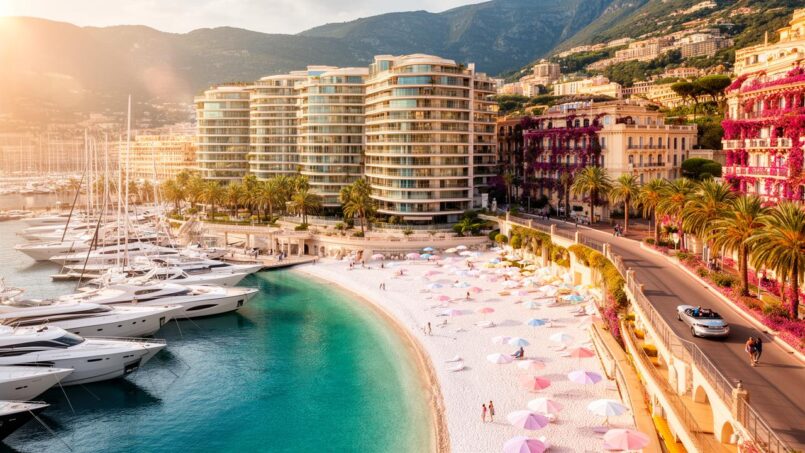
Larvotto, nestled against the public beach of the same name and the legendary Avenue Princesse Grace, has become the symbol of the new Monegasque era. This seaside district, redesigned by Renzo Piano with a planted promenade, an expanded beach, and new restaurant and wellness areas, now forms the heart of the Principality’s coastal narrative.
Benchmark Prices, Boosted by Mareterra and Bay House
The numbers speak for themselves. According to the 2024 Real Estate Observatory, Larvotto recorded an average resale price of €97,563/m², a year-on-year increase of 48.1%. This is the first time a Monegasque district has so clearly crossed the €70,000/m² threshold, with peaks above €120,000–130,000/m² for certain lots in Mareterra. In 2025, the average stands around €71,167/m² on a revised index, confirming its status as the most expensive district in Monaco.
Choosing Fontvieille over Larvotto for a 200 m² apartment results in savings of approximately €3.7 million on the purchase price.
This is clearly visible through resale statistics: in 2025, only 13 transactions took place in Larvotto, but they represent nearly €852M in volume, a near quintupling in value in just a few years. In other words, very few lots change hands, but each sale resets price benchmarks.
Property Types and Price Levels
The real estate offering in Larvotto mainly consists of contemporary buildings or high-end modern architecture: 21 Princesse Grace, La Réserve, Testimonio II, Bay House, not to mention iconic residences such as Roccabella or Le Vallespir. Almost all apartments feature deep terraces, large bay windows, and services worthy of a palace: 24/7 concierge, pools, fitness rooms, secure parking.
Here is a simplified snapshot of the price ranges in the district:
| Property Type | Typical Surface | Average Price €/m² (order of magnitude) | Indicative Price Range | Common Features |
|---|---|---|---|---|
| Studio / pied-à-terre | 30–50 m² | ~64,000 | €1.9–3.2M | Rare, often with balcony, rental target |
| 1 bedroom | 60–80 m² | ~65,500 | €3.9–5.2M | Side sea view, terrace |
| 2 bedrooms | 90–130 m² | ~66,800 | €6–8.7M | Modern residences, beach access |
| 3 bedrooms | 150–250 m² | ~67,500 | €10–17M | Large panoramic terraces |
| 4 bedrooms and more | 250–400 m² | ~68,000 | €17–27M and above | Penthouses, “urban villas,” 5* services |
| Duplex / ultra-prime penthouse | 300–1,000+ m² | >70,000 (often >100,000) | €20–50M or more | Private pool, rooftop terrace, 360° views |
These figures reflect the reality of a market where each property is virtually a unique piece. Large high-floor units oriented south with spectacular terraces command significant premiums. Transactions very often occur off-market, especially for surfaces of 200 m² and above, or for iconic lots in Mareterra and Bay House.
Compressed Yields, but Historic Capital Gains
In Larvotto, the investment logic is almost exclusively wealth-oriented. Purchase prices are so high that rental yield is mechanically compressed. Market data suggests gross yields in the range of 1.5% to 2%, sometimes up to 2.5% for more “standard” products (1–2 bedrooms) well positioned in terms of rent. In practice, after fees and management, net yield rarely exceeds 2%.
A renovated sea-view apartment at La Réserve, resold in less than two years, generated over 20% capital gain after the waterfront modernization; another property gained 15% in two years thanks to new infrastructure. These examples illustrate Larvotto’s capital performance, with returns of approximately 33.6% over five years.
For an international investor, the equation is therefore clear: Larvotto is not chosen to “generate yield”, but rather to anchor a portion of one’s wealth in a capital preservation vehicle, combining scarcity of seafronts, extreme prestige of the address, and absence of capital gains tax upon resale as a resident.
Who is Larvotto For?
Buyer profiles are relatively homogeneous: ultra-wealthy families settling in Monaco to live there more than 183 days a year, international entrepreneurs seeking a primary residence with a secure tax status, or investors looking for a “trophy asset” on the seafront. The transition to Monegasque residency is facilitated by owning a home (purchase or long-term lease), proof of financial means (often a deposit of at least €500,000 in a local bank account), and a straightforward compliance file (clean criminal record, KYC verification).
Clients seek recent or fully renovated high-end properties with exceptional amenities and large spaces.
3–4 bedroom apartments with generous terraces and hotel-style amenities are particularly sought after.
At Bay House or Mareterra, these properties exceed 500 to 1,000 m² with private pools, hanging gardens, and 180- or 360-degree views.
Fontvieille: The “Rational” Alternative with Upside Potential
At the opposite end of the spectrum, Fontvieille offers a more “balanced” reading of Monegasque investment. Built on land reclaimed from the sea in the 1970s–1980s at the western end of the Principality, it combines a marina, large recent buildings, numerous offices, green spaces, and local amenities. It is also where the heliport, parks (Fontvieille, Roseraie Princesse Grace, UNESCO Garden), and a good part of the local economic fabric are located.
More Affordable Prices, Larger Spaces
Fontvieille sits in a second “price tier,” just below the heights of Larvotto and the Carré d’Or. Several sources converge on an average of about €52,500/m² in 2025, compared to slightly under €54,000/m² for Monte-Carlo. In 2024, the district showed around €53,900/m², nearly stable year-on-year, after a very strong decade-long increase. Over the long term, growth remains solid, with an estimated ROI around 7% in some 2025 indices, slightly lower than Monte-Carlo and Larvotto, but very respectable in absolute terms.
Fontvieille represented more than 12.5% of Monaco’s residential stock in 2016.
To give an order of magnitude: a 100 m² apartment in Fontvieille costs around €5.2–5.3M at the district average; the same square footage in Larvotto exceeds €7.1M based on €71,000/m², with peaks much higher on iconic buildings. The price arbitrage is therefore considerable for an investor willing to move away from the beach to favor the marina and the port of Cap d’Ail.
Example of Price Positioning in Fontvieille
We can summarize the usual ranges as follows, emphasizing the variety of residences:
| Segment in Fontvieille | Indicative Price Range (resale) | Market Comment |
|---|---|---|
| “Village” residences (Donatello, Botticelli, Michelangelo, Giorgione, etc.) | ~€45,000–55,000/m² | 1970s–80s buildings, highly sought after by families and investors |
| High-end waterfront (Seaside Plaza, Terrasses du Port, Monte Marina, Rosa Maris, etc.) | ~€55,000–65,000/m² (or more) | 5* amenities, large terraces, full sea view |
| Buildings needing renovation (1970s–80s, partial view) | <€50,000/m² sometimes | Ideal target for a “renovation + premium” strategy |
| Recent/exclusive developments (Petrini Exclusive, Le Méridien, etc.) | ~€60,000/m² | New or fully refurbished products |
Even within the same residences, the differences can be significant. A large 2-room at Donatello, about 70–80 m², with a view of the Roseraie Princesse Grace and a loggia, will trade at a more rational price than a 4-room direct sea view at Seaside Plaza, some lots of which exceed 400–500 m² (up to 677 m² for certain entire-floor apartments, or even more for combined sets).
A Playground for the “Renovation” Strategy
Fontvieille concentrates a significant portion of the 1970s–1980s stock, well-designed but sometimes dated in terms of finishes or interior layout. However, the Monegasque market is seeing a growing gap between “turnkey” ultra-contemporary products and older stock. Professionals speak of a “renovation gap” that can translate into a differential of €15,000/m² between an unrenovated older property and one brought up to new-build standards.
An investor buys a large 3-room in an 80s building at €45,000/m², fully renovates it with very high-end finishes, and can hope to resell it near €60,000/m² in the same district, or even more in sought-after residences like Seaside Plaza or Monte Marina, where penthouses bought off-plan have appreciated upon delivery thanks to the port’s prestige and the quality of the fittings.
Yields and Rental Liquidity
Fontvieille shows a price/location ratio considered particularly interesting for an investor not solely seeking maximum prestige. Average rents are competitive: references mention about €95/m² for standard rentals, with peaks up to €130/m² for large units in prime buildings. For a well-positioned property, gross yield generally remains below 2.5%, but slightly higher than in ultra-luxury districts like Larvotto.
Rental demand in Fontvieille is supported by Monegasque or resident families, local corporate executives, and an international clientele attracted by the calm, green setting. The vacancy rate for high-end properties is virtually zero, especially for large family apartments, a very tight segment across Monaco.
A Family-Friendly, Practical, and Evolving District
Fontvieille also stands out for its atmosphere: quiet but lively residential areas around the marina, waterside restaurants, proximity to schools, the shopping center, and the heliport (for quick connections to Nice or other cities). Views often overlook the port of Cap d’Ail, the Mediterranean, the Rock, or the parks, making it a privileged place for families who want a secure environment that is less exposed than the immediate surroundings of the Casino.
Ongoing modernization projects in the district reinforce this attractiveness: building upgrades, shop renovations, development of residential complexes like Petrini Exclusive, contemporary architecture by noted designers (Le Méridien was designed by Alexandre Giraldi). For an international investor, Fontvieille therefore offers a rare combination in Monaco: an entry ticket still “reasonable” on a local scale, prospects for appreciation through renovation and modernization, and solid rental liquidity.
Comparing Fontvieille and Larvotto: Which Strategy for Which Profile?
For a foreign investor, the question is not only “how much does it cost?” but “what investment story do I want to write: current yield, capital gain, primary residence, or a combination of the three?” Fontvieille and Larvotto cater to significantly different sets of requirements.
Comparative Overview of the Two Districts
The table below allows visualization of the main contrasts:
| Criteria | Fontvieille | Larvotto |
|---|---|---|
| Location | West of Monaco, land reclaimed from the sea | East, waterfront on public beach |
| Average price 2025 | ~€52,500/m² | ~€71,000/m² (resales can exceed €97,000/m²) |
| Gap vs. Monaco average | Slightly below the high average | Clearly above, most expensive district |
| Type of properties | Large apartments, 70s–80s stock, marina, parks | Ultra-luxury apartments, penthouses, Mareterra, Bay House |
| Gross rental yield | Up to ~2.5% on good products | 1.5–2%, sometimes 2.5% on small units |
| Investment logic | Mix yield/capital gain, renovation strategy | Pure wealth preservation, capital protection |
| Dominant clientele | Families, executives, rational investors | UHNWIs, ultra-wealthy families, “trophy buyers” |
| Upside potential | Solid, boosted by modernization and “renovation gap” | Always upward in the very long term, but already at the top |
| Atmosphere | Family-friendly, practical, green, marina | Seaside, glamorous, urban resort |
We can see two possible trajectories. Larvotto suits an investor already highly exposed to risk in other asset classes, seeking an extraordinarily rare safe-haven asset, with assured resale liquidity and virtually zero downside risk over the long term. Rental yield is a bonus, but never the priority.
Fontvieille, on the other hand, speaks more to those who want to “work” their asset: buy at a price still in line with the rest of Monaco, optimize through renovation, profit from the price differential between older stock and new-build standards. It also suits families who want to live in Monaco on a daily basis, away from the bustle of Place du Casino, while remaining just minutes from all key locations.
Fontvieille
Financing an Investment in Fontvieille or Larvotto
For international investors, access to credit in Monaco almost always goes through local private banks or the Monegasque branches of major international groups (Barclays Monaco, Société Générale Monaco, Crédit Agricole Indosuez, Banque Edmond de Rothschild, etc.). These institutions are accustomed to dealing with non-residents, but require strong financial profiles.
Mortgage Loans and Bank Leverage
As a general rule, banks finance 50% to 70% of the estimated value of the property, with a personal contribution of at least 30%, often 40–50% in the ultra-prime segment. Fixed rates commonly range between 3% and 4% for standard loans, with the possibility of fixing the rate for the entire term, which is rather rare internationally. Variable rates are indexed to Euribor, with a margin of 1 to 2 points.
Several credit structures exist: amortizing loan, fixed rate, adjustable rate, mixed, or “in fine.” For wealthy clients, interest-only loans with LTV up to 100% are possible, subject to placing assets (e.g., 20% of the loan) in management with the bank.
Alternatives: Lombard, Family Office, Bridge Loans
Not all investors use the “classic” mortgage. Some prefer the Lombard loan, i.e., a loan secured by an investment portfolio, allowing the financing of a real estate purchase without a mortgage registration in Monaco. Loan-to-value ratios typically range between 50% and 60% of the portfolio’s value, with a faster and more flexible process.
Family offices use intra-group structures or capital contributions from a parent company, as well as short-term bridge loans to act quickly on off-market opportunities in Fontvieille or Larvotto while waiting for the liquidation of other assets.
In all cases, Monegasque banks impose a thorough KYC analysis (source of funds, income stability, reasonable debt level), a significant equity contribution, and often a broader wealth management relationship.
Taxation: An Ultra-Competitive Framework for the Foreign Investor
One of the great advantages of real estate in Fontvieille and Larvotto is operating within a tax framework among the most favorable in the world for a resident individual.
At Purchase: Transfer Taxes and Fees
For an individual or a transparent Monegasque SCI, acquiring an existing property (resale) typically incurs 4.75% registration duties, plus about 1.5% notary fees. In practice, the “package” of duties + notary fees totals about 6% of the purchase price. Agency fees, common but not mandatory, are payable by the buyer at 3% of the price, while the seller pays 5%.
More opaque structures (foreign companies, trusts, etc.) are more heavily taxed, at a rate of 7.5% or even 10% in some cases, unless the buyer qualifies as a property dealer benefiting from a specific regime (50% reduction in duties if resold within a set timeframe).
For new or deeply renovated properties considered as new, the Monegasque VAT of 20% (aligned with France) applies, sometimes in addition to or in place of duties depending on the transaction. Investors often buy off-plan or at completion in developments like Mareterra or Bay House.
During Ownership: Zero Recurring Taxes
This is one of the most striking points for an investor accustomed to French, British, or Spanish markets: Monaco levies no annual property tax, no occupancy tax, and no real estate wealth tax. Owning an apartment in Fontvieille or Larvotto therefore generates no recurring taxation solely by virtue of ownership. Only condominium fees, energy costs, services (internet, etc.), and, if applicable, management fees remain.
The “rental tax” of 1% on the annual rent amount plus charges is paid by the tenant when the lease is registered.
Upon Resale: No Capital Gains Tax for Individuals
Another major particularity: capital gains realized by a resident individual upon resale of real estate in Monaco are not taxed in the Principality. This applies equally to a studio in Fontvieille or a penthouse in Larvotto, provided the sale is made by a natural person or a transparent SCI not subject to corporate income tax. The only exceptions concern Monegasque companies subject to corporate income tax (25%), for example when they engage in property dealing or substantial commercial activity.
For a foreign investor who becomes a Monegasque resident, the only limit to this optimization lies in the possible taxation of their country of origin, particularly for French nationals subject to a specific treaty if they transferred their residence to Monaco after 1957.
Purchase Procedure for an International Investor
Whether it is an apartment to renovate in Fontvieille or a turnkey duplex in Larvotto, the legal mechanics of the purchase are well defined. All transactions go through a Monegasque notary, a public officer responsible for securing the sale, verifying the chain of title, and registering the deed with the tax authorities.
The investor typically begins by working with a local agency to find properties, including those not listed (off-market). After finding a property, they submit a written purchase offer, which becomes binding upon the seller’s acceptance. Then, the notary drafts a preliminary contract (compromise or promise of sale) and receives a deposit of 10% into an escrow account. Due diligence includes verifying the title deed, mortgages, compliance, and diagnostics.
In parallel, the investor finalizes their financing (firm bank agreement, possible SCI or holding company structure, estate planning). After a few weeks, the final deed is signed at the notary’s office, the balance is paid (price + fees), and the new owner receives an official certificate of ownership. This document will then be a key piece for any Monegasque residency application.
For a non-resident, buying in Fontvieille or Larvotto is possible without nationality restrictions or prior residency requirements. Additional formalities include: current residence certificates, criminal record extract from the last 5 years, proof of source of funds, and, for non-EEA nationals, a possible long-stay visa. These steps do not block the acquisition.
Which Scenario for Which Investor?
Ultimately, real estate in Fontvieille and Larvotto serves very distinct investment strategies, but complementary ones in a portfolio logic.
An investor wishing to combine residence and tax status will frequently choose a 3- or 4-bedroom in Larvotto, for example an apartment of 120–150 m² in a residence like Testimonio II or La Réserve, around €9–15M. They can occupy it for a large part of the year and rent it occasionally to expatriates or transitioning entrepreneurs, with rents easily exceeding €100–115/m², or even €30,000/month for very high-end products.
The gross rental yield obtained after purchase and renovation of a property in Fontvieille is approximately 2.5%.
Some family offices even arbitrate by building a dual exposure: an iconic address in Larvotto (prestigious pied-à-terre and store-of-value asset) combined with one or more apartments in Fontvieille or peripheral districts with higher rental yields. In a world marked by high macroeconomic and geopolitical volatility, these combinations offer a rare mix of security, liquidity, and tax visibility.
Entering the Monegasque market in Fontvieille or Larvotto requires a very high entry ticket, rigorous attention to the intrinsic quality of the property, and a long-term investment vision. For international investors, Fontvieille represents a laboratory of value and reasoned yield, while Larvotto embodies the ultimate showcase of seafront capital preservation.
A wealth project or a question? Contact us now to speak with a wealth management expert.
Disclaimer: The information provided on this website is for informational purposes only and does not constitute financial, legal, or professional advice. We encourage you to consult qualified experts before making any investment, real estate, or expatriation decisions. Although we strive to maintain up-to-date and accurate information, we do not guarantee the completeness, accuracy, or timeliness of the proposed content. As investment and expatriation involve risks, we disclaim any liability for potential losses or damages arising from the use of this site. Your use of this site confirms your acceptance of these terms and your understanding of the associated risks.

Cyril Jarnias is an independent expert in international wealth management with over 20 years of experience. As an expatriate himself, he is dedicated to helping individuals and business leaders build, protect, and pass on their wealth with complete peace of mind.
On his website, cyriljarnias.com, he shares his expertise on international real estate, offshore company formation, and expatriation.
Thanks to his expertise, he offers sound advice to optimize his clients' wealth management. Cyril Jarnias is also recognized for his appearances in many prestigious media outlets such as BFM Business, les Français de l’étranger, Le Figaro, Les Echos, and Mieux vivre votre argent, where he shares his knowledge and know-how in wealth management.





