
 Published on and written by Cyril Jarnias
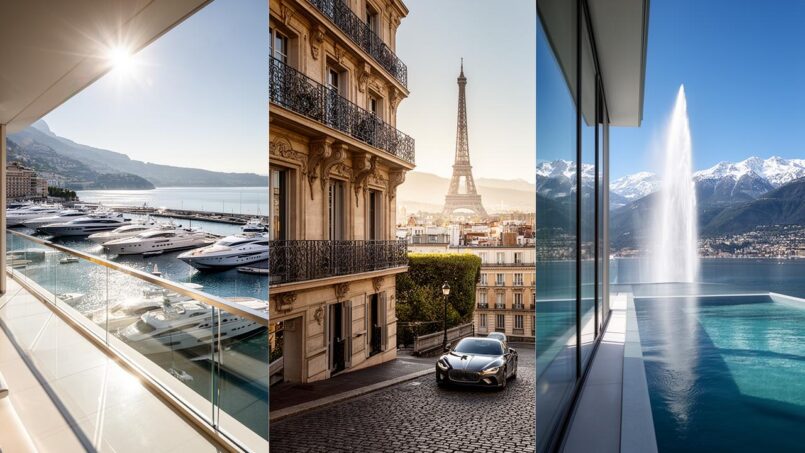
The same observation recurs among all major wealth advisory firms in 2026: the ultra-wealthy are no longer just buying square footage—they are buying a jurisdiction, a tax regime, resale liquidity, a passport of stability. In this landscape, three markets dominate conversations about high-end European real estate: Monaco, Paris, and Geneva.
Behind an apparent geographical proximity lie three radically different investment logics: one aims to maximize capital preservation within a unique tax haven, another plays the trade-off between yield and prestige in a global capital, and the third offers a Swiss compromise between security, scarcity, and a heavier but predictable tax burden.
The challenge for a wealthy investor in 2026 is therefore not to find a “best” market in absolute terms, but to align the chosen city with his or her strategy: yield vs. wealth protection, residential use vs. pure investment, tax optimization vs. regulatory flexibility.
Monaco: The Wealth and Tax Fortress
Monaco remains in 2026 the extreme laboratory of scarcity. On just 2.08 km², the residential market combines three powerful drivers: an almost frozen supply of land, extraordinary personal taxation, and international demand that does not falter even when the rest of the world slows down.
Prices That Redefine the Notion of “Luxury”
The numbers speak for themselves. In 2024, the average resale price stood at around €51,967/m², with an increase of about 44% over ten years. In 2025, the Monaco Real Estate Observatory noted a new threshold around €57,500/m², placing the Principality at the top of the global ranking of the most expensive residential markets.
This average masks spectacular disparities between districts. Larvotto illustrates this polarization. Driven by the delivery of the Mareterra project, this waterfront area exceeded €70,000/m² for the first time, reaching approximately €71,167/m² in 2025, making it the most expensive neighborhood in the country. In practice, very high-end transactions in this area, or in the “billionaire triangle” linking the Rock, Place du Casino, and the waterfront, close well above these levels, with occasional off-market sales exceeding €100,000/m².
The resale data illustrate this hierarchy:
| Monaco District | Average Resale Price (€/m², recent) |
|---|---|
| Larvotto | ~97,500 (old IMSEE data) |
| Monte-Carlo | ~53,900 |
| Fontvieille | ~53,900 |
| La Condamine | ~53,800 |
| Jardin Exotique | ~49,800 |
| La Rousse | ~45,300 |
| Les Moneghetti | ~42,300 |
Meanwhile, the new-build segment has soared to almost conceptual levels: in 2024, the average price per new unit approached €36.4 million (median €22.1 million), with more than half of sales above €20 million and several transactions exceeding €100 million. In 2025, some series of new developments posted averages above €40 million per unit, while still finding buyers.
Logical result: a simple 100 m² space now represents a ticket close to €6 million on average, and more than €7 million in Larvotto.
An Ultra-Prime Market That Segments by Quality
After the post-Covid euphoria phase, the 2026 Monaco market is not in decline, but in a sorting phase. Volumes reached a historic high in 2024 with €5.92 billion in transactions (all segments combined), then new-home sales declined slightly in 2025 after the Mareterra peak, while resales surged nearly 50%, crossing the €3 billion mark for the first time.
This new configuration is characterized by several structuring trends:
– Large family-sized units are becoming the core of demand: more than 80% of new sales in 2025 were for apartments with three or more bedrooms, proof that the Principality is attracting families who settle long-term, no longer just “fiscal pied-à-terre”;
– The premium on large apartments is striking: resales of properties with five rooms or more averaged around €29 million in 2025, up more than 50% year-on-year—nearly €10 million gained in a single year for this category;
– The gap widens between new or fully renovated buildings with services (Bay House, SBM projects, Mareterra) and the older 1970s stock: investors target the latter for renovation, seeking to capture a potential uplift of up to €15,000/m².
This shift toward a “quality-driven” market is reflected in buying behavior: international buyers now scrutinize orientation, construction quality, in-building services, privacy, and future liquidity at least as much as the mere address.
Modest Yields, but Extraordinary Appreciation
Monaco is not a yield market, and it does not claim to be. Historically, gross rental yields were around 1.5% to 2%. Recent data, however, show a noticeable improvement. Global Property Guide, for example, reports an average gross yield of about 2.87% in mid-2025, compared to about 3.02% at the end of 2024. Other sources mention, for well-optimized structures, net yields between 2.5% and 3.5% over 2025-2026, which is remarkable at those price levels.
Calculations on typical cases illustrate the order of magnitude of the phenomenon.
| Property Type | Estimated Purchase Price | Estimated Monthly Rent | Approx. Gross Yield |
|---|---|---|---|
| Studio | €1,790,000 | €3,300 | ~2.2% |
| 1-bedroom | €3,500,000 | €6,500 | ~2.2% |
| 2-bedroom | €5,800,000 | €14,000 | ~2.9% |
| 3-bedroom | €12,500,000 | €30,000 | ~2.9% |
Net of management fees, non-recoverable expenses, and maintenance provisions, yields usually range between 1.8% and 2.3% for a well-managed property. The bulk of the return therefore comes from capital appreciation: +44% over ten years on average, with no capital gains tax for individuals at resale. In an environment where real estate wealth tax, inheritance taxes, or social contributions erode returns in other countries, this snowball effect on wealth becomes central.
Unbeatable Personal Taxation… Except for the French
Monaco’s strength lies not only in real estate values, but also in a tax framework with virtually no equivalent.
For a non-French resident:
– Income tax: 0% (all sources, local or foreign);
– Wealth tax: 0%;
– Private capital gains tax: 0%;
– Direct line inheritance tax (spouse, children): 0%; between close relatives, rates remain low (8% between siblings, 10–16% between non-relatives);
– No recurring property tax or occupancy tax; only registration fees of about 6% are due at purchase.
For companies, the picture is more nuanced: a Monaco company that generates at least 75% of its turnover in the Principality is exempt from corporate income tax, while those exceeding 25% of turnover outside Monaco are taxed at a rate close to 25% since harmonization with the international standard.
In Monaco, wealth tax does not exceed about 1% per year, compared to cumulative rates that can reach 40% for income tax in Geneva.
There is, however, a major exception: the treatment of French nationals. Under the 1963 Franco-Monegasque tax treaty, a French person domiciled in Monaco (except rare historical cases) remains taxable in France on all worldwide income, as if he or she still lived in Paris or Lyon. Therefore, he or she cannot benefit from the Principality’s absence of income tax. On the other hand, he or she escapes the non-existent local Monaco taxes, the CSG/CRDS on investment income, and benefits from a much more favorable inheritance framework after having resided at least five years in the Principality.
For Which Investor Profile in 2026?
In 2026, Monaco ticks three unique boxes: extreme wealth protection, minimal taxation, and an ultra-liquid market in the world’s most expensive segment. But this “holy grail” comes at a price: entry tickets of several million euros, cost of living and operating costs far higher than Andorra, Portugal, or even Geneva, and limited rental yields.
Monaco is therefore essentially suited for:
– UHNWIs who prioritize capital preservation and long-term legal stability;
– International families ready to relocate, able to bear high living costs to maximize tax benefits and quality of life;
– Investors who accept a modest current return in exchange for regular appreciation and virtually no taxation on income and capital gains.
For a French investor heavily taxed on income, the Principality remains attractive in terms of wealth transfer and capital taxation, but does not constitute the absolute Eldorado often fantasized about, due to the continued application of French taxation.
Paris: Balancing Prestige, Yield, and Potential
A few hundred kilometers away, Paris plays a very different tune. The French capital offers neither a “zero” personal tax regime, nor a scarcity of land as extreme as Monaco. What it does bring, however, are three powerful advantages for a high-end investor: unparalleled market depth, a diversity of strategies (wealth preservation, yield, capital gains), and a purchase framework very open to foreigners.
A Luxurious but Heterogeneous Market
In the Parisian universe, luxury begins around €15,000/m². Above €2 million or €15,000/m², we speak of the “luxury” segment; above €5 million, we enter ultra-luxury. Five areas concentrate the majority of prestigious transactions: the 6th, 7th, 8th, and 16th arrondissements, plus the 4th through Île Saint-Louis.
The price ranges for luxury properties illustrate this hierarchy:
| Arrondissement / Area | Luxury Price Range (€/m²) | Particularities |
|---|---|---|
| 6th (Saint-Germain-des-Prés, Luxembourg) | 18,000 – 25,000 | Intellectual prestige, strong scarcity for large units |
| 7th (Eiffel, Invalides, Champ-de-Mars) | 17,000 – 28,000+ | Eiffel Tower views fetch up to €30,000/m² |
| 8th (Triangle d’Or) | 16,000 – 22,000 | International clientele, mixed use (pied-à-terre, professional) |
| 16th (Passy, Trocadéro, La Muette) | 14,000 – 20,000 | Large family apartments, good size/price ratio |
| Île Saint-Louis (4th) | 20,000 – 25,000 | Extreme scarcity, fewer than 2,000 residents, ~20 sales/year |
In absolute terms, these levels remain far below those of Monaco, but they place Paris in the top global tier alongside London or Hong Kong for very high-end real estate. What sets the French capital apart is the extreme granularity of its market: each neighborhood, sometimes each street, corresponds to a different buyer profile and investment logic.
Thus, Saint-Germain-des-Prés remains, in 2026, the most expensive neighborhood in France, with prime assets between about €12,000 and €16,600/m², peaks above €25,000/m² for corner apartments with high ceilings and unobstructed views. The 7th arrondissement, around Champ-de-Mars, Quai Voltaire, or Rue de Varenne, posts prices between €17,000 and €28,000/m², sometimes €30,000/m² for a direct view of the Eiffel Tower or Les Invalides, with nearly 40% foreign buyers.
At the opposite end, the 18th, 19th, and 20th arrondissements offer more accessible entry tickets, averaging around €8,100 to €8,600/m², but with gross rental yields ranging from 3.8% to over 5%, and above-average revaluation potential in some micro-neighborhoods like Belleville or Saint-Blaise.
Three Parises for Three Strategies
The strength of Paris is its ability to adapt to very diverse investor profiles. Recent analyses of the Parisian market thus distinguish three main strategy families.
The 6th, 7th, 8th, and 16th arrondissements form the historic core of residential luxury in Paris. These areas offer modest gross yields (2.2% to 2.5%, sometimes 3%), but constitute highly liquid international safe-haven assets with sustained foreign demand. After a correction of 8 to 12% between 2022 and 2024 due to rising rates, prices have stabilized and are expected to grow by about 3 to 4% per year in 2026 for the best assets.
The second family is the yield / capital gains balance. It concerns the 9th, 10th, 11th, 14th, 17th, 12th, and 13th arrondissements. These sectors benefit from strong tenant demand, still reasonable purchase prices, and urban dynamics driven by transportation and gentrification. Gross yields hover around 3.0 to 3.5%, with above-average appreciation potential, especially around Canal Saint-Martin, Oberkampf, Nation, or Olympiades.
The third family is the pure yield quest. It concentrates in the 18th, 19th, and 20th arrondissements, as well as some Grand Paris communes like Saint-Ouen. Prices there still start around €8,000 to €9,000/m², for gross yields often between 3.8% and 4.6%, or even higher by optimizing furnished rentals or certain formats. The flip side: a higher risk profile in case of an economic downturn and a tenant base more sensitive to purchasing power.
A summary table helps visualize this strategic triptych:
| Primary Objective | Targeted Arrondissements | Typical Gross Yield | Risk Profile |
|---|---|---|---|
| Wealth Preservation | 6th, 7th, 8th, 16th | 2.2 – 2.5% | Low, high liquidity |
| Yield + Appreciation | 9th, 10th, 11th, 14th, 17th, 12th, 13th | 3.0 – 3.5% | Moderate |
| Optimized Yield | 18th, 19th, 20th (Belleville, Goutte-d’Or) | 3.8 – 4.6% (or 5%+) | Higher, cyclical market |
Highly Differentiated Micro-Markets
Even within these broad groups, dynamics are very contrasted. The 6th arrondissement remains a beacon of stability, with a unique literary heritage, a housing stock dominated by medium-sized units, and great scarcity of apartments over 150 m². Prices oscillate between €15,000 and €22,000/m² for character properties, and some parts of Saint-Germain-des-Prés regularly exceed €25,000/m².
With prices from €17,000 to €28,000/m² (up to €30,000/m² for monumental views), the 7th arrondissement remains the absolute reference for very high-end real estate. Located between the École Militaire, Les Invalides, and Boulevard Saint-Germain, it attracts a largely international clientele thanks to its unique combination of residential calm, majestic Haussmannian architecture, and global renown—more than for its yield.
At the other end of the spectrum, Belleville, Ménilmontant, Père-Lachaise, Charonne, or Saint-Fargeau, all in the 20th, as well as Buttes-Chaumont, Amérique-La Mouzaïa, Pont de Flandre and La Villette in the 19th, or Goutte d’Or in the 18th, post the best rental yields in the capital. In these neighborhoods, one can still buy around €8,000 to €9,000/m², while targeting gross yields between 4.5% and 5%, thanks to strong rental demand and a young demographic. The downside: higher sensitivity to economic cycles and sometimes urban renewal challenges.
Between these two extremes, neighborhoods like Oberkampf and Charonne in the 11th have reached an interesting maturity. Long considered emerging, they are no longer “pioneer bets,” yet are not as expensive as the Left Bank. They combine regular appreciation (3 to 4% per year likely), decent yields (around 4 to 5% on some products), and sufficient market depth to allow smooth exits.
A Legal Framework Open but More Regulated
For non-resident investors, Paris has a major advantage: virtually no purchase restrictions. In 2026, a foreigner can buy an apartment, a townhouse, or a house in full ownership, without foreign co-ownership quotas or a local partner requirement. The only constraints are to go through the notarial process, which verifies identity and the source of funds, and to accept acquisition costs of 7 to 8% on existing properties.
The rate spread, in percentage points, between a mortgage granted to a foreign investor and to a French borrower in early 2026.
Taxation, on the other hand, is far from neutral. Dividends, capital gains on securities, and crypto-asset income are taxed at 30%, the real estate wealth tax (IFI) applies to net real estate assets exceeding €1.3 million (progressive rates from 0.5% to 1.5%), and secondary residences in Paris can incur more than €3,000 per year in taxes (property tax + surcharge on occupancy tax). Since 2025, homes rated G on the energy performance certificate can no longer be rented; those rated F will follow in 2028, then E in 2034, forcing investors to factor the cost of energy renovations into profitability calculations.
Finally, Paris is engaged in a tug-of-war with short-term rentals. The city requires registration of tourist furnished rentals and heavily restricts the use of secondary residences for Airbnb-type rentals, especially in central arrondissements, reducing yield potential for “buy + seasonal rental” strategies.
For Which Investor in 2026?
Paris offers a virtually endless playing field, but one that must be mastered. In 2026, the metropolis is particularly suited for:
– The wealth investor seeking a combination of prestige + liquidity in the 6th, 7th, 8th, 16th, or on Île Saint-Louis, accepting a modest yield in exchange for strong long-term resilience;
– The balanced investor aiming for 3 to 3.5% gross yield and regular appreciation in the 9th, 10th, 11th, 14th, 17th, 12th, and 13th;
– The yield-oriented investor who accepts higher risk in the northeast (18th, 19th, 20th), targeting 4.5 to 5% gross yield with probable revaluation over a 7 to 10-year horizon.
Unlike Monaco or Geneva, Paris does not grant any residency or visa advantage: buying a property does not facilitate obtaining a residence permit. The city therefore fits a purely real estate and wealth logic, without personal tax leverage. That is both its weakness… and its transparency.
Geneva: The Swiss Bastion of Stability
Lastly, Geneva, the third pillar of this triangle. Less flashy than Monaco, less teeming than Paris, the lakeside metropolis has established itself, through successive crises, as one of the most robust and institutional markets in Europe for high-end real estate.
Prices Already Stratospheric… But Justified by Scarcity
On paper, Geneva is already one of the most expensive cities on the continent. Recent studies place the average price of housing in 2026 between CHF 13,000 and 16,500/m², with a level around CHF 15,500/m² in central neighborhoods like Eaux-Vives or Champel. The citywide average even approaches CHF 16,500/m² according to some indicators, a level comparable to many prime Parisian areas.
On the very high-end front, the bar is significantly higher. Prestige properties in Geneva trade around CHF 30,000/m² in the best urban left-bank neighborhoods, while in Cologny and Vandoeuvres, flagship communes on the lakeside slope, villas in the first row on the lake fetch about CHF 28,000 to 30,000/m² at current prices, and even CHF 43,000/m² when considering all luxury properties in that commune, making it the most expensive non-alpine location in Switzerland.
In practice, the price range for 80% of Geneva transactions lies between CHF 800,000 and 3.5 million, with:
– a median apartment around CHF 950,000, for an average transaction price close to CHF 10,600/m² (official data), but listings that flirt rather with CHF 16,900/m²;
– a median house around CHF 2.14 million, for an average closer to CHF 2.7 to 2.8 million in practice.
In the luxury segment stricto sensu, typical properties range between CHF 4 and 10 million, whether villas of 250 to 400 m² in Cologny with lake views, or new one-bedroom very high-end apartments in the city center that can be listed around €3 million per unit.
A Measured but Decidedly Upward Price Dynamic
Unlike Monaco, where spectacular increases follow one another, Geneva progresses at a slower but constant tempo. Between January 2025 and January 2026, Geneva prices rose by about 2 to 4%, slightly below the Swiss national average (3.5%), due to already very stretched price levels and affordability ceilings reached for part of the population.
Apartments in well-served areas are rising by 3.5 to 5.5% per year, 1 to 2 points more than single-family homes. In Lancy, Vernier, and Meyrin, along the Léman Express, the increase reaches 4 to 7% per year, thanks to improved public transport and prices lower than the hyper-center.
Over a five-year timeframe, projections point to a cumulative rise of 15 to 25% in residential prices in Geneva, or about 3 to 5% compound annual growth. Near-zero vacancy (only 0.34%) and the maintenance of attractive mortgage rates (between 1.35% and 2.05% for a 10-year fixed in 2026) fuel this progression without overheating.
In the Swiss luxury segment (all regions combined), prices rose by 3.2% in 2025 across the 31 exceptional locations analyzed, after years of stronger increases; the Lake Geneva region sits at around +2% year-on-year for very high-end properties, and about +15% since 2020. Swiss real estate economists anticipate an even more modest progression for 2026, below 2% in the luxury segment, with a plateau already reached around Lake Geneva and Zurich on some primary residence markets.
Systemic Security as a Central Argument
If Geneva may appear “expensive” by international comparison, this level is explained by a rare combination of factors. The very structure of the market is very different from that of Monaco or Paris.
First, the demand base is largely local or European, backed by some of the highest incomes on the continent, a banking center that manages about 25% of global offshore wealth, and an ecosystem of international organizations (UN, WHO, WTO) and commodity trading companies that provides an economic depth hard to find elsewhere.
Swiss real estate market analysis
Second, supply is structurally constrained. Topography, very strict regulations on new construction, permit delays, and the high proportion of multi-unit buildings (70 to 75% of listings are apartments) durably limit new production capacity: barely 10 to 15% of available properties are recent constructions.
The vacancy rate of 0.34%, one of the lowest in Europe, testifies to this chronic tension. It translates into reasonable marketing times (70 to 90 days for a well-positioned apartment, 120 to 140 days for a house) and extremely limited negotiation margins: in sought-after neighborhoods like Eaux-Vives or Champel, 60 to 70% of apartments sell at or slightly above the asking price.
Finally, the Swiss framework itself acts as a bulwark: political stability, strong Swiss franc perceived as a safe-haven currency, prudent regulation via the famous Lex Koller which limits non-residents’ purchases of secondary residences and prevents purely speculative bubbles.
In this context, Geneva positions itself, in the eyes of wealthy investors, as a “Swiss gold” investment: modest yield, but exceptional long-term security.
Constrained Yields, but Impeccable Wealth Profile
From a strictly financial angle, Geneva is not a yield paradise. Rents are constrained by the ability to pay of a population already heavily pressured by sales prices. Gross yields in prime locations are “often below 3%,” and late 2025 studies mention net yields between 2.2% and 2.7% for prime residential assets, slightly down from 2024 due to falling interest rates and spread compression.
Annual income needed in CHF for a household to access family apartments in central neighborhoods, due to a tight price-to-income ratio.
For an international investor, taxation constitutes the main blind spot. Unlike Monaco, Switzerland applies income tax at multiple levels (federal, cantonal, municipal) that can reach 40% for the highest incomes depending on the canton, as well as a wealth tax that, in Geneva, can approach 1% per year for very large estates. While some cantons, like Zug or Schwyz, have a much lighter burden, Geneva sits rather at the high end of the national range in terms of wealth tax pressure.
This severity is partly mitigated by mechanisms such as lump-sum taxation, which allows wealthy foreigners to negotiate taxation based on their level of expenses rather than on actual income, but these regimes are not accessible to the Swiss themselves and remain politically constrained.
For Which Investor in 2026?
Geneva appeals to a different investor profile than Monaco or Paris:
– Families and entrepreneurs who want to combine a primary residence, international schooling, and institutional security in a very high quality urban setting;
– Wealth investors who accept heavier taxation in exchange for very high long-term visibility and strong resilience in the event of geopolitical or financial shocks;
– Institutional players, for whom net yields of 2.2 to 2.7% remain acceptable given the extremely low risk, especially on top-tier ESG residential assets.
The condition for an individual is to have sufficient means not only for the acquisition—a reasonable entry ticket for a small apartment already sits around CHF 550,000 to 750,000—but also for significant annual taxation, whether on income or wealth.
Monaco, Paris, Geneva: How to Decide in 2026?
Once this overview is complete, the central question returns: where to invest in 2026 when you have a substantial estate and are targeting high-end real estate? The answer depends less on a ranking than on a personal diagnosis.
Compare What Is Comparable: Taxation, Prices, Yield
A first level of comparison goes through a simplified table of the main characteristics of the three markets.
| Key Criterion | Monaco | Paris | Geneva |
|---|---|---|---|
| Average high-end price | ~€52,000 – 57,500/m² (average) | ~€12,000 – 18,000/m² prime zones | ~CHF 15,000 – 30,000/m² (prime) |
| Peak price | >€100,000/m² (off-market ultra-prime) | €30,000 – 50,000/m² (trophy) | ~CHF 43,000/m² (Cologny luxury) |
| Typical gross yield | 2 – 3% (residential) | 2.5 – 3% luxury, up to 5% periphery | <3% in prime, 2.2 – 2.7% net |
| Income tax | 0% (except French) | Progressive bracket up to 45% | Up to ~40% depending on canton |
| Wealth tax | 0% | IFI on real estate > €1.3M | 0.3 – 1%/year depending on canton |
| Direct inheritance tax | 0% | Moderate but real direct line duties | 0% for spouses/children in most cantons |
| Vacancy rate | Nearly zero on high-end | Variable, very low in good neighborhoods | 0.34% (structurally tight) |
| Foreign access | Residence possible, financial conditions | No purchase restrictions, no automatic visa | Lex Koller limits non-resident purchases based on use |
Monaco dominates without discussion on wealth and personal taxation: zero income tax, zero wealth tax, zero private capital gains tax, 0% inheritance tax in direct line. But this tax perfection comes at the cost of absolute scarcity, prices per square meter three to four times higher than Paris or Geneva, and low current yield.
Geneva offers a macro, monetary, and institutional environment of exceptional robustness, with already very high prices, low yield but enormous stability, at the price of a significant level of income and capital taxation, even though some optimization tools exist.
In some areas of Paris, gross rental yields can approach 5%.
Alignment with Investment Objective
In 2026, the choice between Monaco, Paris, and Geneva essentially comes down to honestly answering three questions.
1. Is the primary objective personal taxation? If minimizing income tax, wealth tax, and inheritance duties is the absolute priority, Monaco wins. Geneva, with its wealth tax and income tax rates, cannot compete. Paris, with its IFI and high marginal rates, even less. Only caveat: French nationality, which largely neutralizes the benefit of Monaco’s lack of income tax.
For sustained rental yield, Paris is more interesting: up to 4.5-5% gross in the 18th, 19th, and 20th arrondissements, compared to 2-3% in Monaco and less than 3% gross in Geneva in the best locations. However, watch out for Parisian regulatory complexity (DPE, rent caps, taxation).
3. Is the objective long-term wealth security over 10 or 20 years? On this front, all three markets have arguments. Monaco and Geneva are in the lead, thanks to their structural scarcity and the nature of their demand (UHNWIs for the former, highly solvent international and domestic elites for the latter). Paris, in its historic luxury arrondissements, has also proven its ability to weather crises without lasting collapse in values, but remains more sensitive to taxation and political cycles.
Diversify Rather Than Decide?
For a very substantial estate, the most rational solution in 2026 often consists of combining these three registers rather than opposing them. A sophisticated wealth structure could, for example:
Geographic and typological allocation to optimize value preservation, yield, and stability
Primary residence and a very long-term allocation pocket in one or two ultra-prime assets with strong value preservation potential
A mix of one prestige asset (6th, 7th, 8th, or Île Saint-Louis) for status and liquidity, and several yield properties in the 10th, 11th, 12th, or 19th
One or two assets in Geneva (Eaux-Vives, Champel, Nations, Cologny), ESG-compliant, for long-term stability and a foothold in case of political turbulence
The key, in this strategy, is not to seek maximum yield everywhere, but to spread jurisdiction, currency, and regulatory risk. Monaco brings taxation and ultra-scarcity, Geneva brings monetary and institutional stability, Paris brings market depth and a palette of trade-offs between yield and prestige.
In 2026, global fortunes no longer ask only how many square meters they can buy, but rather under what rules of the game those square meters operate. From this perspective, Monaco, Paris, and Geneva are not direct competitors: they form a complementary triptych, within which each high-end investor must compose his or her own score.
A wealth project or a question? Contact us now to speak with a wealth management expert.
Disclaimer: The information provided on this website is for informational purposes only and does not constitute financial, legal, or professional advice. We encourage you to consult qualified experts before making any investment, real estate, or expatriation decisions. Although we strive to maintain up-to-date and accurate information, we do not guarantee the completeness, accuracy, or timeliness of the proposed content. As investment and expatriation involve risks, we disclaim any liability for potential losses or damages arising from the use of this site. Your use of this site confirms your acceptance of these terms and your understanding of the associated risks.

Cyril Jarnias is an independent expert in international wealth management with over 20 years of experience. As an expatriate himself, he is dedicated to helping individuals and business leaders build, protect, and pass on their wealth with complete peace of mind.
On his website, cyriljarnias.com, he shares his expertise on international real estate, offshore company formation, and expatriation.
Thanks to his expertise, he offers sound advice to optimize his clients' wealth management. Cyril Jarnias is also recognized for his appearances in many prestigious media outlets such as BFM Business, les Français de l’étranger, Le Figaro, Les Echos, and Mieux vivre votre argent, where he shares his knowledge and know-how in wealth management.





