
 Published on and written by Cyril Jarnias
Owning an address in Monaco has never been more expensive… nor more strategic. While real estate is declining or stagnating in many major European cities, the Principality is setting records: nearly €5.9 billion in transactions in 2025, an average price around €57,500 per square meter, individual sales regularly exceeding €20 to 40 million, and deals over €100 million concentrated between the Carré d’Or and Mareterra.
For a French investor, French tax rules continue to apply, governed by the bilateral treaty of 1963. The year 2026 is pivotal, with rising values, a strengthened regulatory and transparency framework, and a strategic choice between primary residence, diversification, or rental, weighing options against the Côte d’Azur.
This guide provides a concrete, data-driven overview specifically tailored to French nationals considering real estate investment in Monaco in 2026.
An Ultra-Prime Market Built on Scarcity and Stability
The Monaco market operates on dynamics largely disconnected from classic real estate cycles. Over a decade, price growth has averaged about 44%, representing a rate of just over 4% per year, with no significant correction phase. Between 2012 and 2024, the average price per square meter rose from around €30,000 to over €52,000, then to nearly €57,500 in 2025 according to IMSEE data.
Monaco’s real estate market reached a historic volume of €5.9 billion in 2025, with 493 sales and an average price of €57,569/m².
This momentum rests on three structural pillars: a limited area of 2.08 km², an international buyer base with very high purchasing power, and a tax regime with no equivalent for non-French residents (no income tax, no property tax, no capital gains tax for individuals, etc.).
Figures Confirming Steady Growth
Recent data illustrate steady price appreciation while also showing a growing segmentation between ultra-prime neighborhoods and the rest of the territory.
| Key Indicator | ~2014 | 2024 | 2025 |
|---|---|---|---|
| Average price €/m² (all properties) | ~€40,000 – 42,000 | ~€51,967 | €57,569 |
| 10-year increase | – | +44% vs. 2014 | +~44% over 10 years |
| Total sales volume | – | €5.92 billion | €5.9 billion |
| Total number of transactions | – | +12% vs. 2023 | 493 |
| Share of new sales (value) | – | Up 260% vs. 2023 | > €2.6 billion |
For a French investor, this means you’re not betting on a short-term speculative surge, but on slow, resilient, and continuous appreciation, supported by structural demand and a virtually fixed supply.
2026: A Tight but More Readable Market
On the eve of 2026, all indicators converge: demand remains strong, deliveries of new programs are becoming scarce, and prices should continue to rise by around 2 to 5% depending on the neighborhood and property quality. The real estate observatory and key market players highlight several major developments.
First, a tightening of supply. After major projects like Testimonio II, Bay House, and Mareterra were delivered around 2024, the pipeline of new projects is thinning out. Major deliveries in the coming years (Schuylkill, Villa Lucia, Villa Ninetta, certain public programs) are already largely targeted by international clients, often through off-market sales. Fewer available properties, especially in the most sought-after segments, means more competition among buyers and sustained price levels.
The price per square meter can reach €120,000 in Monaco’s “Billionaire’s Triangle,” extending from the Carré d’Or to Mareterra.
Finally, the strengthening of the regulatory framework and the fight against money laundering is transforming how business is done, but without undermining attractiveness: the prospect of being removed from the FATF grey list in 2026, following intensified controls and transparency obligations, actually reassures major investors, who see it as validation of the Monégasque model as an irreproachable financial center.
Where to Invest in Monaco: Neighborhood Mapping for 2026
Monaco is not a homogeneous market. Price differences are significant from one neighborhood to another, and yield or capital gains profiles vary widely. For a French investor, understanding this fine geography is essential.
Larvotto: Ultra-Luxury Showcase and Price Driver
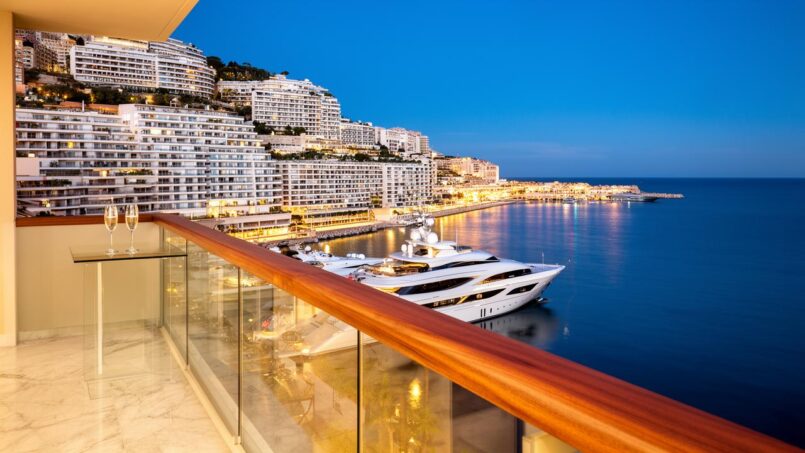
Larvotto has become the absolute star of the market. Driven by the Mareterra project – a high-end sea extension delivered in 2024, with waterfront villas, exceptional apartments, and a marina – the neighborhood has crossed a symbolic threshold: more than €70,000/m² on average in 2025, and up to €97,563/m² for the resale market in 2024 according to IMSEE.
| Neighborhood | Average resale price 2024 | 2025 indications |
|---|---|---|
| Larvotto | €97,563/m² | > €71,000/m² (overall average), with peaks of €60–120k/m² in the best locations |
Properties on the waterfront or with panoramic views position themselves as heritage trophies for an ultra-wealthy international clientele. For a French buyer, Larvotto is ill-suited for seeking high rental yield: even very high rents struggle to keep up with stratospheric purchase prices, limiting net yields to the low end of the market (often around 1.5–2% net in the best addresses).
This micro-segment has already recorded more than 30% growth over five years in certain sub-segments, with a potentially prolonged but moderate trend.
Monte-Carlo and Carré d’Or: Prestige, Liquidity, and Wealth Security
Monte-Carlo remains the most sought-after signature for those who want to combine prestige, centrality, and liquidity. In 2024, the average price was around €53,911/m², and Monte-Carlo holds steady in the €54,000/m² range in 2025, with much higher peaks in the Carré d’Or.
Transactions are numerous, properties are very liquid, and price growth prospects are estimated between 3% and 5% for the coming years, especially in the most exclusive areas near Place du Casino. Large family apartments with terraces, services, and views are particularly sought after and have seen their values jump: five-room and larger apartments average around €29 million in 2025, representing a year-on-year increase of about 54% in this ultra-prime segment.
For a long-term French investor, Monte-Carlo appears as a relatively “defensive” choice: deep market, high liquidity, strong resale values, and an ideal central location for mixed use (residence + investment).
Fontvieille: Port, Diversity, and a Slightly Lower Entry Point
Fontvieille, a seaside neighborhood with a marina and a more residential feel, remains very popular, but with a slightly lower entry point than the heart of Monte-Carlo. In 2024, the average price was around €53,908/m², close to Monte-Carlo but with greater product diversity.
The neighborhood combines several advantages for an investor: stable rental demand, pleasant living environment, and the presence of shops and services. Yields are generally slightly better than in hyper-luxury micro-neighborhoods, while offering moderate but steady appreciation potential.
La Condamine: Relative Affordability and Rental Yield
La Condamine is steadily emerging as one of the most interesting sectors for balancing still “reasonable” entry prices by Monaco standards with above-average rental yields. Prices are around €50,000–55,000/m², below the ultra-prime level, with a more varied market in terms of size and type.
Market data indicate that rental yields in this neighborhood can slightly exceed the Monégasque average, especially on compact units (well-located studios, one- or two-bedroom apartments). For a French investor targeting a rental investment rather than a pure collector asset, La Condamine is among the most relevant options in 2026.
Jardin Exotique, Les Moneghetti, La Rousse – Saint-Roman: Monaco’s “Affordable” Range
Within the Principality, some neighborhoods remain relatively “accessible”. Jardin Exotique had an average price of around €41,600/m² in 2023, the lowest in Monaco, and €49,847/m² in 2024. Les Moneghetti also falls in the lower range, around €42,000–44,000/m² depending on the year. La Rousse – Saint-Roman sits in an intermediate zone, around €45,000–50,000/m², statistically held back by the presence of many buildings from the 1970s–1980s.
The Jardin Exotique neighborhood attracts families thanks to accessible per-square-meter prices, spectacular views, and the arrival of new real estate programs such as L’Exotique, Grand Ida, or Villa Ninetta.
| Neighborhood | Average price 2024 (resale) |
|---|---|
| Les Moneghetti | €42,326/m² |
| Jardin Exotique | €49,847/m² |
| La Rousse | €45,303/m² |
For a French investor seeking slightly higher rental yields and a less dizzying entry ticket, these peripheral neighborhoods represent the main opportunity zone. The market logic is clear: the lower the acquisition price in Monaco, the closer the net yield tends to approach the market’s upper range (2.5–3.5% net).
Monaco-Ville: A Special Case
Monaco-Ville, the historic Rock, remains a very specific market with extremely low transaction volumes. In 2023, IMSEE reported an average price around €38,000/m², but this figure should be handled with caution due to low volumes. Investment here is more about heritage than financial return, and the absolute scarcity of available properties significantly limits opportunities.
Rental Yield: A Long-Time Low Market, Now Improving Significantly
Monaco has long been labeled a market with compressed rental yields: in practice, net yields hovered around 1.5–2%, rarely higher. Since 2025, the landscape has changed noticeably. Extreme tension between supply and demand, combined with rising rents (on the order of 8% to 15% over 2025 depending on the segment), is now pushing yields upward.
Available figures for 2025–2026 show gross yields averaging around 2.8–3.3%, and net yields generally ranging from 2% to 3.5% depending on type and neighborhood.
By Property Type: Small Units vs. Large Signatures
Market data shows average gross yields by property type that are quite revealing:
| Property Type | Average Purchase Price | Average Monthly Rent | Estimated Gross Yield |
|---|---|---|---|
| Studio | €1.79 million | €3,300 | ~2.21% |
| 1-bedroom | €3.5 million | €6,500 | ~2.23% |
| 2-bedroom | €5.8 million | €14,000 | ~2.90% |
| 3-bedroom | €12.5 million | €30,000 | ~2.88% |
| 4+ bedrooms | €29.5 million | €150,000 | ~6.10% |
In practice, these figures should be nuanced: large 4+ bedroom units yielding 6% gross represent a very specific subset of ultra-luxury properties, rented at exceptional amounts (€150,000/month and above), often in new programs with services worthy of a palace. Such opportunities remain rare and require massive initial capital.
For most investors, studios and one-bedroom apartments offer the best liquidity-to-yield ratio. Although their “theoretical” gross yield appears modest (around 2.2%), market reality shows that in more moderately priced neighborhoods (La Condamine, Jardin Exotique, Les Moneghetti), well-positioned rents allow approaching or even exceeding 3% net in some cases.
Net Yield: A Limited Gap Thanks to No Property Tax
Unlike France, where the difference between gross yield and net yield easily reaches one percentage point (or more) due to property taxes and other levies, Monaco imposes neither property tax nor recurring local tax on ownership. Condominium fees, property management costs (often 8–12% of rent), landlord insurance, and occasional refurbishment work are the main items to account for.
In ultra-prime neighborhoods, net yield for a well-managed property in a high-quality building typically falls within this range.
Seasonal and Short-Term Rentals: A Limited Bonus
The temptation of seasonal rentals is strong, especially around major events (Grand Prix, Yacht Show, conferences) and in neighborhoods like Larvotto or Fontvieille. Weekly rents can seem spectacular: a two-room sea-view apartment rents for €4,000 to €7,000 per week in high season, a four-room penthouse can reach €15,000 to €30,000 weekly.
However, strict regulations and seasonality limit overall performance: market analyses indicate net yields on the order of 3–4% for high-end seasonal rentals, barely higher than what can be achieved with well-optimized long-term rentals. This is more a tool for flexibility (being able to reclaim the property, use it occasionally) than a massive profitability lever.
Comparing Monaco and the Côte d’Azur: Tax, Yield, Usage
A French investor faced with Monégasque prices is naturally tempted to look toward Nice, Cannes, Antibes, or the neighboring capes. At €8,000–40,000/m² on the Côte d’Azur, compared to €50,000–100,000/m² in Monaco, the difference in entry ticket is staggering. Gross yields on the Riviera frequently range between 3% and 5%, with an average near 3.3%, and can climb to 5–8% net for very professional seasonal rental strategies (Cannes Croisette, Nice Promenade, Antibes, Juan-les-Pins).
The Côte d’Azur applies French tax rules (property tax, IFI, capital gains tax). Monaco levies no income tax, capital gains tax, wealth tax on real estate, or property tax for non-French residents and on Monégasque real estate, offering a major advantage for international investors.
For a French national, however, the picture is more nuanced: the 1963 tax treaty subjects French nationals residing in Monaco to French tax on their worldwide income, including rents and capital gains. In other words, the Monégasque “tax haven” does not apply in its full form to French nationals, even if they officially reside in the Principality.
Many investors adopt a mixed strategy: an address in Monaco for security, prestige, political stability, and quality of life, and a rental portfolio with higher yields on the Côte d’Azur (Nice, Cannes, Antibes), where they can achieve gross yields of up to 10% on certain highly targeted short-term rentals near Monaco, to generate cash flow.
Tax: A Massive Advantage… Except for the French
The Monégasque tax system is based on the absence of direct taxation: no income tax, no wealth tax, no property or occupancy tax, no capital gains tax on real estate for resident individuals, no inheritance tax between spouses and in the direct line, and modest rates for other transfers. This largely explains the growing concentration of ultra-wealthy individuals and the scarcity of supply.
Residency and Taxation in Monaco: Who Really Benefits?
To be recognized as a Monégasque tax resident, you must notably:
– hold a residence permit (carte de séjour),
– actually reside in the Principality (practice recommends at least 183 days per year, and in any case live there more than in any other country),
– provide proof of housing suitable for the size of your household,
– demonstrate sufficient financial resources, often through a deposit of at least €500,000 in a Monégasque bank.
For any non-French resident, this status grants exemption from taxes on income, capital gains on securities and real estate (including crypto-assets, stocks, business sales), as well as tax neutrality on rents received in Monaco. For example, reselling an apartment bought for €5 million and sold for €8 million incurs no capital gains tax at the Monégasque level.
French nationals, however, constitute an exception: the treaty of May 18, 1963 stipulates that French nationals who settled in Monaco after October 13, 1962 remain taxable in France on their worldwide income, and are subject to the wealth tax on real estate (IFI) on their global real estate assets exceeding €1.3 million. They continue to apply French tax rules on real estate capital gains, with exemption after 22 years of ownership for income tax and 30 years for social contributions, as well as on rental income.
In short, for a French person, real estate investment in Monaco does not allow escaping French tax, but it does provide access to an exceptional market that is extremely protective from a wealth management perspective and very attractive in terms of local succession.
Inheritance Tax: A Strong Wealth Planning Interest
Regarding succession, Monaco applies very favorable taxation for properties located on its territory, regardless of the nationality or residence of the deceased or heirs. Monégasque inheritance tax rates are zero between spouses and in the direct line (children, grandchildren). They rise to 4% between civil union partners, 8% between siblings, 10% between uncles/aunts and nephews/nieces, 13% for other collateral relatives, and 16% between non-relatives.
For an heir who is a French tax resident, assets received, including those located in Monaco, are taxed in France according to French rates. The Franco-Monégasque treaty of April 1, 1950 allocates the taxing right: real estate in Monaco is subject to Monégasque inheritance tax, with a tax credit in France to avoid double taxation. Monégasque real estate can thus play a key role in wealth transfer, especially for direct transfers or to a spouse.
Acquisition Costs: A High Entry Fee but No Recurring Taxes
Investing in Monaco involves a significant entry cost in the form of registration duties and notary fees, but this cost is only incurred upon acquisition, with no annual property tax.
For an individual buying a resale property, the typical cost structure is as follows:
| Item | Indicative Rate |
|---|---|
| Registration duty (resale) | 4.75% |
| Notary fees and disbursements | ~1.5% |
| Total legal acquisition costs | ~6.25% |
For an off-plan (VEFA) purchase (new or under construction) by an individual, the transaction is generally subject to VAT (included in the price) and benefits from reduced registration duties:
| Property Type | Registration Duty | Notary | Approximate Total |
|---|---|---|---|
| New / Off-plan (individual / Monégasque SCI) | 1% | ~1.5% | ~2.5% |
Purchases via foreign or non-transparent companies are, however, heavily taxed, with registration duty rates of 7.5% to 10%, plus notary fees. Recent reforms have also strengthened indirect taxation in the event of a change in the beneficial owner of a structure holding real estate in Monaco, with a duty of 4.75% on the property’s value if transparency is not fully ensured.
Nearly 99% of real estate transactions go through an agency.
Financing: Mortgages Available but Selective
Contrary to popular belief, it is possible to obtain financing in Monaco, even as a non-resident foreigner. Monégasque banks – subsidiaries of major international groups – offer real estate loans to investors, but with more selective requirements than in France.
Typical features include:
– High minimum loan amount: often starting at €500,000,
– Prudent loan-to-value ratios: 50–70% of the property value for standard loans, exceptionally up to 100% with asset collateral,
– Relatively short terms: generally 5 to 15 years, with cases extending to 25 years,
– Interest rates aligned with the eurozone: around 3–4% fixed rate in 2024–2025, variable rates indexed to Euribor + 1–2%.
Banks require proof of income, assets, and financial stability, and may demand significant deposits or a transfer of assets under management for non-residents.
For a French investor accustomed to French mortgage lending, the contrast is sharp: in France, in 2026, 20-year rates are around 3–3.5% for the best-rated residents, with LTVs up to 80–90% (or even 100% in certain savings-backed structures). In return, French taxation on rents and capital gains remains fully applicable.
For a purely financial investment, the trade-off is simple: in France, more generous leverage but heavy taxation; in Monaco, virtually no local tax for non-French buyers, but harder credit and a higher entry ticket.
Transparency and Compliance: A More Demanding but Reassuring Environment
In recent years, Monaco has strengthened its regulatory arsenal to meet international standards against money laundering and terrorist financing. Laws adopted in 2023–2024 have introduced:
Foreign entities owning real estate in Monaco must now identify their beneficial owners, subject to an annual tax of 1% of the property’s value. The property trading activity is regulated: the full exemption from registration duties has ended, with a capped allowance of 50% subject to quick resale and compliance conditions. Real estate professionals see their status strengthened with mandatory professional cards, initial and ongoing training, a ban on advertising by non-professionals, and heavy penalties.
At the same time, cooperation with the FATF should allow Monaco to be removed from the “grey list” in 2026, lifting the last regulatory cloud that could still worry some major institutional investors. For a French investor, these changes translate into more rigorous procedures, stronger controls, and the need to work with authorized intermediaries, but also into greater legal and reputational security.
What Strategy for a French Investor in 2026?
Given the specific French tax situation, the structure of Monégasque prices, and market dynamics, several investment paths emerge for a French investor in 2026.
1. Ultra-Prime Purchase: Long-Term Capitalization and Prestige
Target: Larvotto, Carré d’Or, extremely central Monte-Carlo, programs like Mareterra, Bay House, Schuylkill, etc.
Primary objective: long-term wealth preservation and growth more than yield.
This strategy essentially treats the Monégasque apartment as a “safe in concrete”, benefiting from:
– very strong value stability,
– growing global demand,
– absolute scarcity of new land.
Net rental yield will be modest, often below 2%, but the asset can play a crucial role in wealth structuring, especially for transfers (low Monégasque duties) and for image or lifestyle comfort.
For a French person subject to income tax and IFI, this model nevertheless remains costly in terms of annual tax burden, unless the ownership structure and choices between primary/secondary residence are finely optimized.
2. Moderate-Yield Investment: “Affordable” Neighborhoods and Small Units
Target: La Condamine, Jardin Exotique, Les Moneghetti, even La Rousse – Saint-Roman, with a preference for studios and one-bedroom apartments.
The primary objective is to achieve a net yield between 2.5% and 3.5%, favoring a very liquid market and betting on moderate but steady capital appreciation.
This strategy suits investors who accept limited price risk (since levels are already very high) but want a minimum income to offset opportunity cost. For a French person, this income remains taxable in France, but the near absence of local taxation (no property tax, no Monégasque social contributions) helps preserve part of the profitability.
3. The Monaco + Côte d’Azur Combination
Target: a pied-à-terre or residence in Monaco, and a high-yield rental portfolio on the French Riviera.
The objective is to enjoy Monaco’s stability, prestige, and lifestyle while generating yield from properties in Nice, Cannes, Antibes, or inland villages. Expected yields are 4–5% gross for long-term rentals, or even 5–8% net for well-managed seasonal rentals.
This setup appeals to many wealthy French nationals: they accept French taxation on the rental portfolio, but use the Monégasque address as a symbolic, logistical, and potentially future wealth transfer anchor.
4. The “Renovation and Upgrading” Angle
Target: older buildings in La Rousse – Saint-Roman, certain segments of Moneghetti or Jardin Exotique, even Monte-Carlo outside the ultra-prime zone.
Primary objective: buy a property to renovate, enhance its standard (finishes, kitchen, bathrooms, home automation, space optimization, obtaining parking spaces or amenities) to capture capital gains above the market’s simple inflation.
This strategy requires excellent knowledge of the local fabric, regulations (especially regarding urban planning, condominium rules, and technical standards), and craftspeople capable of working in a very demanding environment. It is riskier, but for a French person subject to capital gains tax, it can allow benefiting from reduction schemes based on holding period and reasonable leverage from financing.
Why 2026 Is a Strategic Window
Finally, several factors converge to make 2026 a pivotal time to seriously consider Monégasque real estate.
First, the stabilization of interest rates in the eurozone at levels well below the 2023–2024 peaks provides clearer visibility on the cost of debt, both in Monaco and France. Second, the prospect of removal from the FATF “grey list” reinforces the institutional attractiveness of the Monégasque center.
The cycle of exceptional deliveries (Mareterra, Bay House, Testimonio II, L’Exotique) is coming to an end. New supply is dwindling, prices remain stable and high, and international demand is strong. The rental market is rising, making investment in quality assets potentially profitable over the long term (15–20 years), even without a price reduction.
For a French investor, the key is not to try to replicate the tax optimization structures reserved for non-nationals, but to integrate Monaco into a global strategy: personal use, international diversification, succession engineering, complementarity with other assets in France and abroad.
In this context, 2026 is not the year for speculative coups, but for structuring decisions and very long-term wealth consolidation. Monaco, through its scarcity and consistency, remains one of the rare markets where price stability merges with a form of silent growth, driven by time and the definitive rigidity of geography.
A wealth project or a question? Contact us now to speak with a wealth management expert.
Disclaimer: The information provided on this website is for informational purposes only and does not constitute financial, legal, or professional advice. We encourage you to consult qualified experts before making any investment, real estate, or expatriation decisions. Although we strive to maintain up-to-date and accurate information, we do not guarantee the completeness, accuracy, or timeliness of the proposed content. As investment and expatriation involve risks, we disclaim any liability for potential losses or damages arising from the use of this site. Your use of this site confirms your acceptance of these terms and your understanding of the associated risks.

Cyril Jarnias is an independent expert in international wealth management with over 20 years of experience. As an expatriate himself, he is dedicated to helping individuals and business leaders build, protect, and pass on their wealth with complete peace of mind.
On his website, cyriljarnias.com, he shares his expertise on international real estate, offshore company formation, and expatriation.
Thanks to his expertise, he offers sound advice to optimize his clients' wealth management. Cyril Jarnias is also recognized for his appearances in many prestigious media outlets such as BFM Business, les Français de l’étranger, Le Figaro, Les Echos, and Mieux vivre votre argent, where he shares his knowledge and know-how in wealth management.





