
 Published on and written by Cyril Jarnias
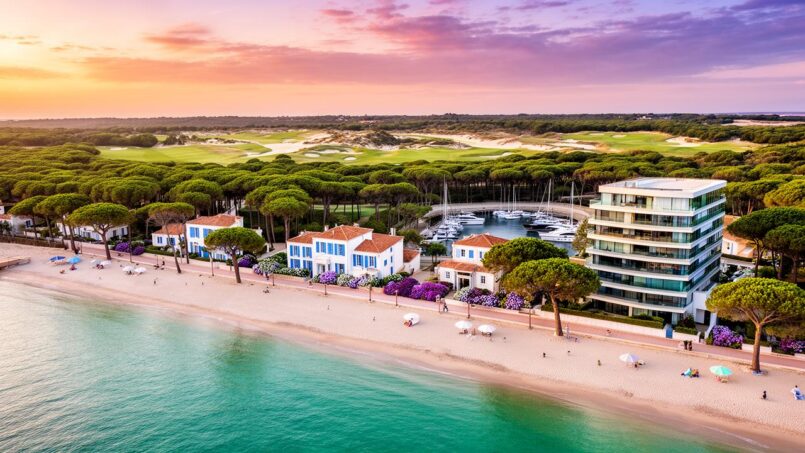
The French Atlantic coast has become, in just a few years, one of the favorite playgrounds for international investors. Between La Rochelle, Royan, Biarritz, the Arcachon basin, or the long Landes beaches, the region combines tourist appeal, quality of life, and a real estate market still less strained than the Côte d’Azur or Paris. For a foreign buyer, it is both an opportunity and a genuine regulatory, tax, and administrative journey.
This guide provides a practical overview of real estate on the Atlantic coast and seaside resorts for foreign investors, with recent data on the French market, the legal framework, taxation, and financing.
1. Why the Atlantic Coast Attracts Foreign Investors
The Atlantic coast combines several advantages that immediately appeal to non-resident investors: a milder climate than the Mediterranean, family-friendly beaches, waves prized by surfers, dynamic mid-sized cities like Bordeaux or La Rochelle, and an increasingly protected natural heritage.
In the Southwest, prices have surged up to 55% over ten years, with a clear additional increase along the Basque coast and in highly touristy municipalities.
1.1. High Prices on the Coast, but Still Below Paris
The market remains highly heterogeneous. On one hand, ultra-premium destinations like Cap-Ferret or Biarritz, now nearly on par with certain Parisian neighborhoods. On the other, more affordable resorts, often in the process of upgrading.
Key figures illustrate this diversity:
| Area / City | Average Price per m² (approx.) | Comments |
|---|---|---|
| France – national average | €2,930 / m² | National benchmark |
| Southwest (2026 average) | €4,700 / m² | Up about 2% year-over-year |
| Nouvelle-Aquitaine (overall) | €4,500–5,200 / m² | Includes Bordeaux, coastline, etc. |
| La Rochelle (older properties) | ~€4,800–5,000 / m² | Slight recent decline, but strong rental tension |
| La Rochelle (new builds) | >€5,000 / m² | High demand, gross yields 3.5–4.5% |
| Biarritz (apartments) | ~€7,500–7,800 / m² | Very high-end market |
| Lège–Cap-Ferret | ~€11,800 / m² | Ultra-luxury segment |
| Urrugne (Basque coast) | ~€5,200 / m² | Somewhat more accessible alternative |
On a national scale, the Atlantic coast is therefore clearly above the national average, but still below central Paris, where apartments hover around €9,500–9,700 / m². For a foreign investor, this means a significant entry price at iconic locations, but still a wide range of opportunities in less “starred” resorts.
1.2. A Generally Healthy and Regulated Market
The French real estate market is known for its strict regulation and lack of massive speculation. The increase in Nouvelle-Aquitaine remains contained (2–3% per year expected), far from the surges of some Anglo-Saxon markets. Sales of existing homes have returned to a dynamic level (nearly 900,000 transactions over 12 months nationwide), while new construction suffers more from a regulatory environment and rising construction costs.
For the foreign investor, this regulated market structure offers a more predictable environment, at the cost of sometimes heavy procedures and a slower decision-making pace.
2. Foreigners’ Rights: What French Law Says
Unlike other countries, France applies a principle of equal treatment: the Constitution and the Civil Code guarantee that a foreigner can purchase a residential property under the same conditions as a French citizen, regardless of nationality. There are no “reserved zones” or acquisition quotas.
A foreign investor can therefore:
Possibility to buy anywhere in metropolitan France, including on the Atlantic coast and in seaside resorts. The property can be owned 100% individually, jointly, or through a company. The purchase concerns an apartment, house, villa, building land, or certain rural land with restrictions.
The only notable difference lies in the control of the origin of funds and the greater difficulty in accessing credit for a non-resident.
2.1. No “Golden Visa,” No Automatic Residency
A frequent misunderstanding, especially among North American and British buyers, is the belief that purchasing real estate grants a residence permit or passport after a few years. In France, real estate and immigration are two entirely separate matters.
Buying a property does not grant any residency rights or automatic “golden visa.” However, ownership can facilitate a visa application by proving accommodation or local ties, without legally influencing the decision.
A non-European, including British or American, can:
– Visit visa-free for up to 90 days out of 180 in the Schengen area.
– To stay longer (e.g., a year on the Atlantic coast), apply for a long-stay visa, such as the VLS-TS “visitor” for financially independent individuals.
The VLS-TS visitor visa typically requires:
– Resources of at least €1,800 per month from passive or remote income.
– A home (purchased or rented) in France.
– A commitment not to work or engage in commercial activity in France.
After 5 years of continuous residence under appropriate permits, it becomes theoretically possible to apply for naturalization, but again real estate is only an accessory factor.
3. Where to Invest on the Atlantic Coast? Focus on La Rochelle, Biarritz & Co.
The Atlantic coastline is not a homogeneous block: price dynamics, rentals, and regulations vary greatly between, for example, a studio in Biarritz and a house in Royan.
3.1. La Rochelle: Dynamic but Regulated
La Rochelle illustrates current contrasts well. Prices for existing homes have slightly declined to around €4,800–5,000 / m², while new builds frequently exceed €5,000 / m². Despite this temporary dip, the city remains highly sought after, with an average time on market of about 60 days.
Professional observatories anticipate a slight price recovery of 2 to 3% by 2026.
For a foreign investor, La Rochelle therefore combines:
– Structural rental tension (strong tourist appeal, university, port, TGV).
– Significant entry price, but lower than Biarritz or Cap-Ferret.
– New construction market impacted by environmental standards, which reduces supply and supports prices of existing properties with good energy performance.
3.2. Biarritz, Arcachon, Cap-Ferret: The Ultra High-End
In the premium segment, the Atlantic coast is no longer inferior to the Côte d’Azur. In Biarritz, apartments trade around €7,500–7,800 / m² and Cap-Ferret easily exceeds €11,000 / m². Gross rental yields may seem modest (often 3–4%), but capital appreciation remains the main argument.
Projected annual growth in coastal departments like Landes or Charente-Maritime, according to regional projections.
3.3. Southwestern Atlantic: Underlying Trends
Beyond a few iconic cities, the Southwestern Atlantic shows robust trends:
| Regional indicator (Southwest / broader Atlantic) | Value / recent change |
|---|---|
| Price increase over 10 years | +35 to +55% |
| Median price per m² (early 2026) | ~€4,100 / m² |
| Average price per m² (early 2026) | ~€4,700 / m² |
| Annual increase (2025 → 2026) | ~+2% (nominal) |
| Inflation-adjusted change | Nearly stagnant |
| Increase in existing home sales (France) | +10% approx. |
| Sales increase in Gironde | +18% |
The coastal departments like Landes or Charente-Maritime show annual increases of 4 to 7%, with higher rises for apartments (popular for seasonal rentals) than for detached houses.
4. Renting Out Your Property on the Coast: Profitability, Regulations, and EPC
For a foreign investor on the Atlantic coast, the dominant logic remains the profitable second home: rented by the week during part of the year (school holidays, summer, long weekends) and personally used the rest of the time.
4.1. Seasonal Rental Levels and Yields
Available data indicate that, on the Atlantic coast, seasonal rents generally range between €25 and €30 per m² per month on average over the year (including low season), with much higher peaks in July–August.
In some highly touristy areas, gross yields can exceed 6% on optimized properties, compared to the norm of 3.5 to 4.5% in La Rochelle.
4.2. Rental Rules and Energy Constraints
France has significantly tightened regulations on the energy performance of housing. The Energy Performance Certificate (EPC) directly impacts rental use:
| EPC rating of property | Rental status in France |
|---|---|
| Class G | Banned from rental since 2025 |
| Class F | Banned from rental starting 2028 |
| Class E | Banned from rental starting 2034 |
These dates will also apply to properties in Atlantic coast seaside resorts. Concretely, a foreign investor buying a class F apartment by the sea today faces the impossibility of renting it out within a few years, unless undertaking energy renovation work.
A notarial study has already shown a discount of at least 10% between well-rated properties (A/B) and poorly insulated ones (D and above). On the coast, where prices are high, this discount can represent tens of thousands of euros.
Tourist furnished rentals are increasingly regulated, especially in major cities. Paris applies the strictest rules, and many Atlantic municipalities limit the number of rental days or require specific authorization.
4.3. Should You Aim for the LMNP Status?
For a foreigner renting out a furnished apartment in La Rochelle, Biarritz, or Arcachon, the LMNP (Non-Professional Furnished Lessor) regime is particularly attractive. It allows:
– Deducting most expenses (loan interest, renovations, management fees…).
– Depreciating the property in accounting, which greatly reduces taxable income.
– In many cases, little or no tax on rental income for 10 to 15 years, even for a non-resident.
This structure, however, must be studied with a professional, as it interacts with the tax treaty of the investor’s country of residence and French rules on rental income.
5. Taxation for Foreign Investors: What You Really Need to Plan For
French taxation may seem intimidating, but it is based on a few clear principles for non-residents.
5.1. Tax on Rental Income: Tax Rates
All rental income from a property located in France is taxable in France, even if the owner lives elsewhere. Two elements come into play: income tax and social contributions.
For a non-resident:
– The minimum income tax rate is 20% on the lower income bracket, then 30% above approximately €29,000 of taxable income.
– Social contributions are added: 7.5% for residents of the EU/EEA/Switzerland, 17.2% for others.
The table below summarizes the typical impact on net rental income (after expenses) for a foreign investor without specific optimization:
| Owner’s tax profile | Income tax (min.) | Social contributions | Approximate total rate |
|---|---|---|---|
| EU/EEA/Swiss resident | 20% | 7.5% | ~27.5% |
| Non-EU resident (USA, UK post-Brexit…) | 20–30% | 17.2% | ~37.2 to 47.2% |
In practice, thanks to real cost regimes and LMNP, the taxable base can be greatly reduced, hence the importance of proper structuring.
5.2. Capital Gains on Resale
Upon resale with capital gains, a non-resident is taxed at the same base rate as a resident for the tax component:
The overall tax rate on real estate capital gains for an individual, including 19% tax and 17.2% social contributions.
A system of progressive allowances however reduces these rates over time:
| Holding period | Tax effect on capital gains (excluding social contributions) |
|---|---|
| Up to 6 years | No allowance |
| 6 to 22 years | Progressive allowance |
| ≥ 22 years | Full exemption from capital gains tax |
| ≥ 30 years | Full exemption from social contributions as well |
In other words, a long-term investor who keeps a seaside apartment for more than 30 years can resell without any capital gains tax. Conversely, rapid turnover of assets will be more heavily taxed.
5.3. IFI: The “Real Estate Wealth Tax”
The Real Estate Wealth Tax (IFI) only concerns a minority of international investors, but quickly becomes a topic on the Atlantic coast where values easily exceed one million for a villa with a sea view.
Key principles:
IFI only concerns real estate assets, not financial assets. The threshold is €1.3 million in net real estate assets. For a non-resident, only real estate located in France is considered.
2025 scale (which remains unchanged in its main principles):
| Net real estate wealth bracket | IFI rate |
|---|---|
| < €800,000 | 0% |
| €800,000 – €1.3M | 0.5% |
| €1.3M – €2.57M | 0.7% |
| €2.57M – €5M | 1.0% |
| €5M – €10M | 1.25% |
| > €10M | 1.5% |
On the Atlantic coast, it is therefore common for a portfolio of two or three properties (e.g., a 3-room apartment in Biarritz, a house in La Rochelle, and a small rental building in a mid-sized city) to cross this threshold over time.
5.4. Local Taxes: Property Tax and Residence Tax on Second Homes
Every owner, resident or not, is liable for property tax. On the Atlantic coast, expect on average:
– €900–1,300 per year for an apartment.
– €1,150–1,800 per year for a house.
Residence tax has been abolished for primary residences but remains on second homes – which applies to the majority of foreign investors on the coast. Some mayors of highly touristy resorts even increase this tax to combat the “residentialization” of homes into tourist rentals.
6. Financing a Purchase When You Are Not a Resident
French banks willingly finance foreign buyers, but with stricter requirements than for residents.
6.1. Amounts, Down Payments, and Rates for Non-Residents
In 2025–early 2026, the average observed conditions are as follows:
| Borrower profile / bank type | Down payment required (approx.) | LTV (loan-to-value ratio) | Typical fixed rate (non-resident) |
|---|---|---|---|
| Standard non-resident (retail bank) | 30–40% | 60–70% | 3.4–4.2% |
| French resident | 10–20% | 80–90%, sometimes 100% | 3.1–3.4% |
| Non-resident HNWI (private bank) | 10–30% (with assets as collateral) | Up to 90–100% (if portfolio pledged) | Negotiated case by case |
Notable institutions for working with non-residents include BNP Paribas (Non-Residents service), Banque Transatlantique, CIC, LCL, Crédit Agricole, BRED, and Société Générale through their expatriate divisions.
Important points for the foreign investor:
For a non-resident, verifying income and assets from abroad complicates obtaining a loan, justifying higher down payments. Banks impose a strict debt-to-income ratio of 30 to 33% of gross income. Additionally, processing takes 90 to 120 days, compared to 45 days for a resident.
6.2. Types of Loans and Financing Strategies
The credit offer is diverse, even for foreigners:
– Fixed-rate loans (very common in France, from 6 to 25 years, often 20 years).
– Variable-rate loans indexed to Euribor, with a margin of 1–2 points.
– Mixed loans (initial fixed rate, then variable).
– Interest-only loans, especially for portfolios over €1M.
– Bridge loans to buy before selling.
For a foreign investor by the sea, a common strategy involves: acquiring properties in tourist areas to maximize rental yield, benefiting from selling these properties at a premium, or developing real estate projects to attract potential buyers seeking vacation homes or second residences. This approach leverages the appeal of seaside destinations and the growing demand for quality housing.
To maximize your chances of obtaining a mortgage, bring a substantial down payment of 30 to 40%, which improves your rate and reassures the bank. Calculate the monthly payment based on your repayment capacity, while allowing a margin for renovations and unexpected rental costs. Additionally, consider an LMNP (Non-Professional Furnished Lessor) setup to depreciate the property and improve your net profitability.
6.3. Currency Risk: A Parameter Not to Overlook
All purchases are denominated in euros. For an investor earning in dollars, pounds, or Canadian dollars, the volatility of the exchange rate EUR/GBP or EUR/USD directly impacts the final cost of the property, especially between the offer and the final signing (about 3 months).
Solutions exist to mitigate this risk:
– Forward contracts to lock in an exchange rate several months in advance.
– Multi-currency accounts, allowing conversions on an ongoing basis with reduced fees.
– Financing directly in euros from a French bank, reducing the need for large one-time transfers.
A simple 0.04 swing in the GBP/EUR rate can change the cost, in the original currency, of a €300,000 purchase by €10,000.
7. The Purchase Process: From Preliminary Contract to Final Deed
The acquisition procedure in France can be confusing for a buyer accustomed to Anglo-Saxon systems. It is highly standardized, overseen by the notary, a state representative, and conducted in French.
7.1. The Central Role of the Notary
The notary is neither the seller’s nor the buyer’s lawyer. They act as a guarantor of the legality of the transaction, verify the title deed, easements, mortgages, gather regulatory diagnostics, and calculate and collect taxes.
On the Atlantic coast, as elsewhere, no purchase is possible without them. It is common for one notary to represent both parties, but a foreign buyer can appoint “their” notary, who will co-work with the seller’s notary.
7.2. Key Steps for a Foreign Investor
Without going into every legal detail, the framework is fairly consistent:
The steps include: 1) Morally binding purchase offer. 2) Preliminary contract drafted by the notary with property description, price, loan period, and conditions precedent. 3) 10-day withdrawal period for the individual buyer. 4) Deposit of 5 to 10% placed in escrow. 5) Legal checks by the notary (zoning, mortgages, diagnostics). 6) Signing of the final deed, final payment, and handover of keys.
Between the preliminary contract and the final deed, allow 2 to 4 months on average, sometimes longer for a foreign financing file. The buyer can grant power of attorney and not be physically present; the entire transaction can be managed remotely, provided there is trustworthy support (notary, bilingual agent, translator).
7.3. Total Cost of the Transaction
On the Atlantic coast, as everywhere, you must account for significant acquisition costs:
| Type of property | Notary fees + transfer taxes | Typical total additional cost |
|---|---|---|
| Existing home | ~7–8% of price | 10–15% including work, furniture, etc. |
| New build (off-plan, recent construction) | ~2.5–4% | 5–10% if adding finishes and furnishings |
A house at €500,000 in La Rochelle could therefore result in a real budget close to €550,000–575,000, especially if energy renovations are needed to remain rentable long-term.
8. Environmental Standards and Their Impact on Atlantic Seaside Resorts
The Atlantic coast is directly affected by the French and European environmental shift. In addition to the EPC mentioned above, several laws impact new programs and renovation.
8.1. Rising Construction Costs, Fewer Permits
The new regulations (RE2020, Climate and Resilience Law, tertiary schemes, etc.) impose:
– Very low CO₂ emission ceilings per m² for new construction.
– The gradual near-disappearance of oil and gas boilers.
– Stricter insulation requirements and adaptation to heatwaves without massive air conditioning.
– Obligations for greening or solar energy production on part of the roofs or parking areas.
The number of building permits fell by about 30% in 2023.
– A scarcity of quality new supply, especially energy-efficient.
– Sustained support for prices of well-insulated existing properties.
– Increased pressure on owners of “thermal sieves” that become progressively unsellable to investors wanting to rent.
8.2. Opportunities for “Green” Renovation
The government offers energy renovation grants up to about €10,000 for certain work (insulation, heating system replacement, etc.). Foreign owners may qualify under conditions. On the coast, combining:
– A slightly discounted purchase of a poorly rated property (F or G).
– Targeted renovation to bring it up to at least D or C.
– An LMNP strategy to depreciate the investment.
can result in a winning mid-term transaction, even if the initial bill is heavy.
9. How to Strategically Approach an Investment on the Atlantic Coast
Faced with the legal, fiscal, and regulatory complexity, the foreign investor is better off adopting a structured approach rather than being guided solely by a crush on an ocean view.
A few basic principles emerge from market analysis and the legal framework.
9.1. Clarify Your Objective: Personal Use vs. Yield
Most purchases in Atlantic seaside resorts are lifestyle investments: a vacation home that can partially self-finance through rentals. In this case, a moderate gross return (3.5–4.5%) is often tolerated in exchange for:
– A high probability of capital appreciation.
– Regular personal use (family, future retirement).
Conversely, a purely yield-oriented investor should aim for:
To succeed in your rental investment, prioritize cities or resorts with moderate price per m², opt for optimized tax regimes like LMNP (real cost) or corporate structures, and select properties with good EPC ratings to ensure rentability after 2025-2034.
Target cities and resorts where purchase costs remain affordable to maximize profitability.
Use regimes like LMNP (real cost) or appropriate corporate structures to reduce taxes.
Choose properties with a good EPC rating to stay rentable after 2025-2034 and avoid regulatory constraints.
9.2. Factor in Taxation from the Project’s Conception
Income tax on rent, potential IFI, capital gains tax, and inheritance rules must be anticipated before signing the deed. This often involves:
Choose between direct ownership or via a real estate company (SCI, possibly subject to corporate tax). Check tax treaties (tax credit, non-double taxation). Project a resale scenario (10, 20, or 30 years) to optimize capital gains allowances.
9.3. Build a Local Team
French law, governed by a Civil Code over 200 years old and extensively revised, can seem bewildering. The French language, especially its legal variant, adds an extra barrier. It is therefore crucial to surround yourself with:
– A notary experienced with foreign files (ideally bilingual or working with an official interpreter).
– A real estate agent familiar with coastal areas, their true price levels, and local seasonal rental regulations.
– A tax advisor / lawyer to align the project with the home country’s taxation.
– Possibly a mortgage broker specialized in non-residents to optimize financing.
10. Conclusion: A Demanding Market, but Rich in Opportunities
This guide to real estate on the Atlantic coast and seaside resorts for foreign investors highlights an ambivalent reality. On one hand, an attractive market, supported by:
– A weaker euro that increases purchasing power for investors in dollars or pounds.
– Prices generally lower than in Paris or certain areas of the Côte d’Azur.
– Solid tourist demand, boosted by the search for nature and preserved coastline.
– Moderate but steady price growth prospects (2–3% annually on average, more in certain coastal pockets).
On the other hand, an environment where:
Regulatory constraints like the EPC and furnished rental norms complicate second-home projects. Taxation on rental income, capital gains, and IFI penalizes speculative strategies. Financing for non-residents requires a high down payment and solid files.
For a clear-eyed, prepared, and properly guided foreign investor, the French Atlantic coast nevertheless remains a top destination: a tangible investment in a politically stable country with a regulated real estate market, in cities and resorts that combine quality of life, lasting tourism, and cultural heritage. The key lies in careful selection of location, mastery of the legal framework, and a long-term vision rather than a quest for immediate double-digit returns.
In other words: the Atlantic coast is not a speculative El Dorado, but an excellent base to patiently build European heritage by the sea.
A wealth planning project or a question? Contact us now to speak with a wealth management expert.
Disclaimer: The information provided on this website is for informational purposes only and does not constitute financial, legal, or professional advice. We encourage you to consult qualified experts before making any investment, real estate, or expatriation decisions. Although we strive to maintain up-to-date and accurate information, we do not guarantee the completeness, accuracy, or timeliness of the proposed content. As investment and expatriation involve risks, we disclaim any liability for potential losses or damages arising from the use of this site. Your use of this site confirms your acceptance of these terms and your understanding of the associated risks.

Cyril Jarnias is an independent expert in international wealth management with over 20 years of experience. As an expatriate himself, he is dedicated to helping individuals and business leaders build, protect, and pass on their wealth with complete peace of mind.
On his website, cyriljarnias.com, he shares his expertise on international real estate, offshore company formation, and expatriation.
Thanks to his expertise, he offers sound advice to optimize his clients' wealth management. Cyril Jarnias is also recognized for his appearances in many prestigious media outlets such as BFM Business, les Français de l’étranger, Le Figaro, Les Echos, and Mieux vivre votre argent, where he shares his knowledge and know-how in wealth management.





