
 Published on and written by Cyril Jarnias
Real estate in Senegal is increasingly attractive: urban growth, high demand in Dakar, the prospect of high rents, infrastructure projects like the BRT… On paper, everything seems aligned for profitable deals. But behind this potential lies a minefield: land conflicts, unclear titles, informal practices, organized scams, and cumbersome administrative procedures.
Nearly 90% of conflict risks in Senegal are land-related, according to President Macky Sall.
This article provides an in-depth overview of the main pitfalls and mistakes to avoid before investing in real estate in Senegal, based on research, official data, and concrete cases.
Understanding the Senegalese land context before any decision
Investing without understanding the specifics of Senegalese land law is like signing a blank check. The first instinct should be to place the land or building in the correct legal framework.
National Domain, Land Title, and customary rights: three realities not to be confused
The vast majority of Senegalese territory—around 90 to 95% depending on sources—falls under the National Domain, defined notably by law 64‑46. On these lands, there is in principle no private property in the classical sense. The State and local authorities allocate usage rights (occupation, exploitation), often managed in practice through decisions by rural councils or community deliberations.
Alongside this vast National Domain, there are lands benefiting from a Land Title (TF). This document constitutes the absolute and definitive proof of ownership. The TF is registered with the Land Registry (DGID) and allows for clear transfer that is enforceable against all.
In many rural areas and urban peripheries, customary rights persist. Land management and transfer are handled by traditional chiefs or community leaders, often without any registration in official records.
For an investor, the security hierarchy is clear:
| Type of right | Level of legal security | Main risks |
|---|---|---|
| Land Title (TF) | Very High | Occasional litigation, judicial delays |
| Administrative acts (deliberations, leases, etc.) | Medium | Revocability, disputes, overlaps |
| Customary rights / “neighborhood papers” | Low | Multiple sales, expropriation, local conflicts |
The most serious mistake for a foreigner is to buy a property without a TF, settling for promises like “we’ll get the title later” or “the town hall will regularize it.” In the Senegalese context, this means exposing yourself to discovering, sometimes years later, that the land was Non-titrable National Domain at the time, that another buyer obtained a competing deed, or that the local community totally contests the sale.
A formal legal system… but difficult to access and often contested
In theory, Senegal has a fairly structured framework: Civil Code inspired by French law, specific laws on the National Domain, state property, private property, and hierarchical courts (lower courts, regional courts, Court of Appeal, Supreme Court). The country has acceded to major international arbitration conventions (New York Convention, ICSID), and in principle accepts international arbitration for investment disputes.
In practice, the protection of land rights is hindered by numerous significant obstacles that make their defense particularly complex.
– Long and costly judicial procedures, with sometimes contradictory, poorly reasoned, or poorly disseminated decisions.
– Difficulty of access to courts, especially for rural populations who lack transportation, legal counsel, and see justice as “opaque” or unfavorable to their interests.
– Suspicions of bias or corruption, fueling strong distrust of formal institutions.
– Frequent preference for traditional mediation mechanisms, which are faster and focused on social peace, but poorly suited when a private investor, especially a foreign one, is involved.
Result: many land conflicts are resolved on a political or community basis, rather than strictly legal. For an investor, this means that even a seemingly “regular” deed can be contested locally, with parallel recourse through elected officials, customary chiefs, or even social mobilization.
The weight of land conflicts and the example of Fanaye
African statistics show that the majority of conflicts related to land investments stem from evictions of local communities. A study cited in the research indicates that 63% of land disputes in Africa arise from population displacement, and that 70% of tenant conflicts originate from displacement issues, with the remainder relating to compensation disputes.
This project, awarded without the consent of local communities, sparked violent protests in Fanaye Dieri resulting in two deaths, forcing the state to withdraw the concession. Relocated to the Ndiael reserve, it deprived herders of access to pastures, generating new tensions. Six years later, only 1,500 hectares out of 20,000 allocated were being used.
For the real estate investor, this case recalls a reality: acquiring a right to land is not enough; that right must also be socially accepted. Ignoring neighboring populations, herders, and traditional users opens the door to blockages, even violence.
Fake titles, multiple sales, and scams: anatomy of a high-risk sector
Beyond structural issues regarding land ownership, Senegalese real estate suffers from a proliferation of more classic but equally dangerous scams: fake developers, identity theft, forged documents, multiple sales, and undeclared “coxeurs” (informal intermediaries).
A sector plagued by informality and fraud
Nearly 45% of constructions in Senegal are reportedly carried out without regular title, based on simple “private deeds,” provisional certificates, or unconverted deliberations. Courts handle hundreds of cases related to land fraud, while the media regularly report cases of people ruined after buying land that was already sold or belonging to the state.
Among the most common practices:
Beware of fake developers or municipal agents who present fake administrative documents and pocket the money before the buyer discovers the land belongs to someone else. Multiple sales of the same property to several buyers, forged land titles, identity theft of the owner (especially if residing abroad), and transactions based on unlegalized or fabricated powers of attorney are also common scams.
Victims are numerous, particularly among the diaspora who invest remotely, through relatives or “contacts” found on social media.
The ambiguous role of “coxeurs” and pseudo-real estate agents
The market is full of intermediaries who present themselves as “real estate agents,” but without clear status or professional oversight. Many juggle other activities (selling cars, food) and have neither liability insurance nor a proper written mandate.
Several documented abuses include:
These practices include charging for fictitious viewings, making excuses to avoid actual visits while demanding a deposit, inflated prices with abusive commissions (up to 30%), and appropriating private listings without a mandate to resell at a markup, disrupting the market.
Without a written mandate, without verification by a notary, if the transaction goes wrong, there is no guarantee for the buyer.
Red flags that should immediately make you back away
Several red flags consistently appear in fraud cases:
– Abnormally low price compared to the market, presented as “urgent opportunities.”
– Pressure to act quickly: you are told another buyer is interested, and you must pay a deposit “today” to secure the property.
– Refusal to involve a Senegalese notary from the start, or minimizing the notary’s role (“we’ll do that at the end”).
– Willingness to limit exchanges to WhatsApp or email, without a physical meeting or signature before a notary.
– Request for payment via Mobile Money to a stranger, or to a foreign account, without an invoice or contract.
– Refusal to show the originals of documents (land title, cadastral plan, tax receipts), or providing only poor-quality copies.
In practice, a good-faith seller will accept the necessary time for verifications and drafting of a deed before a notary. A seller who pressures you and systematically avoids these steps is a major risk.
The fatal mistake: confusing administrative papers with a true land title
A much more subtle, but equally dangerous, trap is believing that a paper issued by the town hall or community constitutes proof of ownership. In many municipalities, you will be proudly presented with:
– a deliberation of the municipal council,
– a provisional allocation certificate,
– a subdivision decision,
– a lease or lease notification,
– or a simple private deed of sale signed under private seal.
These documents have legal value, but they are not equivalent to a Land Title. They can be revoked, contested, or conflict with other rights. In a context where registers are not systematic, they fuel situations of overlapping rights, with the same land “allocated” by different authorities to different people.
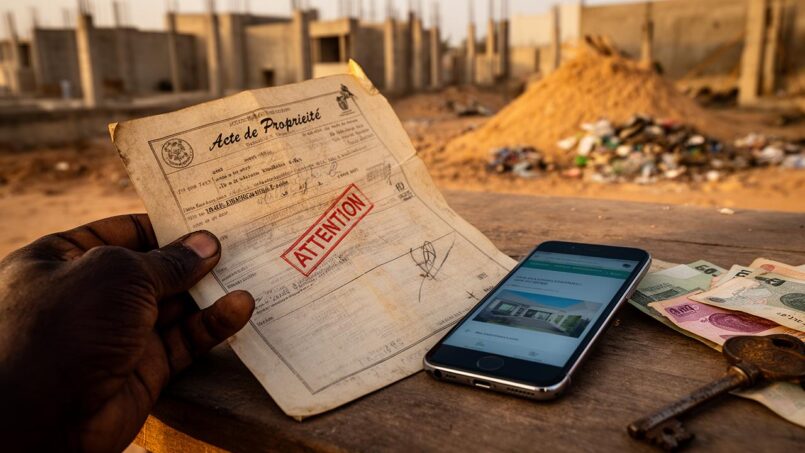
Warning on land documents
Why only registration with the Land Registry truly secures your right
In Senegal, ownership is secured when several conditions are met:
To guarantee your purchase, verify that the seller is indeed the owner on the Land Title, sign the deed of sale before a notary who checks for any encumbrances, have the deed registered and published at the Land Registry, then ensure the Land Title is updated in your name.
Many buyers make the mistake of believing that simply signing a deed of sale, even before a notary, makes them owners. As long as the transfer is not registered with the Land Registry, they do not have an enforceable right.
A simple principle therefore applies: never consider yourself the owner until your name appears on the Land Title.
Even for a regular property with a TF, administrative procedures in Senegal are heavy, numerous, and financially significant. Underestimating these aspects is a classic mistake.
Transaction costs: much more than the listed price
According to several sources used in the research, transaction costs for the buyer are far from negligible. They include:
– Registration fees (approximately 5% of the value),
– Land formalities and publicity fees,
– Notary fees (degressive scale, subject to VAT),
– Fiscal stamps,
– Possible value-added taxes for new properties.
Estimates converge on an overall range of 10 to 15% of the property price for a standard purchase, with some detailed calculations going up to 16.75 to 20.5% depending on the nature of the property and the declared price’s accuracy.
On the seller’s side, add 5 to 8% in fees (capital gains, agency fees, etc.). For an investor, this means a short-term buy-sell operation must compensate for a round-trip of over 20% in cumulative costs just to begin being profitable.
A mostly cash market, scarce and expensive credit
Another specific feature: the Senegalese market is largely cash-based. The reasons are multiple:
Difficulties faced by foreigners and dysfunctions in the local banking system
Foreigners struggle to open foreign currency accounts or transfer funds due to stringent authorization requirements.
Distrust of the banking system leads sellers and buyers to favor cash payments.
The mortgage market is underdeveloped, with a near absence of secondary markets and few long-term loan products.
Even though some institutions now offer real estate loans to foreigners, rates remain high (around 8–9% annually), with substantial equity requirements (30 to 50% down payment). Many investors effectively find themselves without competitive local financing, or must structure their operations from abroad, multiplying legal and tax constraints.
Buying land is only part of the equation. As soon as it comes to building or modifying a structure, Senegal requires the issuance of a building permit. The law is explicit: no one may undertake work (new construction, extension, raising, fence over 2 meters, etc.) without administrative authorization.
The main outlines of the process are as follows:
The applicant must be the owner or authorized. The file, submitted to the urban planning department, includes a copy of the land title, architectural plans, location plan, certified site plan, project description, cost estimate, and sanitation study. Planning taxes and fiscal stamps (a few thousand CFA francs) are required. Processing time is 4 to 6 weeks in theory, sometimes longer depending on the file’s complexity.
Failure to comply with these obligations is not trivial: the law provides for fines of up to 10 million FCFA, and even prison sentences for project owners and companies that built without a permit. Courts can order the demolition of illegal structures. In parallel, for environmental matters, certain projects (industries, tourism activities, etc.) require an Environmental Impact Assessment (EIA) and environmental certification; here again, financial and criminal penalties are provided for non-compliance.
For an investor, launching a construction or renovation project without a permit, out of impatience or to “save time,” can later result in massive regularization costs, or even the inability to rent or sell, or the obligation to partially demolish the structure.
In many areas, particularly rural but not exclusively, real estate investment remains intimately linked to local social balances. A frequent mistake, especially among foreign or urban investors, is to completely ignore these dimensions.
The weight of customary chiefs and local communities
Research reminds us that in practice, even in urban areas, neighborhood heads, village chiefs, and notables still play a crucial role in the daily management of land. In rural areas, customary law remains the reference: the community recognizes the usage of a family, clan, or herder, sometimes without any official document mentioning it.
Do not buy rural or peri-urban land solely on the basis of administrative papers, without the full verification process required.
– meeting customary chiefs,
– sounding out neighboring families,
– checking for pastoral routes, fishing areas or gathering zones,
is to risk encountering hostility from populations who feel dispossessed. The example of Fanaye, as well as other disputes related to large agricultural or tourism projects, illustrates how these tensions can escalate.
In the most serious cases, the investor may be legally in the right but practically unable to exploit their property due to protests, land occupations, or destruction.
Prevent rather than suffer: integrating consultation from the outset
To reduce these risks, it is essential to integrate a dimension of local consultation from the start:
– meet traditional and administrative authorities (mayor, sub-prefect, village chief),
– clearly explain the project, its scope, and impacts,
– discuss possible compensations, local employment, shared access to certain spaces,
– understand existing uses (pastures, transhumance routes, water access).
This work may seem heavy and far removed from the concerns of a purely financial investor, but it is often the best insurance against future conflicts, in a context where exclusive recourse to the courts is insufficient.
Indispensable due diligence steps to avoid the worst
Faced with this complex landscape, the only reasonable strategy is to adopt a rigorous due diligence approach, combining legal, technical, and local expertise.
Verifying the seller’s identity and the chain of ownership
Before even discussing price, you must:
– demand presentation of the seller’s original identification documents,
– verify that the name matches the name on the Land Title or the presented deed,
– ask for proof of how they became the owner (previous purchase deed, inheritance, donation),
– analyze the chain of deeds over at least 10 to 15 years, or even 30 years for properties with a complex history.
The notary must request from the Land Registry a statement of real rights or equivalent, a document that summarizes successive holders, mortgages, seizures, any easements, and indicates the existence of registered disputes.
Analyzing the legal status of the land and buildings
It is essential to:
Before acquiring land, ensure it is titled and not from the National Domain, check for the absence of encumbrances like mortgages or easements, and verify the regularity of constructions regarding building permits, urban planning, and environmental standards.
For vacant land, the lawyer or notary must also verify its buildability with respect to urban plans (non-constructible zones, coastal protection easements, flood zones, etc.).
Securing tax and administrative aspects
It is prudent to request:
Documents to gather to finalize the real estate transaction
Receipts for payment of property taxes
Proof of payment for water and electricity bills
Non-litigation certificates issued by the competent court
Certified plan updated at the cadastre showing exact boundaries
A site visit with a surveyor is highly recommended to verify that boundaries exist, that the announced area matches reality, and that there is no encroachment from a neighboring plot.
Managing relationships with intermediaries
Using a professional only makes sense if they are themselves secure:
– prioritize a notary registered with the Chamber of Notaries of Senegal, with proven experience in real estate,
– verify the legal existence of the real estate agency (NINEA, RCCM, professional card),
– formalize a written mandate specifying the intermediary’s role, powers (visits, negotiations, signatures), and compensation.
And above all, apply an inviolable rule: any significant sum must go through the notary’s escrow account, never directly into the hands of an intermediary, even a “recommended” one.
After the purchase: protecting your investment over time
Many investors think the risk ends on the day of signing before the notary. In Senegal, several precautions remain necessary after acquisition.
Formalize and archive all documents
After a secure transaction, you must keep, ideally in several copies (physical and digital):
– the authentic deed of sale signed before a notary,
– the Land Title updated in your name,
– the certified boundary plan,
– the payment receipts for registration fees, transfer costs, etc.
In case of loss or dispute, these documents will be your best defense.
Occupy, fence, and signal the property
Undeveloped but titled land remains vulnerable to illegal occupations or fraudulent resale attempts, especially if the owner lives abroad. A few simple measures greatly reduce the risk:
To protect your land, have it visited regularly by yourself or a trusted person, install a fence as soon as possible, and post a sign with your contact information and a clear message like “Titled land – Not for sale”.
This sends a visible signal to the community and discourages opportunistic appropriation maneuvers.
Anticipate rental management and regulatory changes
For rental investments (apartments, villas, buildings), you also need to manage:
Selecting tenants and drafting leases compliant with Senegalese law (duration, security deposit, grounds for eviction) are essential. You must declare rental income and pay the corresponding taxes, as well as take out adequate home insurance, whose annual costs remain reasonable depending on the property’s value.
Furthermore, the legal and tax framework is subject to change. Ongoing land reform efforts (new land policy, universal cadastre project, transformation of usage rights into real rights, etc.) aim to further secure rights and enable smoother transfers. Monitoring these developments—or being accompanied by a lawyer or tax specialist—allows you to anticipate both opportunities and constraints.
Conclusion: investing in Senegal, an opportunity requiring maximum vigilance
Senegalese real estate offers real prospects, especially in certain districts of Dakar where rental demand remains strong and properties with land titles continue to attract, despite economic turbulence. But this attractiveness comes with specific risks: complexity of land ownership, weight of the National Domain, inadequate cadastre, judicial delays, importance of customary rights, and proliferation of fake intermediaries.
The mistakes to absolutely avoid before investing can be summarized in a few key points:
Do not settle for a simple administrative or customary paper without a Land Title, do not buy without involving a Senegalese notary from the start, do not pay a significant deposit directly to an individual or a ‘coxeur’, do not neglect verifying the chain of ownership, the cadastral situation, and encumbrances, do not ignore local communities (especially in rural areas), and do not build without a building permit or required environmental authorizations.
Conversely, an investor who:
– primarily targets properties with clear land titles,
– surrounds themselves with a competent notary and, if necessary, a specialized lawyer,
– is willing to dedicate time and a budget to exhaustive due diligence,
– ensures good local acceptance of their project,
maximizes their chances of turning Senegalese real estate into a true asset, rather than a source of endless disputes. The challenge is not only to find “the right deal,” but to build a legal and social position strong enough to withstand the inevitable shocks of a market undergoing restructuring.
An asset project or a question? Contact us now to speak with a wealth management expert.
Disclaimer: The information provided on this website is for informational purposes only and does not constitute financial, legal, or professional advice. We encourage you to consult qualified experts before making any investment, real estate, or expatriation decisions. Although we strive to maintain up-to-date and accurate information, we do not guarantee the completeness, accuracy, or timeliness of the proposed content. As investment and expatriation involve risks, we disclaim any liability for potential losses or damages arising from the use of this site. Your use of this site confirms your acceptance of these terms and your understanding of the associated risks.

Cyril Jarnias is an independent expert in international wealth management with over 20 years of experience. As an expatriate himself, he is dedicated to helping individuals and business leaders build, protect, and pass on their wealth with complete peace of mind.
On his website, cyriljarnias.com, he shares his expertise on international real estate, offshore company formation, and expatriation.
Thanks to his expertise, he offers sound advice to optimize his clients' wealth management. Cyril Jarnias is also recognized for his appearances in many prestigious media outlets such as BFM Business, les Français de l’étranger, Le Figaro, Les Echos, and Mieux vivre votre argent, where he shares his knowledge and know-how in wealth management.





