
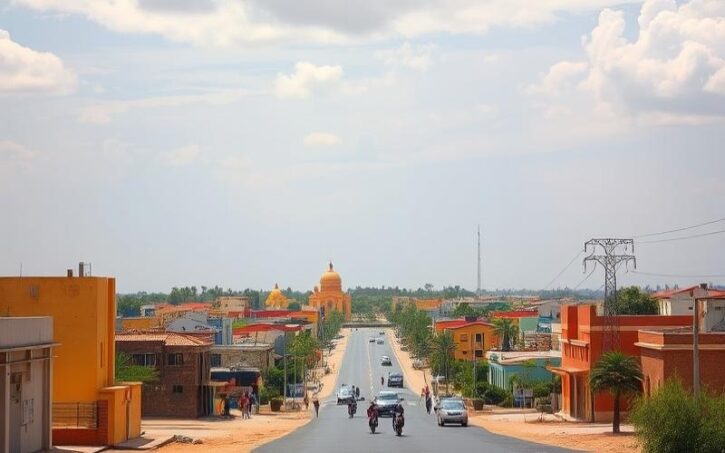
 Published on and written by Cyril Jarnias
As the real estate market in Senegal was experiencing promising growth, the war in Ukraine has generated unexpected repercussions on this regional dynamic. The surge in material prices, catalyzed by supply chain disruptions and rising energy costs, has slowed down many construction projects.
In this complex situation, investors, developers, and potential buyers are facing major economic challenges, while trying to navigate an uncertain global climate.
This article explores how these geopolitical events thousands of miles away directly affect Senegal’s real estate sector, while highlighting the strategies adopted to mitigate these significant impacts.
Geopolitical Consequences of the War in Ukraine on Senegal
The Russo-Ukrainian conflict has generated significant repercussions on Senegal’s diplomatic relations, altering the balance of its international alliances and indirectly influencing its real estate sector.
Senegal has adopted a strategic position of neutrality regarding the conflict, abstaining from the March 2 United Nations General Assembly vote condemning the Russian invasion. This balancing diplomatic posture reflects a trend observed in several African countries, seeking to maintain relations with the various powers involved.
Ukraine has intensified its diplomatic presence in Africa to counter Russian influence, notably with the opening of new embassies in Abidjan in April 2025 and Nouakchott in May 2025. Senegal has maintained official diplomatic relations with Ukraine since 1992, with a Ukrainian embassy in Dakar operational since 2012. Senegal, for its part, manages its relations with Ukraine through its embassy in Warsaw since 2017.
| Diplomatic Representation | Senegal | Ukraine |
| Diplomatic Mission | Non-resident Ambassador based in Poland | Embassy in Dakar |
| Current Ambassador | Amadou Dabo (since 2017) | Yuriy Pivovarov (since 2021) |
This diplomatic reconfiguration is part of a broader context where Gulf countries are becoming important mediators in international conflicts, particularly regarding Ukraine and Gaza. In parallel, some Sahel countries are undergoing a pro-Russian realignment, creating new regional dynamics.
For the Senegalese real estate sector, these geopolitical developments have several implications:
- The diversification of diplomatic partnerships potentially opens up new sources of foreign investment, including Ukrainian, in infrastructure and real estate
- International tensions have led to a reorientation of some investments towards markets considered stable, from which Senegal benefits due to its relative political stability
- The opening of the Senegalese honorary consulate in Ternopil in 2021 could facilitate trade and bilateral investments
International investors, seeking to diversify their portfolios amid uncertainties in Eastern Europe, are increasingly considering West Africa as a viable alternative, with Senegal as a regional gateway. This trend particularly favors real estate projects in urban areas like Dakar, where demand for offices and upscale housing is rising.
Senegal’s balanced diplomatic positioning allows it to maintain relations with all parties, thereby maximizing opportunities to attract diversified investments into its real estate sector, while avoiding the negative consequences of exclusive alignment with either of the conflicting powers.
Good to know:
The war in Ukraine has redirected certain geopolitical dynamics, indirectly affecting Senegal. In response to tensions between major powers, Senegal has balanced its diplomatic relations, maintaining a neutral stance while strengthening ties with nations like Russia and China for economic reasons. This situation has led to adjustments in international trade policies, especially with European partners concerned about energy security, which could influence foreign capital flows to Senegal. Uncertainties in Europe have prompted some investors to explore African markets, including Senegal, with renewed interest in under-exploited sectors like real estate. This redistribution of investments could stimulate the development of real estate and infrastructure projects in strategic areas of the country, potentially creating a more favorable environment for new construction and the improvement of existing housing.
Impact of the Ukrainian Crisis on the Senegalese Real Estate Market
The Ukrainian crisis has generated major economic repercussions that have affected the Senegalese real estate sector on several levels. Disruptions to global supply chains, a direct consequence of the conflict, have significantly impacted the import of construction materials in Senegal. This situation has caused a significant rise in food and hydrocarbon prices, creating an inflationary context that has affected the entire Senegalese economy.
The Senegalese real estate sector, particularly dynamic in recent years with the spectacular rise of luxury real estate, has had to face unprecedented challenges. The government recently took measures to regulate this sector, notably with the intervention of the Minister of Finance who ordered the halt of certain luxury real estate projects. This decision is part of a desire to rebalance a market that has become inaccessible for the majority of Senegalese people.
Foreign investors, traditionally attracted by the potential of the Senegalese real estate market, have shown increased caution since the start of the conflict. This reluctance is explained by the climate of geopolitical and economic uncertainty prevailing globally. The economic sanctions imposed on Russia have also contributed to this hesitancy, leading to a notable decrease in investor confidence.
| Impact Factors | Consequences for Senegalese Real Estate |
|---|---|
| Supply chain disruptions | Shortage and increased cost of construction materials |
| Rise in hydrocarbon prices | Increase in transportation and construction costs |
| Geopolitical uncertainty | Increased caution among foreign investors |
| Inflation | Erosion of household real estate purchasing power |
Faced with these challenges, local investors have adopted various adaptation strategies. Some have scaled back their expansion plans, while others have sought to diversify their sources of construction materials. This situation has also fostered the emergence of initiatives aimed at promoting local materials and traditional construction techniques, which are less dependent on imports.
The Senegalese government has implemented several measures to mitigate the negative impacts of this crisis. In addition to regulating the luxury real estate sector, tax incentives have been offered to real estate developers committed to building social and intermediate housing. Public-private partnerships have also been encouraged to stimulate the construction of affordable housing.
Experts in the Senegalese real estate sector agree that this crisis, despite its negative aspects, could constitute an opportunity to rethink the country’s real estate development model. The need to reduce dependence on imports and develop local production chains for construction materials is now perceived as a strategic priority.
- Diversification of supply sources
- Promotion of local materials and construction techniques
- Development of more affordable housing
- Strengthening public-private partnerships
The crisis has also highlighted the need for better urban planning and a more balanced distribution of real estate investments across the entire Senegalese territory, beyond the traditional concentration in the capital Dakar. This awareness could foster the emergence of new real estate development hubs in the country’s secondary cities.
Good to know:
The Ukrainian crisis has had significant repercussions on the Senegalese real estate market, notably by disrupting supply chains and causing a rise in construction material prices. Exchange rate fluctuations have also affected the financing capacity of real estate projects. These factors have dampened the enthusiasm of foreign investors, although some experts, like Mamadou Séne of the National Order of Real Estate Experts of Senegal, highlight the resilience of local investors who seek to capitalize on national assets. A recent study by the National Agency of Statistics and Demography shows that real estate transactions have decreased by 15% since the beginning of 2022. The Senegalese government has taken measures to stimulate the sector, including revising real estate taxation to attract new investors. Local initiatives, such as financing by banks specialized in real estate credit, aim to revitalize the market.
Ukrainian Refugees and Housing Challenges in Senegal
Since the start of the Russo-Ukrainian conflict in February 2022, Europe has recorded over 6.3 million Ukrainian refugees according to the latest available data from April 2025. The majority of these refugees headed to neighboring countries of Ukraine, with a high concentration in Germany which has taken in over 1.1 million, while France counted approximately 55,000 Ukrainian refugees benefiting from temporary protection status in February 2025.
Regarding the situation in Senegal, the data does not show a significant influx of Ukrainian refugees. The country hosted approximately 11,856 refugees in 2023, representing a slight increase of 0.46% compared to 2022. However, these statistics concern all refugees in Senegal, without specific mention of a Ukrainian influx.
The conflict in Ukraine has had devastating consequences, with the occupation of about 20% of Ukrainian territory and heavy human losses. Estimates of military losses vary considerably depending on the source, ranging from 43,000 to 80,000 Ukrainian soldiers killed, while civilian losses are estimated at around 10,000 dead and 28,000 wounded according to the UN.
| Country | Number of Ukrainian Refugees (February 2025) |
| Germany | Over 1.1 million |
| France | Approximately 55,000 |
| Senegal | No specific data on Ukrainian refugees |
Refugee statistics in Senegal show a moderate trend:
- 2023: 11,856 refugees (all nationalities combined)
- 2022: 11,802 refugees (all nationalities combined)
- 2021: Decrease of 18.49% compared to the previous year
In the absence of specific data on an influx of Ukrainian refugees in Senegal and their impact on the local real estate market, it is not possible to provide a detailed analysis of the housing challenges related to this population in Senegal. The available information does not allow establishing the existence of a significant community of Ukrainian refugees in Senegal nor specific measures taken by the Senegalese government to welcome them.
Good to know:
Since the start of the conflict in Ukraine, a growing number of Ukrainian refugees have settled in Senegal, exerting notable pressure on the real estate market in major cities such as Dakar and Saint-Louis. This influx has led to an increase in housing demand, complicating the situation for both newcomers and local residents. In response, the Senegalese government, in partnership with various NGOs, has implemented reception and temporary accommodation programs for these refugees, although they often face logistical and economic challenges, such as a shortage of affordable housing and rising rents. Refugees report difficulties in finding suitable housing, often forced to share cramped spaces or settle in less equipped neighborhoods. In the long term, this situation could encourage the development of new real estate projects aimed at alleviating the shortage, while requiring a strengthened regulatory framework to stabilize the market.
Geopolitics and Real Estate Investment Opportunities in Senegal
Russia’s invasion of Ukraine has profoundly disrupted global geopolitics, causing a realignment of alliances and increased market volatility. This context of uncertainty has had several repercussions on international investment flows, including in Senegal.
Impact of the War in Ukraine on Real Estate Investments in Senegal
- Overall increase in economic uncertainties that discourages some foreign investors but strengthens the status of real estate as a safe haven in other regions.
- Major fluctuations in global energy and raw material prices, which indirectly affect construction costs and the profitability of real estate projects.
- Partial disruption of international supply chains: delays in the delivery of imported materials (steel, cement) impacting the timeline and final cost of real estate projects.
Recent Evolution of the Senegalese International Framework
Senegal has strengthened its diplomatic relations with the European Union and the United States since 2022:
- Intensification of economic cooperation with these Western partners to compensate for certain vulnerabilities that emerged following the Ukrainian crisis.
- Active pursuit of new trade agreements to secure access to strategic materials needed for its major urban and tourism projects.
Government Initiatives to Attract Foreign Investors
Since 2024, the Senegalese government has been multiplying several incentive measures:
- Implementation of the Emerging Senegal Plan (PSE), extended by a new priority action plan covering 2024–2028. This program aims to facilitate private financing in all segments of the real estate sector (social housing, offices, hotel residences).
- Strengthening of the single window to accelerate all administrative procedures related to land or real estate investments.
- Targeted tax incentives: temporary exemptions on certain tax duties to encourage rapid acquisition or construction by foreign capital.
| Factors | Direct/Indirect Consequences |
|---|---|
| High global prices | Increase in material costs |
| Logistics chains | Delays & imported inflation |
| Financial volatility | Increased selectivity among investors |
Predictable Effects on the Senegalese Real Estate Sector (2025–2029)
- Maintenance or even accentuation of relative attractiveness compared to a Europe perceived as less geopolitically safe.
- Persistent growth of the high-end market despite the recent attempt by the Senegalese government to regulate this segment to avoid any speculative bubble.
- Sustained growth expected thanks to strong local demand combined with the gradual return of some European institutional investors seeking diversification outside the eurozone.
Sector Forecasts:
- The average annual growth rate expected for the residential real estate sector is estimated between 6% and 7% until 2028, provided no other major external shocks occur.
- The commercial & logistics segments should also benefit indirectly from the strategic repositioning undertaken by Dakar towards its historical Western partners as well as increasing diversification towards Central and Southern Africa.
In summary, while the war in Ukraine has introduced more global uncertainties in all sectors related to international trade – including real estate – it also contributes to sustainably positioning Dakar as an attractive regional hub for investors seeking relative political stability and confirmed economic potential.
Good to know:
The war in Ukraine has reshaped the contours of global geopolitics, notably impacting real estate investment opportunities in Senegal. The country has benefited from a strengthening of its international relations with key players such as the United States and certain European states, which has positively influenced the business climate. Senegal has launched attractive policies, including tax advantages to capture the interest of foreign investors, while supply chain instability and rising raw material prices, a consequence of the conflict, pose challenges for real estate projects. In 2023, increases in construction costs were noted, partially compromising developers’ margins. However, forecasts for the coming years remain optimistic, encouraged by the country’s adherence to regional economic initiatives aimed at stabilizing the market and increasing its resilience to international geopolitical turbulence.
Disclaimer: The information provided on this website is for informational purposes only and does not constitute financial, legal, or professional advice. We encourage you to consult qualified experts before making any investment, real estate, or expatriation decisions. Although we strive to maintain up-to-date and accurate information, we do not guarantee the completeness, accuracy, or timeliness of the proposed content. As investment and expatriation involve risks, we disclaim any liability for potential losses or damages arising from the use of this site. Your use of this site confirms your acceptance of these terms and your understanding of the associated risks.

Cyril Jarnias is an independent expert in international wealth management with over 20 years of experience. As an expatriate himself, he is dedicated to helping individuals and business leaders build, protect, and pass on their wealth with complete peace of mind.
On his website, cyriljarnias.com, he shares his expertise on international real estate, offshore company formation, and expatriation.
Thanks to his expertise, he offers sound advice to optimize his clients' wealth management. Cyril Jarnias is also recognized for his appearances in many prestigious media outlets such as BFM Business, les Français de l’étranger, Le Figaro, Les Echos, and Mieux vivre votre argent, where he shares his knowledge and know-how in wealth management.





